EXCESS GIBBS FREE
ENERGY MODELS
1
CONTENT
• EAXCESS GIBBS FREE ENERGY MODELS
• MARGULES EQUATION
• REDLICH-KISTER EQUATION
• VAN LAAR EQUATION
• WILSON AND “NRTL” EQUATION
• UNIversal QUAsi Chemical equation
2
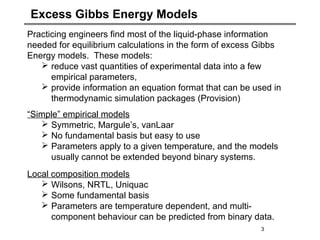
Excess Gibbs Energy Models
Practicing engineers find most of the liquid-phase information
needed for equilibrium calculations in the form of excess Gibbs
Energy models. These models:
 reduce vast quantities of experimental data into a few
empirical parameters,
 provide information an equation format that can be used in
thermodynamic simulation packages (Provision)
“Simple” empirical models
 Symmetric, Margule’s, vanLaar
 No fundamental basis but easy to use
 Parameters apply to a given temperature, and the models
usually cannot be extended beyond binary systems.
Local composition models
 Wilsons, NRTL, Uniquac
 Some fundamental basis
 Parameters are temperature dependent, and multi-
component behaviour can be predicted from binary data.
3
Margule’s Equations
212121
21
E
xAxA
xRTx
G
+=
4
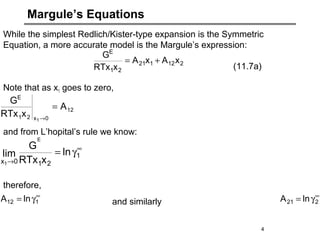
While the simplest Redlich/Kister-type expansion is the Symmetric
Equation, a more accurate model is the Margule’s expression:
(11.7a)
Note that as x1 goes to zero,
and from L’hopital’s rule we know:
therefore,
and similarly
∞
→
γ= 1
210x
ln
xRTx
G
lim
E
1
12
0x21
E
A
xRTx
G
1
=
→
∞
γ= 112 lnA ∞
γ= 221 lnA
Margule’s Equations
212121
21
E
xAxA
xRTx
G
+=
5
If you have Margule’s parameters, the activity coefficients are
easily derived from the excess Gibbs energy expression:
(11.7a)
to yield:
(11.8ab)
These empirical equations are widely used to describe binary
solutions. A knowledge of A12 and A21 at the given T is all we require
to calculate activity coefficients for a given solution composition.
]x)AA(2A[xln 1122112
2
21 −+=γ
]x)AA(2A[xln 2211221
2
12 −+=γ
Redlich-Kister equation
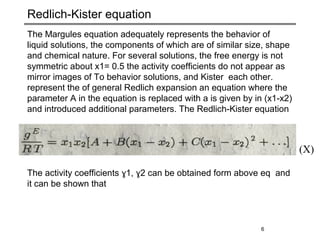
The Margules equation adequately represents the behavior of
liquid solutions, the components of which are of similar size, shape
and chemical nature. For several solutions, the free energy is not
symmetric about x1= 0.5 the activity coefficients do not appear as
mirror images of To behavior solutions, and Kister each other.
represent the of general Redlich expansion an equation where the
parameter A in the equation is replaced with a is given by in (x1-x2)
and introduced additional parameters. The Redlich-Kister equation
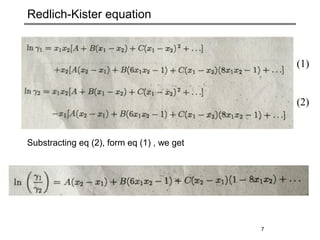
The activity coefficients 1, 2 can be obtained form above eq andɣ ɣ
it can be shown that
6
(X)
Redlich-Kister equation
7
Substracting eq (2), form eq (1) , we get
(1)
(2)
Redlich-Kister equation
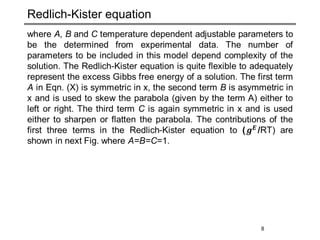
8
9
Redlich-Kister equation
van Laar Equations
2
/
121
/
21
/
21
/
12
21
E
xAxA
AA
xRTx
G
+
=
10
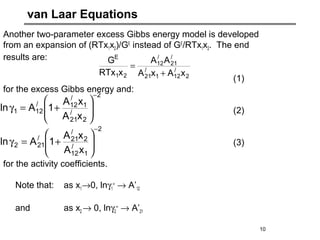
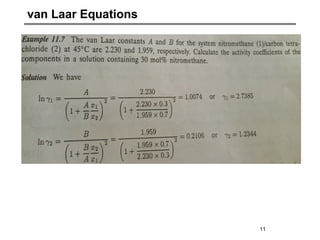
Another two-parameter excess Gibbs energy model is developed
from an expansion of (RTx1x2)/GE
instead of GE
/RTx1x2. The end
results are:
(1)
for the excess Gibbs energy and:
(2)
(3)
for the activity coefficients.
Note that: as x1→0, lnγ1
∞
→ A’12
and as x2 → 0, lnγ2
∞
→ A’21
2
2
/
21
1
/
12/
121
xA
xA
1Aln
−






+=γ
2
1
/
12
2
/
21/
212
xA
xA
1Aln
−






+=γ
van Laar Equations
11
Wilson’s Equations for Binary Solution Activity
)xxln(x)xxln(x
RT
G
2112212211
E
Λ+−Λ+=
12
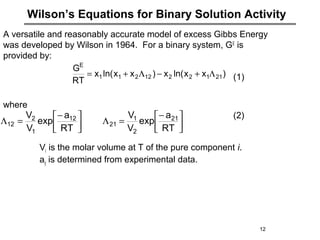
A versatile and reasonably accurate model of excess Gibbs Energy
was developed by Wilson in 1964. For a binary system, GE
is
provided by:
(1)
where
(2)
Vi is the molar volume at T of the pure component i.
aij is determined from experimental data.



−
=Λ


−
=Λ
RT
a
exp
V
V
RT
a
exp
V
V 21
2
1
21
12
1
2
12
Wilson’s Equations for Binary Solution Activity






Λ+
Λ
−
Λ+
Λ
+Λ+−=γ
2112
21
1221
12
212211
xxxx
x)xxln(ln
13
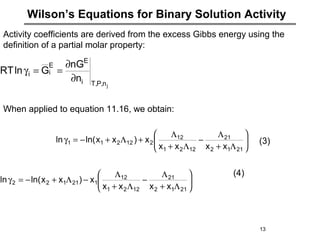
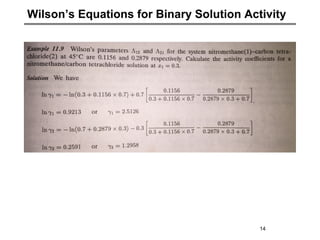
Activity coefficients are derived from the excess Gibbs energy using the
definition of a partial molar property:
When applied to equation 11.16, we obtain:
(3)
(4)






Λ+
Λ
−
Λ+
Λ
−Λ+−=γ
2112
21
1221
12
121122
xxxx
x)xxln(ln
jn,P,Ti
E
E
ii
n
nG
GlnRT
∂
∂
==γ
Wilson’s Equations for Binary Solution Activity
14
UNIversal QUAsi Chemical (UNIQUACK) equation
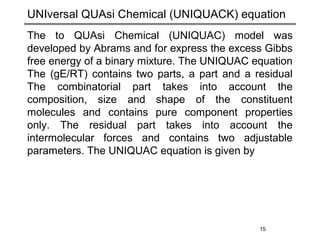
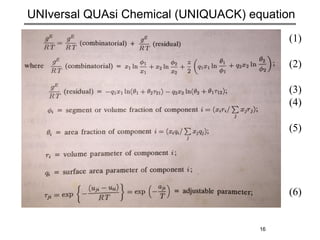
The to QUAsi Chemical (UNIQUAC) model was
developed by Abrams and for express the excess Gibbs
free energy of a binary mixture. The UNIQUAC equation
The (gE/RT) contains two parts, a part and a residual
The combinatorial part takes into account the
composition, size and shape of the constituent
molecules and contains pure component properties
only. The residual part takes into account the
intermolecular forces and contains two adjustable
parameters. The UNIQUAC equation is given by
15
UNIversal QUAsi Chemical (UNIQUACK) equation
16
(1)
(2)
(3)
(4)
(5)
(6)
17
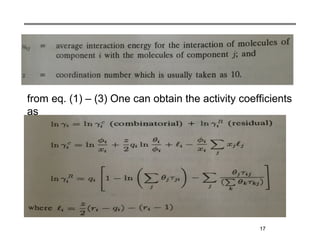
from eq. (1) – (3) One can obtain the activity coefficients
as
UNIversal QUAsi Chemical (UNIQUACK) equation
18
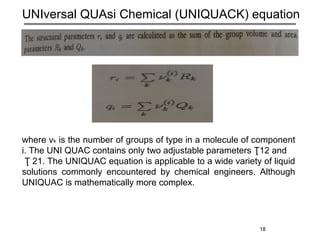
where vk is the number of groups of type in a molecule of component
i. The UNI QUAC contains only two adjustable parameters Ʈ12 and
Ʈ 21. The UNIQUAC equation is applicable to a wide variety of liquid
solutions commonly encountered by chemical engineers. Although
UNIQUAC is mathematically more complex.

Excess gibbs free energy models

  • 1.
  • 2.
    CONTENT • EAXCESS GIBBSFREE ENERGY MODELS • MARGULES EQUATION • REDLICH-KISTER EQUATION • VAN LAAR EQUATION • WILSON AND “NRTL” EQUATION • UNIversal QUAsi Chemical equation 2
  • 3.
    Excess Gibbs EnergyModels Practicing engineers find most of the liquid-phase information needed for equilibrium calculations in the form of excess Gibbs Energy models. These models:  reduce vast quantities of experimental data into a few empirical parameters,  provide information an equation format that can be used in thermodynamic simulation packages (Provision) “Simple” empirical models  Symmetric, Margule’s, vanLaar  No fundamental basis but easy to use  Parameters apply to a given temperature, and the models usually cannot be extended beyond binary systems. Local composition models  Wilsons, NRTL, Uniquac  Some fundamental basis  Parameters are temperature dependent, and multi- component behaviour can be predicted from binary data. 3
  • 4.
    Margule’s Equations 212121 21 E xAxA xRTx G += 4 While thesimplest Redlich/Kister-type expansion is the Symmetric Equation, a more accurate model is the Margule’s expression: (11.7a) Note that as x1 goes to zero, and from L’hopital’s rule we know: therefore, and similarly ∞ → γ= 1 210x ln xRTx G lim E 1 12 0x21 E A xRTx G 1 = → ∞ γ= 112 lnA ∞ γ= 221 lnA
  • 5.
    Margule’s Equations 212121 21 E xAxA xRTx G += 5 If youhave Margule’s parameters, the activity coefficients are easily derived from the excess Gibbs energy expression: (11.7a) to yield: (11.8ab) These empirical equations are widely used to describe binary solutions. A knowledge of A12 and A21 at the given T is all we require to calculate activity coefficients for a given solution composition. ]x)AA(2A[xln 1122112 2 21 −+=γ ]x)AA(2A[xln 2211221 2 12 −+=γ
  • 6.
    Redlich-Kister equation The Margulesequation adequately represents the behavior of liquid solutions, the components of which are of similar size, shape and chemical nature. For several solutions, the free energy is not symmetric about x1= 0.5 the activity coefficients do not appear as mirror images of To behavior solutions, and Kister each other. represent the of general Redlich expansion an equation where the parameter A in the equation is replaced with a is given by in (x1-x2) and introduced additional parameters. The Redlich-Kister equation The activity coefficients 1, 2 can be obtained form above eq andɣ ɣ it can be shown that 6 (X)
  • 7.
    Redlich-Kister equation 7 Substracting eq(2), form eq (1) , we get (1) (2)
  • 8.
  • 9.
  • 10.
    van Laar Equations 2 / 121 / 21 / 21 / 12 21 E xAxA AA xRTx G + = 10 Anothertwo-parameter excess Gibbs energy model is developed from an expansion of (RTx1x2)/GE instead of GE /RTx1x2. The end results are: (1) for the excess Gibbs energy and: (2) (3) for the activity coefficients. Note that: as x1→0, lnγ1 ∞ → A’12 and as x2 → 0, lnγ2 ∞ → A’21 2 2 / 21 1 / 12/ 121 xA xA 1Aln −       +=γ 2 1 / 12 2 / 21/ 212 xA xA 1Aln −       +=γ
  • 11.
  • 12.
    Wilson’s Equations forBinary Solution Activity )xxln(x)xxln(x RT G 2112212211 E Λ+−Λ+= 12 A versatile and reasonably accurate model of excess Gibbs Energy was developed by Wilson in 1964. For a binary system, GE is provided by: (1) where (2) Vi is the molar volume at T of the pure component i. aij is determined from experimental data.    − =Λ   − =Λ RT a exp V V RT a exp V V 21 2 1 21 12 1 2 12
  • 13.
    Wilson’s Equations forBinary Solution Activity       Λ+ Λ − Λ+ Λ +Λ+−=γ 2112 21 1221 12 212211 xxxx x)xxln(ln 13 Activity coefficients are derived from the excess Gibbs energy using the definition of a partial molar property: When applied to equation 11.16, we obtain: (3) (4)       Λ+ Λ − Λ+ Λ −Λ+−=γ 2112 21 1221 12 121122 xxxx x)xxln(ln jn,P,Ti E E ii n nG GlnRT ∂ ∂ ==γ
  • 14.
    Wilson’s Equations forBinary Solution Activity 14
  • 15.
    UNIversal QUAsi Chemical(UNIQUACK) equation The to QUAsi Chemical (UNIQUAC) model was developed by Abrams and for express the excess Gibbs free energy of a binary mixture. The UNIQUAC equation The (gE/RT) contains two parts, a part and a residual The combinatorial part takes into account the composition, size and shape of the constituent molecules and contains pure component properties only. The residual part takes into account the intermolecular forces and contains two adjustable parameters. The UNIQUAC equation is given by 15
  • 16.
    UNIversal QUAsi Chemical(UNIQUACK) equation 16 (1) (2) (3) (4) (5) (6)
  • 17.
    17 from eq. (1)– (3) One can obtain the activity coefficients as
  • 18.
    UNIversal QUAsi Chemical(UNIQUACK) equation 18 where vk is the number of groups of type in a molecule of component i. The UNI QUAC contains only two adjustable parameters Ʈ12 and Ʈ 21. The UNIQUAC equation is applicable to a wide variety of liquid solutions commonly encountered by chemical engineers. Although UNIQUAC is mathematically more complex.