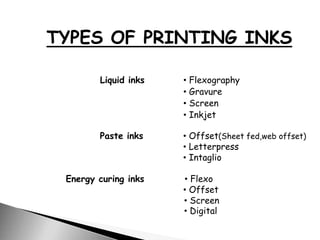
TYPES OF PRINTING INKS
Paste inks
Energy curing inks
Liquid inks
• Offset(Sheet fed,web offset)
• Letterpress
• Intaglio
• Flexo
• Offset
• Screen
• Flexography
• Gravure
• Screen
• Inkjet
• Digital
 The Gravure Press is a form of Intaglio printing. This
is where the print is engraved into a cylinder of
copper.
 The engravings are tiny honeycomb shaped cells.
 The cylinder turns in a big bowl of ink called an ‘ink
pan’.
 Advantages
- Highest quality possible in a print.
- The printer can work for decades.
- Each cylinder can make a large number of prints without
degrading.
-The gravure cylinder can be created with analog or digital
plating processes.
-Gravure is the preferred method of producing magazines and
catalogs
 Disadvantages
- Expensive Price - $1 million USD for the printer and each
cylinder costs $5000.
 The Plates are large cylinder with minute honeycomb
shaped pieces of copper. The copper pieces are
placed an equal distance apart Below the copper is a
thin wear-resistant layer which is un-engravable to
ensure that it will only get into the copper.
 Each plate can make a large number of impressions
without degrading.
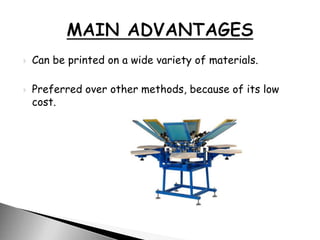
 Can be printed on a wide variety of materials.
 Preferred over other methods, because of its low
cost.
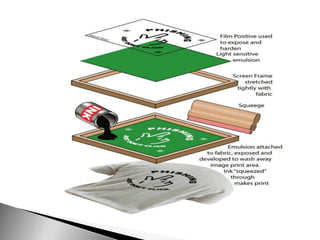
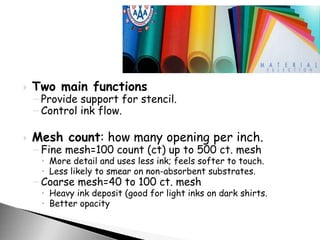
 Two main functions
– Provide support for stencil.
– Control ink flow.
 Mesh count: how many opening per inch.
– Fine mesh=100 count (ct) up to 500 ct. mesh
 More detail and uses less ink; feels softer to touch.
 Less likely to smear on non-absorbent substrates.
– Coarse mesh=40 to 100 ct. mesh
 Heavy ink deposit (good for light inks on dark shirts.
 Better opacity
 Inkjet Printing came about in the late 1980’s
 Have become the replacement printer for the Serial
Dot Matrix in the home
 Two Main Reasons:
I. Price
II. Color capabilities
 Produce characters by squirting a precisely
controlled amount of ink onto the paper
 Dots are extremely small usually 50-60 microns in
diameter (Human Hair approx 70 microns)
 Dots are placed very precisely on the paper in a
pattern up to 1440 x 720 dots per inch
 Dots can be different colors and can be of
photographic quality
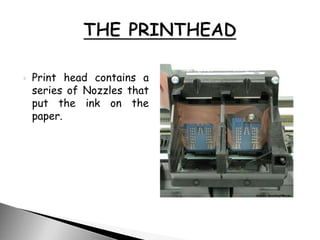
 Print head contains a
series of Nozzles that
put the ink on the
paper.
 Offset lithography
◦ type is offset from the printing plate to a blanket
then to the paper.
 Engraving
◦ ink wells shaped like the type transfer image
direct to the paper -- ink surface is raised off the
paper
 Thermography
◦ treated inks, heat dried to rise (like bread) from
the paper surface
 Reprographics
◦ copying or duplicating (Xerox or Kinko’s)
 Digital printing
◦ printing direct from computer files (Giclée, IRIS
continuous tone printing)
 Silk screen
◦ ink is pressed through a sieve onto many surfaces
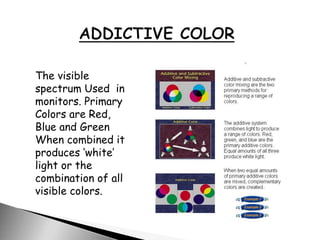
The visible
spectrum Used in
monitors. Primary
Colors are Red,
Blue and Green
When combined it
produces ‘white’
light or the
combination of all
visible colors.
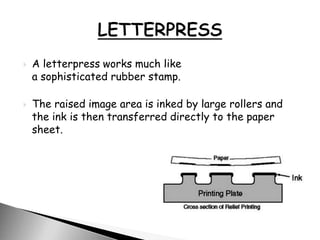
 A letterpress works much like
a sophisticated rubber stamp.
 The raised image area is inked by large rollers and
the ink is then transferred directly to the paper
sheet.
 The oldest printing process
 Relief printing
 One color (usually black) thick layer of ink
 Economical for between 500 and 5,000 copies
 Limited typefaces available
 Used mainly for text only - not suitable for half tone
illustrations
 Most often used for text pages of books
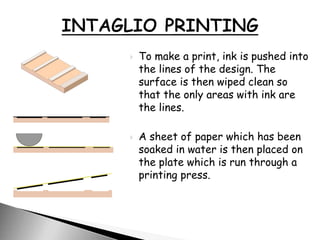
 To make a print, ink is pushed into
the lines of the design. The
surface is then wiped clean so
that the only areas with ink are
the lines.
 A sheet of paper which has been
soaked in water is then placed on
the plate which is run through a
printing press.
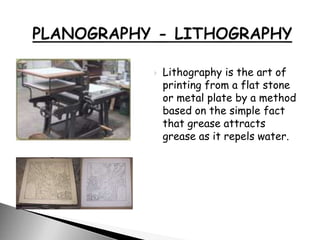
 Lithography is the art of
printing from a flat stone
or metal plate by a method
based on the simple fact
that grease attracts
grease as it repels water.
THANK YOU

Printing inks

  • 2.
    TYPES OF PRINTINGINKS Paste inks Energy curing inks Liquid inks • Offset(Sheet fed,web offset) • Letterpress • Intaglio • Flexo • Offset • Screen • Flexography • Gravure • Screen • Inkjet • Digital
  • 4.
     The GravurePress is a form of Intaglio printing. This is where the print is engraved into a cylinder of copper.  The engravings are tiny honeycomb shaped cells.  The cylinder turns in a big bowl of ink called an ‘ink pan’.
  • 5.
     Advantages - Highestquality possible in a print. - The printer can work for decades. - Each cylinder can make a large number of prints without degrading. -The gravure cylinder can be created with analog or digital plating processes. -Gravure is the preferred method of producing magazines and catalogs  Disadvantages - Expensive Price - $1 million USD for the printer and each cylinder costs $5000.
  • 6.
     The Platesare large cylinder with minute honeycomb shaped pieces of copper. The copper pieces are placed an equal distance apart Below the copper is a thin wear-resistant layer which is un-engravable to ensure that it will only get into the copper.  Each plate can make a large number of impressions without degrading.
  • 8.
     Can beprinted on a wide variety of materials.  Preferred over other methods, because of its low cost.
  • 9.
     Two mainfunctions – Provide support for stencil. – Control ink flow.  Mesh count: how many opening per inch. – Fine mesh=100 count (ct) up to 500 ct. mesh  More detail and uses less ink; feels softer to touch.  Less likely to smear on non-absorbent substrates. – Coarse mesh=40 to 100 ct. mesh  Heavy ink deposit (good for light inks on dark shirts.  Better opacity
  • 10.
     Inkjet Printingcame about in the late 1980’s  Have become the replacement printer for the Serial Dot Matrix in the home  Two Main Reasons: I. Price II. Color capabilities
  • 11.
     Produce charactersby squirting a precisely controlled amount of ink onto the paper  Dots are extremely small usually 50-60 microns in diameter (Human Hair approx 70 microns)  Dots are placed very precisely on the paper in a pattern up to 1440 x 720 dots per inch  Dots can be different colors and can be of photographic quality
  • 12.
     Print headcontains a series of Nozzles that put the ink on the paper.
  • 13.
     Offset lithography ◦type is offset from the printing plate to a blanket then to the paper.  Engraving ◦ ink wells shaped like the type transfer image direct to the paper -- ink surface is raised off the paper  Thermography ◦ treated inks, heat dried to rise (like bread) from the paper surface
  • 14.
     Reprographics ◦ copyingor duplicating (Xerox or Kinko’s)  Digital printing ◦ printing direct from computer files (Giclée, IRIS continuous tone printing)  Silk screen ◦ ink is pressed through a sieve onto many surfaces
  • 15.
    The visible spectrum Usedin monitors. Primary Colors are Red, Blue and Green When combined it produces ‘white’ light or the combination of all visible colors.
  • 16.
     A letterpressworks much like a sophisticated rubber stamp.  The raised image area is inked by large rollers and the ink is then transferred directly to the paper sheet.
  • 17.
     The oldestprinting process  Relief printing  One color (usually black) thick layer of ink  Economical for between 500 and 5,000 copies  Limited typefaces available  Used mainly for text only - not suitable for half tone illustrations  Most often used for text pages of books
  • 18.
     To makea print, ink is pushed into the lines of the design. The surface is then wiped clean so that the only areas with ink are the lines.  A sheet of paper which has been soaked in water is then placed on the plate which is run through a printing press.
  • 19.
     Lithography isthe art of printing from a flat stone or metal plate by a method based on the simple fact that grease attracts grease as it repels water.
  • 20.