See discussions, stats, and author profiles for this publication at: https://www.researchgate.net/publication/267310887
283900 A Pilot Plant Study of a VSA Process for CO2 Capture From Power Plant
Flue Gas
Conference Paper · October 2012
CITATIONS
3
READS
737
8 authors, including:
Some of the authors of this publication are also working on these related projects:
Selection of Third-Party Service Contracts for Chemical Logistics View project
Adsorption View project
Rama Rao Vemula
Lehigh University
22 PUBLICATIONS   358 CITATIONS   
SEE PROFILE
Shreenath Krishnamurthy
SINTEF
19 PUBLICATIONS   332 CITATIONS   
SEE PROFILE
Iftekhar A Karimi
National University of Singapore
368 PUBLICATIONS   8,089 CITATIONS   
SEE PROFILE
All content following this page was uploaded by Shreenath Krishnamurthy on 13 July 2018.
The user has requested enhancement of the downloaded file.
SEPARATIONS: MATERIALS, DEVICES AND PROCESSES
CO2 Capture from Dry Flue Gas by Vacuum Swing Adsorption:
A Pilot Plant Study
Shreenath Krishnamurthy and Vemula Rama Rao
Dept. of Chemical and Biomolecular Engineering, National University of Singapore, Singapore 117585
Sathishkumar Guntuka and Paul Sharratt
Institute of Chemical and Engineering Sciences, Singapore 627833
Reza Haghpanah, Arvind Rajendran, and Mohammad Amanullah
School of Chemical and Biomedical Engineering, Nanyang Technological University, Singapore 637459
Iftekhar A. Karimi and Shamsuzzaman Farooq
Dept. of Chemical and Biomolecular Engineering, National University of Singapore, Singapore 117585
DOI 10.1002/aic.14435
Published online March 20, 2014 in Wiley Online Library (wileyonlinelibrary.com)
The capture and concentration of CO2 from a dry flue gas by vacuum swing adsorption (VSA) has been experimentally demon-
strated in a pilot plant. The pilot plant has the provision for using two coupled columns that are each packed with approxi-
mately 41 kg of Zeochem zeolite 13X. Breakthrough experiments were first carried out by perturbing a N2 saturated bed with
15% CO2 and 85% N2 feed, which is representative of a dry flue gas from coal-fired power plants. The breakthrough results
showed long plateaus in temperature profiles confirming a near adiabatic behavior. In the process study, a basic four-step vac-
uum swing adsorption (VSA) cycle comprising the following steps: pressurization with feed, adsorption, forward blowdown,
and reverse evacuation was investigated first. In the absence of any coupling among the steps, a single bed was used. With this
cycle configuration, CO2 was concentrated to 95.9 6 1% with a recovery of 86.4 6 5.6%. To improve the process performance,
a four-step cycle with light product pressurization (LPP) using two beds was investigated. This cycle was able to achieve
94.8 6 1% purity and 89.7 6 5.6% recovery. The Department of Energy requirements are 95% purity and 90% recovery. The
proposed underlying physics of performance improvement of the four-step cycle with LPP has also been experimentally vali-
dated. The pilot plant results were then used for detailed validation of a one-dimensional, nonisothermal, and nonisobaric
model. Both transient profiles of various measured variables and cyclic steady state performance results were compared with
the model predictions, and they were in good agreement. The energy consumptions in the pilot plant experiments were 339–
583 6 36.7 kWh tonne21
CO2 captured and they were significantly different from the theoretical power consumptions obtained
from isentropic compression calculations. The productivities were 0.87–1.46 0.07 tonne CO2 m23
adsorbent day21
. The results
from our pilot plant were also compared with available results from other pilot plant studies on CO2 capture from flue gas.
V
C 2014 American Institute of Chemical Engineers AIChE J, 60: 1830–1842, 2014
This work is dedicated to the memory of Dr PK Wong who did not live to see the completion of CCU TSRP that he initiated
and managed for the most part of the program’s duration.
Keywords: CO2 capture, zeolite 13X, vacuum swing adsorption, light product pressurization, modeling and simulation,
pilot plant demonstration
Introduction
The increase in CO2 concentration in the earth’s atmosphere
due to anthropogenic activities has been acknowledged as the
major cause for global warming. Bulk of the CO2 emissions
come from power plants using nonrenewable energy sources
like coal.1
Thus, various options are being explored to reduce
CO2 emissions from these sources. One possible way is to
completely substitute fossil fuels with renewable sources of
energy. However, it has been estimated that coal will still sup-
ply 28% of the world’s energy demands in 2030.2
Therefore,
This article is based on a contribution that was identified by Holly M. Krutka
(ADA Environmental Solutions) and Joeri Denayer (Vrije Universiteit Brussel) as
the Best Presentation in the session “CO2 Capture by Adsorption Process and
Storage” of the 2012 AIChE Annual Meeting in Pittsburgh, PA.
Additional Supporting Information may be found in the online version of this
article.
Current address of Arvind Rajendran: Dept. of Chemical and Materials Engi-
neering, University of Alberta, Edmonton, Alberta T6G2V4, Canada
Correspondence concerning this article should be addressed to S. Farooq at
chesf@nus.edu.sg.
V
C 2014 American Institute of Chemical Engineers
1830 AIChE Journal
May 2014 Vol. 60, No. 5
the interim measure advocated for reducing CO2 emissions is
its capture and storage.1
This is expected to be achieved by ret-
rofitting existing plants and by constructing new ones with a
capture plant. Postcombustion flue gas from coal-fired power
plants contains 12–15 mol % CO2 at atmospheric pressure.
The capture units are expected to concentrate the CO2 from
flue gas with purity and recovery exceeding 95 and 90%,
respectively.3
The most mature technology for postcombustion
carbon capture is absorption using amine-based liquid sol-
vents.4,5
But this technology is energy intensive due to the
high energy requirements for solvent regeneration.6
Therefore,
alternate technologies are being explored and adsorption,
using solid sorbents, is one promising alternative.5,7–9
Cyclic adsorption processes alter between adsorption and
desorption modes of operation. Based on the intensive vari-
able that is cycled, the adsorption processes are broadly clas-
sified as pressure swing (PSA) or temperature swing
adsorption (TSA) processes. If the cycle switches between
adsorption at atmospheric pressure and desorption at vac-
uum, then it is called vacuum swing adsorption (VSA). Pres-
sure vacuum swing adsorption (PVSA) cycles have
adsorption step at pressures above atmospheric and desorp-
tion under vacuum.
Adsorption-based processes for gas separations have
extensively been studied and several industrial applications
like air separation,10,11
hydrogen purification,12,13
hydrocar-
bon separation,14
and air drying15
are in existence. Several
PSA/VSA cycles specific to CO2 capture have also been
studied in the literature.16
An early experimental work on
carbon capture was by Ishibashi et al.17
who used a two-
stage process in a pilot plant to capture CO2 from a power
plant flue gas with Ca-X zeolite. In the first stage, a PSA-
TSA process was studied, where the adsorption took place at
atmospheric pressure and desorption was carried out by
simultaneous heating and depressurization. In the first stage,
they were able to concentrate the flue gas stream to 60 mol
% CO2. In the second stage, using a PSA process, 90 mol %
CO2 recovery with 99% purity was achieved. The overall
energy consumption was 560 kWh tonne21
CO2 captured.
Cho et al.18
studied a two-stage PSA process with zeolite
13X for a flue gas containing 10.5 mol % CO2. The major
steps involved in their process were adsorption, pressure
equalization, blowdown, low pressure purge, and feed pres-
surization. Their first stage gave an enriched stream contain-
ing 63.2 mol % CO2 with a recovery of 92.4%. This stream
was then concentrated to 99% in the second stage with 88%
recovery. The overall recovery of the process was 80% and
experimental power consumption was 1.26–1.52 kWh Nm23
CO2 (641.5–770 kWh tonne21
CO2 captured).
Liu et al.19
used zeolite 5A to study the capture and con-
centration of CO2 from a dry flue gas using a three-bed,
seven-step PVSA process. The major steps involved in their
process were pressurization, high pressure adsorption, cocur-
rent depressurization, heavy product rinse, blowdown, purge,
and pressure equalization. With this cycle configuration,
79% of the CO2 was captured with 85% purity. The overall
energy consumption of this process was 2.37 MJ kg21
of
CO2 captured (656 kWh tonne21
CO2 captured).
Lu et al.20
studied the capture of CO2 from a dry flue gas in
a three-bed, seven-step, single-stage process which involved
adsorption, blowdown, evacuation, purge, rinse, and pressure
equalization steps. The adsorbent used in their study was zeo-
lite 13X. The best result achieved from this cycle was 85%
purity and 80% recovery with an energy consumption of 440
kWh tonne21
CO2 capture. In a follow up work,21
they used a
two-stage PVSA process. The first stage, comprising three
beds, used a five-step VSA process consisting of the following
steps: pressurization, adsorption, rinse, blowdown, and purge.
With 13X zeolite as the adsorbent, this stage was able to
achieve a CO2 purity of 73–82% and a recovery of 85–95%. In
the second stage, using a two-bed, six-step VSA process with
activated carbon, CO2 was concentrated to 95% with an over-
all recovery of 90%. The total energy consumption of this
cycle configuration was 675 kWh tonne21
CO2.
Webley and coworkers22,23
have demonstrated the capture
of CO2 with six-step and nine-step VSA processes from a
feed containing 12% CO2 and 88% N2 using zeolite 13X as
the adsorbent. With the nine-step process, 95% purity and
85% recovery were achieved, and the energy consumption
was 387 kWh tonne21
CO2. In the six-step process, 85% of
CO2 was captured with a purity of 83%. The overall energy
consumption of this process was 249 kWh tonne21
CO2.
The main objective of the current work is to communicate
the results from a pilot-scale study on CO2 capture from dry
flue gas containing 15% CO2 in balance nitrogen on 13X
zeolite—the current benchmark adsorbent for CO2 capture
and concentration. The main contributions of this communi-
cation are:
1. Pilot-scale demonstration of capture and concentration
of CO2 from a dry flue gas containing 15 mol % CO2 to a
95% CO2 with 90% recovery in a single stage.
2. Modeling of four-step cycle and its light product pres-
surization (LPP) variant along with the analysis of CO2
purity, recovery, productivity, and energy consumption.
3. Direct experimental validation of the underlying physics
contributing to the performance improvement of the four-
step cycle with LPP.
4. Comparison of the measured energy consumption val-
ues from direct measurements with those from conventional
isentropic and adiabatic compression calculations.
Adsorption Equilibrium and Kinetics
As the first step, single component isotherms of CO2 and
N2 in Zeochem zeolite 13X were obtained using the RUBO-
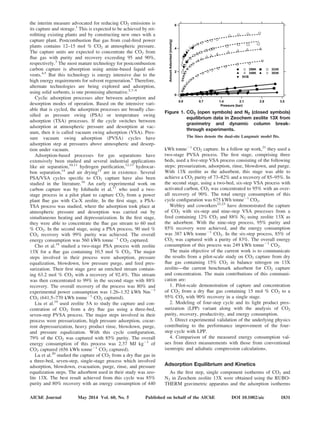
THERM gravimetric apparatus and the adsorption isotherms
Figure 1. CO2 (open symbols) and N2 (closed symbols)
equilibrium data in Zeochem zeolite 13X from
gravimetry and dynamic column break-
through experiments.
The lines denote the dual-site Langmuir model fits.
AIChE Journal May 2014 Vol. 60, No. 5 Published on behalf of the AIChE DOI 10.1002/aic 1831
are shown in Figure 1. The isotherm data were then fitted to
a dual-site Langmuir model,23
which is of the form
q
i 5
qsb;ibiCi
11biCi
1
qsd;idiCi
11diCi
(1)
bi5b0ie
2DUb;i
RT (2)
di5d0ie
2DUd;i
RT (3)
The model parameters reported earlier by Haghpanah et al.9
are reproduced in Table 1 for the sake of completeness.
Dynamic column breakthrough (DCB) experiments were then
performed to confirm the single component gravimetric data
and validate the extended dual-site Langmuir model for binary
adsorption. Equilibrium data obtained from mass balances of
the single component DCB runs are included in Figure 1,
showing good agreement with the gravimetric data. The binary
equilibrium data, similarly extracted from the mass balance of
the binary breakthrough runs, were also in good agreement
with the predictions of the positively correlated extended dual-
site Langmuir model,24
using single component parameters, as
may be seen from Figure 2. The breakthrough experiments for
binary equilibrium validation are detailed in the Supplemen-
tary Information.
In addition to the adsorption equilibrium, information
about the mass transfer kinetics is also necessary to design
an effective adsorption process. Hu et al.25
studied the diffu-
sion mechanism of CO2 in 13X by zero-length column tech-
nique with bead sizes of 1.96 and 3.8 mm and it was found
that adsorption of CO2 was macropore molecular diffusion
controlled with contribution from Knudsen diffusion in the
low pressure regime. Giesy et al.26
measured the mass trans-
fer rate for CO2 adsorption on zeolite 13X using frequency
Table 1. Adsorption Isotherm Parameters of CO2 and N2 in
Zeochem zeolite 13X
Parameter CO2 N2
qsb (mol m23
) 3489.44 6613.55
b0 (m3
mol21
) 8.65 3 1027
2.50 3 1026
DUb (kJ mol21
) 236.64 215.82
qsd (mol m23
) 2872.35 0
d0 (m3
mol21
) 2.63 3 1028
0
DUd (kJ mol21
) 235.70 0
Figure 2. Validation of the positively correlated
extended dual-site Langmuir model for
binary adsorption.
The experimental results are from binary dynamic col-
umn breakthrough experiments.
Figure 3. Schematic of the pilot plant.
SV-solenoid valve, PT-pressure transducer, FM-flow meter, FC-flow controller, A1-A3-CO2 analyzers, T1-T4-thermocouples, VP1
and VP2-vacuum pumps. The instrument specifications are also listed here.
1832 DOI 10.1002/aic Published on behalf of the AIChE May 2014 Vol. 60, No. 5 AIChE Journal
response technique for pressures of 0.125, 0.5, and 1 bar and
had found that that mass transfer kinetics was well described
by the Knudsen diffusion mechanism. In view of these stud-
ies, macropore molecular diffusion control was assumed for
adsorption kinetics in the present study.
Description of the Pilot Plant Setup
A simplified schematic of the pilot plant is shown in Figure
3 along with the instrument specifications. Some representa-
tive snapshots of the pilot plant are shown in Figure S2 in the
Supplementary Information. The pilot plant is equipped with
two identical adsorption columns with 0.3 m internal diameter
and a wall thickness of 0.02 m. Each of the two columns was
packed up to 0.867 m of height with 41 kg of adsorbent (bed
voidage of 0.428 and particle size in the range 1.6–2.6 mm).
Both columns were fitted with custom-built distributors to
ensure that the feed was well distributed in the radial direction.
The columns were mounted onto the main panel carrying the
piping, valves, and pressure sensors. Two mass flow control-
lers were used to supply CO2 and N2 at the desired flow rates.
Thermocouples were inserted along the column at four axial
positions (0.043, 0.28, 0.51, and 0.75 m from the bottom dis-
tributor plate) to measure transient temperature profiles during
the experiments. The pressures at the inlet and outlet of the
columns were measured using the pressure transducers located
at both ends of the column. The exit CO2 compositions were
analyzed using different infrared CO2 analyzers for the high
pressure adsorption, blowdown, and evacuation steps, respec-
tively. Two vacuum pumps (EVISA E-65 and E-100) were
used for the blowdown and evacuation steps. The exit flow
rates were measured by two separate flow meters for the blow-
down and evacuation steps. The flow meters were located as
close as possible to the vacuum pumps. Two dedicated power
meters were used to continuously measure power consump-
tions of the two vacuum pumps, the only power consuming
equipment in the unit. The solenoid valves located near the
inlets and outlets of the columns were used to switch between
the different steps in the cyclic experiments. All the solenoid
valves, flow controllers and meters, pressure transducers, ther-
mocouples and CO2 analyzers were connected to a program-
mable logic controller (PLC) manufactured by General
Electric Corporation for implementing the cyclic operation,
controlling the set points and measuring the process variables.
Error Analysis of Pilot Plant Data
The instrument specifications are listed along with the sche-
matic in Figure 3. The accuracies of various direct measurements
are bound by the accuracies of the measuring instruments.
The readings from the 60th cycle from two VSA experi-
ments with identical operating conditions were compared to
obtain the differences between various measured profiles. The
differences in the collected sensor readings versus time data
were subjected to t-tests. For all the sensor readings, t values
were less than t0.05, confirming good reproducibility of the
experimental runs.
Experimental error bars for various performance indicators,
namely purity, recovery, energy consumption, and productiv-
ity, were computed with readings from multiple sensors. The
error bars were established by recalculating the performance
indicators using expected upper and lower bounds of the read-
ings from the various sensors based on their accuracies
reported by the manufacturers. The range of errors thus
Table
2.
Summary
of
the
VSA
Experiments
Conducted
at
the
Pilot
Plant
Purity
(%)
Recovery
(%)
Productivity
(tonne
CO
2
/m
3
adsorbent/
day)
Energy
(kWh/tonne
CO
2
)
Exp
t
press
(s)
t
ads
(s)
t
bd
(s)
t
evac
(s)
P
I
(bar)
P
L
(bar)
Exp
Theo
Exp
Theo
Exp
Theo
Exp
g
5
72%
g
5
30%
1
1
20
60
150
310
0.070
0.025
94.7
6
1.05
97.6
85.4
6
4.52
86.2
1.40
6
0.07
1.31
510.5
6
25.5
173.9
417.4
2
20
20
150
310
0.072
0.009
85.1
6
1.01
88.6
93.1
6
4.83
94.2
0.87
6
0.05
0.80
582.7
6
39.4
278.5
668.4
3
20
40
150
310
0.072
0.021
94.5
6
1.01
95.6
85.8
6
5.01
84.8
1.18
6
0.06
1.05
339.2
6
23.6
190.3
456.7
4
20
40
150
310
0.192
0.022
83.4
6
1.03
83.7
94.5
6
5.92
95.6
1.24
6
0.06
1.12
459.0
6
31.9
192.0
460.8
5
20
40
150
310
0.052
0.011
95.9
6
0.98
97.9
86.4
6
5.90
80.6
1.17
6
0.06
1.04
472.2
6
45.4
201.6
483.8
6
40
60
150
310
0.071
0.023
92.9
6
1.01
95.9
93.3
6
7.07
94.0
1.27
6
0.08
1.00
469.0
6
30.4
189.7
455.3
7
40
60
150
310
0.056
0.022
94.8
6
1.04
97.0
89.7
6
7.13
93.3
1.17
6
0.11
0.95
475.0
6
46.6
191.5
459.6
8
40
60
150
310
0.043
0.022
96.3
6
1.02
98.8
86.5
6
4.07
90.3
1.15
6
0.05
0.94
508.3
6
50.8
204.1
489.8
Mean
of
absolute
difference
between
model
prediction
and
experimental
result
normalized
with
model
prediction
(%)
2.3
2.55
15.46
137.33
9.22
Standard
deviation
1.06
2.17
7.06
31.24
9.25
The
calculated
error
bars
for
the
performance
indicators
are
also
included.
“1”
denotes
the
run
chosen
as
the
base
case
for
LPP.
Runs
1–3:
Effect
of
adsorption
step
duration,
Runs
3–5:
effect
of
blowdown
pressure,
Runs
6–
8:
four-step
with
LPP.
P
H
5
1.5
bar
for
all
cases.
Note
that
the
purity,
recovery,
and
energy
consumption
values
are
represented
up
to
one
decimal
place,
and
productivity
up
to
two
decimal
places.
AIChE Journal May 2014 Vol. 60, No. 5 Published on behalf of the AIChE DOI 10.1002/aic 1833
calculated were 61% for purity, 64–7% for recovery,
60.05–0.11 tonne CO2 m23
adsorbent day21
for productivity,
and 623.6–50.8 kWh tonne21
CO2 for energy consumption.
The exact values are reported in Table 2 where the pilot plant
runs have been compiled. The averages of these exact values,
65.6% for recovery, 60.07 tonne CO2 m23
adsorbent day21
,
and 636.7 kWh tonne21
CO2 for energy consumption, are
used when the results are discussed in later sections.
Modeling and Simulation of the Pilot Plant
Experiments
Modeling and simulation of the pilot plant breakthrough
and cyclic experiments were based on the nonisothermal,
nonisobaric model presented by Haghpanah et al.27
The
model equations consisted of component and total mass bal-
ances, column and wall energy balance equations, and mass
transfer rate equations. The pressure drop across the column
was described by Darcy’s equation. Linear driving force
(LDF) approximation was used to describe the transport
between gas and solid phases.28
The model equations were
discretized in space by WENO finite volume technique and
the coupled ordinary differential equations (ODEs) were
solved in MATLAB using stiff ODE solver ode23s and 30
finite volume elements were used for discretization. The
model equations and the finite volume numerical scheme are
provided in the Supplementary Information.
DCB Study
The column was packed with the adsorbent using a pow-
der flex unit (Dietrich powder flex 100) which helped main-
tain a uniform distribution of the adsorbent in the column.
After packing, the column was regenerated in a specially
designed facility at 350
C for 8–10 h. To avoid heat loss
and obtain a uniform temperature along the length of the
column during regeneration, the column was insulated with
2 in.-thick glass wool pads. The column was subsequently
cooled to ambient temperature, mounted onto the skid, and
connected to the feed and product lines by flexible hoses.
Adsorption breakthrough experiments were carried out by
first saturating the column with pure N2 and then introducing
a feed containing 15% CO2 and 85% N2. Once the break-
through was complete, desorption was started by switching
back to pure nitrogen flow. The total inlet flow rate in all the
breakthrough runs was kept at 1000 SLPM. It should be
noted that thermal regeneration was carried out only once
during the entire period of operation that lasted for 15
months and the column was regenerated by nitrogen purge
for 12–15 h before each experiment.
Breakthrough experiments were carried out in both the
columns and the results of these runs are discussed in this
section. Figure 4 shows representative breakthrough curves
from Column 1. The long plateaus at thermocouples T2–T4
clearly indicated that the column diameter was large enough
to attain adiabatic behavior. Any significant heat loss from
the columns in the radial direction would prevent the forma-
tion of such temperature plateaus. The temperature plateaus
reached close to 110
C during adsorption and 0
C during
desorption, which are expected due to the high enthalpy for
CO2 adsorption on zeolite 13X. The lower temperature rise
recorded by the first thermocouple, T1, was most likely due
to the influence of the distributor plate, which was only
0.043 m away. The CO2 composition measured at the col-
umn outlet shows two transitions. The first transition around
600 s, a sharp jump from 0 to 12 mol % CO2, was a conse-
quence of the adiabatic thermal front. The second transition
around 4000 s, a gradual transition from 12 to 15 mol %
CO2, corresponded to the complete elution of the thermal
front from the adiabatic plateau back to the initial tempera-
ture. Consequently, the second transition closely followed
the drop in the temperature of the 4th thermocouple, T4,
which was nearest to the column exit where the CO2 concen-
tration was monitored.
The results from the simulation are shown along with the
experimental profiles in Figure 4. It is worth noting that the
simulations are fully predictive using single component equi-
librium data obtained from the gravimetric balance (that
Figure 4. Adsorption and desorption profiles in a binary breakthrough experiment.
The lines denote model predictions.
1834 DOI 10.1002/aic Published on behalf of the AIChE May 2014 Vol. 60, No. 5 AIChE Journal
used 1 g of the adsorbent) and by assuming macropore
molecular diffusion controlled mass transfer rate. The simu-
lation was able to capture the breakthrough time and the
transitions in the composition and temperature profiles. The
maximum (plateau) temperature reached in the experiment
was however higher than that attained in the simulation.
This was consistently seen in all the breakthrough runs.
Parameter tuning to compensate for suspected underestima-
tion of heat of adsorption or overestimation of adsorbent
heat capacity were able to increase the predicted plateau
temperature, but at the expense of losing the agreements
with the transitions. Given the good matches with all other
key features of the breakthrough profiles, the mismatch in
the maximum temperature is somewhat intriguing. As
already mentioned, any significant heat loss from the col-
umns in the radial direction would prevent the formation of
the temperature plateaus. This is evident from the profiles of
T4 in Figure 4, where it is shown that the temperature pla-
teau is not obtained from simulation even for a small non-
zero inside heat-transfer coefficient (hi) of 2.5 W m22
K.
Two breakthrough experiments, performed 10 months
apart in Column 1, gave nearly identical responses (see Fig-
ure S3 in Supplementary Information), thereby, confirming
that the adsorbent capacity was unaffected after repeated
cycling, and the method adopted to regenerate the adsorbent
between the runs, a combination of nitrogen purge and pull-
ing vacuum, was indeed effective. The breakthrough results
from Column 1 and Column 2, conducted under very similar
conditions, were also compared. Like in the previous case,
the breakthrough experiments showed good reproducibility
(see Figure S4 in the Supplementary Information). Therefore,
the two columns were considered to be identical and suitable
for performing VSA process experiments involving coupled
steps, which are discussed later.
Cyclic Experiments
Basic four-step VSA
After the breakthrough experiments, the next step was to
explore VSA cycles. In a previous publication, we reported a
detailed theoretical study of a simple four-step VSA process
consisting of pressurization, high pressure adsorption, for-
ward blowdown, and reverse evacuation.9
It was shown that
it is possible to exploit the high selectivity of zeolite 13X
using this rather simple cycle to obtain high purity and
recovery. In this section, the experimental implementation of
this process is described. The four-step cycle shown in Fig-
ure 5a comprised of the following steps:
1. Pressurization: in this step, the column, which was ini-
tially at vacuum, was pressurized to a high pressure, PH, by
introducing the feed at a predetermined rate from the feed
end with the other end of the column closed.
2. High pressure adsorption: the column was continuously
fed at the same rate, but the product end was now opened.
CO2 was preferentially adsorbed, while nitrogen product was
withdrawn from the product end.
3. Forward blowdown: in this step, the feed end was
closed while the column was depressurized to an intermedi-
ate pressure, PI, from the product end. The main purpose of
this forward blowdown step was to remove as much nitrogen
as possible from the column while conserving CO2 as much
as possible to obtain CO2 with high purity and recovery
from the evacuation step.
4. Reverse evacuation: the column was evacuated to a low
pressure, PL, in the reverse direction from the feed end to
recover the adsorbed CO2.
The advantage of the above uncoupled steps is that the
cycle can be implemented in a single bed. However, a single
bed implementation cannot take in continuous feed.
Prior to any experiment, the column was purged with N2
overnight for 12–15 h. It was then evacuated to a low pressure
(0.02 bar). The durations of each step, flow rates, intermediate
pressure (PI), number of cycles, and the operating sequence of
the solenoid valves were fed as inputs to the PLC and the
entire process was operated in an automatic mode. The process
was run for 300 cycles to ensure cyclic steady state (CSS) was
reached. During this period, the exit CO2 compositions, tem-
peratures at four different locations along the column, inlet
and exit pressures, and exit flow rates were continuously
logged using the Intouch Wonderware software.
In the VSA runs, the adsorption step operated at a pressure of
1.5 bars. In all the runs, the pressurization time was kept con-
stant at 20 s. Any duration less than 20 s is not easy to imple-
ment using solenoid valves, while longer durations did not have
any significant impact on the performance of the process.9
Five basic four-step VSA runs were carried out, which are
detailed in Table 2. Figures 6–8 show variations of the dif-
ferent measured variables with cycle number for a represen-
tative Run 1 in Table 2. The CO2 composition profiles
during high pressure adsorption, forward blowdown, and
reverse evacuation steps are shown in Figure 6. These pro-
files indicate that there were significant CO2 losses in the
adsorption and the blowdown steps and the CO2 concentra-
tion in the evacuation step was more than 90%. The transient
temperature profiles shown in Figure 8 clearly indicate the
progress of the thermal front during the cycles. The tempera-
ture swings in the thermocouples T1 and T2 were much
higher than those in T3 and T4, indicating that the CO2
adsorption and desorption, were primarily confined in the
first half of the bed, while the rest of the bed mostly had
adsorption and desorption of nitrogen. The rise and fall of
the mean temperature levels at T2 to T4 in sequence before
coming to CSS further suggest that there was a net progress
of the thermal front in the direction of the feed flow. This is
expected because there was net accumulation of CO2 in the
early cycles before reaching CSS, when adsorption and
desorption amounts became equal.
In the basic four-step VSA process simulations, the bed was
initially assumed to be saturated with the light component at
low pressure (PL) at the average of the temperatures recorded
by the four thermocouples at the end of nitrogen purge for the
run under consideration. In the first step, that is, pressurization,
the inlet pressure profile with time was provided as the input
and the pressure across the column was calculated from the
total mass balance. The inlet velocity was obtained from the
Darcy’s equation and the exit velocity was kept zero. In the
adsorption step, the inlet velocity and the exit pressure were
provided as the inputs. For the blowdown and evacuation
steps, which involved depressurization to different vacuum
levels, the pressure profiles at the open ends were provided as
exponential functions, with the exponential time constant
tuned to match the measured pressure profiles in the pilot
plant. The final conditions of each step were taken as the ini-
tial conditions of the subsequent step. To be consistent with
the experimental runs, the VSA processes were simulated for
300 cycles and the transients of the 300th cycle were used to
calculate CO2 purity, recovery, and productivity, and energy
consumption of the process.
AIChE Journal May 2014 Vol. 60, No. 5 Published on behalf of the AIChE DOI 10.1002/aic 1835
The computed (model predictions) transient profiles of com-
position, pressure, flow rate, and temperature profiles for Run
1 in Table 2 are included in Figures 6–8. The predicted trends
were generally in good agreement with the profiles measured
in the pilot plant. From Figure 8, it can be seen that except for
the first thermocouple, the maximum values attained in the
simulation at the other thermocouples were lower than those
obtained in the experiment. These trends are similar to those
observed in the breakthrough experiments discussed earlier.
However, the predicted swings as well as the mean tempera-
ture levels were generally somewhat higher than those in the
experiment. The net progress of the thermal front in the direc-
tion of the feed flow, evident from the rise and fall of the
mean temperature levels at T2 to T4 in sequence before com-
ing to the CSS, was also somewhat faster in the simulation
than in the actual run. On the other hand, in the breakthrough
runs, the experimental and computed transitions in the temper-
ature profiles were in good agreement, which was an indica-
tion that the thermal wave velocity was correctly calculated in
the breakthrough simulation. The mismatch in case of the
VSA runs most likely arises from not fully capturing the
dynamics of rapid pressurization from low vacuum pressure to
atmospheric pressure at the entrance of the bed. Despite the
small quantitative differences, the overall qualitative features
of the four thermocouple readings observed experimentally
were correctly captured in the computed profiles. The
Figure 5. (a) Basic four-step VSA and (b) four-step VSA with light product pressurization.
PH—high pressure, PI—blowdown pressure, PL—evacuation pressure, tads—adsorption time, tbd—blowdown time, and tevac—evacu-
ation time.
1836 DOI 10.1002/aic Published on behalf of the AIChE May 2014 Vol. 60, No. 5 AIChE Journal
computed temperature profiles also showed lower temperature
swings in thermocouples 3 and 4, which, as mentioned earlier,
indicated that these zones of the bed were mainly undergoing
adsorption/desorption of nitrogen and CO2 concentration front
was confined in the first half of the bed. Better bed utilization
was not possible due to the tail that developed from the unfav-
orable desorption of the strongly favorable CO2 equilibrium
isotherm.
The effects of adsorption step duration and the blowdown
pressure on purity and recovery were also studied and these
results are presented in Figure 9. As shown in Figure 9a,
with an increase in the adsorption step time, there was an
improvement in purity while the recovery decreased. This
was due to the fact that with increase in the adsorption time,
the CO2 front moved further into the column resulting in
more losses in the effluents from the high pressure adsorp-
tion and blowdown steps. Therefore, in our experiments,
when the adsorption time was increased from 20 to 40 s, the
purity improved from 85.1 6 1 to 94.5 6 1%, while the
recovery dropped from 93.1 6 5.6 to 85.8 6 5.6%. Further
Figure 6. Transient CO2 composition profiles for VSA experiment Run 1 in Table 2.
The symbols are experimental results and the lines denote model predictions. Ads, Bd, and Evac stand for adsorption, blowdown,
and evacuation, respectively.
Figure 7. Transient pressure and flow profiles for VSA experiment Run 1 in Table 2.
The symbols are experimental results and the lines denote model predictions. Ads, Bd, and Evac stand for adsorption, blowdown,
and evacuation, respectively. Pin and Pout are pressures at the feed and the light product ends, respectively.
AIChE Journal May 2014 Vol. 60, No. 5 Published on behalf of the AIChE DOI 10.1002/aic 1837
increase in the adsorption time to 60 s improved the purity
to 94.7 6 1% with a small drop in recovery.
It was earlier mentioned that the main purpose of the
blowdown step was to remove the nitrogen from the product
end to recover CO2 in high purity in the evacuation step.
With an increase in the blowdown pressure, the purity
decreased and recovery increased (see Figure 9b). At higher
blowdown pressures, nitrogen was not sufficiently removed
from the column and hence the CO2 was recovered in the
evacuation step at a lower purity. Higher blowdown pressure
also meant lower CO2 loss, which explains the increase in
recovery. In our study, we analyzed three blowdown step
pressures, viz. 0.052, 0.072, and 0.192 bar and the results
are shown in Figure 9b. When the pressure was increased
from 0.072 to 0.192 bar, the purity dropped from 94.5 6 1%
to 83.4 6 1%, while the recovery improved from
85.8 6 5.6% to 94.5 6 5.6%. By further reducing the pres-
sure from 0.072 to 0.052 bar, the purity increased to around
95.9 6 1% while the recovery remained around 86.4 6 5.6%.
The model predictions shown in Figure 9 are in good
agreement with the experimental trends. Detailed comparison
of all the performance indicators, namely, purity, recovery,
energy consumption, and productivity for all the basic four-
step runs are also included in Table 2 along with the ranges
of errors for the experimental values. The extents of quanti-
tative agreements between the experimental and theoretical
values will be addressed after discussing the results from
four-step VSA process with LPP.
Four-step VSA with LPP
In the basic four-step VSA process, CO2 losses with the
nitrogen product in the high pressure adsorption step and in
the effluent from the blowdown step affect its recovery. It is
therefore essential to minimize the CO2 loss from these two
steps without compromising nitrogen removal, which con-
trols CO2 product purity. One way to achieve this is to pres-
surize the bed with the light product from the product end to
recycle the CO2, which would otherwise be lost with the
nitrogen product. However, nitrogen that is recycled, if not
adequately removed in the blowdown step, will contaminate
the CO2 product from the evacuation step and reduce its
purity. Haghpanah et al.27
have shown using detailed simula-
tions that LPP sharpens the CO2 concentration front in the
bed. As a result, compared to the basic four-step cycle, the
blowdown step can be executed at a lower PI to remove the
excess nitrogen recycled with CO2 without sacrificing the
increased recovery benefit from the recycled CO2. Thus, the
four-step VSA with LPP increases both purity and recovery
compared to the basic four-step cycle. Following a rigorous
energy-productivity optimization subject to purity-recovery
constraints, Haghpanah et al.27
further showed that the four-
step cycle with LPP was the most energy efficient cycle
amongst the six cycle configurations investigated. Therefore,
the four-step VSA with LPP was included in the pilot plant
study.
In the pilot plant, the four-step VSA cycle with LPP was
implemented by using two adsorption columns with appro-
priately inserted idle/hold steps, as shown in Figure 5b. The
exit stream during high pressure adsorption step from Col-
umn 1 was used to pressurize Column 2. After the high pres-
sure adsorption step, blowdown and evacuation steps were
carried out in the former while the latter remained idle. Sub-
sequently, these steps were carried out in Column 2 and Col-
umn 1 remained idle for some time after pressurization with
the light product from Column 2. Similar to the basic four-
step VSA experiment, the LPP runs were also carried out for
300 cycles to ensure CSS. The LPP runs are also summar-
ized in Table 2.
To experimentally validate the performance improvement
of the four-step cycle with LPP over the basic four-step
cycle, we chose Run 1 in Table 1, which had significant
CO2 losses in the adsorption and blowdown steps, as the
base case. The CO2 composition profiles in the adsorption
and blowdown steps from this run are compared with two
LPP Runs 6 and 7 in Figures 10a, b. Besides the pressuriza-
tion time, all other operating conditions for Runs 1, 6, and 7
Figure 8. Transient temperature profiles for VSA experi-
ment Run 1 in Table 2.
The lines denote model predictions.
Figure 9. Effect of (a) adsorption step duration and (b)
blowdown step pressure.
The lines denote model predictions.
1838 DOI 10.1002/aic Published on behalf of the AIChE May 2014 Vol. 60, No. 5 AIChE Journal
were the same. The pressurization time in the basic four-step
VSA process was kept fixed at 20 s. However, in case of
LPP, longer duration (40 s) was needed to pressurize the bed
with the product from the high pressure adsorption step in
the other bed. Longer pressurization time did not have any
impact of the performance of the basic four-step cycle.
Hence, the difference in pressurization times of the two
cycles was not consequential. It is clear that the CO2 losses
in Run 6 were much lower compared to those in Run 1, thus
confirming the recovery benefit of the LPP cycle. However,
the CO2 concentration in the evacuation step was lower in
Run 6 compared to Run 1, as shown in Figure 10c. By low-
ering the blowdown pressure, the loss in CO2 purity was
more than compensated which is also seen from Figure 10c.
The actual purity-recovery values from the LPP cycle are
compared with those from the basic four-step cycle in Figure
11. As seen from the figure, under similar conditions of
PI 5 0.07 bar, the LPP experiment had a much higher recov-
ery (93.3 6 5.6% versus 85.4 6 5.6%) but a lower purity
(92.9 6 1% versus 94.7 6 1%). This is due to the contamina-
tion of the CO2 product by the nitrogen, which was used to
pressurize the bed. The loss in purity was recovered by
slightly lowering the blowdown pressure to 0.056 bar to
remove sufficient amount of nitrogen. The recovery of CO2
reduced slightly but was still higher than the CO2 recovery
obtained from the basic four-step. Further reduction in the
blowdown pressure to 0.043 bar improved the purity to
96.3 6 1%, while the recovery was 86.5 6 5.6%.
Figure 10. CO2 concentration profiles in (a) adsorption step (b) blowdown step, and (c) evacuation step in basic
four-step VSA Run 1 and LPP Runs 6 and 7.
Ads, Bd, and Evac represent adsorption, blowdown, and evacuation steps, respectively. The symbols have the same meanings in
all three parts of the figure.
Figure 11. Demonstration of improvement in purity and
recovery by incorporating a LPP step.
[Color figure can be viewed in the online issue, which
is available at wileyonlinelibrary.com.]
Figure 12. Comparison of experimentally achieved
purity and recovery in this study with other
pilot plant data reported in the literature.
The error bars are shown only for purity and recov-
ery values from our pilot plant runs.
[Color figure can be viewed in the online issue, which
is available at wileyonlinelibrary.com.]
AIChE Journal May 2014 Vol. 60, No. 5 Published on behalf of the AIChE DOI 10.1002/aic 1839
The purity-recovery values obtained from the pilot plant
experiments are compared with the values reported in the lit-
erature17–22
in Figure 12. Clearly, our pilot plant was able to
achieve 94.8 6 1% purity and 89.7 6 5.6% recovery in a sin-
gle stage. These are very close to the 95% purity and 90%
recovery requirements specified by the US Department of
Energy.
In the present study, the productivity values for all pilot
plant runs were in the range 0.87–1.4 6 0.07 tonnes CO2
m23
adsorbent day21
. The mean and standard deviation val-
ues for the absolute percentage differences between the
model predictions and experimental results normalized with
respect to the former are also given in Table 2 for all the
performance indicators. The overall quantitative agreements
between the experimental and theoretical purity and recovery
were satisfactory, as suggested by the low values of mean
and standard deviation. These values were relatively higher
for productivity indicating modest agreements between
experimental values and model predictions. The deviations
for energy consumption were exceptionally large, which is
discussed next.
Energy consumption in a cyclic VSA process
As the high pressure steps were operated around atmos-
pheric pressure, the energy consumption in our pilot plant
VSA experiments came from the blowdown and the evacua-
tion steps. The power consumed by the vacuum pumps in
these two steps was measured directly with power meters.
The readings from the power meters are plotted along with
the flow rates in Figure 13. The initial rise in the power
meter readings corresponds to the time when the vacuum
pump was turned on (position A). There was some degree of
overshoot, which settled over the next couple of seconds till
the solenoid valves were turned on, indicated by position B.
Once the solenoid valves were turned on, the vacuum pumps
started to receive flow and this increased in the power meter
readings. The flow rate decreased with time and this effect
was also seen in the power profiles. The solenoid valves
were closed a few seconds before the vacuum pumps. Clos-
ing of solenoid valves and vacuum pumps are indicated by
positions C and D, respectively. The readings became zero
once the vacuum pump was turned off. However, in case of
the blowdown step, the flow ceased around 126 s, beyond
which the vacuum pump was operating without receiving
any gas from the column. This would not have happened if
the variable speed pumps were used. This situation will also
not arise in a continuous process, where the vacuum pumps
will receive gas for the entire duration. Therefore, the true
power consumed in the blowdown step is the area under the
curve between positions B and E shown by shaded region.
The total power consumption in a VSA process is the sum
of the power consumptions in the blowdown and evacuation
steps. The energy consumption values in the pilot plant
experiments were in the range of 339–583 6 36.7 kWh
tonne21
of CO2 captured. The power consumptions obtained
from direct measurements are compared with the results
obtained from conventional isentropic calculations in Figure
14. The commonly used efficiency in most published carbon
capture studies based only on process simulation is 72%.29,30
It can be seen that, with 72% efficiency, the theoretical
power consumptions were considerably lower than the direct
measurements from the experiments and a lower efficiency
Figure 13. Power and flow rate measurements in (a)
blowdown and (b) evacuation steps.
A: vacuum pump on, B: solenoid valve on, C: solenoid
valve off, D: vacuum pump off E: zero flow.
Figure 14. Comparison of Energy consumption values
from our pilot plant experiments with other
data in literature.
The dotted line denotes an efficiency of 72% while the
solid line denotes an efficiency of 30%. Note that all
the experiments, both from this work and from the lit-
erature, resulted in different purity-recovery values,
and care should be taken in comparing their energy
consumptions. [Color figure can be viewed in the
online issue, which is available at wileyonlinelibrary.
com.]
1840 DOI 10.1002/aic Published on behalf of the AIChE May 2014 Vol. 60, No. 5 AIChE Journal
of 30% was found to match the experimental power con-
sumptions for all the runs. As shown in Table 2, the mean of
absolute % deviations between experimental and predicted
results normalized with respect to the latter reduced from
137.33% at 72% efficiency to 9.22% at 30% efficiency. The
power consumptions from our experiments are of similar
orders of magnitude to those in the literature17–22
obtained
from similar direct measurements and these are also shown
in Figure 14. We are unable to calculate the efficiencies for
the published power consumption values due to lack of nec-
essary details. But comparable magnitude of measured power
may imply that the efficiencies could be much lower than
72%, as observed in our runs. In fact, 72% efficiency is rep-
resentative of typical compressors, but reported efficiencies
are in the range 50–70% for typical vacuum systems based
on hydrocarbon data.31
Our measured value of 30% is the
first reported for a CO2 evacuation.
Conclusions
The capture of CO2 from a dry flue gas was demonstrated
on a pilot plant scale. Column breakthrough experiments
were conducted first and the temperature profiles in these
experiments showed long plateaus, typical of an adiabatic
column. Basic four-step VSA experiments were then con-
ducted using a single column in the pilot plant. The effects
of adsorption step duration and blowdown step pressures
were studied. Further, four-step VSA experiments with LPP
step were conducted and these experiments showed signifi-
cant improvement in recovery compared to the basic four-
step VSA experiments. The pilot plant experiments were
then used to validate a nonisothermal nonisobaric model and
in general, good agreement between the experiment and
theory was observed. Next, the energy consumption values
obtained from direct measurements in our pilot plant were
compared with theoretical isentropic calculations and it was
found that an efficiency factor of 30% best described our
pilot plant energy consumption values. The best performance
achieved for the basic four-step VSA cycle was 95.9 6 1%
purity, 86.4 6 5.6% recovery with a productivity of
1.17 6 0.07 tonne CO2 m23
adsorbent day21
and an energy
consumption of 472.2 6 36.7 kWh tonne21
CO2. In case of
LPP, 94.8 6 1% purity and 89.7 6 7% recovery were
achieved with a productivity of 1.17 6 0.07 tonne CO2 m23
adsorbent day21
and an energy consumption of 475 6 36.7
kWh tonne21
CO2. The higher error bars for the recovery is
due to the lower flow rates during the evacuation step. This
is the first pilot plant study in which nearly 95% purity and
90% recovery were achieved in a single stage.
The present study is based on dry flue gas and it does not
address the process economics. Effect of moisture and costing
are important issues. However, these issues are research topics
in their own right and merit-independent attention. Detailed
studies are in progress on carbon capture from wet flue gas and
costing of a large-scale adsorption-based capture process.
These two studies in progress will be communicated in due
course.
Acknowledgments
Financial support from the A*STAR grant on Carbon cap-
ture and utilization—Thematic strategic research program
(CCU-TSRP) is acknowledged. We acknowledge Zeochem
for providing the adsorbent used in the pilot plant.
Notation
b = pre-exponential constant for site 1 in dual-site Langmuir isotherm,
m23
mol
c = gas phase composition, mol m23
d = pre-exponential constant for site 2 in dual-site Langmuir isotherm,
m23
mol
P = pressure, bar
q* = equilibrium loading, mol m23
qsb = saturation constant for site 1 in dual-site Langmuir model, mol
m23
qsd = saturation constant for site 2 in dual-site Langmuir model, mol
m23
R = universal gas constant, J mol21
K21
T = temperature, K
U = internal energy, J mol21
Subscripts
0 = pre exponential constant
b = site 1 in dual-site Langmuir isotherm
d = site 2 in dual-site Langmuir isotherm
H = high pressure
I = intermediate pressure
i = component
L = low pressure
Literature Cited
1. IPCC Special Report. Carbon dioxide capture and storage. In: IPCC
Special Report, Prepared by Working Group III of the Intergovern-
mental Panel on Climate Change, Bert Metz, Ogunlade Davidson,
Heleen de conninck, Manuela Loos, Leo de Meyer, Editors. New
York: Cambridge University Press, 2005.
2. Haszeldine RS. Carbon capture and storage: how green can black
be? Science. 2009;325(5948):1647–1652.
3. Report of DOE NETL, Office of Program Planning and Analysis.
Quality guidelines for energy system studies, CO2 impurity design
parameters, DOE-NETL, Jan. 2012.
4. Bhown AS, Freeman BC. Analysis and status of post-combustion
carbon dioxide capture technologies. Env Sci Tech. 2011;45(20):
8624–8632.
5. Steeneveldt R, Berger B, Torp T. CO2 Capture and storage: closing
the Knowing–Doing Gap. Chem Eng Res Des. 2006;84(9):739–763.
6. Davison J, Thambimuthu K. Technologies for capture of carbon
dioxide, Greenhouse Gas Control Technol. 2005;7:3–13.
7. Aaron D, Tsouris C. Separation of CO2 from Flue Gas: a review.
Sep Sci Technol. 2005;40(1):321–348.
8. Zhang J, Webley P, Xiao P. Effect of process parameters on
power requirements of vacuum swing adsorption technology for
CO2 capture from flue gas. Energy Convers Manage. 2008;49(2):
346–356.
9. Haghpanah R, Majumder A, Nilam R, Rajendran A, Farooq S,
Karimi IA. Multiobjective optimization of a four-step adsorption
process for postcombustion CO2 capture via finite volume simula-
tion. Ind Eng Chem Res. 2013;52(11):4249–4265.
10. Farooq S, Ruthven DM. Numerical simulation of a kinetically con-
trolled pressure swing adsorption bulk separation process based on a
diffusion model. Chem Eng Sci. 1991;46(9):2213–2224.
11. Wilson SJ, Beh CCK, Webley PA, Todd RS. The effects of a read-
ily adsorbed trace component (water) in a bulk separation PSA pro-
cess: the case of oxygen VSA. Ind Eng Chem Res. 2001;40(12):
2702–2713.
12. Malek A, Farooq S. Hydrogen purification from refinery fuel gas by
pressure swing adsorption. AIChE J. 1998;44(9):1985–1992.
13. Sircar S, Golden TC. Purification of hydrogen by pressure swing
adsorption. Sep Sci Technol. 2000;35(5):667–687.
14. Grande CA, Rodrigues AE. Propane/propylene separation by Pres-
sure Swing Adsorption using zeolite 4A. Ind Eng Chem Res. 2005;
44(23):8815–8829.
15. Ritter JA, Yang RT. Pressure swing adsorption: experimental and
theoretical study on air purification and vapor recovery. Ind Eng
Chem Res. 1991;30(5):1023–1032.
AIChE Journal May 2014 Vol. 60, No. 5 Published on behalf of the AIChE DOI 10.1002/aic 1841
16. Ebner AD, Ritter JA. State-of-the-art adsorption and membrane sepa-
ration processes for carbon dioxide production from carbon dioxide
emitting industries. Sep Sci Technol. 2009;44(6):1273–1421.
17. Ishibashi M, Ota H, Akutsu N, Umeda S, Tajika M, Izumi J,
Yasutake A, Kabata T, Kageyama Y. Technology for removing car-
bon dioxide from power plant flue gas by the physical adsorption
method. Energy Convers Manage. 1996;37(6–8):929–933.
18. Cho S-H, Park J-H, Beum H-T, Han S-S, Kim J-N. A 2-stage psa
process for the recovery of CO2 from flue gas and its power con-
sumption. Stud Surf Sci Catal. 2004;153:405–410.
19. Liu Z, Wang L, Kong X, Li P, Yu J, Rodrigues AE. Onsite CO2
capture from flue gas by an adsorption process in a coal-fired power
plant. Ind Eng Chem Res. 2012;51(21):7355–7363.
20. Lu W, Ying Y, Shen W, Li P, Yu J. CO2 capture from flue gas in
an existing coal power plant. In: 6th Pacific Basin Conference on
Adsorption Science and Technology, Baltimore, MD, 2013.
21. Lu W, Ying Y, Shen W, Li P, Yu J. Experimental evaluation on
CO2 capture from flue gas by two successive VPSA units in an
existing coal power plant. In: 11th International Conference on Fun-
damentals of Adsorption, Baltimore, MD, 2013.
22. Webley PA. Adsorption processes for CO2 separation. In: 11th Inter-
national Conference on Fundamentals of Adsorption, Baltimore,
MD, 2013.
23. Xiao P, Zhang J, Webley P, Li G, Singh R, Todd R. Capture of CO2
from flue gas streams with zeolite 13X by vacuum-pressure swing
adsorption. Adsorption. 2008;14(4-5):575–582.
24. Ritter JA, Bhadra SJ, Ebner AD. On the use of the dual-process
langmuir model for correlating unary equilibria and predicting
mixed-gas adsorption equilibria. Langmuir. 2011;27(8):4700–4712.
25. Hu X, Mangano E, Friedrich D, Ahn H, Brandani S. Diffusion mecha-
nism of CO2 in 13X zeolite beads. Adsorption. 2013;20(1):121–135.
26. Giesy TJ, Wang Y, Levan MD. Measurement of mass transfer rates
in adsorbents: new combined-technique frequency response apparatus
and application to CO2 in 13X zeolite. Ind Eng Chem Res. 2012;
51(35):11509–11517.
27. Haghpanah R, Nilam R, Rajendran A, Farooq S, Karimi IA. Cycle
synthesis and optimization of a VSA process for postcombustion
CO2 capture. AIChE J. 2013;59(12):4735–4757.
28. Glueckauf E. Theory of chromatography. Part 10 formula for diffu-
sion into spheres and their application to chromatography. Trans Far
Soc. 1955;51:1540–1951.
29. Agarwal A, Biegler LT, Zitney SE. A superstructure-based optimal
synthesis of PSA cycles for post-combustion CO2 capture. AIChE J.
2010;56(7):1813–1828.
30. Maring BJ, Webley PA. A new simplified pressure/vacuum swing
adsorption model for rapid adsorbent screening for CO2 capture
applications. Int J Greenhouse Gas Control. 2013;15:16–31.
31. Ulrich GD, Vasudevan, PT. Chemical Engineering: Process Design
and Economics A Practical Guide, 2nd ed. New Hampshire: Process
Publishing, 2004.
Manuscript received Aug. 17, 2013, and revision received Jan. 3, 2014.
1842 DOI 10.1002/aic Published on behalf of the AIChE May 2014 Vol. 60, No. 5 AIChE Journal
View publication stats

2014 krishnamurthy ai_ch_ej_pilotplant

  • 1.
    See discussions, stats,and author profiles for this publication at: https://www.researchgate.net/publication/267310887 283900 A Pilot Plant Study of a VSA Process for CO2 Capture From Power Plant Flue Gas Conference Paper · October 2012 CITATIONS 3 READS 737 8 authors, including: Some of the authors of this publication are also working on these related projects: Selection of Third-Party Service Contracts for Chemical Logistics View project Adsorption View project Rama Rao Vemula Lehigh University 22 PUBLICATIONS   358 CITATIONS    SEE PROFILE Shreenath Krishnamurthy SINTEF 19 PUBLICATIONS   332 CITATIONS    SEE PROFILE Iftekhar A Karimi National University of Singapore 368 PUBLICATIONS   8,089 CITATIONS    SEE PROFILE All content following this page was uploaded by Shreenath Krishnamurthy on 13 July 2018. The user has requested enhancement of the downloaded file.
  • 2.
    SEPARATIONS: MATERIALS, DEVICESAND PROCESSES CO2 Capture from Dry Flue Gas by Vacuum Swing Adsorption: A Pilot Plant Study Shreenath Krishnamurthy and Vemula Rama Rao Dept. of Chemical and Biomolecular Engineering, National University of Singapore, Singapore 117585 Sathishkumar Guntuka and Paul Sharratt Institute of Chemical and Engineering Sciences, Singapore 627833 Reza Haghpanah, Arvind Rajendran, and Mohammad Amanullah School of Chemical and Biomedical Engineering, Nanyang Technological University, Singapore 637459 Iftekhar A. Karimi and Shamsuzzaman Farooq Dept. of Chemical and Biomolecular Engineering, National University of Singapore, Singapore 117585 DOI 10.1002/aic.14435 Published online March 20, 2014 in Wiley Online Library (wileyonlinelibrary.com) The capture and concentration of CO2 from a dry flue gas by vacuum swing adsorption (VSA) has been experimentally demon- strated in a pilot plant. The pilot plant has the provision for using two coupled columns that are each packed with approxi- mately 41 kg of Zeochem zeolite 13X. Breakthrough experiments were first carried out by perturbing a N2 saturated bed with 15% CO2 and 85% N2 feed, which is representative of a dry flue gas from coal-fired power plants. The breakthrough results showed long plateaus in temperature profiles confirming a near adiabatic behavior. In the process study, a basic four-step vac- uum swing adsorption (VSA) cycle comprising the following steps: pressurization with feed, adsorption, forward blowdown, and reverse evacuation was investigated first. In the absence of any coupling among the steps, a single bed was used. With this cycle configuration, CO2 was concentrated to 95.9 6 1% with a recovery of 86.4 6 5.6%. To improve the process performance, a four-step cycle with light product pressurization (LPP) using two beds was investigated. This cycle was able to achieve 94.8 6 1% purity and 89.7 6 5.6% recovery. The Department of Energy requirements are 95% purity and 90% recovery. The proposed underlying physics of performance improvement of the four-step cycle with LPP has also been experimentally vali- dated. The pilot plant results were then used for detailed validation of a one-dimensional, nonisothermal, and nonisobaric model. Both transient profiles of various measured variables and cyclic steady state performance results were compared with the model predictions, and they were in good agreement. The energy consumptions in the pilot plant experiments were 339– 583 6 36.7 kWh tonne21 CO2 captured and they were significantly different from the theoretical power consumptions obtained from isentropic compression calculations. The productivities were 0.87–1.46 0.07 tonne CO2 m23 adsorbent day21 . The results from our pilot plant were also compared with available results from other pilot plant studies on CO2 capture from flue gas. V C 2014 American Institute of Chemical Engineers AIChE J, 60: 1830–1842, 2014 This work is dedicated to the memory of Dr PK Wong who did not live to see the completion of CCU TSRP that he initiated and managed for the most part of the program’s duration. Keywords: CO2 capture, zeolite 13X, vacuum swing adsorption, light product pressurization, modeling and simulation, pilot plant demonstration Introduction The increase in CO2 concentration in the earth’s atmosphere due to anthropogenic activities has been acknowledged as the major cause for global warming. Bulk of the CO2 emissions come from power plants using nonrenewable energy sources like coal.1 Thus, various options are being explored to reduce CO2 emissions from these sources. One possible way is to completely substitute fossil fuels with renewable sources of energy. However, it has been estimated that coal will still sup- ply 28% of the world’s energy demands in 2030.2 Therefore, This article is based on a contribution that was identified by Holly M. Krutka (ADA Environmental Solutions) and Joeri Denayer (Vrije Universiteit Brussel) as the Best Presentation in the session “CO2 Capture by Adsorption Process and Storage” of the 2012 AIChE Annual Meeting in Pittsburgh, PA. Additional Supporting Information may be found in the online version of this article. Current address of Arvind Rajendran: Dept. of Chemical and Materials Engi- neering, University of Alberta, Edmonton, Alberta T6G2V4, Canada Correspondence concerning this article should be addressed to S. Farooq at chesf@nus.edu.sg. V C 2014 American Institute of Chemical Engineers 1830 AIChE Journal May 2014 Vol. 60, No. 5
  • 3.
    the interim measureadvocated for reducing CO2 emissions is its capture and storage.1 This is expected to be achieved by ret- rofitting existing plants and by constructing new ones with a capture plant. Postcombustion flue gas from coal-fired power plants contains 12–15 mol % CO2 at atmospheric pressure. The capture units are expected to concentrate the CO2 from flue gas with purity and recovery exceeding 95 and 90%, respectively.3 The most mature technology for postcombustion carbon capture is absorption using amine-based liquid sol- vents.4,5 But this technology is energy intensive due to the high energy requirements for solvent regeneration.6 Therefore, alternate technologies are being explored and adsorption, using solid sorbents, is one promising alternative.5,7–9 Cyclic adsorption processes alter between adsorption and desorption modes of operation. Based on the intensive vari- able that is cycled, the adsorption processes are broadly clas- sified as pressure swing (PSA) or temperature swing adsorption (TSA) processes. If the cycle switches between adsorption at atmospheric pressure and desorption at vac- uum, then it is called vacuum swing adsorption (VSA). Pres- sure vacuum swing adsorption (PVSA) cycles have adsorption step at pressures above atmospheric and desorp- tion under vacuum. Adsorption-based processes for gas separations have extensively been studied and several industrial applications like air separation,10,11 hydrogen purification,12,13 hydrocar- bon separation,14 and air drying15 are in existence. Several PSA/VSA cycles specific to CO2 capture have also been studied in the literature.16 An early experimental work on carbon capture was by Ishibashi et al.17 who used a two- stage process in a pilot plant to capture CO2 from a power plant flue gas with Ca-X zeolite. In the first stage, a PSA- TSA process was studied, where the adsorption took place at atmospheric pressure and desorption was carried out by simultaneous heating and depressurization. In the first stage, they were able to concentrate the flue gas stream to 60 mol % CO2. In the second stage, using a PSA process, 90 mol % CO2 recovery with 99% purity was achieved. The overall energy consumption was 560 kWh tonne21 CO2 captured. Cho et al.18 studied a two-stage PSA process with zeolite 13X for a flue gas containing 10.5 mol % CO2. The major steps involved in their process were adsorption, pressure equalization, blowdown, low pressure purge, and feed pres- surization. Their first stage gave an enriched stream contain- ing 63.2 mol % CO2 with a recovery of 92.4%. This stream was then concentrated to 99% in the second stage with 88% recovery. The overall recovery of the process was 80% and experimental power consumption was 1.26–1.52 kWh Nm23 CO2 (641.5–770 kWh tonne21 CO2 captured). Liu et al.19 used zeolite 5A to study the capture and con- centration of CO2 from a dry flue gas using a three-bed, seven-step PVSA process. The major steps involved in their process were pressurization, high pressure adsorption, cocur- rent depressurization, heavy product rinse, blowdown, purge, and pressure equalization. With this cycle configuration, 79% of the CO2 was captured with 85% purity. The overall energy consumption of this process was 2.37 MJ kg21 of CO2 captured (656 kWh tonne21 CO2 captured). Lu et al.20 studied the capture of CO2 from a dry flue gas in a three-bed, seven-step, single-stage process which involved adsorption, blowdown, evacuation, purge, rinse, and pressure equalization steps. The adsorbent used in their study was zeo- lite 13X. The best result achieved from this cycle was 85% purity and 80% recovery with an energy consumption of 440 kWh tonne21 CO2 capture. In a follow up work,21 they used a two-stage PVSA process. The first stage, comprising three beds, used a five-step VSA process consisting of the following steps: pressurization, adsorption, rinse, blowdown, and purge. With 13X zeolite as the adsorbent, this stage was able to achieve a CO2 purity of 73–82% and a recovery of 85–95%. In the second stage, using a two-bed, six-step VSA process with activated carbon, CO2 was concentrated to 95% with an over- all recovery of 90%. The total energy consumption of this cycle configuration was 675 kWh tonne21 CO2. Webley and coworkers22,23 have demonstrated the capture of CO2 with six-step and nine-step VSA processes from a feed containing 12% CO2 and 88% N2 using zeolite 13X as the adsorbent. With the nine-step process, 95% purity and 85% recovery were achieved, and the energy consumption was 387 kWh tonne21 CO2. In the six-step process, 85% of CO2 was captured with a purity of 83%. The overall energy consumption of this process was 249 kWh tonne21 CO2. The main objective of the current work is to communicate the results from a pilot-scale study on CO2 capture from dry flue gas containing 15% CO2 in balance nitrogen on 13X zeolite—the current benchmark adsorbent for CO2 capture and concentration. The main contributions of this communi- cation are: 1. Pilot-scale demonstration of capture and concentration of CO2 from a dry flue gas containing 15 mol % CO2 to a 95% CO2 with 90% recovery in a single stage. 2. Modeling of four-step cycle and its light product pres- surization (LPP) variant along with the analysis of CO2 purity, recovery, productivity, and energy consumption. 3. Direct experimental validation of the underlying physics contributing to the performance improvement of the four- step cycle with LPP. 4. Comparison of the measured energy consumption val- ues from direct measurements with those from conventional isentropic and adiabatic compression calculations. Adsorption Equilibrium and Kinetics As the first step, single component isotherms of CO2 and N2 in Zeochem zeolite 13X were obtained using the RUBO- THERM gravimetric apparatus and the adsorption isotherms Figure 1. CO2 (open symbols) and N2 (closed symbols) equilibrium data in Zeochem zeolite 13X from gravimetry and dynamic column break- through experiments. The lines denote the dual-site Langmuir model fits. AIChE Journal May 2014 Vol. 60, No. 5 Published on behalf of the AIChE DOI 10.1002/aic 1831
  • 4.
    are shown inFigure 1. The isotherm data were then fitted to a dual-site Langmuir model,23 which is of the form q i 5 qsb;ibiCi 11biCi 1 qsd;idiCi 11diCi (1) bi5b0ie 2DUb;i RT (2) di5d0ie 2DUd;i RT (3) The model parameters reported earlier by Haghpanah et al.9 are reproduced in Table 1 for the sake of completeness. Dynamic column breakthrough (DCB) experiments were then performed to confirm the single component gravimetric data and validate the extended dual-site Langmuir model for binary adsorption. Equilibrium data obtained from mass balances of the single component DCB runs are included in Figure 1, showing good agreement with the gravimetric data. The binary equilibrium data, similarly extracted from the mass balance of the binary breakthrough runs, were also in good agreement with the predictions of the positively correlated extended dual- site Langmuir model,24 using single component parameters, as may be seen from Figure 2. The breakthrough experiments for binary equilibrium validation are detailed in the Supplemen- tary Information. In addition to the adsorption equilibrium, information about the mass transfer kinetics is also necessary to design an effective adsorption process. Hu et al.25 studied the diffu- sion mechanism of CO2 in 13X by zero-length column tech- nique with bead sizes of 1.96 and 3.8 mm and it was found that adsorption of CO2 was macropore molecular diffusion controlled with contribution from Knudsen diffusion in the low pressure regime. Giesy et al.26 measured the mass trans- fer rate for CO2 adsorption on zeolite 13X using frequency Table 1. Adsorption Isotherm Parameters of CO2 and N2 in Zeochem zeolite 13X Parameter CO2 N2 qsb (mol m23 ) 3489.44 6613.55 b0 (m3 mol21 ) 8.65 3 1027 2.50 3 1026 DUb (kJ mol21 ) 236.64 215.82 qsd (mol m23 ) 2872.35 0 d0 (m3 mol21 ) 2.63 3 1028 0 DUd (kJ mol21 ) 235.70 0 Figure 2. Validation of the positively correlated extended dual-site Langmuir model for binary adsorption. The experimental results are from binary dynamic col- umn breakthrough experiments. Figure 3. Schematic of the pilot plant. SV-solenoid valve, PT-pressure transducer, FM-flow meter, FC-flow controller, A1-A3-CO2 analyzers, T1-T4-thermocouples, VP1 and VP2-vacuum pumps. The instrument specifications are also listed here. 1832 DOI 10.1002/aic Published on behalf of the AIChE May 2014 Vol. 60, No. 5 AIChE Journal
  • 5.
    response technique forpressures of 0.125, 0.5, and 1 bar and had found that that mass transfer kinetics was well described by the Knudsen diffusion mechanism. In view of these stud- ies, macropore molecular diffusion control was assumed for adsorption kinetics in the present study. Description of the Pilot Plant Setup A simplified schematic of the pilot plant is shown in Figure 3 along with the instrument specifications. Some representa- tive snapshots of the pilot plant are shown in Figure S2 in the Supplementary Information. The pilot plant is equipped with two identical adsorption columns with 0.3 m internal diameter and a wall thickness of 0.02 m. Each of the two columns was packed up to 0.867 m of height with 41 kg of adsorbent (bed voidage of 0.428 and particle size in the range 1.6–2.6 mm). Both columns were fitted with custom-built distributors to ensure that the feed was well distributed in the radial direction. The columns were mounted onto the main panel carrying the piping, valves, and pressure sensors. Two mass flow control- lers were used to supply CO2 and N2 at the desired flow rates. Thermocouples were inserted along the column at four axial positions (0.043, 0.28, 0.51, and 0.75 m from the bottom dis- tributor plate) to measure transient temperature profiles during the experiments. The pressures at the inlet and outlet of the columns were measured using the pressure transducers located at both ends of the column. The exit CO2 compositions were analyzed using different infrared CO2 analyzers for the high pressure adsorption, blowdown, and evacuation steps, respec- tively. Two vacuum pumps (EVISA E-65 and E-100) were used for the blowdown and evacuation steps. The exit flow rates were measured by two separate flow meters for the blow- down and evacuation steps. The flow meters were located as close as possible to the vacuum pumps. Two dedicated power meters were used to continuously measure power consump- tions of the two vacuum pumps, the only power consuming equipment in the unit. The solenoid valves located near the inlets and outlets of the columns were used to switch between the different steps in the cyclic experiments. All the solenoid valves, flow controllers and meters, pressure transducers, ther- mocouples and CO2 analyzers were connected to a program- mable logic controller (PLC) manufactured by General Electric Corporation for implementing the cyclic operation, controlling the set points and measuring the process variables. Error Analysis of Pilot Plant Data The instrument specifications are listed along with the sche- matic in Figure 3. The accuracies of various direct measurements are bound by the accuracies of the measuring instruments. The readings from the 60th cycle from two VSA experi- ments with identical operating conditions were compared to obtain the differences between various measured profiles. The differences in the collected sensor readings versus time data were subjected to t-tests. For all the sensor readings, t values were less than t0.05, confirming good reproducibility of the experimental runs. Experimental error bars for various performance indicators, namely purity, recovery, energy consumption, and productiv- ity, were computed with readings from multiple sensors. The error bars were established by recalculating the performance indicators using expected upper and lower bounds of the read- ings from the various sensors based on their accuracies reported by the manufacturers. The range of errors thus Table 2. Summary of the VSA Experiments Conducted at the Pilot Plant Purity (%) Recovery (%) Productivity (tonne CO 2 /m 3 adsorbent/ day) Energy (kWh/tonne CO 2 ) Exp t press (s) t ads (s) t bd (s) t evac (s) P I (bar) P L (bar) Exp Theo Exp Theo Exp Theo Exp g 5 72% g 5 30% 1 1 20 60 150 310 0.070 0.025 94.7 6 1.05 97.6 85.4 6 4.52 86.2 1.40 6 0.07 1.31 510.5 6 25.5 173.9 417.4 2 20 20 150 310 0.072 0.009 85.1 6 1.01 88.6 93.1 6 4.83 94.2 0.87 6 0.05 0.80 582.7 6 39.4 278.5 668.4 3 20 40 150 310 0.072 0.021 94.5 6 1.01 95.6 85.8 6 5.01 84.8 1.18 6 0.06 1.05 339.2 6 23.6 190.3 456.7 4 20 40 150 310 0.192 0.022 83.4 6 1.03 83.7 94.5 6 5.92 95.6 1.24 6 0.06 1.12 459.0 6 31.9 192.0 460.8 5 20 40 150 310 0.052 0.011 95.9 6 0.98 97.9 86.4 6 5.90 80.6 1.17 6 0.06 1.04 472.2 6 45.4 201.6 483.8 6 40 60 150 310 0.071 0.023 92.9 6 1.01 95.9 93.3 6 7.07 94.0 1.27 6 0.08 1.00 469.0 6 30.4 189.7 455.3 7 40 60 150 310 0.056 0.022 94.8 6 1.04 97.0 89.7 6 7.13 93.3 1.17 6 0.11 0.95 475.0 6 46.6 191.5 459.6 8 40 60 150 310 0.043 0.022 96.3 6 1.02 98.8 86.5 6 4.07 90.3 1.15 6 0.05 0.94 508.3 6 50.8 204.1 489.8 Mean of absolute difference between model prediction and experimental result normalized with model prediction (%) 2.3 2.55 15.46 137.33 9.22 Standard deviation 1.06 2.17 7.06 31.24 9.25 The calculated error bars for the performance indicators are also included. “1” denotes the run chosen as the base case for LPP. Runs 1–3: Effect of adsorption step duration, Runs 3–5: effect of blowdown pressure, Runs 6– 8: four-step with LPP. P H 5 1.5 bar for all cases. Note that the purity, recovery, and energy consumption values are represented up to one decimal place, and productivity up to two decimal places. AIChE Journal May 2014 Vol. 60, No. 5 Published on behalf of the AIChE DOI 10.1002/aic 1833
  • 6.
    calculated were 61%for purity, 64–7% for recovery, 60.05–0.11 tonne CO2 m23 adsorbent day21 for productivity, and 623.6–50.8 kWh tonne21 CO2 for energy consumption. The exact values are reported in Table 2 where the pilot plant runs have been compiled. The averages of these exact values, 65.6% for recovery, 60.07 tonne CO2 m23 adsorbent day21 , and 636.7 kWh tonne21 CO2 for energy consumption, are used when the results are discussed in later sections. Modeling and Simulation of the Pilot Plant Experiments Modeling and simulation of the pilot plant breakthrough and cyclic experiments were based on the nonisothermal, nonisobaric model presented by Haghpanah et al.27 The model equations consisted of component and total mass bal- ances, column and wall energy balance equations, and mass transfer rate equations. The pressure drop across the column was described by Darcy’s equation. Linear driving force (LDF) approximation was used to describe the transport between gas and solid phases.28 The model equations were discretized in space by WENO finite volume technique and the coupled ordinary differential equations (ODEs) were solved in MATLAB using stiff ODE solver ode23s and 30 finite volume elements were used for discretization. The model equations and the finite volume numerical scheme are provided in the Supplementary Information. DCB Study The column was packed with the adsorbent using a pow- der flex unit (Dietrich powder flex 100) which helped main- tain a uniform distribution of the adsorbent in the column. After packing, the column was regenerated in a specially designed facility at 350 C for 8–10 h. To avoid heat loss and obtain a uniform temperature along the length of the column during regeneration, the column was insulated with 2 in.-thick glass wool pads. The column was subsequently cooled to ambient temperature, mounted onto the skid, and connected to the feed and product lines by flexible hoses. Adsorption breakthrough experiments were carried out by first saturating the column with pure N2 and then introducing a feed containing 15% CO2 and 85% N2. Once the break- through was complete, desorption was started by switching back to pure nitrogen flow. The total inlet flow rate in all the breakthrough runs was kept at 1000 SLPM. It should be noted that thermal regeneration was carried out only once during the entire period of operation that lasted for 15 months and the column was regenerated by nitrogen purge for 12–15 h before each experiment. Breakthrough experiments were carried out in both the columns and the results of these runs are discussed in this section. Figure 4 shows representative breakthrough curves from Column 1. The long plateaus at thermocouples T2–T4 clearly indicated that the column diameter was large enough to attain adiabatic behavior. Any significant heat loss from the columns in the radial direction would prevent the forma- tion of such temperature plateaus. The temperature plateaus reached close to 110 C during adsorption and 0 C during desorption, which are expected due to the high enthalpy for CO2 adsorption on zeolite 13X. The lower temperature rise recorded by the first thermocouple, T1, was most likely due to the influence of the distributor plate, which was only 0.043 m away. The CO2 composition measured at the col- umn outlet shows two transitions. The first transition around 600 s, a sharp jump from 0 to 12 mol % CO2, was a conse- quence of the adiabatic thermal front. The second transition around 4000 s, a gradual transition from 12 to 15 mol % CO2, corresponded to the complete elution of the thermal front from the adiabatic plateau back to the initial tempera- ture. Consequently, the second transition closely followed the drop in the temperature of the 4th thermocouple, T4, which was nearest to the column exit where the CO2 concen- tration was monitored. The results from the simulation are shown along with the experimental profiles in Figure 4. It is worth noting that the simulations are fully predictive using single component equi- librium data obtained from the gravimetric balance (that Figure 4. Adsorption and desorption profiles in a binary breakthrough experiment. The lines denote model predictions. 1834 DOI 10.1002/aic Published on behalf of the AIChE May 2014 Vol. 60, No. 5 AIChE Journal
  • 7.
    used 1 gof the adsorbent) and by assuming macropore molecular diffusion controlled mass transfer rate. The simu- lation was able to capture the breakthrough time and the transitions in the composition and temperature profiles. The maximum (plateau) temperature reached in the experiment was however higher than that attained in the simulation. This was consistently seen in all the breakthrough runs. Parameter tuning to compensate for suspected underestima- tion of heat of adsorption or overestimation of adsorbent heat capacity were able to increase the predicted plateau temperature, but at the expense of losing the agreements with the transitions. Given the good matches with all other key features of the breakthrough profiles, the mismatch in the maximum temperature is somewhat intriguing. As already mentioned, any significant heat loss from the col- umns in the radial direction would prevent the formation of the temperature plateaus. This is evident from the profiles of T4 in Figure 4, where it is shown that the temperature pla- teau is not obtained from simulation even for a small non- zero inside heat-transfer coefficient (hi) of 2.5 W m22 K. Two breakthrough experiments, performed 10 months apart in Column 1, gave nearly identical responses (see Fig- ure S3 in Supplementary Information), thereby, confirming that the adsorbent capacity was unaffected after repeated cycling, and the method adopted to regenerate the adsorbent between the runs, a combination of nitrogen purge and pull- ing vacuum, was indeed effective. The breakthrough results from Column 1 and Column 2, conducted under very similar conditions, were also compared. Like in the previous case, the breakthrough experiments showed good reproducibility (see Figure S4 in the Supplementary Information). Therefore, the two columns were considered to be identical and suitable for performing VSA process experiments involving coupled steps, which are discussed later. Cyclic Experiments Basic four-step VSA After the breakthrough experiments, the next step was to explore VSA cycles. In a previous publication, we reported a detailed theoretical study of a simple four-step VSA process consisting of pressurization, high pressure adsorption, for- ward blowdown, and reverse evacuation.9 It was shown that it is possible to exploit the high selectivity of zeolite 13X using this rather simple cycle to obtain high purity and recovery. In this section, the experimental implementation of this process is described. The four-step cycle shown in Fig- ure 5a comprised of the following steps: 1. Pressurization: in this step, the column, which was ini- tially at vacuum, was pressurized to a high pressure, PH, by introducing the feed at a predetermined rate from the feed end with the other end of the column closed. 2. High pressure adsorption: the column was continuously fed at the same rate, but the product end was now opened. CO2 was preferentially adsorbed, while nitrogen product was withdrawn from the product end. 3. Forward blowdown: in this step, the feed end was closed while the column was depressurized to an intermedi- ate pressure, PI, from the product end. The main purpose of this forward blowdown step was to remove as much nitrogen as possible from the column while conserving CO2 as much as possible to obtain CO2 with high purity and recovery from the evacuation step. 4. Reverse evacuation: the column was evacuated to a low pressure, PL, in the reverse direction from the feed end to recover the adsorbed CO2. The advantage of the above uncoupled steps is that the cycle can be implemented in a single bed. However, a single bed implementation cannot take in continuous feed. Prior to any experiment, the column was purged with N2 overnight for 12–15 h. It was then evacuated to a low pressure (0.02 bar). The durations of each step, flow rates, intermediate pressure (PI), number of cycles, and the operating sequence of the solenoid valves were fed as inputs to the PLC and the entire process was operated in an automatic mode. The process was run for 300 cycles to ensure cyclic steady state (CSS) was reached. During this period, the exit CO2 compositions, tem- peratures at four different locations along the column, inlet and exit pressures, and exit flow rates were continuously logged using the Intouch Wonderware software. In the VSA runs, the adsorption step operated at a pressure of 1.5 bars. In all the runs, the pressurization time was kept con- stant at 20 s. Any duration less than 20 s is not easy to imple- ment using solenoid valves, while longer durations did not have any significant impact on the performance of the process.9 Five basic four-step VSA runs were carried out, which are detailed in Table 2. Figures 6–8 show variations of the dif- ferent measured variables with cycle number for a represen- tative Run 1 in Table 2. The CO2 composition profiles during high pressure adsorption, forward blowdown, and reverse evacuation steps are shown in Figure 6. These pro- files indicate that there were significant CO2 losses in the adsorption and the blowdown steps and the CO2 concentra- tion in the evacuation step was more than 90%. The transient temperature profiles shown in Figure 8 clearly indicate the progress of the thermal front during the cycles. The tempera- ture swings in the thermocouples T1 and T2 were much higher than those in T3 and T4, indicating that the CO2 adsorption and desorption, were primarily confined in the first half of the bed, while the rest of the bed mostly had adsorption and desorption of nitrogen. The rise and fall of the mean temperature levels at T2 to T4 in sequence before coming to CSS further suggest that there was a net progress of the thermal front in the direction of the feed flow. This is expected because there was net accumulation of CO2 in the early cycles before reaching CSS, when adsorption and desorption amounts became equal. In the basic four-step VSA process simulations, the bed was initially assumed to be saturated with the light component at low pressure (PL) at the average of the temperatures recorded by the four thermocouples at the end of nitrogen purge for the run under consideration. In the first step, that is, pressurization, the inlet pressure profile with time was provided as the input and the pressure across the column was calculated from the total mass balance. The inlet velocity was obtained from the Darcy’s equation and the exit velocity was kept zero. In the adsorption step, the inlet velocity and the exit pressure were provided as the inputs. For the blowdown and evacuation steps, which involved depressurization to different vacuum levels, the pressure profiles at the open ends were provided as exponential functions, with the exponential time constant tuned to match the measured pressure profiles in the pilot plant. The final conditions of each step were taken as the ini- tial conditions of the subsequent step. To be consistent with the experimental runs, the VSA processes were simulated for 300 cycles and the transients of the 300th cycle were used to calculate CO2 purity, recovery, and productivity, and energy consumption of the process. AIChE Journal May 2014 Vol. 60, No. 5 Published on behalf of the AIChE DOI 10.1002/aic 1835
  • 8.
    The computed (modelpredictions) transient profiles of com- position, pressure, flow rate, and temperature profiles for Run 1 in Table 2 are included in Figures 6–8. The predicted trends were generally in good agreement with the profiles measured in the pilot plant. From Figure 8, it can be seen that except for the first thermocouple, the maximum values attained in the simulation at the other thermocouples were lower than those obtained in the experiment. These trends are similar to those observed in the breakthrough experiments discussed earlier. However, the predicted swings as well as the mean tempera- ture levels were generally somewhat higher than those in the experiment. The net progress of the thermal front in the direc- tion of the feed flow, evident from the rise and fall of the mean temperature levels at T2 to T4 in sequence before com- ing to the CSS, was also somewhat faster in the simulation than in the actual run. On the other hand, in the breakthrough runs, the experimental and computed transitions in the temper- ature profiles were in good agreement, which was an indica- tion that the thermal wave velocity was correctly calculated in the breakthrough simulation. The mismatch in case of the VSA runs most likely arises from not fully capturing the dynamics of rapid pressurization from low vacuum pressure to atmospheric pressure at the entrance of the bed. Despite the small quantitative differences, the overall qualitative features of the four thermocouple readings observed experimentally were correctly captured in the computed profiles. The Figure 5. (a) Basic four-step VSA and (b) four-step VSA with light product pressurization. PH—high pressure, PI—blowdown pressure, PL—evacuation pressure, tads—adsorption time, tbd—blowdown time, and tevac—evacu- ation time. 1836 DOI 10.1002/aic Published on behalf of the AIChE May 2014 Vol. 60, No. 5 AIChE Journal
  • 9.
    computed temperature profilesalso showed lower temperature swings in thermocouples 3 and 4, which, as mentioned earlier, indicated that these zones of the bed were mainly undergoing adsorption/desorption of nitrogen and CO2 concentration front was confined in the first half of the bed. Better bed utilization was not possible due to the tail that developed from the unfav- orable desorption of the strongly favorable CO2 equilibrium isotherm. The effects of adsorption step duration and the blowdown pressure on purity and recovery were also studied and these results are presented in Figure 9. As shown in Figure 9a, with an increase in the adsorption step time, there was an improvement in purity while the recovery decreased. This was due to the fact that with increase in the adsorption time, the CO2 front moved further into the column resulting in more losses in the effluents from the high pressure adsorp- tion and blowdown steps. Therefore, in our experiments, when the adsorption time was increased from 20 to 40 s, the purity improved from 85.1 6 1 to 94.5 6 1%, while the recovery dropped from 93.1 6 5.6 to 85.8 6 5.6%. Further Figure 6. Transient CO2 composition profiles for VSA experiment Run 1 in Table 2. The symbols are experimental results and the lines denote model predictions. Ads, Bd, and Evac stand for adsorption, blowdown, and evacuation, respectively. Figure 7. Transient pressure and flow profiles for VSA experiment Run 1 in Table 2. The symbols are experimental results and the lines denote model predictions. Ads, Bd, and Evac stand for adsorption, blowdown, and evacuation, respectively. Pin and Pout are pressures at the feed and the light product ends, respectively. AIChE Journal May 2014 Vol. 60, No. 5 Published on behalf of the AIChE DOI 10.1002/aic 1837
  • 10.
    increase in theadsorption time to 60 s improved the purity to 94.7 6 1% with a small drop in recovery. It was earlier mentioned that the main purpose of the blowdown step was to remove the nitrogen from the product end to recover CO2 in high purity in the evacuation step. With an increase in the blowdown pressure, the purity decreased and recovery increased (see Figure 9b). At higher blowdown pressures, nitrogen was not sufficiently removed from the column and hence the CO2 was recovered in the evacuation step at a lower purity. Higher blowdown pressure also meant lower CO2 loss, which explains the increase in recovery. In our study, we analyzed three blowdown step pressures, viz. 0.052, 0.072, and 0.192 bar and the results are shown in Figure 9b. When the pressure was increased from 0.072 to 0.192 bar, the purity dropped from 94.5 6 1% to 83.4 6 1%, while the recovery improved from 85.8 6 5.6% to 94.5 6 5.6%. By further reducing the pres- sure from 0.072 to 0.052 bar, the purity increased to around 95.9 6 1% while the recovery remained around 86.4 6 5.6%. The model predictions shown in Figure 9 are in good agreement with the experimental trends. Detailed comparison of all the performance indicators, namely, purity, recovery, energy consumption, and productivity for all the basic four- step runs are also included in Table 2 along with the ranges of errors for the experimental values. The extents of quanti- tative agreements between the experimental and theoretical values will be addressed after discussing the results from four-step VSA process with LPP. Four-step VSA with LPP In the basic four-step VSA process, CO2 losses with the nitrogen product in the high pressure adsorption step and in the effluent from the blowdown step affect its recovery. It is therefore essential to minimize the CO2 loss from these two steps without compromising nitrogen removal, which con- trols CO2 product purity. One way to achieve this is to pres- surize the bed with the light product from the product end to recycle the CO2, which would otherwise be lost with the nitrogen product. However, nitrogen that is recycled, if not adequately removed in the blowdown step, will contaminate the CO2 product from the evacuation step and reduce its purity. Haghpanah et al.27 have shown using detailed simula- tions that LPP sharpens the CO2 concentration front in the bed. As a result, compared to the basic four-step cycle, the blowdown step can be executed at a lower PI to remove the excess nitrogen recycled with CO2 without sacrificing the increased recovery benefit from the recycled CO2. Thus, the four-step VSA with LPP increases both purity and recovery compared to the basic four-step cycle. Following a rigorous energy-productivity optimization subject to purity-recovery constraints, Haghpanah et al.27 further showed that the four- step cycle with LPP was the most energy efficient cycle amongst the six cycle configurations investigated. Therefore, the four-step VSA with LPP was included in the pilot plant study. In the pilot plant, the four-step VSA cycle with LPP was implemented by using two adsorption columns with appro- priately inserted idle/hold steps, as shown in Figure 5b. The exit stream during high pressure adsorption step from Col- umn 1 was used to pressurize Column 2. After the high pres- sure adsorption step, blowdown and evacuation steps were carried out in the former while the latter remained idle. Sub- sequently, these steps were carried out in Column 2 and Col- umn 1 remained idle for some time after pressurization with the light product from Column 2. Similar to the basic four- step VSA experiment, the LPP runs were also carried out for 300 cycles to ensure CSS. The LPP runs are also summar- ized in Table 2. To experimentally validate the performance improvement of the four-step cycle with LPP over the basic four-step cycle, we chose Run 1 in Table 1, which had significant CO2 losses in the adsorption and blowdown steps, as the base case. The CO2 composition profiles in the adsorption and blowdown steps from this run are compared with two LPP Runs 6 and 7 in Figures 10a, b. Besides the pressuriza- tion time, all other operating conditions for Runs 1, 6, and 7 Figure 8. Transient temperature profiles for VSA experi- ment Run 1 in Table 2. The lines denote model predictions. Figure 9. Effect of (a) adsorption step duration and (b) blowdown step pressure. The lines denote model predictions. 1838 DOI 10.1002/aic Published on behalf of the AIChE May 2014 Vol. 60, No. 5 AIChE Journal
  • 11.
    were the same.The pressurization time in the basic four-step VSA process was kept fixed at 20 s. However, in case of LPP, longer duration (40 s) was needed to pressurize the bed with the product from the high pressure adsorption step in the other bed. Longer pressurization time did not have any impact of the performance of the basic four-step cycle. Hence, the difference in pressurization times of the two cycles was not consequential. It is clear that the CO2 losses in Run 6 were much lower compared to those in Run 1, thus confirming the recovery benefit of the LPP cycle. However, the CO2 concentration in the evacuation step was lower in Run 6 compared to Run 1, as shown in Figure 10c. By low- ering the blowdown pressure, the loss in CO2 purity was more than compensated which is also seen from Figure 10c. The actual purity-recovery values from the LPP cycle are compared with those from the basic four-step cycle in Figure 11. As seen from the figure, under similar conditions of PI 5 0.07 bar, the LPP experiment had a much higher recov- ery (93.3 6 5.6% versus 85.4 6 5.6%) but a lower purity (92.9 6 1% versus 94.7 6 1%). This is due to the contamina- tion of the CO2 product by the nitrogen, which was used to pressurize the bed. The loss in purity was recovered by slightly lowering the blowdown pressure to 0.056 bar to remove sufficient amount of nitrogen. The recovery of CO2 reduced slightly but was still higher than the CO2 recovery obtained from the basic four-step. Further reduction in the blowdown pressure to 0.043 bar improved the purity to 96.3 6 1%, while the recovery was 86.5 6 5.6%. Figure 10. CO2 concentration profiles in (a) adsorption step (b) blowdown step, and (c) evacuation step in basic four-step VSA Run 1 and LPP Runs 6 and 7. Ads, Bd, and Evac represent adsorption, blowdown, and evacuation steps, respectively. The symbols have the same meanings in all three parts of the figure. Figure 11. Demonstration of improvement in purity and recovery by incorporating a LPP step. [Color figure can be viewed in the online issue, which is available at wileyonlinelibrary.com.] Figure 12. Comparison of experimentally achieved purity and recovery in this study with other pilot plant data reported in the literature. The error bars are shown only for purity and recov- ery values from our pilot plant runs. [Color figure can be viewed in the online issue, which is available at wileyonlinelibrary.com.] AIChE Journal May 2014 Vol. 60, No. 5 Published on behalf of the AIChE DOI 10.1002/aic 1839
  • 12.
    The purity-recovery valuesobtained from the pilot plant experiments are compared with the values reported in the lit- erature17–22 in Figure 12. Clearly, our pilot plant was able to achieve 94.8 6 1% purity and 89.7 6 5.6% recovery in a sin- gle stage. These are very close to the 95% purity and 90% recovery requirements specified by the US Department of Energy. In the present study, the productivity values for all pilot plant runs were in the range 0.87–1.4 6 0.07 tonnes CO2 m23 adsorbent day21 . The mean and standard deviation val- ues for the absolute percentage differences between the model predictions and experimental results normalized with respect to the former are also given in Table 2 for all the performance indicators. The overall quantitative agreements between the experimental and theoretical purity and recovery were satisfactory, as suggested by the low values of mean and standard deviation. These values were relatively higher for productivity indicating modest agreements between experimental values and model predictions. The deviations for energy consumption were exceptionally large, which is discussed next. Energy consumption in a cyclic VSA process As the high pressure steps were operated around atmos- pheric pressure, the energy consumption in our pilot plant VSA experiments came from the blowdown and the evacua- tion steps. The power consumed by the vacuum pumps in these two steps was measured directly with power meters. The readings from the power meters are plotted along with the flow rates in Figure 13. The initial rise in the power meter readings corresponds to the time when the vacuum pump was turned on (position A). There was some degree of overshoot, which settled over the next couple of seconds till the solenoid valves were turned on, indicated by position B. Once the solenoid valves were turned on, the vacuum pumps started to receive flow and this increased in the power meter readings. The flow rate decreased with time and this effect was also seen in the power profiles. The solenoid valves were closed a few seconds before the vacuum pumps. Clos- ing of solenoid valves and vacuum pumps are indicated by positions C and D, respectively. The readings became zero once the vacuum pump was turned off. However, in case of the blowdown step, the flow ceased around 126 s, beyond which the vacuum pump was operating without receiving any gas from the column. This would not have happened if the variable speed pumps were used. This situation will also not arise in a continuous process, where the vacuum pumps will receive gas for the entire duration. Therefore, the true power consumed in the blowdown step is the area under the curve between positions B and E shown by shaded region. The total power consumption in a VSA process is the sum of the power consumptions in the blowdown and evacuation steps. The energy consumption values in the pilot plant experiments were in the range of 339–583 6 36.7 kWh tonne21 of CO2 captured. The power consumptions obtained from direct measurements are compared with the results obtained from conventional isentropic calculations in Figure 14. The commonly used efficiency in most published carbon capture studies based only on process simulation is 72%.29,30 It can be seen that, with 72% efficiency, the theoretical power consumptions were considerably lower than the direct measurements from the experiments and a lower efficiency Figure 13. Power and flow rate measurements in (a) blowdown and (b) evacuation steps. A: vacuum pump on, B: solenoid valve on, C: solenoid valve off, D: vacuum pump off E: zero flow. Figure 14. Comparison of Energy consumption values from our pilot plant experiments with other data in literature. The dotted line denotes an efficiency of 72% while the solid line denotes an efficiency of 30%. Note that all the experiments, both from this work and from the lit- erature, resulted in different purity-recovery values, and care should be taken in comparing their energy consumptions. [Color figure can be viewed in the online issue, which is available at wileyonlinelibrary. com.] 1840 DOI 10.1002/aic Published on behalf of the AIChE May 2014 Vol. 60, No. 5 AIChE Journal
  • 13.
    of 30% wasfound to match the experimental power con- sumptions for all the runs. As shown in Table 2, the mean of absolute % deviations between experimental and predicted results normalized with respect to the latter reduced from 137.33% at 72% efficiency to 9.22% at 30% efficiency. The power consumptions from our experiments are of similar orders of magnitude to those in the literature17–22 obtained from similar direct measurements and these are also shown in Figure 14. We are unable to calculate the efficiencies for the published power consumption values due to lack of nec- essary details. But comparable magnitude of measured power may imply that the efficiencies could be much lower than 72%, as observed in our runs. In fact, 72% efficiency is rep- resentative of typical compressors, but reported efficiencies are in the range 50–70% for typical vacuum systems based on hydrocarbon data.31 Our measured value of 30% is the first reported for a CO2 evacuation. Conclusions The capture of CO2 from a dry flue gas was demonstrated on a pilot plant scale. Column breakthrough experiments were conducted first and the temperature profiles in these experiments showed long plateaus, typical of an adiabatic column. Basic four-step VSA experiments were then con- ducted using a single column in the pilot plant. The effects of adsorption step duration and blowdown step pressures were studied. Further, four-step VSA experiments with LPP step were conducted and these experiments showed signifi- cant improvement in recovery compared to the basic four- step VSA experiments. The pilot plant experiments were then used to validate a nonisothermal nonisobaric model and in general, good agreement between the experiment and theory was observed. Next, the energy consumption values obtained from direct measurements in our pilot plant were compared with theoretical isentropic calculations and it was found that an efficiency factor of 30% best described our pilot plant energy consumption values. The best performance achieved for the basic four-step VSA cycle was 95.9 6 1% purity, 86.4 6 5.6% recovery with a productivity of 1.17 6 0.07 tonne CO2 m23 adsorbent day21 and an energy consumption of 472.2 6 36.7 kWh tonne21 CO2. In case of LPP, 94.8 6 1% purity and 89.7 6 7% recovery were achieved with a productivity of 1.17 6 0.07 tonne CO2 m23 adsorbent day21 and an energy consumption of 475 6 36.7 kWh tonne21 CO2. The higher error bars for the recovery is due to the lower flow rates during the evacuation step. This is the first pilot plant study in which nearly 95% purity and 90% recovery were achieved in a single stage. The present study is based on dry flue gas and it does not address the process economics. Effect of moisture and costing are important issues. However, these issues are research topics in their own right and merit-independent attention. Detailed studies are in progress on carbon capture from wet flue gas and costing of a large-scale adsorption-based capture process. These two studies in progress will be communicated in due course. Acknowledgments Financial support from the A*STAR grant on Carbon cap- ture and utilization—Thematic strategic research program (CCU-TSRP) is acknowledged. We acknowledge Zeochem for providing the adsorbent used in the pilot plant. Notation b = pre-exponential constant for site 1 in dual-site Langmuir isotherm, m23 mol c = gas phase composition, mol m23 d = pre-exponential constant for site 2 in dual-site Langmuir isotherm, m23 mol P = pressure, bar q* = equilibrium loading, mol m23 qsb = saturation constant for site 1 in dual-site Langmuir model, mol m23 qsd = saturation constant for site 2 in dual-site Langmuir model, mol m23 R = universal gas constant, J mol21 K21 T = temperature, K U = internal energy, J mol21 Subscripts 0 = pre exponential constant b = site 1 in dual-site Langmuir isotherm d = site 2 in dual-site Langmuir isotherm H = high pressure I = intermediate pressure i = component L = low pressure Literature Cited 1. IPCC Special Report. Carbon dioxide capture and storage. In: IPCC Special Report, Prepared by Working Group III of the Intergovern- mental Panel on Climate Change, Bert Metz, Ogunlade Davidson, Heleen de conninck, Manuela Loos, Leo de Meyer, Editors. New York: Cambridge University Press, 2005. 2. Haszeldine RS. Carbon capture and storage: how green can black be? Science. 2009;325(5948):1647–1652. 3. Report of DOE NETL, Office of Program Planning and Analysis. Quality guidelines for energy system studies, CO2 impurity design parameters, DOE-NETL, Jan. 2012. 4. Bhown AS, Freeman BC. Analysis and status of post-combustion carbon dioxide capture technologies. Env Sci Tech. 2011;45(20): 8624–8632. 5. Steeneveldt R, Berger B, Torp T. CO2 Capture and storage: closing the Knowing–Doing Gap. Chem Eng Res Des. 2006;84(9):739–763. 6. Davison J, Thambimuthu K. Technologies for capture of carbon dioxide, Greenhouse Gas Control Technol. 2005;7:3–13. 7. Aaron D, Tsouris C. Separation of CO2 from Flue Gas: a review. Sep Sci Technol. 2005;40(1):321–348. 8. Zhang J, Webley P, Xiao P. Effect of process parameters on power requirements of vacuum swing adsorption technology for CO2 capture from flue gas. Energy Convers Manage. 2008;49(2): 346–356. 9. Haghpanah R, Majumder A, Nilam R, Rajendran A, Farooq S, Karimi IA. Multiobjective optimization of a four-step adsorption process for postcombustion CO2 capture via finite volume simula- tion. Ind Eng Chem Res. 2013;52(11):4249–4265. 10. Farooq S, Ruthven DM. Numerical simulation of a kinetically con- trolled pressure swing adsorption bulk separation process based on a diffusion model. Chem Eng Sci. 1991;46(9):2213–2224. 11. Wilson SJ, Beh CCK, Webley PA, Todd RS. The effects of a read- ily adsorbed trace component (water) in a bulk separation PSA pro- cess: the case of oxygen VSA. Ind Eng Chem Res. 2001;40(12): 2702–2713. 12. Malek A, Farooq S. Hydrogen purification from refinery fuel gas by pressure swing adsorption. AIChE J. 1998;44(9):1985–1992. 13. Sircar S, Golden TC. Purification of hydrogen by pressure swing adsorption. Sep Sci Technol. 2000;35(5):667–687. 14. Grande CA, Rodrigues AE. Propane/propylene separation by Pres- sure Swing Adsorption using zeolite 4A. Ind Eng Chem Res. 2005; 44(23):8815–8829. 15. Ritter JA, Yang RT. Pressure swing adsorption: experimental and theoretical study on air purification and vapor recovery. Ind Eng Chem Res. 1991;30(5):1023–1032. AIChE Journal May 2014 Vol. 60, No. 5 Published on behalf of the AIChE DOI 10.1002/aic 1841
  • 14.
    16. Ebner AD,Ritter JA. State-of-the-art adsorption and membrane sepa- ration processes for carbon dioxide production from carbon dioxide emitting industries. Sep Sci Technol. 2009;44(6):1273–1421. 17. Ishibashi M, Ota H, Akutsu N, Umeda S, Tajika M, Izumi J, Yasutake A, Kabata T, Kageyama Y. Technology for removing car- bon dioxide from power plant flue gas by the physical adsorption method. Energy Convers Manage. 1996;37(6–8):929–933. 18. Cho S-H, Park J-H, Beum H-T, Han S-S, Kim J-N. A 2-stage psa process for the recovery of CO2 from flue gas and its power con- sumption. Stud Surf Sci Catal. 2004;153:405–410. 19. Liu Z, Wang L, Kong X, Li P, Yu J, Rodrigues AE. Onsite CO2 capture from flue gas by an adsorption process in a coal-fired power plant. Ind Eng Chem Res. 2012;51(21):7355–7363. 20. Lu W, Ying Y, Shen W, Li P, Yu J. CO2 capture from flue gas in an existing coal power plant. In: 6th Pacific Basin Conference on Adsorption Science and Technology, Baltimore, MD, 2013. 21. Lu W, Ying Y, Shen W, Li P, Yu J. Experimental evaluation on CO2 capture from flue gas by two successive VPSA units in an existing coal power plant. In: 11th International Conference on Fun- damentals of Adsorption, Baltimore, MD, 2013. 22. Webley PA. Adsorption processes for CO2 separation. In: 11th Inter- national Conference on Fundamentals of Adsorption, Baltimore, MD, 2013. 23. Xiao P, Zhang J, Webley P, Li G, Singh R, Todd R. Capture of CO2 from flue gas streams with zeolite 13X by vacuum-pressure swing adsorption. Adsorption. 2008;14(4-5):575–582. 24. Ritter JA, Bhadra SJ, Ebner AD. On the use of the dual-process langmuir model for correlating unary equilibria and predicting mixed-gas adsorption equilibria. Langmuir. 2011;27(8):4700–4712. 25. Hu X, Mangano E, Friedrich D, Ahn H, Brandani S. Diffusion mecha- nism of CO2 in 13X zeolite beads. Adsorption. 2013;20(1):121–135. 26. Giesy TJ, Wang Y, Levan MD. Measurement of mass transfer rates in adsorbents: new combined-technique frequency response apparatus and application to CO2 in 13X zeolite. Ind Eng Chem Res. 2012; 51(35):11509–11517. 27. Haghpanah R, Nilam R, Rajendran A, Farooq S, Karimi IA. Cycle synthesis and optimization of a VSA process for postcombustion CO2 capture. AIChE J. 2013;59(12):4735–4757. 28. Glueckauf E. Theory of chromatography. Part 10 formula for diffu- sion into spheres and their application to chromatography. Trans Far Soc. 1955;51:1540–1951. 29. Agarwal A, Biegler LT, Zitney SE. A superstructure-based optimal synthesis of PSA cycles for post-combustion CO2 capture. AIChE J. 2010;56(7):1813–1828. 30. Maring BJ, Webley PA. A new simplified pressure/vacuum swing adsorption model for rapid adsorbent screening for CO2 capture applications. Int J Greenhouse Gas Control. 2013;15:16–31. 31. Ulrich GD, Vasudevan, PT. Chemical Engineering: Process Design and Economics A Practical Guide, 2nd ed. New Hampshire: Process Publishing, 2004. Manuscript received Aug. 17, 2013, and revision received Jan. 3, 2014. 1842 DOI 10.1002/aic Published on behalf of the AIChE May 2014 Vol. 60, No. 5 AIChE Journal View publication stats View publication stats