Non-isothermal Multi-cell Model for pressure
swing adsorption process
Anshu Shukla, Satyanjay Sahoo, Arun S. Moharir*
Department of Chemical Engineering, Indian Institute of Technology Bombay, Mumbai, 400076, India
a r t i c l e i n f o
Article history:
Received 2 September 2016
Received in revised form
29 November 2016
Accepted 30 November 2016
Available online xxx
Keywords:
PSA process
Multi-cell Model
Multi-component system
Non-isothermal effects
Hydrogen purification
a b s t r a c t
In the present study, a comprehensive generic model is developed for pressure swing
adsorption process. The model overcomes the inadequacy related to frozen solid concept,
isothermality assumption etc. and treats them as per physics of adsorption as well as
hydrodynamics. Results are presented to show that there is significant adsorption/
desorption during pressure changing steps (pressurization, blowdown), which in turn has
significant effect on process performance. Hydrogen pressure swing adsorption process
demands high purity and recovery, which can be achieved by complex cycle configuration.
It has been used as a case study. The model is validated using the reported simulation/
experimental data to the extent possible. The present study reports separation of Hydrogen
from five-component mixture using a six-bed process. The dynamics of the process were
studied and are presented incorporating non-isothermal effects. The model is easily
adaptable to different adsorption/desorption kinetics and thermodynamics due to its
effective decoupling of bed hydrodynamics from adsorption/desorption.
© 2016 Hydrogen Energy Publications LLC. Published by Elsevier Ltd. All rights reserved.
Introduction
Adsorptive separation technologies have found a very wide
application base. Considering the separation objectives, wide
ranges of process variations have been established for use on
commercial scale. The various adsorption processes for gas
phase separation are Temperature Swing Adsorption (TSA),
Thermal Pressure Swing Adsorption (TPSA), and Pressure
Swing Adsorption (PSA) [1]. PSA is widely used because of its
advantages like low energy requirement and capital invest-
ment cost up to a certain scale of operation. Like all adsorptive
separations, the PSA process is also discrete-continuous in
nature and several cycles are required to attain Cyclic Steady
State (CSS) performance. Literature reports experimental and
theoretical studies for several industrially important gaseous
separations using PSA process. Hydrogen purification is
possibly the most major and widely used PSA process in terms
of its scale [2]. A one dimensional model on Comsol platform
for multi-component system for Hydrogen purification is re-
ported by Xiao et al. [3]. Few researchers report modeling
approach for PSA process for high purity hydrogen for fuel cell
application [4,5]. Air drying, Air separation to get enriched
oxygen or nitrogen are other two widely used techniques [6].
Most PSA processes give one desired product richer in one of
the feed components. PSA processes where more than one
components of the feed are sought to be enriched are rare.
Cen and Yang reported bulk separation of equimolar
mixture of Methane (CH4) and Hydrogen (H2) using a 5-step
PSA process [2]. The five cyclic steps include pressurization,
adsorption, co-current depressurization, counter current
depressurization and purge. They report 90% purity for both
* Corresponding author. Fax: þ91 22 2572 6895.
E-mail address: amoharir@iitb.ac.in (A.S. Moharir).
Available online at www.sciencedirect.com
ScienceDirect
journal homepage: www.elsevier.com/locate/he
i n t e r n a t i o n a l j o u r n a l o f h y d r o g e n e n e r g y x x x ( 2 0 1 6 ) 1 e1 8
http://dx.doi.org/10.1016/j.ijhydene.2016.11.200
0360-3199/© 2016 Hydrogen Energy Publications LLC. Published by Elsevier Ltd. All rights reserved.
Please cite this article in press as: Shukla A, et al., Non-isothermal Multi-cell Model for pressure swing adsorption process, International
Journal of Hydrogen Energy (2016), http://dx.doi.org/10.1016/j.ijhydene.2016.11.200
Nomenclatures
AP Specific surface area of the adsorbent particle, m2
/
kg
b Langmuir isotherm parameter of each
component, m3
/mol
bref Langmuir isotherm parameter at a reference
temperature of each component, used in the
calculation of ‘b’ at any given temperature, m3
/
mol
Cpads Heat transfer coefficient of adsorbents, J/kg K
Cpg Heat transfer coefficient of gas mixture, J/mol K
Cin
v Valve coefficient of the inlet valve
Cout
v Valve coefficient of the outlet valve
db Diameter of bed, m
dp Diameter of adsorbent particle, m
D Distribution coefficient
D Diffusivity of component, used in Eq. (34), m2
/s
Hamb bulk Heat loss to bulk phase, J
Hamb Loss Heat loss to ambient, J
Hgen Heat generated in the adsorbent due to
adsorption/desorption, J/mol
kLDF
LDF coefficient of each component, 1/s
Lfeed Height of feed in the bed, m
L Height of adsorbent layer, m
mads Mass of the adsorbent present in the bed, kg
m Number of cells in the bed
M Number of temporal nodes
n Number of components in the feed mixture
Nin
Number of moles entering the bed through inlet
valve, gmol
Nout
Number of moles exiting the bed through outlet
valve, gmol
N Number of moles present in each cell, gmol
P*
Pressure in the bed after IBPE, Pa
Pin
Pressure of the inlet tank, Pa
Pout
Pressure of the outlet tank, Pa
Ptank
Pressure of gas in a tank, Pa
P Pressure in a cell, Pa
q*
Equilibrium concentration at the surface of the
particle, mol/m3
qs
Monolayer saturation capacity of each
component, mol/m3
q Adsorbate concentration in adsorbent particle,
mol/m3
R Universal gas constant, J/mol K
tcycle
Total cycle time of a PSA cycle, s
tstep
Duration of a PSA step, s
Tin
Temperature of the inlet stream, K
Tr
Temperature of the raffinate stream, K
Tads Adsorbed phase temperature in each cell, K
Tbulk Bulk phase temperature in each cell, K
Tref Reference temperature at which ‘bref’ is given, K
u Velocity of inlet and outlet stream, m/s
Uamb Heat transfer coefficient for bed to ambient heat
transfer, J/m2
K s
Ubulk Heat transfer coefficient for adsorbed to bulk
phase, J/m2
K s
Vin
Volume of the inlet stream, m3
Vout
Volume of the outlet stream, m3
Vads Volume of the adsorbent in the bed, m3
Vbulk Volume of the bulk phase in the bed, m3
yr
Mole fraction in raffinate stream
y Mole fraction in bulk phase
Greek symbol
g Cycle index, used in Eqs. (33a)e(33d)
DH Heat of adsorption, J/mol
DL Height of L-cell, m
Dq Change in moles in the adsorbent due to
adsorption/desorption, mol/m3
Dt Step time, s
DTads Change in adsorbent temperature, K
DTbulk Change in bulk phase temperature, K
DZ Height of Z-cell, m
ε Bed porosity
rmix Density of the fluid mixture, kg/m3
rp Density of the adsorbent particle, kg/m3
f Cross-sectional area of the bed, m2
J Surface area of the bed, m2
Subscripts and superscripts
amb Ambient
bulk Bulk phase
extract Extract stream
feed Feed stream
i Index for component
in Inlet stream
j Index for temporal position
k Index for cells in the bed
out Outlet stream
purgein Purge in stream
purgeout Purge out stream
r Raffinate stream
Abbreviations
CMS Carbon Molecular Sieve
CP Counter-current Pressurization step with a
customized stream
CSS Cyclic Steady State
DE Desorption to Extract
DR Desorption to Raffinate
FA Feed Adsorption
ID Incubation or Idle
PE Pressure Equalization
PF Pressurization with Feed
PP Provide Purge
PR Pressurization with Raffinate
RP Raffinate Purge
i n t e r n a t i o n a l j o u r n a l o f h y d r o g e n e n e r g y x x x ( 2 0 1 6 ) 1 e1 82
Please cite this article in press as: Shukla A, et al., Non-isothermal Multi-cell Model for pressure swing adsorption process, International
Journal of Hydrogen Energy (2016), http://dx.doi.org/10.1016/j.ijhydene.2016.11.200
the products. They concluded purge step to be an essential
step for achieving hydrogen purity and that pressurization
with H2 is more effective than pressurization with feed. The
purity of CH4 depends mainly on co-current depressurization.
With the increase in the commercial applications of PSA
process, it was realized that the process is not limited to
separation of binary components and can be extended to
separation of multi-component gas mixtures.
Doong and Yang reported separation of ternary mixture
(H2/CH4/CO2) over activated carbon as adsorbent [7]. They
restricted the studies to five cyclic steps. Effect of various
parameters such as pressure, temperature, size of adsorbent
particle and flow-rate were studied. They concluded that
Knudsen as well as surface diffusion governs the mass
transfer rates and reported that the simulation results are
comparable with experimental results. The surface diffusion
flux plays an important role and is able to predict correct dy-
namics in the bed.
Yang and Lee reported requirement of multi-layered
adsorbent bed PSA process for H2 recovery since single
adsorbent in the bed is unable to offer high purity for this
multi-component system [8]. The advantages include selec-
tivity for certain components of the feed to be removed and
prevention of any feed component getting adsorbed in an
adsorbent which displays very non-linear adsorption
isotherm and makes desorption of the same very difficult.
Difficulty in removing the adsorbed component during
regeneration steps can affect process performance drastically.
PSA technology for purification of Hydrogen often uses an
adsorbent bed with three different adsorbents stacked in
three layers in each adsorbent bed due to this consideration.
Selectivity, high adsorption capacity and ease of desorption
are all important aspects for commercial success of any PSA
process. Adsorbent development and process design have to
keep all these aspects in mind.
The recent research on PSA process is mostly on adsor-
bents. Literature reports use of adsorbents like polymeric
hollow fiber for CO2 capture. Use of MOF's for H2 purification is
also reported by Banu and co-workers [9]. PSA is often
modeled as an isothermal process. Heat effects in the bed due
to exothermic adsorption are generally ignored. This is a
reasonable simplification if the component being removed
adsorb sparingly or is present in the feed in smaller pro-
portions or the heat of adsorption is not very significant. The
heat effect studies are important especially for systems,
which do not satisfy these criteria. H2 purification is one such
system where temperature rise can affect the adsorption pa-
rameters significantly. Several authors have reported break-
through studies for hydrogen separation with heat effects in
the adsorbent bed [1,8,10,11].
Although the PSA process is discrete-continuous in nature,
two or more beds are employed to ensure that the product is
produced continuously from one of the beds at any time.
Literature reports use of 2, 3 or even more beds, depending on
the relative ease of adsorption/desorption. This often is gov-
erned by the nature of adsorption thermodynamics. Non-
linear the adsorption isotherm is, more difficult is desorp-
tion as compared to adsorption and more is the required time
for bed regeneration after the productive adsorption step. This
in turn will entail use of more than 2 adsorbent beds, with one
undergoing adsorption and others undergoing various stages
of desorption. The sequence of the steps in the adsorbent bed
has to be synchronized for continuous production of the
desired product stream.
For PSA process, valves, which let the gas in or out of the
bed, play an important role. Although the valves are mostly of
on-off type, authors have studied and reported importance of
using flow control valves with the percentage opening of the
valves changing with time to implement optimum flow pro-
files [12]. PSA process involves several steps to achieve desired
process performance. The various steps are pressurization,
feed adsorption, co-current depressurization, counter current
depressurization, purge, pressure equalization, counter cur-
rent pressurization, and incubation/idle.
Non-isothermal Multi-cell Model is reported in the present
study for PSA process to understand the heat effects involved
during the various PSA process steps and their overall impact
on process performance. A Multi-cell Model for isothermal
PSA process has been discussed earlier [13]. The model is
extended here to incorporate heat effects of adsorption/
desorption as well as heat loss-gain from bed walls. The model
was also extended to support additional PSA steps such as
pressure equalization, provided purge (used in many H2 PSA
processes). With this, the model could compare its predictions
with reported experimental results in the literature as well as
alternative modeling approaches. The present model is vali-
dated for isothermal and non-isothermal systems [7,12,13].
The values of Langmuir adsorption parameter (b) and mono-
layer saturation capacities (qs
) are calculated from the
adsorption isotherm reported in the literature [8]. The values
of “b” and “qs
” were used in Extended Langmuir (EL) Isotherm
to describe adsorption thermodynamics. Linear Driving Force
Model (LDFM) was used to describe mass transfer rate.
Multi-cell PSA model
Industrial PSA processes consist of complex cyclic steps such
as pressurization, adsorption, co-current depressurization,
countercurrent depressurization, purge, pressure equaliza-
tion, and counter current pressurization. The significance and
purpose of the steps is widely discussed in the literature
[7,12,13]. These and more steps are supported by our modeling
approach. The steps are discussed here in brief.
In the pressurization step, the bed is pressurized either
with feed or with desired product component. In the adsorp-
tion step, feed enters the bed and effluent obtained is richer in
the desired component than in the feed. This is also called as
raffinate product. To recover more such raffinate product, co-
current depressurization step follows feed adsorption step. In
this step, the feed valve is closed and bed is allowed to
depressurize into the raffinate tank. At the end of this step, the
bed does not have capacity to adsorb the undesired compo-
nents from the feed and must be regenerated. For this, the bed
is depressurized in counter current direction to recover
strongly adsorbed component as another product stream.
This stream is richer in the undesired components than the
feed stream and is called as extract stream. This step is often
called as blowdown or counter current depressurization step.
The bed is partly regenerated in this step as the undesired
i n t e r n a t i o n a l j o u r n a l o f h y d r o g e n e n e r g y x x x ( 2 0 1 6 ) 1 e1 8 3
Please cite this article in press as: Shukla A, et al., Non-isothermal Multi-cell Model for pressure swing adsorption process, International
Journal of Hydrogen Energy (2016), http://dx.doi.org/10.1016/j.ijhydene.2016.11.200
component in the bulk phase of the bed and is mostly recov-
ered as the extract stream. Part of the undesired components
that were adsorbed in the adsorbent during earlier steps also
desorbs because low-pressure favors desorption. As a finish-
ing or cleaning step to further regenerate the bed, purge step is
used after the blowdown step. In this step, part of the raffinate
is allowed to flow through the bed in counter current direction
to the feed to collect more extract stream. The bed is then
pressurized with raffinate stream in counter current direction.
This fills the raffinate end of the bed with previously collected
raffinate and simultaneously pressurizes it. The bed is now
ready to undergo next PSA cycle starting with feed pressuri-
zation. Additional steps in more recent PSA processes have
also been reported [14]. These steps are conceived to improve
both purity and recovery. Some of these steps also reduce
energy footprint of separation by PSA. In addition to these
steps, incubation or idle step is used, where all the valves of a
bed are closed. This step is mainly provides finite time in-
tervals between the production and regeneration parts of the
bed to take into account finite time taken by any valve to close
or open. Without these short duration incubation steps, there
is a possibility of feed short-circuiting into product lines,
thereby degrading product purity. The pressure equalization
steps mainly are energy saving steps. In pressure equalization
step, the high and low-pressure adsorbent beds are connected
through a valve. One of the possibilities can be where the
connection is topetop, which means raffinate end of the two
adsorbent beds are connected through a valve. The second
possibility can be top-bottom; meaning the raffinate end of
high-pressure adsorbent bed is connected with the feed (also
extract) end of the low-pressure adsorbent bed through a
valve. The third possibility can be the bottomebottom,
meaning feed ends of both the beds are connected through a
valve. The fourth possibility can be bottom-top where feed
end of high-pressure bed is connected with the raffinate end
of the low-pressure bed. Topetop connection during pressure
equalization step is more common than the other alterna-
tives. Apart from acting as an energy saving step, the pressure
equalization step also reduces the losses that occur during
blowdown step and consequently increases the recovery of
the desired product. Several simulation models assume that
the adsorbent in the beds involved in these steps are ‘frozen’
during the steps and that there is no mass transfer between
the adsorbed and bulk phase. This is however not true and the
beds are fully ‘active’ during these steps and significant
adsorption/desorption occurs having direct impact on product
purity. The present model, therefore, supports phenomeno-
logical capture of the events during these steps.
Another step, the provided purge step is incorporated in
some PSA processes, especially some designs of Hydrogen
PSA, to improve raffinate product (enriched hydrogen) purity.
In this step, the bed with high pressure is connected to the bed
with lower pressure as in the pressure equalization step, but
with the extract valve of the low-pressure bed open. The
discharge from the lower pressure bed contributes to the
extract stream, or even collects as second extract streams that
depend on the requirement. This step helps in effectively
purging the bed without having to use raffinate for the pur-
pose. The step simultaneously improves raffinate purity as
well as recovery. This is one of the few parameters in a PSA
process that favorably affects purity and recovery both. Most
other measures give higher purity at the cost of recovery and
vice versa. Our model supports this step also.
For brevity, the acronyms used in the present study are PF,
FA, DE, DR, RP, PR, PE, PP, CP and ID for Pressurization with
Feed, Feed Adsorption, Desorption to Extract, Desorption to
Raffinate, Raffinate Purge, Pressurization with Raffinate,
Pressure Equalization, Provided Purge, Counter current
Pressurization and Idle (Incubation) respectively.
Description of Multi-cell Model
Rajasree et al. have discussed one of the possibilities for PSA
process model to overcome the disadvantages associated with
frozen solid concept in pressure changing steps [15]. In gen-
eral, there are two distinct phenomena happening in the bed
at any time. There is convective flow due to pressure differ-
ential between the two ends of the bed connected to tanks at
different pressures and simultaneous adsorption/desorption
between the bulk phase at any location in the bed and the
adsorbent at that location. These two phenomena occur at
quite different speeds with the convective flow happening
much faster than the adsorptionedesorption. Rajasree et al.
assumed instantaneous response to pressure differential
causing convective flow at the beginning of every step fol-
lowed by continuous adsorption/desorption over the time step
[15]. The difference between the two time scales is stretched
to the extreme by shrinking the convective flow due to pres-
sure differential happening instantaneously. The Multi-cell
Model carries this concept forward systematically as follows.
A PSA process could employ several beds, two and three
bed processes being quite common. However, each bed goes
through an identical sequence of steps as discussed above
with a phase lag with the other beds. Therefore, it suffices to
consider the steps implemented over one of the beds to get the
overall process performance at the cyclic steady state. Fig. 1
show a representative packed bed connected to various
tanks through valves. Valve V1 connects the feed tank and
adsorbent bed. Valve V2 connects the extract tank and
adsorbent bed. Similarly, Valves V3 and V4 connect the
adsorbent bed with purge tank and raffinate tank respectively.
Valves used for bed-to-bed connections as required in pres-
sure equalization and provided purge steps are not shown
explicitly in the figure. These valves are presumed to provide
the necessary flow connectivity between the two beds without
causing any pressure drop due to flow across the valves.
Valves play an important role in any PSA process and the flow
exchange between the bed and a tank is governed entirely by
the pressure differential between the tank pressure and the
pressure at the bed end connected to the valve. These flow
rates are calculated using standard valve equations involving
valve coefficients.
To implement any of the PSA cycle steps discussed earlier,
except the PE and PP steps, two valves each at the bottom and
the top of the bed are sufficient. Such a simplified view of the
bed is taken while explaining the salient features of the Multi-
cell Model. Therefore, the bed in Fig. 1 has two valves (V1 and
V2) at one end connected to two different tanks (say Feed Tank
and Extract Tank) and two valves (V3 and V4) at the opposite
end connected similarly to the same or two different tanks.
i n t e r n a t i o n a l j o u r n a l o f h y d r o g e n e n e r g y x x x ( 2 0 1 6 ) 1 e1 84
Please cite this article in press as: Shukla A, et al., Non-isothermal Multi-cell Model for pressure swing adsorption process, International
Journal of Hydrogen Energy (2016), http://dx.doi.org/10.1016/j.ijhydene.2016.11.200
We have shown only Raffinate tank also used as Purge tank in
the figure. By suitably keeping none, one or more of these
valves open, all PSA steps can be implemented (except PE and
PP steps).
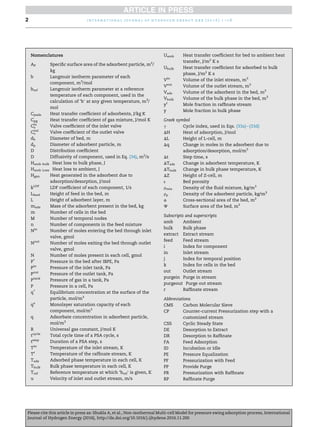
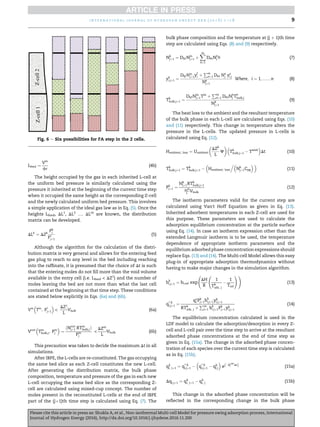
Fig. 1 specifically shows the schematic of a bed during FA
step of any PSA process. The closed valves are grayed for that
purpose. With only valves connected to the Feed tank and
Raffinate tank open, FA step is implemented. The schematic
also shows the bed divided into ‘m’ slices (or cells) and the
corresponding nomenclature for various state parameters of
the cell such as pressure, temperatures in the bulk and
adsorbed phases, mole fractions of individual species in the
bulk phase and the adsorbed phase concentrations of the
species.
Each such axial cell or slice has static adsorbent in contact
with the bulk phase in that cell. For better understanding of
the model, we have chosen to call the adsorbent part of the
cell as Z-cell and the bulk phase part as L-cell. The choice of
nomenclature is simply because both Z and L are often used as
nomenclature for the bed length. The difference between the
Z-cells and L-cells is that while the former is static, the gas in
the latter can move as feed enters and/or product leaves the
bed. The gas in the L-cells can also move axially due to
adsorptionedesorption which changes the net moles of gas in
the L-cells and changes their pressure. This is what could
happen even during the incubation step when there is no
inflow of feed in or outflow of product.
The Multi-cell Model works in principle as follows. The bed
has certain known bulk and adsorbed phase concentration
and temperature profiles as well as pressure profile at any
point of time. What happens over the next incremental time
step is visualized as taking place as a series of two distinct
events. One of them is Instantaneous Bulk phase Pressure
Equalization (IBPE) that happens at the beginning of the time
step and the other is continuous adsorptionedesorption be-
tween adsorbent and the bulk phase in contact with it. The gas
moves only during the IBPE step. During this step, entire gas
inflow that would take place over the time step is deemed to
take place instantaneously. The amount of gas inflow is
decided by the valve equation of the valve at the feed end of
the bed that relates the flow rate to instantaneous difference
between the valve upstream and downstream pressures at the
beginning of the time step. Similarly, valve equation pertain-
ing to the valve at the product end decides the amount of
product gas that would instantaneously leave the bed. A mass
balance decides the moles that remain in the bed. This gas in
the bed is assumed to undergo instantaneous pressure
equalization leaving a uniform pressure in the bed valid over
the entire time step. The gas in the L-cells move as isolated gas
plugs because of this inflow, outflow and pressure
Fig. 1 e Schematic of an adsorbent bed with ‘m’ number of cells for FA step.
i n t e r n a t i o n a l j o u r n a l o f h y d r o g e n e n e r g y x x x ( 2 0 1 6 ) 1 e1 8 5
Please cite this article in press as: Shukla A, et al., Non-isothermal Multi-cell Model for pressure swing adsorption process, International
Journal of Hydrogen Energy (2016), http://dx.doi.org/10.1016/j.ijhydene.2016.11.200
equalization during the IBPE. These gas plugs are considered
to move as isolated plugs without intermingling. As a result of
this movement, the bulk phase in contact with any Z-cell in
the bed would be constituted by fractions of one or more gas
plugs which represented gas in the L-cells inherited at the
beginning of the step just before IBPE. Depending on the
amount of feed that has entered and the volume it has occu-
pied at the feed end of the bed after IBPE, it could also
contribute entirely or partly to the bulk phase against any Z-
cell. What constitutes bulk phase against any Z-cell is the new
L-cell and its composition and temperature govern the
adsorptionedesorption over the time step. Implementation of
IBPE and definition of new L-cell composition and tempera-
ture prior to adsorptionedesorption is an important part of
the model. Once IBPE is implemented, the adsorp-
tionedesorption in each Z-cell and the new L-cell in contact
with it takes place independently and there is no axial bulk
phase movement during this continuous part of the two-step
approximation. Adsorptionedesorption changes the compo-
sition and temperature of the adsorbed phase and bulk phase
in each Z-cell and L-cell pair. The bulk phase pressure in each
cell also changes depending on the net mass transfer between
the adsorbed and bulk phases. The bed wall against each L-cell
is assumed to be in thermal equilibrium with the L-cell. The
heat transfer between the bed wall and the constant ambient
temperature is also incorporated into the model if the bed is
not insulated. The state of the Z-cells and L-cells at the end of
all these phenomena over the time step is inherited as their
initial state for implementing the next incremental time step.
The heights of Z-cell 1, Z-cell 2 to Z-cell m are designated as
DZ1
, DZ2
to DZm
. Similarly, heights of L-cell 1, L-cell 2 to L-cell
m are designated as DL1
, DL2
to DLm
. As shown in Fig. 1, every
L-cell has its own pressure, temperature and gas composition
in terms of mole fractions and total number of moles. Simi-
larly, each Z-cell will have its own adsorbed phase concen-
tration and temperature. The adsorbent particle is considered
to have a uniform temperature in any Z-cell. Thus, for L-cell 1
and Z-cell 1, the mole fraction of ith component, temperature,
pressure, total number of moles, adsorbed phase concentra-
tion of ith component and adsorbent temperature are desig-
nated as y1
i;j; T1
bulk j P1
j ; N1
j ; q1
i; j; T1
ads j for jth time step. The mole
fractions and adsorbed phase concentrations are for all
components.
Reconstitution of L-cells after IBPE step
The IBPE step causes movement of feed gas into the bed,
product gas out of the bed, and resultant movement of gas in
the inherited L-cells. The bulk phase standing against each Z-
cell will thus be constituted by fractions of gas in the inherited
L-cells. The gas in the bulk phase against each Z-cell will
attain new pressure, temperature and composition calculated
as their mixed cup values after the composition of the cell in
terms of various gas plugs contributing to it are known. What
one needs to know is how the feed plug and the gas in
inherited L-cells prior to IBPE distribute themselves in the
various slices of the bed. This general distribution is quanti-
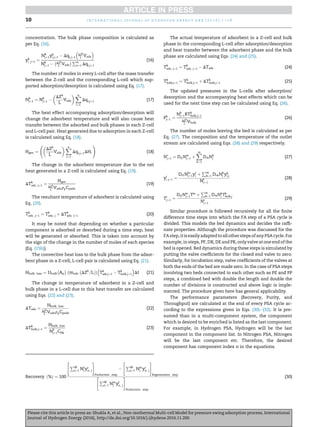
tatively captured in the distribution matrix. The feed plug and
the relocated gas plugs in inherited L-cells move in axial di-
rection without intermingling as discussed earlier. After IBPE,
what fractions of each such gas plug are against static phys-
ical demarcations of the bed into ‘m’ cells are the information
content of the distribution matrix. General structure and
nomenclature of the matrix for a general case of m divisions is
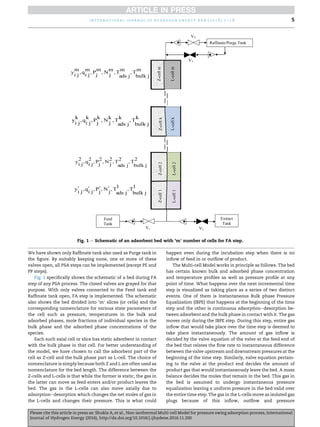
as shown in Fig. 2.
In Fig. 2, first row of the matrix (from bottom) shows frac-
tions of feed plug and the relocated gas plugs belonging to the
inherited L-cells that would contribute to the new recon-
stituted L-cell 1 that occupies the first cell in the bed along
with Z-cell 1. Similarly, the elements in the second row show
fractions of feed plug and the relocated gas plugs belonging to
the inherited L-cells that would contribute to the new recon-
stituted L-cell 2 that occupies the second cell in the bed along
with Z-cell 2. Subsequent rows similarly capture the consti-
tution of L-cells 3 to L-cell m in terms of the feed plug and
relocated gas plugs of inherited cells. The last row of the
matrix shows the fraction of feed and the gas in the inherited
L-cells that end up in the raffinate. Being fractions of various
gas plugs, the elements of the matrix are normalized and their
values are between 0 and 1. Viewed alternately, the first col-
umn in the matrix corresponds to feed distribution in recon-
stituted L-cells standing against Z-cells and the raffinate
stream. Similarly, the second column captures the distribu-
tion of gas in the inherited L-cell 1 in the reconstituted L-cells
standing against Z-cells and the raffinate stream. The next
column shows the distribution of gas in inherited L-cell 3 in
the reconstituted L-cells standing against Z-cell and the raf-
finate stream, and so on.
It can be appreciated that the sum of all elements in every
column of the matrix is unity because it simply captures the
fractions of each distinct gas plug (feed and gas in inherited L-
cells) in the various reconstituted L-cells and the raffinate
stream. It can also be seen that the matrix size is
(m þ 1) Â (m þ 1) if the bed is divided into ‘m’ cells.
With this understanding about the distribution matrix
structure and nomenclature, we can now see how the matrix
elements can be calculated after the IBPE step. Once that is
done, the composition, pressure and temperature of the
reconstituted L-cells can be easily calculated as mixed cup
properties. The adsorptionedesorption between each pair of a
Z-cell and corresponding L-cell is then executed. Execution of
the IBPE and generation of the distribution matrix are quite
complex in nature.
Fig. 2 e Distribution matrix for ‘m’ cells in the bed.
i n t e r n a t i o n a l j o u r n a l o f h y d r o g e n e n e r g y x x x ( 2 0 1 6 ) 1 e1 86
Please cite this article in press as: Shukla A, et al., Non-isothermal Multi-cell Model for pressure swing adsorption process, International
Journal of Hydrogen Energy (2016), http://dx.doi.org/10.1016/j.ijhydene.2016.11.200
Distribution matrix for 2 cells in the bed
For the purpose of conceptual clarity, the structure of distri-
bution matrix is explained considering that the bed is divided
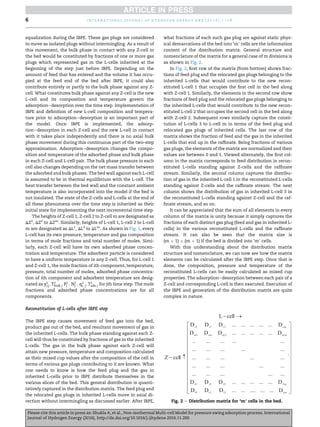
into two cells (m ¼ 2) as shown in Fig. 3 at “jth” time step. The
distribution matrix will then be a 3 Â 3 matrix in this case. The
composition, pressure and temperature in the Z-cells and the
corresponding L-cells which govern adsorption/desorption
can be calculated using the distribution matrix. Fig. 4(a) shows
the distribution matrix for a bed divided into two cells at the
beginning of the jth time step as well as at the end of IBPE
during this step. After the completion of the jth time step, the
Z-cells and the L-cells have the same size. Their specifications
are inherited for the simulation of the next, i.e. (j þ 1)th time
step. The feed is yet to enter and the raffinate yet to leave. At
this stage, all the elements in the first column and the last row
of the distribution matrix are zero as shown in Fig. 4(a). The
height of each Z-cell is same as the height of the corre-
sponding L-cell and only the elements corresponding to each
combination are 1 in the inherited distribution matrix. The
IBPE step for the (j þ 1)th time step begins with this status.
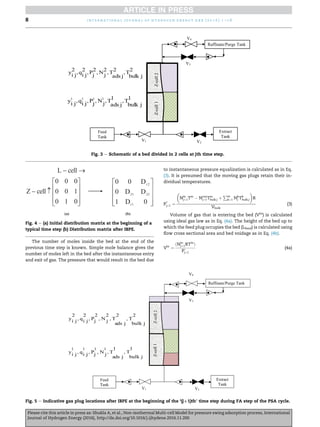
Fig. 5 displays one of the possible bed conditions at the end
of the IBPE step of the (j þ 1)th time step. The operational PSA
cycle step is the FA step as indicated in the figure during which
the feed enters and the raffinate leaves from the bed. The bulk
phase composition, pressure and temperature in each
inherited L-cell as well as the solid phase composition and
temperature in each inherited Z-cell are
yk
i;j; Tk
bulk j Pk
j ; Nk
j ; qk
i; j; Tk
ads j. The index ‘k’ depicts spatial posi-
tion in the bed that varies in this simplified case from 1 to 2.
The color codes for the gas in inherited L-cells in Fig. 5 are
given below along with the color code for the feed plug that
will enter as a part of IBPE step.
Fig. 5 shows only one of the scenarios possible during IBPE
step. The feed has moved in but stays entirely within the bulk
phase against Z-cell 1, the gas in the inherited L-cell 1 has
moved up and straddles across both the Z-cells and the gas in
the inherited L-cell 2 has also moved up with a part occupying
position against Z-cell 2 and the remaining part moving out of
the bed contributing to the raffinate stream. There are other
possible scenarios depending upon the amounts of gas
entering and leaving and also the extent to which the gas in
the inherited cells expand/compress due to pressure equal-
ization. It can be shown that for the present case of the bed
being divided into 2 cells, the total possibilities are 6 in num-
ber. The six possibilities are shown qualitatively in Fig. 6. The
movement of the three gas plugs (feed plug and gas in
inherited L-cell 1 and L-cell 2) relative to the two static Z-cells
is shown. The figure is self explanatory. The first of the six
possibilities corresponds to Fig. 6. The only non-zero elements
in the distribution matrix for this case which help define the
gas quality in the reconstituted L-cells will be as shown in
Fig. 4(b). In general, the number of distinct possibilities for
positioning of gas in the inherited L-cells and the entering feed
plug in FA step are m  (m þ 1). Sahoo has discussed the
quantitative aspect of generation of the distribution matrix in
detail [13].
The calculations are valid for multi-component system.
The index ‘i’ depicts the component. The time index is ‘j’ and
it varies from 0 e M, M being the total number of temporal
divisions of any PSA step duration. After the IBPE part of the
(j þ 1)th time step is executed, L-cells will be reconstituted
which will attain the same position as the corresponding Z-
cells in the bed. Fig. 5 shows the movement of the gas plugs
that were occupying void space in each bed cell along with the
feed gas plug that has pushed itself up in the bed. The
nomenclature for various parameters is shown as valid for the
end of the time step j. At the end of the next time step (j þ 1),
similar nomenclature will be valid with j replaced by (j þ 1).
The following procedure is a step by step explanation to get
various parameter values at the end of time step (j þ 1) from
the values at the end of step j. It can be used recursively to
march in time starting with j ¼ 1 to j ¼ M.
Governing equations
Consider an adsorbent bed divided into ‘m’ cells performing
FA step as shown in Fig. 1. In FA step, the inlet valve (V1) and
outlet valve (V4) are open throughout the duration of the time
step. The following set of equations present the method to
simulate the happenings over the ‘j þ 1’ time step given the
conditions in the bed at the end of the jth time step. The
equations are applicable recursively over every time step into
which the PSA step is divided.
The velocities of the inlet/outlet streams are calculated by
using the valve equations as shown in Eqs. (1a) and (1b).
uin
jþ1 ¼ Cin
v
ffiffiffiffiffiffiffiffiffiffiffiffiffiffiffiffiffiffiffiffiffiffiffiffiffiffiffiffiffiffiffiffiffiffiffiffiffiffiffiffiffiffiffiffi
Pin
ÀP1
j
rðevaluated at Pin
Þ
v
u
u
t (1a)
uout
jþ1 ¼ Cout
v
ffiffiffiffiffiffiffiffiffiffiffiffiffiffiffiffiffiffiffiffiffiffiffiffiffiffiffiffiffiffiffiffiffiffiffiffiffiffiffiffiffiffiffiffiffiffi
Pm
j ÀPout
r

evaluated at P
m
j

v
u
u
u
t (1b)
The number of moles entering and exiting the adsorbent
bed is calculated using ideal gas law as given in Eqs. (2a) and
(2b).
Nin
jþ1 ¼
uin
jþ1f Pin
Dt
RTin
(2a)
Nout
jþ1 ¼
uout
jþ1fPm
j Dt
RTm
bulk;j
(2b)
L-cell 1
L-cell 2
feed plug
i n t e r n a t i o n a l j o u r n a l o f h y d r o g e n e n e r g y x x x ( 2 0 1 6 ) 1 e1 8 7
Please cite this article in press as: Shukla A, et al., Non-isothermal Multi-cell Model for pressure swing adsorption process, International
Journal of Hydrogen Energy (2016), http://dx.doi.org/10.1016/j.ijhydene.2016.11.200
The number of moles inside the bed at the end of the
previous time step is known. Simple mole balance gives the
number of moles left in the bed after the instantaneous entry
and exit of gas. The pressure that would result in the bed due
to instantaneous pressure equalization is calculated as in Eq.
(3). It is presumed that the moving gas plugs retain their in-
dividual temperatures.
P*
jþ1 ¼

Nin
jþ1Tin
À Nout
jþ1Tm
bulk;j þ
Pm
k¼1 Nk
j Tk
bulk;j

R
Vbulk
(3)
Volume of gas that is entering the bed (Vin
) is calculated
using ideal gas law as in Eq. (4a). The height of the bed up to
which the feed plug occupies the bed (Lfeed) is calculated using
flow cross sectional area and bed voidage as in Eq. (4b).
Vin
¼
ðNin
jþ1RTin
Þ
PÃ
jþ1
(4a)
Fig. 5 e Indicative gas plug locations after IBPE at the beginning of the ‘(jþ1)th’ time step during FA step of the PSA cycle.
Z-cell2Z-cell1
Raffinate/Purge Tank
Feed
Tank
Extract
Tank
2
jbulk
T,
2
jads
T,
2
j
N,
2
j
P,
2
ji
q,
2
ji
y
1
jbulk
T,
1
jads
T,
j
N,
j
P,
ji
q,
ji
y
1111
V1 V2
V4
V3
Fig. 3 e Schematic of a bed divided in 2 cells at jth time step.
Fig. 4 e (a) Initial distribution matrix at the beginning of a
typical time step (b) Distribution matrix after IBPE.
i n t e r n a t i o n a l j o u r n a l o f h y d r o g e n e n e r g y x x x ( 2 0 1 6 ) 1 e1 88
Please cite this article in press as: Shukla A, et al., Non-isothermal Multi-cell Model for pressure swing adsorption process, International
Journal of Hydrogen Energy (2016), http://dx.doi.org/10.1016/j.ijhydene.2016.11.200
Lfeed ¼
Vin
fε
(4b)
The height occupied by the gas in each inherited L-cell at
the uniform bed pressure is similarly calculated using the
pressure it inherited at the beginning of the current time step
when it occupied the same height as the corresponding Z-cell
and the newly calculated uniform bed pressure. This involves
a simple application of the ideal gas law as in Eq. (5). Once the
heights Lfeed, DL1
, DL2
…. DLm
are known, the distribution
matrix can be developed.
DLk
¼ DZk
Pk
j
P*
jþ1
(5)
Although the algorithm for the calculation of the distri-
bution matrix is very general and allows for the entering feed
gas plug to reach to any level in the bed including reaching
into the raffinate, it is presumed that the choice of Dt is such
that the entering moles do not fill more than the void volume
available in the entry cell (i.e. Lfeed  DZ1
) and the number of
moles leaving the bed are not more than what the last cell
contained at the beginning at that time step. These conditions
are stated below explicitly in Eqs. (6a) and (6b).
Vin

Tin
; P*
jþ1


DZ1
L
Vbulk (6a)
Vout

Tm
bulk;j; Pm
j

¼
ðNout
jþ1 RTm
bulk;jÞ
Pm
j

DZm
L
Vbulk (6b)
This precaution was taken to decide the maximum Dt in all
simulations.
After IBPE, the L-cells are re-constituted. The gas occupying
the same bed slice as each Z-cell constitutes the new L-cell.
After generating the distribution matrix, the bulk phase
composition, temperature and pressure of the gas in each new
L-cell occupying the same bed slice as the corresponding Z-
cell are calculated using mixed-cup concept. The number of
moles present in the reconstituted L-cells at the end of IBPE
part of the (jþ1)th time step is calculated using Eq. (7). The
bulk phase composition and the temperature at (j þ 1)th time
step are calculated using Eqs. (8) and (9) respectively.
Nk
jþ1 ¼ Dkf Nin
jþ1 þ
Xm
q¼1
DkqNq
j q (7)
yk
i;jþ1 ¼
Dkf Nin
jþ1y
f
i þ
Pm
q¼1 Dkq Nq
j yq
i;j
Nk
jþ1
Where; i ¼ 1; ……n (8)
Tk
bulk;jþ1 ¼
Dkf Nin
jþ1Tin
þ
Pm
q¼1 DkqNq
j Tq
bulk;j
Nk
jþ1
(9)
The heat loss to the ambient and the resultant temperature
of the bulk phase in each L-cell are calculated using Eqs. (10)
and (11) respectively. This change in temperature alters the
pressure in the L-cells. The updated pressure in L-cells is
calculated using Eq. (12).
Hambient; loss ¼ Uambient

DZk
L
J

Tk
bulk;jþ1 À Tamb

Dt (10)
Tk
bulk;jþ1 ¼ Tk
bulk;jþ1 À

Hambient; loss
.
Nk
jþ1Cpg
 
(11)
Pk
jþ1 ¼
Nk
jþ1RTk
bulk;jþ1
DZk
L
Vbulk
(12)
The isotherm parameters valid for the current step are
calculated using Van't Hoff Equation as given in Eq. (13).
Inherited adsorbent temperatures in each Z-cell are used for
this purpose. These parameters are used to calculate the
adsorption equilibrium concentration at the particle surface
using Eq. (14). In case an isotherm expression other than the
extended Langmuir isotherm is to be used, the temperature
dependence of appropriate isotherm parameters and the
equilibrium adsorbed phase concentration expressions should
replace Eqs. (13) and (14). The Multi-cell Model allows this easy
plug-in of appropriate adsorption thermodynamics without
having to make major changes in the simulation algorithm.
b
k
i;jþ1 ¼ bi;ref exp
DH
R
1
Tk
ads; j
À
1
Tref
! !
(13)
q*;k
i;jþ1 ¼
qs
i Pk
jþ1b
k
i;jþ1yk
i;jþ1
RTk
ads; j þ
Pm
I¼1 b
k
I;jþ1Pk
jþ1yk
I;jþ1
(14)
The equilibrium concentration calculated is used in the
LDF model to calculate the adsorption/desorption in every Z-
cell and L-cell pair over the time step to arrive at the resultant
adsorbed phase concentrations at the end of time step as
given in Eq. (15a). The change in the adsorbed phase concen-
tration of each species over the current time step is calculated
as in Eq. (15b).
qk
i; jþ1 ¼ q*;k
i;jþ1 À

q*;k
i;jþ1 À qk
i;j

eðÀkLDF
i DtÞ (15a)
Dqi;jþ1 ¼ qk
i; jþ1 À qk
i; j (15b)
This change in the adsorbed phase concentration will be
reflected in the corresponding change in the bulk phase
Z-cell2Z-cell1
Fig. 6 e Six possibilities for FA step in the 2 cells.
i n t e r n a t i o n a l j o u r n a l o f h y d r o g e n e n e r g y x x x ( 2 0 1 6 ) 1 e1 8 9
Please cite this article in press as: Shukla A, et al., Non-isothermal Multi-cell Model for pressure swing adsorption process, International
Journal of Hydrogen Energy (2016), http://dx.doi.org/10.1016/j.ijhydene.2016.11.200
concentration. The bulk phase composition is calculated as
per Eq. (16).
yk
i ;jþ1 ¼
Nk
jþ1yk
i;jþ1 À Dqi;jþ1

DZk
L
Vads

Nk
jþ1 À
ÀDZk
L
Vads
Á Pn
i¼1 Dqi;jþ1
(16)
The number of moles in every L-cell after the mass transfer
between the Z-cell and the corresponding L-cell which sup-
ported adsorption/desorption is calculated using Eq. (17).
Nk
jþ1 ¼ Nk
jþ1 À

DZk
L
Vads
 Xn
i¼1
Dqi;jþ1 (17)
The heat effect accompanying adsorption/desorption will
change the adsorbent temperature and will also cause heat
transfer between the adsorbed and bulk phases in each Z-cell
and L-cell pair. Heat generated due to adsorption in each Z-cell
is calculated using Eq. (18).
Hgen ¼

DZk
L
Vads
 Xn
i¼1
Dqi;jþ1DHi
!
(18)
The change in the adsorbent temperature due to the net
heat generated in a Z-cell is calculated using Eq. (19).
DTk
ads; jþ1 ¼
Hgen
DZk
L
VadsrpCpads
(19)
The resultant temperature of adsorbent is calculated using
Eq. (20).
Tk
ads; jþ1 ¼ Tk
ads; j þ DTk
ads; jþ1 (20)
It may be noted that depending on whether a particular
component is adsorbed or desorbed during a time step, heat
will be generated or absorbed. This is taken into account by
the sign of the change in the number of moles of each species
(Eq. (15b)).
The convective heat loss to the bulk phase from the adsor-
bent phase in a Z-cell, L-cell pair is calculated using Eq. (21).
Hbulk; loss ¼ Ubulk
À
Ap
Á À
mads
À
DZk
=LÞ
Á
Tk
ads;jþ1 À Tk
bulk;jþ1

Dt (21)
The change in temperature of adsorbent in a Z-cell and
bulk phase in a L-cell due to this heat transfer are calculated
using Eqs. (22) and (23).
DTads ¼
Hbulk; loss
DZk
L
VadsrpCpads
(22)
DTk
bulk;jþ1 ¼
Hbulk; loss
Nk
jþ1Cpg
(23)
The actual temperature of adsorbent in a Z-cell and bulk
phase in the corresponding L-cell after adsorption/desorption
and heat transfer between the adsorbent phase and the bulk
phase are calculated using Eqs. (24) and (25).
Tk
ads; jþ1 ¼ Tk
ads; jþ1 À DTads (24)
Tk
bulk;jþ1 ¼ Tk
bulk;jþ1 þ DTk
bulk;jþ1 (25)
The updated pressures in the L-cells after adsorption/
desorption and the accompanying heat effects which can be
used for the next time step can be calculated using Eq. (26).
Pk
jþ1 ¼
Nk
jþ1RTk
bulk;jþ1
DZk
L
Vbulk
(26)
The number of moles leaving the bed is calculated as per
Eq. (27). The composition and the temperature of the outlet
stream are calculated using Eqs. (28) and (29) respectively.
Nr
jþ1 ¼ Drf Nin
jþ1 þ
Xm
k¼1
DrkNk
j (27)
yr
i jþ1 ¼
Drf Nin
jþ1yf
i þ
Pm
k¼1 DrkNk
j yk
i;j
Nr
jþ1
(28)
Tr
jþ1 ¼
Drf Nin
jþ1Tin
þ
Pm
k¼1 DrkNk
j Tk
bulk;j
Nr
jþ1
(29)
Similar procedure is followed recursively for all the finite
difference time steps into which the FA step of a PSA cycle is
divided. This models the bed dynamics and decides the raffi-
nate properties. Although the procedure was discussed for the
FAstep, itiseasilyadaptedtoall othersteps ofany PSA cycle. For
example, in steps, PF, DR, DE and PR, only valve at one end of the
bed is opened. Bed dynamics during these steps is simulated by
putting the valve coefficients for the closed end valve to zero.
Similarly, for incubation step, valve coefficients of the valves at
both the ends of the bed are made zero. In the case of PSA steps
involving two beds connected to each other such as PE and PP
steps, a combined bed with double the length and double the
number of divisions is constructed and above logic is imple-
mented. The procedure given here has general applicability.
The performance parameters (Recovery, Purity, and
Throughput) are calculated at the end of every PSA cycle ac-
cording to the expressions given in Eqs. (30)e(32). It is pre-
sumed than in a multi-component system, the component
which is desired to be enriched is listed as the last component.
For example, in Hydrogen PSA, Hydrogen will be the last
component in the component list. In Nitrogen PSA, Nitrogen
will be the last component etc. Therefore, the desired
component has component index n in the equations.
Recovery ð%Þ ¼ 100

PM
j¼1 Nr
j yr
n; j
#
Production step
À

PM
j¼1 Nin
j yr
n; j
#
Regeneration step

PM
j¼1 Nin
j yf
n; j
#
Production step
(30)
i n t e r n a t i o n a l j o u r n a l o f h y d r o g e n e n e r g y x x x ( 2 0 1 6 ) 1 e1 810
Please cite this article in press as: Shukla A, et al., Non-isothermal Multi-cell Model for pressure swing adsorption process, International
Journal of Hydrogen Energy (2016), http://dx.doi.org/10.1016/j.ijhydene.2016.11.200
Purity ð%Þ ¼ 100

PM
j¼1 Nr
j yr
n; j
#
Production step

PM
j¼1 Nr
j
#
Production step
(31)
Throughput ¼

PM
j¼1 Nin
j
#
Production step
Vadsrpðtcycle
Þ
(32)
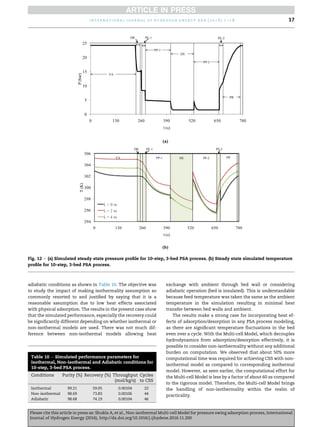
PSA cycles are simulated by simulating sequential steps
that comprise the cycle. For the purpose of process perfor-
mance evaluation, what is important is the Cyclic Steady State
(CSS) performance. Multiple criteria have been used in the
present work to decide whether the CSS is reached or not.
These are given in Eqs (33a)e(33d). In the first condition, Eq.
(33a), we compare the time averaged raffinate tank composi-
tion of two consecutive PSA cycles. If the absolute difference is
under the stipulated tolerance, the CSS is considered to have
been reached. In the second and third conditions, Eqs. (33b)
and (33c) respectively, we compare the axial bulk phase and
adsorbed phase concentration profiles in the bed for two
consecutive cycles at the completion of one major step of the
production phase of any PSA cycle. We have chosen FA step
for this purpose in this work. In the fourth condition, Eq. (33d),
we compare the fractional recovery of two consecutive cycles.
It is the fraction of desired component present in the feed that
has reached in the raffinate stream. For example, in the case
of Nitrogen PSA which enriches Nitrogen in air, what fraction
of Nitrogen in the feed stream used over a PSA cycle has been
captured in the net raffinate withdrawal in the cycle would be
the fractional purity. Typical tolerance value used in the pre-
sent work is 0.00001.


nÀ
yr
n
Á
gthcycle
À
À
yr
n
Á
ðgÀ1Þth
cycle
o

 e (33a)


n
yk
n; M

gthcycle
À

yk
n; M

ðgÀ1Þth
cycle
o

 e for all k (33b)


1
1000
h
qk
i; M

gthcycle
À

qk
i; M

ðgÀ1Þth
cycle
i '


 e for all k (33c)


1
100
h
Recoveryð Þgthcycle À Recoveryð ÞðgÀ1Þth
cycle
i '


 e (33d)
Considering that the quantities being considered in Eqs.
(33a), (33b) and (33d) (mole fraction of raffinate, mole fraction
inside L-cells and fractional recovery respectively) are
normalized, this is a fairly stringent tolerance. To approxi-
mately get the condition on adsorbed phase concentration (Eq.
(33c)) to match with the same rigor, the adsorbed phase con-
centrations were divided by 1000 considering that their typical
maximum values are in the range of 600 (mol/m3
of adsorbent)
or so for the adsorbenteadsorbate system used in this work.
Results and discussions
The model is validated using the reported models and
experimental data. We have not done experimental validation
ourselves. The cases considered in this paper have been used
to demonstrate the versatility of our model in handling
isothermal and non-isothermal operation, multi-component
systems, multi-bed systems, and complex PSA cycles
involving a large number of distinct component steps.
The following cases have been considered:
Case 1: Binary mixture, isothermal system (comparison
with reported simulated performance)
Case 2: Ternary mixture, non-isothermal system (com-
parison with reported experimental results)
Case 3: Same as Case 2 except that comparison is with
reported simulated performance
These cases are discussed in detail in the following.
Case 1: Air separation for N2 enrichment using Carbon
Molecular Sieve (CMS) as adsorbent was studied. The adsor-
benteadsorbate properties are given in Table 1. The model
inputs and design parameters are given in Table 2. Isothermal
operation was mimicked by considering heat of adsorption as
zero in our non-isothermal PSA model. This was done to
established parity with two reported simulation models, one
being the isothermal rigorous model by Mhaskar et al. [12] and
another being an isothermal Multi-cell Model of Sahoo [13].
The adsorbateeadsorbent properties were taken as re-
ported by Mhaskar et al. [12]. The comparative results are
tabulated in Table 3. From the results, it can be seen that the
steady state performances predicted by the two models are
comparable. A minor discrepancy is found in performance
parameters, which can be attributed to the different time step
used in the present study (0.01 s), compared to that used in the
other two studies (0.02 s). Table 3 also shows the computa-
tional times required by the three models on identical
computing machine. The results show the advantages of
using Multi-cell Model over rigorous model in terms of time
taken for simulation. For rigorous model, it took 300 min as
compared to 5 min taken by the Multi-cell Model.
Case 2: The simulated results are validated for multi-
component, non-isothermal system by comparing it with
the experimental data presented by Doong and Yang [7].
Adsorptive separation of ternary mixture of H2/CH4/CO2 using
activated carbon as adsorbent is studied and results are pre-
sented. In the present study, the flow rates for input or output
streams are controlled by valves and do not remain constant
over PSA steps. However, Doong and Yang have reported
constant flow rates over FA and RP steps. Valve co-efficient for
relevant valves in our model were adjusted to give same in-
tegrated volumetric inflow over the corresponding steps. The
Table 1 e Adsorbenteadsorbate properties.
Feed component Case 1 Case 2 and Case 3 [7]
Parameters O2 N2 CH4 CO2 H2
Mole fraction of
components in
the feed, y
0.21 0.79 0.333 0.333 0.334
kLDF
(1/s) 0.038 0.0058 0.142 0.142 0.727
qs
(mol/m3
of particle) 2640 2640 5214 9444 1472
b (m3
/mol) 0.0035 0.00337 0.00258 0.00409 0.000951
i n t e r n a t i o n a l j o u r n a l o f h y d r o g e n e n e r g y x x x ( 2 0 1 6 ) 1 e1 8 11
Please cite this article in press as: Shukla A, et al., Non-isothermal Multi-cell Model for pressure swing adsorption process, International
Journal of Hydrogen Energy (2016), http://dx.doi.org/10.1016/j.ijhydene.2016.11.200
adsorbent properties like equilibrium constant and monolayer
saturation capacity in the Extended Langmuir model were
also calculated using the experimental adsorption isotherm
reported by Yang and Lee who used the same CMS [16].
Adsorbenteadsorbate properties are shown in Table 1.
Performance parameters were compared with the reported
experimental data. Equimolar feed mixture was used in the
experiment. The operating and design parameters are given in
Table 2. The process was run for five cyclic steps for the re-
covery of Hydrogen as raffinate. The experimental results for
Run 1 were considered for comparison of the results with the
present Multi-cell Model [13]. The cyclic sequence of PSA pro-
cess is as explained by Doong and Yang [7]. In step I, i.e. CP step,
pure H2 is used for pressurization of the bed. FA step follows
the CP step. In FA step, feed mixture is allowed to flow through
the bed. The raffinate collected in FA step is expected to have
maximum H2 purity. The DR step is divided into two parts
namely DR-1 and DR-2. It is as expected to recover additional
H2 in DR-1 and a stream rich in CH4 in DR-2 step. CO2 and CH4
are recovered in the DE and RP steps as extract stream.
The results are compared with the performances obtained
in the experiments as shown in Table 4. The simulated purity
of H2 is 99%, which compares reasonably well with the re-
ported experimental results. The mismatch in the results is
attributed to the LDF model used in our simulations to define
the adsorption kinetics. Doong and Yang had suggested that
the controlling mechanism could be simultaneous surface
and Knudsen diffusion. In addition, one of the reasons can be
that our flow rates are variable as they are governed by valve
coefficient and the pressure differential between the up-
stream and downstream locations of the valve. Doong and
Yang have reported averaged flow over the steps only [7]. In
our simulations, it is found that part of CO2 is collected in
raffinate tank with H2 and CH4 in DR-2 step, which is not the
case in the reported study. This also could be due to our model
not accounting for Knudsen diffusion. Effectively, we have
ignored the contribution of Knudsen diffusion. The surface
diffusion has been accounted for by equivalent LDF coefficient
as per Glueckauf relation [17]. Collectively, simultaneous
Knudsen and surface diffusion in their work possibly offers
somewhat different selectivities for the competing compo-
nents than pure surface diffusion simulated by us. We have
used Langmuir model with parameters extracted from re-
ported isotherms. Use of Loading Ratio Correlation (LRC)
model has not shown much deviation in the results.
Case 3: The model was also validated using simulated cy-
clic steady state performance and pressure-time profiles at
the feed end of the bed. The PSA cycle, adsorbent and the feed
were the same as in Case 2. As stated earlier in Case 2, the
mass transfer model used in the reported study was simul-
taneous surface and Knudsen diffusion model, whereas the
present simulation study considers linear driving force model.
The model inputs are same as for the experimental studies
except that the pressure for adsorption step is 26 bar and the
valve coefficients are accordingly adjusted to obtain inte-
grated flow rates matching with those reported for the
experimental studies. The comparison is between our CSS
results and the simulation results by Doong and Yang [7]. The
CSS was attained in 10 cycles as reported by Doong and Yang
Table 2 e Model inputs for simulation of PSA process.
Parameters Case 1 Case 2 Case 3
Inner diameter of bed, db (m) 0.035 0.051 0.051
Adsorbent layer height, L (m) 0.35 0.6 0.6
Duration of PF step, tPF
(s) 15 e e
Duration of FA step, tFA
(s) 60 180 180
Duration of DR-1 step, tDR-1
(s) e 120 215
Duration of DR-2 step, tDR-2
(s) e 270 265
Duration of DE step, tDE
(s) 15 60 120
Duration of RP step, tRP
(s) 60 60 120
Duration of CP step, tPR
(s) e 30 30
Feed valve coefficient, Cfeed
v 0.00021 0.00002 0.00016
Raffinate valve coefficient,
Cr
v [FA]
0.000018 0.0000015 0.0000046
Raffinate valve coefficient,
Cr
v [DR-1]
e 0.000008 0.0000095
Raffinate valve coefficient,
Cr
v [DR-2]
e 0.000005 0.000008
Extract valve coefficient,
Cextract
v
0.006 0.009 0.00007
Purge in valve coefficient,
Cpurgein
v
0.00011 0.000156 0.00005
Purge out valve coefficient,
Cpurgeout
v
0.00014 0.0000727 0.00008
Bed voidage, ε 0.5 0.78 0.78
Feed tank pressure, Pfeed
(bar) 3.039 9 26.2
Raffinate tank pressure,
Pr
(bar) [FA]
1.213 6 7
Raffinate tank pressure,
Pr
(bar) [DR-1]
e 3.3 6
Raffinate tank pressure,
Pr
(bar) [DR-2]
e 2.3 3.5
Extract tank pressure,
Pextract
(bar)
1 1.5 1.5
Purge tank pressure,
Ppurgein
(bar)
1.2 2.5 2.3
Purge tank pressure,
Ppurgeout
(bar)
1.0 1.5 2.3
Adsorption
Temperature, T (K)
303 300 300
Total cycle time, tcycle
(s) 150 720 720
Density of gas mixture at 1bar,
r (kg/m3
)
1.2 0.22 0.22
Density of adsorbent particle,
rp (kg/m3
)
980 850 850
Length of a time step, Dt (s) 0.01 0.01 0.01
Number of cells in the bed 40 30 30
Diameter of adsorbent particle,
dp (m)
0.0032 0.00056 0.00056
Cpads (J/kg.K) e 1050 1050
Cpg (J/mol.K) e 31.2 31.2
Table 3 e Model validation with reported performance
parameters.
Purity (%) Recovery (%) Time
(min)
Rigorous model [12] 94 18.6 300
Multi-cell Model [13] 93.8 18.3 5
Multi-cell Model
(This work)
93.7 18.8 5
i n t e r n a t i o n a l j o u r n a l o f h y d r o g e n e n e r g y x x x ( 2 0 1 6 ) 1 e1 812
Please cite this article in press as: Shukla A, et al., Non-isothermal Multi-cell Model for pressure swing adsorption process, International
Journal of Hydrogen Energy (2016), http://dx.doi.org/10.1016/j.ijhydene.2016.11.200
whereas in the present study CSS was attained in 28 cycles.
This could be due to very stringent CSS conditions adopted by
us. As in the earlier case, the valve coefficients for the various
valves were calculated by us using the average flow rate re-
ported by Doong and Yang for different steps. The stepwise
flow rates of various streams used by them and achieved by
our adjusted valve equations are compared in Table 5. There is
marginal difference in the flow rates as seen from the table.
The CSS performances are compared in Table 6. The slight
discrepancy in the results can be attributed to the different
mass transfer rate models used in the studies. Doong and
Yang have reported surface and Knudsen diffusion model as
accurate and concluded that results are almost comparable
with their experimental results. Simulation with diffusion
models involve solution of partial differential equations
capturing the phenomena and can consume a lot of compu-
tational time in solving the equations over each time step by
finite difference technique. It can be plugged in effortlessly in
the Multi-cell Model but at the cost of prohibitive computa-
tional efforts. We have instead used a simplified approxima-
tion of the surface diffusion model in terms of Linear Driving
Force (LDF) model and taken our LDF coefficient commensu-
rate with their surface diffusivity as per Glueckauf's approxi-
mation as follows [17]. Their being no equivalent
approximation for the Knudsen diffusion, we could not
consider the same. Our simulation results deviate from those
of Doong and Yang mainly for Methane. It could be because
the Knudsen diffusion, which we have ignored, changes
selectivity of adsorbent towards methane significantly which
our surface diffusion model approximation was not able to
capture.
k
LDF
i ¼
60Di
d
2
p
(34)
The authors also reported the experimental pressure pro-
file for this case [7]. The pressure profiles simulated by us were
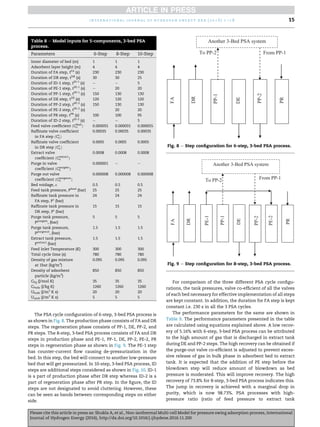
compared with their experimental profiles. Fig. 7(a) shows the
pressure profile at CSS over the entire PSA cycle. The pressure
profile is plotted considering the pressure near the feed end of
the bed.
The model and experimental pressure profiles are in good
agreement that shows that the Multi-cell Model is able to
capture the bed hydrodynamics closely. Experimental tem-
peratureetime profiles were not reported. Our simulated
temperature profiles are as shown in Fig. 7(b).
The temperature profiles have been shown in the figure at
the bed bottom, middle, and top over the entire PSA cycle. The
durations of individual steps have been marked as distinct
color bands for a better feel. Considering that the feed tem-
perature is 289 K, the temperature rise of about 30 K due to
adsorption is significant and affects the performance signifi-
cantly. Doong and Yang have also reported temperature rise of
about 40 K in their experiment. They have, however not re-
ported temperature profiles for this experimental run. Simi-
larly, during regeneration steps, significant temperature drops
are evident due to desorption. As can be observed, the bed
temperatures go below even the feed temperature to about
282 K. The overall temperature swing of the bed is thus about
37 K. Doong and Yang have not reported such temperatures
below the feed temperature in their experimental work [7].
The temperature profiles at different bed heights also show
the mass transfer zones traveling in the bed with time as
evident from the crossover of temperature profiles.
Complex PSA process
After the above exercise to validate the Multi-cell Model with
reported experimental-simulated performance data, we have
tried to use the model for a more complex PSA process with 6,
8 and 10 step PSA cycle implemented on a 3 bed PSA process.
This is discussed in the following.
Industrial PSA process designs often employ several addi-
tional steps in the PSA cycle to improve process performance.
Hydrogen PSA is one important example. To demonstrate
working of our simulation model for complex PSA processes
like this as well as to quantitatively show the effect of these
so-called minor steps on process performance, we have car-
ried out simulation of a five-component mixture for H2 puri-
fication. AdsorbenteAdsorbate properties are mentioned in
Table 5 e Comparison of flow rates for Case 3.
Reported work [7] This work
Inlet Outlet Inlet Outlet
FA 33 17.1 32.3 16.9
DR-1 e 10.6 e 10.1
DR-2 e 3.6 e 4.14
DE, RP e, 1.9 19.6 e, 1.6 19.7
CP (H2) 14 e 16.9 e
Table 4 e Comparison of simulated and experimental performance parameters.
Purity % Recovery (%)
Reported
Work [7]
This Work Reported
Work [7]
This Work
Purity/Recovery (in terms of H2) of
raffinate stream collected in FA
and DR-1 steps in terms of H2
99 99.6 83 78
Purity/Recovery (in terms of CH4)
of raffinate stream collected in
DR-2 step
90 82.1 32 30
Purity/Recovery (in terms of CO2)
of extract stream collected in
DE and RP step
60 51.26 99 76.71
i n t e r n a t i o n a l j o u r n a l o f h y d r o g e n e n e r g y x x x ( 2 0 1 6 ) 1 e1 8 13
Please cite this article in press as: Shukla A, et al., Non-isothermal Multi-cell Model for pressure swing adsorption process, International
Journal of Hydrogen Energy (2016), http://dx.doi.org/10.1016/j.ijhydene.2016.11.200
Table 7. The design parameters are as shown in Table 8. The
simulations were performed for various steps of PSA process
considering energy saving step like pressure equalization. The
PP step is added after DR step so that initial purging can be
done with less pure component. This helps reduce raffinate
loss and thus recovery can be enhanced without adverse
impact on purity.
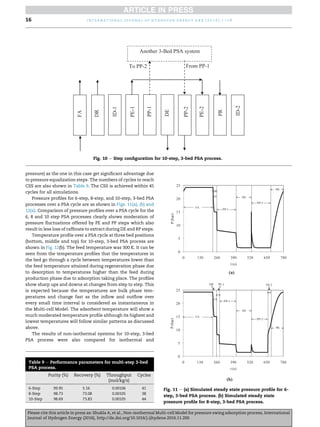
Separation performances were compared for 6-step, 8-
step, and 10-step, 3-bed PSA processes for same feed
mixture, desired product, total cycle time, bed design. This
helps in judging the relative importance of the various addi-
tional PSA steps on performance parameters, especially purity
and recovery. The 6-step PSA includes provided purge (PP)
step. The 8-step PSA includes PE as well as PP steps. In the 10-
step PSA process, we have included two short duration incu-
bation (ID) steps. Implementation of the PP step in all the three
PSA processes requires bed effluent from one bed to purge
another bed rather than using collected raffinate for the pur-
pose. For the given PSA cycle configurations, it was not
possible to use a bed in a 3-bed system to implement PP step
involving another concurrent step happening in another bed
of the same 3-bed system. A suitable bed in another identical
3-bed system is required to be used for this purpose. This
other 3-bed system follows the same PSA cycle, but with a
suitable time lag. Technically, the PSA system thus becomes a
6-bed system. This is very common in Hydrogen PSA in-
stallations. We have preferred to call it a 3-bed PSA because
the second 3-bed system essentially follows the same PSA
cycle as the first PSA system. The two 3-bed systems interact
with each other only during the PP step.
FA and DR steps in production phase collect the raffinate in
raffinate tank. PE-1 step follows the DE step. In this step, the
bed pressure is reduced and equalizes with another bed at
higher pressure operating PE-2 step. The PP step is imple-
mented on beds in one 3-bed system with a bed operating RP
step in another 3-bed PSA system. Effectively, one bed in one
system is undergoing co-current depressurization with the
effluent counter-currently purging another bed in another
system. The implementation thus called for topetop
connection of two beds in two systems.
The PE and PP steps require direct connection of two
adsorbent systems. This was achieved in simulation by con-
structing a ‘double’ bed by suitably connecting the cascade of
Z-cells in one bed to a cascade of Z-cells in another bed. This
double bed thus has double the number of Z-cells (2m). The
distribution matrix will thus be double the size and its gen-
eration is that much more involved. The conceptual approach
however remains the same as was discussed earlier.
Table 6 e Performance of PSA process at steady state for Non-isothermal system.
Steps CH4 CO2 H2
Reported work [7] This work Reported work [7] This work Reported work [7] This work
FA 0.1 0.2 0 0 99.9 99.8
DR-1 3.0 10.8 0.1 0.3 96.9 88.9
DR-2 89.9 82.3 0.6 6.1 9.5 11.6
DE 37.6 37.3 54.6 53.4 7.8 9.3
RP 37.6 37.3 54.6 53.4 7.8 9.3
(b)
(a)
280
290
300
310
320
330
0 310 620 930
T(K)
t (s)
L = 0.0 m
L = 0.3 m
L = 0.6 m
L =
L =
L =
=
=
=
0.0 m
0.3 m
0.6 m
FA DR-1 DR-2 DE RP
CP
0
5
10
15
20
25
0 310 620 930
P(bar)
t (s)
This Work
Reported Work [7]
FA
DR-1
DR-2
DE
RP
CP
Fig. 7 e (a) Comparison of experimental and simulated
pressure profiles at CSS. (b) Steady state simulated
temperature profile against time at various bed positions.
Table 7 e Adsorbenteadsorbate properties for 5-
components, 3-bed PSA process.
Parameter CH4 CO2 CO N2 H2
yfeed
(mole fraction) 0.005 0.015 0.01 0.02 0.95
b (m3
/mol) 0.0007 0.1 0.04 0.009 0.00008
kLDF
(sÀ1
) 0.001 0.00158 0.002 0.0025 0.003
qs
(mol/m3
) 2100 3510 3750 3920 4150
DH (J/mol) 35,119 14,350 8433 7817 246,400
i n t e r n a t i o n a l j o u r n a l o f h y d r o g e n e n e r g y x x x ( 2 0 1 6 ) 1 e1 814
Please cite this article in press as: Shukla A, et al., Non-isothermal Multi-cell Model for pressure swing adsorption process, International
Journal of Hydrogen Energy (2016), http://dx.doi.org/10.1016/j.ijhydene.2016.11.200
The PSA cycle configuration of 6-step, 3-bed PSA process is
as shown in Fig. 8. The production phase consists of FA and DR
steps. The regeneration phase consists of PP-1, DE, PP-2, and
PR steps. The 8-step, 3-bed PSA process consists of FA and DR
steps in production phase and PE-1, PP-1, DE, PP-2, PE-2, PR
steps in regeneration phase as shown in Fig. 9. The PE-1 step
has counter-current flow causing de-pressurization in the
bed. In this step, the bed will connect to another low-pressure
bed that will get pressurized. In 10-step, 3-bed PSA process, ID
steps are additional steps considered as shown in Fig. 10. ID-1
is a part of production phase after DR step whereas ID-2 is a
part of regeneration phase after PR step. In the figure, the ID
steps are not designated to avoid cluttering. However, these
can be seen as bands between corresponding steps on either
side.
For comparison of the three different PSA cycle configu-
rations, the tank pressures, valve co-efficient of all the valves
of each bed necessary for effective implementation of all steps
are kept constant. In addition, the duration for FA step is kept
constant i.e. 230 s in all the 3 PSA cycles.
The performance parameters for the same are shown in
Table 9. The performance parameters presented in the table
are calculated using equations explained above. A low recov-
ery of 5.16% with 6-step, 3-bed PSA process can be attributed
to the high amount of gas that is discharged in extract tank
during DE and PP-2 steps. The high recovery can be obtained if
the purge-out valve co-efficient is adjusted to prevent exces-
sive release of gas in bulk phase in adsorbent bed to extract
tank. It is expected that the addition of PE step before the
blowdown step will reduce amount of blowdown as bed
pressure is moderated. This will improve recovery. The high
recovery of 73.8% for 8-step, 3-bed PSA process indicates this.
The jump in recovery is achieved with a marginal drop in
purity, which is now 98.73%. PSA processes with high-
pressure ratio (ratio of feed pressure to extract tank
Fig. 9 e Step configuration for 8-step, 3-bed PSA process.
Table 8 e Model inputs for 5-components, 3-bed PSA
process.
Parameters 6-Step 8-Step 10-Step
Inner diameter of bed (m) 1 1 1
Adsorbent layer height (m) 4 4 4
Duration of FA step, tFA
(s) 230 230 230
Duration of DR step, tDR
(s) 30 30 25
Duration of ID-1 step, tID-1
(s) e e 5
Duration of PE-1 step, tPE-1
(s) e 20 20
Duration of PP-1 step, tPP-1
(s) 150 130 130
Duration of DE step, tDE
(s) 120 120 120
Duration of PP-2 step, tPP-2
(s) 150 130 130
Duration of PE-2 step, tPE-2
(s) 20 20
Duration of PR step, tPR
(s) 100 100 95
Duration of ID-2 step, tID-2
(s) e e 5
Feed valve coefficient ðCfeed
v Þ 0.000055 0.000055 0.000055
Raffinate valve coefficient
in FA step ðCr
vÞ
0.00035 0.00035 0.00035
Raffinate valve coefficient
in DR step ðCr
vÞ
0.0005 0.0005 0.0005
Extract valve
coefficient ðCextract
v Þ
0.0008 0.0008 0.0008
Purge in valve
coefficient ðCpurgein
v Þ
0.000001 e e
Purge out valve
coefficient ðCpurgeout
v Þ
0.000008 0.000008 0.000008
Bed voidage, ε 0.5 0.5 0.5
Feed tank pressure, Pfeed
(bar) 25 25 25
Raffinate tank pressure in
FA step, Pr
(bar)
24 24 24
Raffinate tank pressure in
DR step, Pr
(bar)
15 15 15
Purge tank pressure,
Ppurgein
, (bar)
5 5 5
Purge tank pressure,
Ppurgeout
, (bar)
1.5 1.5 1.5
Extract tank pressure,
Pextract
(bar)
1.5 1.5 1.5
Feed Inlet Temperature (K) 300 300 300
Total cycle time (s) 780 780 780
Density of gas mixture
at 1bar (kg/m3
)
0.095 0.095 0.095
Density of adsorbent
particle (kg/m3
)
850 850 850
CPg (J/mol K) 35 35 35
CPads (J/kg K) 1260 1260 1260
Ubulk (J/m2
K s) 20 20 20
Uamb (J/m2
K s) 5 5 5
Fig. 8 e Step configuration for 6-step, 3-bed PSA process.
i n t e r n a t i o n a l j o u r n a l o f h y d r o g e n e n e r g y x x x ( 2 0 1 6 ) 1 e1 8 15
Please cite this article in press as: Shukla A, et al., Non-isothermal Multi-cell Model for pressure swing adsorption process, International
Journal of Hydrogen Energy (2016), http://dx.doi.org/10.1016/j.ijhydene.2016.11.200
pressure) as the one in this case get significant advantage due
to pressure equalization steps. The numbers of cycles to reach
CSS are also shown in Table 9. The CSS is achieved within 45
cycles for all simulations.
Pressure profiles for 6-step, 8-step, and 10-step, 3-bed PSA
processes over a PSA cycle are as shown in Figs. 11(a), (b) and
12(a). Comparison of pressure profiles over a PSA cycle for the
6, 8 and 10 step PSA processes clearly shows moderation of
pressure fluctuations offered by PE and PP steps which also
result in less loss of raffinate to extract during DE and RP steps.
Temperature profile over a PSA cycle at three bed positions
(bottom, middle and top) for 10-step, 3-bed PSA process are
shown in Fig. 12(b). The feed temperature was 300 K. It can be
seen from the temperature profiles that the temperatures in
the bed go through a cycle between temperatures lower than
the feed temperature attained during regeneration phase due
to desorption to temperatures higher than the feed during
production phase due to adsorption taking place. The profiles
show sharp ups and downs at changes from step to step. This
is expected because the temperatures are bulk phase tem-
peratures and change fast as the inflow and outflow over
every small time interval is considered as instantaneous in
the Multi-cell Model. The adsorbent temperature will show a
much moderated temperature profile although its highest and
lowest temperatures will follow similar patterns as discussed
above.
The results of non-isothermal systems for 10-step, 3-bed
PSA process were also compared for isothermal and
Fig. 10 e Step configuration for 10-step, 3-bed PSA process.
Table 9 e Performance parameters for multi-step 3-bed
PSA process.
Purity (%) Recovery (%) Throughput
(mol/kg/s)
Cycles
6-Step 99.95 5.16 0.00106 41
8-Step 98.73 73.08 0.00105 38
10-Step 98.69 73.83 0.00105 44
0
5
10
15
20
25
0 130 260 390 520 650 780
P(bar)
t (s)
FA
DR
PP-1
DE
PP-2
PR
0
5
10
15
20
25
0 130 260 390 520 650 780
P(bar)
t (s)
DR PE-1 PE-2
FA
PP-1
DE
PP-2
PR
(a)
(b)
Fig. 11 e (a) Simulated steady state pressure profile for 6-
step, 3-bed PSA process. (b) Simulated steady state
pressure profile for 8-step, 3-bed PSA process.
i n t e r n a t i o n a l j o u r n a l o f h y d r o g e n e n e r g y x x x ( 2 0 1 6 ) 1 e1 816
Please cite this article in press as: Shukla A, et al., Non-isothermal Multi-cell Model for pressure swing adsorption process, International
Journal of Hydrogen Energy (2016), http://dx.doi.org/10.1016/j.ijhydene.2016.11.200
adiabatic conditions as shown in Table 10. The objective was
to study the impact of making isothermality assumption so
commonly resorted to and justified by saying that it is a
reasonable assumption due to low heat effects associated
with physical adsorption. The results in the present case show
that the simulated performance, especially the recovery could
be significantly different depending on whether isothermal or
non-isothermal models are used. There was not much dif-
ference between non-isothermal models allowing heat
exchange with ambient through bed wall or considering
adiabatic operation (bed is insulated). This is understandable
because feed temperature was taken the same as the ambient
temperature in the simulation resulting in minimal heat
transfer between bed walls and ambient.
The results make a strong case for incorporating heat ef-
fects of adsorption/desorption in any PSA process modeling,
as there are significant temperature fluctuations in the bed
even over a cycle. With the Multi-cell Model, which decouples
hydrodynamics from adsorption/desorption effectively, it is
possible to consider non-isothermality without any additional
burden on computation. We observed that about 50% more
computational time was required for achieving CSS with non-
isothermal model as compared to corresponding isothermal
model. However, as seen earlier, the computational effort for
the Multi-cell Model is less by a factor of about 60 as compared
to the rigorous model. Therefore, the Multi-cell Model brings
the handling of non-isothermality within the realm of
practicality.
0
5
10
15
20
25
0 130 260 390 520 650 780
P(bar)
t (s)
PE-2DR PE-1
FA
PP-1
DE
PP-2
PR
294
296
298
300
302
304
306
0 130 260 390 520 650 780
T(K)
t (s)
L = 0 m
L = 2 m
L = 4 m
L = 0 m
L = 2 m
L = 4 m
FA
DR PE-1
PP-1 DE PP-2
PE-2
PR
(a)
(b)
Fig. 12 e (a) Simulated steady state pressure profile for 10-step, 3-bed PSA process. (b) Steady state simulated temperature
profile for 10-step, 3-bed PSA process.
Table 10 e Simulated performance parameters for
Isothermal, Non-isothermal and Adiabatic conditions for
10-step, 3-bed PSA process.
Conditions Purity (%) Recovery (%) Throughput
(mol/kg/s)
Cycles
to CSS
Isothermal 99.21 59.05 0.00104 22
Non-isothermal 98.69 73.83 0.00106 44
Adiabatic 98.68 74.19 0.00104 46
i n t e r n a t i o n a l j o u r n a l o f h y d r o g e n e n e r g y x x x ( 2 0 1 6 ) 1 e1 8 17
Please cite this article in press as: Shukla A, et al., Non-isothermal Multi-cell Model for pressure swing adsorption process, International
Journal of Hydrogen Energy (2016), http://dx.doi.org/10.1016/j.ijhydene.2016.11.200
Conclusions
Multi-cell Model for multi-component separation, especially
H2 purification, is studied. Representative calculation steps for
one finite difference time step in one of the PSA steps over a
finite difference step along the bed are presented. The simu-
lation model is validated with reported results of isothermal
and non-isothermal experimental and simulation studies.
The comparison indicates that the model does capture es-
sentials of a complex PSA process and predicts the relevant
performance parameters such as product purity and recovery
reasonably well. The computational time was less by a factor
of 60 as compared to reported rigorous models.
A five-component system for recovery of Hydrogen using
6-step, 8-step and 10-step, 3-bed PSA processes was studied. It
was mainly to study and quantify the importance of minor
steps such as pressure equalization, provided purge and in-
cubation on process performance. The impact on purity was
observed to be marginal whereas the impact on recovery is
significant.
The temperature profile for 10-step, 3-bed PSA process for
three locations in the bed gave an understanding about the
thermal effects due to adsorption/desorption. From the re-
sults, it can be seen that even in the case of physical adsorp-
tion, temperature increase/decrease in the beds is significant
and affects recovery significantly. Incorporation of non-
isothermal effects in simulation and simulation-based
design is achievable using the Multi-cell Model as process
simulation due to its minimal computational footprint as
compared to other rigorous models.
r e f e r e n c e s
[1] Xiao J, Peng Y, Benard P, Chahine R. Thermal effects on
breakthrough curves of pressure swing adsorption for
hydrogen purification. Int J Hydrogen Energy
2016;41:8236e45. http://dx.doi.org/10.1016/
j.ijhydene.2015.11.126.
[2] Cen P, Yang RT. Bulk gas separation by pressure swing
adsorption. Ind Eng Chem Fundam 1986;25:758e67. http://
dx.doi.org/10.1021/i100024a047.
[3] Xiao J, Li R, Benard P, Chahine R. Heat and mass transfer
model of multicomponent adsorption system for hydrogen
purification. Int J Hydrogen Energy 2015;40:4794e803. http://
dx.doi.org/10.1016/j.ijhydene.2015.02.042.
[4] You YW, Lee DG, Yoon KY, Moon DK, Kim SM, Lee CH. H2 PSA
purifier for CO removal from hydrogen mixtures. Int J
Hydrogen Energy 2012;37:18175e86. http://dx.doi.org/
10.1016/j.ijhydene.2012.09.044.
[5] Papadias DD, Ahmed S, Kumar R, Joseck F. Hydrogen quality
for fuel-cell vehicles-A modeling study of the sensitivity of
impurity content in hydrogen to the process variables in the
SMR-PSA pathway. Int J Hydrogen Energy 2009;34:6021e35.
http://dx.doi.org/10.1016/j.ijhydene.2009.06.026.
[6] Ruthven DM, Farooq S. Air separation by pressure swing
adsorption. Gas Sep Purif 1990;4:141e8. http://dx.doi.org/
10.1016/0950-4214(90)80016-E.
[7] Doong SJ, Yang RT. Bulk separation of multicomponent gas
mixtures by pressure swing adsorption: Pore/surface
diffusion and equilibrium models. AIChE J 1986;32:397e410.
http://dx.doi.org/10.1002/aic.690320306.
[8] Yang J, Lee C. Adsorption dynamics of a layered bed PSA for
H2 recovery from coke oven gas. AIChE J 1998;44:1325e34.
http://dx.doi.org/10.1016/S0140-6701(99)97697-X.
[9] Banu A, Friedrich D, Brandani S, Du T. A multiscale study of
MOFs as Adsorbents in H2 PSA purification. Ind Eng Chem
Res 2013;52:9946e57. http://dx.doi.org/10.1021/ie4011035.
[10] Caldwett SJ, Duri BA, Sun N, Sun CG, Snape CE, Li K, et al.
Carbon di-oxide separation from nitrogen hydrogen
mixtures over activated carbon beads: adsorption isotherms
and breakthrough studies. Energy Fuels 2015;29:3796e807.
http://dx.doi.org/10.1021/acs.energyfuels.5b00164.
[11] Lopes FVS, Grande CA, Rodrigues AE. Activated carbon for
hydrogen purification by pressure swing adsorption:
Multicomponent breakthrough curves and {PSA}
performance. Chem Eng Sci 2011;66:303e17. http://
dx.doi.org/10.1016/j.ces.2010.10.034.
[12] Mhaskar PR, Peter SA, Moharir AS. Generic mathematical
model for PSA process. Chem Prod Process Model 2012;7.
http://dx.doi.org/10.1515/1934-2659.1574.
[13] Sahoo S. Simulation-based design of pressure swing
adsorption process. Indian Institute of Technology Bombay;
2016.
[14] Luberti M, Friedrich D, Brandani S, Ahn H. Design of a H2 PSA
for cogeneration of ultrapure hydrogen and power at an
advanced integrated gasification combined cycle with pre-
combustion capture. Adsorption 2014;20:511e24. http://
dx.doi.org/10.1007/s10450-013-9598-0.
[15] Rajsree R, Moharir AS. Simulation based synthesis, design
and optimization of pressure swing adsorption (PSA)
processes. Comput Chem Eng 2000;24:2493e505. http://
dx.doi.org/10.1016/s0098-1354(00)00606-2.
[16] Yang J, Lee C. Separation of hydrogen mixtures by a two-bed
pressure swing adsorption process using zeolite 5A. Ind. Eng.
Chem. Res 1997;36:2789e98. http://dx.doi.org/10.1021/
ie960728h.
[17] Glueckauf E. Theory of chromatography. Part 10.-Formulae
for diffusion into spheres and their application to
chromatography. Trans Faraday Soc 1955;51:1540e51. http://
dx.doi.org/10.1039/TF9555101540.
i n t e r n a t i o n a l j o u r n a l o f h y d r o g e n e n e r g y x x x ( 2 0 1 6 ) 1 e1 818
Please cite this article in press as: Shukla A, et al., Non-isothermal Multi-cell Model for pressure swing adsorption process, International
Journal of Hydrogen Energy (2016), http://dx.doi.org/10.1016/j.ijhydene.2016.11.200

HydrogenPSA

  • 1.
    Non-isothermal Multi-cell Modelfor pressure swing adsorption process Anshu Shukla, Satyanjay Sahoo, Arun S. Moharir* Department of Chemical Engineering, Indian Institute of Technology Bombay, Mumbai, 400076, India a r t i c l e i n f o Article history: Received 2 September 2016 Received in revised form 29 November 2016 Accepted 30 November 2016 Available online xxx Keywords: PSA process Multi-cell Model Multi-component system Non-isothermal effects Hydrogen purification a b s t r a c t In the present study, a comprehensive generic model is developed for pressure swing adsorption process. The model overcomes the inadequacy related to frozen solid concept, isothermality assumption etc. and treats them as per physics of adsorption as well as hydrodynamics. Results are presented to show that there is significant adsorption/ desorption during pressure changing steps (pressurization, blowdown), which in turn has significant effect on process performance. Hydrogen pressure swing adsorption process demands high purity and recovery, which can be achieved by complex cycle configuration. It has been used as a case study. The model is validated using the reported simulation/ experimental data to the extent possible. The present study reports separation of Hydrogen from five-component mixture using a six-bed process. The dynamics of the process were studied and are presented incorporating non-isothermal effects. The model is easily adaptable to different adsorption/desorption kinetics and thermodynamics due to its effective decoupling of bed hydrodynamics from adsorption/desorption. © 2016 Hydrogen Energy Publications LLC. Published by Elsevier Ltd. All rights reserved. Introduction Adsorptive separation technologies have found a very wide application base. Considering the separation objectives, wide ranges of process variations have been established for use on commercial scale. The various adsorption processes for gas phase separation are Temperature Swing Adsorption (TSA), Thermal Pressure Swing Adsorption (TPSA), and Pressure Swing Adsorption (PSA) [1]. PSA is widely used because of its advantages like low energy requirement and capital invest- ment cost up to a certain scale of operation. Like all adsorptive separations, the PSA process is also discrete-continuous in nature and several cycles are required to attain Cyclic Steady State (CSS) performance. Literature reports experimental and theoretical studies for several industrially important gaseous separations using PSA process. Hydrogen purification is possibly the most major and widely used PSA process in terms of its scale [2]. A one dimensional model on Comsol platform for multi-component system for Hydrogen purification is re- ported by Xiao et al. [3]. Few researchers report modeling approach for PSA process for high purity hydrogen for fuel cell application [4,5]. Air drying, Air separation to get enriched oxygen or nitrogen are other two widely used techniques [6]. Most PSA processes give one desired product richer in one of the feed components. PSA processes where more than one components of the feed are sought to be enriched are rare. Cen and Yang reported bulk separation of equimolar mixture of Methane (CH4) and Hydrogen (H2) using a 5-step PSA process [2]. The five cyclic steps include pressurization, adsorption, co-current depressurization, counter current depressurization and purge. They report 90% purity for both * Corresponding author. Fax: þ91 22 2572 6895. E-mail address: amoharir@iitb.ac.in (A.S. Moharir). Available online at www.sciencedirect.com ScienceDirect journal homepage: www.elsevier.com/locate/he i n t e r n a t i o n a l j o u r n a l o f h y d r o g e n e n e r g y x x x ( 2 0 1 6 ) 1 e1 8 http://dx.doi.org/10.1016/j.ijhydene.2016.11.200 0360-3199/© 2016 Hydrogen Energy Publications LLC. Published by Elsevier Ltd. All rights reserved. Please cite this article in press as: Shukla A, et al., Non-isothermal Multi-cell Model for pressure swing adsorption process, International Journal of Hydrogen Energy (2016), http://dx.doi.org/10.1016/j.ijhydene.2016.11.200
  • 2.
    Nomenclatures AP Specific surfacearea of the adsorbent particle, m2 / kg b Langmuir isotherm parameter of each component, m3 /mol bref Langmuir isotherm parameter at a reference temperature of each component, used in the calculation of ‘b’ at any given temperature, m3 / mol Cpads Heat transfer coefficient of adsorbents, J/kg K Cpg Heat transfer coefficient of gas mixture, J/mol K Cin v Valve coefficient of the inlet valve Cout v Valve coefficient of the outlet valve db Diameter of bed, m dp Diameter of adsorbent particle, m D Distribution coefficient D Diffusivity of component, used in Eq. (34), m2 /s Hamb bulk Heat loss to bulk phase, J Hamb Loss Heat loss to ambient, J Hgen Heat generated in the adsorbent due to adsorption/desorption, J/mol kLDF LDF coefficient of each component, 1/s Lfeed Height of feed in the bed, m L Height of adsorbent layer, m mads Mass of the adsorbent present in the bed, kg m Number of cells in the bed M Number of temporal nodes n Number of components in the feed mixture Nin Number of moles entering the bed through inlet valve, gmol Nout Number of moles exiting the bed through outlet valve, gmol N Number of moles present in each cell, gmol P* Pressure in the bed after IBPE, Pa Pin Pressure of the inlet tank, Pa Pout Pressure of the outlet tank, Pa Ptank Pressure of gas in a tank, Pa P Pressure in a cell, Pa q* Equilibrium concentration at the surface of the particle, mol/m3 qs Monolayer saturation capacity of each component, mol/m3 q Adsorbate concentration in adsorbent particle, mol/m3 R Universal gas constant, J/mol K tcycle Total cycle time of a PSA cycle, s tstep Duration of a PSA step, s Tin Temperature of the inlet stream, K Tr Temperature of the raffinate stream, K Tads Adsorbed phase temperature in each cell, K Tbulk Bulk phase temperature in each cell, K Tref Reference temperature at which ‘bref’ is given, K u Velocity of inlet and outlet stream, m/s Uamb Heat transfer coefficient for bed to ambient heat transfer, J/m2 K s Ubulk Heat transfer coefficient for adsorbed to bulk phase, J/m2 K s Vin Volume of the inlet stream, m3 Vout Volume of the outlet stream, m3 Vads Volume of the adsorbent in the bed, m3 Vbulk Volume of the bulk phase in the bed, m3 yr Mole fraction in raffinate stream y Mole fraction in bulk phase Greek symbol g Cycle index, used in Eqs. (33a)e(33d) DH Heat of adsorption, J/mol DL Height of L-cell, m Dq Change in moles in the adsorbent due to adsorption/desorption, mol/m3 Dt Step time, s DTads Change in adsorbent temperature, K DTbulk Change in bulk phase temperature, K DZ Height of Z-cell, m ε Bed porosity rmix Density of the fluid mixture, kg/m3 rp Density of the adsorbent particle, kg/m3 f Cross-sectional area of the bed, m2 J Surface area of the bed, m2 Subscripts and superscripts amb Ambient bulk Bulk phase extract Extract stream feed Feed stream i Index for component in Inlet stream j Index for temporal position k Index for cells in the bed out Outlet stream purgein Purge in stream purgeout Purge out stream r Raffinate stream Abbreviations CMS Carbon Molecular Sieve CP Counter-current Pressurization step with a customized stream CSS Cyclic Steady State DE Desorption to Extract DR Desorption to Raffinate FA Feed Adsorption ID Incubation or Idle PE Pressure Equalization PF Pressurization with Feed PP Provide Purge PR Pressurization with Raffinate RP Raffinate Purge i n t e r n a t i o n a l j o u r n a l o f h y d r o g e n e n e r g y x x x ( 2 0 1 6 ) 1 e1 82 Please cite this article in press as: Shukla A, et al., Non-isothermal Multi-cell Model for pressure swing adsorption process, International Journal of Hydrogen Energy (2016), http://dx.doi.org/10.1016/j.ijhydene.2016.11.200
  • 3.
    the products. Theyconcluded purge step to be an essential step for achieving hydrogen purity and that pressurization with H2 is more effective than pressurization with feed. The purity of CH4 depends mainly on co-current depressurization. With the increase in the commercial applications of PSA process, it was realized that the process is not limited to separation of binary components and can be extended to separation of multi-component gas mixtures. Doong and Yang reported separation of ternary mixture (H2/CH4/CO2) over activated carbon as adsorbent [7]. They restricted the studies to five cyclic steps. Effect of various parameters such as pressure, temperature, size of adsorbent particle and flow-rate were studied. They concluded that Knudsen as well as surface diffusion governs the mass transfer rates and reported that the simulation results are comparable with experimental results. The surface diffusion flux plays an important role and is able to predict correct dy- namics in the bed. Yang and Lee reported requirement of multi-layered adsorbent bed PSA process for H2 recovery since single adsorbent in the bed is unable to offer high purity for this multi-component system [8]. The advantages include selec- tivity for certain components of the feed to be removed and prevention of any feed component getting adsorbed in an adsorbent which displays very non-linear adsorption isotherm and makes desorption of the same very difficult. Difficulty in removing the adsorbed component during regeneration steps can affect process performance drastically. PSA technology for purification of Hydrogen often uses an adsorbent bed with three different adsorbents stacked in three layers in each adsorbent bed due to this consideration. Selectivity, high adsorption capacity and ease of desorption are all important aspects for commercial success of any PSA process. Adsorbent development and process design have to keep all these aspects in mind. The recent research on PSA process is mostly on adsor- bents. Literature reports use of adsorbents like polymeric hollow fiber for CO2 capture. Use of MOF's for H2 purification is also reported by Banu and co-workers [9]. PSA is often modeled as an isothermal process. Heat effects in the bed due to exothermic adsorption are generally ignored. This is a reasonable simplification if the component being removed adsorb sparingly or is present in the feed in smaller pro- portions or the heat of adsorption is not very significant. The heat effect studies are important especially for systems, which do not satisfy these criteria. H2 purification is one such system where temperature rise can affect the adsorption pa- rameters significantly. Several authors have reported break- through studies for hydrogen separation with heat effects in the adsorbent bed [1,8,10,11]. Although the PSA process is discrete-continuous in nature, two or more beds are employed to ensure that the product is produced continuously from one of the beds at any time. Literature reports use of 2, 3 or even more beds, depending on the relative ease of adsorption/desorption. This often is gov- erned by the nature of adsorption thermodynamics. Non- linear the adsorption isotherm is, more difficult is desorp- tion as compared to adsorption and more is the required time for bed regeneration after the productive adsorption step. This in turn will entail use of more than 2 adsorbent beds, with one undergoing adsorption and others undergoing various stages of desorption. The sequence of the steps in the adsorbent bed has to be synchronized for continuous production of the desired product stream. For PSA process, valves, which let the gas in or out of the bed, play an important role. Although the valves are mostly of on-off type, authors have studied and reported importance of using flow control valves with the percentage opening of the valves changing with time to implement optimum flow pro- files [12]. PSA process involves several steps to achieve desired process performance. The various steps are pressurization, feed adsorption, co-current depressurization, counter current depressurization, purge, pressure equalization, counter cur- rent pressurization, and incubation/idle. Non-isothermal Multi-cell Model is reported in the present study for PSA process to understand the heat effects involved during the various PSA process steps and their overall impact on process performance. A Multi-cell Model for isothermal PSA process has been discussed earlier [13]. The model is extended here to incorporate heat effects of adsorption/ desorption as well as heat loss-gain from bed walls. The model was also extended to support additional PSA steps such as pressure equalization, provided purge (used in many H2 PSA processes). With this, the model could compare its predictions with reported experimental results in the literature as well as alternative modeling approaches. The present model is vali- dated for isothermal and non-isothermal systems [7,12,13]. The values of Langmuir adsorption parameter (b) and mono- layer saturation capacities (qs ) are calculated from the adsorption isotherm reported in the literature [8]. The values of “b” and “qs ” were used in Extended Langmuir (EL) Isotherm to describe adsorption thermodynamics. Linear Driving Force Model (LDFM) was used to describe mass transfer rate. Multi-cell PSA model Industrial PSA processes consist of complex cyclic steps such as pressurization, adsorption, co-current depressurization, countercurrent depressurization, purge, pressure equaliza- tion, and counter current pressurization. The significance and purpose of the steps is widely discussed in the literature [7,12,13]. These and more steps are supported by our modeling approach. The steps are discussed here in brief. In the pressurization step, the bed is pressurized either with feed or with desired product component. In the adsorp- tion step, feed enters the bed and effluent obtained is richer in the desired component than in the feed. This is also called as raffinate product. To recover more such raffinate product, co- current depressurization step follows feed adsorption step. In this step, the feed valve is closed and bed is allowed to depressurize into the raffinate tank. At the end of this step, the bed does not have capacity to adsorb the undesired compo- nents from the feed and must be regenerated. For this, the bed is depressurized in counter current direction to recover strongly adsorbed component as another product stream. This stream is richer in the undesired components than the feed stream and is called as extract stream. This step is often called as blowdown or counter current depressurization step. The bed is partly regenerated in this step as the undesired i n t e r n a t i o n a l j o u r n a l o f h y d r o g e n e n e r g y x x x ( 2 0 1 6 ) 1 e1 8 3 Please cite this article in press as: Shukla A, et al., Non-isothermal Multi-cell Model for pressure swing adsorption process, International Journal of Hydrogen Energy (2016), http://dx.doi.org/10.1016/j.ijhydene.2016.11.200
  • 4.
    component in thebulk phase of the bed and is mostly recov- ered as the extract stream. Part of the undesired components that were adsorbed in the adsorbent during earlier steps also desorbs because low-pressure favors desorption. As a finish- ing or cleaning step to further regenerate the bed, purge step is used after the blowdown step. In this step, part of the raffinate is allowed to flow through the bed in counter current direction to the feed to collect more extract stream. The bed is then pressurized with raffinate stream in counter current direction. This fills the raffinate end of the bed with previously collected raffinate and simultaneously pressurizes it. The bed is now ready to undergo next PSA cycle starting with feed pressuri- zation. Additional steps in more recent PSA processes have also been reported [14]. These steps are conceived to improve both purity and recovery. Some of these steps also reduce energy footprint of separation by PSA. In addition to these steps, incubation or idle step is used, where all the valves of a bed are closed. This step is mainly provides finite time in- tervals between the production and regeneration parts of the bed to take into account finite time taken by any valve to close or open. Without these short duration incubation steps, there is a possibility of feed short-circuiting into product lines, thereby degrading product purity. The pressure equalization steps mainly are energy saving steps. In pressure equalization step, the high and low-pressure adsorbent beds are connected through a valve. One of the possibilities can be where the connection is topetop, which means raffinate end of the two adsorbent beds are connected through a valve. The second possibility can be top-bottom; meaning the raffinate end of high-pressure adsorbent bed is connected with the feed (also extract) end of the low-pressure adsorbent bed through a valve. The third possibility can be the bottomebottom, meaning feed ends of both the beds are connected through a valve. The fourth possibility can be bottom-top where feed end of high-pressure bed is connected with the raffinate end of the low-pressure bed. Topetop connection during pressure equalization step is more common than the other alterna- tives. Apart from acting as an energy saving step, the pressure equalization step also reduces the losses that occur during blowdown step and consequently increases the recovery of the desired product. Several simulation models assume that the adsorbent in the beds involved in these steps are ‘frozen’ during the steps and that there is no mass transfer between the adsorbed and bulk phase. This is however not true and the beds are fully ‘active’ during these steps and significant adsorption/desorption occurs having direct impact on product purity. The present model, therefore, supports phenomeno- logical capture of the events during these steps. Another step, the provided purge step is incorporated in some PSA processes, especially some designs of Hydrogen PSA, to improve raffinate product (enriched hydrogen) purity. In this step, the bed with high pressure is connected to the bed with lower pressure as in the pressure equalization step, but with the extract valve of the low-pressure bed open. The discharge from the lower pressure bed contributes to the extract stream, or even collects as second extract streams that depend on the requirement. This step helps in effectively purging the bed without having to use raffinate for the pur- pose. The step simultaneously improves raffinate purity as well as recovery. This is one of the few parameters in a PSA process that favorably affects purity and recovery both. Most other measures give higher purity at the cost of recovery and vice versa. Our model supports this step also. For brevity, the acronyms used in the present study are PF, FA, DE, DR, RP, PR, PE, PP, CP and ID for Pressurization with Feed, Feed Adsorption, Desorption to Extract, Desorption to Raffinate, Raffinate Purge, Pressurization with Raffinate, Pressure Equalization, Provided Purge, Counter current Pressurization and Idle (Incubation) respectively. Description of Multi-cell Model Rajasree et al. have discussed one of the possibilities for PSA process model to overcome the disadvantages associated with frozen solid concept in pressure changing steps [15]. In gen- eral, there are two distinct phenomena happening in the bed at any time. There is convective flow due to pressure differ- ential between the two ends of the bed connected to tanks at different pressures and simultaneous adsorption/desorption between the bulk phase at any location in the bed and the adsorbent at that location. These two phenomena occur at quite different speeds with the convective flow happening much faster than the adsorptionedesorption. Rajasree et al. assumed instantaneous response to pressure differential causing convective flow at the beginning of every step fol- lowed by continuous adsorption/desorption over the time step [15]. The difference between the two time scales is stretched to the extreme by shrinking the convective flow due to pres- sure differential happening instantaneously. The Multi-cell Model carries this concept forward systematically as follows. A PSA process could employ several beds, two and three bed processes being quite common. However, each bed goes through an identical sequence of steps as discussed above with a phase lag with the other beds. Therefore, it suffices to consider the steps implemented over one of the beds to get the overall process performance at the cyclic steady state. Fig. 1 show a representative packed bed connected to various tanks through valves. Valve V1 connects the feed tank and adsorbent bed. Valve V2 connects the extract tank and adsorbent bed. Similarly, Valves V3 and V4 connect the adsorbent bed with purge tank and raffinate tank respectively. Valves used for bed-to-bed connections as required in pres- sure equalization and provided purge steps are not shown explicitly in the figure. These valves are presumed to provide the necessary flow connectivity between the two beds without causing any pressure drop due to flow across the valves. Valves play an important role in any PSA process and the flow exchange between the bed and a tank is governed entirely by the pressure differential between the tank pressure and the pressure at the bed end connected to the valve. These flow rates are calculated using standard valve equations involving valve coefficients. To implement any of the PSA cycle steps discussed earlier, except the PE and PP steps, two valves each at the bottom and the top of the bed are sufficient. Such a simplified view of the bed is taken while explaining the salient features of the Multi- cell Model. Therefore, the bed in Fig. 1 has two valves (V1 and V2) at one end connected to two different tanks (say Feed Tank and Extract Tank) and two valves (V3 and V4) at the opposite end connected similarly to the same or two different tanks. i n t e r n a t i o n a l j o u r n a l o f h y d r o g e n e n e r g y x x x ( 2 0 1 6 ) 1 e1 84 Please cite this article in press as: Shukla A, et al., Non-isothermal Multi-cell Model for pressure swing adsorption process, International Journal of Hydrogen Energy (2016), http://dx.doi.org/10.1016/j.ijhydene.2016.11.200
  • 5.
    We have shownonly Raffinate tank also used as Purge tank in the figure. By suitably keeping none, one or more of these valves open, all PSA steps can be implemented (except PE and PP steps). Fig. 1 specifically shows the schematic of a bed during FA step of any PSA process. The closed valves are grayed for that purpose. With only valves connected to the Feed tank and Raffinate tank open, FA step is implemented. The schematic also shows the bed divided into ‘m’ slices (or cells) and the corresponding nomenclature for various state parameters of the cell such as pressure, temperatures in the bulk and adsorbed phases, mole fractions of individual species in the bulk phase and the adsorbed phase concentrations of the species. Each such axial cell or slice has static adsorbent in contact with the bulk phase in that cell. For better understanding of the model, we have chosen to call the adsorbent part of the cell as Z-cell and the bulk phase part as L-cell. The choice of nomenclature is simply because both Z and L are often used as nomenclature for the bed length. The difference between the Z-cells and L-cells is that while the former is static, the gas in the latter can move as feed enters and/or product leaves the bed. The gas in the L-cells can also move axially due to adsorptionedesorption which changes the net moles of gas in the L-cells and changes their pressure. This is what could happen even during the incubation step when there is no inflow of feed in or outflow of product. The Multi-cell Model works in principle as follows. The bed has certain known bulk and adsorbed phase concentration and temperature profiles as well as pressure profile at any point of time. What happens over the next incremental time step is visualized as taking place as a series of two distinct events. One of them is Instantaneous Bulk phase Pressure Equalization (IBPE) that happens at the beginning of the time step and the other is continuous adsorptionedesorption be- tween adsorbent and the bulk phase in contact with it. The gas moves only during the IBPE step. During this step, entire gas inflow that would take place over the time step is deemed to take place instantaneously. The amount of gas inflow is decided by the valve equation of the valve at the feed end of the bed that relates the flow rate to instantaneous difference between the valve upstream and downstream pressures at the beginning of the time step. Similarly, valve equation pertain- ing to the valve at the product end decides the amount of product gas that would instantaneously leave the bed. A mass balance decides the moles that remain in the bed. This gas in the bed is assumed to undergo instantaneous pressure equalization leaving a uniform pressure in the bed valid over the entire time step. The gas in the L-cells move as isolated gas plugs because of this inflow, outflow and pressure Fig. 1 e Schematic of an adsorbent bed with ‘m’ number of cells for FA step. i n t e r n a t i o n a l j o u r n a l o f h y d r o g e n e n e r g y x x x ( 2 0 1 6 ) 1 e1 8 5 Please cite this article in press as: Shukla A, et al., Non-isothermal Multi-cell Model for pressure swing adsorption process, International Journal of Hydrogen Energy (2016), http://dx.doi.org/10.1016/j.ijhydene.2016.11.200
  • 6.
    equalization during theIBPE. These gas plugs are considered to move as isolated plugs without intermingling. As a result of this movement, the bulk phase in contact with any Z-cell in the bed would be constituted by fractions of one or more gas plugs which represented gas in the L-cells inherited at the beginning of the step just before IBPE. Depending on the amount of feed that has entered and the volume it has occu- pied at the feed end of the bed after IBPE, it could also contribute entirely or partly to the bulk phase against any Z- cell. What constitutes bulk phase against any Z-cell is the new L-cell and its composition and temperature govern the adsorptionedesorption over the time step. Implementation of IBPE and definition of new L-cell composition and tempera- ture prior to adsorptionedesorption is an important part of the model. Once IBPE is implemented, the adsorp- tionedesorption in each Z-cell and the new L-cell in contact with it takes place independently and there is no axial bulk phase movement during this continuous part of the two-step approximation. Adsorptionedesorption changes the compo- sition and temperature of the adsorbed phase and bulk phase in each Z-cell and L-cell pair. The bulk phase pressure in each cell also changes depending on the net mass transfer between the adsorbed and bulk phases. The bed wall against each L-cell is assumed to be in thermal equilibrium with the L-cell. The heat transfer between the bed wall and the constant ambient temperature is also incorporated into the model if the bed is not insulated. The state of the Z-cells and L-cells at the end of all these phenomena over the time step is inherited as their initial state for implementing the next incremental time step. The heights of Z-cell 1, Z-cell 2 to Z-cell m are designated as DZ1 , DZ2 to DZm . Similarly, heights of L-cell 1, L-cell 2 to L-cell m are designated as DL1 , DL2 to DLm . As shown in Fig. 1, every L-cell has its own pressure, temperature and gas composition in terms of mole fractions and total number of moles. Simi- larly, each Z-cell will have its own adsorbed phase concen- tration and temperature. The adsorbent particle is considered to have a uniform temperature in any Z-cell. Thus, for L-cell 1 and Z-cell 1, the mole fraction of ith component, temperature, pressure, total number of moles, adsorbed phase concentra- tion of ith component and adsorbent temperature are desig- nated as y1 i;j; T1 bulk j P1 j ; N1 j ; q1 i; j; T1 ads j for jth time step. The mole fractions and adsorbed phase concentrations are for all components. Reconstitution of L-cells after IBPE step The IBPE step causes movement of feed gas into the bed, product gas out of the bed, and resultant movement of gas in the inherited L-cells. The bulk phase standing against each Z- cell will thus be constituted by fractions of gas in the inherited L-cells. The gas in the bulk phase against each Z-cell will attain new pressure, temperature and composition calculated as their mixed cup values after the composition of the cell in terms of various gas plugs contributing to it are known. What one needs to know is how the feed plug and the gas in inherited L-cells prior to IBPE distribute themselves in the various slices of the bed. This general distribution is quanti- tatively captured in the distribution matrix. The feed plug and the relocated gas plugs in inherited L-cells move in axial di- rection without intermingling as discussed earlier. After IBPE, what fractions of each such gas plug are against static phys- ical demarcations of the bed into ‘m’ cells are the information content of the distribution matrix. General structure and nomenclature of the matrix for a general case of m divisions is as shown in Fig. 2. In Fig. 2, first row of the matrix (from bottom) shows frac- tions of feed plug and the relocated gas plugs belonging to the inherited L-cells that would contribute to the new recon- stituted L-cell 1 that occupies the first cell in the bed along with Z-cell 1. Similarly, the elements in the second row show fractions of feed plug and the relocated gas plugs belonging to the inherited L-cells that would contribute to the new recon- stituted L-cell 2 that occupies the second cell in the bed along with Z-cell 2. Subsequent rows similarly capture the consti- tution of L-cells 3 to L-cell m in terms of the feed plug and relocated gas plugs of inherited cells. The last row of the matrix shows the fraction of feed and the gas in the inherited L-cells that end up in the raffinate. Being fractions of various gas plugs, the elements of the matrix are normalized and their values are between 0 and 1. Viewed alternately, the first col- umn in the matrix corresponds to feed distribution in recon- stituted L-cells standing against Z-cells and the raffinate stream. Similarly, the second column captures the distribu- tion of gas in the inherited L-cell 1 in the reconstituted L-cells standing against Z-cells and the raffinate stream. The next column shows the distribution of gas in inherited L-cell 3 in the reconstituted L-cells standing against Z-cell and the raf- finate stream, and so on. It can be appreciated that the sum of all elements in every column of the matrix is unity because it simply captures the fractions of each distinct gas plug (feed and gas in inherited L- cells) in the various reconstituted L-cells and the raffinate stream. It can also be seen that the matrix size is (m þ 1) Â (m þ 1) if the bed is divided into ‘m’ cells. With this understanding about the distribution matrix structure and nomenclature, we can now see how the matrix elements can be calculated after the IBPE step. Once that is done, the composition, pressure and temperature of the reconstituted L-cells can be easily calculated as mixed cup properties. The adsorptionedesorption between each pair of a Z-cell and corresponding L-cell is then executed. Execution of the IBPE and generation of the distribution matrix are quite complex in nature. Fig. 2 e Distribution matrix for ‘m’ cells in the bed. i n t e r n a t i o n a l j o u r n a l o f h y d r o g e n e n e r g y x x x ( 2 0 1 6 ) 1 e1 86 Please cite this article in press as: Shukla A, et al., Non-isothermal Multi-cell Model for pressure swing adsorption process, International Journal of Hydrogen Energy (2016), http://dx.doi.org/10.1016/j.ijhydene.2016.11.200
  • 7.
    Distribution matrix for2 cells in the bed For the purpose of conceptual clarity, the structure of distri- bution matrix is explained considering that the bed is divided into two cells (m ¼ 2) as shown in Fig. 3 at “jth” time step. The distribution matrix will then be a 3  3 matrix in this case. The composition, pressure and temperature in the Z-cells and the corresponding L-cells which govern adsorption/desorption can be calculated using the distribution matrix. Fig. 4(a) shows the distribution matrix for a bed divided into two cells at the beginning of the jth time step as well as at the end of IBPE during this step. After the completion of the jth time step, the Z-cells and the L-cells have the same size. Their specifications are inherited for the simulation of the next, i.e. (j þ 1)th time step. The feed is yet to enter and the raffinate yet to leave. At this stage, all the elements in the first column and the last row of the distribution matrix are zero as shown in Fig. 4(a). The height of each Z-cell is same as the height of the corre- sponding L-cell and only the elements corresponding to each combination are 1 in the inherited distribution matrix. The IBPE step for the (j þ 1)th time step begins with this status. Fig. 5 displays one of the possible bed conditions at the end of the IBPE step of the (j þ 1)th time step. The operational PSA cycle step is the FA step as indicated in the figure during which the feed enters and the raffinate leaves from the bed. The bulk phase composition, pressure and temperature in each inherited L-cell as well as the solid phase composition and temperature in each inherited Z-cell are yk i;j; Tk bulk j Pk j ; Nk j ; qk i; j; Tk ads j. The index ‘k’ depicts spatial posi- tion in the bed that varies in this simplified case from 1 to 2. The color codes for the gas in inherited L-cells in Fig. 5 are given below along with the color code for the feed plug that will enter as a part of IBPE step. Fig. 5 shows only one of the scenarios possible during IBPE step. The feed has moved in but stays entirely within the bulk phase against Z-cell 1, the gas in the inherited L-cell 1 has moved up and straddles across both the Z-cells and the gas in the inherited L-cell 2 has also moved up with a part occupying position against Z-cell 2 and the remaining part moving out of the bed contributing to the raffinate stream. There are other possible scenarios depending upon the amounts of gas entering and leaving and also the extent to which the gas in the inherited cells expand/compress due to pressure equal- ization. It can be shown that for the present case of the bed being divided into 2 cells, the total possibilities are 6 in num- ber. The six possibilities are shown qualitatively in Fig. 6. The movement of the three gas plugs (feed plug and gas in inherited L-cell 1 and L-cell 2) relative to the two static Z-cells is shown. The figure is self explanatory. The first of the six possibilities corresponds to Fig. 6. The only non-zero elements in the distribution matrix for this case which help define the gas quality in the reconstituted L-cells will be as shown in Fig. 4(b). In general, the number of distinct possibilities for positioning of gas in the inherited L-cells and the entering feed plug in FA step are m  (m þ 1). Sahoo has discussed the quantitative aspect of generation of the distribution matrix in detail [13]. The calculations are valid for multi-component system. The index ‘i’ depicts the component. The time index is ‘j’ and it varies from 0 e M, M being the total number of temporal divisions of any PSA step duration. After the IBPE part of the (j þ 1)th time step is executed, L-cells will be reconstituted which will attain the same position as the corresponding Z- cells in the bed. Fig. 5 shows the movement of the gas plugs that were occupying void space in each bed cell along with the feed gas plug that has pushed itself up in the bed. The nomenclature for various parameters is shown as valid for the end of the time step j. At the end of the next time step (j þ 1), similar nomenclature will be valid with j replaced by (j þ 1). The following procedure is a step by step explanation to get various parameter values at the end of time step (j þ 1) from the values at the end of step j. It can be used recursively to march in time starting with j ¼ 1 to j ¼ M. Governing equations Consider an adsorbent bed divided into ‘m’ cells performing FA step as shown in Fig. 1. In FA step, the inlet valve (V1) and outlet valve (V4) are open throughout the duration of the time step. The following set of equations present the method to simulate the happenings over the ‘j þ 1’ time step given the conditions in the bed at the end of the jth time step. The equations are applicable recursively over every time step into which the PSA step is divided. The velocities of the inlet/outlet streams are calculated by using the valve equations as shown in Eqs. (1a) and (1b). uin jþ1 ¼ Cin v ffiffiffiffiffiffiffiffiffiffiffiffiffiffiffiffiffiffiffiffiffiffiffiffiffiffiffiffiffiffiffiffiffiffiffiffiffiffiffiffiffiffiffiffi Pin ÀP1 j rðevaluated at Pin Þ v u u t (1a) uout jþ1 ¼ Cout v ffiffiffiffiffiffiffiffiffiffiffiffiffiffiffiffiffiffiffiffiffiffiffiffiffiffiffiffiffiffiffiffiffiffiffiffiffiffiffiffiffiffiffiffiffiffi Pm j ÀPout r evaluated at P m j v u u u t (1b) The number of moles entering and exiting the adsorbent bed is calculated using ideal gas law as given in Eqs. (2a) and (2b). Nin jþ1 ¼ uin jþ1f Pin Dt RTin (2a) Nout jþ1 ¼ uout jþ1fPm j Dt RTm bulk;j (2b) L-cell 1 L-cell 2 feed plug i n t e r n a t i o n a l j o u r n a l o f h y d r o g e n e n e r g y x x x ( 2 0 1 6 ) 1 e1 8 7 Please cite this article in press as: Shukla A, et al., Non-isothermal Multi-cell Model for pressure swing adsorption process, International Journal of Hydrogen Energy (2016), http://dx.doi.org/10.1016/j.ijhydene.2016.11.200
  • 8.
    The number ofmoles inside the bed at the end of the previous time step is known. Simple mole balance gives the number of moles left in the bed after the instantaneous entry and exit of gas. The pressure that would result in the bed due to instantaneous pressure equalization is calculated as in Eq. (3). It is presumed that the moving gas plugs retain their in- dividual temperatures. P* jþ1 ¼ Nin jþ1Tin À Nout jþ1Tm bulk;j þ Pm k¼1 Nk j Tk bulk;j R Vbulk (3) Volume of gas that is entering the bed (Vin ) is calculated using ideal gas law as in Eq. (4a). The height of the bed up to which the feed plug occupies the bed (Lfeed) is calculated using flow cross sectional area and bed voidage as in Eq. (4b). Vin ¼ ðNin jþ1RTin Þ PÃ jþ1 (4a) Fig. 5 e Indicative gas plug locations after IBPE at the beginning of the ‘(jþ1)th’ time step during FA step of the PSA cycle. Z-cell2Z-cell1 Raffinate/Purge Tank Feed Tank Extract Tank 2 jbulk T, 2 jads T, 2 j N, 2 j P, 2 ji q, 2 ji y 1 jbulk T, 1 jads T, j N, j P, ji q, ji y 1111 V1 V2 V4 V3 Fig. 3 e Schematic of a bed divided in 2 cells at jth time step. Fig. 4 e (a) Initial distribution matrix at the beginning of a typical time step (b) Distribution matrix after IBPE. i n t e r n a t i o n a l j o u r n a l o f h y d r o g e n e n e r g y x x x ( 2 0 1 6 ) 1 e1 88 Please cite this article in press as: Shukla A, et al., Non-isothermal Multi-cell Model for pressure swing adsorption process, International Journal of Hydrogen Energy (2016), http://dx.doi.org/10.1016/j.ijhydene.2016.11.200
  • 9.
    Lfeed ¼ Vin fε (4b) The heightoccupied by the gas in each inherited L-cell at the uniform bed pressure is similarly calculated using the pressure it inherited at the beginning of the current time step when it occupied the same height as the corresponding Z-cell and the newly calculated uniform bed pressure. This involves a simple application of the ideal gas law as in Eq. (5). Once the heights Lfeed, DL1 , DL2 …. DLm are known, the distribution matrix can be developed. DLk ¼ DZk Pk j P* jþ1 (5) Although the algorithm for the calculation of the distri- bution matrix is very general and allows for the entering feed gas plug to reach to any level in the bed including reaching into the raffinate, it is presumed that the choice of Dt is such that the entering moles do not fill more than the void volume available in the entry cell (i.e. Lfeed DZ1 ) and the number of moles leaving the bed are not more than what the last cell contained at the beginning at that time step. These conditions are stated below explicitly in Eqs. (6a) and (6b). Vin Tin ; P* jþ1 DZ1 L Vbulk (6a) Vout Tm bulk;j; Pm j ¼ ðNout jþ1 RTm bulk;jÞ Pm j DZm L Vbulk (6b) This precaution was taken to decide the maximum Dt in all simulations. After IBPE, the L-cells are re-constituted. The gas occupying the same bed slice as each Z-cell constitutes the new L-cell. After generating the distribution matrix, the bulk phase composition, temperature and pressure of the gas in each new L-cell occupying the same bed slice as the corresponding Z- cell are calculated using mixed-cup concept. The number of moles present in the reconstituted L-cells at the end of IBPE part of the (jþ1)th time step is calculated using Eq. (7). The bulk phase composition and the temperature at (j þ 1)th time step are calculated using Eqs. (8) and (9) respectively. Nk jþ1 ¼ Dkf Nin jþ1 þ Xm q¼1 DkqNq j q (7) yk i;jþ1 ¼ Dkf Nin jþ1y f i þ Pm q¼1 Dkq Nq j yq i;j Nk jþ1 Where; i ¼ 1; ……n (8) Tk bulk;jþ1 ¼ Dkf Nin jþ1Tin þ Pm q¼1 DkqNq j Tq bulk;j Nk jþ1 (9) The heat loss to the ambient and the resultant temperature of the bulk phase in each L-cell are calculated using Eqs. (10) and (11) respectively. This change in temperature alters the pressure in the L-cells. The updated pressure in L-cells is calculated using Eq. (12). Hambient; loss ¼ Uambient DZk L J Tk bulk;jþ1 À Tamb Dt (10) Tk bulk;jþ1 ¼ Tk bulk;jþ1 À Hambient; loss . Nk jþ1Cpg (11) Pk jþ1 ¼ Nk jþ1RTk bulk;jþ1 DZk L Vbulk (12) The isotherm parameters valid for the current step are calculated using Van't Hoff Equation as given in Eq. (13). Inherited adsorbent temperatures in each Z-cell are used for this purpose. These parameters are used to calculate the adsorption equilibrium concentration at the particle surface using Eq. (14). In case an isotherm expression other than the extended Langmuir isotherm is to be used, the temperature dependence of appropriate isotherm parameters and the equilibrium adsorbed phase concentration expressions should replace Eqs. (13) and (14). The Multi-cell Model allows this easy plug-in of appropriate adsorption thermodynamics without having to make major changes in the simulation algorithm. b k i;jþ1 ¼ bi;ref exp DH R 1 Tk ads; j À 1 Tref ! ! (13) q*;k i;jþ1 ¼ qs i Pk jþ1b k i;jþ1yk i;jþ1 RTk ads; j þ Pm I¼1 b k I;jþ1Pk jþ1yk I;jþ1 (14) The equilibrium concentration calculated is used in the LDF model to calculate the adsorption/desorption in every Z- cell and L-cell pair over the time step to arrive at the resultant adsorbed phase concentrations at the end of time step as given in Eq. (15a). The change in the adsorbed phase concen- tration of each species over the current time step is calculated as in Eq. (15b). qk i; jþ1 ¼ q*;k i;jþ1 À q*;k i;jþ1 À qk i;j eðÀkLDF i DtÞ (15a) Dqi;jþ1 ¼ qk i; jþ1 À qk i; j (15b) This change in the adsorbed phase concentration will be reflected in the corresponding change in the bulk phase Z-cell2Z-cell1 Fig. 6 e Six possibilities for FA step in the 2 cells. i n t e r n a t i o n a l j o u r n a l o f h y d r o g e n e n e r g y x x x ( 2 0 1 6 ) 1 e1 8 9 Please cite this article in press as: Shukla A, et al., Non-isothermal Multi-cell Model for pressure swing adsorption process, International Journal of Hydrogen Energy (2016), http://dx.doi.org/10.1016/j.ijhydene.2016.11.200
  • 10.
    concentration. The bulkphase composition is calculated as per Eq. (16). yk i ;jþ1 ¼ Nk jþ1yk i;jþ1 À Dqi;jþ1 DZk L Vads Nk jþ1 À ÀDZk L Vads Á Pn i¼1 Dqi;jþ1 (16) The number of moles in every L-cell after the mass transfer between the Z-cell and the corresponding L-cell which sup- ported adsorption/desorption is calculated using Eq. (17). Nk jþ1 ¼ Nk jþ1 À DZk L Vads Xn i¼1 Dqi;jþ1 (17) The heat effect accompanying adsorption/desorption will change the adsorbent temperature and will also cause heat transfer between the adsorbed and bulk phases in each Z-cell and L-cell pair. Heat generated due to adsorption in each Z-cell is calculated using Eq. (18). Hgen ¼ DZk L Vads Xn i¼1 Dqi;jþ1DHi ! (18) The change in the adsorbent temperature due to the net heat generated in a Z-cell is calculated using Eq. (19). DTk ads; jþ1 ¼ Hgen DZk L VadsrpCpads (19) The resultant temperature of adsorbent is calculated using Eq. (20). Tk ads; jþ1 ¼ Tk ads; j þ DTk ads; jþ1 (20) It may be noted that depending on whether a particular component is adsorbed or desorbed during a time step, heat will be generated or absorbed. This is taken into account by the sign of the change in the number of moles of each species (Eq. (15b)). The convective heat loss to the bulk phase from the adsor- bent phase in a Z-cell, L-cell pair is calculated using Eq. (21). Hbulk; loss ¼ Ubulk À Ap Á À mads À DZk =LÞ Á Tk ads;jþ1 À Tk bulk;jþ1 Dt (21) The change in temperature of adsorbent in a Z-cell and bulk phase in a L-cell due to this heat transfer are calculated using Eqs. (22) and (23). DTads ¼ Hbulk; loss DZk L VadsrpCpads (22) DTk bulk;jþ1 ¼ Hbulk; loss Nk jþ1Cpg (23) The actual temperature of adsorbent in a Z-cell and bulk phase in the corresponding L-cell after adsorption/desorption and heat transfer between the adsorbent phase and the bulk phase are calculated using Eqs. (24) and (25). Tk ads; jþ1 ¼ Tk ads; jþ1 À DTads (24) Tk bulk;jþ1 ¼ Tk bulk;jþ1 þ DTk bulk;jþ1 (25) The updated pressures in the L-cells after adsorption/ desorption and the accompanying heat effects which can be used for the next time step can be calculated using Eq. (26). Pk jþ1 ¼ Nk jþ1RTk bulk;jþ1 DZk L Vbulk (26) The number of moles leaving the bed is calculated as per Eq. (27). The composition and the temperature of the outlet stream are calculated using Eqs. (28) and (29) respectively. Nr jþ1 ¼ Drf Nin jþ1 þ Xm k¼1 DrkNk j (27) yr i jþ1 ¼ Drf Nin jþ1yf i þ Pm k¼1 DrkNk j yk i;j Nr jþ1 (28) Tr jþ1 ¼ Drf Nin jþ1Tin þ Pm k¼1 DrkNk j Tk bulk;j Nr jþ1 (29) Similar procedure is followed recursively for all the finite difference time steps into which the FA step of a PSA cycle is divided. This models the bed dynamics and decides the raffi- nate properties. Although the procedure was discussed for the FAstep, itiseasilyadaptedtoall othersteps ofany PSA cycle. For example, in steps, PF, DR, DE and PR, only valve at one end of the bed is opened. Bed dynamics during these steps is simulated by putting the valve coefficients for the closed end valve to zero. Similarly, for incubation step, valve coefficients of the valves at both the ends of the bed are made zero. In the case of PSA steps involving two beds connected to each other such as PE and PP steps, a combined bed with double the length and double the number of divisions is constructed and above logic is imple- mented. The procedure given here has general applicability. The performance parameters (Recovery, Purity, and Throughput) are calculated at the end of every PSA cycle ac- cording to the expressions given in Eqs. (30)e(32). It is pre- sumed than in a multi-component system, the component which is desired to be enriched is listed as the last component. For example, in Hydrogen PSA, Hydrogen will be the last component in the component list. In Nitrogen PSA, Nitrogen will be the last component etc. Therefore, the desired component has component index n in the equations. Recovery ð%Þ ¼ 100 PM j¼1 Nr j yr n; j # Production step À PM j¼1 Nin j yr n; j # Regeneration step PM j¼1 Nin j yf n; j # Production step (30) i n t e r n a t i o n a l j o u r n a l o f h y d r o g e n e n e r g y x x x ( 2 0 1 6 ) 1 e1 810 Please cite this article in press as: Shukla A, et al., Non-isothermal Multi-cell Model for pressure swing adsorption process, International Journal of Hydrogen Energy (2016), http://dx.doi.org/10.1016/j.ijhydene.2016.11.200
  • 11.
    Purity ð%Þ ¼100 PM j¼1 Nr j yr n; j # Production step PM j¼1 Nr j # Production step (31) Throughput ¼ PM j¼1 Nin j # Production step Vadsrpðtcycle Þ (32) PSA cycles are simulated by simulating sequential steps that comprise the cycle. For the purpose of process perfor- mance evaluation, what is important is the Cyclic Steady State (CSS) performance. Multiple criteria have been used in the present work to decide whether the CSS is reached or not. These are given in Eqs (33a)e(33d). In the first condition, Eq. (33a), we compare the time averaged raffinate tank composi- tion of two consecutive PSA cycles. If the absolute difference is under the stipulated tolerance, the CSS is considered to have been reached. In the second and third conditions, Eqs. (33b) and (33c) respectively, we compare the axial bulk phase and adsorbed phase concentration profiles in the bed for two consecutive cycles at the completion of one major step of the production phase of any PSA cycle. We have chosen FA step for this purpose in this work. In the fourth condition, Eq. (33d), we compare the fractional recovery of two consecutive cycles. It is the fraction of desired component present in the feed that has reached in the raffinate stream. For example, in the case of Nitrogen PSA which enriches Nitrogen in air, what fraction of Nitrogen in the feed stream used over a PSA cycle has been captured in the net raffinate withdrawal in the cycle would be the fractional purity. Typical tolerance value used in the pre- sent work is 0.00001. nÀ yr n Á gthcycle À À yr n Á ðgÀ1Þth cycle o e (33a) n yk n; M gthcycle À yk n; M ðgÀ1Þth cycle o e for all k (33b) 1 1000 h qk i; M gthcycle À qk i; M ðgÀ1Þth cycle i ' e for all k (33c) 1 100 h Recoveryð Þgthcycle À Recoveryð ÞðgÀ1Þth cycle i ' e (33d) Considering that the quantities being considered in Eqs. (33a), (33b) and (33d) (mole fraction of raffinate, mole fraction inside L-cells and fractional recovery respectively) are normalized, this is a fairly stringent tolerance. To approxi- mately get the condition on adsorbed phase concentration (Eq. (33c)) to match with the same rigor, the adsorbed phase con- centrations were divided by 1000 considering that their typical maximum values are in the range of 600 (mol/m3 of adsorbent) or so for the adsorbenteadsorbate system used in this work. Results and discussions The model is validated using the reported models and experimental data. We have not done experimental validation ourselves. The cases considered in this paper have been used to demonstrate the versatility of our model in handling isothermal and non-isothermal operation, multi-component systems, multi-bed systems, and complex PSA cycles involving a large number of distinct component steps. The following cases have been considered: Case 1: Binary mixture, isothermal system (comparison with reported simulated performance) Case 2: Ternary mixture, non-isothermal system (com- parison with reported experimental results) Case 3: Same as Case 2 except that comparison is with reported simulated performance These cases are discussed in detail in the following. Case 1: Air separation for N2 enrichment using Carbon Molecular Sieve (CMS) as adsorbent was studied. The adsor- benteadsorbate properties are given in Table 1. The model inputs and design parameters are given in Table 2. Isothermal operation was mimicked by considering heat of adsorption as zero in our non-isothermal PSA model. This was done to established parity with two reported simulation models, one being the isothermal rigorous model by Mhaskar et al. [12] and another being an isothermal Multi-cell Model of Sahoo [13]. The adsorbateeadsorbent properties were taken as re- ported by Mhaskar et al. [12]. The comparative results are tabulated in Table 3. From the results, it can be seen that the steady state performances predicted by the two models are comparable. A minor discrepancy is found in performance parameters, which can be attributed to the different time step used in the present study (0.01 s), compared to that used in the other two studies (0.02 s). Table 3 also shows the computa- tional times required by the three models on identical computing machine. The results show the advantages of using Multi-cell Model over rigorous model in terms of time taken for simulation. For rigorous model, it took 300 min as compared to 5 min taken by the Multi-cell Model. Case 2: The simulated results are validated for multi- component, non-isothermal system by comparing it with the experimental data presented by Doong and Yang [7]. Adsorptive separation of ternary mixture of H2/CH4/CO2 using activated carbon as adsorbent is studied and results are pre- sented. In the present study, the flow rates for input or output streams are controlled by valves and do not remain constant over PSA steps. However, Doong and Yang have reported constant flow rates over FA and RP steps. Valve co-efficient for relevant valves in our model were adjusted to give same in- tegrated volumetric inflow over the corresponding steps. The Table 1 e Adsorbenteadsorbate properties. Feed component Case 1 Case 2 and Case 3 [7] Parameters O2 N2 CH4 CO2 H2 Mole fraction of components in the feed, y 0.21 0.79 0.333 0.333 0.334 kLDF (1/s) 0.038 0.0058 0.142 0.142 0.727 qs (mol/m3 of particle) 2640 2640 5214 9444 1472 b (m3 /mol) 0.0035 0.00337 0.00258 0.00409 0.000951 i n t e r n a t i o n a l j o u r n a l o f h y d r o g e n e n e r g y x x x ( 2 0 1 6 ) 1 e1 8 11 Please cite this article in press as: Shukla A, et al., Non-isothermal Multi-cell Model for pressure swing adsorption process, International Journal of Hydrogen Energy (2016), http://dx.doi.org/10.1016/j.ijhydene.2016.11.200
  • 12.
    adsorbent properties likeequilibrium constant and monolayer saturation capacity in the Extended Langmuir model were also calculated using the experimental adsorption isotherm reported by Yang and Lee who used the same CMS [16]. Adsorbenteadsorbate properties are shown in Table 1. Performance parameters were compared with the reported experimental data. Equimolar feed mixture was used in the experiment. The operating and design parameters are given in Table 2. The process was run for five cyclic steps for the re- covery of Hydrogen as raffinate. The experimental results for Run 1 were considered for comparison of the results with the present Multi-cell Model [13]. The cyclic sequence of PSA pro- cess is as explained by Doong and Yang [7]. In step I, i.e. CP step, pure H2 is used for pressurization of the bed. FA step follows the CP step. In FA step, feed mixture is allowed to flow through the bed. The raffinate collected in FA step is expected to have maximum H2 purity. The DR step is divided into two parts namely DR-1 and DR-2. It is as expected to recover additional H2 in DR-1 and a stream rich in CH4 in DR-2 step. CO2 and CH4 are recovered in the DE and RP steps as extract stream. The results are compared with the performances obtained in the experiments as shown in Table 4. The simulated purity of H2 is 99%, which compares reasonably well with the re- ported experimental results. The mismatch in the results is attributed to the LDF model used in our simulations to define the adsorption kinetics. Doong and Yang had suggested that the controlling mechanism could be simultaneous surface and Knudsen diffusion. In addition, one of the reasons can be that our flow rates are variable as they are governed by valve coefficient and the pressure differential between the up- stream and downstream locations of the valve. Doong and Yang have reported averaged flow over the steps only [7]. In our simulations, it is found that part of CO2 is collected in raffinate tank with H2 and CH4 in DR-2 step, which is not the case in the reported study. This also could be due to our model not accounting for Knudsen diffusion. Effectively, we have ignored the contribution of Knudsen diffusion. The surface diffusion has been accounted for by equivalent LDF coefficient as per Glueckauf relation [17]. Collectively, simultaneous Knudsen and surface diffusion in their work possibly offers somewhat different selectivities for the competing compo- nents than pure surface diffusion simulated by us. We have used Langmuir model with parameters extracted from re- ported isotherms. Use of Loading Ratio Correlation (LRC) model has not shown much deviation in the results. Case 3: The model was also validated using simulated cy- clic steady state performance and pressure-time profiles at the feed end of the bed. The PSA cycle, adsorbent and the feed were the same as in Case 2. As stated earlier in Case 2, the mass transfer model used in the reported study was simul- taneous surface and Knudsen diffusion model, whereas the present simulation study considers linear driving force model. The model inputs are same as for the experimental studies except that the pressure for adsorption step is 26 bar and the valve coefficients are accordingly adjusted to obtain inte- grated flow rates matching with those reported for the experimental studies. The comparison is between our CSS results and the simulation results by Doong and Yang [7]. The CSS was attained in 10 cycles as reported by Doong and Yang Table 2 e Model inputs for simulation of PSA process. Parameters Case 1 Case 2 Case 3 Inner diameter of bed, db (m) 0.035 0.051 0.051 Adsorbent layer height, L (m) 0.35 0.6 0.6 Duration of PF step, tPF (s) 15 e e Duration of FA step, tFA (s) 60 180 180 Duration of DR-1 step, tDR-1 (s) e 120 215 Duration of DR-2 step, tDR-2 (s) e 270 265 Duration of DE step, tDE (s) 15 60 120 Duration of RP step, tRP (s) 60 60 120 Duration of CP step, tPR (s) e 30 30 Feed valve coefficient, Cfeed v 0.00021 0.00002 0.00016 Raffinate valve coefficient, Cr v [FA] 0.000018 0.0000015 0.0000046 Raffinate valve coefficient, Cr v [DR-1] e 0.000008 0.0000095 Raffinate valve coefficient, Cr v [DR-2] e 0.000005 0.000008 Extract valve coefficient, Cextract v 0.006 0.009 0.00007 Purge in valve coefficient, Cpurgein v 0.00011 0.000156 0.00005 Purge out valve coefficient, Cpurgeout v 0.00014 0.0000727 0.00008 Bed voidage, ε 0.5 0.78 0.78 Feed tank pressure, Pfeed (bar) 3.039 9 26.2 Raffinate tank pressure, Pr (bar) [FA] 1.213 6 7 Raffinate tank pressure, Pr (bar) [DR-1] e 3.3 6 Raffinate tank pressure, Pr (bar) [DR-2] e 2.3 3.5 Extract tank pressure, Pextract (bar) 1 1.5 1.5 Purge tank pressure, Ppurgein (bar) 1.2 2.5 2.3 Purge tank pressure, Ppurgeout (bar) 1.0 1.5 2.3 Adsorption Temperature, T (K) 303 300 300 Total cycle time, tcycle (s) 150 720 720 Density of gas mixture at 1bar, r (kg/m3 ) 1.2 0.22 0.22 Density of adsorbent particle, rp (kg/m3 ) 980 850 850 Length of a time step, Dt (s) 0.01 0.01 0.01 Number of cells in the bed 40 30 30 Diameter of adsorbent particle, dp (m) 0.0032 0.00056 0.00056 Cpads (J/kg.K) e 1050 1050 Cpg (J/mol.K) e 31.2 31.2 Table 3 e Model validation with reported performance parameters. Purity (%) Recovery (%) Time (min) Rigorous model [12] 94 18.6 300 Multi-cell Model [13] 93.8 18.3 5 Multi-cell Model (This work) 93.7 18.8 5 i n t e r n a t i o n a l j o u r n a l o f h y d r o g e n e n e r g y x x x ( 2 0 1 6 ) 1 e1 812 Please cite this article in press as: Shukla A, et al., Non-isothermal Multi-cell Model for pressure swing adsorption process, International Journal of Hydrogen Energy (2016), http://dx.doi.org/10.1016/j.ijhydene.2016.11.200
  • 13.
    whereas in thepresent study CSS was attained in 28 cycles. This could be due to very stringent CSS conditions adopted by us. As in the earlier case, the valve coefficients for the various valves were calculated by us using the average flow rate re- ported by Doong and Yang for different steps. The stepwise flow rates of various streams used by them and achieved by our adjusted valve equations are compared in Table 5. There is marginal difference in the flow rates as seen from the table. The CSS performances are compared in Table 6. The slight discrepancy in the results can be attributed to the different mass transfer rate models used in the studies. Doong and Yang have reported surface and Knudsen diffusion model as accurate and concluded that results are almost comparable with their experimental results. Simulation with diffusion models involve solution of partial differential equations capturing the phenomena and can consume a lot of compu- tational time in solving the equations over each time step by finite difference technique. It can be plugged in effortlessly in the Multi-cell Model but at the cost of prohibitive computa- tional efforts. We have instead used a simplified approxima- tion of the surface diffusion model in terms of Linear Driving Force (LDF) model and taken our LDF coefficient commensu- rate with their surface diffusivity as per Glueckauf's approxi- mation as follows [17]. Their being no equivalent approximation for the Knudsen diffusion, we could not consider the same. Our simulation results deviate from those of Doong and Yang mainly for Methane. It could be because the Knudsen diffusion, which we have ignored, changes selectivity of adsorbent towards methane significantly which our surface diffusion model approximation was not able to capture. k LDF i ¼ 60Di d 2 p (34) The authors also reported the experimental pressure pro- file for this case [7]. The pressure profiles simulated by us were compared with their experimental profiles. Fig. 7(a) shows the pressure profile at CSS over the entire PSA cycle. The pressure profile is plotted considering the pressure near the feed end of the bed. The model and experimental pressure profiles are in good agreement that shows that the Multi-cell Model is able to capture the bed hydrodynamics closely. Experimental tem- peratureetime profiles were not reported. Our simulated temperature profiles are as shown in Fig. 7(b). The temperature profiles have been shown in the figure at the bed bottom, middle, and top over the entire PSA cycle. The durations of individual steps have been marked as distinct color bands for a better feel. Considering that the feed tem- perature is 289 K, the temperature rise of about 30 K due to adsorption is significant and affects the performance signifi- cantly. Doong and Yang have also reported temperature rise of about 40 K in their experiment. They have, however not re- ported temperature profiles for this experimental run. Simi- larly, during regeneration steps, significant temperature drops are evident due to desorption. As can be observed, the bed temperatures go below even the feed temperature to about 282 K. The overall temperature swing of the bed is thus about 37 K. Doong and Yang have not reported such temperatures below the feed temperature in their experimental work [7]. The temperature profiles at different bed heights also show the mass transfer zones traveling in the bed with time as evident from the crossover of temperature profiles. Complex PSA process After the above exercise to validate the Multi-cell Model with reported experimental-simulated performance data, we have tried to use the model for a more complex PSA process with 6, 8 and 10 step PSA cycle implemented on a 3 bed PSA process. This is discussed in the following. Industrial PSA process designs often employ several addi- tional steps in the PSA cycle to improve process performance. Hydrogen PSA is one important example. To demonstrate working of our simulation model for complex PSA processes like this as well as to quantitatively show the effect of these so-called minor steps on process performance, we have car- ried out simulation of a five-component mixture for H2 puri- fication. AdsorbenteAdsorbate properties are mentioned in Table 5 e Comparison of flow rates for Case 3. Reported work [7] This work Inlet Outlet Inlet Outlet FA 33 17.1 32.3 16.9 DR-1 e 10.6 e 10.1 DR-2 e 3.6 e 4.14 DE, RP e, 1.9 19.6 e, 1.6 19.7 CP (H2) 14 e 16.9 e Table 4 e Comparison of simulated and experimental performance parameters. Purity % Recovery (%) Reported Work [7] This Work Reported Work [7] This Work Purity/Recovery (in terms of H2) of raffinate stream collected in FA and DR-1 steps in terms of H2 99 99.6 83 78 Purity/Recovery (in terms of CH4) of raffinate stream collected in DR-2 step 90 82.1 32 30 Purity/Recovery (in terms of CO2) of extract stream collected in DE and RP step 60 51.26 99 76.71 i n t e r n a t i o n a l j o u r n a l o f h y d r o g e n e n e r g y x x x ( 2 0 1 6 ) 1 e1 8 13 Please cite this article in press as: Shukla A, et al., Non-isothermal Multi-cell Model for pressure swing adsorption process, International Journal of Hydrogen Energy (2016), http://dx.doi.org/10.1016/j.ijhydene.2016.11.200
  • 14.
    Table 7. Thedesign parameters are as shown in Table 8. The simulations were performed for various steps of PSA process considering energy saving step like pressure equalization. The PP step is added after DR step so that initial purging can be done with less pure component. This helps reduce raffinate loss and thus recovery can be enhanced without adverse impact on purity. Separation performances were compared for 6-step, 8- step, and 10-step, 3-bed PSA processes for same feed mixture, desired product, total cycle time, bed design. This helps in judging the relative importance of the various addi- tional PSA steps on performance parameters, especially purity and recovery. The 6-step PSA includes provided purge (PP) step. The 8-step PSA includes PE as well as PP steps. In the 10- step PSA process, we have included two short duration incu- bation (ID) steps. Implementation of the PP step in all the three PSA processes requires bed effluent from one bed to purge another bed rather than using collected raffinate for the pur- pose. For the given PSA cycle configurations, it was not possible to use a bed in a 3-bed system to implement PP step involving another concurrent step happening in another bed of the same 3-bed system. A suitable bed in another identical 3-bed system is required to be used for this purpose. This other 3-bed system follows the same PSA cycle, but with a suitable time lag. Technically, the PSA system thus becomes a 6-bed system. This is very common in Hydrogen PSA in- stallations. We have preferred to call it a 3-bed PSA because the second 3-bed system essentially follows the same PSA cycle as the first PSA system. The two 3-bed systems interact with each other only during the PP step. FA and DR steps in production phase collect the raffinate in raffinate tank. PE-1 step follows the DE step. In this step, the bed pressure is reduced and equalizes with another bed at higher pressure operating PE-2 step. The PP step is imple- mented on beds in one 3-bed system with a bed operating RP step in another 3-bed PSA system. Effectively, one bed in one system is undergoing co-current depressurization with the effluent counter-currently purging another bed in another system. The implementation thus called for topetop connection of two beds in two systems. The PE and PP steps require direct connection of two adsorbent systems. This was achieved in simulation by con- structing a ‘double’ bed by suitably connecting the cascade of Z-cells in one bed to a cascade of Z-cells in another bed. This double bed thus has double the number of Z-cells (2m). The distribution matrix will thus be double the size and its gen- eration is that much more involved. The conceptual approach however remains the same as was discussed earlier. Table 6 e Performance of PSA process at steady state for Non-isothermal system. Steps CH4 CO2 H2 Reported work [7] This work Reported work [7] This work Reported work [7] This work FA 0.1 0.2 0 0 99.9 99.8 DR-1 3.0 10.8 0.1 0.3 96.9 88.9 DR-2 89.9 82.3 0.6 6.1 9.5 11.6 DE 37.6 37.3 54.6 53.4 7.8 9.3 RP 37.6 37.3 54.6 53.4 7.8 9.3 (b) (a) 280 290 300 310 320 330 0 310 620 930 T(K) t (s) L = 0.0 m L = 0.3 m L = 0.6 m L = L = L = = = = 0.0 m 0.3 m 0.6 m FA DR-1 DR-2 DE RP CP 0 5 10 15 20 25 0 310 620 930 P(bar) t (s) This Work Reported Work [7] FA DR-1 DR-2 DE RP CP Fig. 7 e (a) Comparison of experimental and simulated pressure profiles at CSS. (b) Steady state simulated temperature profile against time at various bed positions. Table 7 e Adsorbenteadsorbate properties for 5- components, 3-bed PSA process. Parameter CH4 CO2 CO N2 H2 yfeed (mole fraction) 0.005 0.015 0.01 0.02 0.95 b (m3 /mol) 0.0007 0.1 0.04 0.009 0.00008 kLDF (sÀ1 ) 0.001 0.00158 0.002 0.0025 0.003 qs (mol/m3 ) 2100 3510 3750 3920 4150 DH (J/mol) 35,119 14,350 8433 7817 246,400 i n t e r n a t i o n a l j o u r n a l o f h y d r o g e n e n e r g y x x x ( 2 0 1 6 ) 1 e1 814 Please cite this article in press as: Shukla A, et al., Non-isothermal Multi-cell Model for pressure swing adsorption process, International Journal of Hydrogen Energy (2016), http://dx.doi.org/10.1016/j.ijhydene.2016.11.200
  • 15.
    The PSA cycleconfiguration of 6-step, 3-bed PSA process is as shown in Fig. 8. The production phase consists of FA and DR steps. The regeneration phase consists of PP-1, DE, PP-2, and PR steps. The 8-step, 3-bed PSA process consists of FA and DR steps in production phase and PE-1, PP-1, DE, PP-2, PE-2, PR steps in regeneration phase as shown in Fig. 9. The PE-1 step has counter-current flow causing de-pressurization in the bed. In this step, the bed will connect to another low-pressure bed that will get pressurized. In 10-step, 3-bed PSA process, ID steps are additional steps considered as shown in Fig. 10. ID-1 is a part of production phase after DR step whereas ID-2 is a part of regeneration phase after PR step. In the figure, the ID steps are not designated to avoid cluttering. However, these can be seen as bands between corresponding steps on either side. For comparison of the three different PSA cycle configu- rations, the tank pressures, valve co-efficient of all the valves of each bed necessary for effective implementation of all steps are kept constant. In addition, the duration for FA step is kept constant i.e. 230 s in all the 3 PSA cycles. The performance parameters for the same are shown in Table 9. The performance parameters presented in the table are calculated using equations explained above. A low recov- ery of 5.16% with 6-step, 3-bed PSA process can be attributed to the high amount of gas that is discharged in extract tank during DE and PP-2 steps. The high recovery can be obtained if the purge-out valve co-efficient is adjusted to prevent exces- sive release of gas in bulk phase in adsorbent bed to extract tank. It is expected that the addition of PE step before the blowdown step will reduce amount of blowdown as bed pressure is moderated. This will improve recovery. The high recovery of 73.8% for 8-step, 3-bed PSA process indicates this. The jump in recovery is achieved with a marginal drop in purity, which is now 98.73%. PSA processes with high- pressure ratio (ratio of feed pressure to extract tank Fig. 9 e Step configuration for 8-step, 3-bed PSA process. Table 8 e Model inputs for 5-components, 3-bed PSA process. Parameters 6-Step 8-Step 10-Step Inner diameter of bed (m) 1 1 1 Adsorbent layer height (m) 4 4 4 Duration of FA step, tFA (s) 230 230 230 Duration of DR step, tDR (s) 30 30 25 Duration of ID-1 step, tID-1 (s) e e 5 Duration of PE-1 step, tPE-1 (s) e 20 20 Duration of PP-1 step, tPP-1 (s) 150 130 130 Duration of DE step, tDE (s) 120 120 120 Duration of PP-2 step, tPP-2 (s) 150 130 130 Duration of PE-2 step, tPE-2 (s) 20 20 Duration of PR step, tPR (s) 100 100 95 Duration of ID-2 step, tID-2 (s) e e 5 Feed valve coefficient ðCfeed v Þ 0.000055 0.000055 0.000055 Raffinate valve coefficient in FA step ðCr vÞ 0.00035 0.00035 0.00035 Raffinate valve coefficient in DR step ðCr vÞ 0.0005 0.0005 0.0005 Extract valve coefficient ðCextract v Þ 0.0008 0.0008 0.0008 Purge in valve coefficient ðCpurgein v Þ 0.000001 e e Purge out valve coefficient ðCpurgeout v Þ 0.000008 0.000008 0.000008 Bed voidage, ε 0.5 0.5 0.5 Feed tank pressure, Pfeed (bar) 25 25 25 Raffinate tank pressure in FA step, Pr (bar) 24 24 24 Raffinate tank pressure in DR step, Pr (bar) 15 15 15 Purge tank pressure, Ppurgein , (bar) 5 5 5 Purge tank pressure, Ppurgeout , (bar) 1.5 1.5 1.5 Extract tank pressure, Pextract (bar) 1.5 1.5 1.5 Feed Inlet Temperature (K) 300 300 300 Total cycle time (s) 780 780 780 Density of gas mixture at 1bar (kg/m3 ) 0.095 0.095 0.095 Density of adsorbent particle (kg/m3 ) 850 850 850 CPg (J/mol K) 35 35 35 CPads (J/kg K) 1260 1260 1260 Ubulk (J/m2 K s) 20 20 20 Uamb (J/m2 K s) 5 5 5 Fig. 8 e Step configuration for 6-step, 3-bed PSA process. i n t e r n a t i o n a l j o u r n a l o f h y d r o g e n e n e r g y x x x ( 2 0 1 6 ) 1 e1 8 15 Please cite this article in press as: Shukla A, et al., Non-isothermal Multi-cell Model for pressure swing adsorption process, International Journal of Hydrogen Energy (2016), http://dx.doi.org/10.1016/j.ijhydene.2016.11.200
  • 16.
    pressure) as theone in this case get significant advantage due to pressure equalization steps. The numbers of cycles to reach CSS are also shown in Table 9. The CSS is achieved within 45 cycles for all simulations. Pressure profiles for 6-step, 8-step, and 10-step, 3-bed PSA processes over a PSA cycle are as shown in Figs. 11(a), (b) and 12(a). Comparison of pressure profiles over a PSA cycle for the 6, 8 and 10 step PSA processes clearly shows moderation of pressure fluctuations offered by PE and PP steps which also result in less loss of raffinate to extract during DE and RP steps. Temperature profile over a PSA cycle at three bed positions (bottom, middle and top) for 10-step, 3-bed PSA process are shown in Fig. 12(b). The feed temperature was 300 K. It can be seen from the temperature profiles that the temperatures in the bed go through a cycle between temperatures lower than the feed temperature attained during regeneration phase due to desorption to temperatures higher than the feed during production phase due to adsorption taking place. The profiles show sharp ups and downs at changes from step to step. This is expected because the temperatures are bulk phase tem- peratures and change fast as the inflow and outflow over every small time interval is considered as instantaneous in the Multi-cell Model. The adsorbent temperature will show a much moderated temperature profile although its highest and lowest temperatures will follow similar patterns as discussed above. The results of non-isothermal systems for 10-step, 3-bed PSA process were also compared for isothermal and Fig. 10 e Step configuration for 10-step, 3-bed PSA process. Table 9 e Performance parameters for multi-step 3-bed PSA process. Purity (%) Recovery (%) Throughput (mol/kg/s) Cycles 6-Step 99.95 5.16 0.00106 41 8-Step 98.73 73.08 0.00105 38 10-Step 98.69 73.83 0.00105 44 0 5 10 15 20 25 0 130 260 390 520 650 780 P(bar) t (s) FA DR PP-1 DE PP-2 PR 0 5 10 15 20 25 0 130 260 390 520 650 780 P(bar) t (s) DR PE-1 PE-2 FA PP-1 DE PP-2 PR (a) (b) Fig. 11 e (a) Simulated steady state pressure profile for 6- step, 3-bed PSA process. (b) Simulated steady state pressure profile for 8-step, 3-bed PSA process. i n t e r n a t i o n a l j o u r n a l o f h y d r o g e n e n e r g y x x x ( 2 0 1 6 ) 1 e1 816 Please cite this article in press as: Shukla A, et al., Non-isothermal Multi-cell Model for pressure swing adsorption process, International Journal of Hydrogen Energy (2016), http://dx.doi.org/10.1016/j.ijhydene.2016.11.200
  • 17.
    adiabatic conditions asshown in Table 10. The objective was to study the impact of making isothermality assumption so commonly resorted to and justified by saying that it is a reasonable assumption due to low heat effects associated with physical adsorption. The results in the present case show that the simulated performance, especially the recovery could be significantly different depending on whether isothermal or non-isothermal models are used. There was not much dif- ference between non-isothermal models allowing heat exchange with ambient through bed wall or considering adiabatic operation (bed is insulated). This is understandable because feed temperature was taken the same as the ambient temperature in the simulation resulting in minimal heat transfer between bed walls and ambient. The results make a strong case for incorporating heat ef- fects of adsorption/desorption in any PSA process modeling, as there are significant temperature fluctuations in the bed even over a cycle. With the Multi-cell Model, which decouples hydrodynamics from adsorption/desorption effectively, it is possible to consider non-isothermality without any additional burden on computation. We observed that about 50% more computational time was required for achieving CSS with non- isothermal model as compared to corresponding isothermal model. However, as seen earlier, the computational effort for the Multi-cell Model is less by a factor of about 60 as compared to the rigorous model. Therefore, the Multi-cell Model brings the handling of non-isothermality within the realm of practicality. 0 5 10 15 20 25 0 130 260 390 520 650 780 P(bar) t (s) PE-2DR PE-1 FA PP-1 DE PP-2 PR 294 296 298 300 302 304 306 0 130 260 390 520 650 780 T(K) t (s) L = 0 m L = 2 m L = 4 m L = 0 m L = 2 m L = 4 m FA DR PE-1 PP-1 DE PP-2 PE-2 PR (a) (b) Fig. 12 e (a) Simulated steady state pressure profile for 10-step, 3-bed PSA process. (b) Steady state simulated temperature profile for 10-step, 3-bed PSA process. Table 10 e Simulated performance parameters for Isothermal, Non-isothermal and Adiabatic conditions for 10-step, 3-bed PSA process. Conditions Purity (%) Recovery (%) Throughput (mol/kg/s) Cycles to CSS Isothermal 99.21 59.05 0.00104 22 Non-isothermal 98.69 73.83 0.00106 44 Adiabatic 98.68 74.19 0.00104 46 i n t e r n a t i o n a l j o u r n a l o f h y d r o g e n e n e r g y x x x ( 2 0 1 6 ) 1 e1 8 17 Please cite this article in press as: Shukla A, et al., Non-isothermal Multi-cell Model for pressure swing adsorption process, International Journal of Hydrogen Energy (2016), http://dx.doi.org/10.1016/j.ijhydene.2016.11.200
  • 18.
    Conclusions Multi-cell Model formulti-component separation, especially H2 purification, is studied. Representative calculation steps for one finite difference time step in one of the PSA steps over a finite difference step along the bed are presented. The simu- lation model is validated with reported results of isothermal and non-isothermal experimental and simulation studies. The comparison indicates that the model does capture es- sentials of a complex PSA process and predicts the relevant performance parameters such as product purity and recovery reasonably well. The computational time was less by a factor of 60 as compared to reported rigorous models. A five-component system for recovery of Hydrogen using 6-step, 8-step and 10-step, 3-bed PSA processes was studied. It was mainly to study and quantify the importance of minor steps such as pressure equalization, provided purge and in- cubation on process performance. The impact on purity was observed to be marginal whereas the impact on recovery is significant. The temperature profile for 10-step, 3-bed PSA process for three locations in the bed gave an understanding about the thermal effects due to adsorption/desorption. From the re- sults, it can be seen that even in the case of physical adsorp- tion, temperature increase/decrease in the beds is significant and affects recovery significantly. Incorporation of non- isothermal effects in simulation and simulation-based design is achievable using the Multi-cell Model as process simulation due to its minimal computational footprint as compared to other rigorous models. r e f e r e n c e s [1] Xiao J, Peng Y, Benard P, Chahine R. Thermal effects on breakthrough curves of pressure swing adsorption for hydrogen purification. Int J Hydrogen Energy 2016;41:8236e45. http://dx.doi.org/10.1016/ j.ijhydene.2015.11.126. [2] Cen P, Yang RT. Bulk gas separation by pressure swing adsorption. Ind Eng Chem Fundam 1986;25:758e67. http:// dx.doi.org/10.1021/i100024a047. [3] Xiao J, Li R, Benard P, Chahine R. Heat and mass transfer model of multicomponent adsorption system for hydrogen purification. Int J Hydrogen Energy 2015;40:4794e803. http:// dx.doi.org/10.1016/j.ijhydene.2015.02.042. [4] You YW, Lee DG, Yoon KY, Moon DK, Kim SM, Lee CH. H2 PSA purifier for CO removal from hydrogen mixtures. Int J Hydrogen Energy 2012;37:18175e86. http://dx.doi.org/ 10.1016/j.ijhydene.2012.09.044. [5] Papadias DD, Ahmed S, Kumar R, Joseck F. Hydrogen quality for fuel-cell vehicles-A modeling study of the sensitivity of impurity content in hydrogen to the process variables in the SMR-PSA pathway. Int J Hydrogen Energy 2009;34:6021e35. http://dx.doi.org/10.1016/j.ijhydene.2009.06.026. [6] Ruthven DM, Farooq S. Air separation by pressure swing adsorption. Gas Sep Purif 1990;4:141e8. http://dx.doi.org/ 10.1016/0950-4214(90)80016-E. [7] Doong SJ, Yang RT. Bulk separation of multicomponent gas mixtures by pressure swing adsorption: Pore/surface diffusion and equilibrium models. AIChE J 1986;32:397e410. http://dx.doi.org/10.1002/aic.690320306. [8] Yang J, Lee C. Adsorption dynamics of a layered bed PSA for H2 recovery from coke oven gas. AIChE J 1998;44:1325e34. http://dx.doi.org/10.1016/S0140-6701(99)97697-X. [9] Banu A, Friedrich D, Brandani S, Du T. A multiscale study of MOFs as Adsorbents in H2 PSA purification. Ind Eng Chem Res 2013;52:9946e57. http://dx.doi.org/10.1021/ie4011035. [10] Caldwett SJ, Duri BA, Sun N, Sun CG, Snape CE, Li K, et al. Carbon di-oxide separation from nitrogen hydrogen mixtures over activated carbon beads: adsorption isotherms and breakthrough studies. Energy Fuels 2015;29:3796e807. http://dx.doi.org/10.1021/acs.energyfuels.5b00164. [11] Lopes FVS, Grande CA, Rodrigues AE. Activated carbon for hydrogen purification by pressure swing adsorption: Multicomponent breakthrough curves and {PSA} performance. Chem Eng Sci 2011;66:303e17. http:// dx.doi.org/10.1016/j.ces.2010.10.034. [12] Mhaskar PR, Peter SA, Moharir AS. Generic mathematical model for PSA process. Chem Prod Process Model 2012;7. http://dx.doi.org/10.1515/1934-2659.1574. [13] Sahoo S. Simulation-based design of pressure swing adsorption process. Indian Institute of Technology Bombay; 2016. [14] Luberti M, Friedrich D, Brandani S, Ahn H. Design of a H2 PSA for cogeneration of ultrapure hydrogen and power at an advanced integrated gasification combined cycle with pre- combustion capture. Adsorption 2014;20:511e24. http:// dx.doi.org/10.1007/s10450-013-9598-0. [15] Rajsree R, Moharir AS. Simulation based synthesis, design and optimization of pressure swing adsorption (PSA) processes. Comput Chem Eng 2000;24:2493e505. http:// dx.doi.org/10.1016/s0098-1354(00)00606-2. [16] Yang J, Lee C. Separation of hydrogen mixtures by a two-bed pressure swing adsorption process using zeolite 5A. Ind. Eng. Chem. Res 1997;36:2789e98. http://dx.doi.org/10.1021/ ie960728h. [17] Glueckauf E. Theory of chromatography. Part 10.-Formulae for diffusion into spheres and their application to chromatography. Trans Faraday Soc 1955;51:1540e51. http:// dx.doi.org/10.1039/TF9555101540. i n t e r n a t i o n a l j o u r n a l o f h y d r o g e n e n e r g y x x x ( 2 0 1 6 ) 1 e1 818 Please cite this article in press as: Shukla A, et al., Non-isothermal Multi-cell Model for pressure swing adsorption process, International Journal of Hydrogen Energy (2016), http://dx.doi.org/10.1016/j.ijhydene.2016.11.200