BOYLES LAW
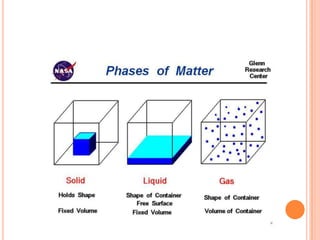
SOLIDS, LIQUIDS AND GASES
 How are the molecules/atoms arranged?
 Solids: Tightly packed and vibrate
 Liquids: Farther apart and can move past each
other.
 Gases: Very far apart and collide with one another
randomly.
KINETIC MOLECULAR THEORY
 1) Gases particles are very small compared to
distance separating them.
 2) Gas molecules are in constant random motion
and collide with one another and walls of container
= gas pressure.
 3) Collisions are elastic- no loss of total kinetic
energy.
 4) As temp increases so does the speed of the
molecules and the average kinetic energy
increases.
 Kinetic Molecular theory
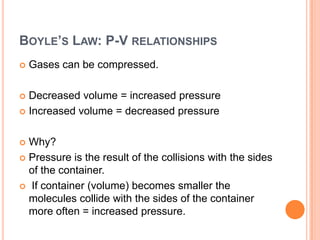
BOYLE’S LAW: P-V RELATIONSHIPS
 Gases can be compressed.
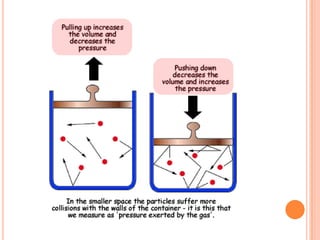
 Decreased volume = increased pressure
 Increased volume = decreased pressure
 Why?
 Pressure is the result of the collisions with the sides
of the container.
 If container (volume) becomes smaller the
molecules collide with the sides of the container
more often = increased pressure.
 Marshmellow pals in a vacuum
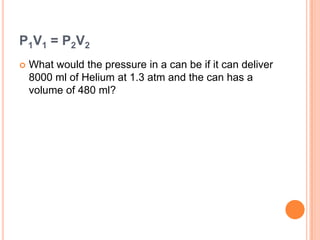
P1V1 = P2V2
 What would the pressure in a can be if it can deliver
8000 ml of Helium at 1.3 atm and the can has a
volume of 480 ml?
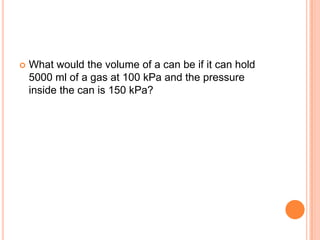
 What would the volume of a can be if it can hold
5000 ml of a gas at 100 kPa and the pressure
inside the can is 150 kPa?

Pressure & Volume

  • 1.
  • 2.
    SOLIDS, LIQUIDS ANDGASES  How are the molecules/atoms arranged?  Solids: Tightly packed and vibrate  Liquids: Farther apart and can move past each other.  Gases: Very far apart and collide with one another randomly.
  • 4.
    KINETIC MOLECULAR THEORY 1) Gases particles are very small compared to distance separating them.  2) Gas molecules are in constant random motion and collide with one another and walls of container = gas pressure.  3) Collisions are elastic- no loss of total kinetic energy.  4) As temp increases so does the speed of the molecules and the average kinetic energy increases.
  • 5.
  • 6.
    BOYLE’S LAW: P-VRELATIONSHIPS  Gases can be compressed.  Decreased volume = increased pressure  Increased volume = decreased pressure  Why?  Pressure is the result of the collisions with the sides of the container.  If container (volume) becomes smaller the molecules collide with the sides of the container more often = increased pressure.
  • 8.
  • 9.
    P1V1 = P2V2 What would the pressure in a can be if it can deliver 8000 ml of Helium at 1.3 atm and the can has a volume of 480 ml?
  • 10.
     What wouldthe volume of a can be if it can hold 5000 ml of a gas at 100 kPa and the pressure inside the can is 150 kPa?