What is Heat?
This is the movement of thermal
energy from a substance at a
higher temperature to another at a
lower temperature.
Heat vs. Temperature
Heat is the actual energy…
Temperature is the measure of average
kinetic energy of particles in a
substance.
Heat is NOT Temperature
Heat Transfer
⚫Heat always moves from a warmer place to a
cooler place.
⚫Hot objects in a cooler room will cool to room
temperature.
⚫Cold objects in a warmer room will heat up to
room temperature.
Heat Transfer Methods
⚫Heat transfers in three ways:
⚫Conduction
⚫Convection
⚫Radiation
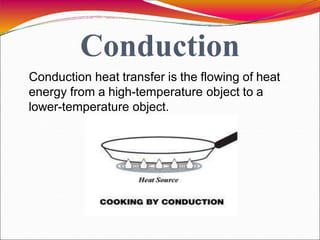
Conduction
Conduction heat transfer is the flowing of heat
energy from a high-temperature object to a
lower-temperature object.
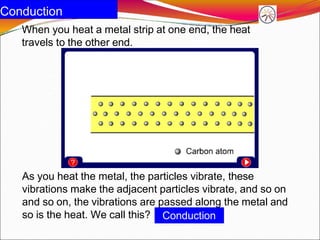
Conduction
When you heat a metal strip at one end, the heat
travels to the other end.
As you heat the metal, the particles vibrate, these
vibrations make the adjacent particles vibrate, and so on
and so on, the vibrations are passed along the metal and
so is the heat. We call this? Conduction
Metals are different
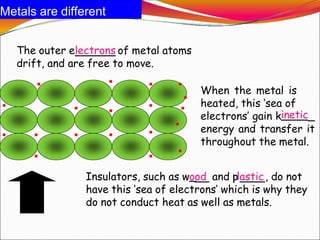
The outer electrons of metal atoms
drift, and are free to move.
When the metal is
heated, this ‘sea of
electrons’ gain kinetic_
energy and transfer it
throughout the metal.
Insulators, such as wo
_od and plastic, do not
have this ‘sea of electrons’ which is why they
do not conduct heat as well as metals.
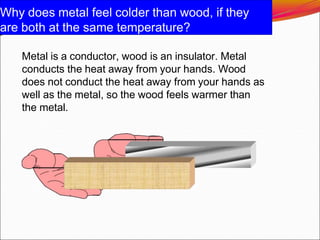
Why does metal feel colder than wood, if they
are both at the same temperature?
Metal is a conductor, wood is an insulator. Metal
conducts the heat away from your hands. Wood
does not conduct the heat away from your hands as
well as the metal, so the wood feels warmer than
the metal.
Convection
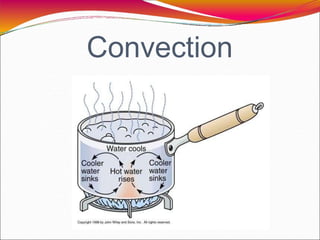
Convection takes place when heated molecules
move from one place to another, taking the heat
with them. Convection is common in both the
atmosphere, as well as in the oceans.
Convection is the primary way that heat moves
through gases and liquids.
Convection
Convection
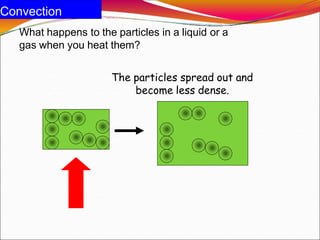
What happens to the particles in a liquid or a
gas when you heat them?
The particles spread out and
become less dense.
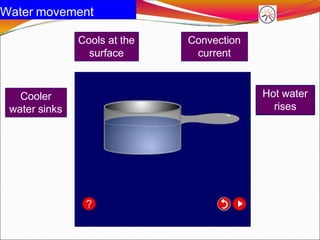
Water movement
Hot water
rises
Cooler
water sinks
Convection
current
Cools at the
surface
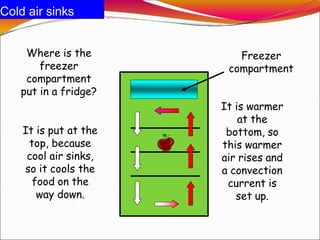
Cold air sinks
Where is the
freezer
compartment
put in a fridge?
Freezer
compartment
It is put at the
top, because
cool air sinks,
so it cools the
food on the
way down.
It is warmer
at the
bottom, so
this warmer
air rises and
a convection
current is
set up.
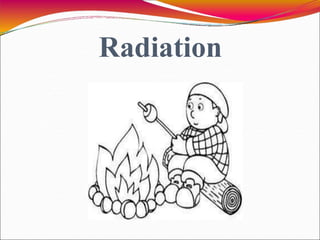
Radiation
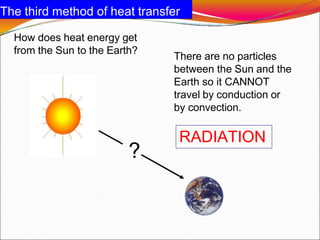
The third method of heat transfer
How does heat energy get
from the Sun to the Earth?
There are no particles
between the Sun and the
Earth so it CANNOT
travel by conduction or
by convection.
?
RADIATION
Radiation
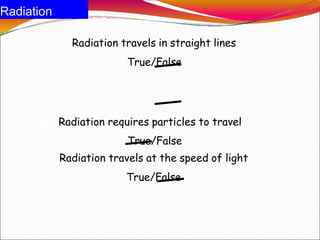
Radiation travels in straight lines
True/False
Radiation requires particles to travel
True/False
Radiation travels at the speed of light
True/False
Radiation
⚫The transfer of energy by electromagnetic waves.
Examples:
⚫Sun
⚫Fire
⚫Light bulb
Radiation question
Why are houses painted white in hot countries?
White reflects heat radiation and keeps the house cooler.
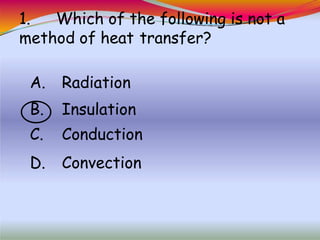
1. Which of the following is not a
method of heat transfer?
A. Radiation
B. Insulation
C. Conduction
D. Convection
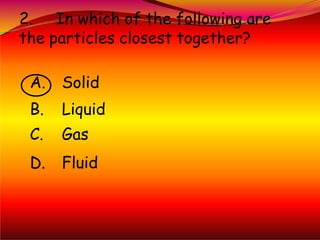
2. In which of the following are
the particles closest together?
A. Solid
B. Liquid
C. Gas
D. Fluid
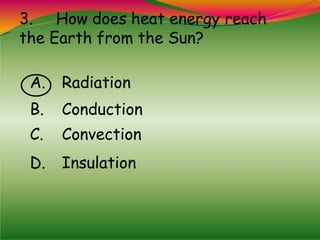
3. How does heat energy reach
the Earth from the Sun?
A. Radiation
B. Conduction
C. Convection
D. Insulation
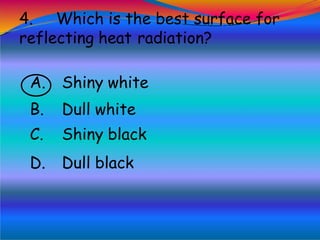
4. Which is the best surface for
reflecting heat radiation?
A. Shiny white
B. Dull white
C. Shiny black
D. Dull black
5. Which is the best surface for
absorbing heat radiation?
A. Shiny white
B. Dull white
C. Shiny black
D. Dull black

HEAT-TRANSFER science 7 third quarter.pptx

  • 2.
    What is Heat? Thisis the movement of thermal energy from a substance at a higher temperature to another at a lower temperature.
  • 3.
    Heat vs. Temperature Heatis the actual energy… Temperature is the measure of average kinetic energy of particles in a substance.
  • 4.
    Heat is NOTTemperature
  • 5.
    Heat Transfer ⚫Heat alwaysmoves from a warmer place to a cooler place. ⚫Hot objects in a cooler room will cool to room temperature. ⚫Cold objects in a warmer room will heat up to room temperature.
  • 6.
    Heat Transfer Methods ⚫Heattransfers in three ways: ⚫Conduction ⚫Convection ⚫Radiation
  • 7.
    Conduction Conduction heat transferis the flowing of heat energy from a high-temperature object to a lower-temperature object.
  • 8.
    Conduction When you heata metal strip at one end, the heat travels to the other end. As you heat the metal, the particles vibrate, these vibrations make the adjacent particles vibrate, and so on and so on, the vibrations are passed along the metal and so is the heat. We call this? Conduction
  • 9.
    Metals are different Theouter electrons of metal atoms drift, and are free to move. When the metal is heated, this ‘sea of electrons’ gain kinetic_ energy and transfer it throughout the metal. Insulators, such as wo _od and plastic, do not have this ‘sea of electrons’ which is why they do not conduct heat as well as metals.
  • 10.
    Why does metalfeel colder than wood, if they are both at the same temperature? Metal is a conductor, wood is an insulator. Metal conducts the heat away from your hands. Wood does not conduct the heat away from your hands as well as the metal, so the wood feels warmer than the metal.
  • 11.
    Convection Convection takes placewhen heated molecules move from one place to another, taking the heat with them. Convection is common in both the atmosphere, as well as in the oceans. Convection is the primary way that heat moves through gases and liquids.
  • 12.
  • 13.
    Convection What happens tothe particles in a liquid or a gas when you heat them? The particles spread out and become less dense.
  • 14.
    Water movement Hot water rises Cooler watersinks Convection current Cools at the surface
  • 15.
    Cold air sinks Whereis the freezer compartment put in a fridge? Freezer compartment It is put at the top, because cool air sinks, so it cools the food on the way down. It is warmer at the bottom, so this warmer air rises and a convection current is set up.
  • 16.
  • 17.
    The third methodof heat transfer How does heat energy get from the Sun to the Earth? There are no particles between the Sun and the Earth so it CANNOT travel by conduction or by convection. ? RADIATION
  • 18.
    Radiation Radiation travels instraight lines True/False Radiation requires particles to travel True/False Radiation travels at the speed of light True/False
  • 19.
    Radiation ⚫The transfer ofenergy by electromagnetic waves. Examples: ⚫Sun ⚫Fire ⚫Light bulb
  • 20.
    Radiation question Why arehouses painted white in hot countries? White reflects heat radiation and keeps the house cooler.
  • 21.
    1. Which ofthe following is not a method of heat transfer? A. Radiation B. Insulation C. Conduction D. Convection
  • 22.
    2. In whichof the following are the particles closest together? A. Solid B. Liquid C. Gas D. Fluid
  • 23.
    3. How doesheat energy reach the Earth from the Sun? A. Radiation B. Conduction C. Convection D. Insulation
  • 24.
    4. Which isthe best surface for reflecting heat radiation? A. Shiny white B. Dull white C. Shiny black D. Dull black
  • 25.
    5. Which isthe best surface for absorbing heat radiation? A. Shiny white B. Dull white C. Shiny black D. Dull black