T- 91-901-568-0202
Email- nm.sspirit@gmail.com
By
Tissues
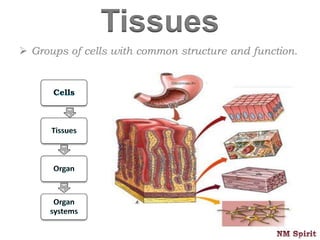
 Groups of cells with common structure and function.
Cells
Tissues
Organ
Organ
systems
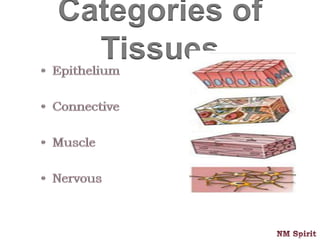
Categories of
Tissues
Epithelial Tissue
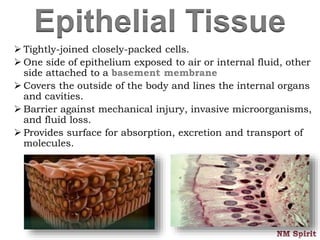
 Tightly-joined closely-packed cells.
 One side of epithelium exposed to air or internal fluid, other
side attached to a basement membrane
 Covers the outside of the body and lines the internal organs
and cavities.
 Barrier against mechanical injury, invasive microorganisms,
and fluid loss.
 Provides surface for absorption, excretion and transport of
molecules.
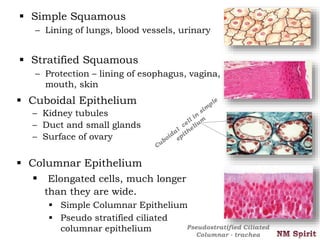
 Simple Squamous
– Lining of lungs, blood vessels, urinary
 Stratified Squamous
– Protection – lining of esophagus, vagina,
mouth, skin
 Cuboidal Epithelium
– Kidney tubules
– Duct and small glands
– Surface of ovary
 Columnar Epithelium
 Elongated cells, much longer
than they are wide.
 Simple Columnar Epithelium
 Pseudo stratified ciliated
columnar epithelium Pseudostratified Ciliated
Columnar - trachea
Types of Epithelial
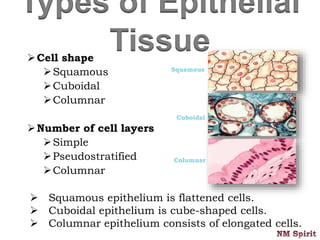
TissueCell shape
Squamous
Cuboidal
Columnar
Number of cell layers
Simple
Pseudostratified
Columnar
 Squamous epithelium is flattened cells.
 Cuboidal epithelium is cube-shaped cells.
 Columnar epithelium consists of elongated cells.
Squamous
Cuboidal
Columnar
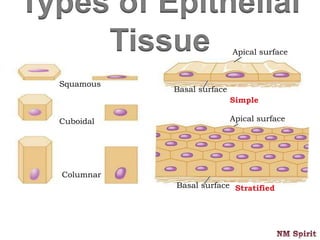
Types of Epithelial
Tissue
Squamous
Cuboidal
Columnar
Apical surface
Basal surface
Apical surface
Basal surface
Simple
Stratified
Connective
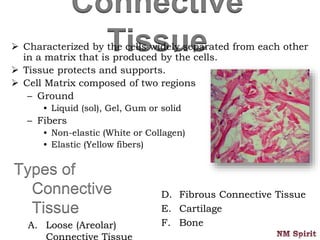
Tissue Characterized by the cells widely separated from each other
in a matrix that is produced by the cells.
 Tissue protects and supports.
 Cell Matrix composed of two regions
– Ground
• Liquid (sol), Gel, Gum or solid
– Fibers
• Non-elastic (White or Collagen)
• Elastic (Yellow fibers)
Types of
Connective
Tissue
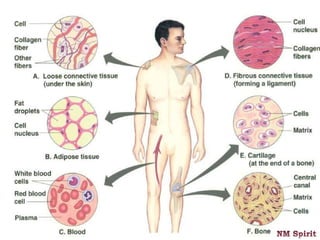
A. Loose (Areolar)
Connective Tissue
D. Fibrous Connective Tissue
E. Cartilage
F. Bone
Loose Connective
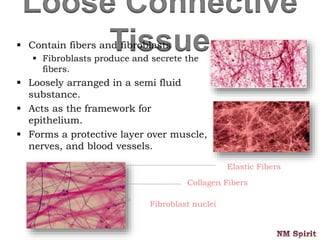
Tissue Contain fibers and fibroblasts
 Fibroblasts produce and secrete the
fibers.
 Loosely arranged in a semi fluid
substance.
 Acts as the framework for
epithelium.
 Forms a protective layer over muscle,
nerves, and blood vessels.
Elastic Fibers
Collagen Fibers
Fibroblast nuclei
Adipose Tissue
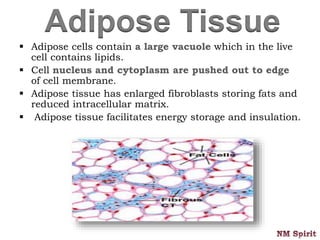
 Adipose cells contain a large vacuole which in the live
cell contains lipids.
 Cell nucleus and cytoplasm are pushed out to edge
of cell membrane.
 Adipose tissue has enlarged fibroblasts storing fats and
reduced intracellular matrix.
 Adipose tissue facilitates energy storage and insulation.
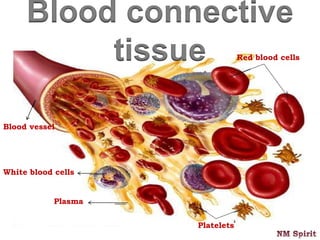
Blood connective
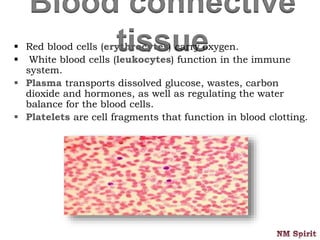
tissue Red blood cells (erythrocytes) carry oxygen.
 White blood cells (leukocytes) function in the immune
system.
 Plasma transports dissolved glucose, wastes, carbon
dioxide and hormones, as well as regulating the water
balance for the blood cells.
 Platelets are cell fragments that function in blood clotting.
Blood vessel
Red blood cells
White blood cells
Plasma
Platelets
Blood connective
tissue
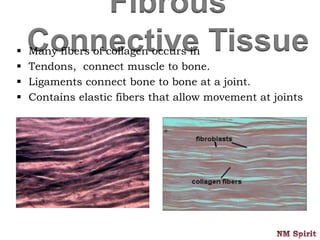
Fibrous
Connective Tissue Many fibers of collagen occurs in
 Tendons, connect muscle to bone.
 Ligaments connect bone to bone at a joint.
 Contains elastic fibers that allow movement at joints
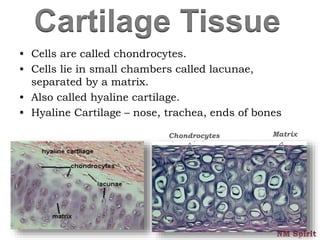
Cartilage Tissue
• Cells are called chondrocytes.
• Cells lie in small chambers called lacunae,
separated by a matrix.
• Also called hyaline cartilage.
• Hyaline Cartilage – nose, trachea, ends of bones
Chondrocytes Matrix
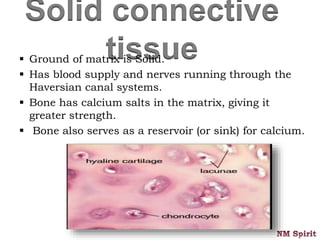
Solid connective
tissue Ground of matrix is Solid.
 Has blood supply and nerves running through the
Haversian canal systems.
 Bone has calcium salts in the matrix, giving it
greater strength.
 Bone also serves as a reservoir (or sink) for calcium.
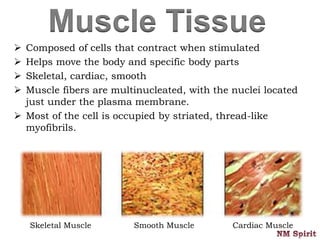
Muscle Tissue
 Composed of cells that contract when stimulated
 Helps move the body and specific body parts
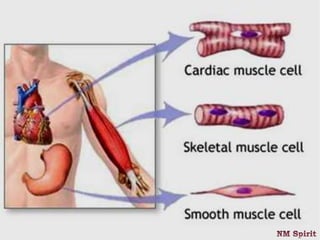
 Skeletal, cardiac, smooth
 Muscle fibers are multinucleated, with the nuclei located
just under the plasma membrane.
 Most of the cell is occupied by striated, thread-like
myofibrils.
Skeletal Muscle Smooth Muscle Cardiac Muscle
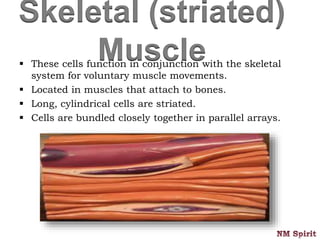
Skeletal (striated)
Muscle These cells function in conjunction with the skeletal
system for voluntary muscle movements.
 Located in muscles that attach to bones.
 Long, cylindrical cells are striated.
 Cells are bundled closely together in parallel arrays.
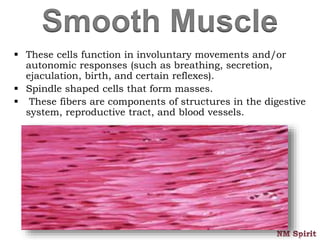
Smooth Muscle
 These cells function in involuntary movements and/or
autonomic responses (such as breathing, secretion,
ejaculation, birth, and certain reflexes).
 Spindle shaped cells that form masses.
 These fibers are components of structures in the digestive
system, reproductive tract, and blood vessels.
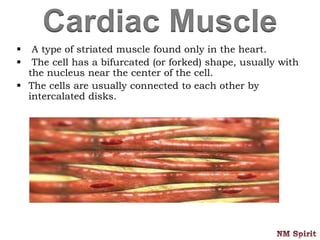
Cardiac Muscle
 A type of striated muscle found only in the heart.
 The cell has a bifurcated (or forked) shape, usually with
the nucleus near the center of the cell.
 The cells are usually connected to each other by
intercalated disks.
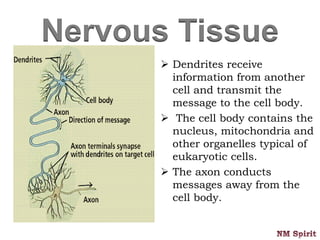
Nervous Tissue
 Dendrites receive
information from another
cell and transmit the
message to the cell body.
 The cell body contains the
nucleus, mitochondria and
other organelles typical of
eukaryotic cells.
 The axon conducts
messages away from the
cell body.
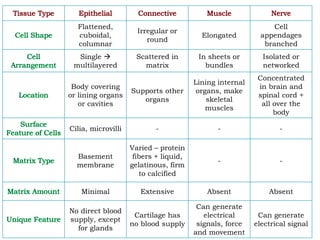
Flattened,
cuboidal,
columnar
Irregular or
round
Elongated
Cell
appendages
branched
Single 
multilayered
Scattered in
matrix
In sheets or
bundles
Isolated or
networked
Body covering
or lining organs
or cavities
Supports other
organs
Lining internal
organs, make
skeletal
muscles
Concentrated
in brain and
spinal cord +
all over the
body
Cilia, microvilli - - -
Basement
membrane
Varied – protein
fibers + liquid,
gelatinous, firm
to calcified
- -
Minimal Extensive Absent Absent
No direct blood
supply, except
for glands
Cartilage has
no blood supply
Can generate
electrical
signals, force
and movement
Can generate
electrical signal
The End
Call Us For More
Information:
91-901-568-
0202

Animal Tissues

  • 1.
  • 2.
    Tissues  Groups ofcells with common structure and function. Cells Tissues Organ Organ systems
  • 3.
  • 4.
    Epithelial Tissue  Tightly-joinedclosely-packed cells.  One side of epithelium exposed to air or internal fluid, other side attached to a basement membrane  Covers the outside of the body and lines the internal organs and cavities.  Barrier against mechanical injury, invasive microorganisms, and fluid loss.  Provides surface for absorption, excretion and transport of molecules.
  • 5.
     Simple Squamous –Lining of lungs, blood vessels, urinary  Stratified Squamous – Protection – lining of esophagus, vagina, mouth, skin  Cuboidal Epithelium – Kidney tubules – Duct and small glands – Surface of ovary  Columnar Epithelium  Elongated cells, much longer than they are wide.  Simple Columnar Epithelium  Pseudo stratified ciliated columnar epithelium Pseudostratified Ciliated Columnar - trachea
  • 6.
    Types of Epithelial TissueCellshape Squamous Cuboidal Columnar Number of cell layers Simple Pseudostratified Columnar  Squamous epithelium is flattened cells.  Cuboidal epithelium is cube-shaped cells.  Columnar epithelium consists of elongated cells. Squamous Cuboidal Columnar
  • 7.
    Types of Epithelial Tissue Squamous Cuboidal Columnar Apicalsurface Basal surface Apical surface Basal surface Simple Stratified
  • 8.
    Connective Tissue Characterized bythe cells widely separated from each other in a matrix that is produced by the cells.  Tissue protects and supports.  Cell Matrix composed of two regions – Ground • Liquid (sol), Gel, Gum or solid – Fibers • Non-elastic (White or Collagen) • Elastic (Yellow fibers) Types of Connective Tissue A. Loose (Areolar) Connective Tissue D. Fibrous Connective Tissue E. Cartilage F. Bone
  • 10.
    Loose Connective Tissue Containfibers and fibroblasts  Fibroblasts produce and secrete the fibers.  Loosely arranged in a semi fluid substance.  Acts as the framework for epithelium.  Forms a protective layer over muscle, nerves, and blood vessels. Elastic Fibers Collagen Fibers Fibroblast nuclei
  • 11.
    Adipose Tissue  Adiposecells contain a large vacuole which in the live cell contains lipids.  Cell nucleus and cytoplasm are pushed out to edge of cell membrane.  Adipose tissue has enlarged fibroblasts storing fats and reduced intracellular matrix.  Adipose tissue facilitates energy storage and insulation.
  • 12.
    Blood connective tissue Redblood cells (erythrocytes) carry oxygen.  White blood cells (leukocytes) function in the immune system.  Plasma transports dissolved glucose, wastes, carbon dioxide and hormones, as well as regulating the water balance for the blood cells.  Platelets are cell fragments that function in blood clotting.
  • 13.
    Blood vessel Red bloodcells White blood cells Plasma Platelets Blood connective tissue
  • 14.
    Fibrous Connective Tissue Manyfibers of collagen occurs in  Tendons, connect muscle to bone.  Ligaments connect bone to bone at a joint.  Contains elastic fibers that allow movement at joints
  • 15.
    Cartilage Tissue • Cellsare called chondrocytes. • Cells lie in small chambers called lacunae, separated by a matrix. • Also called hyaline cartilage. • Hyaline Cartilage – nose, trachea, ends of bones Chondrocytes Matrix
  • 16.
    Solid connective tissue Groundof matrix is Solid.  Has blood supply and nerves running through the Haversian canal systems.  Bone has calcium salts in the matrix, giving it greater strength.  Bone also serves as a reservoir (or sink) for calcium.
  • 17.
    Muscle Tissue  Composedof cells that contract when stimulated  Helps move the body and specific body parts  Skeletal, cardiac, smooth  Muscle fibers are multinucleated, with the nuclei located just under the plasma membrane.  Most of the cell is occupied by striated, thread-like myofibrils. Skeletal Muscle Smooth Muscle Cardiac Muscle
  • 19.
    Skeletal (striated) Muscle Thesecells function in conjunction with the skeletal system for voluntary muscle movements.  Located in muscles that attach to bones.  Long, cylindrical cells are striated.  Cells are bundled closely together in parallel arrays.
  • 20.
    Smooth Muscle  Thesecells function in involuntary movements and/or autonomic responses (such as breathing, secretion, ejaculation, birth, and certain reflexes).  Spindle shaped cells that form masses.  These fibers are components of structures in the digestive system, reproductive tract, and blood vessels.
  • 21.
    Cardiac Muscle  Atype of striated muscle found only in the heart.  The cell has a bifurcated (or forked) shape, usually with the nucleus near the center of the cell.  The cells are usually connected to each other by intercalated disks.
  • 22.
    Nervous Tissue  Dendritesreceive information from another cell and transmit the message to the cell body.  The cell body contains the nucleus, mitochondria and other organelles typical of eukaryotic cells.  The axon conducts messages away from the cell body.
  • 23.
    Flattened, cuboidal, columnar Irregular or round Elongated Cell appendages branched Single  multilayered Scatteredin matrix In sheets or bundles Isolated or networked Body covering or lining organs or cavities Supports other organs Lining internal organs, make skeletal muscles Concentrated in brain and spinal cord + all over the body Cilia, microvilli - - - Basement membrane Varied – protein fibers + liquid, gelatinous, firm to calcified - - Minimal Extensive Absent Absent No direct blood supply, except for glands Cartilage has no blood supply Can generate electrical signals, force and movement Can generate electrical signal
  • 24.
    The End Call UsFor More Information: 91-901-568- 0202