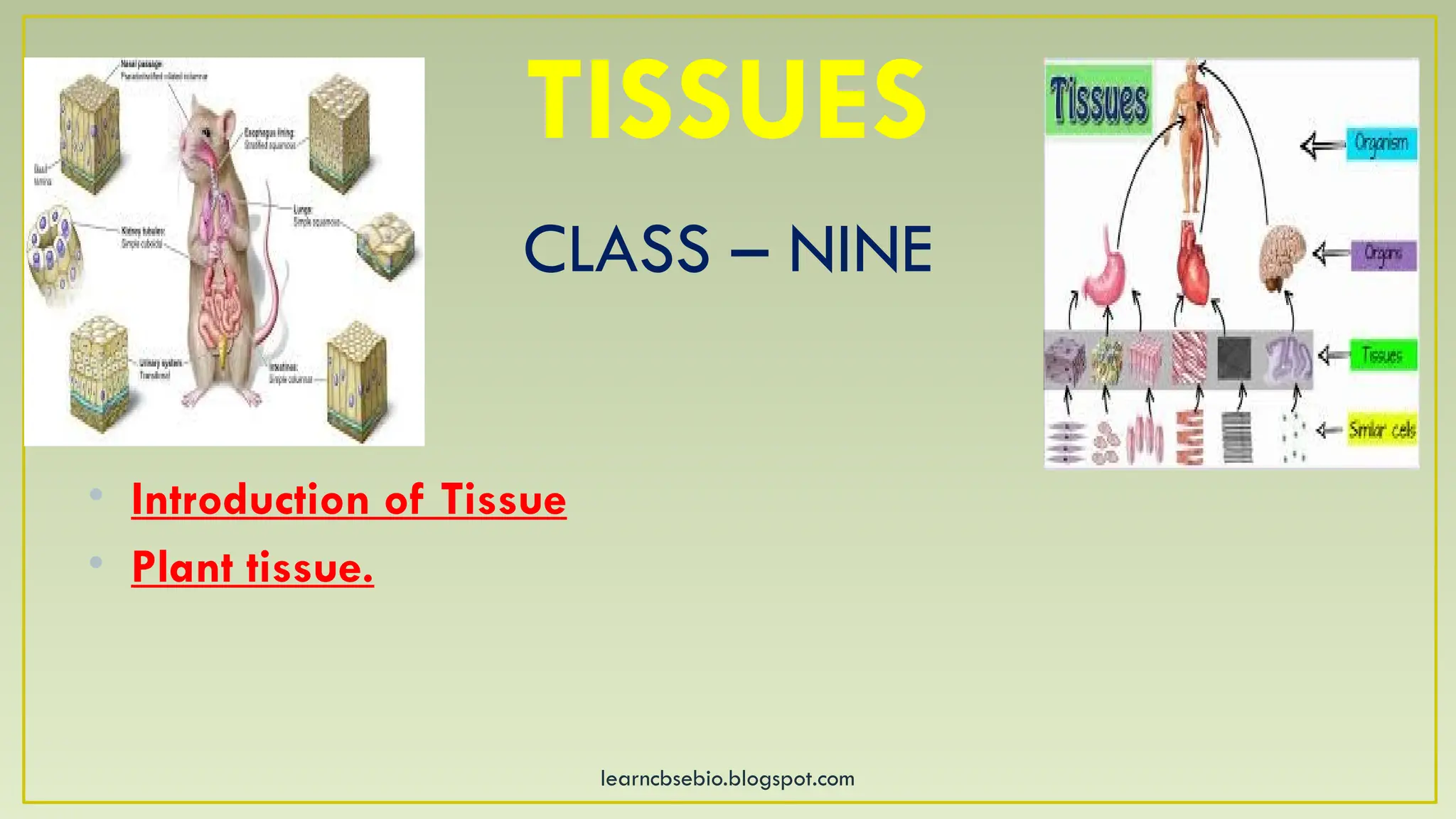
TISSUES
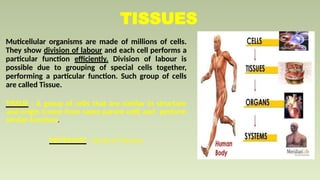
Muticellular organisms aremade of millions of cells.
They show division of labour and each cell performs a
particular function efficiently. Division of labour is
possible due to grouping of special cells together,
performing a particular function. Such group of cells
are called Tissue.
TISSUE : A group of cells that are similar in structure
and origin (come from same parent cell) and perform
similar function.
HISTOLOGY : Study of tissues
3.
learncbsebio.blogspot.com
What is theutility of tissues in multi-cellular organisms?
Multi-cellular organisms have millions of cells. Each group of cell is called tissue and
it performs a special function efficiently.
e.g. muscle cells (contract and relax to bring movement), nerve cells (carry
message) and blood, all are tissues.
In plants, vascular tissues (xylem and phloem ) conduct water and food from one
part of the plant to other parts.
So, multi-cellular organisms show division of labour.
4.
learncbsebio.blogspot.com
Importance of Tissue
1.Formation of tissue has brought about division of labour in Multicellular
Organism
2. Tissue become organised to form organs and organs into organ system
which increase the efficiency of multicelluar organism.
3. Workload of individual cell has decreased.
4. Due to increased efficiency and organisation ,multicellular organism has
higher chances of survival.
5.
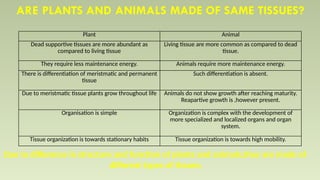
ARE PLANTS ANDANIMALS MADE OF SAME TISSUES?
Due to difference in structure and function of plants and animals,they are made of
different types of tissues.
Plant Animal
Dead supportive tissues are more abundant as
compared to living tissue
Living tissue are more common as compared to dead
tissue.
They require less maintenance energy. Animals require more maintenance energy.
There is differentiation of meristmatic and permanent
tissue
Such differentiation is absent.
Due to meristmatic tissue plants grow throughout life Animals do not show growth after reaching maturity.
Reapartive growth is ,however present.
Organisation is simple Organization is complex with the development of
more specialized and localized organs and organ
system.
Tissue organization is towards stationary habits Tissue organization is towards high mobility.
7.
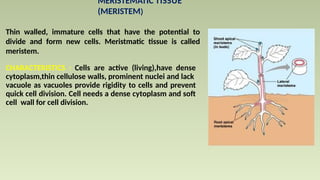
MERISTEMATIC TISSUE
(MERISTEM)
Thin walled,immature cells that have the potential to
divide and form new cells. Meristmatic tissue is called
meristem.
CHARACTERISTICS : Cells are active (living),have dense
cytoplasm,thin cellulose walls, prominent nuclei and lack
vacuole as vacuoles provide rigidity to cells and prevent
quick cell division. Cell needs a dense cytoplasm and soft
cell wall for cell division.
learncbsebio.blogspot.com
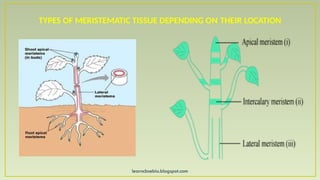
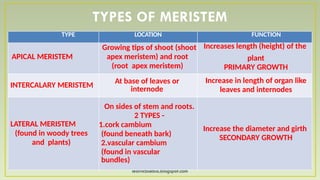
TYPES OF MERISTEM
TYPELOCATION FUNCTION
APICAL MERISTEM
Growing tips of shoot (shoot
apex meristem) and root
(root apex meristem)
Increases length (height) of the
plant
PRIMARY GROWTH
INTERCALARY MERISTEM
At base of leaves or
internode
Increase in length of organ like
leaves and internodes
LATERAL MERISTEM
(found in woody trees
and plants)
On sides of stem and roots.
2 TYPES -
1.cork cambium
(found beneath bark)
2.vascular cambium
(found in vascular
bundles)
Increase the diameter and girth
SECONDARY GROWTH
10.
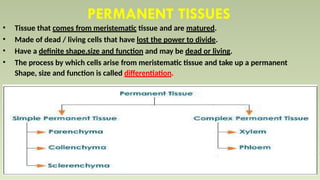
PERMANENT TISSUES
• Tissuethat comes from meristematic tissue and are matured.
• Made of dead / living cells that have lost the power to divide.
• Have a definite shape,size and function and may be dead or living.
• The process by which cells arise from meristematic tissue and take up a permanent
Shape, size and function is called differentiation.
11.
learncbsebio.blogspot.com
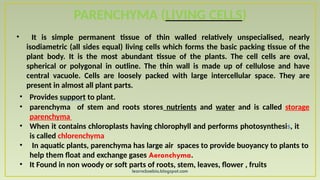
PARENCHYMA (LIVING CELLS)
•It is simple permanent tissue of thin walled relatively unspecialised, nearly
isodiametric (all sides equal) living cells which forms the basic packing tissue of the
plant body. It is the most abundant tissue of the plants. The cell cells are oval,
spherical or polygonal in outline. The thin wall is made up of cellulose and have
central vacuole. Cells are loosely packed with large intercellular space. They are
present in almost all plant parts.
• Provides support to plant.
• parenchyma of stem and roots stores nutrients and water and is called storage
parenchyma
• When it contains chloroplasts having chlorophyll and performs photosynthesis, it
is called chlorenchyma
• In aquatic plants, parenchyma has large air spaces to provide buoyancy to plants to
help them float and exchange gases Aeronchyma.
• It Found in non woody or soft parts of roots, stem, leaves, flower , fruits
12.
learncbsebio.blogspot.com
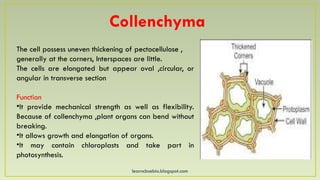
Collenchyma
The cell possessuneven thickening of pectocellulose ,
generally at the corners, Interspaces are little.
The cells are elongated but appear oval ,circular, or
angular in transverse section
Function
•It provide mechanical strength as well as flexibility.
Because of collenchyma ,plant organs can bend without
breaking.
•It allows growth and elongation of organs.
•It may contain chloroplasts and take part in
photosynthesis.
13.
learncbsebio.blogspot.com
Sclerenchyma
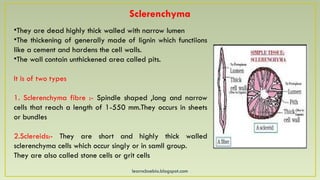
•They are deadhighly thick walled with narrow lumen
•The thickening of generally made of lignin which functiions
like a cement and hardens the cell walls.
•The wall contain unthickened area called pits.
It is of two types
1. Sclerenchyma fibre :- Spindle shaped ,long and narrow
cells that reach a length of 1-550 mm.They occurs in sheets
or bundles
2.Sclereids:- They are short and highly thick walled
sclerenchyma cells which occur singly or in samll group.
They are also called stone cells or grit cells
14.
learncbsebio.blogspot.com
Function of Sclerenchyma
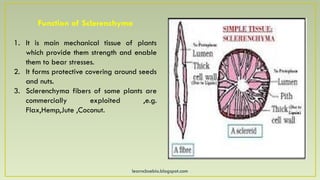
1.It is main mechanical tissue of plants
which provide them strength and enable
them to bear stresses.
2. It forms protective covering around seeds
and nuts.
3. Sclerenchyma fibers of some plants are
commercially exploited ,e.g.
Flax,Hemp,Jute ,Coconut.
15.
EPIDERMIS
ACTIVITY 6.3 pg72
1. Take a fresh leaf of Rheo.
2. Stretch and break it by applying pressure.
3. While breaking it, keep it stretched gently so that
some peel or skin projects out from the cut.
4. Remove this peel and put it in a Petri dish filled
with water and add a few drops of safranin.
5. Wait for few minutes and then transfer it onto a
slide. Gently place a cover slip over it and observe
under microscope.
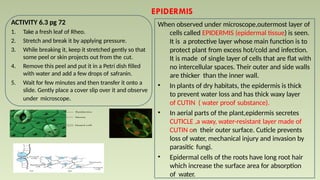
When observed under microscope,outermost layer of
cells called EPIDERMIS (epidermal tissue) is seen.
It is a protective layer whose main function is to
protect plant from excess hot/cold and infection.
It is made of single layer of cells that are flat with
no intercellular spaces. Their outer and side walls
are thicker than the inner wall.
• In plants of dry habitats, the epidermis is thick
to prevent water loss and has thick waxy layer
of CUTIN ( water proof substance).
• In aerial parts of the plant,epidermis secretes
CUTICLE ,a waxy, water-resistant layer made of
CUTIN on their outer surface. Cuticle prevents
loss of water, mechanical injury and invasion by
parasitic fungi.
• Epidermal cells of the roots have long root hair
which increase the surface area for absorption
of water.
16.
learncbsebio.blogspot.com
EPIDERMIS
Layer is thinand transparent.Epidermal
tissues have tiny hairs projecting from
surface of epidermis. Trichomes are
abundant in some plant stem .Root hairs
are elongations of epidermal cells in the
root.Epidermal tissues in leaves are covered
with a waxy cuticle.Some epidermal cells
secrete poisonous or bad-tasting
substances.
Structure
Layer of cells covering surface of entire plant.
Function
1. Acts as a barrier to microorganisms and
pathogens.
2. Allow light to pass through for photosynthesis in
the tissues below.
3. Leaf trichomes trap water to prevent water loss.
4. Root hairs increase the surface area for
absorption of water from the soil .
5. The waxy cuticle prevents water loss from leaves.
6. The bitter taste of the substances prevent grazing
by animals.
17.
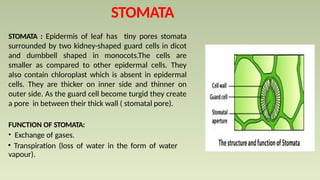
STOMATA : Epidermisof leaf has tiny pores stomata
surrounded by two kidney-shaped guard cells in dicot
and dumbbell shaped in monocots.The cells are
smaller as compared to other epidermal cells. They
also contain chloroplast which is absent in epidermal
cells. They are thicker on inner side and thinner on
outer side. As the guard cell become turgid they create
a pore in between their thick wall ( stomatal pore).
FUNCTION OF STOMATA:
• Exchange of gases.
• Transpiration (loss of water in the form of water
vapour).
STOMATA
18.
learncbsebio.blogspot.com
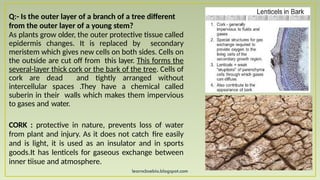
Q:- Is theouter layer of a branch of a tree different
from the outer layer of a young stem?
As plants grow older, the outer protective tissue called
epidermis changes. It is replaced by secondary
meristem which gives new cells on both sides. Cells on
the outside are cut off from this layer. This forms the
several-layer thick cork or the bark of the tree. Cells of
cork are dead and tightly arranged without
intercellular spaces .They have a chemical called
suberin in their walls which makes them impervious
to gases and water.
CORK : protective in nature, prevents loss of water
from plant and injury. As it does not catch fire easily
and is light, it is used as an insulator and in sports
goods.It has lenticels for gaseous exchange between
inner tiisue and atmosphere.
19.
learncbsebio.blogspot.com
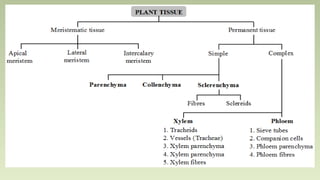
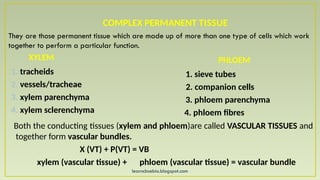
COMPLEX PERMANENT TISSUE
XYLEM
1.tracheids
2. vessels/tracheae
3. xylem parenchyma
4. xylem sclerenchyma
PHLOEM
1. sieve tubes
2. companion cells
3. phloem parenchyma
4. phloem fibres
Both the conducting tissues (xylem and phloem)are called VASCULAR TISSUES and
together form vascular bundles.
X (VT) + P(VT) = VB
xylem (vascular tissue) + phloem (vascular tissue) = vascular bundle
They are those permanent tissue which are made up of more than one type of cells which work
together to perform a particular function.
20.
COMPLEX PERMANENT TISSUE
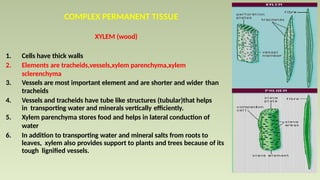
XYLEM(wood)
1. Cells have thick walls
2. Elements are tracheids,vessels,xylem parenchyma,xylem
sclerenchyma
3. Vessels are most important element and are shorter and wider than
tracheids
4. Vessels and tracheids have tube like structures (tubular)that helps
in transporting water and minerals vertically efficiently.
5. Xylem parenchyma stores food and helps in lateral conduction of
water
6. In addition to transporting water and mineral salts from roots to
leaves, xylem also provides support to plants and trees because of its
tough lignified vessels.
21.
learncbsebio.blogspot.com
PHLOEM (bast)
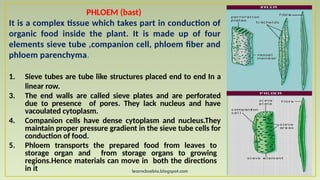
It isa complex tissue which takes part in conduction of
organic food inside the plant. It is made up of four
elements sieve tube ,companion cell, phloem fiber and
phloem parenchyma.
1. Sieve tubes are tube like structures placed end to end In a
linear row.
3. The end walls are called sieve plates and are perforated
due to presence of pores. They lack nucleus and have
vacoulated cytoplasm.
4. Companion cells have dense cytoplasm and nucleus.They
maintain proper pressure gradient in the sieve tube cells for
conduction of food.
5. Phloem transports the prepared food from leaves to
storage organ and from storage organs to growing
regions.Hence materials can move in both the directions
in it
22.
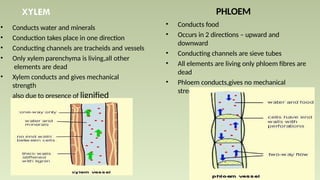
XYLEM
• Conducts waterand minerals
• Conduction takes place in one direction
• Conducting channels are tracheids and vessels
• Only xylem parenchyma is living,all other
elements are dead
• Xylem conducts and gives mechanical
strength
also due to presence of lignified
vessels
PHLOEM
• Conducts food
• Occurs in 2 directions – upward and
downward
• Conducting channels are sieve tubes
• All elements are living only phloem fibres are
dead
• Phloem conducts,gives no mechanical
strength



![Polymer [ बहुलक ] Chemistry Notes PDF - Irfanullah Mehar - JJ Sir Chemistry.pdf](https://cdn.slidesharecdn.com/ss_thumbnails/polymerchemistrynotespdf-irfanullahmehar-jjsirchemistry-260210172118-3f9b37f7-thumbnail.jpg?width=640&height=640&fit=bounds)


