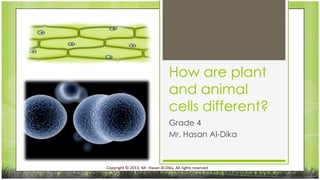
How are plant
and animal
cells different?
Grade 4
Mr. Hasan Al-Dika

Copyright © 2013, Mr. Hasan Al-Dika. All rights reserved
Objectives
 Compare

the parts of plant cells and
animal cells

 Know

the function of some important part
inside the cell.

Copyright © 2013, Mr. Hasan Al-Dika. All rights reserved
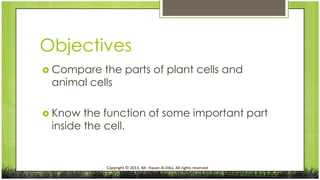
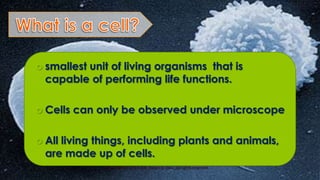
 smallest

unit of living organisms that is
capable of performing life functions.

 Cells

can only be observed under microscope

 All

living things, including plants and animals,
are made up of cells.
Copyright © 2013, Mr. Hasan Al-Dika. All rights reserved
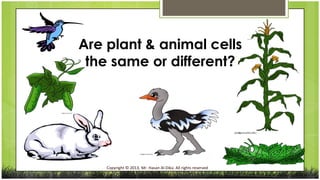
Are plant & animal cells
the same or different?

Copyright © 2013, Mr. Hasan Al-Dika. All rights reserved
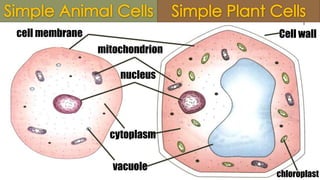
cell membrane

Cell wall
mitochondrion

nucleus

cytoplasm

vacuole

Copyright © 2013, Mr. Hasan Al-Dika. All rights reserved

chloroplast
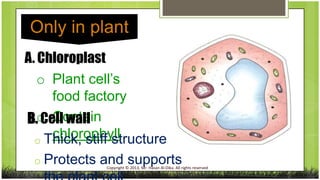
Only in plant
A. Chloroplast
o Plant cell’s
food factory
B.o Contain
Cell wall
chlorophyll
o Thick, stiff structure
o Protects

and supports

Copyright © 2013, Mr. Hasan Al-Dika. All rights reserved
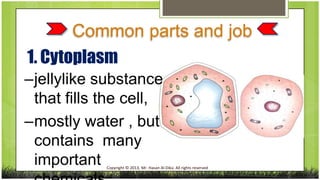
Common parts and job
1. Cytoplasm
–jellylike substance
that fills the cell,
–mostly water , but
contains many
important

Copyright © 2013, Mr. Hasan Al-Dika. All rights reserved
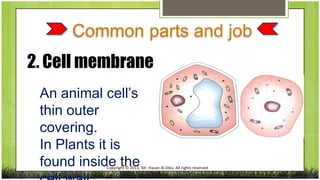
Common parts and job
2. Cell membrane
An animal cell’s
thin outer
• thinouter
covering.
covering.
In Plants it is
found inside the

Copyright © 2013, Mr. Hasan Al-Dika. All rights reserved
Common parts and job
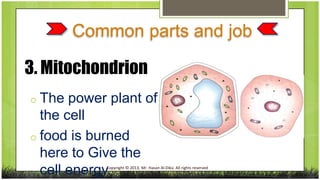
3. Mitochondrion
o The

power plant of
the cell
o food is burned
here to Give the
cell energy.

Copyright © 2013, Mr. Hasan Al-Dika. All rights reserved
Common parts and job
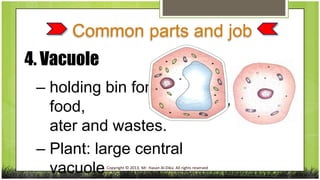
4. Vacuole
– holding bin for
food,
ater and wastes.
– Plant: large central
vacuole

Copyright © 2013, Mr. Hasan Al-Dika. All rights reserved

w
Common parts and job
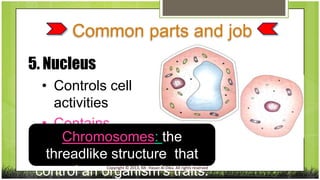
5. Nucleus
• Controls cell
activities
• Contains
Chromosomes:
chromosomes the
threadlike structure that
control an organism's traits.
Copyright © 2013, Mr. Hasan Al-Dika. All rights reserved
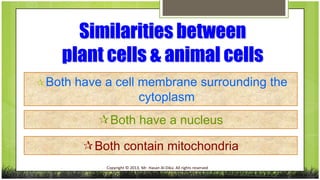
Similarities between
plant cells & animal cells
 Both

have a cell membrane surrounding the
cytoplasm

Both have a nucleus
Both contain mitochondria
Copyright © 2013, Mr. Hasan Al-Dika. All rights reserved
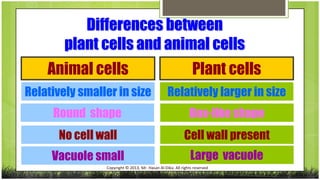
Differences between
plant cells and animal cells

Animal cells

Plant cells

Relatively smaller in size

Relatively larger in size

Round shape

Box-like shape

No cell wall

Cell wall present

Vacuole small

Large vacuole

Copyright © 2013, Mr. Hasan Al-Dika. All rights reserved
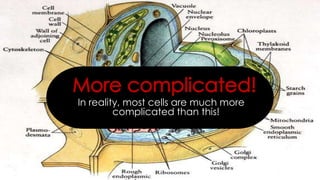
In reality, most cells are much more
complicated than this!
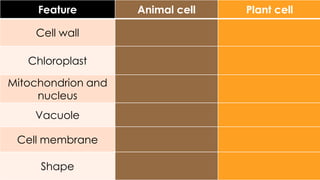
Feature

Cell wall
Chloroplast
Mitochondrion and
nucleus
Vacuole
Cell membrane
Shape

Animal cell

Plant cell
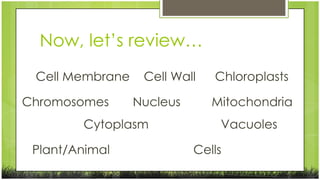
Now, let’s review…
Cell Membrane
Chromosomes

Cell Wall
Nucleus

Cytoplasm
Plant/Animal

Chloroplasts
Mitochondria

Vacuoles
Cells

Differences Between Plant and Animal Cells

  • 1.
    How are plant andanimal cells different? Grade 4 Mr. Hasan Al-Dika Copyright © 2013, Mr. Hasan Al-Dika. All rights reserved
  • 2.
    Objectives  Compare the partsof plant cells and animal cells  Know the function of some important part inside the cell. Copyright © 2013, Mr. Hasan Al-Dika. All rights reserved
  • 3.
     smallest unit ofliving organisms that is capable of performing life functions.  Cells can only be observed under microscope  All living things, including plants and animals, are made up of cells. Copyright © 2013, Mr. Hasan Al-Dika. All rights reserved
  • 4.
    Are plant &animal cells the same or different? Copyright © 2013, Mr. Hasan Al-Dika. All rights reserved
  • 5.
    cell membrane Cell wall mitochondrion nucleus cytoplasm vacuole Copyright© 2013, Mr. Hasan Al-Dika. All rights reserved chloroplast
  • 6.
    Only in plant A.Chloroplast o Plant cell’s food factory B.o Contain Cell wall chlorophyll o Thick, stiff structure o Protects and supports Copyright © 2013, Mr. Hasan Al-Dika. All rights reserved
  • 7.
    Common parts andjob 1. Cytoplasm –jellylike substance that fills the cell, –mostly water , but contains many important Copyright © 2013, Mr. Hasan Al-Dika. All rights reserved
  • 8.
    Common parts andjob 2. Cell membrane An animal cell’s thin outer • thinouter covering. covering. In Plants it is found inside the Copyright © 2013, Mr. Hasan Al-Dika. All rights reserved
  • 9.
    Common parts andjob 3. Mitochondrion o The power plant of the cell o food is burned here to Give the cell energy. Copyright © 2013, Mr. Hasan Al-Dika. All rights reserved
  • 10.
    Common parts andjob 4. Vacuole – holding bin for food, ater and wastes. – Plant: large central vacuole Copyright © 2013, Mr. Hasan Al-Dika. All rights reserved w
  • 11.
    Common parts andjob 5. Nucleus • Controls cell activities • Contains Chromosomes: chromosomes the threadlike structure that control an organism's traits. Copyright © 2013, Mr. Hasan Al-Dika. All rights reserved
  • 12.
    Similarities between plant cells& animal cells  Both have a cell membrane surrounding the cytoplasm Both have a nucleus Both contain mitochondria Copyright © 2013, Mr. Hasan Al-Dika. All rights reserved
  • 13.
    Differences between plant cellsand animal cells Animal cells Plant cells Relatively smaller in size Relatively larger in size Round shape Box-like shape No cell wall Cell wall present Vacuole small Large vacuole Copyright © 2013, Mr. Hasan Al-Dika. All rights reserved
  • 14.
    In reality, mostcells are much more complicated than this!
  • 15.
  • 16.
    Now, let’s review… CellMembrane Chromosomes Cell Wall Nucleus Cytoplasm Plant/Animal Chloroplasts Mitochondria Vacuoles Cells

Editor's Notes

  • #4 The cell as the basic unit of lifeCells are the basic units of organismsAll cells come from preexisting cells through cell division. Unicellular organisms are made of one cell onlyThe cells of multicellular organisms are specialized to perform different functionse.g. mesophyll cells for photosynthesis and root hair cells for water absorptionThere are many different kinds of cells, doing many different jobs in a plant or animal.
  • #5 Most living things can be divided into two. Do you know what they are?To answer this question, look at these two pictures. Left is a picture of a plant cell and right is of an animal cell.
  • #7 Strong and rigidTo trap light energy, to make food the green pigment
  • #8  enclosed by cell membranContains organelles and granules :e.g. chloroplaste.g. mitochondrionProvide a medium for chemical reactions to take place
  • #10 ( mitochondria
  • #14 Glycogen granules as food storeNucleus at the centreStarch granules as food storeNucleus near cell wall
  • #16 Stores glycogen granules and oil droplets in the cytoplasm