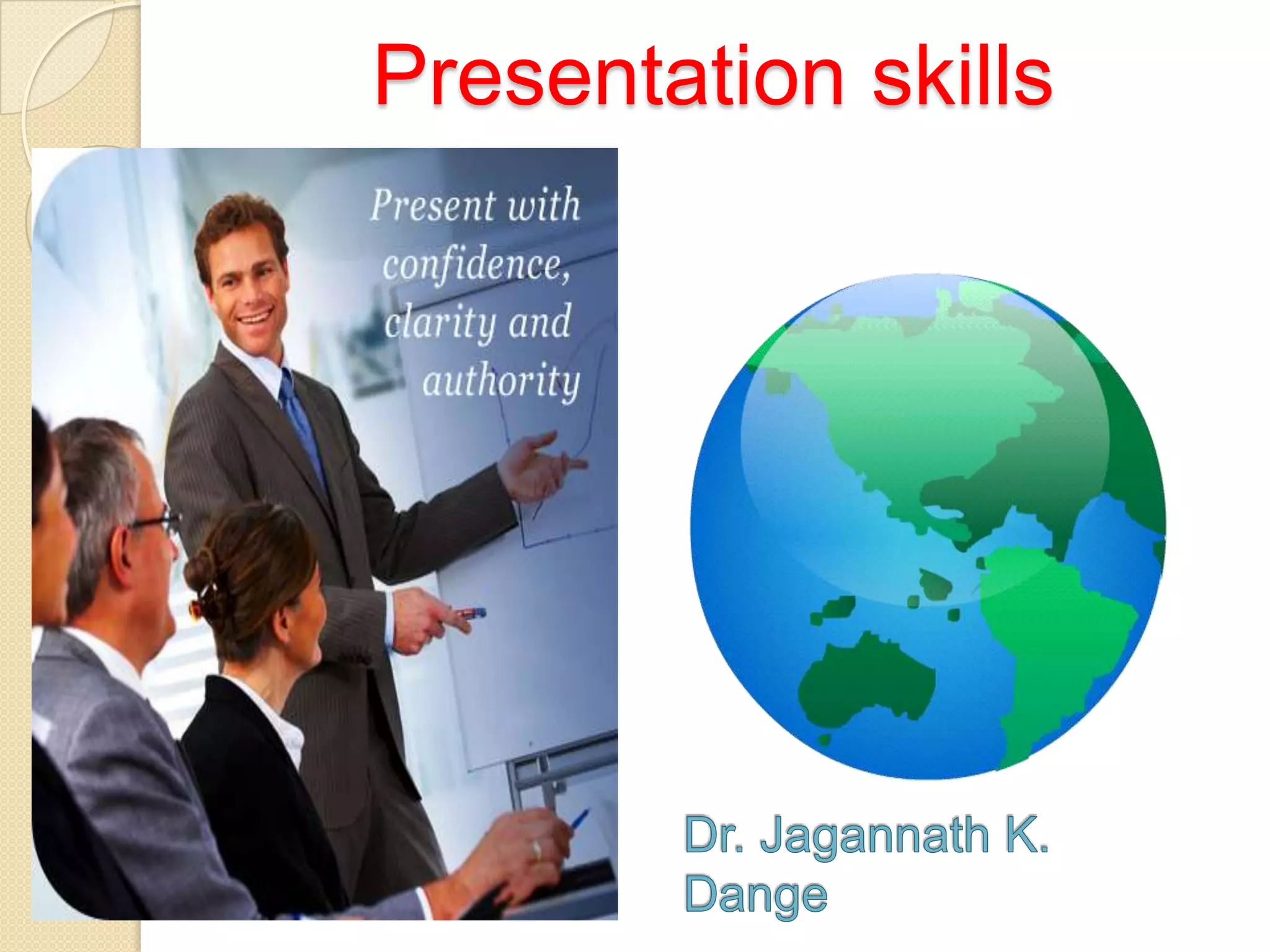
Presentation skills
You’re On! Effective Presentation Skills”


Good speakers/presenters are not born,
        they are developed.
Research has shown that most people would rather
die than give a speech.

Giving a presentation is a skill, like driving a car.
(video)
It can be learned.

A presentation is less formal. Its purpose is to teach
something to the audience.
It is used in classes, interviews, business meetings,
committees or groups.

A presentation is a form of communication with an
audience.
The object of a presentation is to transmit information
and opinion to the audience in your own words, within
a limited amount of time.
Consider:


Who  are the audience?
What points do U want to get across?
How much time have U got?
What Audio-visual aids are available? Power-point
projector? flip chart? Etc.,
GETTING STARTED

Who is your audience?
Begin with a reporter’s five questions of:
Who, What, When, Where and Why?

  Who will be in the audience?
Will they be colleagues, teachers, friends, children,
or a mixture? Will they be male or female?

Things to consider when assessing your audience:

Gender, Age, Occupation, Education, Religion,
Hobbies, Political Belief and Attitudes.
 What are the issues or concerns of your
audience?        How can you address
them?, what is the purpose of your
presentation?

When    will you be presenting?

    In the morning when the audience is alert
    or
    after lunch when the audience is full and a
    little sleepy?--- using a little humor or
    maybe an activity.
    Are there other speakers on the agenda?
 Where will you be presenting? In an auditorium,
   classroom, or outside?
   Consider how your audience is feeling. Are
they     comfortable in cushioned chairs in an
         auditorium.
   Will you be speaking in a noisy area?

Why have they come?            What does the
audience       expect to gain? Information, views
or to be entertained?

  When planning your presentation, write it so
you     would want to hear it, if you were in the
audience.
HAVE A STRUCTURE
Have a beginning, middle and an end.

The Basic presentation
                   Introduction(opening)

                   Welcome the audience.
                   Say what your presentation will be
                   about: the aims and objectives.

                   The introduction should catch the
                   attention.
                   Perhaps a provocative statement or a
                   humorous anecdote(story,tale).
The first thirty seconds are probably the most
important.

 In that period of time you must grab the attention of
the audience.

There are several effective opening techniques:

start with a thought-provoking question, make an
interesting or controversial statement, recite a
relevant quotation or recount a joke.

 Your opening should also indicate your subject (Tell
them what you are going to talk about).
Development(Body)

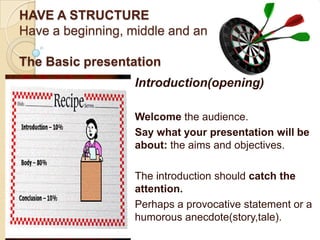
       largest part of your presentation, approximately
80%.

The body of the presentation should prove statements
made in the opening.

Formulate    a series of points.
Organize your points so as to follow one another so each
        point builds upon the previous one.
limit the main points. State the purpose, then
demonstrate, or       recapitulate.

Ways to demonstrate a point:

Appeal to reason, cite examples, quote statistics, quote
an authority, draw a comparison
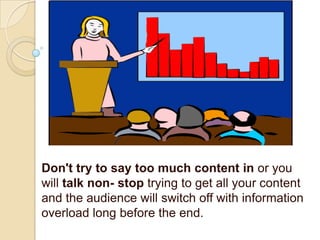
Don't try to say too much content in or you
will talk non- stop trying to get all your content
and the audience will switch off with information
overload long before the end.
Conclusion(closing)

*It should be approximately 10% of your presentation.
*The closing is just as important as the opening.
*It should be clever, thought provoking, strong, clear
and meaningful.
*This is your opportunity to sum it up.


Briefly summarise your main points.
Answer any questions.
Thank the audience for listening.
Look at the audience again, smile and slow down.

The end should be on a strong or positive note –
The above has been neatly summarised as

    "Tell them what you will tell them
(introduction), tell them (development),
      tell them what you told them
              (conclusion)"
USING AUDIO-VISUAL AIDS-
(POWERPOINT, OVERHEAD PROJECTOR OR FLIP CHART, etc.,)

  You may be allowed to use any AVA!

  then it's wise to try to practice on one
  beforehand so you know what you are doing!
Check    the computer and the lighting:
Stand to one side .
Face and speak to your audience, not the
screen.
 All too often the slides are just a security
blanket for the speaker,
Don't use too many slides:
Don't try to write too much on each slide: 30 to 40
words in a large font size is ample for one
transparency. The best slides contain just one
word.
Slides can contain prompts to remind you of,
what you will say next.
Use   a large (about 24 point) Don't put everything in
       upper case as this looks crude.

Use   colour and bold for emphasis

Pictures, especially tables, diagrams and
charts are good

A little   humour can grab the attention of the audience.

Don't  get carried away with flashy PowerPoint
       transition effects as these may distract
attention    form the content.
Write down main points on a postcard sized
piece of card as a prompt and also as a backup
in case the technology fails!

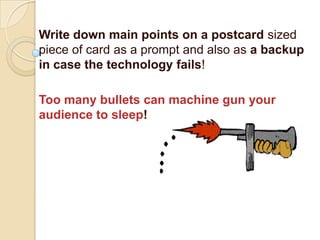
Too many bullets can machine gun your
audience to sleep!
Non-Verbal Delivery

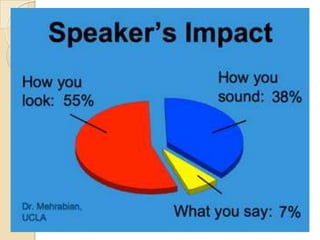
Non-Verbal communication is more powerful
than verbal communication.

 “Action Speaks Louder Than Words”

Body Language is any communication created
by your body. Ex: eye contact, gestures,
    expression, posture, appearance etc.
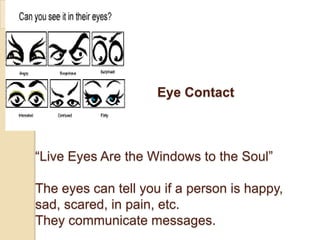
Eye Contact


“Live Eyes Are the Windows to the Soul”

The eyes can tell you if a person is happy,
sad, scared, in pain, etc.
They communicate messages.
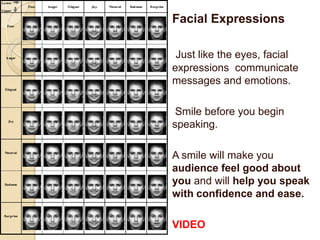
Facial Expressions

 Just like the eyes, facial
expressions communicate
messages and emotions.

 Smile before you begin
speaking.

A smile will make you
audience feel good about
you and will help you speak
with confidence and ease.

VIDEO
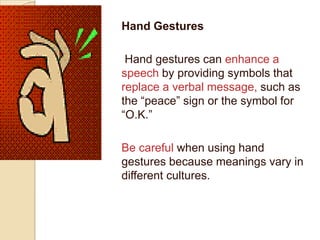
Hand Gestures

 Hand gestures can enhance a
speech by providing symbols that
replace a verbal message, such as
the “peace” sign or the symbol for
“O.K.”

Be careful when using hand
gestures because meanings vary in
different cultures.
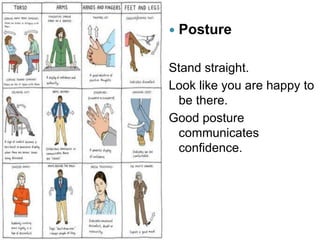
   Posture

Stand straight.
Look like you are happy to
 be there.
Good posture
 communicates
 confidence.
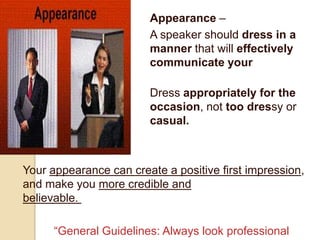
Appearance –
                        A speaker should dress in a
                        manner that will effectively
                        communicate your
message.
                        Dress appropriately for the
                        occasion, not too dressy or
too                     casual.


Your appearance can create a positive first impression,
and make you more credible and
believable.

      “General Guidelines: Always look professional
CONQUERING SPEECH ANXIETY


 Do you have "Stage Fright?“ Find out here
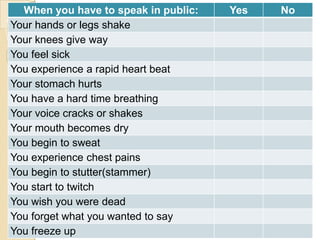
When you have to speak in public:   Yes   No
Your hands or legs shake
Your knees give way
You feel sick
You experience a rapid heart beat
Your stomach hurts
You have a hard time breathing
Your voice cracks or shakes
Your mouth becomes dry
You begin to sweat
You experience chest pains
You begin to stutter(stammer)
You start to twitch
You wish you were dead
You forget what you wanted to say
You freeze up
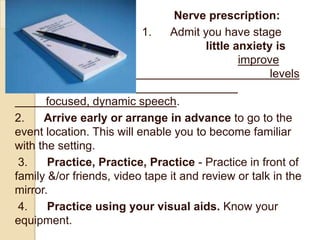
Nerve prescription:
                          1.    Admit you have stage
fight. A                               little anxiety is
good. It will                                  improve
recall, raise energy                                 levels
and make for a more
       focused, dynamic speech.
2.     Arrive early or arrange in advance to go to the
event location. This will enable you to become familiar
with the setting.
 3.     Practice, Practice, Practice - Practice in front of
family &/or friends, video tape it and review or talk in the
mirror.
 4.     Practice using your visual aids. Know your
equipment.
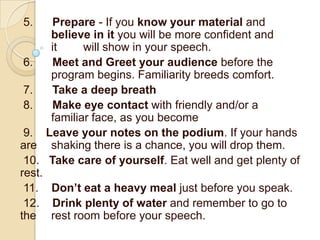
5.    Prepare - If you know your material and
      believe in it you will be more confident and
      it     will show in your speech.
 6.   Meet and Greet your audience before the
      program begins. Familiarity breeds comfort.
 7.   Take a deep breath
 8.   Make eye contact with friendly and/or a
      familiar face, as you become
 9. Leave your notes on the podium. If your hands
are shaking there is a chance, you will drop them.
 10. Take care of yourself. Eat well and get plenty of
rest.
 11. Don’t eat a heavy meal just before you speak.
 12. Drink plenty of water and remember to go to
the rest room before your speech.
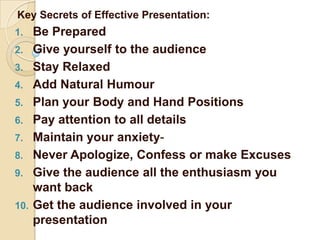
Key Secrets of Effective Presentation:
1.    Be Prepared
2.    Give yourself to the audience
3.    Stay Relaxed
4.    Add Natural Humour
5.    Plan your Body and Hand Positions
6.    Pay attention to all details
7.    Maintain your anxiety-
8.    Never Apologize, Confess or make Excuses
9.    Give the audience all the enthusiasm you
      want back
10.   Get the audience involved in your
      presentation
It is very important that you pay attention to
even the smallest details. You can never over
                      plan.

  The person, who fails to plan, is actually
           planning for a failure
Thank You
   Dr. Jagannath K. Dange
   Department of Education
   Kuvempu University
   Shankaraghatta
   Dist: Shimoga

   jkdange@gmail.com
   http://jkdange.blogspot.com

Presentation skills

  • 1.
  • 2.
    You’re On! EffectivePresentation Skills” Good speakers/presenters are not born, they are developed.
  • 3.
    Research has shownthat most people would rather die than give a speech. Giving a presentation is a skill, like driving a car. (video) It can be learned. A presentation is less formal. Its purpose is to teach something to the audience. It is used in classes, interviews, business meetings, committees or groups. A presentation is a form of communication with an audience. The object of a presentation is to transmit information and opinion to the audience in your own words, within a limited amount of time.
  • 4.
    Consider: Who arethe audience? What points do U want to get across? How much time have U got? What Audio-visual aids are available? Power-point projector? flip chart? Etc.,
  • 5.
    GETTING STARTED Who isyour audience? Begin with a reporter’s five questions of: Who, What, When, Where and Why?  Who will be in the audience? Will they be colleagues, teachers, friends, children, or a mixture? Will they be male or female? Things to consider when assessing your audience: Gender, Age, Occupation, Education, Religion, Hobbies, Political Belief and Attitudes.
  • 6.
     What arethe issues or concerns of your audience? How can you address them?, what is the purpose of your presentation? When will you be presenting? In the morning when the audience is alert or after lunch when the audience is full and a little sleepy?--- using a little humor or maybe an activity. Are there other speakers on the agenda?
  • 7.
     Where willyou be presenting? In an auditorium, classroom, or outside? Consider how your audience is feeling. Are they comfortable in cushioned chairs in an auditorium. Will you be speaking in a noisy area? Why have they come? What does the audience expect to gain? Information, views or to be entertained? When planning your presentation, write it so you would want to hear it, if you were in the audience.
  • 10.
    HAVE A STRUCTURE Havea beginning, middle and an end. The Basic presentation Introduction(opening) Welcome the audience. Say what your presentation will be about: the aims and objectives. The introduction should catch the attention. Perhaps a provocative statement or a humorous anecdote(story,tale).
  • 11.
    The first thirtyseconds are probably the most important. In that period of time you must grab the attention of the audience. There are several effective opening techniques: start with a thought-provoking question, make an interesting or controversial statement, recite a relevant quotation or recount a joke. Your opening should also indicate your subject (Tell them what you are going to talk about).
  • 12.
    Development(Body) largest part of your presentation, approximately 80%. The body of the presentation should prove statements made in the opening. Formulate a series of points. Organize your points so as to follow one another so each point builds upon the previous one. limit the main points. State the purpose, then demonstrate, or recapitulate. Ways to demonstrate a point: Appeal to reason, cite examples, quote statistics, quote an authority, draw a comparison
  • 13.
    Don't try tosay too much content in or you will talk non- stop trying to get all your content and the audience will switch off with information overload long before the end.
  • 14.
    Conclusion(closing) *It should beapproximately 10% of your presentation. *The closing is just as important as the opening. *It should be clever, thought provoking, strong, clear and meaningful. *This is your opportunity to sum it up. Briefly summarise your main points. Answer any questions. Thank the audience for listening. Look at the audience again, smile and slow down. The end should be on a strong or positive note –
  • 15.
    The above hasbeen neatly summarised as "Tell them what you will tell them (introduction), tell them (development), tell them what you told them (conclusion)"
  • 16.
    USING AUDIO-VISUAL AIDS- (POWERPOINT,OVERHEAD PROJECTOR OR FLIP CHART, etc.,) You may be allowed to use any AVA! then it's wise to try to practice on one beforehand so you know what you are doing!
  • 17.
    Check the computer and the lighting: Stand to one side . Face and speak to your audience, not the screen.  All too often the slides are just a security blanket for the speaker, Don't use too many slides: Don't try to write too much on each slide: 30 to 40 words in a large font size is ample for one transparency. The best slides contain just one word. Slides can contain prompts to remind you of, what you will say next.
  • 18.
    Use a large (about 24 point) Don't put everything in upper case as this looks crude. Use colour and bold for emphasis Pictures, especially tables, diagrams and charts are good A little humour can grab the attention of the audience. Don't get carried away with flashy PowerPoint transition effects as these may distract attention form the content.
  • 19.
    Write down mainpoints on a postcard sized piece of card as a prompt and also as a backup in case the technology fails! Too many bullets can machine gun your audience to sleep!
  • 20.
    Non-Verbal Delivery Non-Verbal communicationis more powerful than verbal communication. “Action Speaks Louder Than Words” Body Language is any communication created by your body. Ex: eye contact, gestures, expression, posture, appearance etc.
  • 21.
    Eye Contact “Live EyesAre the Windows to the Soul” The eyes can tell you if a person is happy, sad, scared, in pain, etc. They communicate messages.
  • 22.
    Facial Expressions Justlike the eyes, facial expressions communicate messages and emotions. Smile before you begin speaking. A smile will make you audience feel good about you and will help you speak with confidence and ease. VIDEO
  • 23.
    Hand Gestures Handgestures can enhance a speech by providing symbols that replace a verbal message, such as the “peace” sign or the symbol for “O.K.” Be careful when using hand gestures because meanings vary in different cultures.
  • 24.
    Posture Stand straight. Look like you are happy to be there. Good posture communicates confidence.
  • 26.
    Appearance – A speaker should dress in a manner that will effectively communicate your message. Dress appropriately for the occasion, not too dressy or too casual. Your appearance can create a positive first impression, and make you more credible and believable. “General Guidelines: Always look professional
  • 27.
    CONQUERING SPEECH ANXIETY Do you have "Stage Fright?“ Find out here
  • 28.
    When you haveto speak in public: Yes No Your hands or legs shake Your knees give way You feel sick You experience a rapid heart beat Your stomach hurts You have a hard time breathing Your voice cracks or shakes Your mouth becomes dry You begin to sweat You experience chest pains You begin to stutter(stammer) You start to twitch You wish you were dead You forget what you wanted to say You freeze up
  • 29.
    Nerve prescription: 1. Admit you have stage fight. A little anxiety is good. It will improve recall, raise energy levels and make for a more focused, dynamic speech. 2. Arrive early or arrange in advance to go to the event location. This will enable you to become familiar with the setting. 3. Practice, Practice, Practice - Practice in front of family &/or friends, video tape it and review or talk in the mirror. 4. Practice using your visual aids. Know your equipment.
  • 30.
    5. Prepare - If you know your material and believe in it you will be more confident and it will show in your speech. 6. Meet and Greet your audience before the program begins. Familiarity breeds comfort. 7. Take a deep breath 8. Make eye contact with friendly and/or a familiar face, as you become 9. Leave your notes on the podium. If your hands are shaking there is a chance, you will drop them. 10. Take care of yourself. Eat well and get plenty of rest. 11. Don’t eat a heavy meal just before you speak. 12. Drink plenty of water and remember to go to the rest room before your speech.
  • 31.
    Key Secrets ofEffective Presentation: 1. Be Prepared 2. Give yourself to the audience 3. Stay Relaxed 4. Add Natural Humour 5. Plan your Body and Hand Positions 6. Pay attention to all details 7. Maintain your anxiety- 8. Never Apologize, Confess or make Excuses 9. Give the audience all the enthusiasm you want back 10. Get the audience involved in your presentation
  • 32.
    It is veryimportant that you pay attention to even the smallest details. You can never over plan. The person, who fails to plan, is actually planning for a failure
  • 33.
    Thank You Dr. Jagannath K. Dange Department of Education Kuvempu University Shankaraghatta Dist: Shimoga jkdange@gmail.com http://jkdange.blogspot.com