PRESENTATION
SKILLS
There are always three speeches, for every one
you actually gave. The one you practiced, the one
you gave, and the one you wish you gave."
-- Dale Carnegie
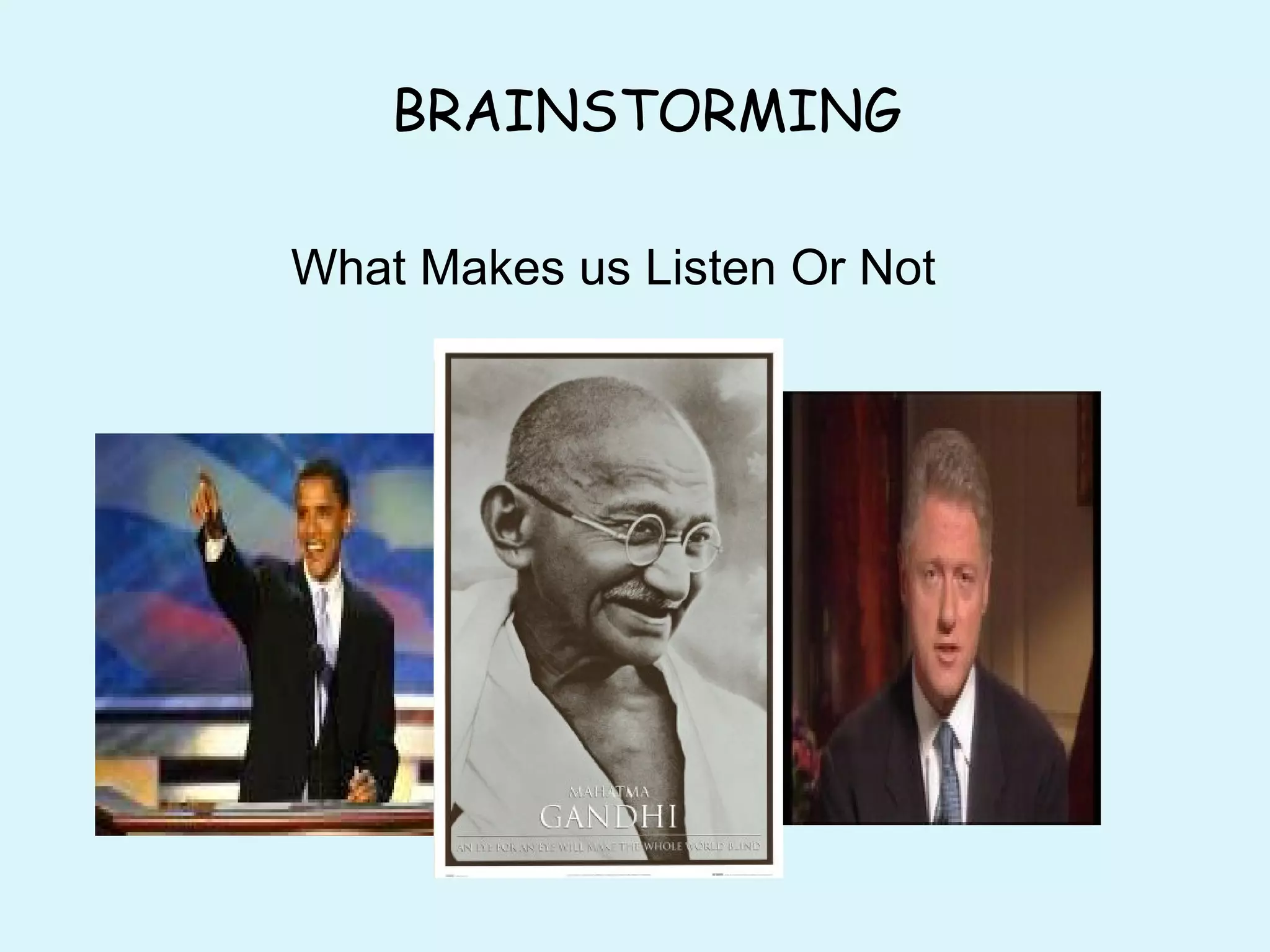
What Makes us Listen Or Not
 
BRAINSTORMING
PART 1—WHAT ARE PRESENTATIONS ?
PART 2—ELEMENTS OF PRESENTATIONS.
PART 3—HOW TO PRESENT WELL.
PART 4—ORAL PRESENTATIONS
PART 5—POSTER PRESENTATION
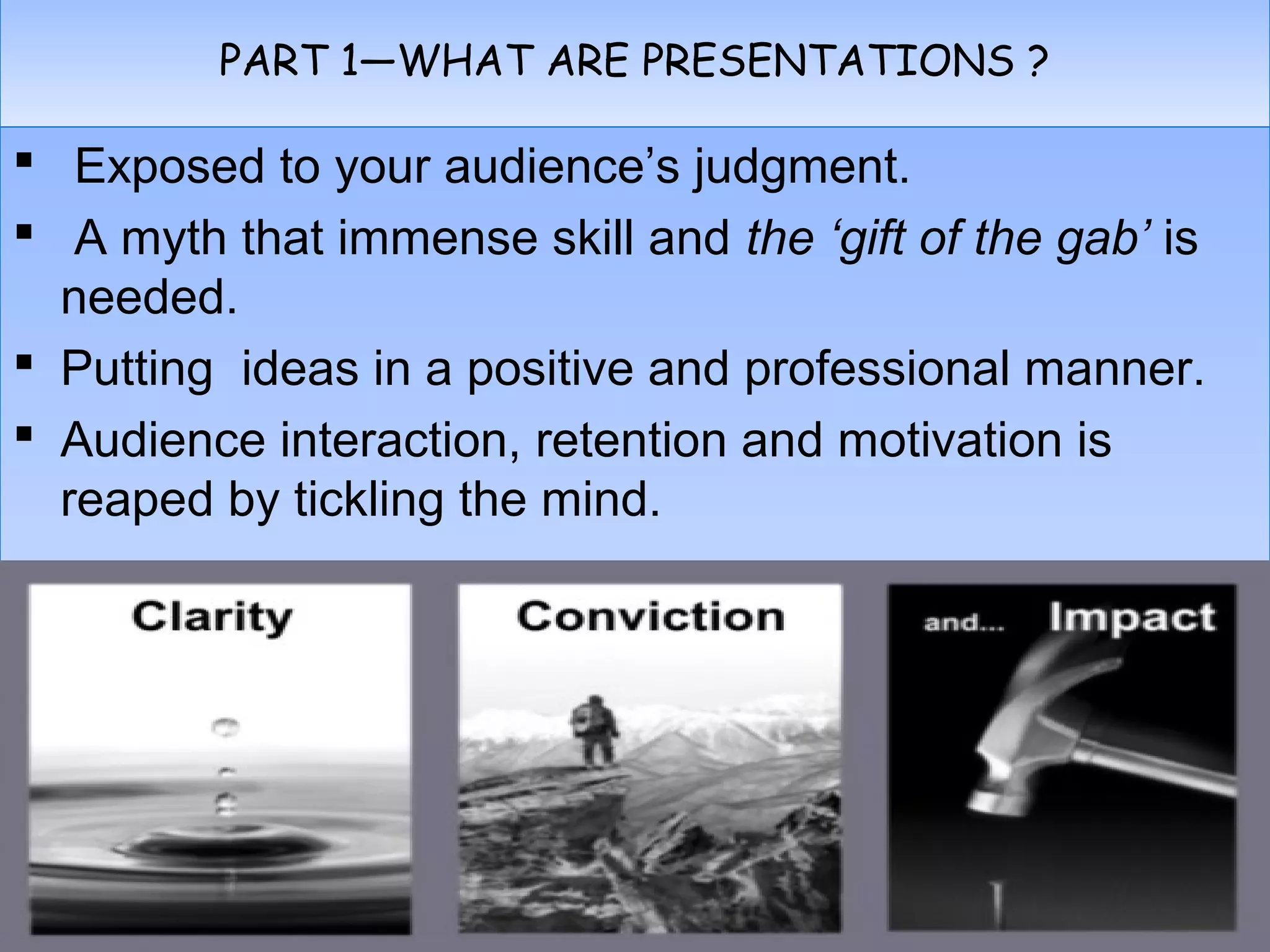
PART 1—WHAT ARE PRESENTATIONS ?PART 1—WHAT ARE PRESENTATIONS ?
 Exposed to your audience’s judgment.
 A myth that immense skill and the ‘gift of the gab’ is
needed.
 Putting ideas in a positive and professional manner.
 Audience interaction, retention and motivation is
reaped by tickling the mind.
 Exposed to your audience’s judgment.
 A myth that immense skill and the ‘gift of the gab’ is
needed.
 Putting ideas in a positive and professional manner.
 Audience interaction, retention and motivation is
reaped by tickling the mind.
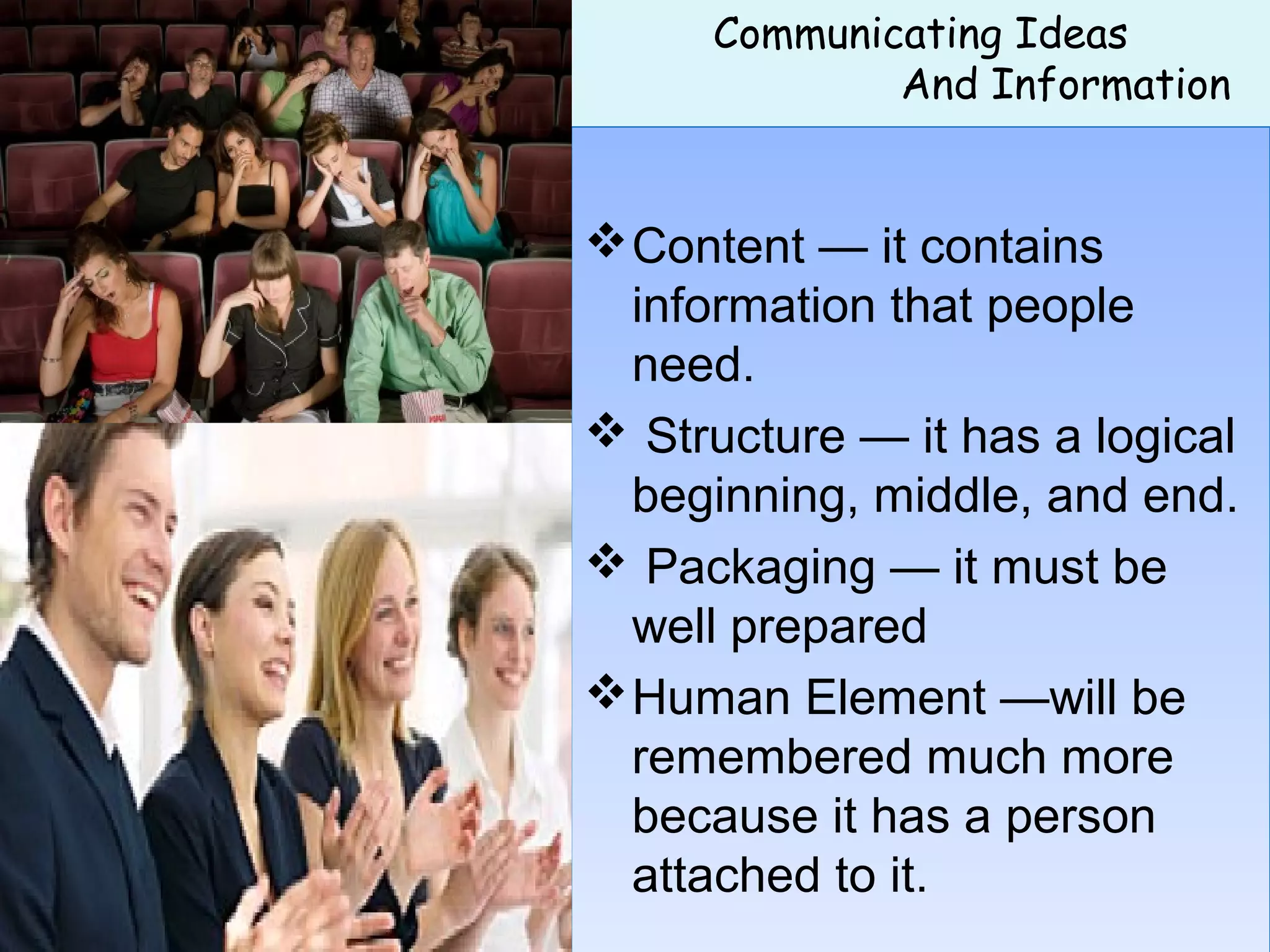
Communicating Ideas
And Information
 
Content — it contains
information that people
need.
 Structure — it has a logical
beginning, middle, and end.
 Packaging — it must be
well prepared
Human Element —will be
remembered much more
because it has a person
attached to it.
Content — it contains
information that people
need.
 Structure — it has a logical
beginning, middle, and end.
 Packaging — it must be
well prepared
Human Element —will be
remembered much more
because it has a person
attached to it.
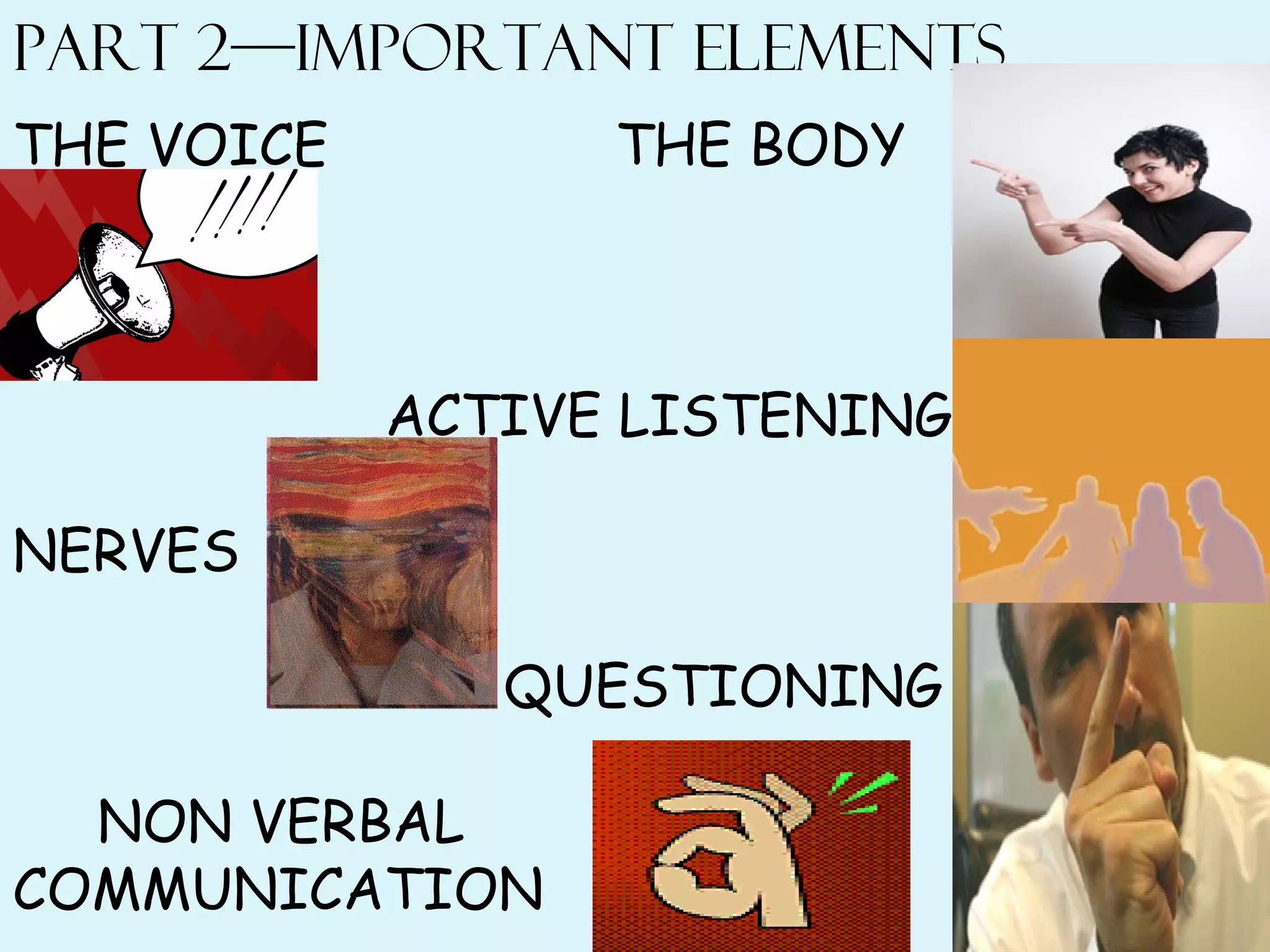
PART 2—IMPORTANT ELEMENTS
THE VOICE THE BODY
ACTIVE LISTENING
NERVES
QUESTIONING
NON VERBAL
COMMUNICATION
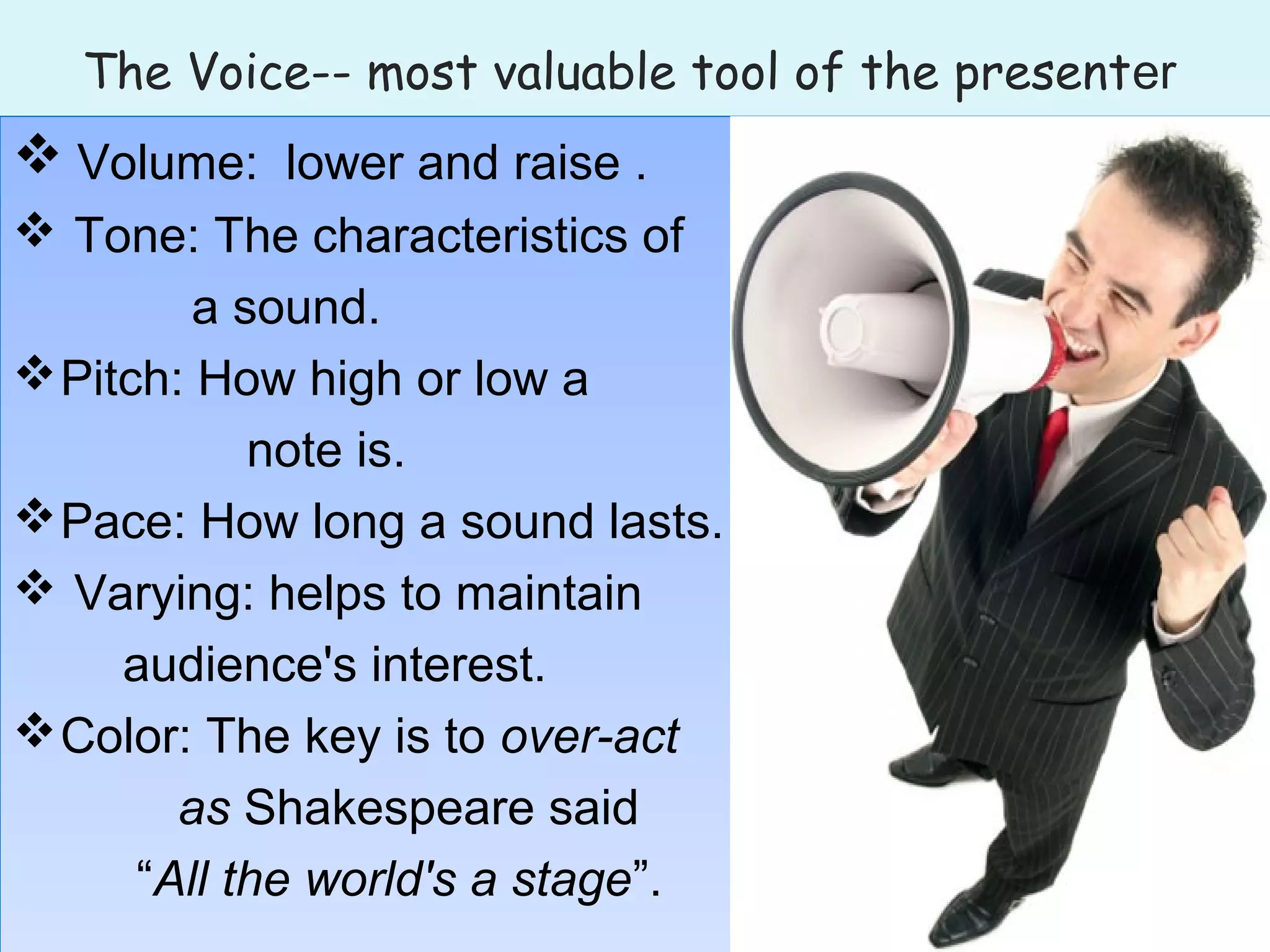
The Voice-- most valuable tool of the presenter
 Volume: lower and raise .
 Tone: The characteristics of
a sound.
Pitch: How high or low a
note is.
Pace: How long a sound lasts.
 Varying: helps to maintain
audience's interest.
Color: The key is to over-act
as Shakespeare said
“All the world's a stage”.
 Volume: lower and raise .
 Tone: The characteristics of
a sound.
Pitch: How high or low a
note is.
Pace: How long a sound lasts.
 Varying: helps to maintain
audience's interest.
Color: The key is to over-act
as Shakespeare said
“All the world's a stage”.
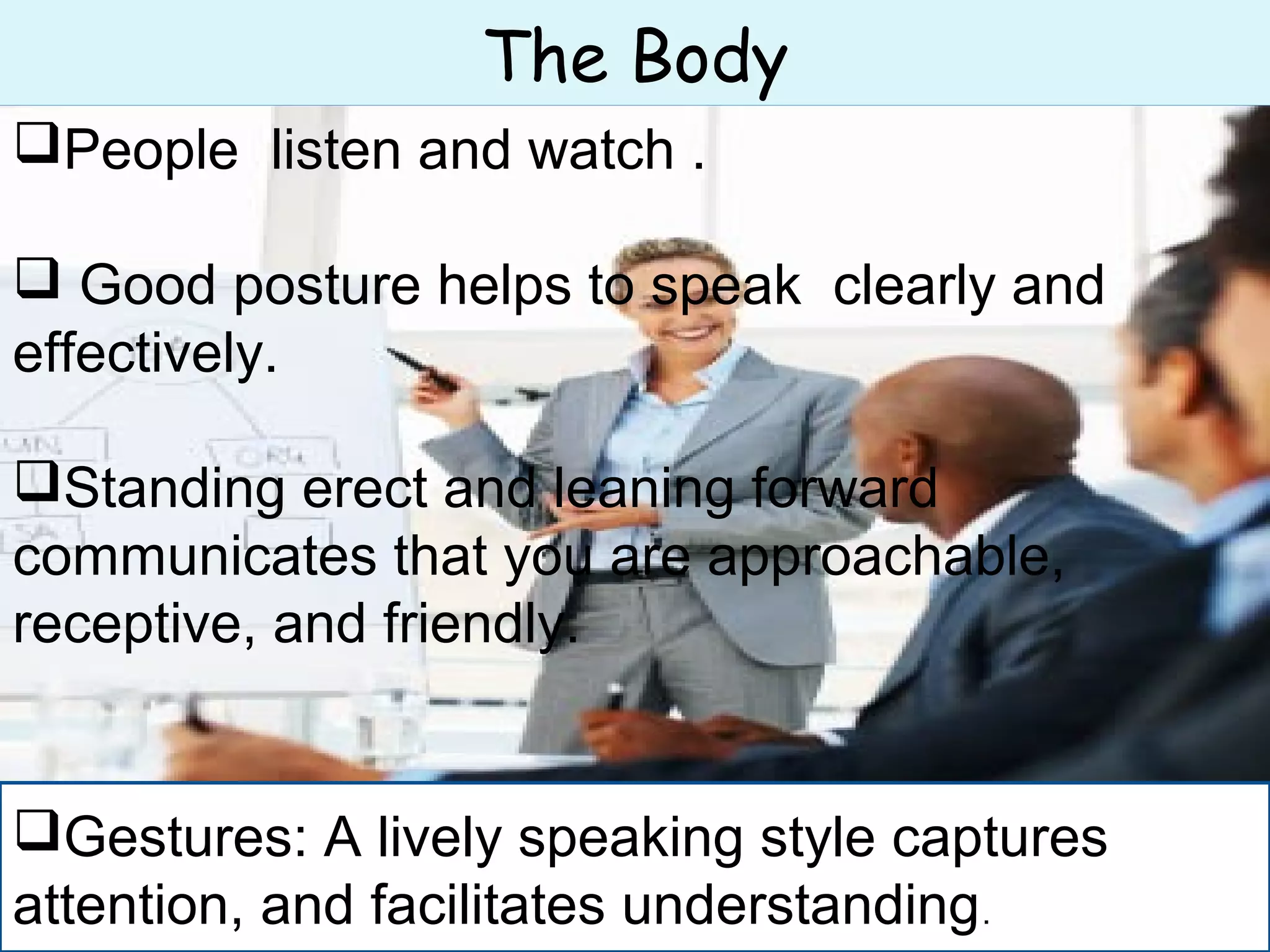
The Body
People listen and watch .
 Good posture helps to speak clearly and
effectively.
Standing erect and leaning forward
communicates that you are approachable,
receptive, and friendly.
Gestures: A lively speaking style captures
attention, and facilitates understanding.
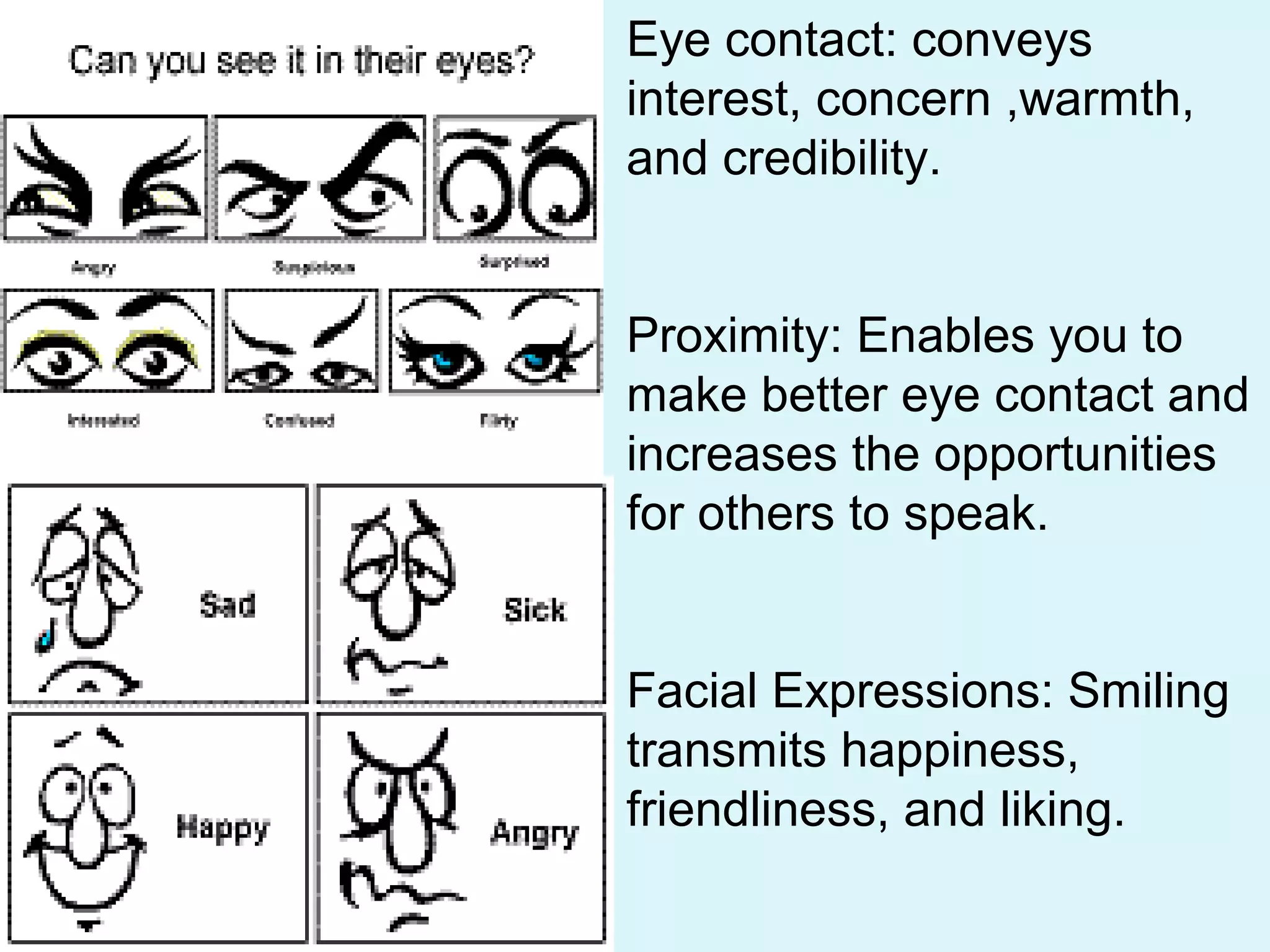
Eye contact: conveys
interest, concern ,warmth,
and credibility.
Proximity: Enables you to
make better eye contact and
increases the opportunities
for others to speak.
Facial Expressions: Smiling
transmits happiness,
friendliness, and liking.
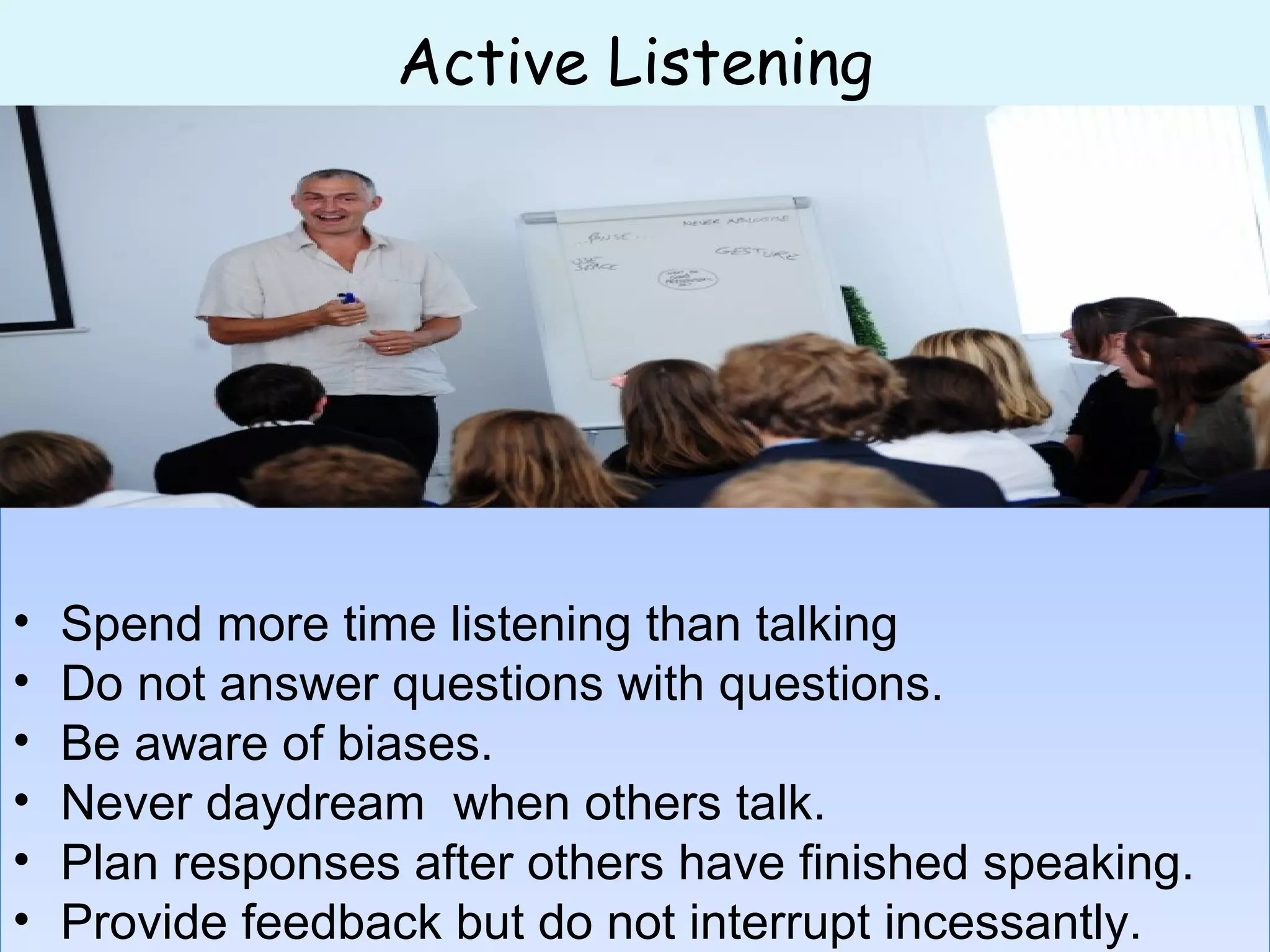
Active Listening
• Spend more time listening than talking
• Do not answer questions with questions.
• Be aware of biases.
• Never daydream when others talk.
• Plan responses after others have finished speaking.
• Provide feedback but do not interrupt incessantly.
• Spend more time listening than talking
• Do not answer questions with questions.
• Be aware of biases.
• Never daydream when others talk.
• Plan responses after others have finished speaking.
• Provide feedback but do not interrupt incessantly.
Nerves ---Reduce Tension
o Mental Visualization: Mentally
go over what you are going to
do.
o During the presentation: Take a
moment to yourself ,relax the
tenseness of your body, saying
to yourself, “I can do it!”.
o Channel the energy into
concentration and
expressiveness.
o The key is to continue on after
the mistake, and so will the
audience. Winners continue!
Losers stop!
o Never drink alcohol to reduce
tension!
o Mental Visualization: Mentally
go over what you are going to
do.
o During the presentation: Take a
moment to yourself ,relax the
tenseness of your body, saying
to yourself, “I can do it!”.
o Channel the energy into
concentration and
expressiveness.
o The key is to continue on after
the mistake, and so will the
audience. Winners continue!
Losers stop!
o Never drink alcohol to reduce
tension!
Questioning
• Always allow time at the end of the presentation for
questions.
• If you do not know the answer, be honest, do not
waffle.
• Answers that last 10 to 40 seconds work best.
• Always allow time at the end of the presentation for
questions.
• If you do not know the answer, be honest, do not
waffle.
• Answers that last 10 to 40 seconds work best.
Keep cool if a questioner
disagrees with you.
Try to find a way to agree
with part of their argument.
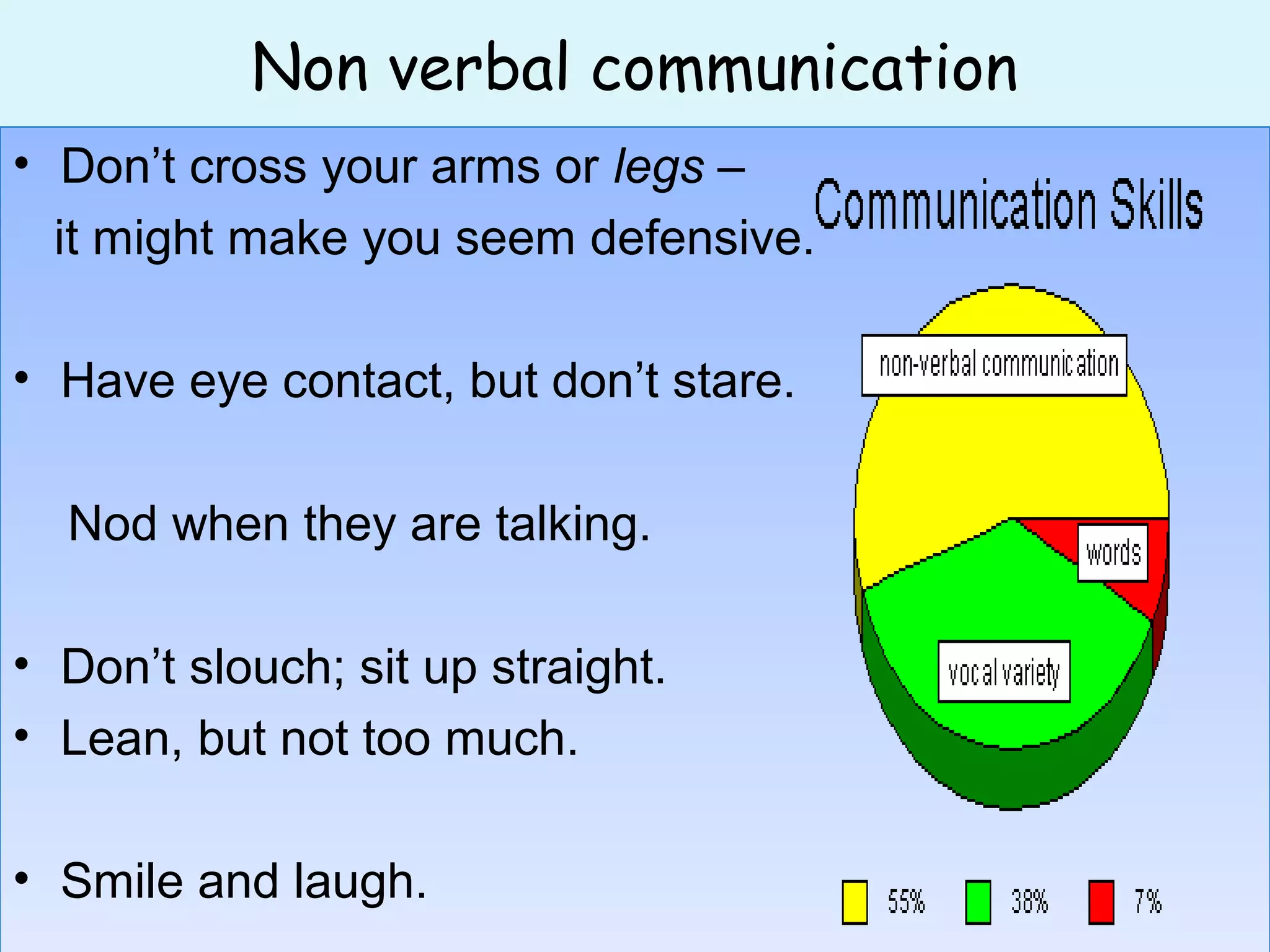
Non verbal communication
• Don’t cross your arms or legs –
it might make you seem defensive.
• Have eye contact, but don’t stare.
Nod when they are talking.
• Don’t slouch; sit up straight.
• Lean, but not too much.
• Smile and laugh.
• Don’t cross your arms or legs –
it might make you seem defensive.
• Have eye contact, but don’t stare.
Nod when they are talking.
• Don’t slouch; sit up straight.
• Lean, but not too much.
• Smile and laugh.
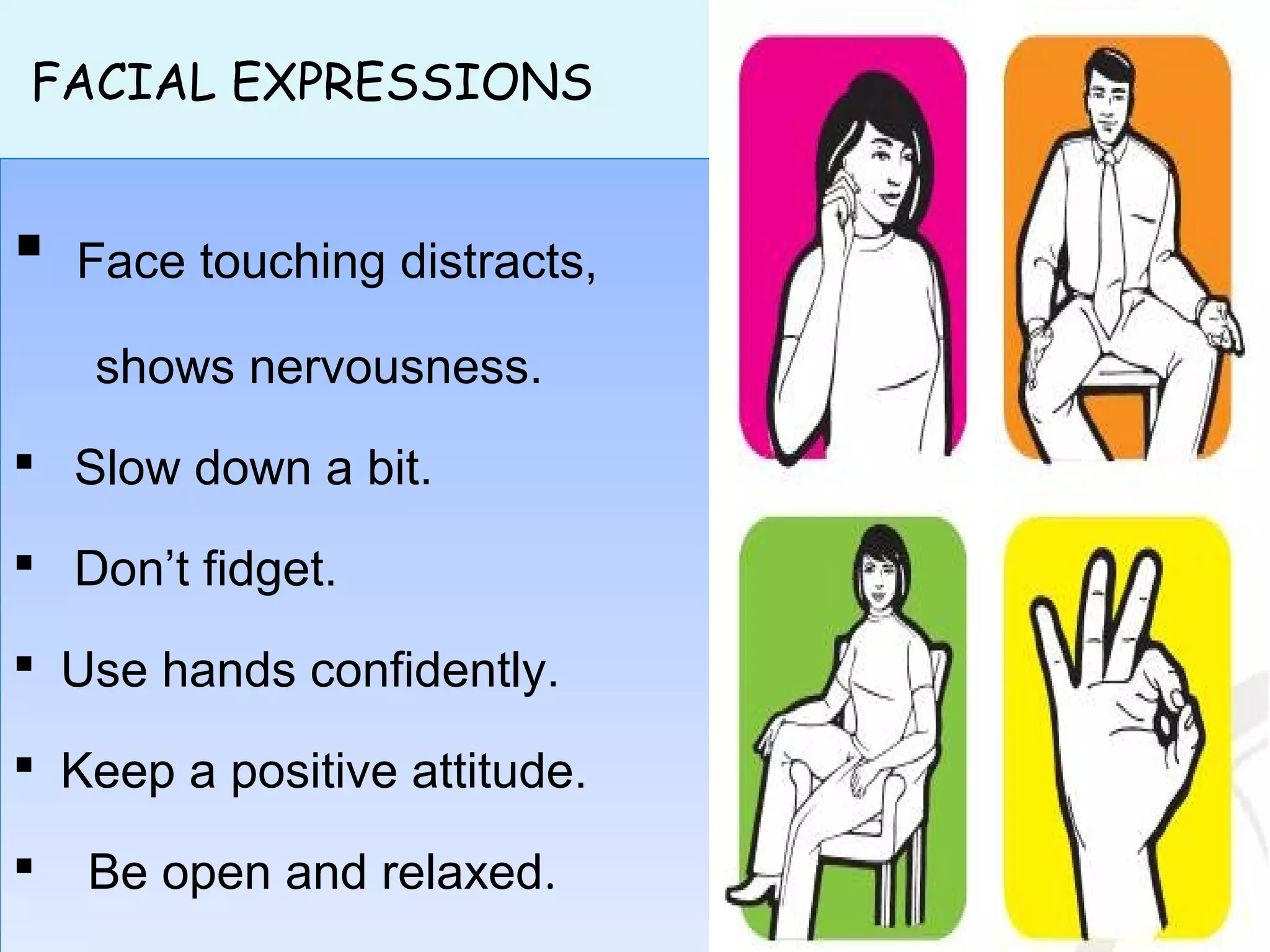
FACIAL EXPRESSIONS
 Face touching distracts,
shows nervousness.
 Slow down a bit.
 Don’t fidget.
 Use hands confidently.
 Keep a positive attitude.
 Be open and relaxed.
 Face touching distracts,
shows nervousness.
 Slow down a bit.
 Don’t fidget.
 Use hands confidently.
 Keep a positive attitude.
 Be open and relaxed.
Self Assessment Quiz.
3-Always / 2- Usually / 1-Sometimes / 0-Never.
1. During presentations I manage my anxiety to use as positive
energy.
2. I know how to reduce stress associated with presentations.
3. I identify the specific “audience- focused” objectives for my
presentations.
4. I evaluate the physical environment in which the presentation
is to be made.
5. To add passion, power and pizzazz to my presentation, I
practice the finished version several times.
6. I do not attempt to put too much information in my visuals.
7. I make certain to use eye contact with different members of
the audience.
8 I monitor my facial expressions and consciously use a variety
of expressions.
9 I vary the pitch, volume, tone and pace of my voice.
10 I look for the opportunities to use stories and real life
illustrations.
11 I use a variety if visuals in my presentation.
12 I am comfortable conducting a Q &A as part of the
presentation.
13 As part of preparation I spend time anticipating likely
audience questions.
14 I try to align the non-verbal messages of body language
match the words I am verbalizing.
15 After the presentation I take time to get feedback and assess
my effectiveness so as to develop a plan for improvement.
TOTAL SCORE 45-37 / 36-16 Average / Below 15 Low
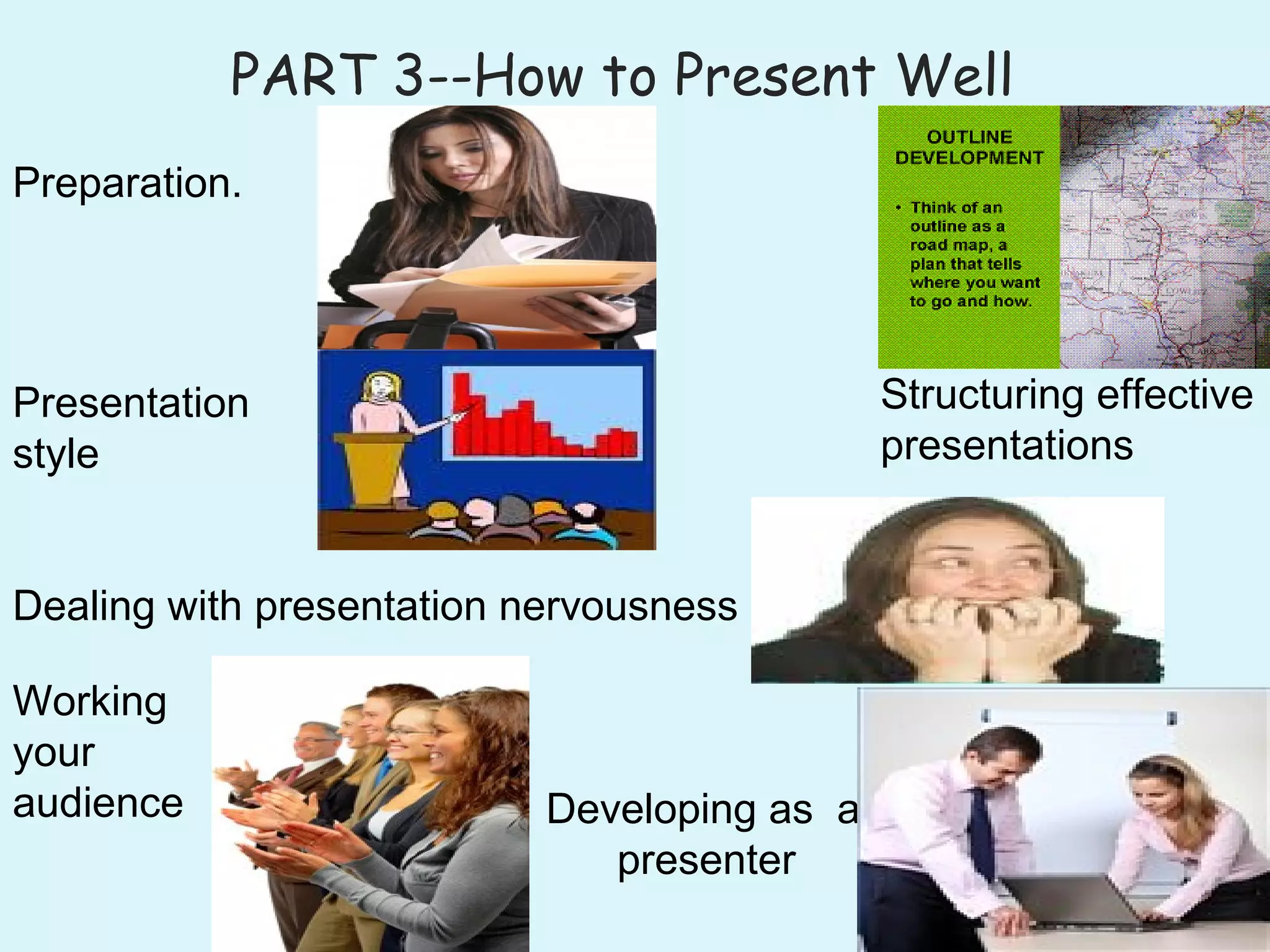
PART 3--How to Present Well
Preparation.
Presentation
style
Dealing with presentation nervousness
Developing as a
presenter
Working
your
audience
Structuring effective
presentations
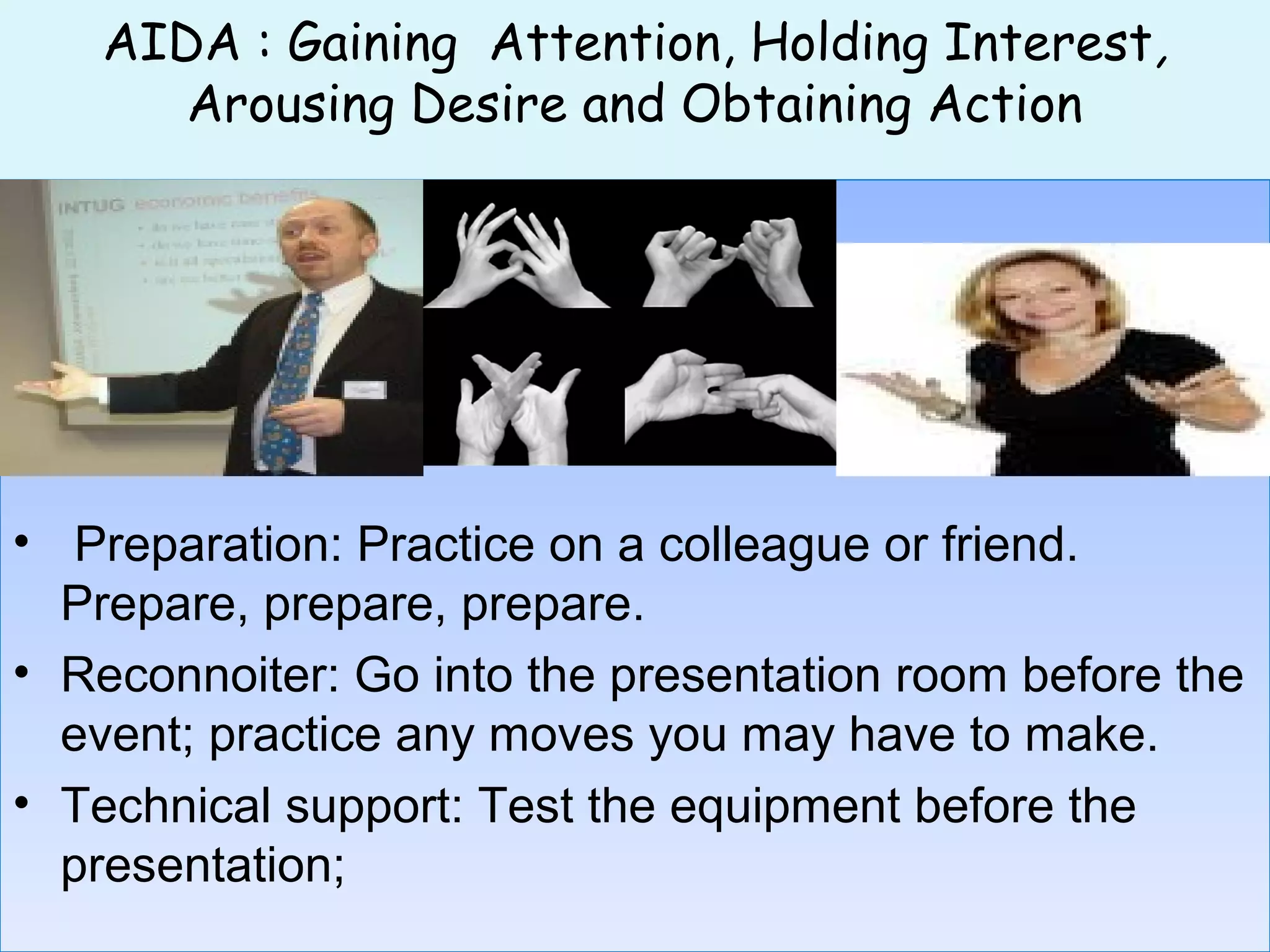
AIDA : Gaining Attention, Holding Interest,
Arousing Desire and Obtaining Action
• Preparation: Practice on a colleague or friend.
Prepare, prepare, prepare.
• Reconnoiter: Go into the presentation room before the
event; practice any moves you may have to make.
• Technical support: Test the equipment before the
presentation;
• Preparation: Practice on a colleague or friend.
Prepare, prepare, prepare.
• Reconnoiter: Go into the presentation room before the
event; practice any moves you may have to make.
• Technical support: Test the equipment before the
presentation;
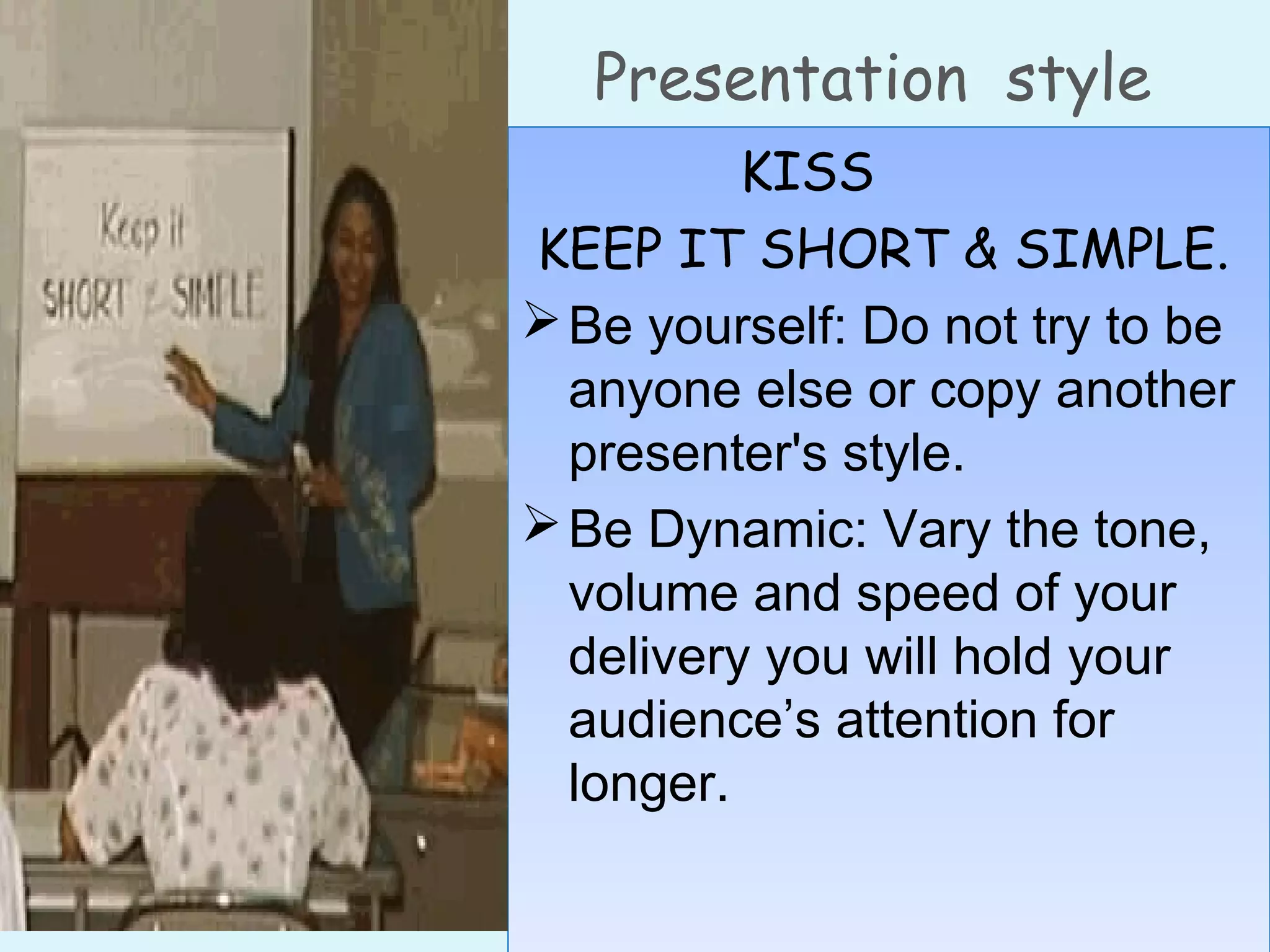
Presentation style
KISS
KEEP IT SHORT & SIMPLE. 
Be yourself: Do not try to be
anyone else or copy another
presenter's style.
Be Dynamic: Vary the tone,
volume and speed of your
delivery you will hold your
audience’s attention for
longer.
KISS
KEEP IT SHORT & SIMPLE. 
Be yourself: Do not try to be
anyone else or copy another
presenter's style.
Be Dynamic: Vary the tone,
volume and speed of your
delivery you will hold your
audience’s attention for
longer.
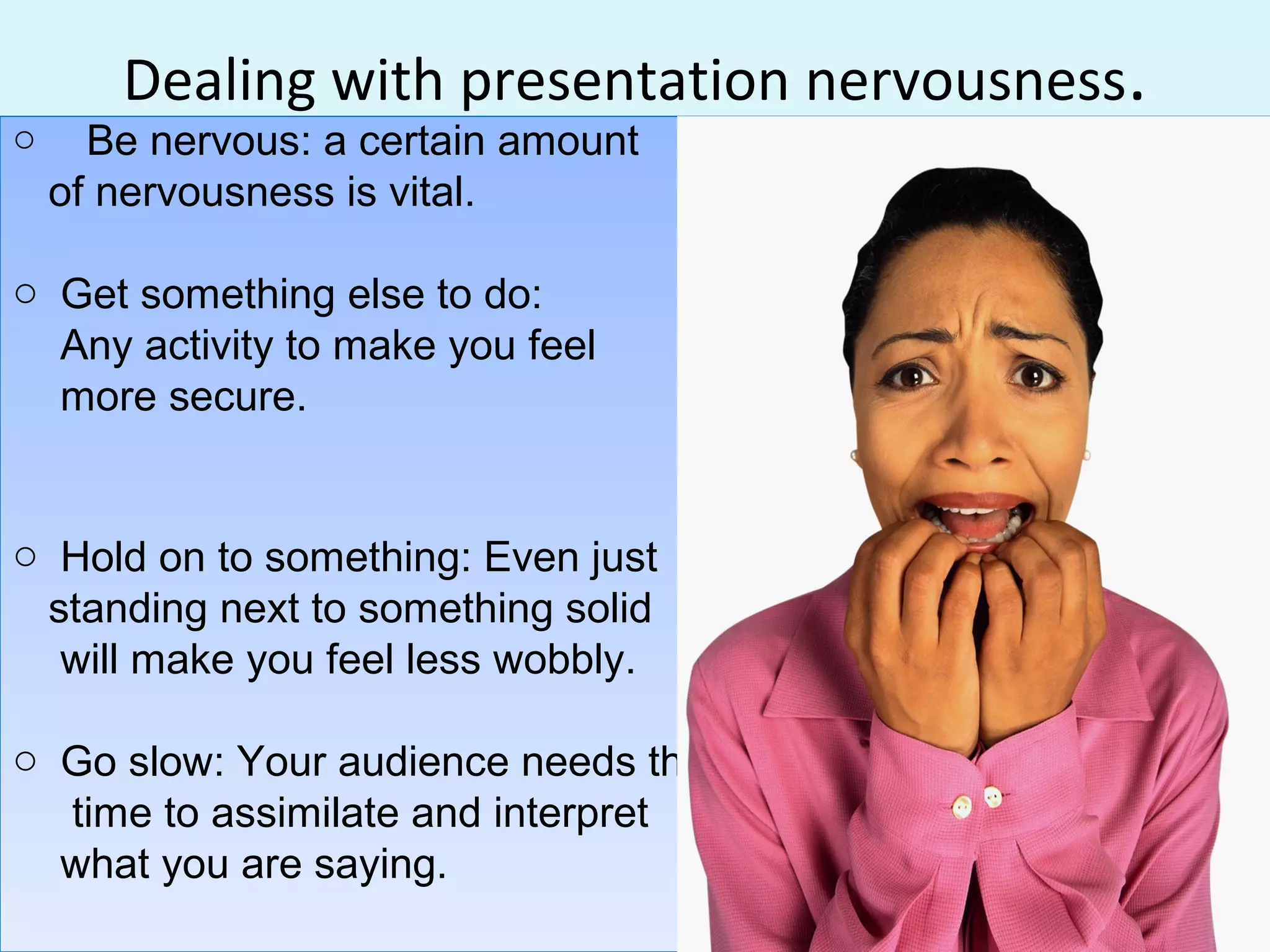
Dealing with presentation nervousness.
o Be nervous: a certain amount
of nervousness is vital.
o Get something else to do:
Any activity to make you feel
more secure.
o Hold on to something: Even just
standing next to something solid
will make you feel less wobbly.
o Go slow: Your audience needs the
time to assimilate and interpret
what you are saying.
o Be nervous: a certain amount
of nervousness is vital.
o Get something else to do:
Any activity to make you feel
more secure.
o Hold on to something: Even just
standing next to something solid
will make you feel less wobbly.
o Go slow: Your audience needs the
time to assimilate and interpret
what you are saying.
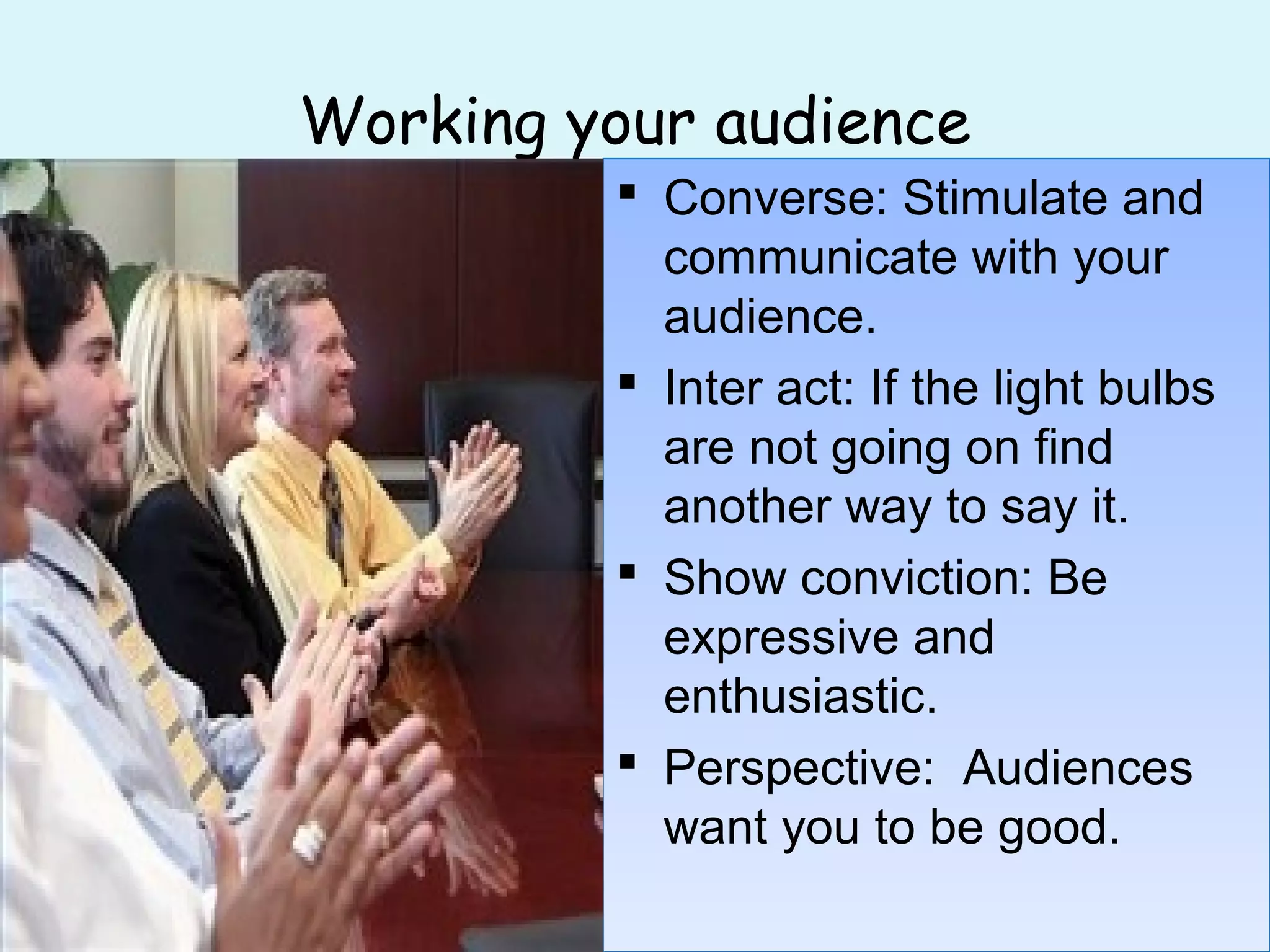
Working your audience
 Converse: Stimulate and
communicate with your
audience.
 Inter act: If the light bulbs
are not going on find
another way to say it.
 Show conviction: Be
expressive and
enthusiastic.
 Perspective: Audiences
want you to be good.
 Converse: Stimulate and
communicate with your
audience.
 Inter act: If the light bulbs
are not going on find
another way to say it.
 Show conviction: Be
expressive and
enthusiastic.
 Perspective: Audiences
want you to be good.
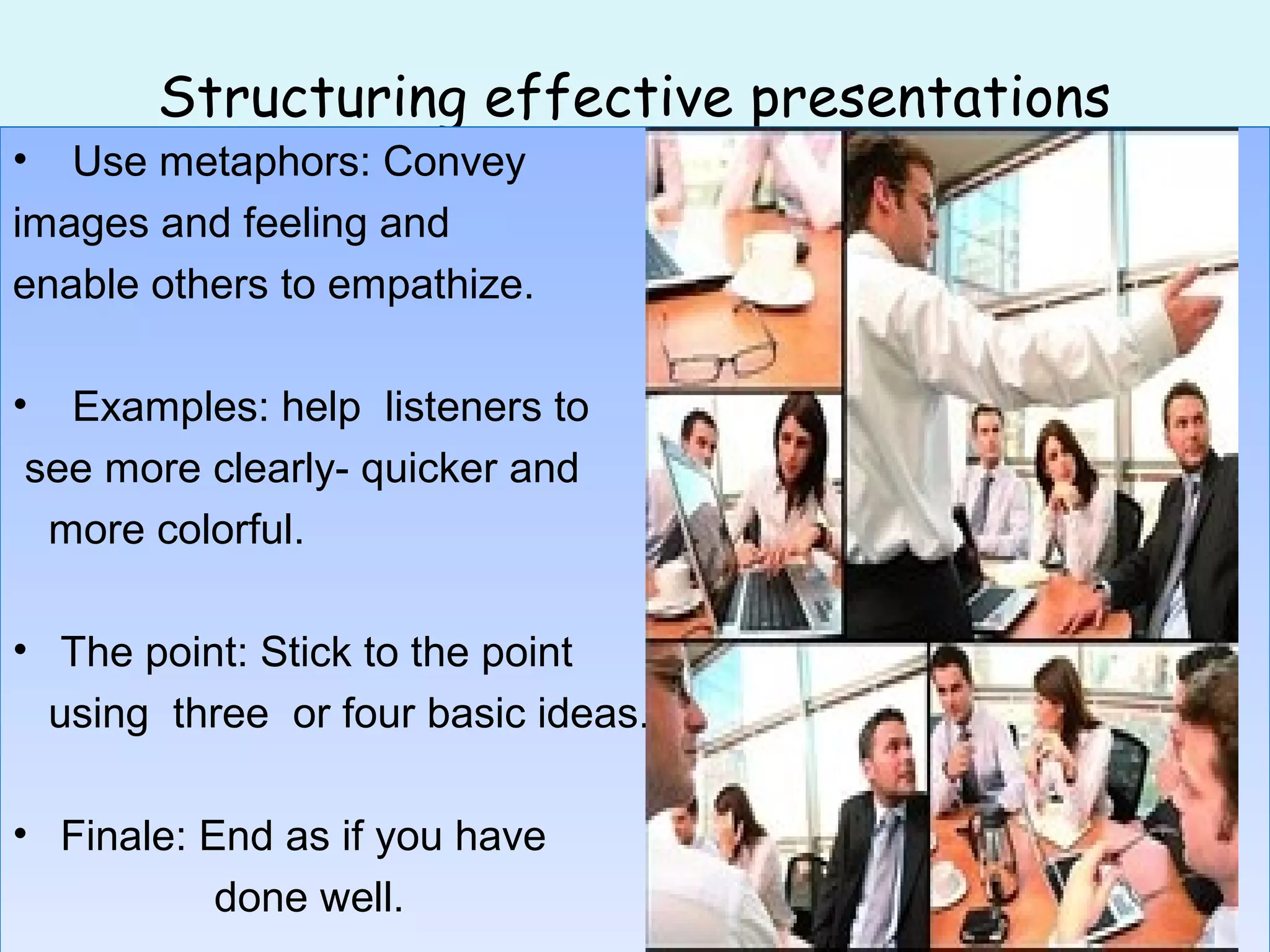
Structuring effective presentations
• Use metaphors: Convey
images and feeling and
enable others to empathize.
• Examples: help listeners to
see more clearly- quicker and
more colorful.
• The point: Stick to the point
using three or four basic ideas.
• Finale: End as if you have
done well.
• Use metaphors: Convey
images and feeling and
enable others to empathize.
• Examples: help listeners to
see more clearly- quicker and
more colorful.
• The point: Stick to the point
using three or four basic ideas.
• Finale: End as if you have
done well.
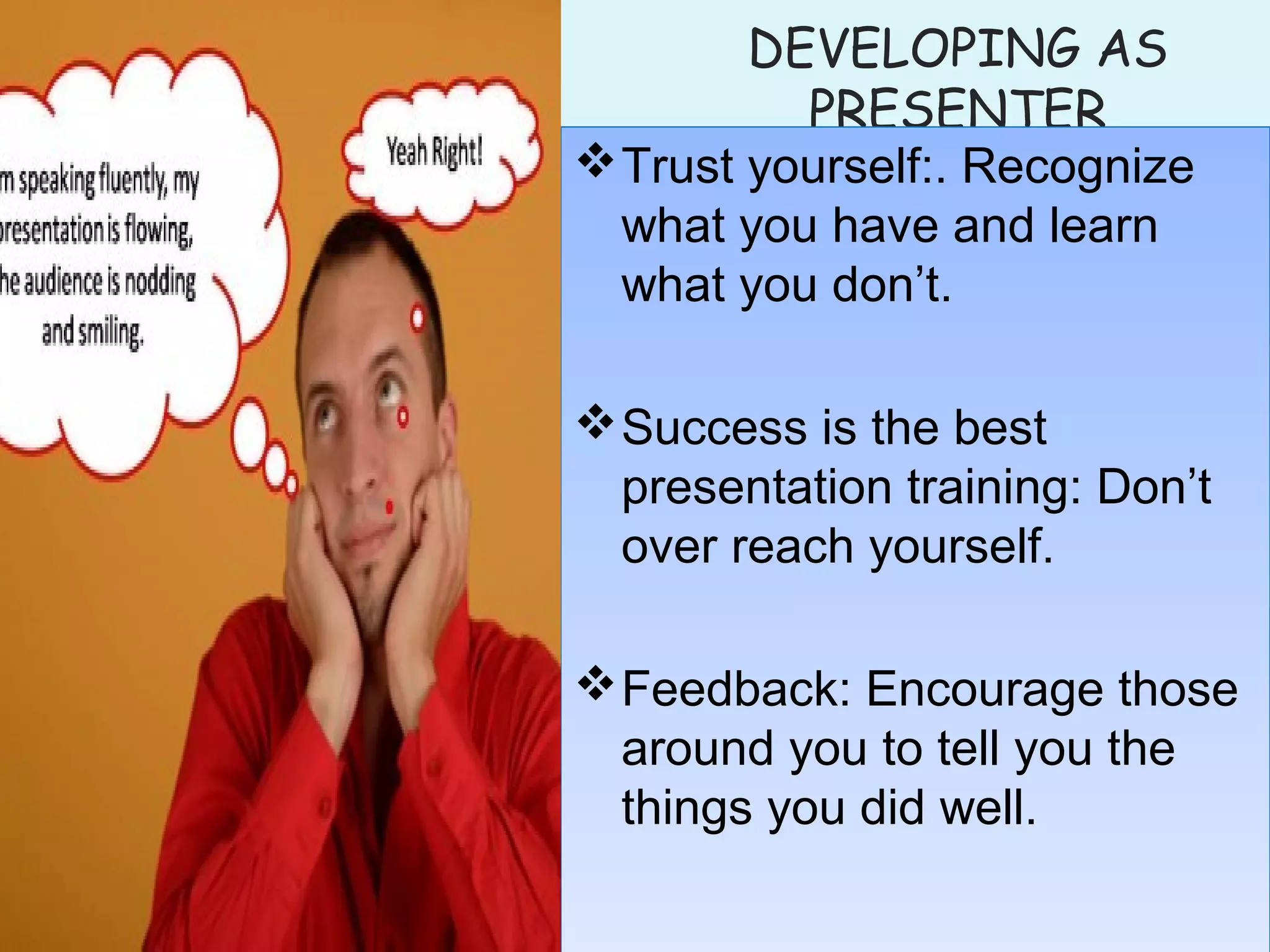
DEVELOPING AS
PRESENTER
Trust yourself:. Recognize
what you have and learn
what you don’t.
Success is the best
presentation training: Don’t
over reach yourself.
Feedback: Encourage those
around you to tell you the
things you did well.
Trust yourself:. Recognize
what you have and learn
what you don’t.
Success is the best
presentation training: Don’t
over reach yourself.
Feedback: Encourage those
around you to tell you the
things you did well.
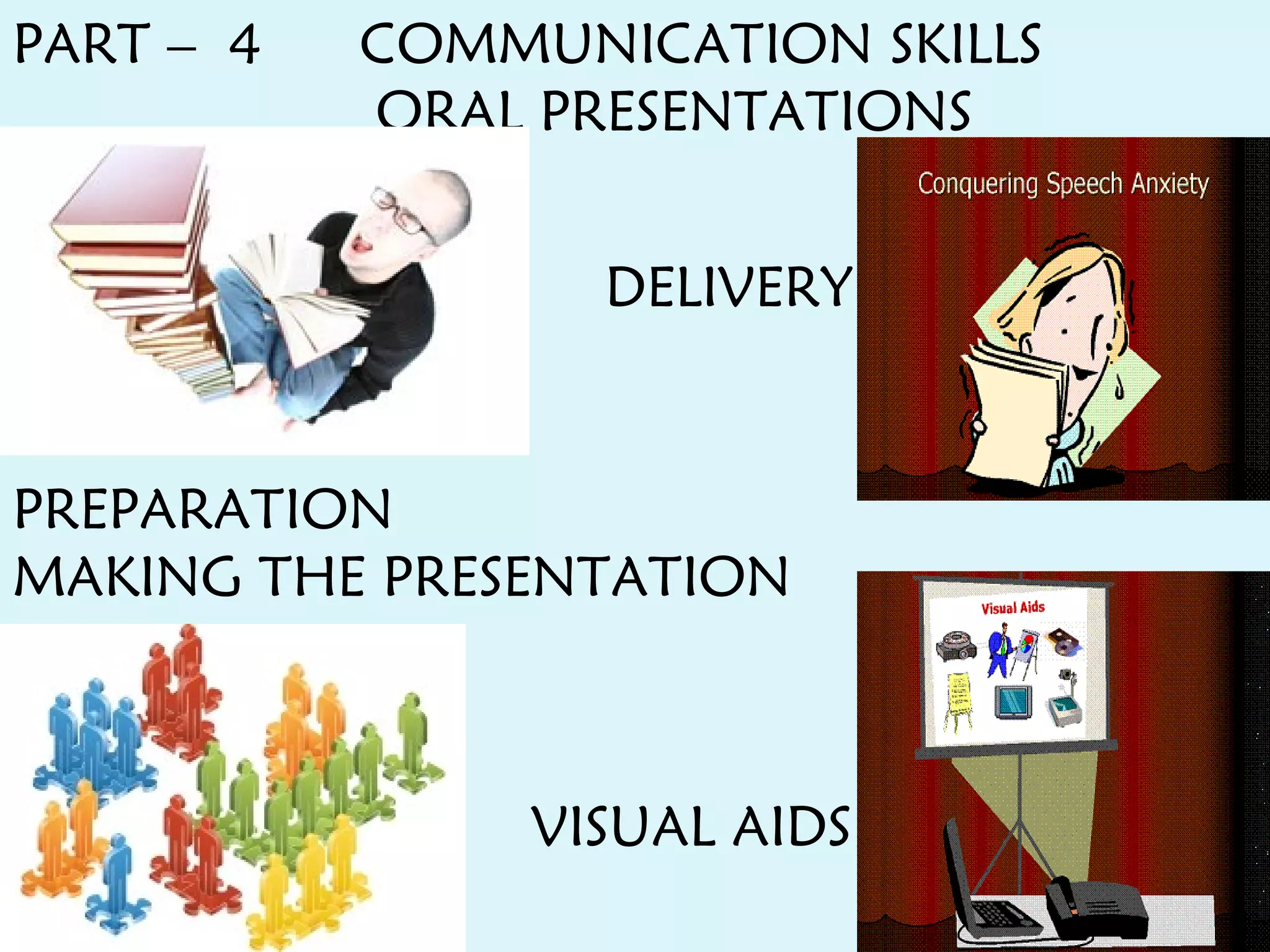
PART – 4 COMMUNICATION SKILLS
ORAL PRESENTATIONS
PREPARATION
MAKING THE PRESENTATION
DELIVERY
VISUAL AIDS
PREPARATION
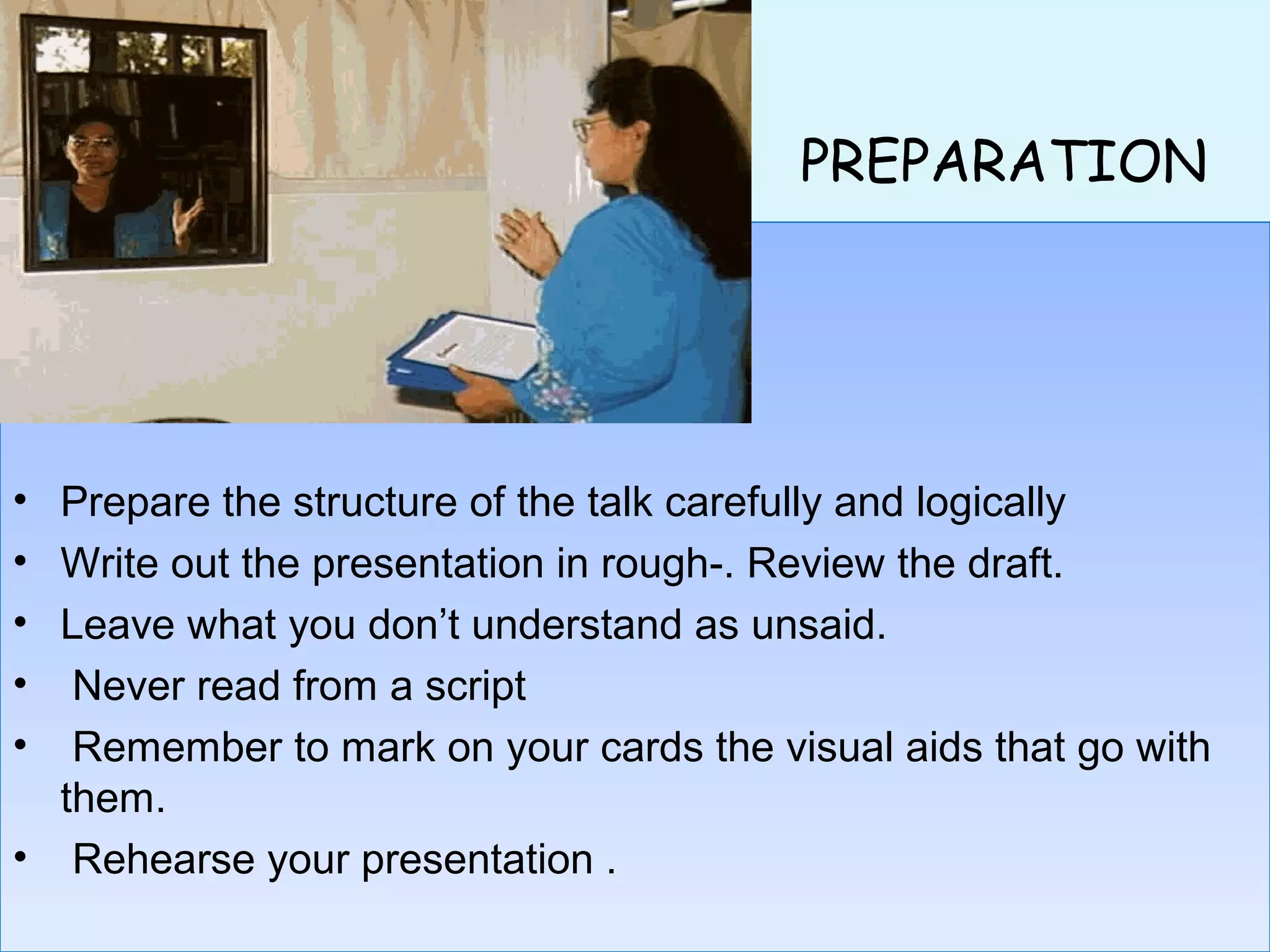
• Prepare the structure of the talk carefully and logically
• Write out the presentation in rough-. Review the draft.
• Leave what you don’t understand as unsaid.
• Never read from a script
• Remember to mark on your cards the visual aids that go with
them.
• Rehearse your presentation .
• Prepare the structure of the talk carefully and logically
• Write out the presentation in rough-. Review the draft.
• Leave what you don’t understand as unsaid.
• Never read from a script
• Remember to mark on your cards the visual aids that go with
them.
• Rehearse your presentation .
MAKING THE PRESENTATION
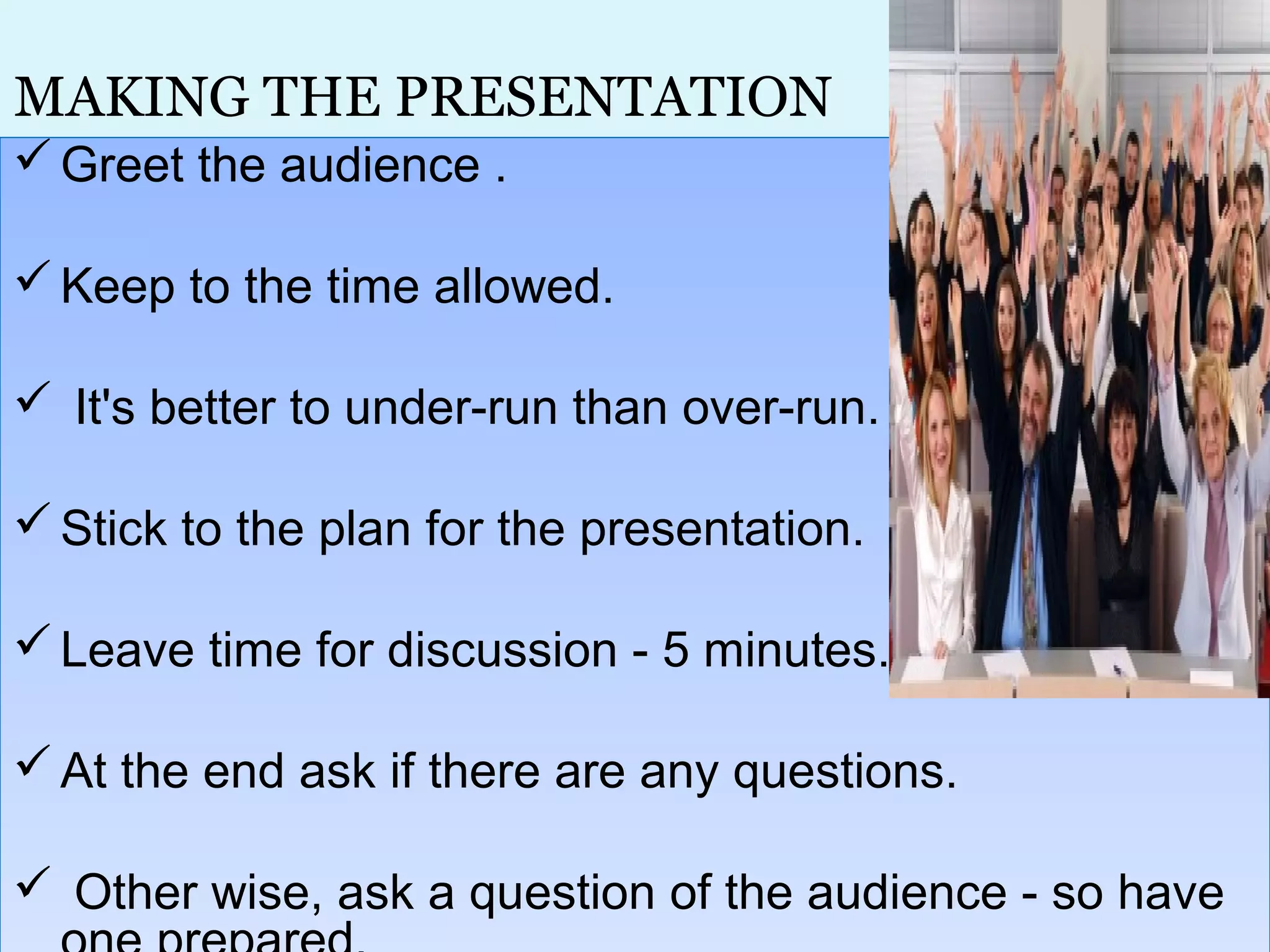
Greet the audience .
Keep to the time allowed.
 It's better to under-run than over-run.
Stick to the plan for the presentation.
Leave time for discussion - 5 minutes.
At the end ask if there are any questions.
 Other wise, ask a question of the audience - so have
Greet the audience .
Keep to the time allowed.
 It's better to under-run than over-run.
Stick to the plan for the presentation.
Leave time for discussion - 5 minutes.
At the end ask if there are any questions.
 Other wise, ask a question of the audience - so have
DELIVERY
• Speak clearly--judge the acoustics of the room.
• Don't rush, or talk deliberately slowly.
• Pause at key points
• Avoid jokes - unless you are a natural expert
• Change your delivery, but not too obviously.
• Use your hands to emphasize points
• Look at the audience as much as possible,
• Avoid moving about too much..
• Keep an eye on the audience's body language
• Speak clearly--judge the acoustics of the room.
• Don't rush, or talk deliberately slowly.
• Pause at key points
• Avoid jokes - unless you are a natural expert
• Change your delivery, but not too obviously.
• Use your hands to emphasize points
• Look at the audience as much as possible,
• Avoid moving about too much..
• Keep an eye on the audience's body language
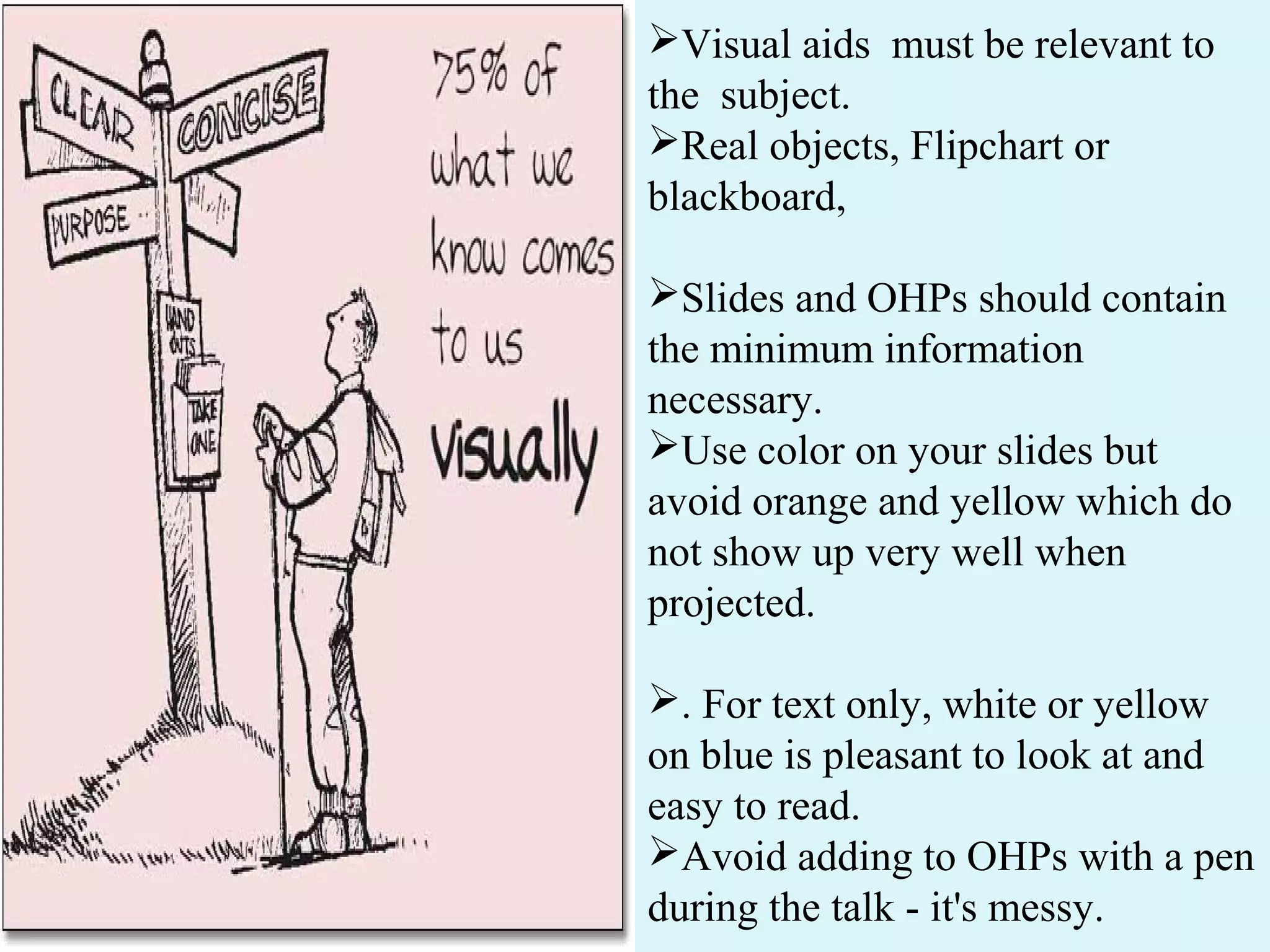
Visual aids must be relevant to
the subject.
Real objects, Flipchart or
blackboard,
Slides and OHPs should contain
the minimum information
necessary.
Use color on your slides but
avoid orange and yellow which do
not show up very well when
projected.
. For text only, white or yellow
on blue is pleasant to look at and
easy to read.
Avoid adding to OHPs with a pen
during the talk - it's messy.
PART 4—POSTER PRESENTATION
• FORMAT
• DESIGN
• FORMAT
• DESIGN
 FORMAT
 DESIGN
 PERSONAL
GROOMING
FORMAT
 A Title page.
 A Summary of the project.
 An Introduction - aims and objectives.
 Methodology that explains the basis of the techniques used.
 Conclusion -listing the main findings of the investigation.
 A Title page.
 A Summary of the project.
 An Introduction - aims and objectives.
 Methodology that explains the basis of the techniques used.
 Conclusion -listing the main findings of the investigation.
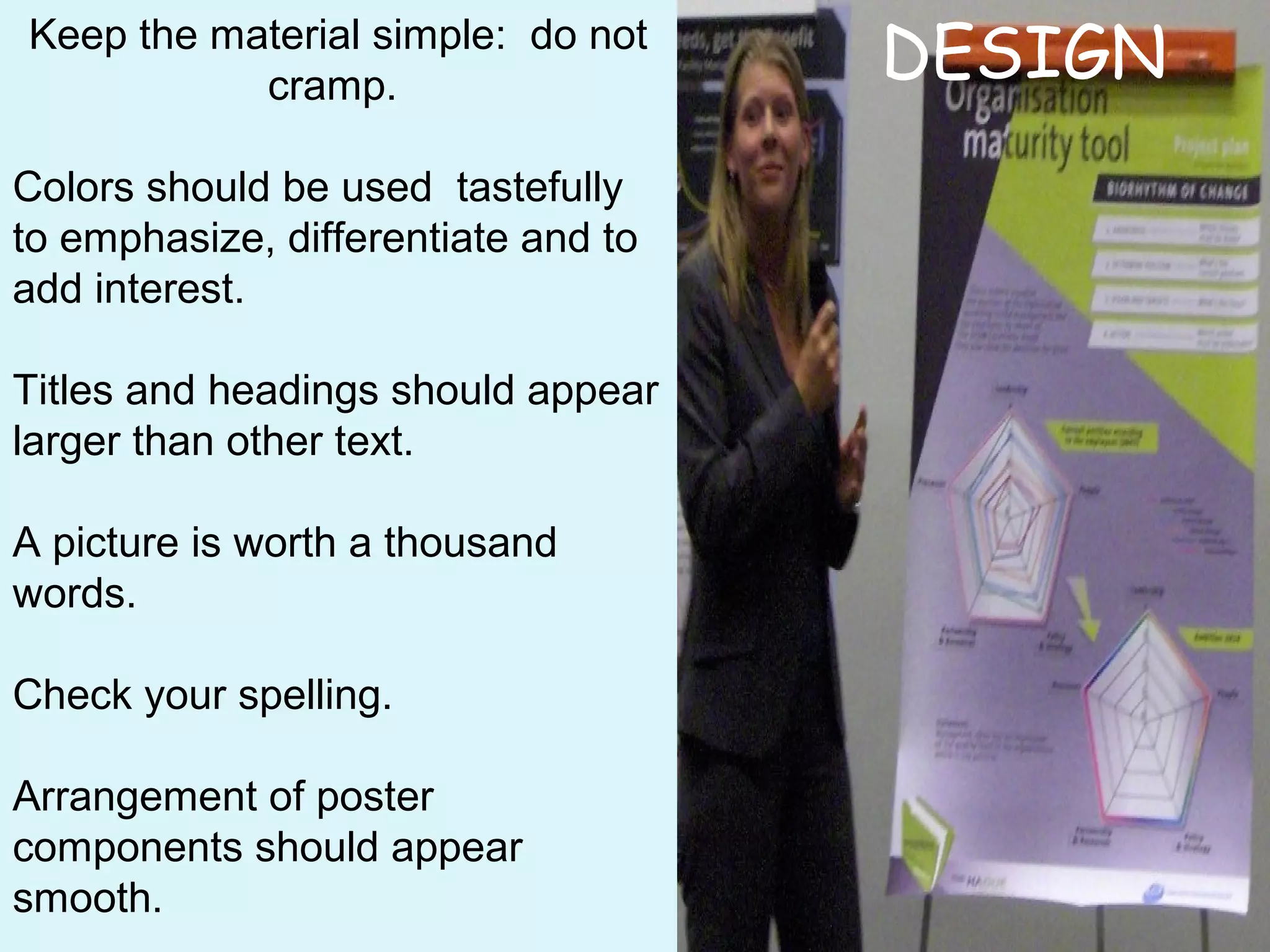
Keep the material simple: do not
cramp.
Colors should be used tastefully
to emphasize, differentiate and to
add interest.
Titles and headings should appear
larger than other text.
A picture is worth a thousand
words.
Check your spelling.
Arrangement of poster
components should appear
smooth.
DESIGN
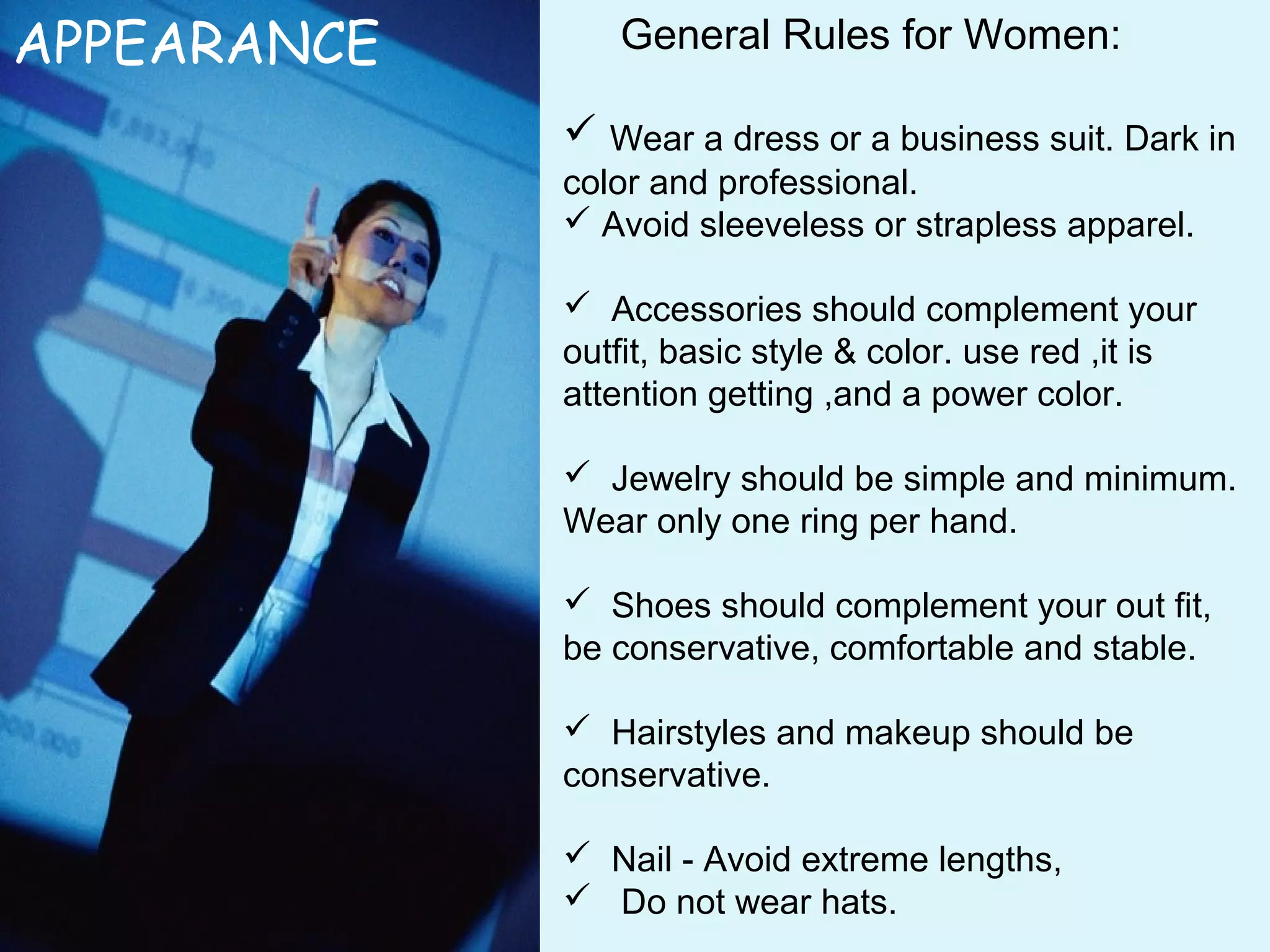
General Rules for Women:
 Wear a dress or a business suit. Dark in
color and professional.
 Avoid sleeveless or strapless apparel.
 Accessories should complement your
outfit, basic style & color. use red ,it is
attention getting ,and a power color.
 Jewelry should be simple and minimum.
Wear only one ring per hand.
 Shoes should complement your out fit,
be conservative, comfortable and stable.
 Hairstyles and makeup should be
conservative.
 Nail - Avoid extreme lengths,
 Do not wear hats.
APPEARANCE
General Rules for Men:
Wear a suit or slacks and a coat. Jackets add
authority. Use conservative colors and avoid
unusual styles.
Wear dress shoes and socks in a coordinating
color .[dark]
 Ties are the most powerful part of your out fit.
It should be conservative in style and non-
constricting. Consider using a red tie or one that
has a red background.
 Jewelry should be simple. Wear a
conservative style watch. Do not wear earrings.
 Hairstyle should be conservative. If you have,
long hair pull it, back.
 Facial hair is acceptable; just make sure it is
well groomed.
 Do not wear hats.
 Do not wear anything that will cause your
audience to question your professionalism or
credibility.
Presentation skills

Presentation skills

  • 1.
    PRESENTATION SKILLS There are alwaysthree speeches, for every one you actually gave. The one you practiced, the one you gave, and the one you wish you gave." -- Dale Carnegie
  • 2.
    What Makes usListen Or Not   BRAINSTORMING
  • 3.
    PART 1—WHAT AREPRESENTATIONS ? PART 2—ELEMENTS OF PRESENTATIONS. PART 3—HOW TO PRESENT WELL. PART 4—ORAL PRESENTATIONS PART 5—POSTER PRESENTATION
  • 4.
    PART 1—WHAT AREPRESENTATIONS ?PART 1—WHAT ARE PRESENTATIONS ?  Exposed to your audience’s judgment.  A myth that immense skill and the ‘gift of the gab’ is needed.  Putting ideas in a positive and professional manner.  Audience interaction, retention and motivation is reaped by tickling the mind.  Exposed to your audience’s judgment.  A myth that immense skill and the ‘gift of the gab’ is needed.  Putting ideas in a positive and professional manner.  Audience interaction, retention and motivation is reaped by tickling the mind.
  • 5.
    Communicating Ideas And Information   Content— it contains information that people need.  Structure — it has a logical beginning, middle, and end.  Packaging — it must be well prepared Human Element —will be remembered much more because it has a person attached to it. Content — it contains information that people need.  Structure — it has a logical beginning, middle, and end.  Packaging — it must be well prepared Human Element —will be remembered much more because it has a person attached to it.
  • 6.
    PART 2—IMPORTANT ELEMENTS THEVOICE THE BODY ACTIVE LISTENING NERVES QUESTIONING NON VERBAL COMMUNICATION
  • 7.
    The Voice-- mostvaluable tool of the presenter  Volume: lower and raise .  Tone: The characteristics of a sound. Pitch: How high or low a note is. Pace: How long a sound lasts.  Varying: helps to maintain audience's interest. Color: The key is to over-act as Shakespeare said “All the world's a stage”.  Volume: lower and raise .  Tone: The characteristics of a sound. Pitch: How high or low a note is. Pace: How long a sound lasts.  Varying: helps to maintain audience's interest. Color: The key is to over-act as Shakespeare said “All the world's a stage”.
  • 8.
    The Body People listenand watch .  Good posture helps to speak clearly and effectively. Standing erect and leaning forward communicates that you are approachable, receptive, and friendly. Gestures: A lively speaking style captures attention, and facilitates understanding.
  • 9.
    Eye contact: conveys interest,concern ,warmth, and credibility. Proximity: Enables you to make better eye contact and increases the opportunities for others to speak. Facial Expressions: Smiling transmits happiness, friendliness, and liking.
  • 10.
    Active Listening • Spendmore time listening than talking • Do not answer questions with questions. • Be aware of biases. • Never daydream when others talk. • Plan responses after others have finished speaking. • Provide feedback but do not interrupt incessantly. • Spend more time listening than talking • Do not answer questions with questions. • Be aware of biases. • Never daydream when others talk. • Plan responses after others have finished speaking. • Provide feedback but do not interrupt incessantly.
  • 11.
    Nerves ---Reduce Tension oMental Visualization: Mentally go over what you are going to do. o During the presentation: Take a moment to yourself ,relax the tenseness of your body, saying to yourself, “I can do it!”. o Channel the energy into concentration and expressiveness. o The key is to continue on after the mistake, and so will the audience. Winners continue! Losers stop! o Never drink alcohol to reduce tension! o Mental Visualization: Mentally go over what you are going to do. o During the presentation: Take a moment to yourself ,relax the tenseness of your body, saying to yourself, “I can do it!”. o Channel the energy into concentration and expressiveness. o The key is to continue on after the mistake, and so will the audience. Winners continue! Losers stop! o Never drink alcohol to reduce tension!
  • 12.
    Questioning • Always allowtime at the end of the presentation for questions. • If you do not know the answer, be honest, do not waffle. • Answers that last 10 to 40 seconds work best. • Always allow time at the end of the presentation for questions. • If you do not know the answer, be honest, do not waffle. • Answers that last 10 to 40 seconds work best. Keep cool if a questioner disagrees with you. Try to find a way to agree with part of their argument.
  • 13.
    Non verbal communication •Don’t cross your arms or legs – it might make you seem defensive. • Have eye contact, but don’t stare. Nod when they are talking. • Don’t slouch; sit up straight. • Lean, but not too much. • Smile and laugh. • Don’t cross your arms or legs – it might make you seem defensive. • Have eye contact, but don’t stare. Nod when they are talking. • Don’t slouch; sit up straight. • Lean, but not too much. • Smile and laugh.
  • 14.
    FACIAL EXPRESSIONS  Facetouching distracts, shows nervousness.  Slow down a bit.  Don’t fidget.  Use hands confidently.  Keep a positive attitude.  Be open and relaxed.  Face touching distracts, shows nervousness.  Slow down a bit.  Don’t fidget.  Use hands confidently.  Keep a positive attitude.  Be open and relaxed.
  • 15.
    Self Assessment Quiz. 3-Always/ 2- Usually / 1-Sometimes / 0-Never. 1. During presentations I manage my anxiety to use as positive energy. 2. I know how to reduce stress associated with presentations. 3. I identify the specific “audience- focused” objectives for my presentations. 4. I evaluate the physical environment in which the presentation is to be made. 5. To add passion, power and pizzazz to my presentation, I practice the finished version several times. 6. I do not attempt to put too much information in my visuals. 7. I make certain to use eye contact with different members of the audience.
  • 16.
    8 I monitormy facial expressions and consciously use a variety of expressions. 9 I vary the pitch, volume, tone and pace of my voice. 10 I look for the opportunities to use stories and real life illustrations. 11 I use a variety if visuals in my presentation. 12 I am comfortable conducting a Q &A as part of the presentation. 13 As part of preparation I spend time anticipating likely audience questions. 14 I try to align the non-verbal messages of body language match the words I am verbalizing. 15 After the presentation I take time to get feedback and assess my effectiveness so as to develop a plan for improvement. TOTAL SCORE 45-37 / 36-16 Average / Below 15 Low
  • 17.
    PART 3--How toPresent Well Preparation. Presentation style Dealing with presentation nervousness Developing as a presenter Working your audience Structuring effective presentations
  • 18.
    AIDA : GainingAttention, Holding Interest, Arousing Desire and Obtaining Action • Preparation: Practice on a colleague or friend. Prepare, prepare, prepare. • Reconnoiter: Go into the presentation room before the event; practice any moves you may have to make. • Technical support: Test the equipment before the presentation; • Preparation: Practice on a colleague or friend. Prepare, prepare, prepare. • Reconnoiter: Go into the presentation room before the event; practice any moves you may have to make. • Technical support: Test the equipment before the presentation;
  • 19.
    Presentation style KISS KEEP ITSHORT & SIMPLE.  Be yourself: Do not try to be anyone else or copy another presenter's style. Be Dynamic: Vary the tone, volume and speed of your delivery you will hold your audience’s attention for longer. KISS KEEP IT SHORT & SIMPLE.  Be yourself: Do not try to be anyone else or copy another presenter's style. Be Dynamic: Vary the tone, volume and speed of your delivery you will hold your audience’s attention for longer.
  • 20.
    Dealing with presentationnervousness. o Be nervous: a certain amount of nervousness is vital. o Get something else to do: Any activity to make you feel more secure. o Hold on to something: Even just standing next to something solid will make you feel less wobbly. o Go slow: Your audience needs the time to assimilate and interpret what you are saying. o Be nervous: a certain amount of nervousness is vital. o Get something else to do: Any activity to make you feel more secure. o Hold on to something: Even just standing next to something solid will make you feel less wobbly. o Go slow: Your audience needs the time to assimilate and interpret what you are saying.
  • 21.
    Working your audience Converse: Stimulate and communicate with your audience.  Inter act: If the light bulbs are not going on find another way to say it.  Show conviction: Be expressive and enthusiastic.  Perspective: Audiences want you to be good.  Converse: Stimulate and communicate with your audience.  Inter act: If the light bulbs are not going on find another way to say it.  Show conviction: Be expressive and enthusiastic.  Perspective: Audiences want you to be good.
  • 22.
    Structuring effective presentations •Use metaphors: Convey images and feeling and enable others to empathize. • Examples: help listeners to see more clearly- quicker and more colorful. • The point: Stick to the point using three or four basic ideas. • Finale: End as if you have done well. • Use metaphors: Convey images and feeling and enable others to empathize. • Examples: help listeners to see more clearly- quicker and more colorful. • The point: Stick to the point using three or four basic ideas. • Finale: End as if you have done well.
  • 23.
    DEVELOPING AS PRESENTER Trust yourself:.Recognize what you have and learn what you don’t. Success is the best presentation training: Don’t over reach yourself. Feedback: Encourage those around you to tell you the things you did well. Trust yourself:. Recognize what you have and learn what you don’t. Success is the best presentation training: Don’t over reach yourself. Feedback: Encourage those around you to tell you the things you did well.
  • 24.
    PART – 4COMMUNICATION SKILLS ORAL PRESENTATIONS PREPARATION MAKING THE PRESENTATION DELIVERY VISUAL AIDS
  • 25.
    PREPARATION • Prepare thestructure of the talk carefully and logically • Write out the presentation in rough-. Review the draft. • Leave what you don’t understand as unsaid. • Never read from a script • Remember to mark on your cards the visual aids that go with them. • Rehearse your presentation . • Prepare the structure of the talk carefully and logically • Write out the presentation in rough-. Review the draft. • Leave what you don’t understand as unsaid. • Never read from a script • Remember to mark on your cards the visual aids that go with them. • Rehearse your presentation .
  • 26.
    MAKING THE PRESENTATION Greetthe audience . Keep to the time allowed.  It's better to under-run than over-run. Stick to the plan for the presentation. Leave time for discussion - 5 minutes. At the end ask if there are any questions.  Other wise, ask a question of the audience - so have Greet the audience . Keep to the time allowed.  It's better to under-run than over-run. Stick to the plan for the presentation. Leave time for discussion - 5 minutes. At the end ask if there are any questions.  Other wise, ask a question of the audience - so have
  • 27.
    DELIVERY • Speak clearly--judgethe acoustics of the room. • Don't rush, or talk deliberately slowly. • Pause at key points • Avoid jokes - unless you are a natural expert • Change your delivery, but not too obviously. • Use your hands to emphasize points • Look at the audience as much as possible, • Avoid moving about too much.. • Keep an eye on the audience's body language • Speak clearly--judge the acoustics of the room. • Don't rush, or talk deliberately slowly. • Pause at key points • Avoid jokes - unless you are a natural expert • Change your delivery, but not too obviously. • Use your hands to emphasize points • Look at the audience as much as possible, • Avoid moving about too much.. • Keep an eye on the audience's body language
  • 28.
    Visual aids mustbe relevant to the subject. Real objects, Flipchart or blackboard, Slides and OHPs should contain the minimum information necessary. Use color on your slides but avoid orange and yellow which do not show up very well when projected. . For text only, white or yellow on blue is pleasant to look at and easy to read. Avoid adding to OHPs with a pen during the talk - it's messy.
  • 29.
    PART 4—POSTER PRESENTATION •FORMAT • DESIGN • FORMAT • DESIGN  FORMAT  DESIGN  PERSONAL GROOMING
  • 30.
    FORMAT  A Titlepage.  A Summary of the project.  An Introduction - aims and objectives.  Methodology that explains the basis of the techniques used.  Conclusion -listing the main findings of the investigation.  A Title page.  A Summary of the project.  An Introduction - aims and objectives.  Methodology that explains the basis of the techniques used.  Conclusion -listing the main findings of the investigation.
  • 31.
    Keep the materialsimple: do not cramp. Colors should be used tastefully to emphasize, differentiate and to add interest. Titles and headings should appear larger than other text. A picture is worth a thousand words. Check your spelling. Arrangement of poster components should appear smooth. DESIGN
  • 32.
    General Rules forWomen:  Wear a dress or a business suit. Dark in color and professional.  Avoid sleeveless or strapless apparel.  Accessories should complement your outfit, basic style & color. use red ,it is attention getting ,and a power color.  Jewelry should be simple and minimum. Wear only one ring per hand.  Shoes should complement your out fit, be conservative, comfortable and stable.  Hairstyles and makeup should be conservative.  Nail - Avoid extreme lengths,  Do not wear hats. APPEARANCE
  • 33.
    General Rules forMen: Wear a suit or slacks and a coat. Jackets add authority. Use conservative colors and avoid unusual styles. Wear dress shoes and socks in a coordinating color .[dark]  Ties are the most powerful part of your out fit. It should be conservative in style and non- constricting. Consider using a red tie or one that has a red background.  Jewelry should be simple. Wear a conservative style watch. Do not wear earrings.  Hairstyle should be conservative. If you have, long hair pull it, back.  Facial hair is acceptable; just make sure it is well groomed.  Do not wear hats.  Do not wear anything that will cause your audience to question your professionalism or credibility.