ETHICS IN SOCIAL SCIENCE RESEARCH
Dr. Jagannath K. Dange
Professor and Dean, Faculty of Education
Kuvempu University
Shankaraghatta
Shimoga, Karnataka
drjkdange@gmail.com
http://jkdange.blogspot.com
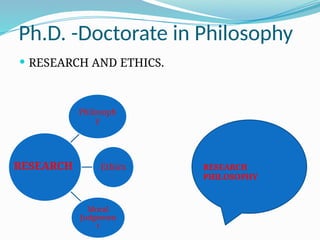
Ph.D. -Doctorate in Philosophy
 RESEARCH AND ETHICS.
Philosoph
y
Ethics
Moral
Judgemen
t
RESEARCH RESEARCH
PHILOSOPHY
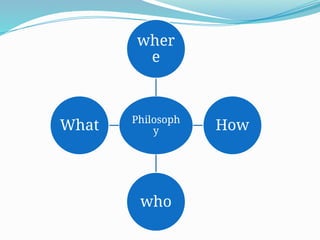
Philosoph
y
wher
e
How
who
What
What is Research?.............
 Curiosity and the self-driven efforts which
involves systematic and creative investigations
in any domain of knowledge.
 These can be related to philosophy or matter,
or anything in this Universe that can be
perceived by our senses.
 KNOWING….KNOWING….KNOWING
 Aristotle stated “The more you know the
more you know you don’t know”.
 Albert Einstein said, “The more I learn, the
more I realize how much I don’t know.”
 KNOW-------KNOWLEDGE----AWARENESS
 KNOWLEDGE-POWER.
 ITs a LIGHT to ERADICATE the DARKNESS
(Buddha)
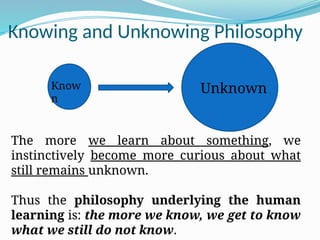
Knowing and Unknowing Philosophy
Know
n
Unknown
The more we learn about something, we
instinctively become more curious about what
still remains unknown.
Thus the philosophy underlying the human
learning is: the more we know, we get to know
what we still do not know.
Research as a Social Responsibility
Research Output- Society
While the research output is self-
satisfying for the researchers as
owners of the new knowledge/
understanding,
and
as a stepping stone for the next level of
enquiry, its dissemination to a larger
peer group is a social responsibility.
What Is Research Ethics?
 Ethical codes are also considered moral codes.
 Most often ethics refers to rules that are a
guide to doing the right thing, although, what
the right thing is, remains relative to the context.
 Research ethics is grounded in the principles
and practice of science.
 There can then be no separation of science and
ethics since the latter is embedded in the
practice of science.
 Following from this the fundamental questions
that every researcher must ask (Williams, 2003):
1. What moral principles guide your research?
2. How do ethical issues influence your selection of a
research problem?
3. How do ethical issues affect how you conduct your
research: the design, sampling procedure, and so on?
4. What responsibility do you have toward your
research subjects? For example, do you have their informed
consent to participate in your project?
5. What ethical issues/dilemmas might come into play
in deciding what research findings you publish?
6. Will your research directly benefit those who
participated in the study?
 Research ethics as it applies to:
1. Choosing the topic of research, conducting literature
survey and framing the research question;
2. Choosing the research design, methodology and
constructing of tools;
3. Responsibilities towards the participants of research;
4. Data collection, data storage, data utilization, and
data security and the analyses of the data;
5. Responsibilities towards the community or society,
which is the subject area of research; informing the
participant population of the research findings;
6. Narrating and presenting the findings, and
7. Publishing the research.
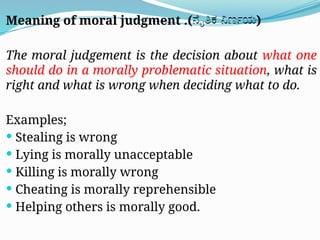
Meaning of moral judgment .(ನೈತಿಕ ನಿರ್ಣಯ)
The moral judgement is the decision about what one
should do in a morally problematic situation, what is
right and what is wrong when deciding what to do.
Examples;
 Stealing is wrong
 Lying is morally unacceptable
 Killing is morally wrong
 Cheating is morally reprehensible
 Helping others is morally good.
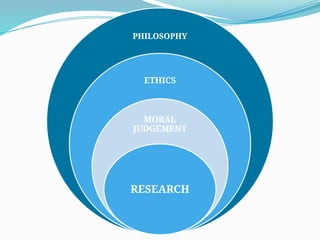
PHILOSOPHY
ETHICS
MORAL
JUDGEMENT
RESEARCH
 ‘Research ethics’ refers to a complex set of
values, standards and institutional schemes
that help to constitute and regulate scientific
activity.
 Social science investigates complex issues
which involve cultural, legal, economic, and
political phenomena (Freed‐Taylor, 1994).
 This complexity means that social science
research must concern itself with “moral
integrity” to ensure that research process and
findings are “trustworthy” and valid (Biber, 2005).
 Research ethics also consists of common norms,
derived from society’s demands and expectations to
research in a broad sense.
 A well-functioning, knowledge-based, and democratic
society relies on research as a source of reliable
knowledge.
Responsibility for research ethics
 Research should be responsibly organised and
practiced, and research ethics is a tool for this purpose.
 Researchers and research institutions are both
responsible for ensuring compliance with research
ethics, and other research actors too ought to behave
in accordance with ethical norms and guidelines.
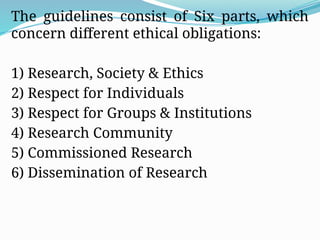
The guidelines consist of Six parts, which
concern different ethical obligations:
1) Research, Society & Ethics
2) Respect for Individuals
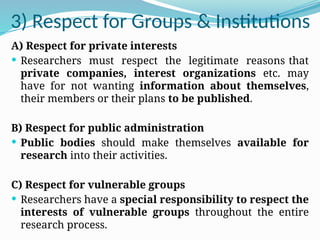
3) Respect for Groups & Institutions
4) Research Community
5) Commissioned Research
6) Dissemination of Research
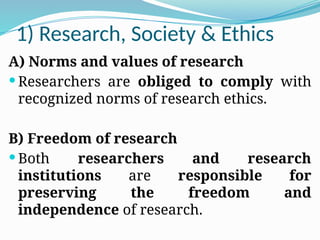
1) Research, Society & Ethics
A) Norms and values of research
 Researchers are obliged to comply with
recognized norms of research ethics.
B) Freedom of research
 Both researchers and research
institutions are responsible for
preserving the freedom and
independence of research.
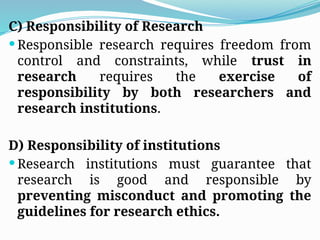
C) Responsibility of Research
 Responsible research requires freedom from
control and constraints, while trust in
research requires the exercise of
responsibility by both researchers and
research institutions.
D) Responsibility of institutions
 Research institutions must guarantee that
research is good and responsible by
preventing misconduct and promoting the
guidelines for research ethics.
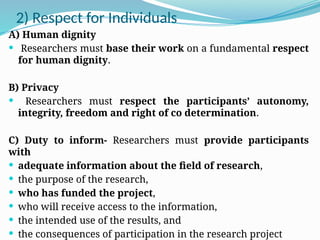
2) Respect for Individuals
A) Human dignity
 Researchers must base their work on a fundamental respect
for human dignity.
B) Privacy
 Researchers must respect the participants’ autonomy,
integrity, freedom and right of co determination.
C) Duty to inform- Researchers must provide participants
with
 adequate information about the field of research,
 the purpose of the research,
 who has funded the project,
 who will receive access to the information,
 the intended use of the results, and
 the consequences of participation in the research project
D) Consent and obligation to notify
 When a research project deals with personal data,
researchers are obliged to inform the participants or
subjects of research and to obtain their consent.
 The consent must be freely given, informed,
and in an explicit form.
E) Confidentiality
 Generally, researchers must process data acquired
about personal matters confidentially.
 Personal data must normally be de-identified,
while publication and dissemination of the
research material must normally be anonymised.
F) Limited re-use
 Identifiable personal data collected for a specific research
purpose cannot automatically be used for other
research.
G) Storage of personal data
 Data related to identifiable individuals must be stored
responsibly.
 Such data must not be stored any longer than what is
necessary to achieve the objective for which it was
collected.
H) Responsibility for avoiding harm
 Researchers are responsible for ensuring that
participants are not exposed to serious physical harm or
other severe or unreasonable strain as result of the
research.
I) Respect for third parties
 Researchers should consider and anticipate
effects on third parties that are not directly
included in the research.
J) Protection of children
 Children and adolescents who take part in research
are particularly entitled to protection.
K) Respect for the values and motives of others
 Researchers must show respect for the values and
views of research participants, not least when
they differ from those generally accepted by
society at large.
L) Respect for privacy and family life
 Researchers must respect individuals’ privacy and
family life.
 Participants are entitled to check whether
confidential information about them is made
available to others.
M) Respect for posthumous reputations
 It is important to act with care when conducting
research on deceased(Late) persons.
N) Defining roles and responsibilities
 Researchers are responsible for explaining to the
participants the limitations, expectations and
requirements associated with their role as researchers.
3) Respect for Groups & Institutions
A) Respect for private interests
 Researchers must respect the legitimate reasons that
private companies, interest organizations etc. may
have for not wanting information about themselves,
their members or their plans to be published.
B) Respect for public administration
 Public bodies should make themselves available for
research into their activities.
C) Respect for vulnerable groups
 Researchers have a special responsibility to respect the
interests of vulnerable groups throughout the entire
research process.
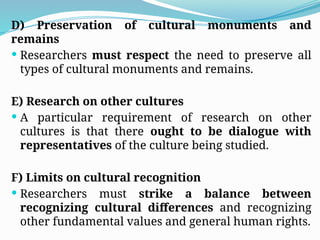
D) Preservation of cultural monuments and
remains
 Researchers must respect the need to preserve all
types of cultural monuments and remains.
E) Research on other cultures
 A particular requirement of research on other
cultures is that there ought to be dialogue with
representatives of the culture being studied.
F) Limits on cultural recognition
 Researchers must strike a balance between
recognizing cultural differences and recognizing
other fundamental values and general human rights.
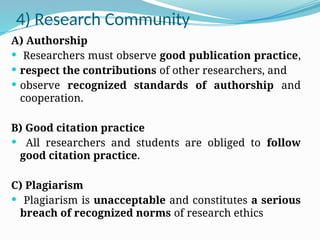
4) Research Community
A) Authorship
 Researchers must observe good publication practice,
 respect the contributions of other researchers, and
 observe recognized standards of authorship and
cooperation.
B) Good citation practice
 All researchers and students are obliged to follow
good citation practice.
C) Plagiarism
 Plagiarism is unacceptable and constitutes a serious
breach of recognized norms of research ethics
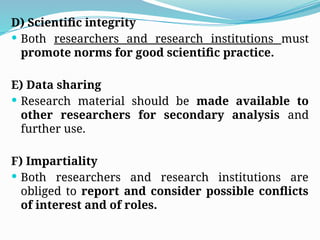
D) Scientific integrity
 Both researchers and research institutions must
promote norms for good scientific practice.
E) Data sharing
 Research material should be made available to
other researchers for secondary analysis and
further use.
F) Impartiality
 Both researchers and research institutions are
obliged to report and consider possible conflicts
of interest and of roles.
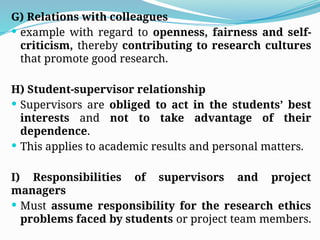
G) Relations with colleagues
 example with regard to openness, fairness and self-
criticism, thereby contributing to research cultures
that promote good research.
H) Student-supervisor relationship
 Supervisors are obliged to act in the students’ best
interests and not to take advantage of their
dependence.
 This applies to academic results and personal matters.
I) Responsibilities of supervisors and project
managers
 Must assume responsibility for the research ethics
problems faced by students or project team members.
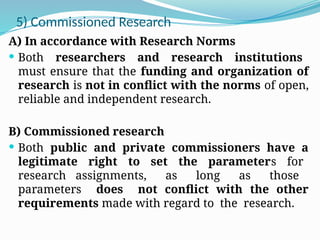
5) Commissioned Research
A) In accordance with Research Norms
 Both researchers and research institutions
must ensure that the funding and organization of
research is not in conflict with the norms of open,
reliable and independent research.
B) Commissioned research
 Both public and private commissioners have a
legitimate right to set the parameters for
research assignments, as long as those
parameters does not conflict with the other
requirements made with regard to the research.
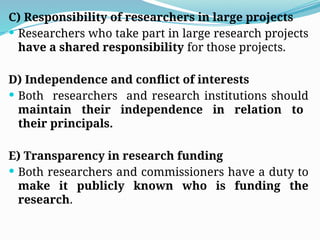
C) Responsibility of researchers in large projects
 Researchers who take part in large research projects
have a shared responsibility for those projects.
D) Independence and conflict of interests
 Both researchers and research institutions should
maintain their independence in relation to
their principals.
E) Transparency in research funding
 Both researchers and commissioners have a duty to
make it publicly known who is funding the
research.
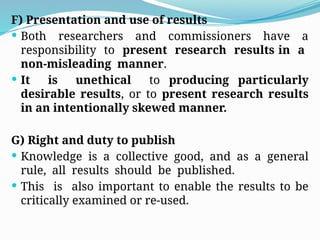
F) Presentation and use of results
 Both researchers and commissioners have a
responsibility to present research results in a
non-misleading manner.
 It is unethical to producing particularly
desirable results, or to present research results
in an intentionally skewed manner.
G) Right and duty to publish
 Knowledge is a collective good, and as a general
rule, all results should be published.
 This is also important to enable the results to be
critically examined or re-used.
6) Dissemination of Research
A) Dissemination as an academic responsibility
 Researchers and research institutions are obliged to
disseminate scientific knowledge to a broader
audience outside the research community.
B) Requirements for individuals and institutions
 Research institutions must create conditions for
extensive and broad dissemination of research
characterized by high quality and relevance.
C) Interdisciplinary discourse and public deliberation
 An important part of dissemination of research in a
modern society emerges from the interaction between
specialists in various academic disciplines and the
public discourse.
D) Participation in public debate
 Researchers should contribute scientific arguments
to the public debate.
 Researchers should express themselves fairly
and clearly in order to avoid tendentious
interpretations of research results.
E) Accountability in dissemination
 The requirement of accountability is equally
stringent in dissemination as in publication.
F) Reporting results to participants
 Researchers have a special obligation to report
results back to the participants in a
comprehensible and acceptable manner.
References
 Academic Integrity and Research Quality(2021) Published by Secretary,
University Grants Commission, New Delhi
 Asheesh Srivastava, Ethical & Moral Concerns Social Science in Research.
Retrieved 26th
February 2025 at
https://mgcub.ac.in/pdf/material/2020040416541218270c71b7.pdf
 Dange.Jagannath.K (2024) Research Philosophy, Ethics and moral Judgement,
Retrieved on 26th February 2025 at
https://www.slideshare.net/slideshow/research-philosophy-ethics-and-moral-
judgement/270251896.
 Freed‐Taylor, M. (1994), ‘Ethical considerations in European cross‐national
research’ International Social Science Journal,(142). Retrieved at
https://books.google.lk/books.
 Guidelines for Research Ethics in the Social Sciences and the
Humanities(2024) Published by Norwegian National Research Ethics
Committees. ISBN: 978-82-7682-114-7.
 Guidelines for Research Ethics in the Social Sciences, Law & Humanities
(2006)Published by Norwegian National Research Ethics Committees.ISBN:82-
7682-050-6
 Guidelines for Research Ethics in the Social Sciences, Humanities, Law
& Theology(2006) Published by Norwegian National Research Ethics
Committees.
 Haggerty, K.D. (Winter 2004), ‘Ethics Creep: Governing Social Sciences
Thank You
Dr. Jagannath K. Dange
Professor
Department of Education
Kuvempu University
Shankaraghatta
Dist: Shimoga,
Karnataka
drjkdange@gmail.com
http://jkdange.blogspot.com