PRESENTATION SKILLS
PART I  - INTRODUCTION PART II  - PREPARING A PRESENTATION PART III  - PREPARING YOUR SELF PART IV  - DELIVERING A PRESENTATION PART V  - HANDLING AN AUDIENCE PREVIEW
PART I - INTRODUCTION WHAT IS A PRESENTATION ?  AIM AND IMPORTANCE OF A PRESENTATION WHAT CAN A PRESENTATION DO FOR YOU ? EFFECTIVE PRESENTATION SKILLS
WHAT IS A PRESENTATION ? Foundational and fundamental business tool Basis of relationship with clients   Reflects  :- Image of the company Its value system Its vision
WHAT IS  A PRESENTATION? FOUNDATIONAL AND FUNDAMENTAL BUSINESS  TOOL BASIS OF RELATIONSHIP WITH CLIENTS REFLECTS COMPANY’S IMAGE VALUE  SYSTEM VISION
AIM OF PRESENTATION To transfer information To communicate views To influence another mind Emphasis is not on transmission but on reception and understanding by audience so that   YOUR MESSAGE IS  UNDERSTOOD ,  REMEMBERED  AND  ACTED UPON !
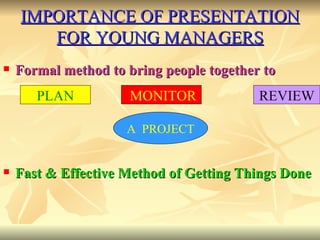
IMPORTANCE OF PRESENTATION FOR YOUNG MANAGERS Formal method to bring people together to Fast & Effective Method of Getting Things Done PLAN MONITOR REVIEW A  PROJECT
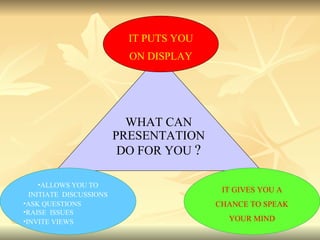
WHAT CAN PRESENTATION DO FOR YOU  ? ALLOWS YOU TO INITIATE  DISCUSSIONS ASK QUESTIONS RAISE  ISSUES INVITE VIEWS IT PUTS YOU ON DISPLAY IT GIVES YOU A CHANCE TO SPEAK YOUR MIND
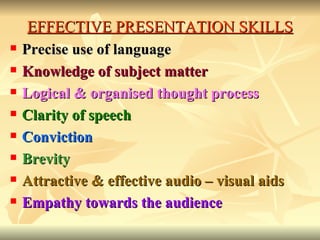
EFFECTIVE PRESENTATION SKILLS Precise use of language Knowledge of subject matter Logical & organised thought process Clarity of speech  Conviction Brevity Attractive & effective audio – visual aids Empathy towards the audience
PART II : PREPARING A PRESENTATION PLANNING A PRESENTATION  THIRTEEN STEPS TO ORGANISED PRESENTATIONS TYPES OF PRESENTATIONS
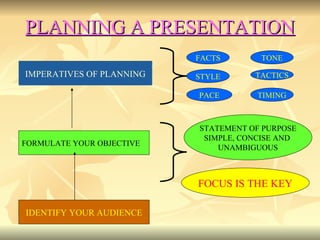
PLANNING A PRESENTATION IDENTIFY YOUR AUDIENCE IMPERATIVES OF PLANNING FACTS STYLE PACE TONE TACTICS TIMING FORMULATE YOUR OBJECTIVE STATEMENT OF PURPOSE SIMPLE, CONCISE AND  UNAMBIGUOUS FOCUS IS THE KEY
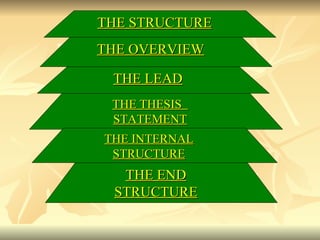
THE STRUCTURE THE OVERVIEW THE LEAD THE THESIS  STATEMENT THE INTERNAL STRUCTURE THE END STRUCTURE
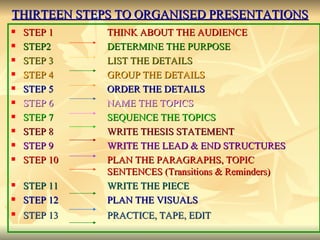
THIRTEEN STEPS TO ORGANISED PRESENTATIONS STEP 1 THINK ABOUT THE AUDIENCE  STEP2 DETERMINE THE PURPOSE   STEP 3  LIST THE DETAILS STEP 4 GROUP THE DETAILS STEP 5  ORDER THE DETAILS STEP 6  NAME THE TOPICS STEP 7 SEQUENCE THE TOPICS STEP 8  WRITE THESIS STATEMENT STEP 9 WRITE THE LEAD & END STRUCTURES STEP 10 PLAN THE PARAGRAPHS, TOPIC  SENTENCES (Transitions & Reminders) STEP 11 WRITE THE PIECE  STEP 12 PLAN THE VISUALS STEP 13 PRACTICE, TAPE, EDIT
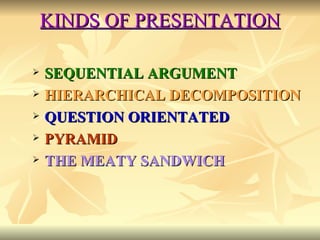
KINDS OF PRESENTATION SEQUENTIAL ARGUMENT HIERARCHICAL DECOMPOSITION QUESTION ORIENTATED PYRAMID THE MEATY SANDWICH
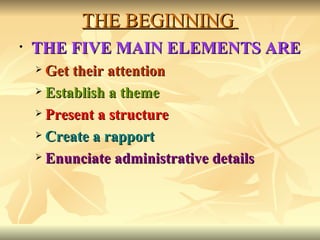
THE BEGINNING   THE FIVE MAIN ELEMENTS ARE Get their attention Establish a theme Present a structure Create a rapport Enunciate administrative details
THE ENDING   Summary of the main points Conclusions & recommendation Finish with a flourish
VISUAL AIDS   Reinforcement of the verbal message: OHP   SLIDE SHOW VIDEO PRESENTATION ROLE PLAY
PART III : PREPARING YOURSELF BELIEVING IN YOUR SELF   ANALYZING APPEARANCE ENHANCING BODY IMAGE IMPROVING YOUR VOICE  ELIMINATING TENSION
STEP 1 - BELIEVING IN YOUR SELF IDENTIFY YOUR STRENGTHS. THINK POSITIVE. VISUALISE SUCCESS. PRACTICAL TIPS . Behave  naturally . Think of the audience as your natural ally. Think of large audience as if it were small.
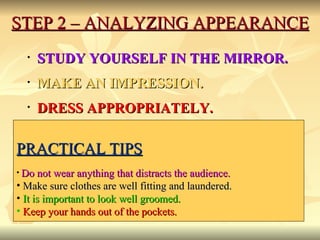
STEP 2 – ANALYZING APPEARANCE STUDY YOURSELF IN THE MIRROR. MAKE AN IMPRESSION. DRESS APPROPRIATELY. PRACTICAL TIPS   Do not wear anything that distracts the audience.   Make sure clothes are well fitting and laundered.  It is important to look well groomed.  Keep your hands out of the pockets.
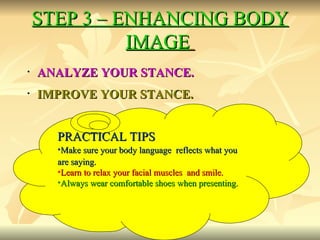
STEP 3 – ENHANCING BODY IMAGE   ANALYZE YOUR STANCE. IMPROVE YOUR STANCE. PRACTICAL TIPS Make sure your body language  reflects what you are saying.  Learn to relax your facial muscles  and smile.  Always wear comfortable shoes when presenting.
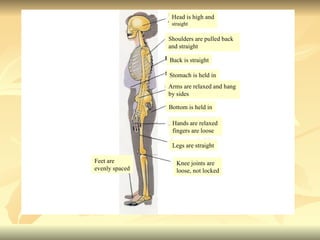
Head is high and straight Shoulders are pulled back and straight Back is straight Stomach is held in Arms are relaxed and hang by sides Bottom is held in Hands are relaxed  fingers are loose Legs are straight Knee joints are loose, not locked Feet are  evenly spaced
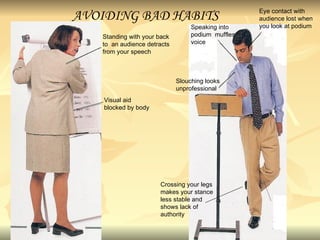
AVOIDING BAD HABITS Eye contact with audience lost when you look at podium Speaking into  podium  muffles  voice Slouching looks unprofessional Standing with your back to  an audience detracts from your speech Visual aid  blocked by body Crossing your legs makes your stance less stable and  shows lack of authority
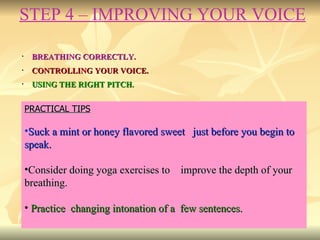
BREATHING CORRECTLY. CONTROLLING YOUR VOICE. USING THE RIGHT PITCH .      STEP 4 – IMPROVING YOUR VOICE PRACTICAL TIPS   Suck a mint or honey flavored sweet  just before you begin to speak.   Consider doing yoga exercises to  improve the depth of your breathing.  Practice  changing intonation of a  few sentences.
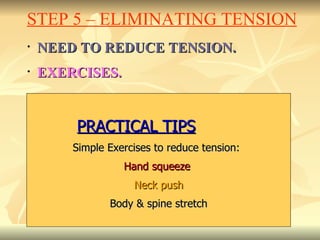
NEED TO REDUCE TENSION. EXERCISES.       STEP 5 – ELIMINATING TENSION PRACTICAL TIPS       Simple Exercises to reduce tension: Hand squeeze  Neck push Body & spine stretch
PART IV : DELIVERING A PRESENTATION CONTROLLING NERVES   SPEAKING CONFIDENTLY CLOSING EFFECTIVELY
CONTROLLING NERVES Identifying nerves. Being prepared. Defusing nerves. Reassuring yourself . Eliminating  tension.
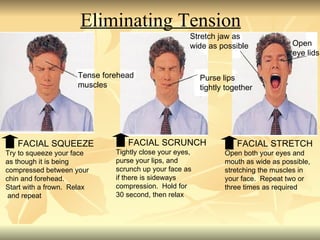
FACIAL SQUEEZE Try to squeeze your face as though it is being  compressed between your chin and forehead. Start with a frown.  Relax and repeat  FACIAL SCRUNCH Tightly close your eyes,  purse your lips, and  scrunch up your face as  if there is sideways compression.  Hold for  30 second, then relax FACIAL STRETCH Open both your eyes and mouth as wide as possible, stretching the muscles in your face.  Repeat two or three times as required Tense forehead  muscles Purse lips  tightly together Stretch jaw as  wide as possible Open  eye lids Eliminating Tension
CONTROLLING NERVES PRACTICAL TIPS List the factors that make you nervous. Smile when it feels natural. Get a good night’s sleep. Follow the same routine. Use nervous energy to enhance your speech. Take a deep breath, relax, smile. And start speaking slowly.
 
Begin confidently. Pace the presentation. Use correct body language. Use correct eye contact. Adapt your gestures to the size of the audience Develop your own style. Limit your speech time . SPEAKING CONFIDENTLY
SPEAKING CONFIDENTLY PRACTICAL TIPS   Scan notes in small sections. Pause briefly each time you make an important point. Tell an anecdote. Make initial eye contact with a friendly person. Make eye contact at every available opportunity. Repeat key numbers . Do not be afraid to use gestures & long pauses.
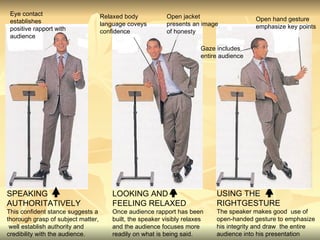
SPEAKING  AUTHORITATIVELY This confident stance suggests a thorough grasp of subject matter, well establish authority and credibility with the audience. LOOKING AND FEELING RELAXED Once audience rapport has been built, the speaker visibly relaxes and the audience focuses more readily on what is being said. USING THE  RIGHTGESTURE The speaker makes good  use of open-handed gesture to emphasize his integrity and draw  the entire audience into his presentation Eye contact establishes positive rapport with audience Relaxed body language coveys  confidence Open jacket  presents an image of honesty Gaze includes entire audience Open hand gesture emphasize key points
SIGN POST THE END. LEAVE AN IMPRESSION THAT LINGERS. SPEAK AUTHORITATIVELY. FINISH STRONGLY. .  CLOSING EFFECTIVELY PRACTICAL TIPS Do not leave visual aids on too long Do not rush as if you’re in hurry. Close with a strong summary. Use alliteration to make an impact. Pause between summary & Q-ans session
PART V : HANDLING AN AUDIENCE JUDGING THE MOOD   DEALING WITH QUESTIONS  COPING WITH HOSTILITY
Assess the mood. Involve the audience. Look for signals. Spot negativity. Look out for  signs of interest. Reading gestures. JUDGING THE MOOD
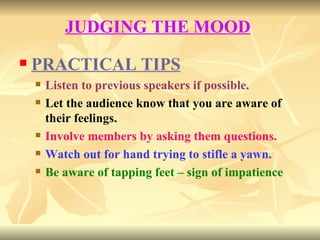
JUDGING THE MOOD   PRACTICAL TIPS Listen to previous speakers if possible. Let the audience know that you are aware of their feelings. Involve members by asking them questions. Watch out for hand trying to stifle a yawn. Be aware of tapping feet – sign of impatience
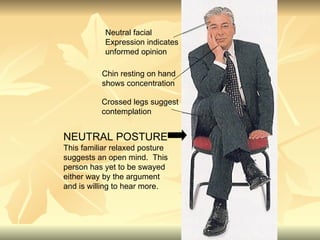
Neutral facial  Expression indicates  unformed opinion Chin resting on hand shows concentration Crossed legs suggest contemplation NEUTRAL POSTURE This familiar relaxed posture suggests an open mind.  This person has yet to be swayed  either way by the argument and is willing to hear more.
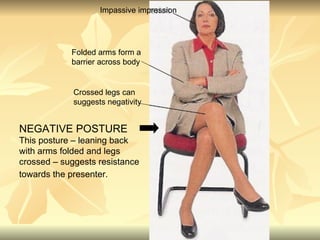
Impassive impression Folded arms form a  barrier across body Crossed legs can suggests negativity NEGATIVE POSTURE This posture – leaning back  with arms folded and legs  crossed – suggests resistance  towards the presenter.
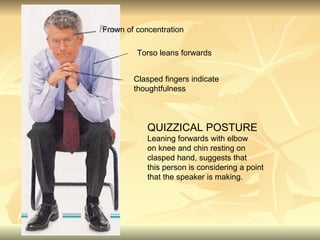
Frown of concentration Torso leans forwards Clasped fingers indicate thoughtfulness  QUIZZICAL POSTURE Leaning forwards with elbow  on knee and chin resting on  clasped hand, suggests that  this person is considering a point that the speaker is making.
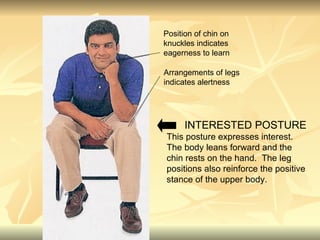
Position of chin on knuckles indicates eagerness to learn Arrangements of legs  indicates alertness INTERESTED POSTURE This posture expresses interest.  The body leans forward and the  chin rests on the hand.  The leg  positions also reinforce the positive stance of the upper body.
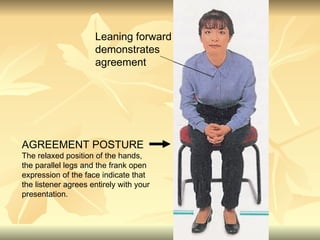
Leaning forward demonstrates  agreement AGREEMENT POSTURE The relaxed position of the hands,  the parallel legs and the frank open expression of the face indicate that the listener agrees entirely with your presentation.
Prepare well. Appear confident. Stay in control. Handling questioners. Analyzing questions. Gaining time. Dealing with hidden agenda. Being honest with the audience. DEALING WITH QUESTIONS
DEALING WITH QUESTIONS PRACTICAL TIPS Practise answering impromptu questions. Remain calm whatever the  tone of the questioners. Encourage shy or nervous questioners. Divert hostile questions back to the questioner or the audience. Address answers to the whole audience. Win over the audience with your knowledge. Take care not to patronize your audience. Prepare one or two lengthy answers in advance.
THE SUMMARY QUESTION: “What you seem to be  saying is… am I right ?” THIS IS AN EFFORT TO RECAP ON PROCEEDINGS. THE STRAIGHT QUESTION : “Can You Tell Me About the Services You Offer in Brazil?” THIS IS A DIRECT APPEAL FOR INFORMATION. THE ME AND MINE QUESTION : “When my mother tried, she found the opposite. How do you explain that?” PERSONAL EXPERIENCE IS USED TO MAKE A POINT. TYPES OF QUESTION TO EXPECT FROM AN AUDIENCE
TYPES OF QUESTIONS……. THE CARTESIAN QUESTION : “How can you say X, yet insist on Y?” HERE LOGIC IS BEING  USED TO DEFEAT THE SPEAKER. THE RAW NERVE QUESTION : “When are vou going to get back to 1995 Levels?”  THIS IS AN ILL- NATURED DIG. THE WELL-CONNECTED QUESTION :  “ Have you talked to my good friend Bill Clinton about this problem?” NAME  DROPPING IS USED TO EMPHASIZE POWER.
There are a number of standard replies you can use in response to difficult questions.  If you do not know an answer, try to offer a satisfactory reply to show you have not ignored the question.  If a questioner persists, throw the question open to the audience. RESPONDING TO UNANSWERABLE QUESTIONS
“ I DON’T KNOW THE ANSWER, BUT  I CAN FIND OUT FOR YOU.  IF YOU  LEAVE ME YOUR ADDRESS, I WILL  GET BACK TO YOU ”
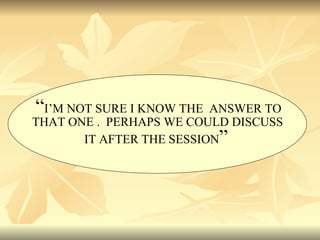
“ I’M NOT SURE I KNOW THE  ANSWER TO THAT ONE .  PERHAPS WE COULD DISCUSS IT AFTER THE SESSION ”
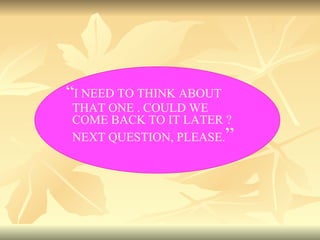
“ I NEED TO THINK ABOUT  THAT ONE . COULD WE  COME BACK TO IT LATER ?  NEXT QUESTION, PLEASE. ”
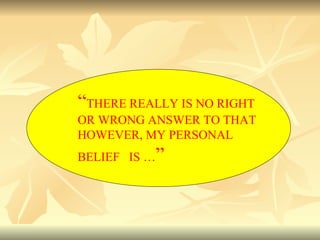
“ THERE REALLY IS NO RIGHT OR WRONG ANSWER TO THAT  HOWEVER, MY PERSONAL  BELIEF  IS … ”
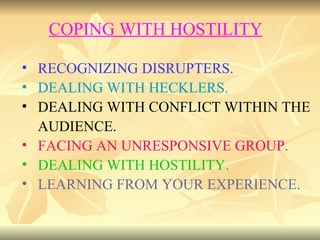
RECOGNIZING DISRUPTERS. DEALING WITH HECKLERS. DEALING WITH CONFLICT WITHIN THE AUDIENCE. FACING AN UNRESPONSIVE GROUP. DEALING WITH HOSTILITY. LEARNING FROM YOUR EXPERIENCE. COPING WITH HOSTILITY
PRACTICAL TIPS Remember the hostility is at your opinion not you. Avoid prolonged eye contact. Back your facts with evidence. Don’t lose your temper but assert your authority. Try to find some common ground with the audience. Give questioner other sources of information. Wait for a question even if none are forthcoming. Be honest with your  audience. Stay relaxed but alert and enjoy your presentation. COPING WITH HOSTILITY
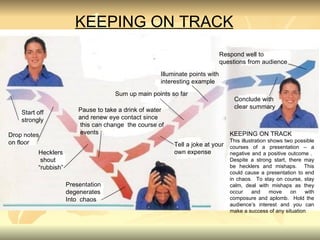
KEEPING ON TRACK This illustration shows two possible courses of a presentation – a negative and a positive outcome .  Despite a strong start, there may be hecklers and mishaps.  This could cause a presentation to end in chaos.  To stay on course, stay calm, deal with mishaps as they occur and move on with composure and aplomb.  Hold the audience’s interest and you can make a success of any situation Respond well to  questions from audience Conclude with  clear summary Illuminate points with  interesting example Sum up main points so far Pause to take a drink of water  and renew eye contact since this can change  the course of events Tell a joke at your  own expense Presentation  degenerates  Into  chaos Hecklers shout “ rubbish” Drop notes on floor Start off strongly KEEPING ON TRACK
DEALING WITH MEDIA If you have to speak at a public meeting  or represent your organization at a press conference, it is important to :- Handle the media confidently. Always answer queries calmly,politely and intelligently. Be careful not to let journalists put words into your mouth.
I HAVE ALREADY STATED MY POINT OF VIEW DURING MY  PRESENTATION. I DON’TTHINK I HAVE ANYTHING MORE TO ADD AT THIS JUNCTURE. YOU HAVE CERTAINLY MADE A VALID POINT . BUT I PREFER  TO THINK THAT …………… NO , THAT IS NOT WHAT I AM SAYING AT ALL. I WANT TO  REITERATE THAT WHAT I AM ACTUALLY SAYING ……… WHERE AS I APPRECIATE WHAT YOU ARE SAYING I FEEL THAT  I MUST EMPHASISE THAT………..

Presentation Skills

  • 1.
  • 2.
    PART I - INTRODUCTION PART II - PREPARING A PRESENTATION PART III - PREPARING YOUR SELF PART IV - DELIVERING A PRESENTATION PART V - HANDLING AN AUDIENCE PREVIEW
  • 3.
    PART I -INTRODUCTION WHAT IS A PRESENTATION ? AIM AND IMPORTANCE OF A PRESENTATION WHAT CAN A PRESENTATION DO FOR YOU ? EFFECTIVE PRESENTATION SKILLS
  • 4.
    WHAT IS APRESENTATION ? Foundational and fundamental business tool Basis of relationship with clients Reflects :- Image of the company Its value system Its vision
  • 5.
    WHAT IS A PRESENTATION? FOUNDATIONAL AND FUNDAMENTAL BUSINESS TOOL BASIS OF RELATIONSHIP WITH CLIENTS REFLECTS COMPANY’S IMAGE VALUE SYSTEM VISION
  • 6.
    AIM OF PRESENTATIONTo transfer information To communicate views To influence another mind Emphasis is not on transmission but on reception and understanding by audience so that YOUR MESSAGE IS UNDERSTOOD , REMEMBERED AND ACTED UPON !
  • 7.
    IMPORTANCE OF PRESENTATIONFOR YOUNG MANAGERS Formal method to bring people together to Fast & Effective Method of Getting Things Done PLAN MONITOR REVIEW A PROJECT
  • 8.
    WHAT CAN PRESENTATIONDO FOR YOU ? ALLOWS YOU TO INITIATE DISCUSSIONS ASK QUESTIONS RAISE ISSUES INVITE VIEWS IT PUTS YOU ON DISPLAY IT GIVES YOU A CHANCE TO SPEAK YOUR MIND
  • 9.
    EFFECTIVE PRESENTATION SKILLSPrecise use of language Knowledge of subject matter Logical & organised thought process Clarity of speech Conviction Brevity Attractive & effective audio – visual aids Empathy towards the audience
  • 10.
    PART II :PREPARING A PRESENTATION PLANNING A PRESENTATION THIRTEEN STEPS TO ORGANISED PRESENTATIONS TYPES OF PRESENTATIONS
  • 11.
    PLANNING A PRESENTATIONIDENTIFY YOUR AUDIENCE IMPERATIVES OF PLANNING FACTS STYLE PACE TONE TACTICS TIMING FORMULATE YOUR OBJECTIVE STATEMENT OF PURPOSE SIMPLE, CONCISE AND UNAMBIGUOUS FOCUS IS THE KEY
  • 12.
    THE STRUCTURE THEOVERVIEW THE LEAD THE THESIS STATEMENT THE INTERNAL STRUCTURE THE END STRUCTURE
  • 13.
    THIRTEEN STEPS TOORGANISED PRESENTATIONS STEP 1 THINK ABOUT THE AUDIENCE STEP2 DETERMINE THE PURPOSE STEP 3 LIST THE DETAILS STEP 4 GROUP THE DETAILS STEP 5 ORDER THE DETAILS STEP 6 NAME THE TOPICS STEP 7 SEQUENCE THE TOPICS STEP 8 WRITE THESIS STATEMENT STEP 9 WRITE THE LEAD & END STRUCTURES STEP 10 PLAN THE PARAGRAPHS, TOPIC SENTENCES (Transitions & Reminders) STEP 11 WRITE THE PIECE STEP 12 PLAN THE VISUALS STEP 13 PRACTICE, TAPE, EDIT
  • 14.
    KINDS OF PRESENTATIONSEQUENTIAL ARGUMENT HIERARCHICAL DECOMPOSITION QUESTION ORIENTATED PYRAMID THE MEATY SANDWICH
  • 15.
    THE BEGINNING THE FIVE MAIN ELEMENTS ARE Get their attention Establish a theme Present a structure Create a rapport Enunciate administrative details
  • 16.
    THE ENDING Summary of the main points Conclusions & recommendation Finish with a flourish
  • 17.
    VISUAL AIDS Reinforcement of the verbal message: OHP SLIDE SHOW VIDEO PRESENTATION ROLE PLAY
  • 18.
    PART III :PREPARING YOURSELF BELIEVING IN YOUR SELF ANALYZING APPEARANCE ENHANCING BODY IMAGE IMPROVING YOUR VOICE ELIMINATING TENSION
  • 19.
    STEP 1 -BELIEVING IN YOUR SELF IDENTIFY YOUR STRENGTHS. THINK POSITIVE. VISUALISE SUCCESS. PRACTICAL TIPS . Behave naturally . Think of the audience as your natural ally. Think of large audience as if it were small.
  • 20.
    STEP 2 –ANALYZING APPEARANCE STUDY YOURSELF IN THE MIRROR. MAKE AN IMPRESSION. DRESS APPROPRIATELY. PRACTICAL TIPS Do not wear anything that distracts the audience. Make sure clothes are well fitting and laundered. It is important to look well groomed. Keep your hands out of the pockets.
  • 21.
    STEP 3 –ENHANCING BODY IMAGE ANALYZE YOUR STANCE. IMPROVE YOUR STANCE. PRACTICAL TIPS Make sure your body language reflects what you are saying. Learn to relax your facial muscles and smile. Always wear comfortable shoes when presenting.
  • 22.
    Head is highand straight Shoulders are pulled back and straight Back is straight Stomach is held in Arms are relaxed and hang by sides Bottom is held in Hands are relaxed fingers are loose Legs are straight Knee joints are loose, not locked Feet are evenly spaced
  • 23.
    AVOIDING BAD HABITSEye contact with audience lost when you look at podium Speaking into podium muffles voice Slouching looks unprofessional Standing with your back to an audience detracts from your speech Visual aid blocked by body Crossing your legs makes your stance less stable and shows lack of authority
  • 24.
    BREATHING CORRECTLY. CONTROLLINGYOUR VOICE. USING THE RIGHT PITCH . STEP 4 – IMPROVING YOUR VOICE PRACTICAL TIPS Suck a mint or honey flavored sweet just before you begin to speak. Consider doing yoga exercises to improve the depth of your breathing. Practice changing intonation of a few sentences.
  • 25.
    NEED TO REDUCETENSION. EXERCISES. STEP 5 – ELIMINATING TENSION PRACTICAL TIPS Simple Exercises to reduce tension: Hand squeeze Neck push Body & spine stretch
  • 26.
    PART IV :DELIVERING A PRESENTATION CONTROLLING NERVES SPEAKING CONFIDENTLY CLOSING EFFECTIVELY
  • 27.
    CONTROLLING NERVES Identifyingnerves. Being prepared. Defusing nerves. Reassuring yourself . Eliminating tension.
  • 28.
    FACIAL SQUEEZE Tryto squeeze your face as though it is being compressed between your chin and forehead. Start with a frown. Relax and repeat FACIAL SCRUNCH Tightly close your eyes, purse your lips, and scrunch up your face as if there is sideways compression. Hold for 30 second, then relax FACIAL STRETCH Open both your eyes and mouth as wide as possible, stretching the muscles in your face. Repeat two or three times as required Tense forehead muscles Purse lips tightly together Stretch jaw as wide as possible Open eye lids Eliminating Tension
  • 29.
    CONTROLLING NERVES PRACTICALTIPS List the factors that make you nervous. Smile when it feels natural. Get a good night’s sleep. Follow the same routine. Use nervous energy to enhance your speech. Take a deep breath, relax, smile. And start speaking slowly.
  • 30.
  • 31.
    Begin confidently. Pacethe presentation. Use correct body language. Use correct eye contact. Adapt your gestures to the size of the audience Develop your own style. Limit your speech time . SPEAKING CONFIDENTLY
  • 32.
    SPEAKING CONFIDENTLY PRACTICALTIPS Scan notes in small sections. Pause briefly each time you make an important point. Tell an anecdote. Make initial eye contact with a friendly person. Make eye contact at every available opportunity. Repeat key numbers . Do not be afraid to use gestures & long pauses.
  • 33.
    SPEAKING AUTHORITATIVELYThis confident stance suggests a thorough grasp of subject matter, well establish authority and credibility with the audience. LOOKING AND FEELING RELAXED Once audience rapport has been built, the speaker visibly relaxes and the audience focuses more readily on what is being said. USING THE RIGHTGESTURE The speaker makes good use of open-handed gesture to emphasize his integrity and draw the entire audience into his presentation Eye contact establishes positive rapport with audience Relaxed body language coveys confidence Open jacket presents an image of honesty Gaze includes entire audience Open hand gesture emphasize key points
  • 34.
    SIGN POST THEEND. LEAVE AN IMPRESSION THAT LINGERS. SPEAK AUTHORITATIVELY. FINISH STRONGLY. . CLOSING EFFECTIVELY PRACTICAL TIPS Do not leave visual aids on too long Do not rush as if you’re in hurry. Close with a strong summary. Use alliteration to make an impact. Pause between summary & Q-ans session
  • 35.
    PART V :HANDLING AN AUDIENCE JUDGING THE MOOD DEALING WITH QUESTIONS COPING WITH HOSTILITY
  • 36.
    Assess the mood.Involve the audience. Look for signals. Spot negativity. Look out for signs of interest. Reading gestures. JUDGING THE MOOD
  • 37.
    JUDGING THE MOOD PRACTICAL TIPS Listen to previous speakers if possible. Let the audience know that you are aware of their feelings. Involve members by asking them questions. Watch out for hand trying to stifle a yawn. Be aware of tapping feet – sign of impatience
  • 38.
    Neutral facial Expression indicates unformed opinion Chin resting on hand shows concentration Crossed legs suggest contemplation NEUTRAL POSTURE This familiar relaxed posture suggests an open mind. This person has yet to be swayed either way by the argument and is willing to hear more.
  • 39.
    Impassive impression Foldedarms form a barrier across body Crossed legs can suggests negativity NEGATIVE POSTURE This posture – leaning back with arms folded and legs crossed – suggests resistance towards the presenter.
  • 40.
    Frown of concentrationTorso leans forwards Clasped fingers indicate thoughtfulness QUIZZICAL POSTURE Leaning forwards with elbow on knee and chin resting on clasped hand, suggests that this person is considering a point that the speaker is making.
  • 41.
    Position of chinon knuckles indicates eagerness to learn Arrangements of legs indicates alertness INTERESTED POSTURE This posture expresses interest. The body leans forward and the chin rests on the hand. The leg positions also reinforce the positive stance of the upper body.
  • 42.
    Leaning forward demonstrates agreement AGREEMENT POSTURE The relaxed position of the hands, the parallel legs and the frank open expression of the face indicate that the listener agrees entirely with your presentation.
  • 43.
    Prepare well. Appearconfident. Stay in control. Handling questioners. Analyzing questions. Gaining time. Dealing with hidden agenda. Being honest with the audience. DEALING WITH QUESTIONS
  • 44.
    DEALING WITH QUESTIONSPRACTICAL TIPS Practise answering impromptu questions. Remain calm whatever the tone of the questioners. Encourage shy or nervous questioners. Divert hostile questions back to the questioner or the audience. Address answers to the whole audience. Win over the audience with your knowledge. Take care not to patronize your audience. Prepare one or two lengthy answers in advance.
  • 45.
    THE SUMMARY QUESTION:“What you seem to be saying is… am I right ?” THIS IS AN EFFORT TO RECAP ON PROCEEDINGS. THE STRAIGHT QUESTION : “Can You Tell Me About the Services You Offer in Brazil?” THIS IS A DIRECT APPEAL FOR INFORMATION. THE ME AND MINE QUESTION : “When my mother tried, she found the opposite. How do you explain that?” PERSONAL EXPERIENCE IS USED TO MAKE A POINT. TYPES OF QUESTION TO EXPECT FROM AN AUDIENCE
  • 46.
    TYPES OF QUESTIONS…….THE CARTESIAN QUESTION : “How can you say X, yet insist on Y?” HERE LOGIC IS BEING USED TO DEFEAT THE SPEAKER. THE RAW NERVE QUESTION : “When are vou going to get back to 1995 Levels?” THIS IS AN ILL- NATURED DIG. THE WELL-CONNECTED QUESTION : “ Have you talked to my good friend Bill Clinton about this problem?” NAME DROPPING IS USED TO EMPHASIZE POWER.
  • 47.
    There are anumber of standard replies you can use in response to difficult questions. If you do not know an answer, try to offer a satisfactory reply to show you have not ignored the question. If a questioner persists, throw the question open to the audience. RESPONDING TO UNANSWERABLE QUESTIONS
  • 48.
    “ I DON’TKNOW THE ANSWER, BUT I CAN FIND OUT FOR YOU. IF YOU LEAVE ME YOUR ADDRESS, I WILL GET BACK TO YOU ”
  • 49.
    “ I’M NOTSURE I KNOW THE ANSWER TO THAT ONE . PERHAPS WE COULD DISCUSS IT AFTER THE SESSION ”
  • 50.
    “ I NEEDTO THINK ABOUT THAT ONE . COULD WE COME BACK TO IT LATER ? NEXT QUESTION, PLEASE. ”
  • 51.
    “ THERE REALLYIS NO RIGHT OR WRONG ANSWER TO THAT HOWEVER, MY PERSONAL BELIEF IS … ”
  • 52.
    RECOGNIZING DISRUPTERS. DEALINGWITH HECKLERS. DEALING WITH CONFLICT WITHIN THE AUDIENCE. FACING AN UNRESPONSIVE GROUP. DEALING WITH HOSTILITY. LEARNING FROM YOUR EXPERIENCE. COPING WITH HOSTILITY
  • 53.
    PRACTICAL TIPS Rememberthe hostility is at your opinion not you. Avoid prolonged eye contact. Back your facts with evidence. Don’t lose your temper but assert your authority. Try to find some common ground with the audience. Give questioner other sources of information. Wait for a question even if none are forthcoming. Be honest with your audience. Stay relaxed but alert and enjoy your presentation. COPING WITH HOSTILITY
  • 54.
    KEEPING ON TRACKThis illustration shows two possible courses of a presentation – a negative and a positive outcome . Despite a strong start, there may be hecklers and mishaps. This could cause a presentation to end in chaos. To stay on course, stay calm, deal with mishaps as they occur and move on with composure and aplomb. Hold the audience’s interest and you can make a success of any situation Respond well to questions from audience Conclude with clear summary Illuminate points with interesting example Sum up main points so far Pause to take a drink of water and renew eye contact since this can change the course of events Tell a joke at your own expense Presentation degenerates Into chaos Hecklers shout “ rubbish” Drop notes on floor Start off strongly KEEPING ON TRACK
  • 55.
    DEALING WITH MEDIAIf you have to speak at a public meeting or represent your organization at a press conference, it is important to :- Handle the media confidently. Always answer queries calmly,politely and intelligently. Be careful not to let journalists put words into your mouth.
  • 56.
    I HAVE ALREADYSTATED MY POINT OF VIEW DURING MY PRESENTATION. I DON’TTHINK I HAVE ANYTHING MORE TO ADD AT THIS JUNCTURE. YOU HAVE CERTAINLY MADE A VALID POINT . BUT I PREFER TO THINK THAT …………… NO , THAT IS NOT WHAT I AM SAYING AT ALL. I WANT TO REITERATE THAT WHAT I AM ACTUALLY SAYING ……… WHERE AS I APPRECIATE WHAT YOU ARE SAYING I FEEL THAT I MUST EMPHASISE THAT………..