Effective Presentation Skills
“Great speakers aren’t born,
they are trained.”
Presenting is a skill…
developed through experience and training.
Agenda


Introduction



Planning Your Presentation



The Presentation Sequence



Presentation Techniques



Creating Effective Visual Aids



Practice
What is its importance???







Helps in getting your ideas across
Gives you Confidence
Makes you Successful
Bestows respect and recognition
Makes an edge over competition
Great asset for career advancement
PANICS!!!!
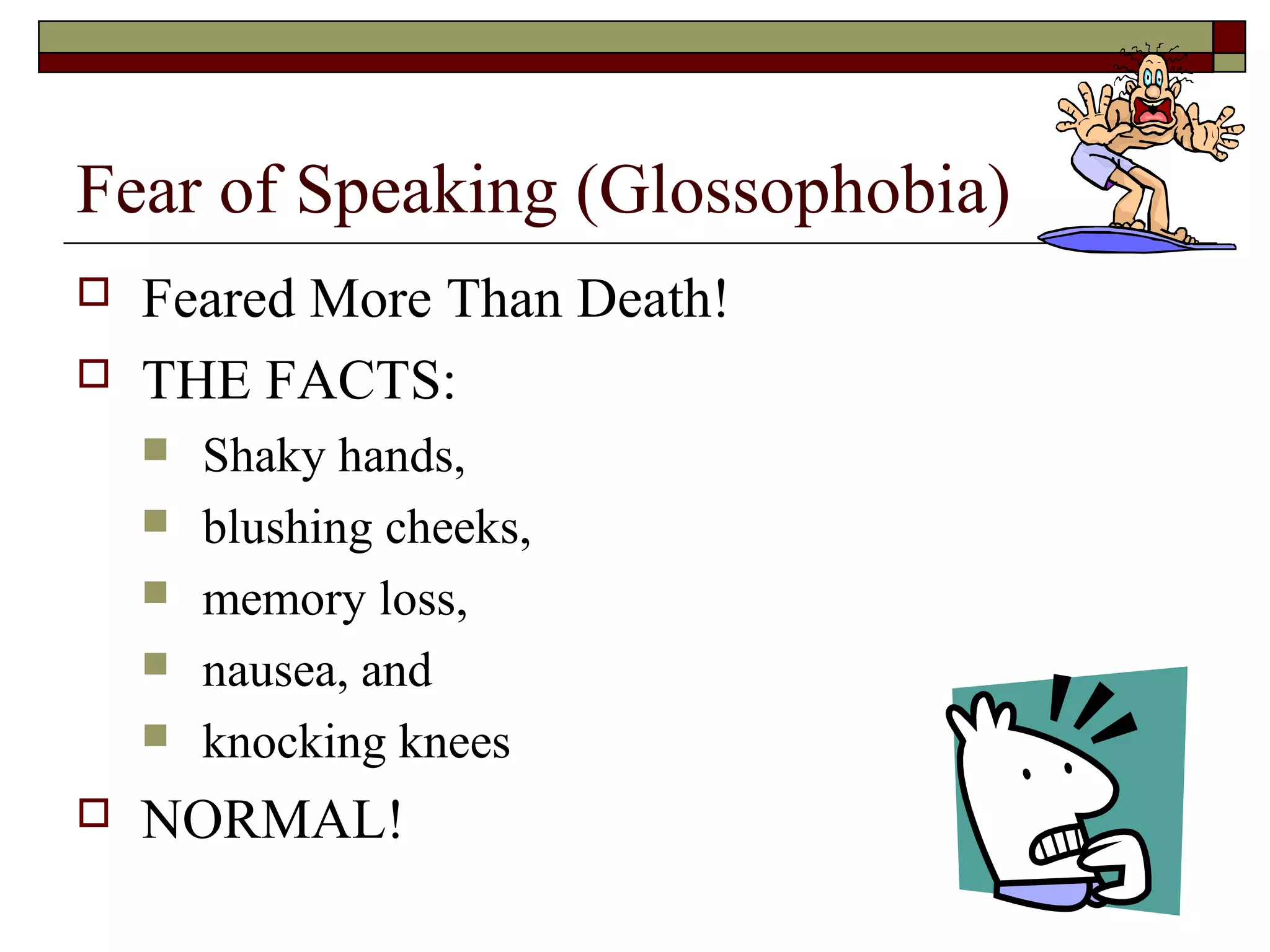
Fear of Speaking (Glossophobia)



Feared More Than Death!
THE FACTS:








Shaky hands,
blushing cheeks,
memory loss,
nausea, and
knocking knees

NORMAL!
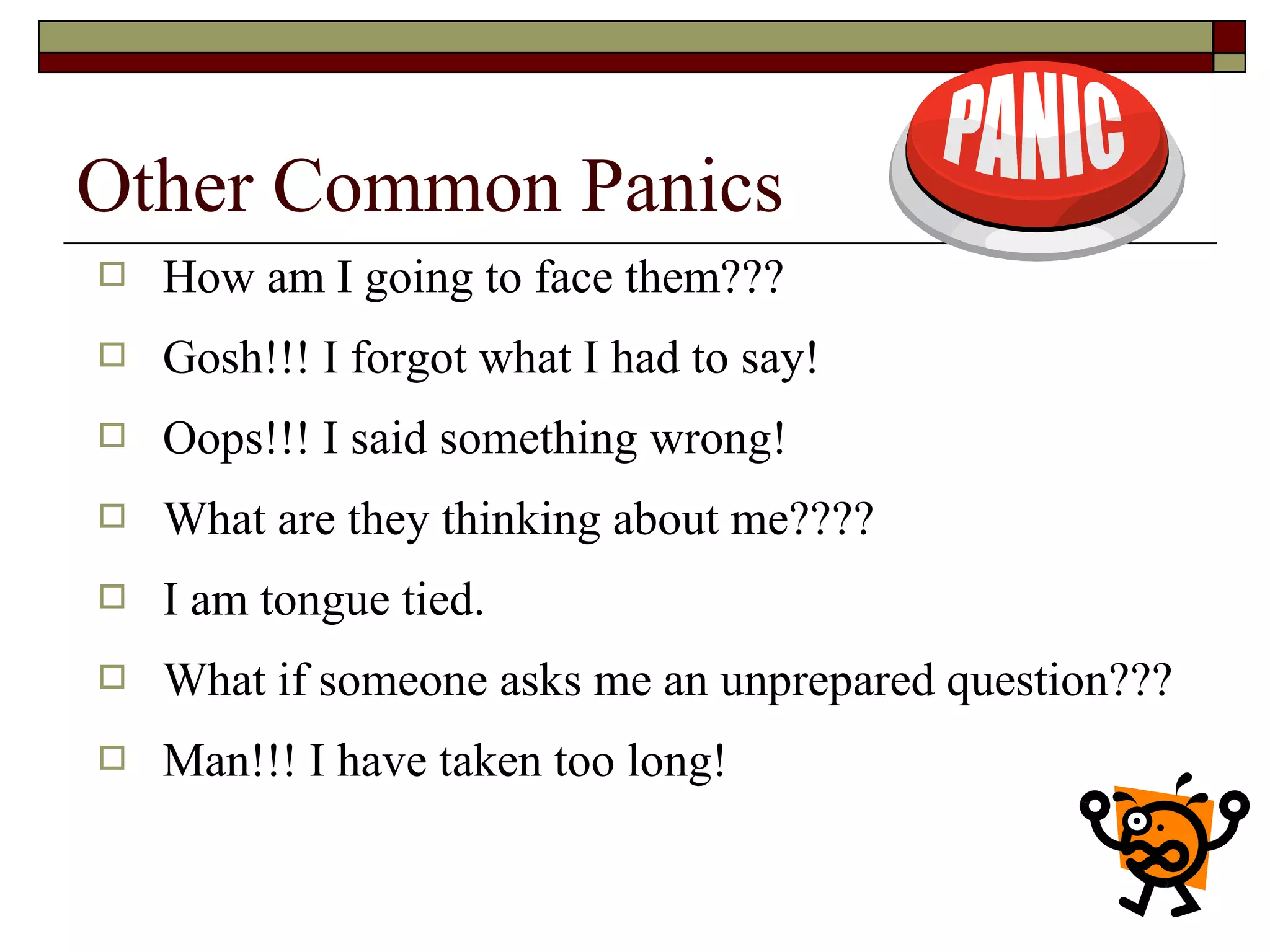
Other Common Panics


How am I going to face them???



Gosh!!! I forgot what I had to say!



Oops!!! I said something wrong!



What are they thinking about me????



I am tongue tied.



What if someone asks me an unprepared question???



Man!!! I have taken too long!
Causes of the Anxiety


Fear of the Unknown OR Loss of Control



Fight or Flight Mode



No Backup Plan



No Enthusiasm For Subject



Focus of Attention
Rise above the Fears…


Give yourself the opportunity to succeed



Be well prepared. Plan carefully.



Know your subject matter thoroughly



Time yourself during practice



Gain experience



Experience builds confidence



Concentrate on the message



Believe in yourself!!!!
The skills and confidence of public
speaking come from two things:



hard work and
practice



So how do you go about the hard work and
practice?



Let’s deal with the practice first.


It is true that no amount of reading and
learning techniques from a book will turn
you into a competent, confident speaker.
‘but how can I get practice’


Speak whenever you get the opportunity



Find your own particular strengths and
weaknesses



Learn to exploit your strengths and avoid
your weaknesses
FIGHT THE FRIGHT….


your audience understands your nervousness



be yourself; let the real you come through; relax,
practise some deep breathing techniques;



begin in your comfort zone; practise with friends;
share your fears with friends



Plan well



concentrate on the message



begin with a slow, well-prepared introduction; have
a confident and clear conclusion



most important: be prepared and practice
Effective Presentations


Control Anxiety



Audience Centered



Accomplish Objective



Fun for the Audience



Fun for the Presenter



Conducted Within Time Frame
Be
PrePared!
!!

SHOW eNTHUSIaSM!!
Part 2:
Planning Your Presentation
Keys to Presentation Excellence
Planning: think the whole process through


Objectives



Occasion



Audience
Planning Your Presentation
1. Determine Purpose
2. Assess Your Audience
 “Success depends on your ability to reach your
audience.”
 Size
 Demographics
 Knowledge Level
 Motivation
Planning contd.
3. Plan Space
 Number of Seats
 Seating Arrangement
 Audio/Visual Equipment
 Distracters
4. What Day and Time?
 Any Day!
 Morning, preferably
Planning contd.
5. Organization
 Determine Main Points (should be 2 to 5)
 Evidence
 Transitions
 Prepare Outline
Organizing Your Presentation
Organizing Patterns
 Topical
 Chronological
 Problem/Solution
 Cause/Effect
Tips to be kept while organizing


Requires an introduction and a conclusion



Should be logical and systematic



‘Look after the beginning and the end…and the
middle will take care itself.’
‘Men perish because they cannot join the
beginning with the end.’
Presentation Outline


Keyword Reminders



Conversational Flow



Flexibility



More Responsive to Audience
Part 3:
The Presentation Sequence
#1: Build Rapport


… relation marked by harmony or affinity




Start Before You Begin







Audience members who trust you and feel that
you care
Mingle; Learn Names
Opportunity to reinforce or correct audience
assessment
Good First Impression

People Listen To People They Like
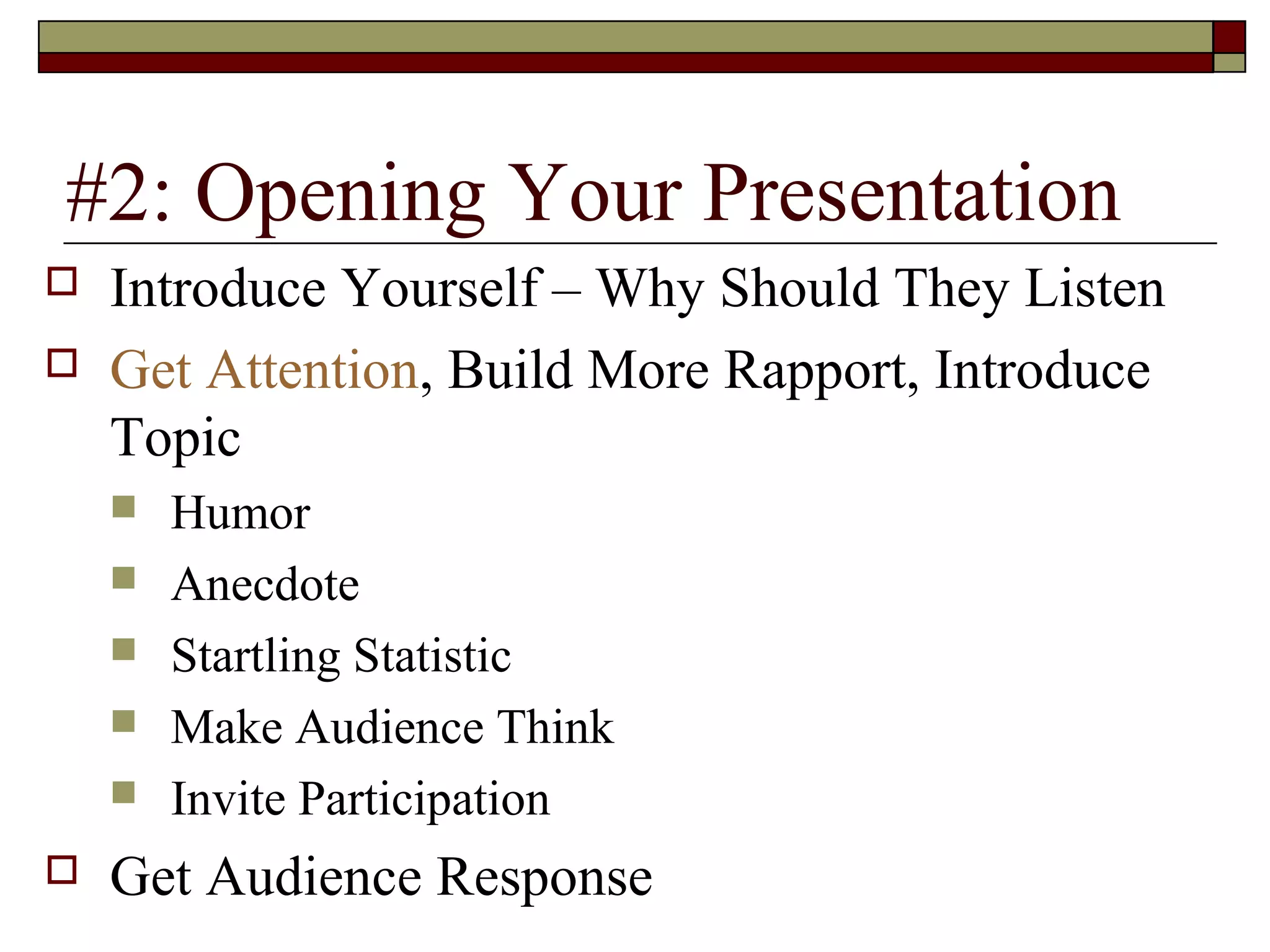
#2: Opening Your Presentation



Introduce Yourself – Why Should They Listen
Get Attention, Build More Rapport, Introduce
Topic








Humor
Anecdote
Startling Statistic
Make Audience Think
Invite Participation

Get Audience Response
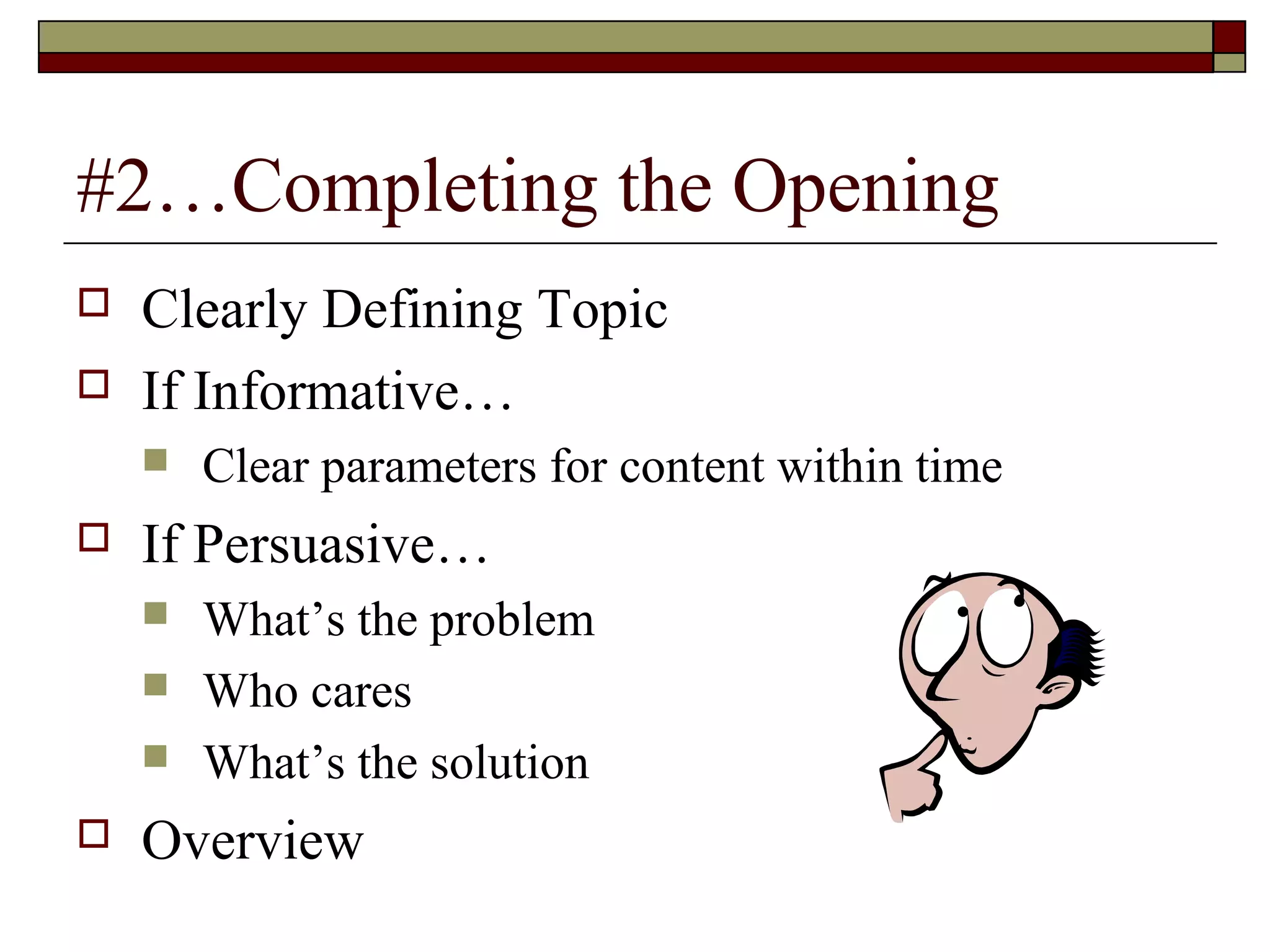
#2…Completing the Opening



Clearly Defining Topic
If Informative…




If Persuasive…






Clear parameters for content within time
What’s the problem
Who cares
What’s the solution
Overview
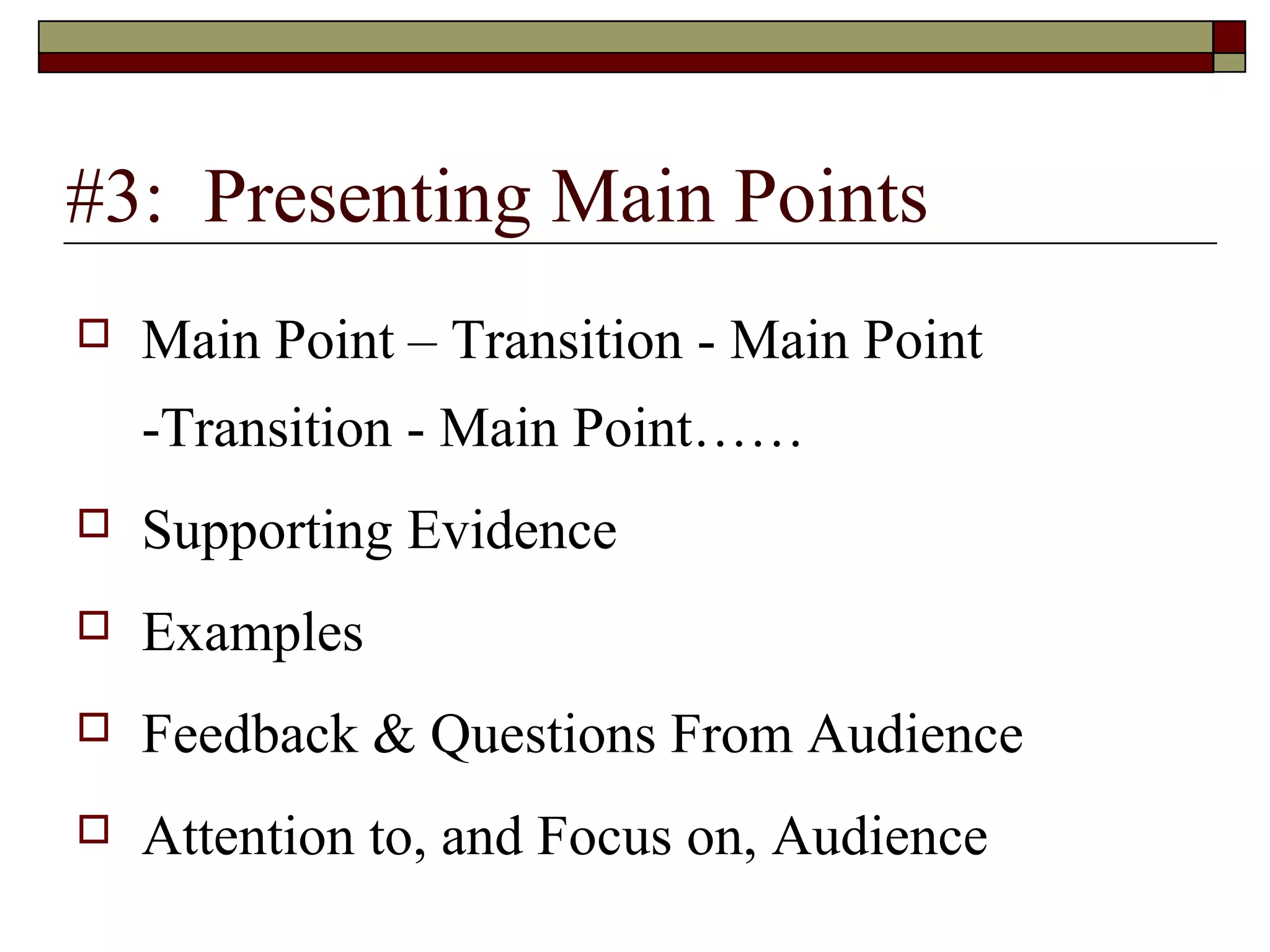
#3: Presenting Main Points


Main Point – Transition - Main Point
-Transition - Main Point……



Supporting Evidence



Examples



Feedback & Questions From Audience



Attention to, and Focus on, Audience
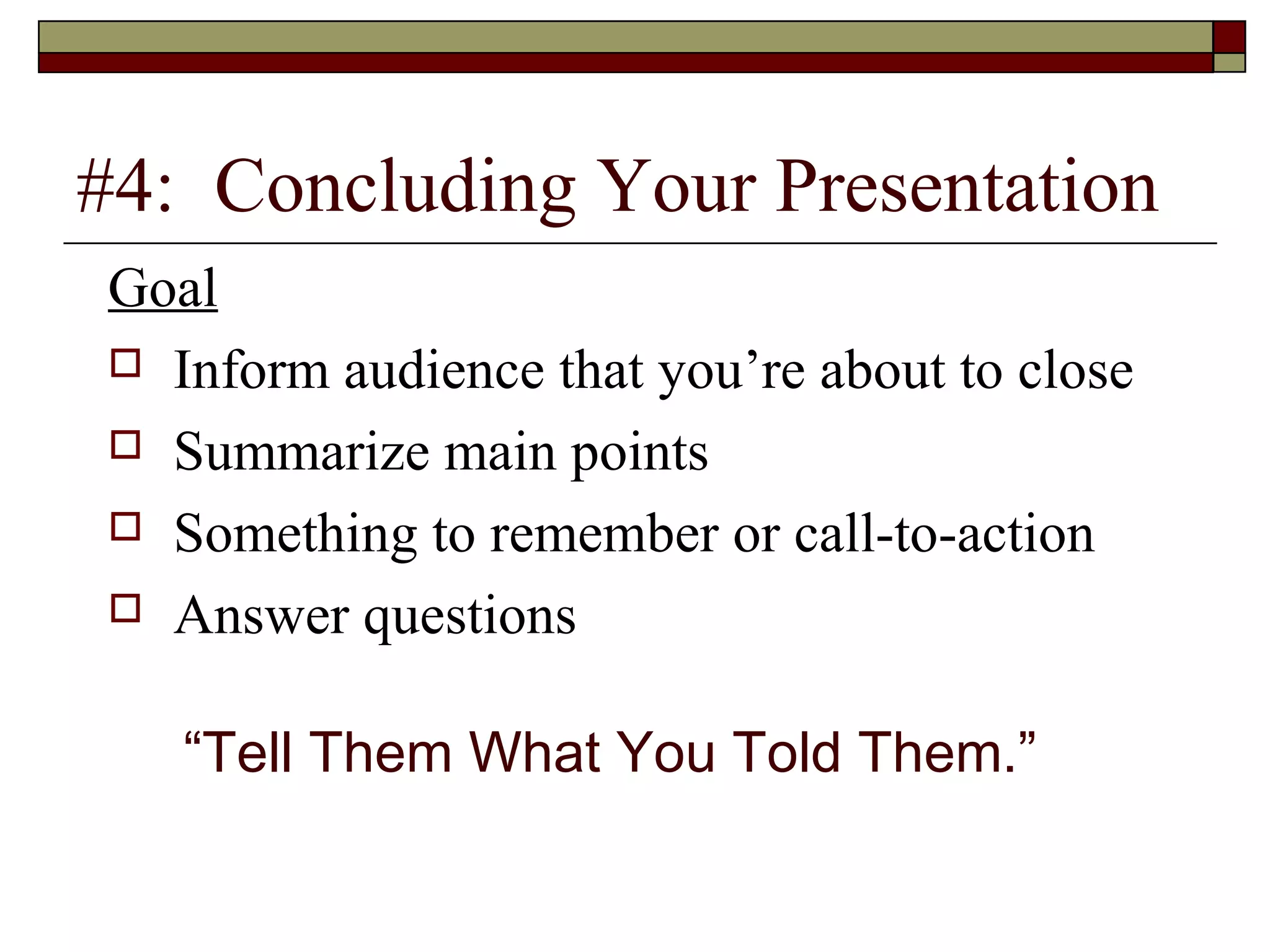
#4: Concluding Your Presentation
Goal
 Inform audience that you’re about to close
 Summarize main points
 Something to remember or call-to-action
 Answer questions
“Tell Them What You Told Them.”
#5: Question Round
ASKING QUESTIONS TO THE AUDIENCE


ask "friendly" questions and avoid asking risky questions



don't let respondent wander or attempt to take control of the
presentation



if extensive audience discussion is desired, avoid isolated oneon-one dialogues with specific individuals



when challenged, be candid and firm but avoid over responding



maintain control of the session and be firm and assertive
without being aggressive or defensive



don't let interruptions disrupt your composure
Guideline for Answering Questions


Anticipate Questions: think of the ten most likely
questions and plan out your answer



Understand the Question: paraphrase it if necessary;
repeat it if needed



Plan the Answer: particularly if you anticipated the
question



Do Not Digress
Part 4:
Effective Presentation Techniques
Presentation Style
3 Elements
1. Vocal Techniques
 Loudness
 Pitch
 Rate
 Pause

 Deviations From the Norm for Emphasis
Presentation Style (contd.)
2. Body Language
 Eye Contact, Gestures, Posture
3. Use of Space
 Can Everyone See You?
 Movement
Common Problems


Verbal fillers









“Um”, “uh”, “like”
Any unrelated word or phrase

Swaying, rocking, and pacing
Hands in pockets
Lip smacking
Fidgeting
Failure to be audience-centered
Five Presentation Tips
1. Smile
2. Breathe
3. Water
4. Notes
5. Finish On Or Under Time
Part 5:
Creating Effective Visual Aids
Visual Aids




Enhance Understanding
Add Variety
Lasting Impact

Used Poorly

A Distraction

Ineffective Presentation
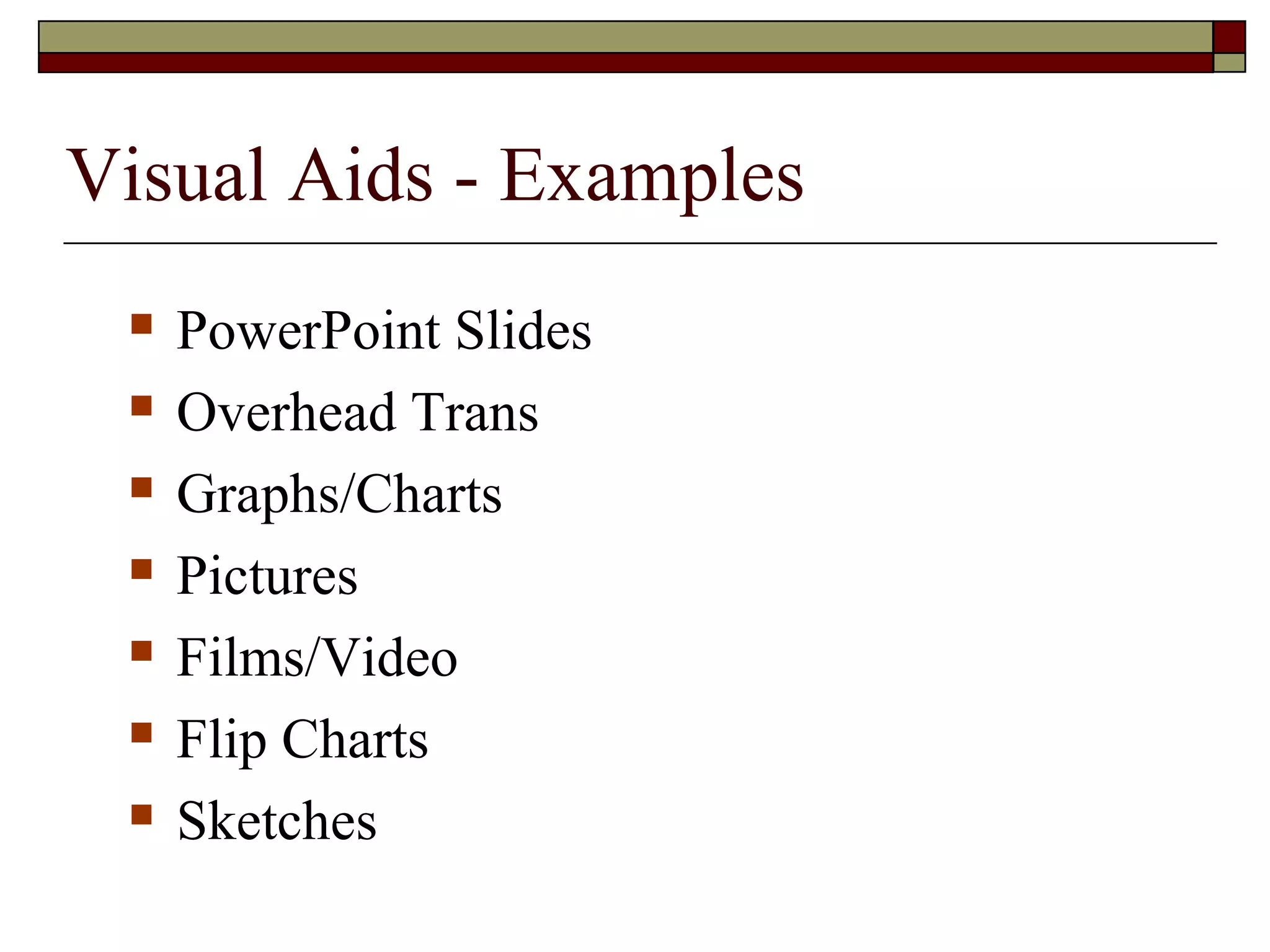
Visual Aids - Examples








PowerPoint Slides
Overhead Trans
Graphs/Charts
Pictures
Films/Video
Flip Charts
Sketches
Keys to Presentation Excellence
Practice and more practice:





perfecting the delivery
well-timed
comprehensible
convincing
Delivery of the Talk
Be yourself! And look at the audience!
 Concentrate on the preparation and on the four
qualities below
-conviction/sincerity
-enthusiasm
-power of speech
-simplicity
These are the basic ingredients of all effective
communication

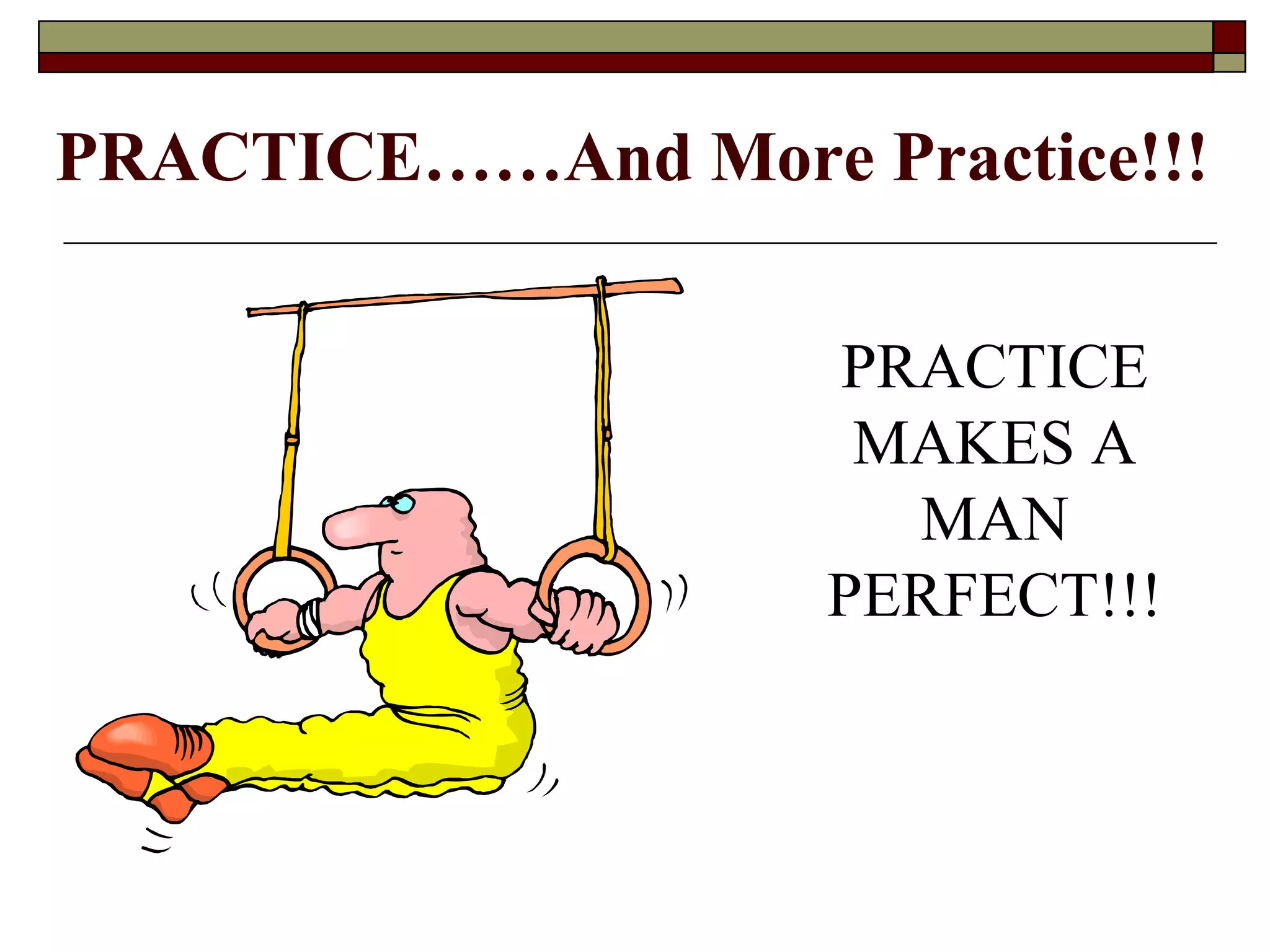
PRACTICE……And More Practice!!!
PRACTICE
MAKES A
MAN
PERFECT!!!

Lec 2 effective presentation skills

  • 1.
  • 2.
    “Great speakers aren’tborn, they are trained.” Presenting is a skill… developed through experience and training.
  • 3.
    Agenda  Introduction  Planning Your Presentation  ThePresentation Sequence  Presentation Techniques  Creating Effective Visual Aids  Practice
  • 4.
    What is itsimportance???       Helps in getting your ideas across Gives you Confidence Makes you Successful Bestows respect and recognition Makes an edge over competition Great asset for career advancement
  • 5.
  • 6.
    Fear of Speaking(Glossophobia)   Feared More Than Death! THE FACTS:       Shaky hands, blushing cheeks, memory loss, nausea, and knocking knees NORMAL!
  • 7.
    Other Common Panics  Howam I going to face them???  Gosh!!! I forgot what I had to say!  Oops!!! I said something wrong!  What are they thinking about me????  I am tongue tied.  What if someone asks me an unprepared question???  Man!!! I have taken too long!
  • 8.
    Causes of theAnxiety  Fear of the Unknown OR Loss of Control  Fight or Flight Mode  No Backup Plan  No Enthusiasm For Subject  Focus of Attention
  • 9.
    Rise above theFears…  Give yourself the opportunity to succeed  Be well prepared. Plan carefully.  Know your subject matter thoroughly  Time yourself during practice  Gain experience  Experience builds confidence  Concentrate on the message  Believe in yourself!!!!
  • 10.
    The skills andconfidence of public speaking come from two things:   hard work and practice  So how do you go about the hard work and practice?  Let’s deal with the practice first.
  • 11.
     It is truethat no amount of reading and learning techniques from a book will turn you into a competent, confident speaker.
  • 12.
    ‘but how canI get practice’  Speak whenever you get the opportunity  Find your own particular strengths and weaknesses  Learn to exploit your strengths and avoid your weaknesses
  • 13.
    FIGHT THE FRIGHT….  youraudience understands your nervousness  be yourself; let the real you come through; relax, practise some deep breathing techniques;  begin in your comfort zone; practise with friends; share your fears with friends  Plan well  concentrate on the message  begin with a slow, well-prepared introduction; have a confident and clear conclusion  most important: be prepared and practice
  • 14.
    Effective Presentations  Control Anxiety  AudienceCentered  Accomplish Objective  Fun for the Audience  Fun for the Presenter  Conducted Within Time Frame
  • 15.
  • 16.
  • 17.
    Keys to PresentationExcellence Planning: think the whole process through  Objectives  Occasion  Audience
  • 18.
    Planning Your Presentation 1.Determine Purpose 2. Assess Your Audience  “Success depends on your ability to reach your audience.”  Size  Demographics  Knowledge Level  Motivation
  • 19.
    Planning contd. 3. PlanSpace  Number of Seats  Seating Arrangement  Audio/Visual Equipment  Distracters 4. What Day and Time?  Any Day!  Morning, preferably
  • 20.
    Planning contd. 5. Organization Determine Main Points (should be 2 to 5)  Evidence  Transitions  Prepare Outline
  • 21.
    Organizing Your Presentation OrganizingPatterns  Topical  Chronological  Problem/Solution  Cause/Effect
  • 22.
    Tips to bekept while organizing  Requires an introduction and a conclusion  Should be logical and systematic  ‘Look after the beginning and the end…and the middle will take care itself.’ ‘Men perish because they cannot join the beginning with the end.’
  • 23.
    Presentation Outline  Keyword Reminders  ConversationalFlow  Flexibility  More Responsive to Audience
  • 24.
  • 25.
    #1: Build Rapport  …relation marked by harmony or affinity   Start Before You Begin     Audience members who trust you and feel that you care Mingle; Learn Names Opportunity to reinforce or correct audience assessment Good First Impression People Listen To People They Like
  • 26.
    #2: Opening YourPresentation   Introduce Yourself – Why Should They Listen Get Attention, Build More Rapport, Introduce Topic       Humor Anecdote Startling Statistic Make Audience Think Invite Participation Get Audience Response
  • 27.
    #2…Completing the Opening   ClearlyDefining Topic If Informative…   If Persuasive…     Clear parameters for content within time What’s the problem Who cares What’s the solution Overview
  • 28.
    #3: Presenting MainPoints  Main Point – Transition - Main Point -Transition - Main Point……  Supporting Evidence  Examples  Feedback & Questions From Audience  Attention to, and Focus on, Audience
  • 29.
    #4: Concluding YourPresentation Goal  Inform audience that you’re about to close  Summarize main points  Something to remember or call-to-action  Answer questions “Tell Them What You Told Them.”
  • 30.
    #5: Question Round ASKINGQUESTIONS TO THE AUDIENCE  ask "friendly" questions and avoid asking risky questions  don't let respondent wander or attempt to take control of the presentation  if extensive audience discussion is desired, avoid isolated oneon-one dialogues with specific individuals  when challenged, be candid and firm but avoid over responding  maintain control of the session and be firm and assertive without being aggressive or defensive  don't let interruptions disrupt your composure
  • 31.
    Guideline for AnsweringQuestions  Anticipate Questions: think of the ten most likely questions and plan out your answer  Understand the Question: paraphrase it if necessary; repeat it if needed  Plan the Answer: particularly if you anticipated the question  Do Not Digress
  • 32.
  • 33.
    Presentation Style 3 Elements 1.Vocal Techniques  Loudness  Pitch  Rate  Pause  Deviations From the Norm for Emphasis
  • 34.
    Presentation Style (contd.) 2.Body Language  Eye Contact, Gestures, Posture 3. Use of Space  Can Everyone See You?  Movement
  • 35.
    Common Problems  Verbal fillers        “Um”,“uh”, “like” Any unrelated word or phrase Swaying, rocking, and pacing Hands in pockets Lip smacking Fidgeting Failure to be audience-centered
  • 36.
    Five Presentation Tips 1.Smile 2. Breathe 3. Water 4. Notes 5. Finish On Or Under Time
  • 37.
  • 38.
    Visual Aids    Enhance Understanding AddVariety Lasting Impact Used Poorly A Distraction Ineffective Presentation
  • 39.
    Visual Aids -Examples        PowerPoint Slides Overhead Trans Graphs/Charts Pictures Films/Video Flip Charts Sketches
  • 40.
    Keys to PresentationExcellence Practice and more practice:     perfecting the delivery well-timed comprehensible convincing
  • 41.
    Delivery of theTalk Be yourself! And look at the audience!  Concentrate on the preparation and on the four qualities below -conviction/sincerity -enthusiasm -power of speech -simplicity These are the basic ingredients of all effective communication 
  • 42.