Dr. Jagannath K. Dange
Dean faculty of Education
Kuvempu University
Shankaraghatta
Dist: Shimoga, Karnataka
drjkdange@gmail.com
http://jkdange.blogspot.com
 The Indian teaching-learning system has been driven by
Guru-Shishya parampara. NALANDA University
 It is a holistic system which provided comprehensive
knowledge, value-based learning as well as requisite life
skills suited to the learners.
 Diverse pedagogies have been used for achieving core
objectives of the entire learning processes, included……
 exposure to real life experiences,
 hands on learning,
 value-based learning through stories/narrations,
 problem-solving through explorations,
 role plays,
 memorization and d
 dissemination through debates and discussions.
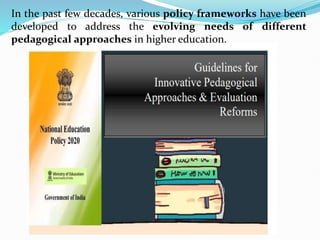
In the past few decades, various policy frameworks have been
developed to address the evolving needs of different
pedagogical approaches in higher education.
 The National Education Policy 2020 (NEP) is to integrate
Indian traditional value-based education with the present
technology dominated teaching and learning process.
 It aims a multipronged approach, one of which is
developing a pedagogy that makes education………
 experiential,
 holistic,
 integrated,
 inquiry-driven,
 discovery-oriented,
 learner-centred,
 discussion-based,
 flexible and enjoyable.
 As the NEP 2020 strives to develop well-rounded, competent
individuals with 21st-century skills.
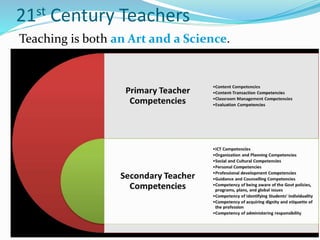
21st Century Teachers
Teaching is both an Art and a Science.
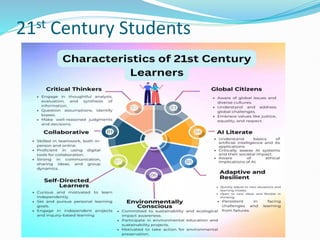
21st Century Students
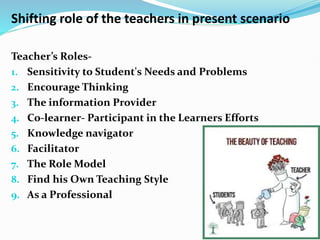
Shifting role of the teachers in present scenario
Teacher’s Roles-
1. Sensitivity to Student's Needs and Problems
2. Encourage Thinking
3. The information Provider
4. Co-learner- Participant in the Learners Efforts
5. Knowledge navigator
6. Facilitator
7. The Role Model
8. Find his Own Teaching Style
9. As a Professional
 Teachers should be provided with requisite training on
pedagogical approaches for capacity building.
 Such aspects of training on pedagogy must focus on the
following: (Design)
1. Addressing the different learning needs of students.
2. The difference in the learning styles of students.
(visual, auditory & kinaesthetic learning styles)
3. Diversity of the background of students in terms of the
discipline of study, the social, economic, cultural and
educational background.
4. The difference in the pace of learning.
 Adopting an inclusive approach: The NEP 2020 focuses on
providing accessible, inclusive and equitable education..
(Development)
1. Embracing Multi-disciplinarity: The pedagogical approach
to instil in the students the multidisciplinary approach for
understanding the core concepts, identifying and formulating
problems, and exploring possible solutions.
2. Learning mode centric pedagogy: The key modes of
learning, viz. physical or offline, online, hybrid or blended
modes, and flipped classroom necessitate varying pedagogies
suited to the channel/s of communication characteristic to each
mode of learning..
3. Learning method based pedagogy: The methods of learning
which can be used based on the desired learning outcomes or
degrees of active participation of learners in the teaching-
learning process.
 Each learning method may have an appropriate pedagogy
for delivering to the learners what is to be learnt. (Development)
 For instance, sensitization about a real-time problem, then
fieldwork with an observational study or survey in addition
to the theoretical grounding required.
 If hands-on or experiential learning, then field-based,
example-based, or project-based learning as pedagogy.
 The active engagement of learners is desired, the use of
collaborative and cooperative learning strategies, such as
group discussion, brainstorming, role plays, case studies,
and
 To encourage articulation, demonstrate new
understandings of the content then, Self-learning methods
supporting flipped classroom pedagogy are the important
teaching-learning methods
11
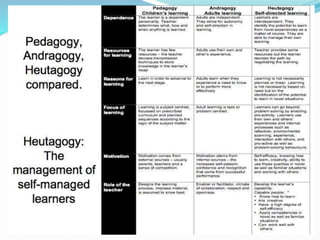
Pedagogy, Andragogy and
Heutogogy; What’s the
Difference?
12
Pedagogy is the discipline that deals with
the theory and practice of teaching.
Pedagogy is an art of sharing knowledge.
Pedagogy informs teaching strategies,
teacher actions, and teacher judgments and
decisions by taking into consideration
theories of learning, understandings of
students and their needs, and the
backgrounds and interests of individual
students.
13
Andragogy is the art and science of helping
adults learn:
Adults desire and enact a tendency toward
self-directedness as they mature
Adults’ experiences are a rich resource
for learning. They learn more effectively
through experimental activities such as
problem solving.
Adults are aware of specific learning
needs generated by real life
14
Principles of adult learning
 Autonomous and self- directed
 Life experiences and knowledge
 Goal- oriented
 Relevancy- oriented
 Practical
 Respect
15
Heutagogy
 The concept of truly self-determined
learning, called heutagogy, builds on
humanistic theory.
 It is suggested that heutagogy is
appropriate to the needs of learners in
the workplace in the twenty-first century,
particularly in the development of
individual capability.
16
The need for Heutagogy
A world in which:
 information is readily and easily accessible;
 discipline-based knowledge is inappropriate to
prepare for living in modern communities and
workplaces;
 learning is increasingly aligned with what we
do;
 modern organizational structures require
flexible learning practices
 There is a need for immediacy of learning.
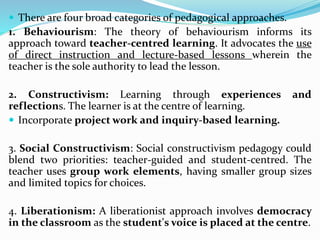
 There are four broad categories of pedagogical approaches.
1. Behaviourism: The theory of behaviourism informs its
approach toward teacher-centred learning. It advocates the use
of direct instruction and lecture-based lessons wherein the
teacher is the sole authority to lead the lesson.
2. Constructivism: Learning through experiences and
reflections. The learner is at the centre of learning.
 Incorporate project work and inquiry-based learning.
3. Social Constructivism: Social constructivism pedagogy could
blend two priorities: teacher-guided and student-centred. The
teacher uses group work elements, having smaller group sizes
and limited topics for choices.
4. Liberationism: A liberationist approach involves democracy
in the classroom as the student's voice is placed at the centre.
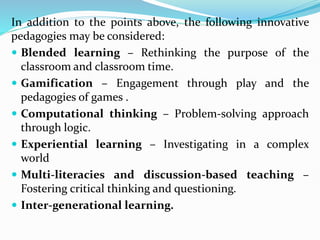
In addition to the points above, the following innovative
pedagogies may be considered:
 Blended learning – Rethinking the purpose of the
classroom and classroom time.
 Gamification – Engagement through play and the
pedagogies of games .
 Computational thinking – Problem-solving approach
through logic.
 Experiential learning – Investigating in a complex
world
 Multi-literacies and discussion-based teaching –
Fostering critical thinking and questioning.
 Inter-generational learning.
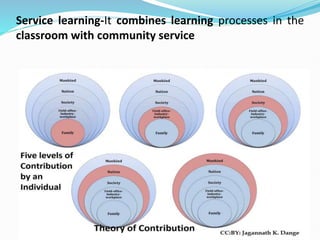
Service learning-It combines learning processes in the
classroom with community service
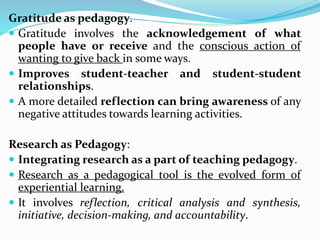
Gratitude as pedagogy.
 Gratitude involves the acknowledgement of what
people have or receive and the conscious action of
wanting to give back in some ways.
 Improves student-teacher and student-student
relationships.
 A more detailed reflection can bring awareness of any
negative attitudes towards learning activities.
Research as Pedagogy:
 Integrating research as a part of teaching pedagogy.
 Research as a pedagogical tool is the evolved form of
experiential learning.
 It involves reflection, critical analysis and synthesis,
initiative, decision-making, and accountability.
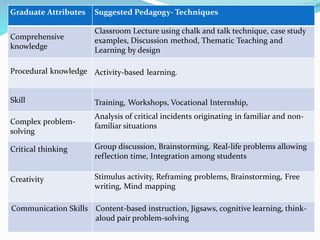
Graduate Attributes Suggested Pedagogy- Techniques
Comprehensive
knowledge
Classroom Lecture using chalk and talk technique, case study
examples, Discussion method, Thematic Teaching and
Learning by design
Procedural knowledge Activity-based learning.
Skill Training, Workshops, Vocational Internship,
Complex problem-
solving
Analysis of critical incidents originating in familiar and non-
familiar situations
Critical thinking Group discussion, Brainstorming, Real-life problems allowing
reflection time, Integration among students
Creativity Stimulus activity, Reframing problems, Brainstorming, Free
writing, Mind mapping
Communication Skills Content-based instruction, Jigsaws, cognitive learning, think-
aloud pair problem-solving
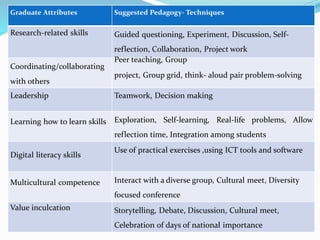
Graduate Attributes Suggested Pedagogy- Techniques
Research-related skills Guided questioning, Experiment, Discussion, Self-
reflection, Collaboration, Project work
Coordinating/collaborating
with others
Peer teaching, Group
project, Group grid, think- aloud pair problem-solving
Leadership Teamwork, Decision making
Learning how to learn skills Exploration, Self-learning, Real-life problems, Allow
reflection time, Integration among students
Digital literacy skills
Use of practical exercises ,using ICT tools and software
Multicultural competence Interact with a diverse group, Cultural meet, Diversity
focused conference
Value inculcation Storytelling, Debate, Discussion, Cultural meet,
Celebration of days of national importance
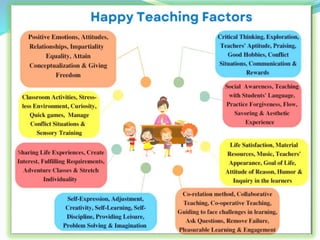
 “Happy learning is a process as well as product which enables
the students to discover the world of knowledge and where
their curiosity, desire to learn grow and it archived perfect
balance between present pleasure and future benefits for
sustainable happiness.”
 The Happiness in the teaching-learning matrix comes from
the smooth relations and mutual attraction between the
teacher and the students.
 So in happy learning, the interests, aptitude and liking of the
students have to be safeguarded.
Thank You
Dr. Jagannath K. Dange
Department of Education
Kuvempu University
Shankaraghatta
Dist: Shimoga
jkdange@gmail.com
http://jkdange.blogspot.com

Innovative Teaching pedagogy for Higher Education

  • 1.
    Dr. Jagannath K.Dange Dean faculty of Education Kuvempu University Shankaraghatta Dist: Shimoga, Karnataka drjkdange@gmail.com http://jkdange.blogspot.com
  • 2.
     The Indianteaching-learning system has been driven by Guru-Shishya parampara. NALANDA University  It is a holistic system which provided comprehensive knowledge, value-based learning as well as requisite life skills suited to the learners.  Diverse pedagogies have been used for achieving core objectives of the entire learning processes, included……  exposure to real life experiences,  hands on learning,  value-based learning through stories/narrations,  problem-solving through explorations,  role plays,  memorization and d  dissemination through debates and discussions.
  • 3.
    In the pastfew decades, various policy frameworks have been developed to address the evolving needs of different pedagogical approaches in higher education.
  • 4.
     The NationalEducation Policy 2020 (NEP) is to integrate Indian traditional value-based education with the present technology dominated teaching and learning process.  It aims a multipronged approach, one of which is developing a pedagogy that makes education………  experiential,  holistic,  integrated,  inquiry-driven,  discovery-oriented,  learner-centred,  discussion-based,  flexible and enjoyable.  As the NEP 2020 strives to develop well-rounded, competent individuals with 21st-century skills.
  • 5.
    21st Century Teachers Teachingis both an Art and a Science.
  • 6.
  • 7.
    Shifting role ofthe teachers in present scenario Teacher’s Roles- 1. Sensitivity to Student's Needs and Problems 2. Encourage Thinking 3. The information Provider 4. Co-learner- Participant in the Learners Efforts 5. Knowledge navigator 6. Facilitator 7. The Role Model 8. Find his Own Teaching Style 9. As a Professional
  • 8.
     Teachers shouldbe provided with requisite training on pedagogical approaches for capacity building.  Such aspects of training on pedagogy must focus on the following: (Design) 1. Addressing the different learning needs of students. 2. The difference in the learning styles of students. (visual, auditory & kinaesthetic learning styles) 3. Diversity of the background of students in terms of the discipline of study, the social, economic, cultural and educational background. 4. The difference in the pace of learning.
  • 9.
     Adopting aninclusive approach: The NEP 2020 focuses on providing accessible, inclusive and equitable education.. (Development) 1. Embracing Multi-disciplinarity: The pedagogical approach to instil in the students the multidisciplinary approach for understanding the core concepts, identifying and formulating problems, and exploring possible solutions. 2. Learning mode centric pedagogy: The key modes of learning, viz. physical or offline, online, hybrid or blended modes, and flipped classroom necessitate varying pedagogies suited to the channel/s of communication characteristic to each mode of learning.. 3. Learning method based pedagogy: The methods of learning which can be used based on the desired learning outcomes or degrees of active participation of learners in the teaching- learning process.
  • 10.
     Each learningmethod may have an appropriate pedagogy for delivering to the learners what is to be learnt. (Development)  For instance, sensitization about a real-time problem, then fieldwork with an observational study or survey in addition to the theoretical grounding required.  If hands-on or experiential learning, then field-based, example-based, or project-based learning as pedagogy.  The active engagement of learners is desired, the use of collaborative and cooperative learning strategies, such as group discussion, brainstorming, role plays, case studies, and  To encourage articulation, demonstrate new understandings of the content then, Self-learning methods supporting flipped classroom pedagogy are the important teaching-learning methods
  • 11.
    11 Pedagogy, Andragogy and Heutogogy;What’s the Difference?
  • 12.
    12 Pedagogy is thediscipline that deals with the theory and practice of teaching. Pedagogy is an art of sharing knowledge. Pedagogy informs teaching strategies, teacher actions, and teacher judgments and decisions by taking into consideration theories of learning, understandings of students and their needs, and the backgrounds and interests of individual students.
  • 13.
    13 Andragogy is theart and science of helping adults learn: Adults desire and enact a tendency toward self-directedness as they mature Adults’ experiences are a rich resource for learning. They learn more effectively through experimental activities such as problem solving. Adults are aware of specific learning needs generated by real life
  • 14.
    14 Principles of adultlearning  Autonomous and self- directed  Life experiences and knowledge  Goal- oriented  Relevancy- oriented  Practical  Respect
  • 15.
    15 Heutagogy  The conceptof truly self-determined learning, called heutagogy, builds on humanistic theory.  It is suggested that heutagogy is appropriate to the needs of learners in the workplace in the twenty-first century, particularly in the development of individual capability.
  • 16.
    16 The need forHeutagogy A world in which:  information is readily and easily accessible;  discipline-based knowledge is inappropriate to prepare for living in modern communities and workplaces;  learning is increasingly aligned with what we do;  modern organizational structures require flexible learning practices  There is a need for immediacy of learning.
  • 18.
     There arefour broad categories of pedagogical approaches. 1. Behaviourism: The theory of behaviourism informs its approach toward teacher-centred learning. It advocates the use of direct instruction and lecture-based lessons wherein the teacher is the sole authority to lead the lesson. 2. Constructivism: Learning through experiences and reflections. The learner is at the centre of learning.  Incorporate project work and inquiry-based learning. 3. Social Constructivism: Social constructivism pedagogy could blend two priorities: teacher-guided and student-centred. The teacher uses group work elements, having smaller group sizes and limited topics for choices. 4. Liberationism: A liberationist approach involves democracy in the classroom as the student's voice is placed at the centre.
  • 19.
    In addition tothe points above, the following innovative pedagogies may be considered:  Blended learning – Rethinking the purpose of the classroom and classroom time.  Gamification – Engagement through play and the pedagogies of games .  Computational thinking – Problem-solving approach through logic.  Experiential learning – Investigating in a complex world  Multi-literacies and discussion-based teaching – Fostering critical thinking and questioning.  Inter-generational learning.
  • 20.
    Service learning-It combineslearning processes in the classroom with community service
  • 21.
    Gratitude as pedagogy. Gratitude involves the acknowledgement of what people have or receive and the conscious action of wanting to give back in some ways.  Improves student-teacher and student-student relationships.  A more detailed reflection can bring awareness of any negative attitudes towards learning activities. Research as Pedagogy:  Integrating research as a part of teaching pedagogy.  Research as a pedagogical tool is the evolved form of experiential learning.  It involves reflection, critical analysis and synthesis, initiative, decision-making, and accountability.
  • 22.
    Graduate Attributes SuggestedPedagogy- Techniques Comprehensive knowledge Classroom Lecture using chalk and talk technique, case study examples, Discussion method, Thematic Teaching and Learning by design Procedural knowledge Activity-based learning. Skill Training, Workshops, Vocational Internship, Complex problem- solving Analysis of critical incidents originating in familiar and non- familiar situations Critical thinking Group discussion, Brainstorming, Real-life problems allowing reflection time, Integration among students Creativity Stimulus activity, Reframing problems, Brainstorming, Free writing, Mind mapping Communication Skills Content-based instruction, Jigsaws, cognitive learning, think- aloud pair problem-solving
  • 23.
    Graduate Attributes SuggestedPedagogy- Techniques Research-related skills Guided questioning, Experiment, Discussion, Self- reflection, Collaboration, Project work Coordinating/collaborating with others Peer teaching, Group project, Group grid, think- aloud pair problem-solving Leadership Teamwork, Decision making Learning how to learn skills Exploration, Self-learning, Real-life problems, Allow reflection time, Integration among students Digital literacy skills Use of practical exercises ,using ICT tools and software Multicultural competence Interact with a diverse group, Cultural meet, Diversity focused conference Value inculcation Storytelling, Debate, Discussion, Cultural meet, Celebration of days of national importance
  • 24.
     “Happy learningis a process as well as product which enables the students to discover the world of knowledge and where their curiosity, desire to learn grow and it archived perfect balance between present pleasure and future benefits for sustainable happiness.”  The Happiness in the teaching-learning matrix comes from the smooth relations and mutual attraction between the teacher and the students.  So in happy learning, the interests, aptitude and liking of the students have to be safeguarded.
  • 27.
    Thank You Dr. JagannathK. Dange Department of Education Kuvempu University Shankaraghatta Dist: Shimoga jkdange@gmail.com http://jkdange.blogspot.com