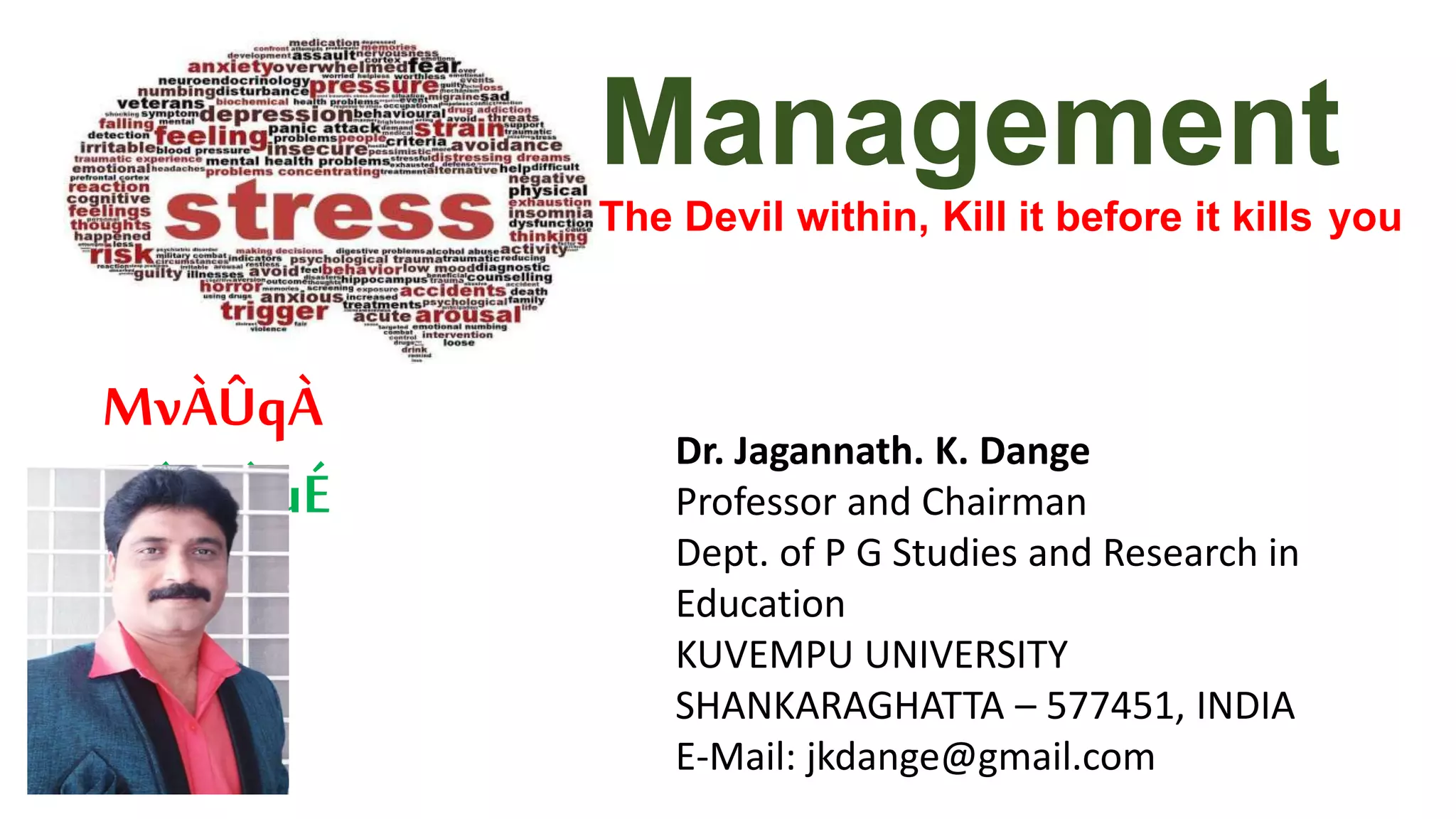
Management
The Devil within, Kill it before it kills you
Dr. Jagannath. K. Dange
Professor and Chairman
Dept. of P G Studies and Research in
Education
KUVEMPU UNIVERSITY
SHANKARAGHATTA – 577451, INDIA
E-Mail: jkdange@gmail.com
MvÀÛqÀ
¤ªÀðºÀuÉ
Content
•What is Stress?
•Sources of Stress
•Positive & Negative stress
•Effect of stress
•Identifying stressors
•Stress : Defense mechanism
•Stressbusters
•Relaxation techniques …………………
TheStressTrap
At every stage of LIFE, Knowingly or Unknowingly we come
across or are at threat to stress: CHILDHOOD TO OLD AGE
 Educational
 Family
 Parental
 Emotional (Relations)
 Occupational (Job related)
 Financial
 Old age
What isStress
 Any interference that disturbs a person’s physical, mental or
emotional well being.
 Stress is a physical, mental or emotional state present in the
person which bring mood swing eitherway.
 Generates when feelings influenced by:
Environmental, Psychological or Social factors
 Uniquely perceived by Individual
 Intensified in response to change of environment or threat
occurs (internally or externally)
Stress is a feeling of emotional or physical tension.
It can come from any event or thought that makes you feel
frustrated, angry, or nervous. (ಹತಾಶೆ, ಕೆ ೋಪ,ಮಾನಸಿಕಓತ್ತಡ)
Stress is your body's reaction to a challenge or demand.
Stress hormones
Hormones, including Cortisol and Norepinephrine, that are released
by the body during a fight-or-flight response.
Stressor : Any event or stimulus that causes stress.
Sources of Stress
• Some stress is of high frequency in nature where as some are of low
frequency.
• Some high frequency stresses like the hassles of daily life are less severe than
the low frequency stress like sudden work load in the workplace, support in
social life (Delongis,Folkman & Lazarus 1988 Kenner et at, 1981 and
Lazarus et al, 1985).
• In this context it can be stated that stress is always with the human being and
it comes from every setup of human life, maybe from marital life, daily
hassles of family life, dissatisfaction in marital life, low economy
performance, job dissatisfaction, disturbed love affairs etc.
• One thing cannot be disregarded that the sources of stress vary from person
to person.
Personality and Stress
With regard to individual differences, the coping ability and the perception of
stress is different from person to person.
Scheier and Carver (1988) from their study proposed that pessimistic people are
more stress resistant than the optimistic people.
In another study Scheier and Carver (1992) stated that pessimistic people used
various tactics to cope with their stress. But optimistic are less able in this
context.
In comparison with male and female, females are less capable to cope with
their stress and perceive stress easily than males (Ptacek, Smith & Dodge,
1994, p- 502).
Some stress is beneficial,
• Prolonged or intense stress can be associated with a variety of negative
physical and psychological outcomes.
• whereas moderate amounts of stress helps to focus our attention.
• Excessive stress leads to diminished attention, concentration, decision-
making, and short-term memory.
• High stress can also lead to a variety of emotional disturbances, including
irritability, depression, and anxiety disorders that can have negative health
outcomes
Research indicates that individuals experiencing high stress are more likely to
engage in excessive alcohol consumption and increased use of drugs and
tobacco products. Ironically, alcohol increases cortisol levels.
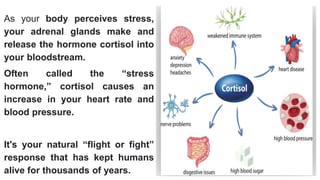
As your body perceives stress,
your adrenal glands make and
release the hormone cortisol into
your bloodstream.
Often called the “stress
hormone,” cortisol causes an
increase in your heart rate and
blood pressure.
It's your natural “flight or fight”
response that has kept humans
alive for thousands of years.
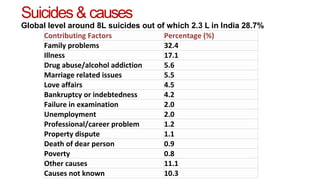
Global level around 8L suicides out of which 2.3 L in India 28.7%
Suicides& causes
Contributing Factors Percentage (%)
Family problems 32.4
Illness 17.1
Drug abuse/alcohol addiction 5.6
Marriage related issues 5.5
Love affairs 4.5
Bankruptcy or indebtedness 4.2
Failure in examination 2.0
Unemployment 2.0
Professional/career problem 1.2
Property dispute 1.1
Death of dear person 0.9
Poverty 0.8
Other causes 11.1
Causes not known 10.3
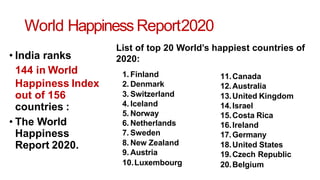
World Happiness Report2020
• India ranks
144 in World
Happiness Index
out of 156
countries :
• The World
Happiness
Report 2020.
1. Finland
2. Denmark
3. Switzerland
4. Iceland
5. Norway
6. Netherlands
7. Sweden
8. New Zealand
9. Austria
10.Luxembourg
11.Canada
12.Australia
13.United Kingdom
14.Israel
15.Costa Rica
16.Ireland
17.Germany
18.United States
19.Czech Republic
20.Belgium
List of top 20 World’s happiest countries of
2020:
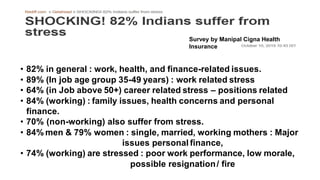
Survey by Manipal Cigna Health
Insurance
• 82% in general : work, health, and finance-related issues.
• 89% (In job age group 35-49 years) : work related stress
• 64% (in Job above 50+) career related stress – positions related
• 84% (working) : family issues, health concerns and personal
finance.
• 70% (non-working) also suffer from stress.
• 84% men & 79% women : single, married, working mothers : Major
issues personal finance,
• 74% (working) are stressed : poor work performance, low morale,
possible resignation/ fire
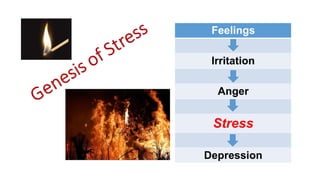
Feelings
Irritation
Anger
Stress
Depression
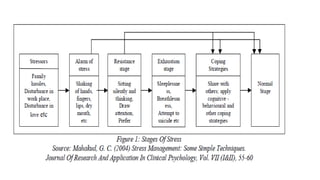
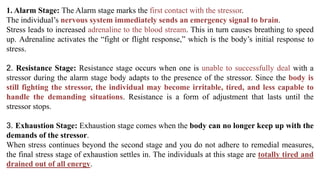
1. Alarm Stage: The Alarm stage marks the first contact with the stressor.
The individual’s nervous system immediately sends an emergency signal to brain.
Stress leads to increased adrenaline to the blood stream. This in turn causes breathing to speed
up. Adrenaline activates the “fight or flight response,” which is the body’s initial response to

stress.
2. Resistance Stage: Resistance stage occurs when one is unable to successfully deal with a
stressor during the alarm stage body adapts to the presence of the stressor. Since the body is
still fighting the stressor, the individual may become irritable, tired, and less capable to
handle the demanding situations. Resistance is a form of adjustment that lasts until the
stressor stops.
3. Exhaustion Stage: Exhaustion stage comes when the body can no longer keep up with the
demands of the stressor.
When stress continues beyond the second stage and you do not adhere to remedial measures,
the final stress stage of exhaustion settles in. The individuals at this stage are totally tired and
drained out of all energy.
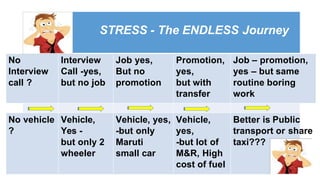
STRESS - The ENDLESS Journey
No Interview Job yes, Promotion, Job – promotion,
Interview Call -yes, But no yes, yes – but same
call ? but no job promotion but with routine boring
transfer work
No vehicle Vehicle, Vehicle, yes, Vehicle, Better is Public
? Yes - -but only yes, transport or share
but only 2 Maruti -but lot of taxi???
wheeler small car M&R, High
cost of fuel
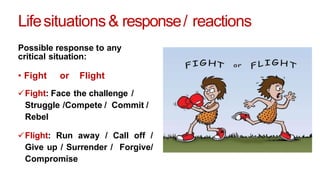
Lifesituations& response/ reactions
Possible response to any
critical situation:
• Fight or Flight
Fight: Face the challenge /
Struggle /Compete / Commit /
Rebel
Flight: Run away / Call off /
Give up / Surrender / Forgive/
Compromise
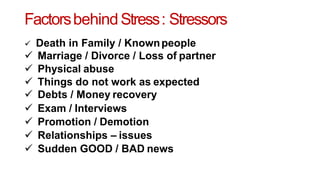
FactorsbehindStress: Stressors
 Death in Family / Knownpeople
 Marriage / Divorce / Loss of partner
 Physical abuse
 Things do not work as expected
 Debts / Money recovery
 Exam / Interviews
 Promotion / Demotion
 Relationships – issues
 Sudden GOOD / BAD news
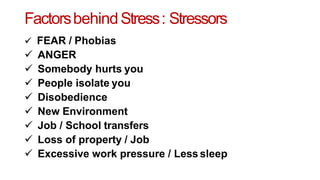
 FEAR / Phobias
 ANGER
 Somebody hurts you
 People isolate you
 Disobedience
 New Environment
 Job / School transfers
 Loss of property / Job
 Excessive work pressure / Less sleep
FactorsbehindStress: Stressors
Effects ofstress
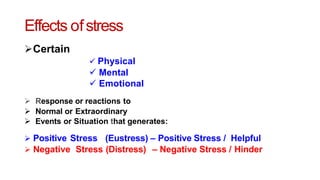
Certain
 Physical
 Mental
 Emotional
 Response or reactions to
 Normal or Extraordinary
 Events or Situation that generates:
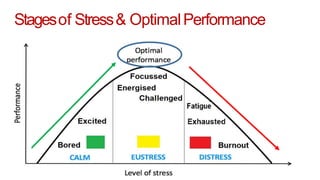
 Positive Stress (Eustress) – Positive Stress / Helpful
 Negative Stress (Distress) – Negative Stress / Hinder
Eustress& Stress
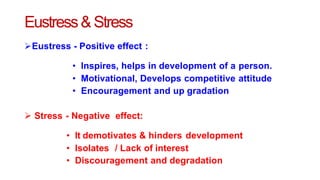
Eustress - Positive effect :
• Inspires, helps in development of a person.
• Motivational, Develops competitive attitude
• Encouragement and up gradation
 Stress - Negative effect:
• It demotivates & hinders development
• Isolates / Lack of interest
• Discouragement and degradation
Stagesof Stress& OptimalPerformance
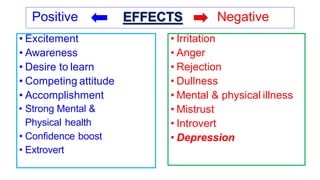
Positive Negative
• Excitement
• Awareness
• Desire to learn
• Competing attitude
• Accomplishment
• Strong Mental &
Physical health
• Confidence boost
• Extrovert
• Irritation
• Anger
• Rejection
• Dullness
• Mental & physical illness
• Mistrust
• Introvert
• Depression
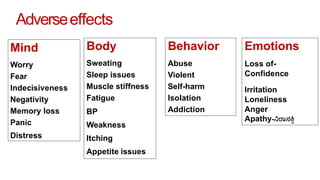
Body
Sweating
Sleep issues
Muscle stiffness
Fatigue
BP
Weakness
Itching
Appetite issues
Mind
Worry
Fear
Indecisiveness
Negativity
Memory loss
Panic
Distress
Emotions
Loss of-
Confidence
Irritation
Loneliness
Anger
Apathy-ನಿರಾಸಕ್ತತ
Behavior
Abuse
Violent
Self-harm
Isolation
Addiction
Adverseeffects
StayAlert –StayAway–StaySafe
• Be careful and always look for / identify the
“Stressors” which can cause stress
• Any time
• Anywhere
• At any Age
• In any Action / Matter
Stress: Defensemechanism
• Understand your capacity & limitations – Be within.
• Forecast / Predict situation
• Learn to say “NO”
• Avoid unproductive arguments / conflicts
• Maintain your physical and mental health on TOP priority
• Maintain your stress diary
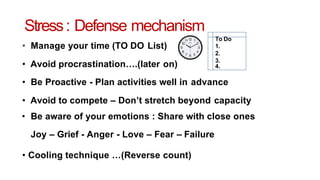
• Manage your time (TO DO List)
• Avoid procrastination….(later on)
• Be Proactive - Plan activities well in advance
• Avoid to compete – Don’t stretch beyond capacity
• Be aware of your emotions : Share with close ones
Joy – Grief - Anger - Love – Fear – Failure
• Cooling technique …(Reverse count)
Stress: Defense mechanism
To Do
1.
2.
3.
4.
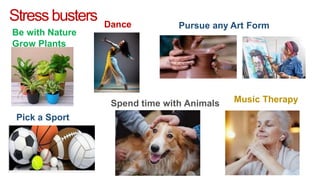
Stressbusters
Be with Nature
Grow Plants
Pursue any Art Form
Dance
Music Therapy
Spend time with Animals
Pick a Sport
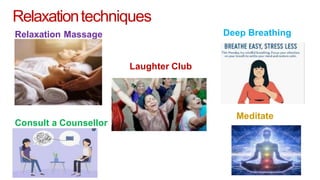
Relaxationtechniques
Relaxation Massage
Consult a Counsellor
Laughter Club
Deep Breathing
Meditate
Wishyouall – Bestof the besttime ahead..
Stay
•Confident
• Healthy
• Stress
Free
Stress
Dr. Jagannath K. Dange
Department of Education
Kuvempu University
drjkdange@gmail.com
http://jkdange.blogspot.com

Stress management

  • 1.
    Management The Devil within,Kill it before it kills you Dr. Jagannath. K. Dange Professor and Chairman Dept. of P G Studies and Research in Education KUVEMPU UNIVERSITY SHANKARAGHATTA – 577451, INDIA E-Mail: jkdange@gmail.com MvÀÛqÀ ¤ªÀðºÀuÉ
  • 2.
    Content •What is Stress? •Sourcesof Stress •Positive & Negative stress •Effect of stress •Identifying stressors •Stress : Defense mechanism •Stressbusters •Relaxation techniques …………………
  • 3.
    TheStressTrap At every stageof LIFE, Knowingly or Unknowingly we come across or are at threat to stress: CHILDHOOD TO OLD AGE  Educational  Family  Parental  Emotional (Relations)  Occupational (Job related)  Financial  Old age
  • 4.
    What isStress  Anyinterference that disturbs a person’s physical, mental or emotional well being.  Stress is a physical, mental or emotional state present in the person which bring mood swing eitherway.  Generates when feelings influenced by: Environmental, Psychological or Social factors  Uniquely perceived by Individual  Intensified in response to change of environment or threat occurs (internally or externally)
  • 5.
    Stress is afeeling of emotional or physical tension. It can come from any event or thought that makes you feel frustrated, angry, or nervous. (ಹತಾಶೆ, ಕೆ ೋಪ,ಮಾನಸಿಕಓತ್ತಡ) Stress is your body's reaction to a challenge or demand. Stress hormones Hormones, including Cortisol and Norepinephrine, that are released by the body during a fight-or-flight response. Stressor : Any event or stimulus that causes stress.
  • 6.
    Sources of Stress •Some stress is of high frequency in nature where as some are of low frequency. • Some high frequency stresses like the hassles of daily life are less severe than the low frequency stress like sudden work load in the workplace, support in social life (Delongis,Folkman & Lazarus 1988 Kenner et at, 1981 and Lazarus et al, 1985). • In this context it can be stated that stress is always with the human being and it comes from every setup of human life, maybe from marital life, daily hassles of family life, dissatisfaction in marital life, low economy performance, job dissatisfaction, disturbed love affairs etc. • One thing cannot be disregarded that the sources of stress vary from person to person.
  • 7.
    Personality and Stress Withregard to individual differences, the coping ability and the perception of stress is different from person to person. Scheier and Carver (1988) from their study proposed that pessimistic people are more stress resistant than the optimistic people. In another study Scheier and Carver (1992) stated that pessimistic people used various tactics to cope with their stress. But optimistic are less able in this context. In comparison with male and female, females are less capable to cope with their stress and perceive stress easily than males (Ptacek, Smith & Dodge, 1994, p- 502).
  • 8.
    Some stress isbeneficial, • Prolonged or intense stress can be associated with a variety of negative physical and psychological outcomes. • whereas moderate amounts of stress helps to focus our attention. • Excessive stress leads to diminished attention, concentration, decision- making, and short-term memory. • High stress can also lead to a variety of emotional disturbances, including irritability, depression, and anxiety disorders that can have negative health outcomes Research indicates that individuals experiencing high stress are more likely to engage in excessive alcohol consumption and increased use of drugs and tobacco products. Ironically, alcohol increases cortisol levels.
  • 9.
    As your bodyperceives stress, your adrenal glands make and release the hormone cortisol into your bloodstream. Often called the “stress hormone,” cortisol causes an increase in your heart rate and blood pressure. It's your natural “flight or fight” response that has kept humans alive for thousands of years.
  • 11.
    Global level around8L suicides out of which 2.3 L in India 28.7% Suicides& causes Contributing Factors Percentage (%) Family problems 32.4 Illness 17.1 Drug abuse/alcohol addiction 5.6 Marriage related issues 5.5 Love affairs 4.5 Bankruptcy or indebtedness 4.2 Failure in examination 2.0 Unemployment 2.0 Professional/career problem 1.2 Property dispute 1.1 Death of dear person 0.9 Poverty 0.8 Other causes 11.1 Causes not known 10.3
  • 12.
    World Happiness Report2020 •India ranks 144 in World Happiness Index out of 156 countries : • The World Happiness Report 2020. 1. Finland 2. Denmark 3. Switzerland 4. Iceland 5. Norway 6. Netherlands 7. Sweden 8. New Zealand 9. Austria 10.Luxembourg 11.Canada 12.Australia 13.United Kingdom 14.Israel 15.Costa Rica 16.Ireland 17.Germany 18.United States 19.Czech Republic 20.Belgium List of top 20 World’s happiest countries of 2020:
  • 13.
    Survey by ManipalCigna Health Insurance • 82% in general : work, health, and finance-related issues. • 89% (In job age group 35-49 years) : work related stress • 64% (in Job above 50+) career related stress – positions related • 84% (working) : family issues, health concerns and personal finance. • 70% (non-working) also suffer from stress. • 84% men & 79% women : single, married, working mothers : Major issues personal finance, • 74% (working) are stressed : poor work performance, low morale, possible resignation/ fire
  • 14.
  • 16.
    1. Alarm Stage:The Alarm stage marks the first contact with the stressor. The individual’s nervous system immediately sends an emergency signal to brain. Stress leads to increased adrenaline to the blood stream. This in turn causes breathing to speed up. Adrenaline activates the “fight or flight response,” which is the body’s initial response to stress. 2. Resistance Stage: Resistance stage occurs when one is unable to successfully deal with a stressor during the alarm stage body adapts to the presence of the stressor. Since the body is still fighting the stressor, the individual may become irritable, tired, and less capable to handle the demanding situations. Resistance is a form of adjustment that lasts until the stressor stops. 3. Exhaustion Stage: Exhaustion stage comes when the body can no longer keep up with the demands of the stressor. When stress continues beyond the second stage and you do not adhere to remedial measures, the final stress stage of exhaustion settles in. The individuals at this stage are totally tired and drained out of all energy.
  • 17.
    STRESS - TheENDLESS Journey No Interview Job yes, Promotion, Job – promotion, Interview Call -yes, But no yes, yes – but same call ? but no job promotion but with routine boring transfer work No vehicle Vehicle, Vehicle, yes, Vehicle, Better is Public ? Yes - -but only yes, transport or share but only 2 Maruti -but lot of taxi??? wheeler small car M&R, High cost of fuel
  • 18.
    Lifesituations& response/ reactions Possibleresponse to any critical situation: • Fight or Flight Fight: Face the challenge / Struggle /Compete / Commit / Rebel Flight: Run away / Call off / Give up / Surrender / Forgive/ Compromise
  • 19.
    FactorsbehindStress: Stressors  Deathin Family / Knownpeople  Marriage / Divorce / Loss of partner  Physical abuse  Things do not work as expected  Debts / Money recovery  Exam / Interviews  Promotion / Demotion  Relationships – issues  Sudden GOOD / BAD news
  • 20.
     FEAR /Phobias  ANGER  Somebody hurts you  People isolate you  Disobedience  New Environment  Job / School transfers  Loss of property / Job  Excessive work pressure / Less sleep FactorsbehindStress: Stressors
  • 22.
    Effects ofstress Certain  Physical Mental  Emotional  Response or reactions to  Normal or Extraordinary  Events or Situation that generates:  Positive Stress (Eustress) – Positive Stress / Helpful  Negative Stress (Distress) – Negative Stress / Hinder
  • 23.
    Eustress& Stress Eustress -Positive effect : • Inspires, helps in development of a person. • Motivational, Develops competitive attitude • Encouragement and up gradation  Stress - Negative effect: • It demotivates & hinders development • Isolates / Lack of interest • Discouragement and degradation
  • 24.
  • 25.
    Positive Negative • Excitement •Awareness • Desire to learn • Competing attitude • Accomplishment • Strong Mental & Physical health • Confidence boost • Extrovert • Irritation • Anger • Rejection • Dullness • Mental & physical illness • Mistrust • Introvert • Depression
  • 26.
    Body Sweating Sleep issues Muscle stiffness Fatigue BP Weakness Itching Appetiteissues Mind Worry Fear Indecisiveness Negativity Memory loss Panic Distress Emotions Loss of- Confidence Irritation Loneliness Anger Apathy-ನಿರಾಸಕ್ತತ Behavior Abuse Violent Self-harm Isolation Addiction Adverseeffects
  • 28.
    StayAlert –StayAway–StaySafe • Becareful and always look for / identify the “Stressors” which can cause stress • Any time • Anywhere • At any Age • In any Action / Matter
  • 29.
    Stress: Defensemechanism • Understandyour capacity & limitations – Be within. • Forecast / Predict situation • Learn to say “NO” • Avoid unproductive arguments / conflicts • Maintain your physical and mental health on TOP priority • Maintain your stress diary
  • 30.
    • Manage yourtime (TO DO List) • Avoid procrastination….(later on) • Be Proactive - Plan activities well in advance • Avoid to compete – Don’t stretch beyond capacity • Be aware of your emotions : Share with close ones Joy – Grief - Anger - Love – Fear – Failure • Cooling technique …(Reverse count) Stress: Defense mechanism To Do 1. 2. 3. 4.
  • 31.
    Stressbusters Be with Nature GrowPlants Pursue any Art Form Dance Music Therapy Spend time with Animals Pick a Sport
  • 32.
    Relaxationtechniques Relaxation Massage Consult aCounsellor Laughter Club Deep Breathing Meditate
  • 35.
    Wishyouall – Bestofthe besttime ahead.. Stay •Confident • Healthy • Stress Free Stress
  • 36.
    Dr. Jagannath K.Dange Department of Education Kuvempu University drjkdange@gmail.com http://jkdange.blogspot.com