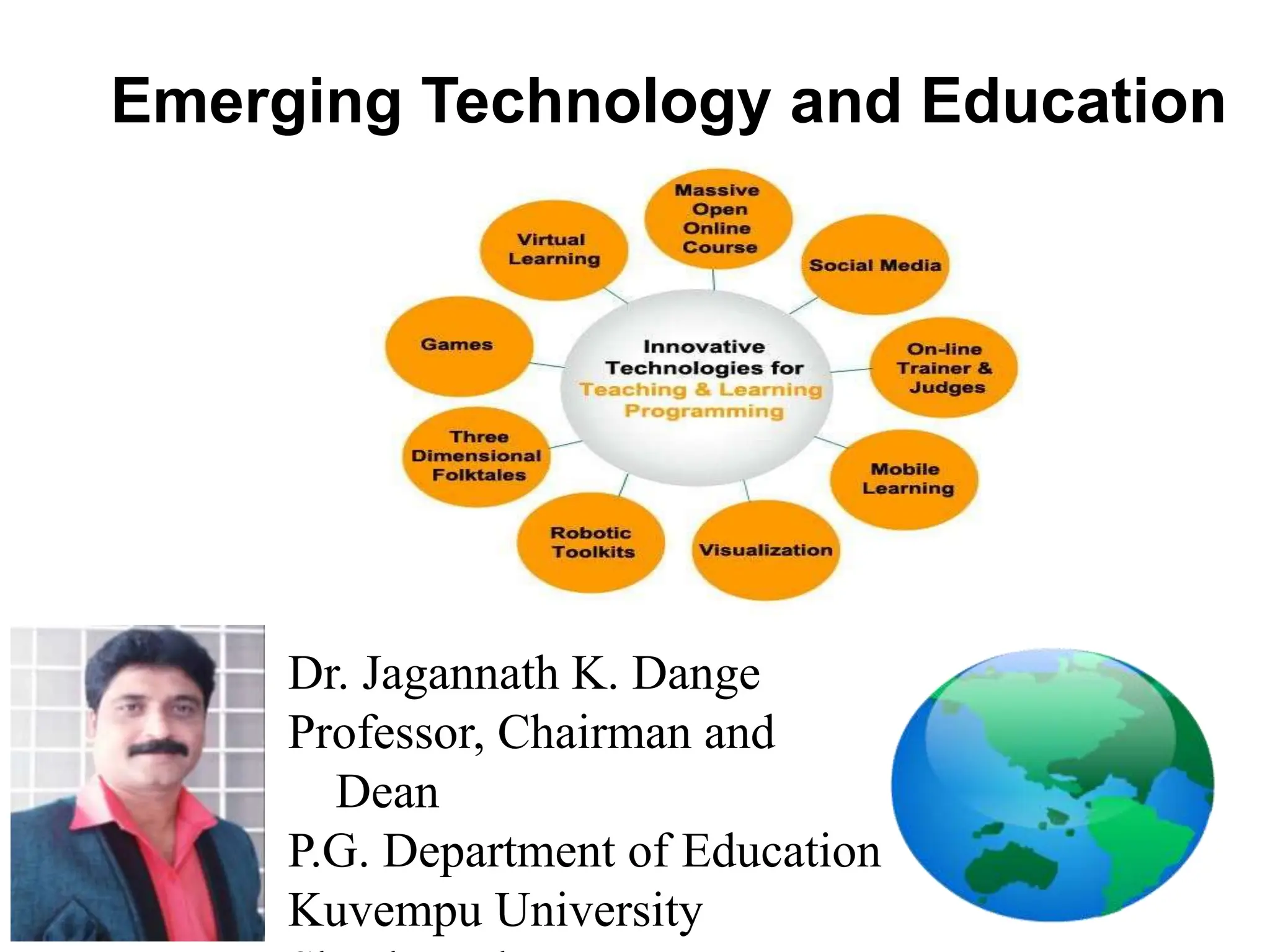
Emerging Technology and Education
Dr. Jagannath K. Dange
Professor, Chairman and
Dean
P.G. Department of Education
Kuvempu University
Education Technology
• Hard Technology: hardware and software
• Media Technology: Journalism, Engineering and
Physics
• Soft Technology (Education Technology):
Teachers use learning theories, methods and
techniques.
• Dramatic change in the learning model.
• The way students are being taught today is very
different from the teaching methods that were
adopted a few decades back.
• Technology has brought about various changes in
the way education is delivered and received.
• we have seen technology make a considerable
impact on the learning and teaching
methodologies.
E- learning - teaching strategies
i) E-Lecturing,
ii) E-Discussion Forum,
iii) E-Mentoring,
iv) E- Tutoring,
v) E-Access to Network Resources,
vi) E- Structured Group Activity,
vii) E-Informal Peer Interaction,
viii)E-Connected Education.
Trends in Education Technology
1. Learning Outside the Classroom Environment
Various technology trends in education keep changing the
digital world.
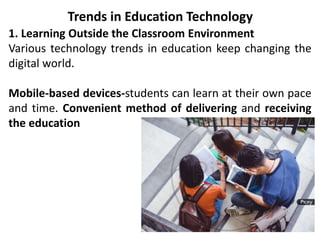
Mobile-based devices-students can learn at their own pace
and time. Convenient method of delivering and receiving
the education
2. Collaborative Learning
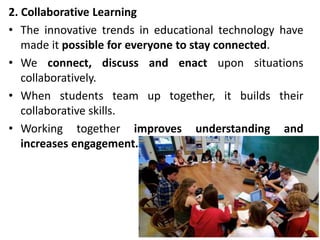
• The innovative trends in educational technology have
made it possible for everyone to stay connected.
• We connect, discuss and enact upon situations
collaboratively.
• When students team up together, it builds their
collaborative skills.
• Working together improves understanding and
increases engagement.
3. Social Media in Learning
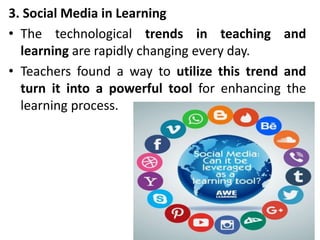
• The technological trends in teaching and
learning are rapidly changing every day.
• Teachers found a way to utilize this trend and
turn it into a powerful tool for enhancing the
learning process.
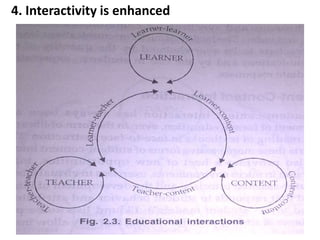
4. Interactivity is enhanced
5. Data Management & Analytics
• Explosion of data.....
• Managing data has become ever so convenient
and important with the advent of technology in
the education system.
• Teachers can now have complete analytics of a
student’s performance, such as the number of
tests attempted, chapters completed etc.
• According to the data available, teachers can
develop action plans to improve students’
performance.
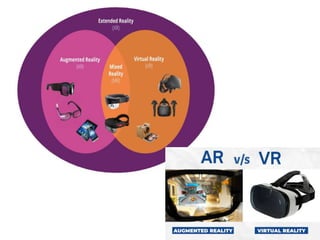
6. Immersive Learning with AR and VR
• Augmented Reality and Virtual Reality, the classroom
learning experience has undergone a tremendous
change.
• Learning has become much more immersive than
traditional methods.
• Augmented reality provides an enhanced view of a real
image.
• Virtual reality gives a false perception of reality around
them.
• AR and VR are increasingly being used to explain
complex concepts.
7. Gamification in Education
• Gamification guarantees an increase in participation,
engagement, and competition, boost motivation and create an
interactive classroom environment.
8. Online Data and Cyber security
• Cloud storage has become the norm these days, it could prove
disastrous at times. People and institutions prefer cloud storage
because it is a shared environment and it makes accessing data
easy for everyone.
• Cyber threats have been a cause of worry for many institutions-
educational and otherwise.
• Education institutes are implementing the best data security
measures to protect their online data and their students’
interests.
9. Personalized Learning
• Personalized learning is an approach to education that tailors
teaching and learning to individual students’ needs and
preferences.
• Teachers and educational technology platforms may use AI
algorithms to analyze student data and provide personalized
recommendations on content, pacing, and learning strategies.
10. Global Online Learning Communities
• Online platforms are connecting students and educators from
around the world.
• This global perspective fosters cultural understanding and
collaboration.
• It also opens up opportunities for diverse learning experiences
and cross-cultural projects.
11.Usage of 5G Technologies in Education
5G is the fifth generation of wireless technology.
Through its improved enhancements, just about
anyone using it can get high speed and low
latency wireless technology.
Students are more likely to benefit from this
unique innovation, as this promises them quick
downloads of student files and resources and
more powerful networks.
Emerging technologies
Future classrooms- Immersive rooms.
Technology for future classrooms-Interactive-
students learn in interesting and fun.
Robotic teaching
Technology trends for Education
•Online and blended learning-hybrid programmes
•Focus on accessibility and Equity- Even students
with disability
•Continued evolution of HW and SW
Autism - Hyper active deficit disorder- learning
disability.
Problem in social communication and difficulty in
expression.
Weak students in schools- Ellon musk, Albert
Einstein, Bill gates, Steve jobs
Stem cells therapy is used to overcome brain
based problems.
Educational technology Classroom Advantages
• Incorporation of Different Learning Styles: Student needs
are diverse, and adjusting the learning plan accordingly can
be challenging.
• Improved Collaboration: Technology also helps teachers
track who is contributing what and analyze
the group’s collective effort.
• Improved Student-Teacher Connection:
From assignments to online discussions, technology has
made student-teacher connections more efficient.
• Preparation for the Future: Incorporating technology in the
classroom can prepare students for future job success.
• An Engaging Environment: Technology can increase
student participation in the classroom.
Technology and Future Generation: Possibilities and
Challenges
• Human beings can be hacked now..
• Computer track eye moment, Gender(boys and girls
nature)
• One can hide from anyone including teacher but not from
Amazon, Face book or Google.
Brain Science/Biology computer power
• We trust algorithm than anybody else........
• Face book- which is new
• Google- what to do
• map- where to go
• Amazon- what to buy
In next 10-20 years.....Algorithm will tell
What to study and where to study?
Algorithm will understand ........
Children, Adolescents and adults and old people.
Computer will find out the deceases and understand our
moods..
Angry/ Fearful/ Depressed-students(Bio chemical changes)
Know yourself is possible now....all philosophers have
advised.
Guide and control human- Rule human being
We can predict but don't know exactly.
We don’t know the nature of work..in 20-30 years
We may become irrelevant in future..
It is more psychological than ecological and
technological.
21st century......
1. Emotional intelligence
2. mental balance/ mental resilience (Flexibility, elasticity)
To deal with hectic life and to compete and adopt
with AI.
Level of stress is increasing year by year
Pace of change is increasing
•Teachers have to reinvent repeatedly Because every 10
years there will be AI revolution.....2025,2035,2045.
New Education system for children, adolescents and
adults
Focus on one thing is important.... Flood of information.
Schools and colleges- Reservoirs of information; now
enormous amount of information
Schools and colleges should map a route for self-learning.
what to take and how to go with the content?
Providing content is the last option...
• Software engineers are making most important
decisions.... No background of ethics, sociology/
psychology/ education.
• Teacher education must include the software
development aspects...based on learning
theories.
• Great need to take right decisions and policies.
•Educating ourselves is important now...
Hardware and Software for everything.
Teaching: designing, modelling, illustrating,
explaining, demonstrating, narrating.
Resources platform: Repositories, websites,
Applications.
Learning platforms, Applications.
Research, Presentation and Evaluation
Teachers must teach students:
1.How to keep learning
2. How to keep changing
“Skill requirement is changing and creation of
virtual worlds”
How to remain flexible- mind ?
I don’t know ability will help learn more.....
Unless We change our Learning; we
cant adjust and teach for next
generation……..
Prof.Jagannath.K.Dange
Thank you........

Emerging technology Trends and Education.ppt

  • 1.
    Emerging Technology andEducation Dr. Jagannath K. Dange Professor, Chairman and Dean P.G. Department of Education Kuvempu University
  • 2.
    Education Technology • HardTechnology: hardware and software • Media Technology: Journalism, Engineering and Physics • Soft Technology (Education Technology): Teachers use learning theories, methods and techniques.
  • 3.
    • Dramatic changein the learning model. • The way students are being taught today is very different from the teaching methods that were adopted a few decades back. • Technology has brought about various changes in the way education is delivered and received. • we have seen technology make a considerable impact on the learning and teaching methodologies.
  • 4.
    E- learning -teaching strategies i) E-Lecturing, ii) E-Discussion Forum, iii) E-Mentoring, iv) E- Tutoring, v) E-Access to Network Resources, vi) E- Structured Group Activity, vii) E-Informal Peer Interaction, viii)E-Connected Education.
  • 5.
    Trends in EducationTechnology 1. Learning Outside the Classroom Environment Various technology trends in education keep changing the digital world. Mobile-based devices-students can learn at their own pace and time. Convenient method of delivering and receiving the education
  • 6.
    2. Collaborative Learning •The innovative trends in educational technology have made it possible for everyone to stay connected. • We connect, discuss and enact upon situations collaboratively. • When students team up together, it builds their collaborative skills. • Working together improves understanding and increases engagement.
  • 7.
    3. Social Mediain Learning • The technological trends in teaching and learning are rapidly changing every day. • Teachers found a way to utilize this trend and turn it into a powerful tool for enhancing the learning process.
  • 8.
  • 9.
    5. Data Management& Analytics • Explosion of data..... • Managing data has become ever so convenient and important with the advent of technology in the education system. • Teachers can now have complete analytics of a student’s performance, such as the number of tests attempted, chapters completed etc. • According to the data available, teachers can develop action plans to improve students’ performance.
  • 10.
    6. Immersive Learningwith AR and VR • Augmented Reality and Virtual Reality, the classroom learning experience has undergone a tremendous change. • Learning has become much more immersive than traditional methods. • Augmented reality provides an enhanced view of a real image. • Virtual reality gives a false perception of reality around them. • AR and VR are increasingly being used to explain complex concepts.
  • 12.
    7. Gamification inEducation • Gamification guarantees an increase in participation, engagement, and competition, boost motivation and create an interactive classroom environment. 8. Online Data and Cyber security • Cloud storage has become the norm these days, it could prove disastrous at times. People and institutions prefer cloud storage because it is a shared environment and it makes accessing data easy for everyone. • Cyber threats have been a cause of worry for many institutions- educational and otherwise. • Education institutes are implementing the best data security measures to protect their online data and their students’ interests.
  • 13.
    9. Personalized Learning •Personalized learning is an approach to education that tailors teaching and learning to individual students’ needs and preferences. • Teachers and educational technology platforms may use AI algorithms to analyze student data and provide personalized recommendations on content, pacing, and learning strategies. 10. Global Online Learning Communities • Online platforms are connecting students and educators from around the world. • This global perspective fosters cultural understanding and collaboration. • It also opens up opportunities for diverse learning experiences and cross-cultural projects.
  • 14.
    11.Usage of 5GTechnologies in Education 5G is the fifth generation of wireless technology. Through its improved enhancements, just about anyone using it can get high speed and low latency wireless technology. Students are more likely to benefit from this unique innovation, as this promises them quick downloads of student files and resources and more powerful networks.
  • 15.
    Emerging technologies Future classrooms-Immersive rooms. Technology for future classrooms-Interactive- students learn in interesting and fun. Robotic teaching Technology trends for Education •Online and blended learning-hybrid programmes •Focus on accessibility and Equity- Even students with disability •Continued evolution of HW and SW
  • 16.
    Autism - Hyperactive deficit disorder- learning disability. Problem in social communication and difficulty in expression. Weak students in schools- Ellon musk, Albert Einstein, Bill gates, Steve jobs Stem cells therapy is used to overcome brain based problems.
  • 17.
    Educational technology ClassroomAdvantages • Incorporation of Different Learning Styles: Student needs are diverse, and adjusting the learning plan accordingly can be challenging. • Improved Collaboration: Technology also helps teachers track who is contributing what and analyze the group’s collective effort. • Improved Student-Teacher Connection: From assignments to online discussions, technology has made student-teacher connections more efficient. • Preparation for the Future: Incorporating technology in the classroom can prepare students for future job success. • An Engaging Environment: Technology can increase student participation in the classroom.
  • 18.
    Technology and FutureGeneration: Possibilities and Challenges • Human beings can be hacked now.. • Computer track eye moment, Gender(boys and girls nature) • One can hide from anyone including teacher but not from Amazon, Face book or Google. Brain Science/Biology computer power • We trust algorithm than anybody else........ • Face book- which is new • Google- what to do • map- where to go • Amazon- what to buy
  • 19.
    In next 10-20years.....Algorithm will tell What to study and where to study? Algorithm will understand ........ Children, Adolescents and adults and old people. Computer will find out the deceases and understand our moods.. Angry/ Fearful/ Depressed-students(Bio chemical changes) Know yourself is possible now....all philosophers have advised. Guide and control human- Rule human being
  • 20.
    We can predictbut don't know exactly. We don’t know the nature of work..in 20-30 years We may become irrelevant in future.. It is more psychological than ecological and technological. 21st century...... 1. Emotional intelligence 2. mental balance/ mental resilience (Flexibility, elasticity) To deal with hectic life and to compete and adopt with AI. Level of stress is increasing year by year Pace of change is increasing
  • 21.
    •Teachers have toreinvent repeatedly Because every 10 years there will be AI revolution.....2025,2035,2045. New Education system for children, adolescents and adults Focus on one thing is important.... Flood of information. Schools and colleges- Reservoirs of information; now enormous amount of information Schools and colleges should map a route for self-learning. what to take and how to go with the content? Providing content is the last option...
  • 22.
    • Software engineersare making most important decisions.... No background of ethics, sociology/ psychology/ education. • Teacher education must include the software development aspects...based on learning theories. • Great need to take right decisions and policies.
  • 23.
    •Educating ourselves isimportant now... Hardware and Software for everything. Teaching: designing, modelling, illustrating, explaining, demonstrating, narrating. Resources platform: Repositories, websites, Applications. Learning platforms, Applications. Research, Presentation and Evaluation
  • 24.
    Teachers must teachstudents: 1.How to keep learning 2. How to keep changing “Skill requirement is changing and creation of virtual worlds” How to remain flexible- mind ? I don’t know ability will help learn more.....
  • 25.
    Unless We changeour Learning; we cant adjust and teach for next generation…….. Prof.Jagannath.K.Dange Thank you........