Chapter 11
The Prokaryotes:
Domains of Bacteria
and Archaea
© 2013 Pearson Education, Inc.
Presented by
D. Mona Othman
Albureikan
Lectures
(11, 12, 13,14,15)
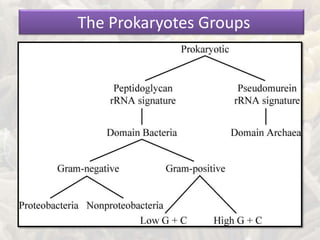
The Prokaryotes Groups
Domain Bacteria
• Proteobacteria
– Gram-negative
– Chemoheterotrophic
– It separated into five classes:
alphaproteobacteria, beta proteobacteria,
gammaproteobacteria, delta proteo bacteria, and
epsilonproteobacteria.
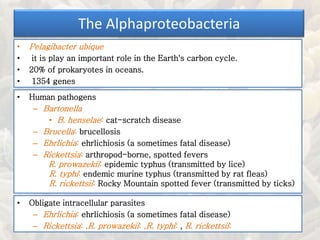
The Alphaproteobacteria
• Pelagibacter ubique
• it is play an important role in the Earth's carbon cycle.
• 20% of prokaryotes in oceans.
• 1354 genes
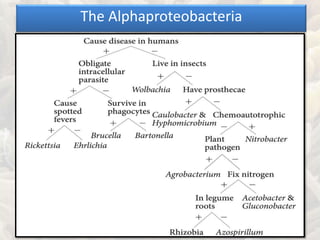
• Human pathogens
– Bartonella
• B. henselae: cat-scratch disease
– Brucella: brucellosis
– Ehrlichia: ehrlichiosis (a sometimes fatal disease)
– Rickettsia: arthropod-borne, spotted fevers
R. prowazekii: epidemic typhus (transmitted by lice)
R. typhi: endemic murine typhus (transmitted by rat fleas)
R. rickettsii: Rocky Mountain spotted fever (transmitted by ticks)
• Obligate intracellular parasites
– Ehrlichia: ehrlichiosis (a sometimes fatal disease)
– Rickettsia: ,R. prowazekii: ,R. typhi: , R. rickettsii:
The Alphaproteobacteria
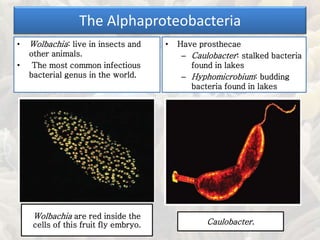
• Wolbachia: live in insects and
other animals.
• The most common infectious
bacterial genus in the world.
Wolbachia are red inside the
cells of this fruit fly embryo.
• Have prosthecae
– Caulobacter: stalked bacteria
found in lakes
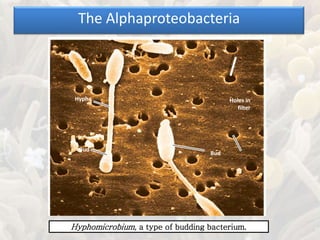
– Hyphomicrobium: budding
bacteria found in lakes
Caulobacter.
Hyphomicrobium, a type of budding bacterium.
Hypha
Bud
Bud
Holes in
filter
The Alphaproteobacteria
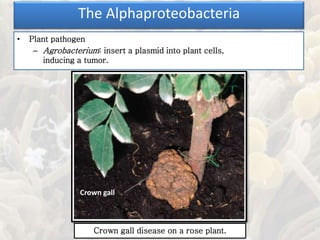
• Plant pathogen
– Agrobacterium: insert a plasmid into plant cells,
inducing a tumor.
The Alphaproteobacteria
Crown gall disease on a rose plant.
Crown gall
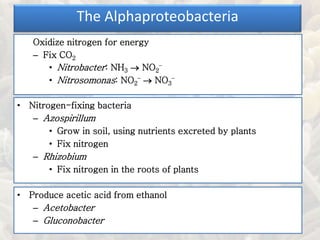
Oxidize nitrogen for energy
– Fix CO2
• Nitrobacter: NH3  NO2
–
• Nitrosomonas: NO2
–  NO3
–
The Alphaproteobacteria
• Nitrogen-fixing bacteria
– Azospirillum
• Grow in soil, using nutrients excreted by plants
• Fix nitrogen
– Rhizobium
• Fix nitrogen in the roots of plants
• Produce acetic acid from ethanol
– Acetobacter
– Gluconobacter
The Alphaproteobacteria
• Thiobacillus
– Oxidize sulfur: H2S  SO4
2– (important in the sulfur cycle)
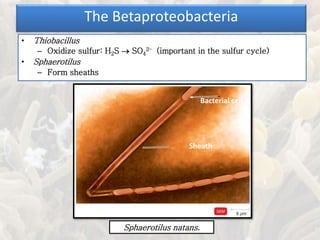
• Sphaerotilus
– Form sheaths
The Betaproteobacteria
Sphaerotilus natans.
Bacterial cell
Sheath
The Betaproteobacteria
• Bordetella
– B. pertussis
– Rods, cause of pertussis, or whooping cough.
• Burkholderia
– Nosocomial infections
- Zoogloea , is important in the
sewage-treatment processes, such
as the activated sludge system .
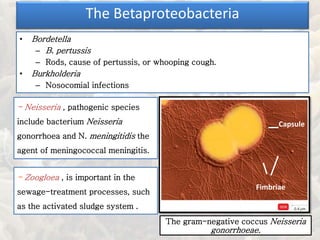
- Neisseria , pathogenic species
include bacterium Neisseria
gonorrhoea and N. meningitidis the
agent of meningococcal meningitis.
The gram-negative coccus Neisseria
gonorrhoeae.
Capsule
Fimbriae
• Pseudomonadales
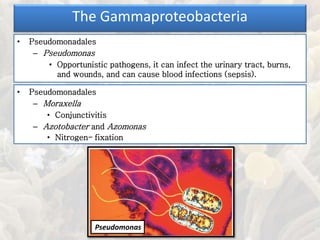
– Pseudomonas
• Opportunistic pathogens, it can infect the urinary tract, burns,
and wounds, and can cause blood infections (sepsis).
The Gammaproteobacteria
Pseudomonas
• Pseudomonadales
– Moraxella
• Conjunctivitis
– Azotobacter and Azomonas
• Nitrogen- fixation
• Legionellales
– Legionella
• Found in streams, warm-
water pipes, cooling
towers
• L. pneumophilia
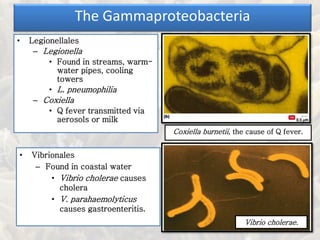
– Coxiella
• Q fever transmitted via
aerosols or milk
The Gammaproteobacteria
• Vibrionales
– Found in coastal water
• Vibrio cholerae causes
cholera
• V. parahaemolyticus
causes gastroenteritis.
Coxiella burnetii, the cause of Q fever.
Vibrio cholerae.
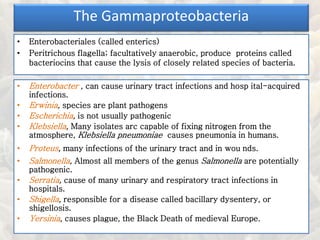
• Enterobacteriales (called enterics)
• Peritrichous flagella; facultatively anaerobic, produce proteins called
bacteriocins that cause the lysis of closely related species of bacteria.
• Enterobacter , can cause urinary tract infections and hosp ital-acquired
infections.
• Erwinia, species are plant pathogens
• Escherichia, is not usually pathogenic
• Klebsiella, Many isolates arc capable of fixing nitrogen from the
atmosphere, Klebsiella pneumoniae causes pneumonia in humans.
• Proteus, many infections of the urinary tract and in wou nds.
• Salmonella, Almost all members of the genus Salmonella are potentially
pathogenic.
• Serratia, cause of many urinary and respiratory tract infections in
hospitals.
• Shigella, responsible for a disease called bacillary dysentery, or
shigellosis.
• Yersinia, causes plague, the Black Death of medieval Europe.
The Gammaproteobacteria
• Pasteurellales
– Pasteurella
• Cause pneumonia and septicemia
– Haemophilus
• Require X (heme) and V (NAD+, NADP+) factors
The Gammaproteobacteria
• Beggiatoa
– Oxidize H2S to S0 for energy
• Francisella
– causes the disease tularemia.
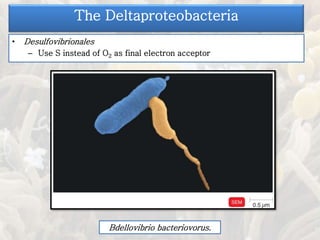
• Desulfovibrionales
– Use S instead of O2 as final electron acceptor
The Deltaproteobacteria
Bdellovibrio bacteriovorus.
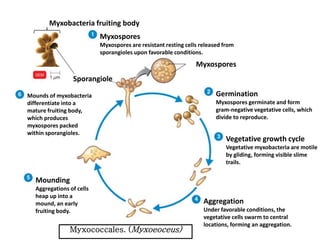
Myxococcales. (Myxoeoceus)
Myxospores
Myxospores are resistant resting cells released from
sporangioles upon favorable conditions.
Germination
Myxospores germinate and form
gram-negative vegetative cells, which
divide to reproduce.
Vegetative growth cycle
Vegetative myxobacteria are motile
by gliding, forming visible slime
trails.
Aggregation
Under favorable conditions, the
vegetative cells swarm to central
locations, forming an aggregation.
Mounding
Aggregations of cells
heap up into a
mound, an early
fruiting body.
Mounds of myxobacteria
differentiate into a
mature fruiting body,
which produces
myxospores packed
within sporangioles.
Sporangiole
Myxobacteria fruiting body
Myxospores
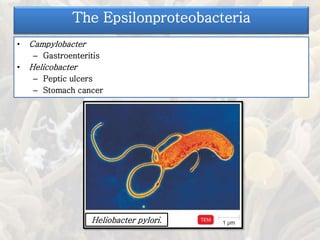
• Campylobacter
– Gastroenteritis
• Helicobacter
– Peptic ulcers
– Stomach cancer
The Epsilonproteobacteria
Heliobacter pylori.
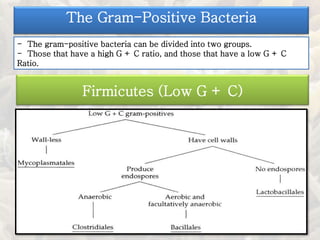
The Gram-Positive Bacteria
- The gram-positive bacteria can be divided into two groups.
- Those that have a high G + C ratio, and those that have a low G + C
Ratio.
Firmicutes (Low G + C)
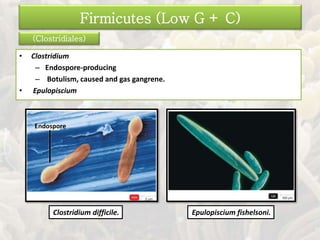
• Clostridium
– Endospore-producing
– Botulism, caused and gas gangrene.
• Epulopiscium
Endospore
(Clostridiales)
Clostridium difficile. Epulopiscium fishelsoni.
• Bacillus
– Endospore-producing rods
– Only a few are pathogenic to humans.
– Bacillus anthracis causes anthrax.
– Several species produce antibiotics.
• Staphylococcus
– Cocci.
– It produces an enterotoxin that causes vomiting
and nausea when ingested; it is one of the most
common causes of food poisoning.
Firmicutes (Low G + C)
(Bacillales)
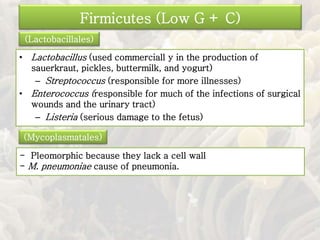
• Lactobacillus (used commerciall y in the production of
sauerkraut, pickles, buttermilk, and yogurt)
– Streptococcus (responsible for more illnesses)
• Enterococcus (responsible for much of the infections of surgical
wounds and the urinary tract)
– Listeria (serious damage to the fetus)
Firmicutes (Low G + C)
(Lactobacillales)
(Mycoplasmatales)
- Pleomorphic because they lack a cell wall
- M. pneumoniae cause of pneumonia.
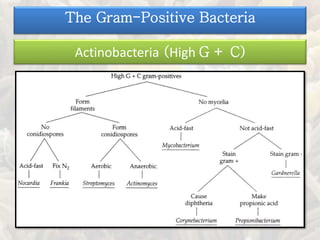
Actinobacteria (High G + C)
The Gram-Positive Bacteria
• Actinomyces
• Corynebacterium
• Frankia
• Gardnerella
• Mycobacterium
• Nocardia
• Propionibacterium
• Streptomyces
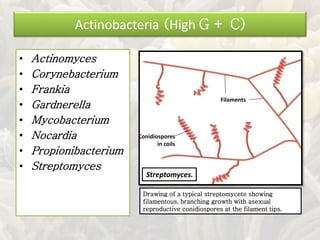
Actinobacteria (High G + C)
Filaments
Conidiospores
in coils
Streptomyces.
Drawing of a typical streptomycete showing
filamentous, branching growth with asexual
reproductive conidiospores at the filament tips.
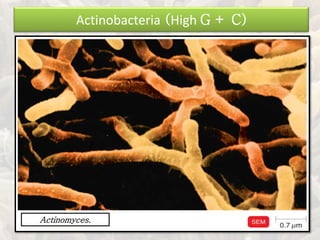
Actinomyces.
Actinobacteria (High G + C)
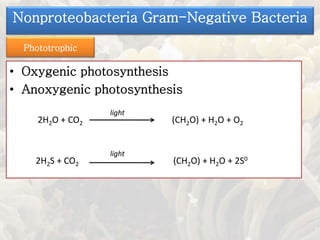
• Oxygenic photosynthesis
• Anoxygenic photosynthesis
Phototrophic
2H2O + CO2
light
(CH2O) + H2O + O2
2H2S + CO2
light
(CH2O) + H2O + 2S0
Nonproteobacteria Gram-Negative Bacteria
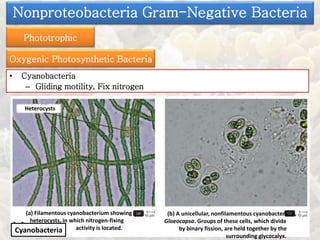
Oxygenic Photosynthetic Bacteria
• Cyanobacteria
– Gliding motility, Fix nitrogen
Phototrophic
Nonproteobacteria Gram-Negative Bacteria
Heterocysts
(b) A unicellular, nonfilamentous cyanobacterium,
Gloeocapsa. Groups of these cells, which divide
by binary fission, are held together by the
surrounding glycocalyx.
(a) Filamentous cyanobacterium showing
heterocysts, in which nitrogen-fixing
activity is located.Cyanobacteria
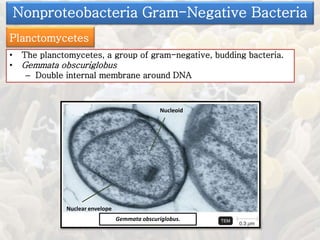
• The planctomycetes, a group of gram-negative, budding bacteria.
• Gemmata obscuriglobus
– Double internal membrane around DNA
Nonproteobacteria Gram-Negative Bacteria
Planctomycetes
Nucleoid
Nuclear envelope
Gemmata obscuriglobus.
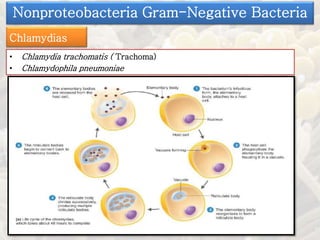
• Chlamydia trachomatis ( Trachoma)
• Chlamydophila pneumoniae
Nonproteobacteria Gram-Negative Bacteria
Chlamydias
– Anaerobic
• Bacteroides are found in the mouth and large intestine
• Cytophaga: degrade cellulose in soil
Nonproteobacteria Gram-Negative Bacteria
Bacteroidetes
Fusobacterium
Are found in the mouth
May be involved in dental diseases
Spirochaetes
- Treponema pallidlum cause of syphilis
- Borrelia Members of the genus Borrelia cause serious diseases that are
usually transmitted by ticks or lice,
- Leptospira Leptospirosis is a disease usually spread to humans by water
contaminated by Leptospira .
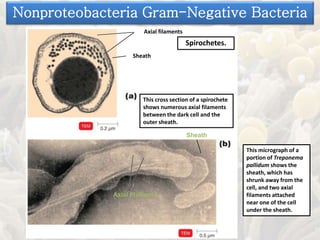
This cross section of a spirochete
shows numerous axial filaments
between the dark cell and the
outer sheath.
This micrograph of a
portion of Treponema
pallidum shows the
sheath, which has
shrunk away from the
cell, and two axial
filaments attached
near one of the cell
under the sheath.
Axial filaments
Sheath
Axial filaments
Sheath
Spirochetes.
Nonproteobacteria Gram-Negative Bacteria
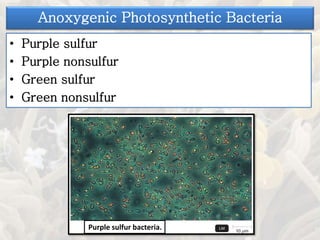
• Purple sulfur
• Purple nonsulfur
• Green sulfur
• Green nonsulfur
Anoxygenic Photosynthetic Bacteria
Purple sulfur bacteria.
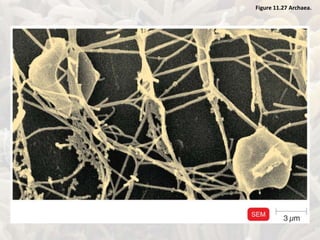
Domain Archaea
Extremophiles
• Hyperthermophiles
– Pyrodictium
– Sulfolobus
• Methanogens
– Methanobacterium
• Extreme halophiles
– Halobacterium
Figure 11.27 Archaea.
Microbial Diversity
• bacteria as small as 0.02 to 0.03 µm
(nanobacteria)
• Few of the total number of different
prokaryotes have been isolated and identified
.
• PCR can be used to uncover the presence of
bacteria that can't be cultured in the
laboratory.
• The polymerase chain reaction (PCR)
• PCR indicates up to 10,000 bacteria per
gram of soil
• Many bacteria have not been identified
because they
– Have not been cultured
– Need special nutrients
– Are a part of complex food chains requiring
the products of other bacteria
– Need to be cultured to understand their
metabolism and ecological role
Microbial Diversity
References
• Microbiology: An Introduction Plus
MasteringMicrobiology with eText - Access Card
Package (11th Edition) Hardcover – January 2, 2012
by Gerard J. Tortora, Berdell R. Funke, Christine L.
Case.
• Some pictures from different sits.

Presentation 6 (Open download)

  • 1.
    Chapter 11 The Prokaryotes: Domainsof Bacteria and Archaea © 2013 Pearson Education, Inc. Presented by D. Mona Othman Albureikan Lectures (11, 12, 13,14,15)
  • 2.
  • 3.
    Domain Bacteria • Proteobacteria –Gram-negative – Chemoheterotrophic – It separated into five classes: alphaproteobacteria, beta proteobacteria, gammaproteobacteria, delta proteo bacteria, and epsilonproteobacteria.
  • 4.
    The Alphaproteobacteria • Pelagibacterubique • it is play an important role in the Earth's carbon cycle. • 20% of prokaryotes in oceans. • 1354 genes • Human pathogens – Bartonella • B. henselae: cat-scratch disease – Brucella: brucellosis – Ehrlichia: ehrlichiosis (a sometimes fatal disease) – Rickettsia: arthropod-borne, spotted fevers R. prowazekii: epidemic typhus (transmitted by lice) R. typhi: endemic murine typhus (transmitted by rat fleas) R. rickettsii: Rocky Mountain spotted fever (transmitted by ticks) • Obligate intracellular parasites – Ehrlichia: ehrlichiosis (a sometimes fatal disease) – Rickettsia: ,R. prowazekii: ,R. typhi: , R. rickettsii:

  • 5.
    The Alphaproteobacteria • Wolbachia:live in insects and other animals. • The most common infectious bacterial genus in the world. Wolbachia are red inside the cells of this fruit fly embryo. • Have prosthecae – Caulobacter: stalked bacteria found in lakes – Hyphomicrobium: budding bacteria found in lakes Caulobacter.
  • 6.
    Hyphomicrobium, a typeof budding bacterium. Hypha Bud Bud Holes in filter The Alphaproteobacteria
  • 7.
    • Plant pathogen –Agrobacterium: insert a plasmid into plant cells, inducing a tumor. The Alphaproteobacteria Crown gall disease on a rose plant. Crown gall
  • 8.
    Oxidize nitrogen forenergy – Fix CO2 • Nitrobacter: NH3  NO2 – • Nitrosomonas: NO2 –  NO3 – The Alphaproteobacteria • Nitrogen-fixing bacteria – Azospirillum • Grow in soil, using nutrients excreted by plants • Fix nitrogen – Rhizobium • Fix nitrogen in the roots of plants • Produce acetic acid from ethanol – Acetobacter – Gluconobacter
  • 9.
  • 10.
    • Thiobacillus – Oxidizesulfur: H2S  SO4 2– (important in the sulfur cycle) • Sphaerotilus – Form sheaths The Betaproteobacteria Sphaerotilus natans. Bacterial cell Sheath
  • 11.
    The Betaproteobacteria • Bordetella –B. pertussis – Rods, cause of pertussis, or whooping cough. • Burkholderia – Nosocomial infections - Zoogloea , is important in the sewage-treatment processes, such as the activated sludge system . - Neisseria , pathogenic species include bacterium Neisseria gonorrhoea and N. meningitidis the agent of meningococcal meningitis. The gram-negative coccus Neisseria gonorrhoeae. Capsule Fimbriae
  • 12.
    • Pseudomonadales – Pseudomonas •Opportunistic pathogens, it can infect the urinary tract, burns, and wounds, and can cause blood infections (sepsis). The Gammaproteobacteria Pseudomonas • Pseudomonadales – Moraxella • Conjunctivitis – Azotobacter and Azomonas • Nitrogen- fixation
  • 13.
    • Legionellales – Legionella •Found in streams, warm- water pipes, cooling towers • L. pneumophilia – Coxiella • Q fever transmitted via aerosols or milk The Gammaproteobacteria • Vibrionales – Found in coastal water • Vibrio cholerae causes cholera • V. parahaemolyticus causes gastroenteritis. Coxiella burnetii, the cause of Q fever. Vibrio cholerae.
  • 14.
    • Enterobacteriales (calledenterics) • Peritrichous flagella; facultatively anaerobic, produce proteins called bacteriocins that cause the lysis of closely related species of bacteria. • Enterobacter , can cause urinary tract infections and hosp ital-acquired infections. • Erwinia, species are plant pathogens • Escherichia, is not usually pathogenic • Klebsiella, Many isolates arc capable of fixing nitrogen from the atmosphere, Klebsiella pneumoniae causes pneumonia in humans. • Proteus, many infections of the urinary tract and in wou nds. • Salmonella, Almost all members of the genus Salmonella are potentially pathogenic. • Serratia, cause of many urinary and respiratory tract infections in hospitals. • Shigella, responsible for a disease called bacillary dysentery, or shigellosis. • Yersinia, causes plague, the Black Death of medieval Europe. The Gammaproteobacteria
  • 15.
    • Pasteurellales – Pasteurella •Cause pneumonia and septicemia – Haemophilus • Require X (heme) and V (NAD+, NADP+) factors The Gammaproteobacteria • Beggiatoa – Oxidize H2S to S0 for energy • Francisella – causes the disease tularemia.
  • 16.
    • Desulfovibrionales – UseS instead of O2 as final electron acceptor The Deltaproteobacteria Bdellovibrio bacteriovorus.
  • 17.
    Myxococcales. (Myxoeoceus) Myxospores Myxospores areresistant resting cells released from sporangioles upon favorable conditions. Germination Myxospores germinate and form gram-negative vegetative cells, which divide to reproduce. Vegetative growth cycle Vegetative myxobacteria are motile by gliding, forming visible slime trails. Aggregation Under favorable conditions, the vegetative cells swarm to central locations, forming an aggregation. Mounding Aggregations of cells heap up into a mound, an early fruiting body. Mounds of myxobacteria differentiate into a mature fruiting body, which produces myxospores packed within sporangioles. Sporangiole Myxobacteria fruiting body Myxospores
  • 18.
    • Campylobacter – Gastroenteritis •Helicobacter – Peptic ulcers – Stomach cancer The Epsilonproteobacteria Heliobacter pylori.
  • 19.
    The Gram-Positive Bacteria -The gram-positive bacteria can be divided into two groups. - Those that have a high G + C ratio, and those that have a low G + C Ratio. Firmicutes (Low G + C)
  • 20.
    Firmicutes (Low G+ C) • Clostridium – Endospore-producing – Botulism, caused and gas gangrene. • Epulopiscium Endospore (Clostridiales) Clostridium difficile. Epulopiscium fishelsoni.
  • 21.
    • Bacillus – Endospore-producingrods – Only a few are pathogenic to humans. – Bacillus anthracis causes anthrax. – Several species produce antibiotics. • Staphylococcus – Cocci. – It produces an enterotoxin that causes vomiting and nausea when ingested; it is one of the most common causes of food poisoning. Firmicutes (Low G + C) (Bacillales)
  • 22.
    • Lactobacillus (usedcommerciall y in the production of sauerkraut, pickles, buttermilk, and yogurt) – Streptococcus (responsible for more illnesses) • Enterococcus (responsible for much of the infections of surgical wounds and the urinary tract) – Listeria (serious damage to the fetus) Firmicutes (Low G + C) (Lactobacillales) (Mycoplasmatales) - Pleomorphic because they lack a cell wall - M. pneumoniae cause of pneumonia.
  • 23.
    Actinobacteria (High G+ C) The Gram-Positive Bacteria
  • 24.
    • Actinomyces • Corynebacterium •Frankia • Gardnerella • Mycobacterium • Nocardia • Propionibacterium • Streptomyces Actinobacteria (High G + C) Filaments Conidiospores in coils Streptomyces. Drawing of a typical streptomycete showing filamentous, branching growth with asexual reproductive conidiospores at the filament tips.
  • 25.
  • 26.
    • Oxygenic photosynthesis •Anoxygenic photosynthesis Phototrophic 2H2O + CO2 light (CH2O) + H2O + O2 2H2S + CO2 light (CH2O) + H2O + 2S0 Nonproteobacteria Gram-Negative Bacteria
  • 27.
    Oxygenic Photosynthetic Bacteria •Cyanobacteria – Gliding motility, Fix nitrogen Phototrophic Nonproteobacteria Gram-Negative Bacteria Heterocysts (b) A unicellular, nonfilamentous cyanobacterium, Gloeocapsa. Groups of these cells, which divide by binary fission, are held together by the surrounding glycocalyx. (a) Filamentous cyanobacterium showing heterocysts, in which nitrogen-fixing activity is located.Cyanobacteria
  • 28.
    • The planctomycetes,a group of gram-negative, budding bacteria. • Gemmata obscuriglobus – Double internal membrane around DNA Nonproteobacteria Gram-Negative Bacteria Planctomycetes Nucleoid Nuclear envelope Gemmata obscuriglobus.
  • 29.
    • Chlamydia trachomatis( Trachoma) • Chlamydophila pneumoniae Nonproteobacteria Gram-Negative Bacteria Chlamydias
  • 30.
    – Anaerobic • Bacteroidesare found in the mouth and large intestine • Cytophaga: degrade cellulose in soil Nonproteobacteria Gram-Negative Bacteria Bacteroidetes Fusobacterium Are found in the mouth May be involved in dental diseases Spirochaetes - Treponema pallidlum cause of syphilis - Borrelia Members of the genus Borrelia cause serious diseases that are usually transmitted by ticks or lice, - Leptospira Leptospirosis is a disease usually spread to humans by water contaminated by Leptospira .
  • 31.
    This cross sectionof a spirochete shows numerous axial filaments between the dark cell and the outer sheath. This micrograph of a portion of Treponema pallidum shows the sheath, which has shrunk away from the cell, and two axial filaments attached near one of the cell under the sheath. Axial filaments Sheath Axial filaments Sheath Spirochetes. Nonproteobacteria Gram-Negative Bacteria
  • 32.
    • Purple sulfur •Purple nonsulfur • Green sulfur • Green nonsulfur Anoxygenic Photosynthetic Bacteria Purple sulfur bacteria.
  • 33.
    Domain Archaea Extremophiles • Hyperthermophiles –Pyrodictium – Sulfolobus • Methanogens – Methanobacterium • Extreme halophiles – Halobacterium
  • 34.
  • 35.
    Microbial Diversity • bacteriaas small as 0.02 to 0.03 µm (nanobacteria) • Few of the total number of different prokaryotes have been isolated and identified . • PCR can be used to uncover the presence of bacteria that can't be cultured in the laboratory. • The polymerase chain reaction (PCR)
  • 36.
    • PCR indicatesup to 10,000 bacteria per gram of soil • Many bacteria have not been identified because they – Have not been cultured – Need special nutrients – Are a part of complex food chains requiring the products of other bacteria – Need to be cultured to understand their metabolism and ecological role Microbial Diversity
  • 37.
    References • Microbiology: AnIntroduction Plus MasteringMicrobiology with eText - Access Card Package (11th Edition) Hardcover – January 2, 2012 by Gerard J. Tortora, Berdell R. Funke, Christine L. Case. • Some pictures from different sits.