Learning, Perception, and
       Attribution
TWO KEY LEARNING
PROCESSES AND E-LEARNING

• Learning is a relatively permanent change
  in behavior based on practice or
  experience. Unless learning takes place,
  few employees would be able to perform
  their jobs satisfactorily.
Two Key Learning Processes
         and e-Learning
• Modeling and Shaping
a. Modeling occurs through imitating someone.
b. Shaping occurs through rewarding small steps.
• Cognitive Learning
e. Assumes that learning is complicated including motivation
   and hunches.
b. Informal learning—organization does not determine or
   design the learning process.
Cognitive Learning
• The learner’s orientation influences the
  amount of cognitive learning. A mastery
  orientation relates to a dedication to
  increasing one’s competence on a task.

• With performance orientation, learners
  focus on how well they perform on a task
  and making comparisons with others.
Two Key Learning Process and e-
        Learning (continued)
• Informal learning includes practical,
  intrapersonal, interpersonal skills, and cultural
  awareness.
• E-Learning is a Web-based form of computer-
  based training.
  a. Used widely when learners are geographically
  dispersed
  b. Cognitive process of self-motivation and
  self-discipline are needed.
Learning Styles
•    People learn best in different ways, such as
     through studying versus doing
•    Visual, Auditory, and Kinesthetic Styles
3.   Visual learners learn best by seeing.
4.   Auditory learners rely on hearing.
5.   Kinesthetic learners learn best by touching and
     moving
6.   Most learners combine the three styles to
     some degree.
Learning Styles
Learning styles have also been divided
into four orientations based on four stages
of the learning cycle:
concrete experienceobservations and
reflectionsformation of abstractions and
generalizationshypotheses to be tested,
leading to new experiences. The four
learning orientations stemming from the
cycle are:
Learning Styles and Implications
1. An orientation toward concrete experiences that
   emphasizes being involved in experiences and dealing
   with human interactions in a personal way.

2. An orientation toward reflective observation that
   emphasizes understanding meanings.

3. An orientation toward abstract conceptualization that
   emphasizes applying logic, ideas, and concepts.

4. An orientation toward testing implications of concepts in
   new situations that emphasizes actively influencing
   people and changing situations.
Individual Differences Related to Skill
               Acquisition
• People with high mental ability and the
  ability to concentrate learn better.
• In one study, air traffic controllers who
  acquired more skills, scored higher on (a)
  cognitive ability test, and (b) warmth factor
  —warm, outgoing, attentive to others,
  cooperative, generous, and trusting.
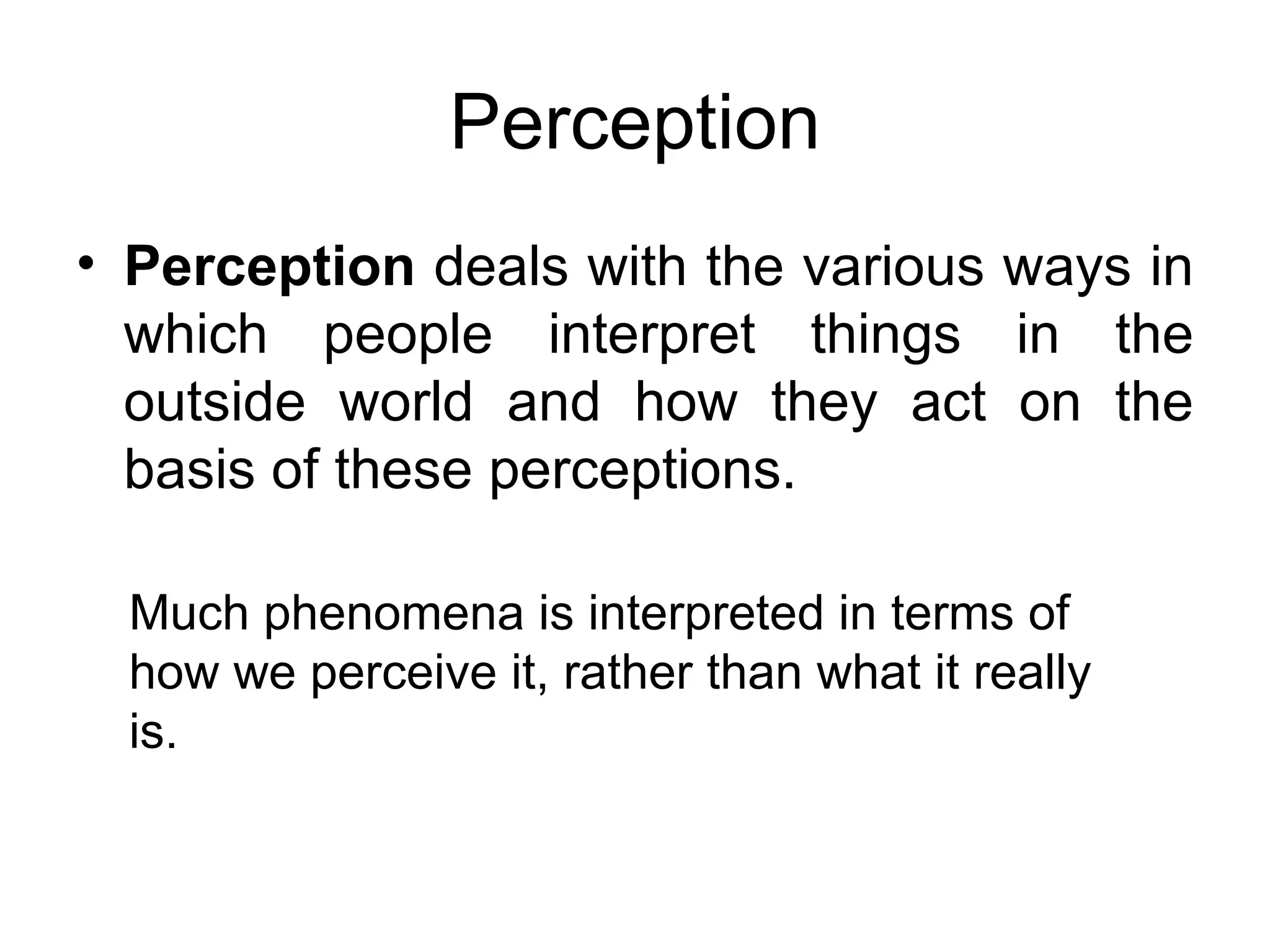
Perception
• Perception deals with the various ways in
  which people interpret things in the
  outside world and how they act on the
  basis of these perceptions.

  Much phenomena is interpreted in terms of
  how we perceive it, rather than what it really
  is.
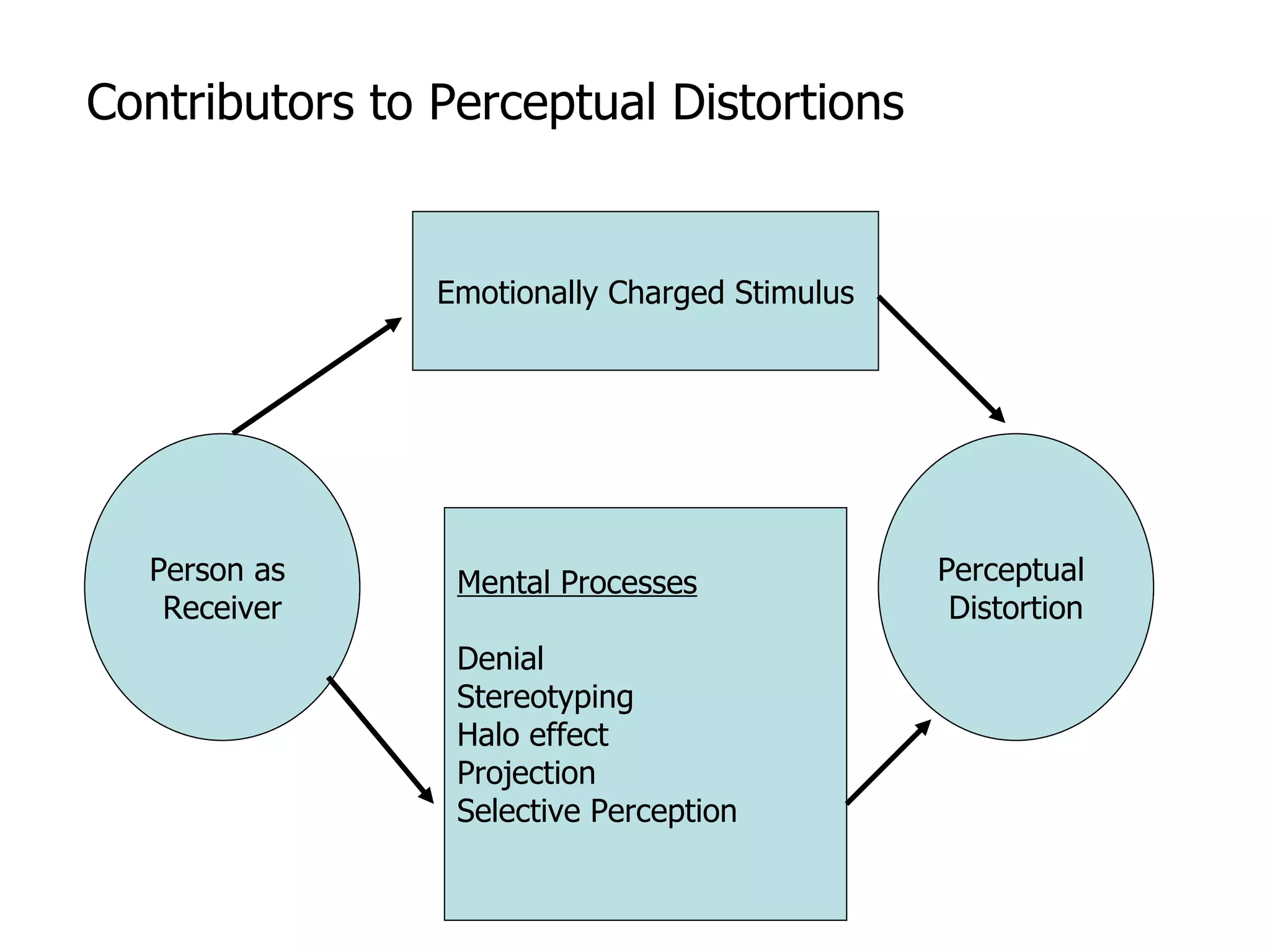
Contributors to Perceptual Distortions


                Emotionally Charged Stimulus


  Person as      Mental Processes              Perceptual
   Receiver                                     Distortion
                 Denial
                 Stereotyping
                 Halo effect
                 Projection
                 Selective Perception
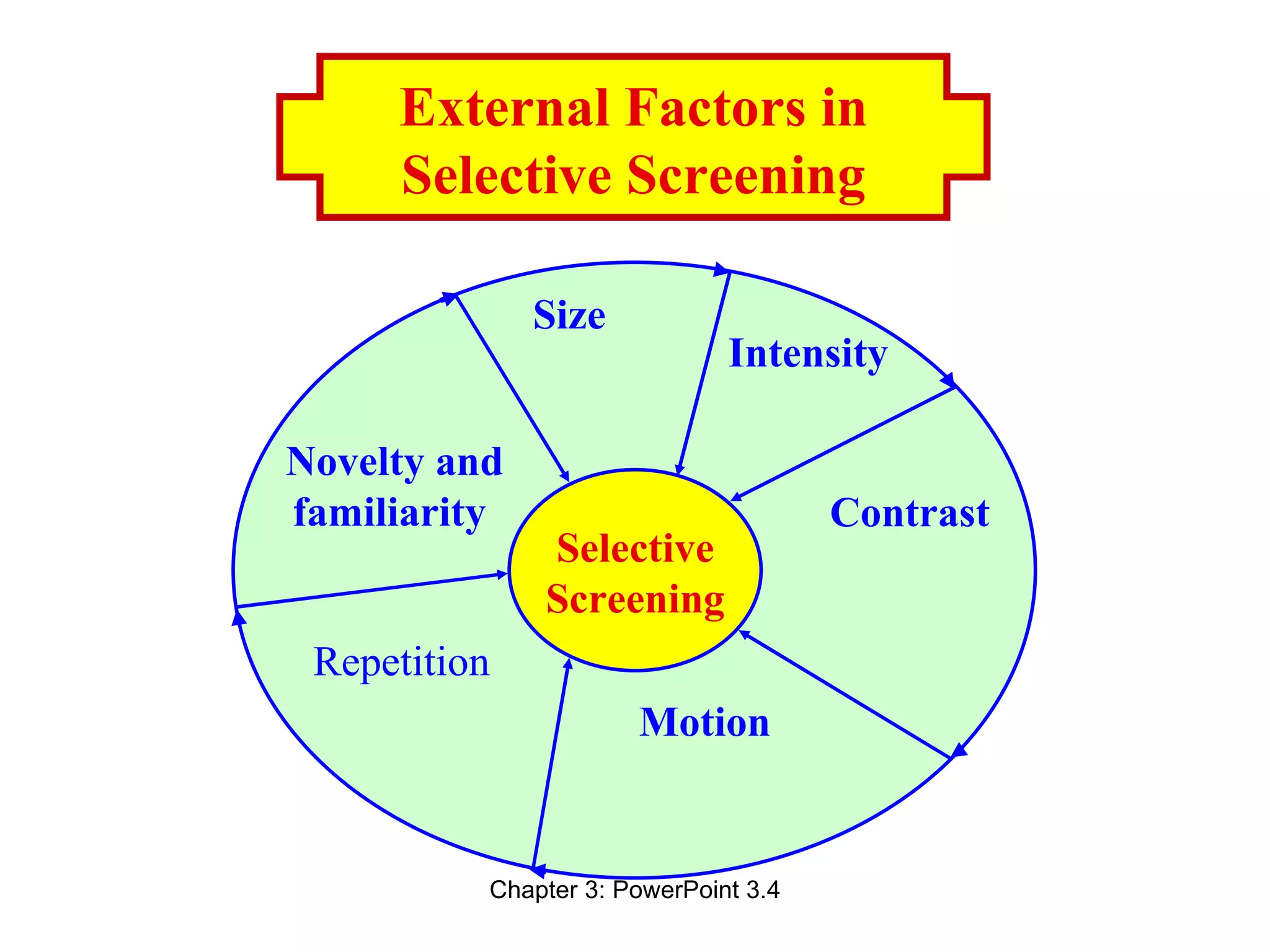
External Factors in
     Selective Screening

              Size
                              Intensity

Novelty and
familiarity                           Contrast
              Selective
              Screening
 Repetition
                      Motion


          Chapter 3: PowerPoint 3.4
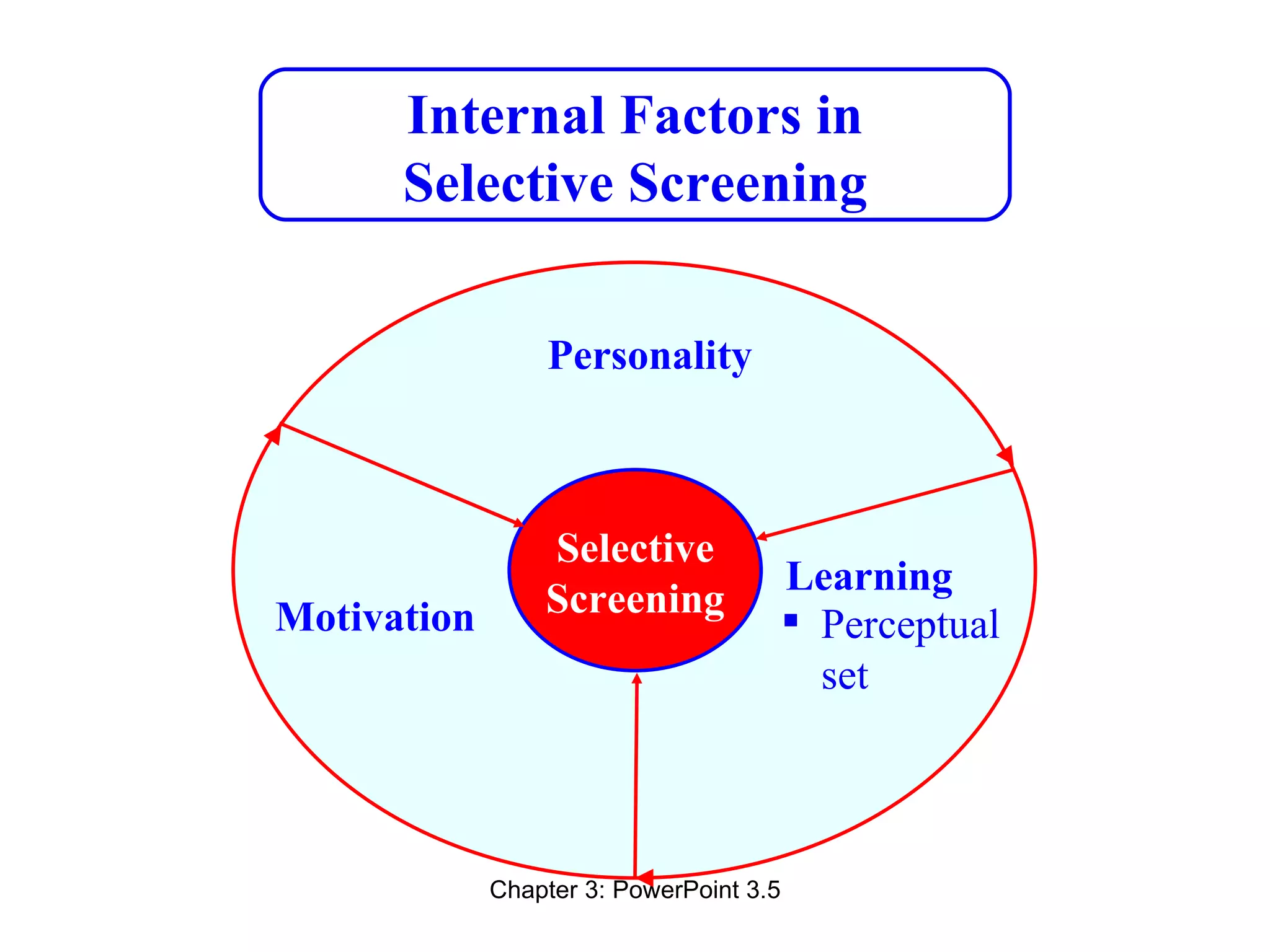
Internal Factors in
      Selective Screening

                 Personality


                 Selective
                                         Learning
Motivation       Screening
                                          Perceptual
                                           set


             Chapter 3: PowerPoint 3.5
Characteristics of the stimulus
• Perceptual problems are most likely
  encountered when the stimulus or cue to
  be perceived affects the emotional status
  of the perceiver. The perception of a
  stimulus or event depends on the
  emotions, needs, attitudes, and motives of
  a person.
Mental processes of people
• The general purpose of these perceptual
  shortcuts is usually to make the reality
  less painful or disturbing. As such, these
  mental processes are types of defensive
  behavior.
Mental processes of people
• Denial. We block out the existence of painful sensory information.

• Stereotyping. We lessen discomfort when we encounter a person
  who does not fit a stereotype by looking for behavior that conforms
  to the stereotype.

• Halo effect. People may color everything that they know about a
  person because of one recognizable favorable or unfavorable
  characteristic.

• Projection. We project out own faults on to others instead of
  making an objective appraisal of the situation.

• Selective perception. People use this mechanism when they
  draw an unjustified conclusion from an unclear situation. (They
  perceive what they want to.)
Attribution Theory and Blame
• Two common attribution errors are (a) the fundamental attribution
  error, and (b) self-serving bias.

  The fundamental attribution error is the tendency to attribute
  behavior to internal causes when focusing on someone else’s
  behavior

  The self-serving bias is the general tendency to attribute one’s
  achievements to good inner qualities, while attributing failure to
  adverse factors within the environment.

• People attribute causes based on three dimensions: consensus (did
  others do it?); consistency (stable performance?); and
  distinctiveness (unusual for the person?)
Attribution Theory and Blame,
                 continued
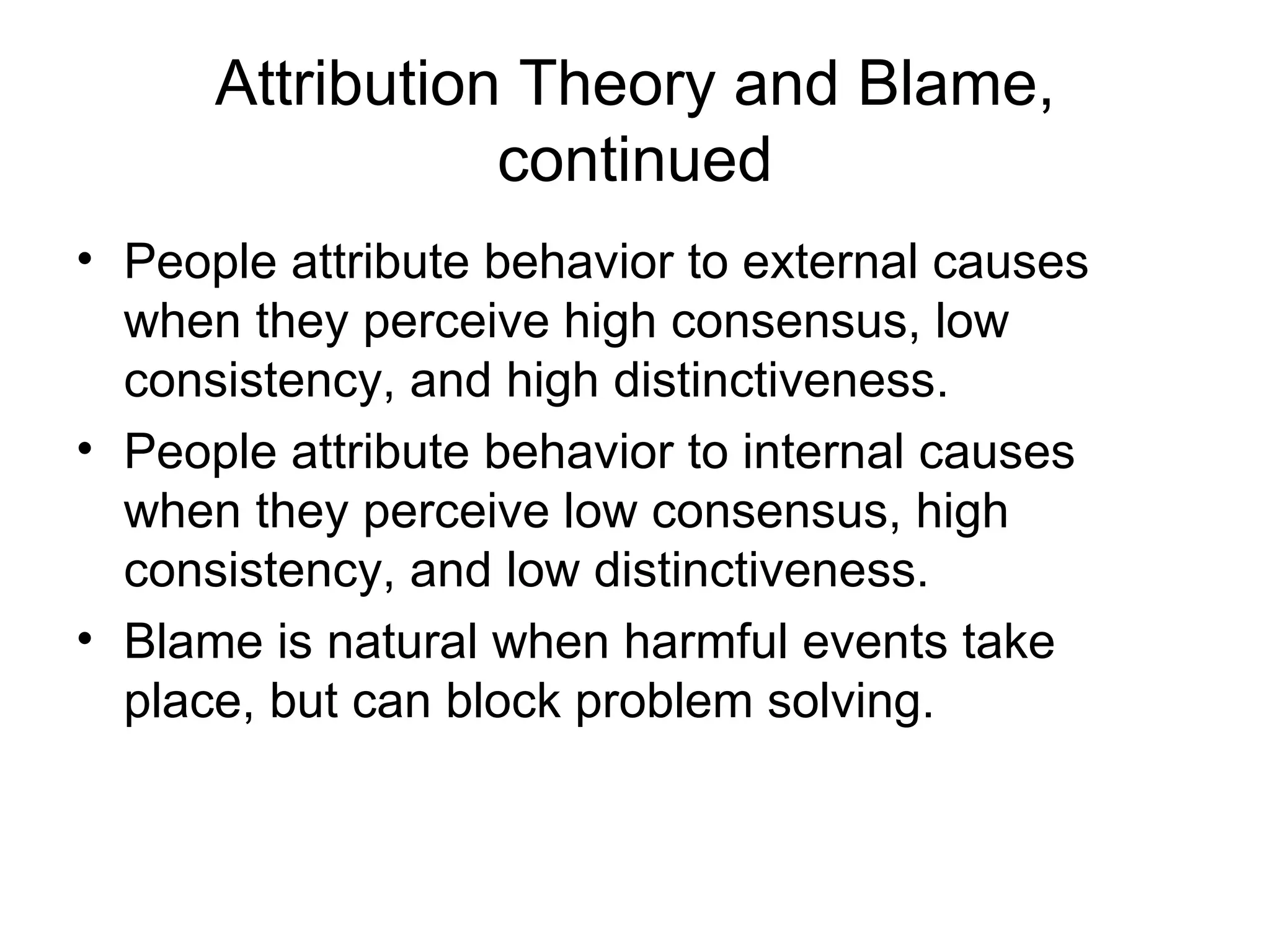
• People attribute behavior to external causes
  when they perceive high consensus, low
  consistency, and high distinctiveness.
• People attribute behavior to internal causes
  when they perceive low consensus, high
  consistency, and low distinctiveness.
• Blame is natural when harmful events take
  place, but can block problem solving.
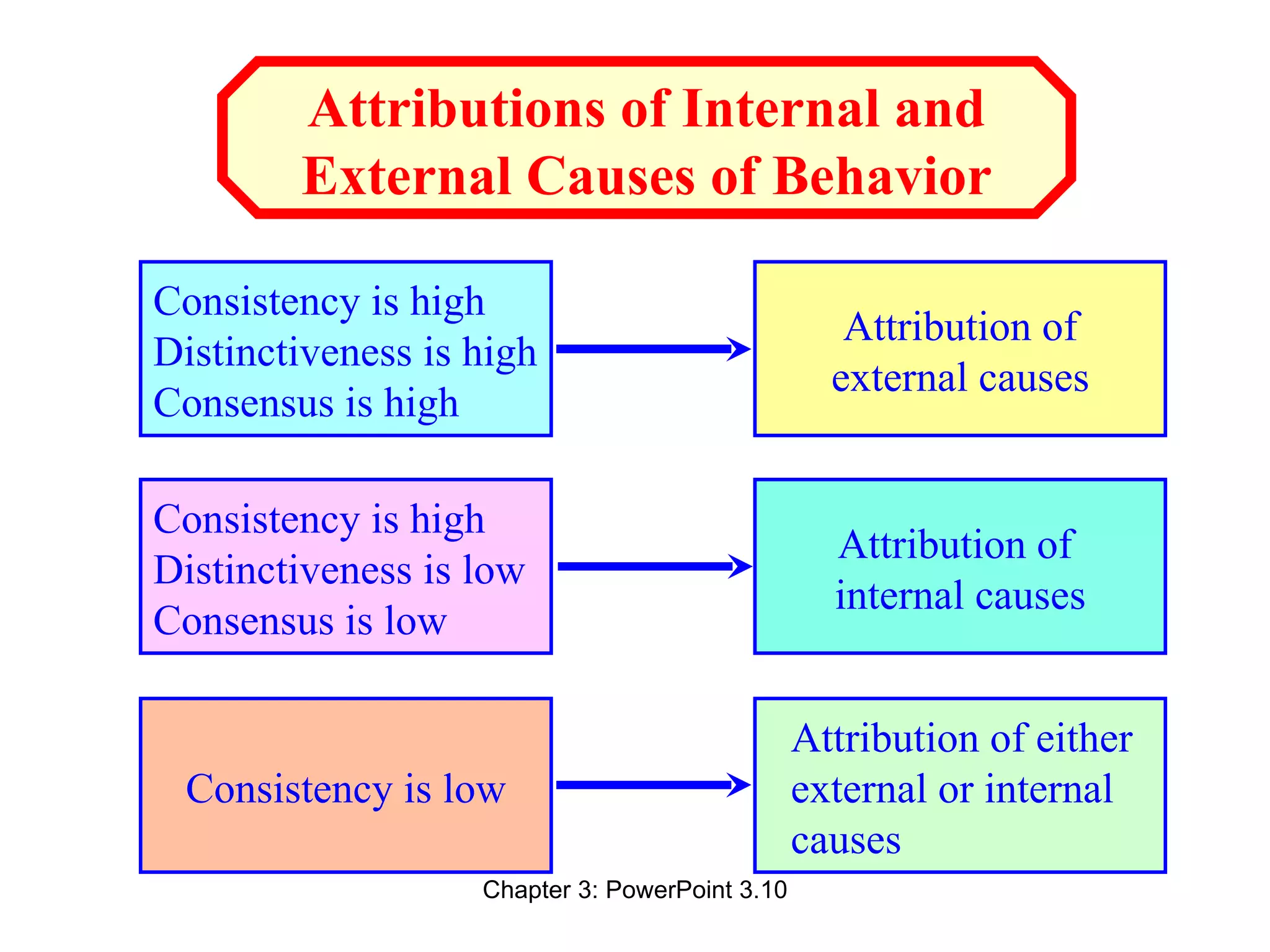
Attributions of Internal and
        External Causes of Behavior

Consistency is high
                                                   Attribution of
Distinctiveness is high
                                                  external causes
Consensus is high

Consistency is high
                                                  Attribution of
Distinctiveness is low
                                                  internal causes
Consensus is low

                                                Attribution of either
 Consistency is low                             external or internal
                                                causes
                   Chapter 3: PowerPoint 3.10

Oblecture3

  • 1.
  • 2.
    TWO KEY LEARNING PROCESSESAND E-LEARNING • Learning is a relatively permanent change in behavior based on practice or experience. Unless learning takes place, few employees would be able to perform their jobs satisfactorily.
  • 3.
    Two Key LearningProcesses and e-Learning • Modeling and Shaping a. Modeling occurs through imitating someone. b. Shaping occurs through rewarding small steps. • Cognitive Learning e. Assumes that learning is complicated including motivation and hunches. b. Informal learning—organization does not determine or design the learning process.
  • 4.
    Cognitive Learning • Thelearner’s orientation influences the amount of cognitive learning. A mastery orientation relates to a dedication to increasing one’s competence on a task. • With performance orientation, learners focus on how well they perform on a task and making comparisons with others.
  • 5.
    Two Key LearningProcess and e- Learning (continued) • Informal learning includes practical, intrapersonal, interpersonal skills, and cultural awareness. • E-Learning is a Web-based form of computer- based training. a. Used widely when learners are geographically dispersed b. Cognitive process of self-motivation and self-discipline are needed.
  • 6.
    Learning Styles • People learn best in different ways, such as through studying versus doing • Visual, Auditory, and Kinesthetic Styles 3. Visual learners learn best by seeing. 4. Auditory learners rely on hearing. 5. Kinesthetic learners learn best by touching and moving 6. Most learners combine the three styles to some degree.
  • 7.
    Learning Styles Learning styleshave also been divided into four orientations based on four stages of the learning cycle: concrete experienceobservations and reflectionsformation of abstractions and generalizationshypotheses to be tested, leading to new experiences. The four learning orientations stemming from the cycle are:
  • 8.
    Learning Styles andImplications 1. An orientation toward concrete experiences that emphasizes being involved in experiences and dealing with human interactions in a personal way. 2. An orientation toward reflective observation that emphasizes understanding meanings. 3. An orientation toward abstract conceptualization that emphasizes applying logic, ideas, and concepts. 4. An orientation toward testing implications of concepts in new situations that emphasizes actively influencing people and changing situations.
  • 9.
    Individual Differences Relatedto Skill Acquisition • People with high mental ability and the ability to concentrate learn better. • In one study, air traffic controllers who acquired more skills, scored higher on (a) cognitive ability test, and (b) warmth factor —warm, outgoing, attentive to others, cooperative, generous, and trusting.
  • 10.
    Perception • Perception dealswith the various ways in which people interpret things in the outside world and how they act on the basis of these perceptions. Much phenomena is interpreted in terms of how we perceive it, rather than what it really is.
  • 11.
    Contributors to PerceptualDistortions Emotionally Charged Stimulus Person as Mental Processes Perceptual Receiver Distortion Denial Stereotyping Halo effect Projection Selective Perception
  • 12.
    External Factors in Selective Screening Size Intensity Novelty and familiarity Contrast Selective Screening Repetition Motion Chapter 3: PowerPoint 3.4
  • 13.
    Internal Factors in Selective Screening Personality Selective Learning Motivation Screening  Perceptual set Chapter 3: PowerPoint 3.5
  • 14.
    Characteristics of thestimulus • Perceptual problems are most likely encountered when the stimulus or cue to be perceived affects the emotional status of the perceiver. The perception of a stimulus or event depends on the emotions, needs, attitudes, and motives of a person.
  • 15.
    Mental processes ofpeople • The general purpose of these perceptual shortcuts is usually to make the reality less painful or disturbing. As such, these mental processes are types of defensive behavior.
  • 16.
    Mental processes ofpeople • Denial. We block out the existence of painful sensory information. • Stereotyping. We lessen discomfort when we encounter a person who does not fit a stereotype by looking for behavior that conforms to the stereotype. • Halo effect. People may color everything that they know about a person because of one recognizable favorable or unfavorable characteristic. • Projection. We project out own faults on to others instead of making an objective appraisal of the situation. • Selective perception. People use this mechanism when they draw an unjustified conclusion from an unclear situation. (They perceive what they want to.)
  • 17.
    Attribution Theory andBlame • Two common attribution errors are (a) the fundamental attribution error, and (b) self-serving bias. The fundamental attribution error is the tendency to attribute behavior to internal causes when focusing on someone else’s behavior The self-serving bias is the general tendency to attribute one’s achievements to good inner qualities, while attributing failure to adverse factors within the environment. • People attribute causes based on three dimensions: consensus (did others do it?); consistency (stable performance?); and distinctiveness (unusual for the person?)
  • 18.
    Attribution Theory andBlame, continued • People attribute behavior to external causes when they perceive high consensus, low consistency, and high distinctiveness. • People attribute behavior to internal causes when they perceive low consensus, high consistency, and low distinctiveness. • Blame is natural when harmful events take place, but can block problem solving.
  • 19.
    Attributions of Internaland External Causes of Behavior Consistency is high Attribution of Distinctiveness is high external causes Consensus is high Consistency is high Attribution of Distinctiveness is low internal causes Consensus is low Attribution of either Consistency is low external or internal causes Chapter 3: PowerPoint 3.10