


Perception & Learning
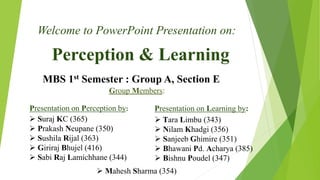
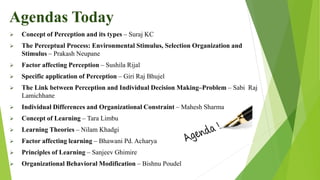
Welcome to PowerPoint Presentation on:
MBS 1st Semester : Group A, Section E
Group Members:
 Suraj KC (365)
 Prakash Neupane (350)
 Sushila Rijal (363)
 Giriraj Bhujel (416)
 Sabi Raj Lamichhane (344)
Presentation on Perception by: Presentation on Learning by:
 Tara Limbu (343)
 Nilam Khadgi (356)
 Sanjeeb Ghimire (351)
 Bhawani Pd. Acharya (385)
 Bishnu Poudel (347)
 Mahesh Sharma (354)
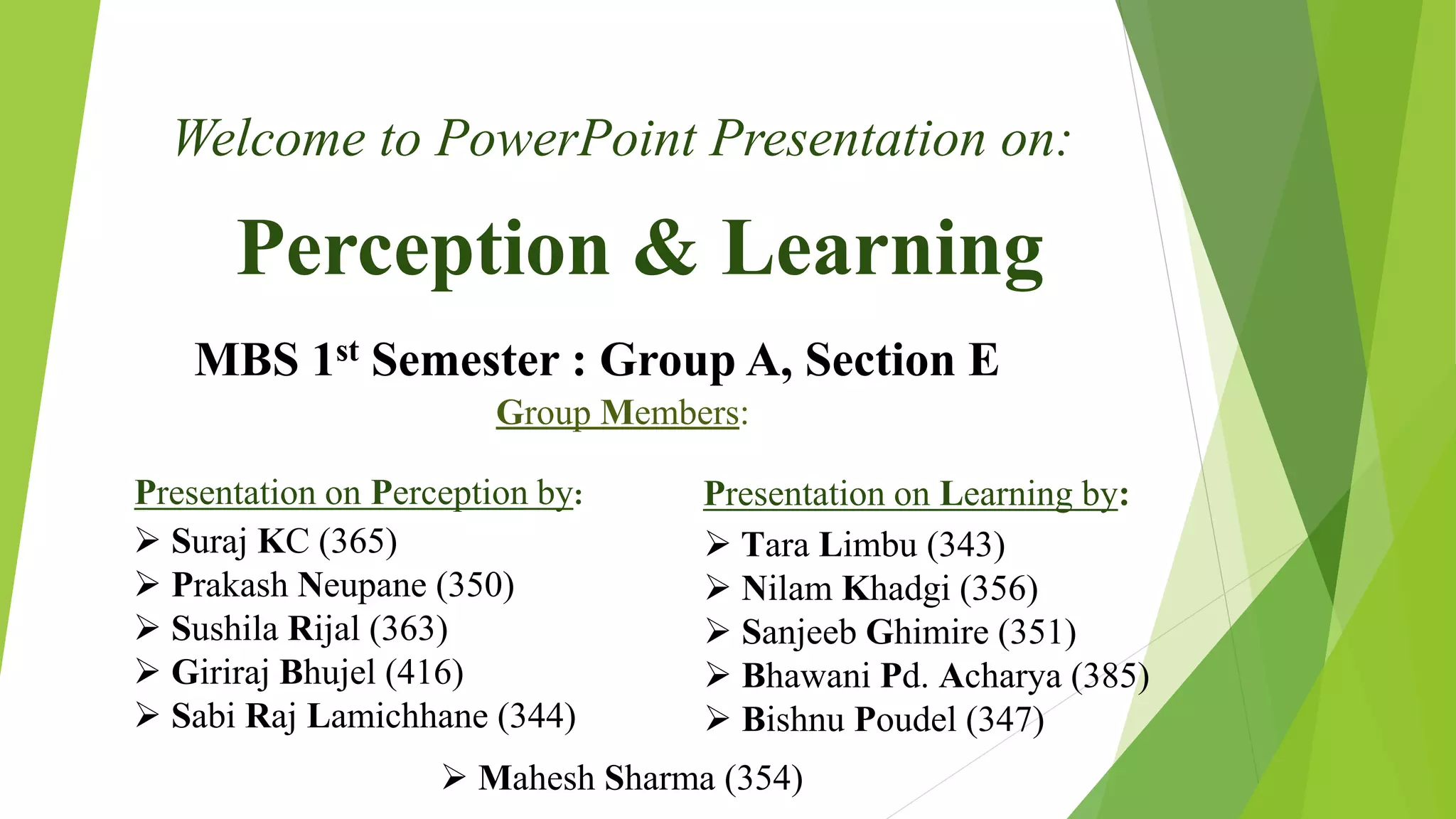
 Concept of Perception and its types – Suraj KC
 The Perceptual Process: Environmental Stimulus, Selection Organization and
Stimulus – Prakash Neupane
 Factor affecting Perception – Sushila Rijal
 Specific application of Perception – Giri Raj Bhujel
 The Link between Perception and Individual Decision Making–Problem – Sabi Raj
Lamichhane
 Individual Differences and Organizational Constraint – Mahesh Sharma
 Concept of Learning – Tara Limbu
 Learning Theories – Nilam Khadgi
 Factor affecting learning – Bhawani Pd. Acharya
 Principles of Learning – Sanjeev Ghimire
 Organizational Behavioral Modification – Bishnu Poudel
Agendas Today
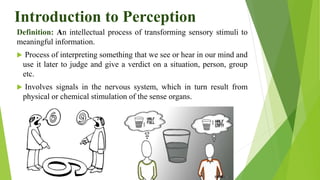
Introduction to Perception
Definition: An intellectual process of transforming sensory stimuli to
meaningful information.
 Process of interpreting something that we see or hear in our mind and
use it later to judge and give a verdict on a situation, person, group
etc.
 Involves signals in the nervous system, which in turn result from
physical or chemical stimulation of the sense organs.
6 Types of Perception:
I. Sound − The ability to receive sound by identifying vibrations.
II. Speech − The competence of interpreting and understanding the sounds of
language heard.
III. Touch − Identifying objects through patterns of its surface by touching it.
IV. Taste − The ability to receive flavor of substances by tasting it through sensory
organs known as taste buds.
V. Other Senses − They approve perception through body, like balance,
acceleration, pain, time, sensation felt in throat and lungs etc.
VI. Of the Social world − It permits people to understand other individuals and
groups of their social world.
Example − Priya goes to a restaurant and likes their customer service, so she will
perceive that it is a good place to hang out and will recommend it to her friends, who
may or may not like it. Priya’s perception about the restaurant is good.
The Perceptual Process
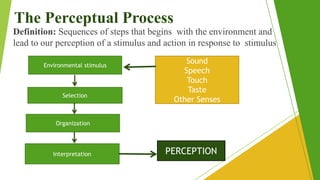
Definition: Sequences of steps that begins with the environment and
lead to our perception of a stimulus and action in response to stimulus
Environmental stimulus
Selection
Interpretation
Organization
Sound
Speech
Touch
Taste
Other Senses
PERCEPTION
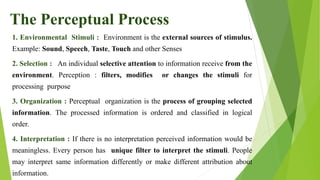
1. Environmental Stimuli : Environment is the external sources of stimulus.
Example: Sound, Speech, Taste, Touch and other Senses
2. Selection : An individual selective attention to information receive from the
environment. Perception : filters, modifies or changes the stimuli for
processing purpose
3. Organization : Perceptual organization is the process of grouping selected
information. The processed information is ordered and classified in logical
order.
4. Interpretation : If there is no interpretation perceived information would be
meaningless. Every person has unique filter to interpret the stimuli. People
may interpret same information differently or make different attribution about
information.
The Perceptual Process
Factors Affecting Perception:
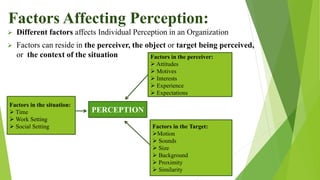
 Different factors affects Individual Perception in an Organization
 Factors can reside in the perceiver, the object or target being perceived,
or the context of the situation Factors in the perceiver:
 Attitudes
 Motives
 Interests
 Experience
 Expectations
PERCEPTION
Factors in the Target:
Motion
 Sounds
 Size
 Background
 Proximity
 Similarity
Factors in the situation:
 Time
 Work Setting
 Social Setting
Managerial Applications
and Importance of Perception
 Employee Interview
 Different interviewers see different things in the same candidate and thus arrive at
different conclusions about the applicant.
 Interviewers generally draw early impressions that become very quickly entrenched.
 Performance Expectations
 Evidence demonstrates that people will attempt to validate their perceptions of reality,
even when those perceptions are faulty.
 Self-fulfilling insight or Pygmalion effect characterizes the fact that people’s
expectations determine their behavior. Expectations become reality.
 Performance Evaluation
 An employee’s performance appraisal is very much dependent on the perceptual process.
 Perception evaluation is of both objective and subjective.
 Employee effort
 Employee existence in organization depend on Devotion of Effort & Subjective Judgments
 Manger judgment must be free from perceptual error.
 Employee Loyalty
 Employee are characterized by their activity.
 Loyalty is highly subjective judgment.
Managerial Applications
and Importance of Perception
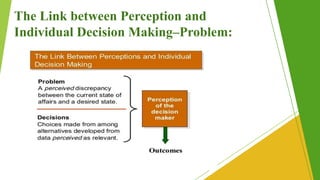
The Link between Perception and
Individual Decision Making–Problem:
Individual Differences & Organizational
Constraint
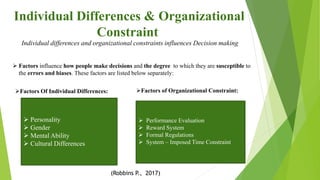
Individual differences and organizational constraints influences Decision making
 Personality
 Gender
 Mental Ability
 Cultural Differences
 Factors influence how people make decisions and the degree to which they are susceptible to
the errors and biases. These factors are listed below separately:
 Performance Evaluation
 Reward System
 Formal Regulations
 System – Imposed Time Constraint
Factors Of Individual Differences: Factors of Organizational Constraint:
(Robbins P., 2017)
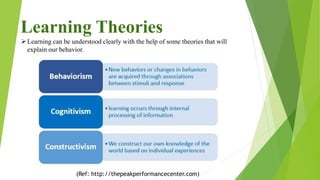
Learning Theories
Learning can be understood clearly with the help of some theories that will
explain our behavior.
(Ref: http://thepeakperformancecenter.com)
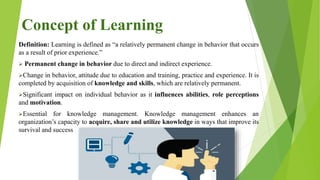
Concept of Learning
Definition: Learning is defined as “a relatively permanent change in behavior that occurs
as a result of prior experience.”
 Permanent change in behavior due to direct and indirect experience.
Change in behavior, attitude due to education and training, practice and experience. It is
completed by acquisition of knowledge and skills, which are relatively permanent.
Significant impact on individual behavior as it influences abilities, role perceptions
and motivation.
Essential for knowledge management. Knowledge management enhances an
organization’s capacity to acquire, share and utilize knowledge in ways that improve its
survival and success
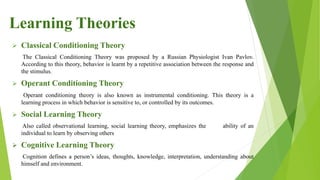
 Classical Conditioning Theory
The Classical Conditioning Theory was proposed by a Russian Physiologist Ivan Pavlov.
According to this theory, behavior is learnt by a repetitive association between the response and
the stimulus.
 Operant Conditioning Theory
Operant conditioning theory is also known as instrumental conditioning. This theory is a
learning process in which behavior is sensitive to, or controlled by its outcomes.
 Social Learning Theory
Also called observational learning, social learning theory, emphasizes the ability of an
individual to learn by observing others
 Cognitive Learning Theory
Cognition defines a person’s ideas, thoughts, knowledge, interpretation, understanding about
himself and environment.
Learning Theories
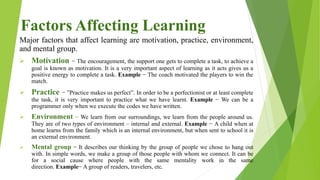
Factors Affecting Learning
Major factors that affect learning are motivation, practice, environment,
and mental group.
 Motivation − The encouragement, the support one gets to complete a task, to achieve a
goal is known as motivation. It is a very important aspect of learning as it acts gives us a
positive energy to complete a task. Example − The coach motivated the players to win the
match.
 Practice − ”Practice makes us perfect”. In order to be a perfectionist or at least complete
the task, it is very important to practice what we have learnt. Example − We can be a
programmer only when we execute the codes we have written.
 Environment − We learn from our surroundings, we learn from the people around us.
They are of two types of environment – internal and external. Example − A child when at
home learns from the family which is an internal environment, but when sent to school it is
an external environment.
 Mental group − It describes our thinking by the group of people we chose to hang out
with. In simple words, we make a group of those people with whom we connect. It can be
for a social cause where people with the same mentality work in the same
direction. Example− A group of readers, travelers, etc.
 Principle of Readiness : Individuals learn best when they are
physically, mentally & emotionally ready to learn and do not learn
well if they see no reason for learning.
 Principle of Exercise : Individuals learn best & retain and remember
information longer when they have meaningful practice and
repetition.
 Principle of Effect : learning is strengthened when accompanied by
a pleasant or satisfying feeling, and weakened when associated with
an unpleasant feeling.
 Principle of Primacy : Things learned first are usually learned
easily and remain, without effort, in the mind of learner.
Principals of Learning
 Principle of Recency : Things most recently learned are best
remembered; frequent review and summarization help fix in the mind
the material covered.
 Principle of Intensity : A sharp, clear, vivid, dramatic or exciting
learning teaches more than a routine or boring experience.
 Principle of Freedom : Things freely learned are best learned. If the
learner is coerced, the more difficult is for him/her to learn, assimilate
and implement what is learned.
 Principle of Requirement : “we must have something to obtain or do
something”. It can be the ability, skill, instrument or anything that may
help us to learn or gain something.
Principals of Learning
Organizational Behavioral Modification
 Behavior modification is the application of reinforcement theory to
people in organizational setting.
 According to reinforcement theory we can increase the frequency of
desirable behavior by linking those behavior with positive
consequences.
 Behavior modification refer s to the technique used to try and decrease
or increase a particular type of behavior or reaction
 We need to procure the capability of influencing, and modifying the
individuals and/or group behavior for the accomplishment of
organizational goals.
 Behavior modification is basically a treatment approach, which is
adopted to replace the undesirable behaviors with the desirable
behaviors.
Steps in OB Modification
The steps of behavior modification presented below
I. Identification performance related behavioral events
II. Measures baseline performance
III. Identify the existing behavioral consequences
IV. Develop and apply appropriate intervention strategy
V. Measures performance
VI. Maintain desirable behavior
Perception and Learning in Organization Behavior

Perception and Learning in Organization Behavior

  • 1.
    Perception & Learning Welcometo PowerPoint Presentation on: MBS 1st Semester : Group A, Section E Group Members:  Suraj KC (365)  Prakash Neupane (350)  Sushila Rijal (363)  Giriraj Bhujel (416)  Sabi Raj Lamichhane (344) Presentation on Perception by: Presentation on Learning by:  Tara Limbu (343)  Nilam Khadgi (356)  Sanjeeb Ghimire (351)  Bhawani Pd. Acharya (385)  Bishnu Poudel (347)  Mahesh Sharma (354)
  • 2.
     Concept ofPerception and its types – Suraj KC  The Perceptual Process: Environmental Stimulus, Selection Organization and Stimulus – Prakash Neupane  Factor affecting Perception – Sushila Rijal  Specific application of Perception – Giri Raj Bhujel  The Link between Perception and Individual Decision Making–Problem – Sabi Raj Lamichhane  Individual Differences and Organizational Constraint – Mahesh Sharma  Concept of Learning – Tara Limbu  Learning Theories – Nilam Khadgi  Factor affecting learning – Bhawani Pd. Acharya  Principles of Learning – Sanjeev Ghimire  Organizational Behavioral Modification – Bishnu Poudel Agendas Today
  • 3.
    Introduction to Perception Definition:An intellectual process of transforming sensory stimuli to meaningful information.  Process of interpreting something that we see or hear in our mind and use it later to judge and give a verdict on a situation, person, group etc.  Involves signals in the nervous system, which in turn result from physical or chemical stimulation of the sense organs.
  • 4.
    6 Types ofPerception: I. Sound − The ability to receive sound by identifying vibrations. II. Speech − The competence of interpreting and understanding the sounds of language heard. III. Touch − Identifying objects through patterns of its surface by touching it. IV. Taste − The ability to receive flavor of substances by tasting it through sensory organs known as taste buds. V. Other Senses − They approve perception through body, like balance, acceleration, pain, time, sensation felt in throat and lungs etc. VI. Of the Social world − It permits people to understand other individuals and groups of their social world. Example − Priya goes to a restaurant and likes their customer service, so she will perceive that it is a good place to hang out and will recommend it to her friends, who may or may not like it. Priya’s perception about the restaurant is good.
  • 5.
    The Perceptual Process Definition:Sequences of steps that begins with the environment and lead to our perception of a stimulus and action in response to stimulus Environmental stimulus Selection Interpretation Organization Sound Speech Touch Taste Other Senses PERCEPTION
  • 6.
    1. Environmental Stimuli: Environment is the external sources of stimulus. Example: Sound, Speech, Taste, Touch and other Senses 2. Selection : An individual selective attention to information receive from the environment. Perception : filters, modifies or changes the stimuli for processing purpose 3. Organization : Perceptual organization is the process of grouping selected information. The processed information is ordered and classified in logical order. 4. Interpretation : If there is no interpretation perceived information would be meaningless. Every person has unique filter to interpret the stimuli. People may interpret same information differently or make different attribution about information. The Perceptual Process
  • 7.
    Factors Affecting Perception: Different factors affects Individual Perception in an Organization  Factors can reside in the perceiver, the object or target being perceived, or the context of the situation Factors in the perceiver:  Attitudes  Motives  Interests  Experience  Expectations PERCEPTION Factors in the Target: Motion  Sounds  Size  Background  Proximity  Similarity Factors in the situation:  Time  Work Setting  Social Setting
  • 8.
    Managerial Applications and Importanceof Perception  Employee Interview  Different interviewers see different things in the same candidate and thus arrive at different conclusions about the applicant.  Interviewers generally draw early impressions that become very quickly entrenched.  Performance Expectations  Evidence demonstrates that people will attempt to validate their perceptions of reality, even when those perceptions are faulty.  Self-fulfilling insight or Pygmalion effect characterizes the fact that people’s expectations determine their behavior. Expectations become reality.
  • 9.
     Performance Evaluation An employee’s performance appraisal is very much dependent on the perceptual process.  Perception evaluation is of both objective and subjective.  Employee effort  Employee existence in organization depend on Devotion of Effort & Subjective Judgments  Manger judgment must be free from perceptual error.  Employee Loyalty  Employee are characterized by their activity.  Loyalty is highly subjective judgment. Managerial Applications and Importance of Perception
  • 10.
    The Link betweenPerception and Individual Decision Making–Problem:
  • 11.
    Individual Differences &Organizational Constraint Individual differences and organizational constraints influences Decision making  Personality  Gender  Mental Ability  Cultural Differences  Factors influence how people make decisions and the degree to which they are susceptible to the errors and biases. These factors are listed below separately:  Performance Evaluation  Reward System  Formal Regulations  System – Imposed Time Constraint Factors Of Individual Differences: Factors of Organizational Constraint: (Robbins P., 2017)
  • 12.
    Learning Theories Learning canbe understood clearly with the help of some theories that will explain our behavior. (Ref: http://thepeakperformancecenter.com)
  • 13.
    Concept of Learning Definition:Learning is defined as “a relatively permanent change in behavior that occurs as a result of prior experience.”  Permanent change in behavior due to direct and indirect experience. Change in behavior, attitude due to education and training, practice and experience. It is completed by acquisition of knowledge and skills, which are relatively permanent. Significant impact on individual behavior as it influences abilities, role perceptions and motivation. Essential for knowledge management. Knowledge management enhances an organization’s capacity to acquire, share and utilize knowledge in ways that improve its survival and success
  • 14.
     Classical ConditioningTheory The Classical Conditioning Theory was proposed by a Russian Physiologist Ivan Pavlov. According to this theory, behavior is learnt by a repetitive association between the response and the stimulus.  Operant Conditioning Theory Operant conditioning theory is also known as instrumental conditioning. This theory is a learning process in which behavior is sensitive to, or controlled by its outcomes.  Social Learning Theory Also called observational learning, social learning theory, emphasizes the ability of an individual to learn by observing others  Cognitive Learning Theory Cognition defines a person’s ideas, thoughts, knowledge, interpretation, understanding about himself and environment. Learning Theories
  • 15.
    Factors Affecting Learning Majorfactors that affect learning are motivation, practice, environment, and mental group.  Motivation − The encouragement, the support one gets to complete a task, to achieve a goal is known as motivation. It is a very important aspect of learning as it acts gives us a positive energy to complete a task. Example − The coach motivated the players to win the match.  Practice − ”Practice makes us perfect”. In order to be a perfectionist or at least complete the task, it is very important to practice what we have learnt. Example − We can be a programmer only when we execute the codes we have written.  Environment − We learn from our surroundings, we learn from the people around us. They are of two types of environment – internal and external. Example − A child when at home learns from the family which is an internal environment, but when sent to school it is an external environment.  Mental group − It describes our thinking by the group of people we chose to hang out with. In simple words, we make a group of those people with whom we connect. It can be for a social cause where people with the same mentality work in the same direction. Example− A group of readers, travelers, etc.
  • 16.
     Principle ofReadiness : Individuals learn best when they are physically, mentally & emotionally ready to learn and do not learn well if they see no reason for learning.  Principle of Exercise : Individuals learn best & retain and remember information longer when they have meaningful practice and repetition.  Principle of Effect : learning is strengthened when accompanied by a pleasant or satisfying feeling, and weakened when associated with an unpleasant feeling.  Principle of Primacy : Things learned first are usually learned easily and remain, without effort, in the mind of learner. Principals of Learning
  • 17.
     Principle ofRecency : Things most recently learned are best remembered; frequent review and summarization help fix in the mind the material covered.  Principle of Intensity : A sharp, clear, vivid, dramatic or exciting learning teaches more than a routine or boring experience.  Principle of Freedom : Things freely learned are best learned. If the learner is coerced, the more difficult is for him/her to learn, assimilate and implement what is learned.  Principle of Requirement : “we must have something to obtain or do something”. It can be the ability, skill, instrument or anything that may help us to learn or gain something. Principals of Learning
  • 18.
    Organizational Behavioral Modification Behavior modification is the application of reinforcement theory to people in organizational setting.  According to reinforcement theory we can increase the frequency of desirable behavior by linking those behavior with positive consequences.  Behavior modification refer s to the technique used to try and decrease or increase a particular type of behavior or reaction  We need to procure the capability of influencing, and modifying the individuals and/or group behavior for the accomplishment of organizational goals.  Behavior modification is basically a treatment approach, which is adopted to replace the undesirable behaviors with the desirable behaviors.
  • 19.
    Steps in OBModification The steps of behavior modification presented below I. Identification performance related behavioral events II. Measures baseline performance III. Identify the existing behavioral consequences IV. Develop and apply appropriate intervention strategy V. Measures performance VI. Maintain desirable behavior