GROWTH & DEVELOPMENT
Growth and Develo pment  as a unit expresses th e sum of  nu merou s changes that take  p lace durin g  the life c ycle of an indivi dual.  The  entire  cour se is a dynamic p rocess that encom passes several int er-related d i mensions.
WHY STUDY GROWTH & DEVELOPMENT? Know what to expect of a child at any age Know certain behaviours that are likely to emerge in mature forms Assess the sequence and norms of G & D of a child Know how to influence G & D favourably Diagnose undernutrition, infectious and other diseases affecting G & D Recognize the potential problems and strengths of individual children & their parents Plan for comprehensive care of the child Work with children effectively in health & disease
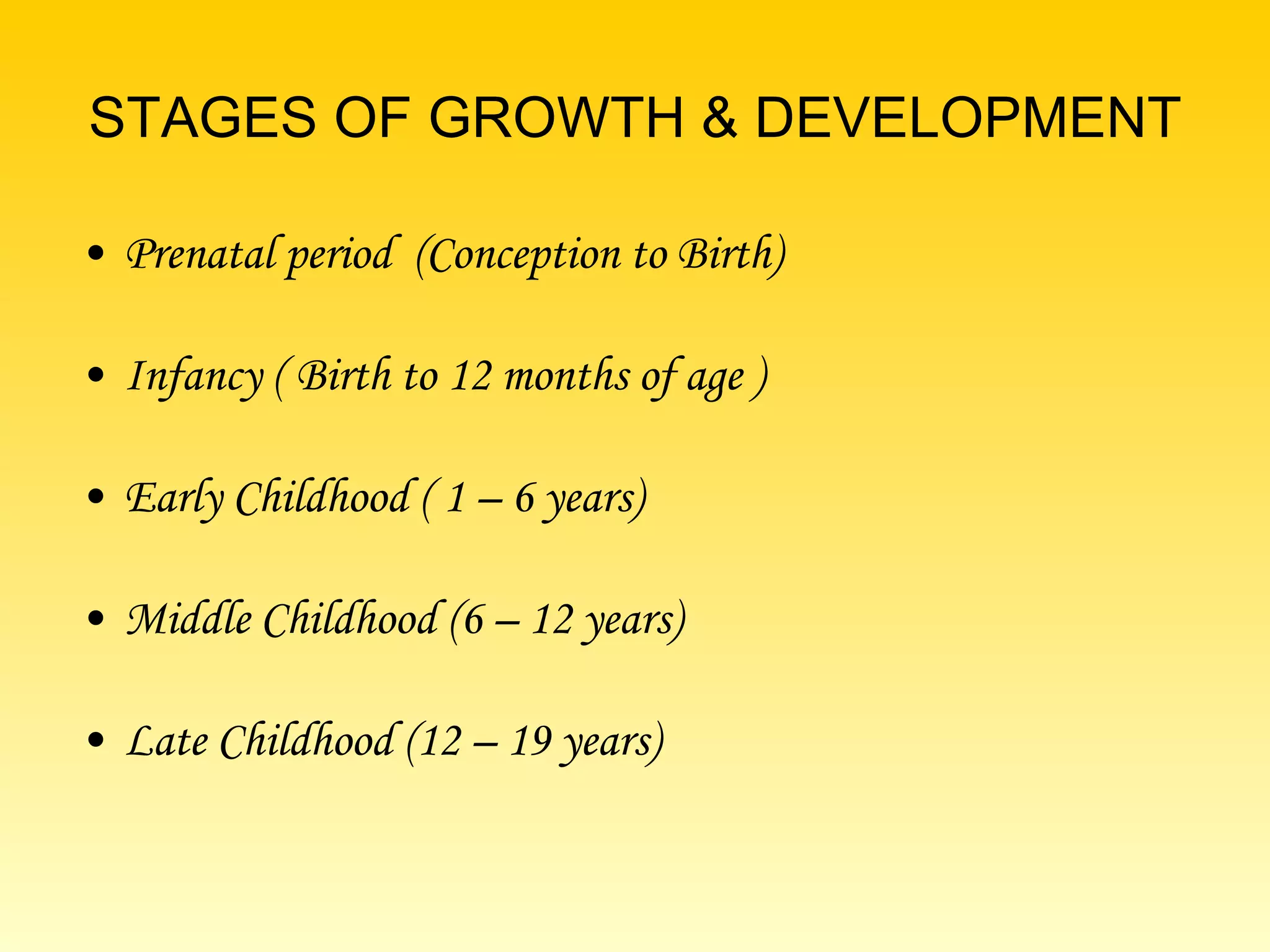
STAGES OF GROWTH & DEVELOPMENT Prenatal period  (Conception to Birth) Infancy ( Birth to 12 months of age ) Early Childhood ( 1 – 6 years) Middle Childhood (6 – 12 years) Late Childhood (12 – 19 years)
PRENATAL GROWTH Zygote – Increased cell organization and differentiation into three basic layers – Ectoderm, Mesoderm, Endoderm. Embryo – Marked organization upto 8 weeks.  Fetal phase – 8 weeks to 40 weeks (birth). -  Increases in length and weight -  Linear growth with maximum velocity  at 4 months
GROWTH & DEVELOPMENT IN INFANCY
INFANCY Neonate – Birth – 28 days  ( Early and late neonatal period)  Infancy  - 28 days – 12 months  -  Rapid motor, cognitive, and social development - Trust, physical adjustment to outside  - Psychological adjustment of parents
GROWTH & PHYSICAL MATURATION
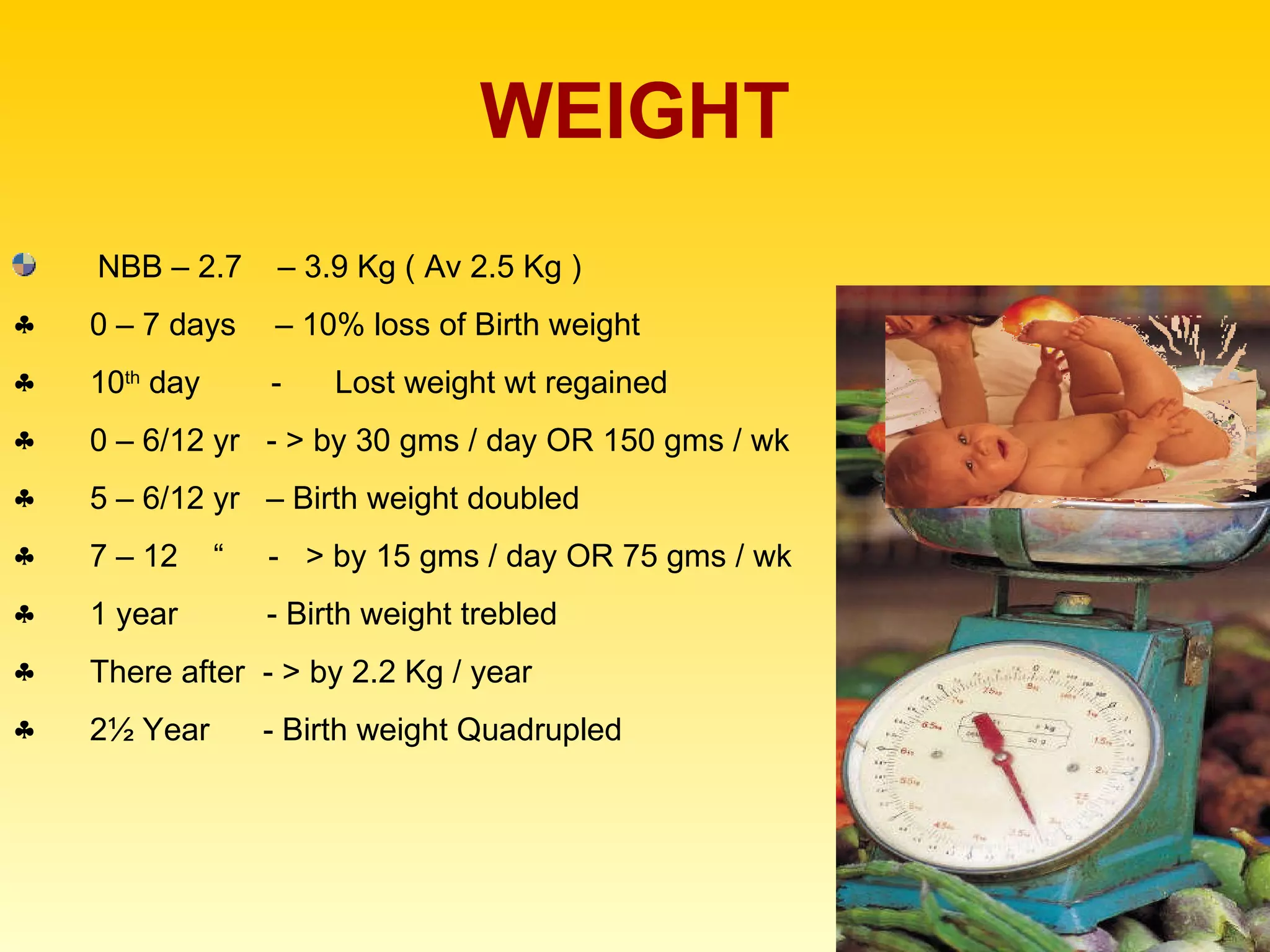
WEIGHT NBB – 2.7  – 3.9 Kg ( Av 2.5 Kg ) 0 – 7 days  – 10% loss of Birth weight 10 th  day  -  Lost weight wt regained 0 – 6/12 yr  - > by 30 gms / day OR 150 gms / wk 5 – 6/12 yr  – Birth weight doubled 7 – 12  “  -  > by 15 gms / day OR 75 gms / wk 1 year  - Birth weight trebled There after  - > by 2.2 Kg / year 2½ Year  - Birth weight Quadrupled
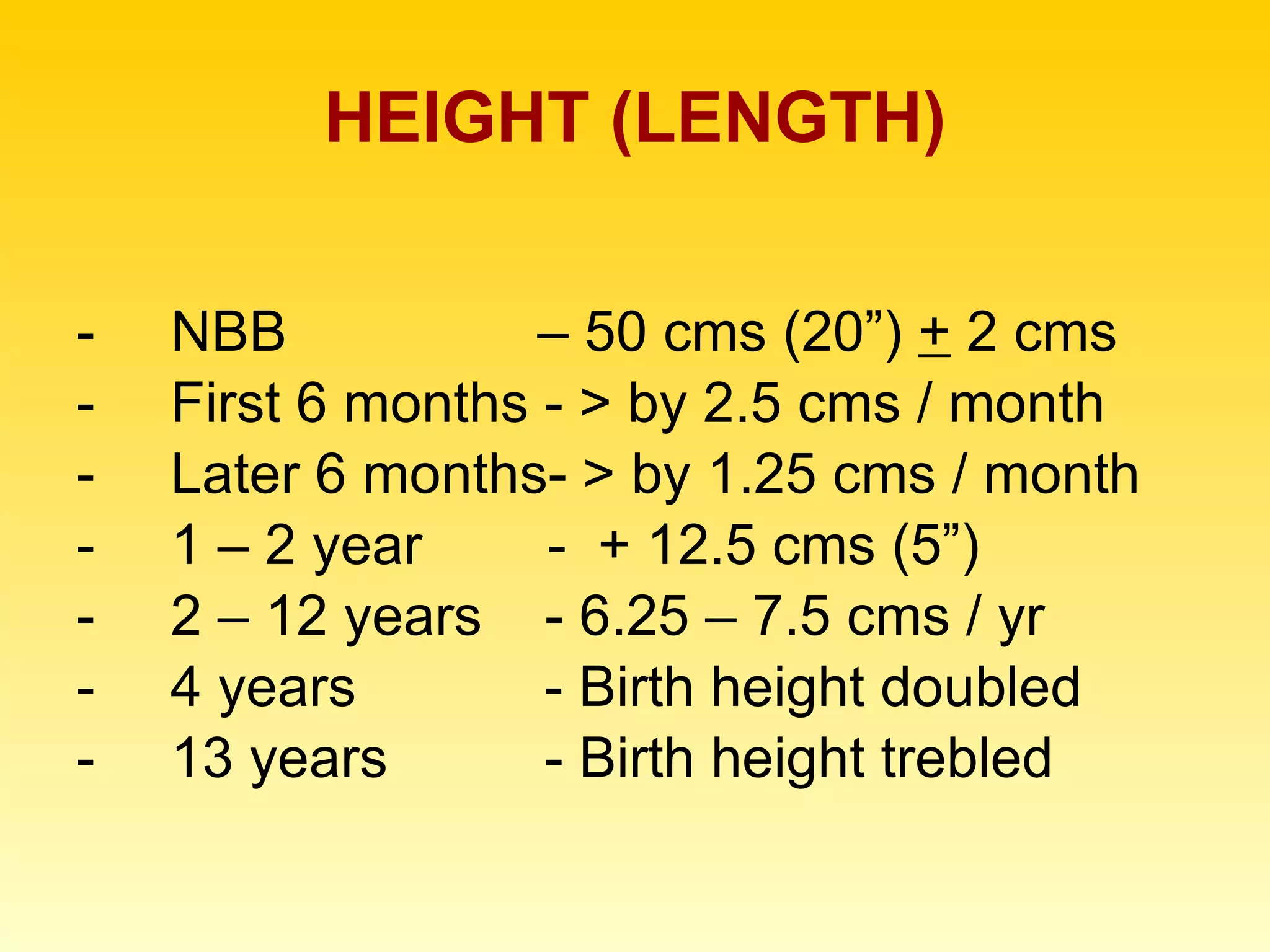
HEIGHT (LENGTH) NBB  – 50 cms (20”)  +  2 cms First 6 months - > by 2.5 cms / month Later 6 months- > by 1.25 cms / month 1 – 2 year  -  + 12.5 cms (5”) 2 – 12 years  - 6.25 – 7.5 cms / yr 4 years  - Birth height doubled 13 years  - Birth height trebled
OCCIPITO-FRONTAL CIRCUMFERENCE (OFC) NBB – 35 cms ( 1.25 – 2.5 cms > Chest Circumference) 0 – 3 months  - > by 2 cms / month 3 – 12 months  -  > by 2 cms / 3 months 1 – 3 years  -  > by 1 cm / 6 month (Equals chest  circumference 1 yr) 3 – 5 years  -  > by 1 cm / year 5 – 6 year  -  Adult head size Thus, OFC at -  1 year  -  47 cms 2 years -  49 cms 3 years -  50 cms 4 years -  50.4 cms 5 years -  50.8 cms 10 years -  53 cms 15 years -  55 cms  Fontanelle closure – Post  - 6 – 8 wks Ant – 12 – 18 months Increase of brain weight – By 2½ times in the first year
CALCULATION OF ANTHROPOMETRICAL PARAMETERS WEIGHT – 3 – 12 MONTHS –  Age ( months ) + 9  K g 2 1 – 6  YEARS  -  Age ( Years) x 2 + 8  Kg 7 – 12  YEARS  -  Age (Years) x 7 + 5  Kg 2 HEIGHT  –  2 – 12 YEARS – Age (Years) x 6 + 77  (cms) Future (Adult) height – Girls – Ht at 2 yrs x 2 Boys – Ht at 2½ yrs x 2 OFC Infant  -  Length (cm)  + 9.5  cms 2
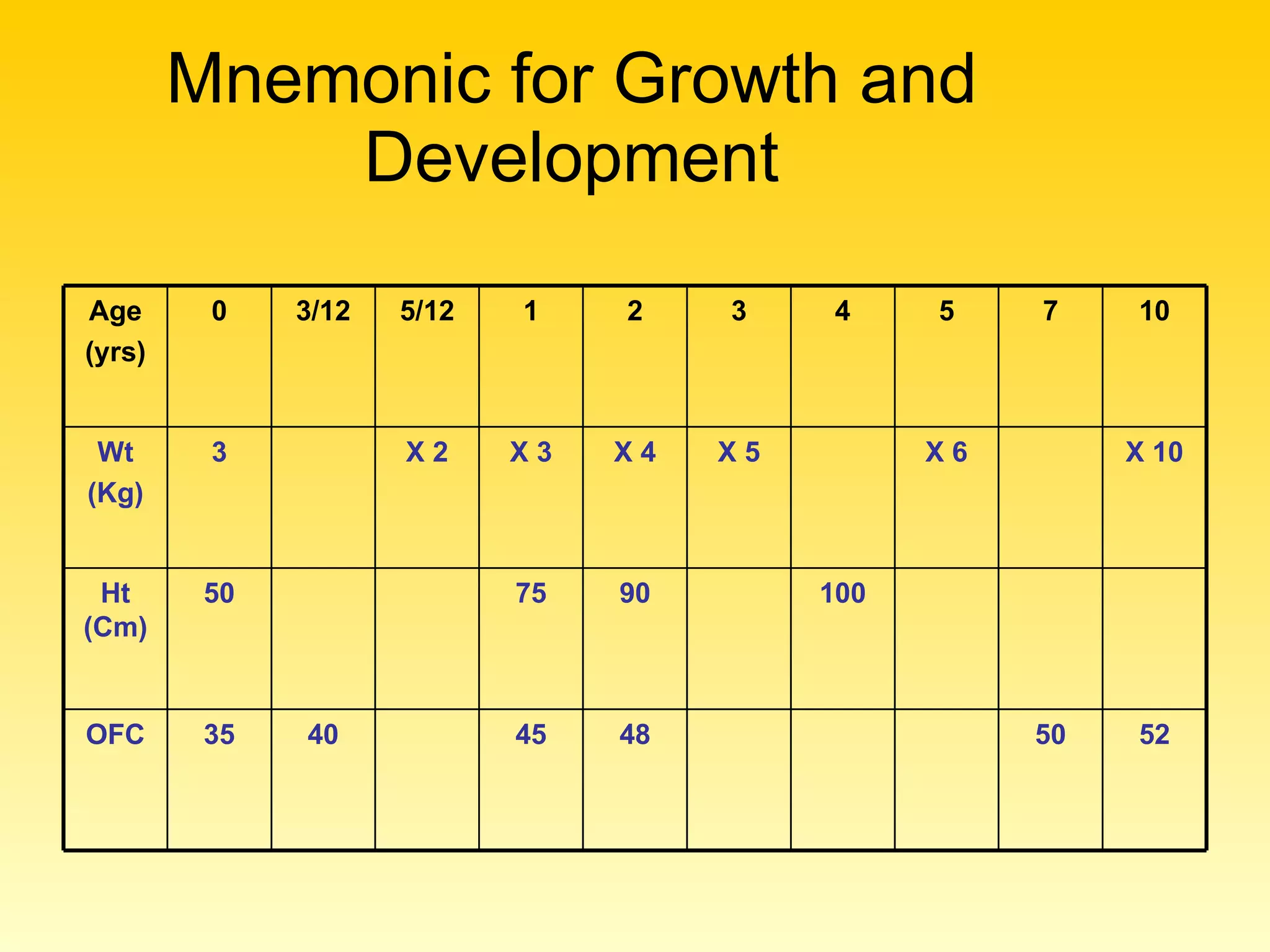
Mnemonic for Growth and Development 52 50 48 45 40 35 OFC 100 90 75 50 Ht (Cm) X 10 X 6 X 5 X 4 X 3 X 2 3 Wt (Kg) 10 7 5 4 3 2 1 5/12 3/12 0 Age (yrs)
CHEST CIRCUMFERENCE & MUAC Chest Circumference  - 33 cms at birth, barrel shaped  - At 1 year Transverse diameter > AP diameter by 25 % - At 6 years transverse diameter > AP diameter by 33 % 6 months – 39 cms 1 year  -  45 cms (Equals OFC) 2 years  -  49 cms 5 years  -  55 cms 10 years  -  64 cms 15 years  -  77 cms MUAC (Mid upper arm circumference)  – NBB – 14.5 cms 1 year – 16 cms.  Then > by 0.25 cm / yr
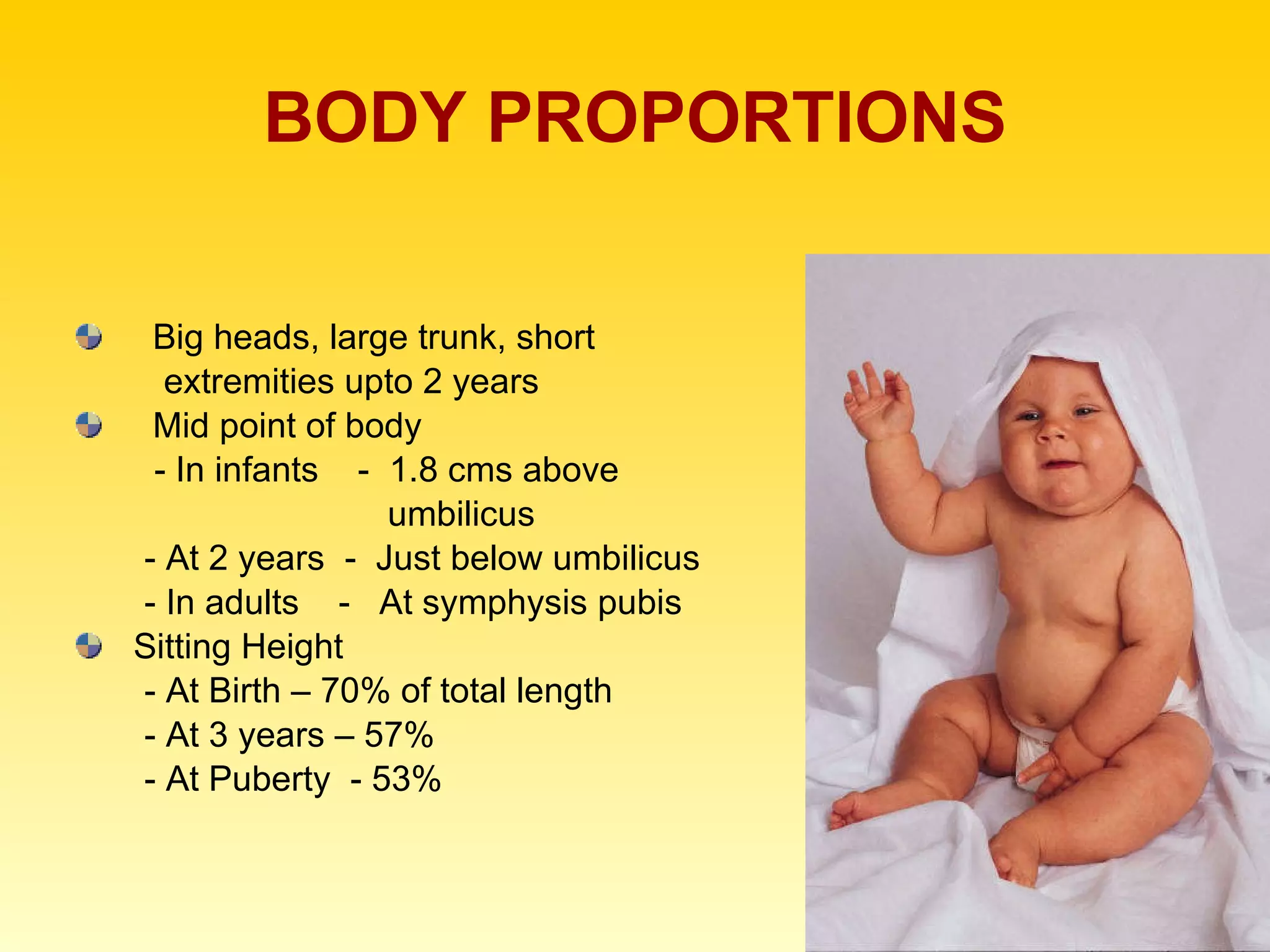
BODY PROPORTIONS Big heads, large trunk, short  extremities upto 2 years Mid point of body - In infants  -  1.8 cms above  umbilicus  - At 2 years  -  Just below umbilicus  - In adults  -  At symphysis pubis Sitting Height - At Birth – 70% of total length - At 3 years – 57% - At Puberty  - 53%
CARDIO-CASCULAR SYSTEM Heart – Transversely placed, Apex beat at IV ICS H R – NBB – 140/mt,  5 yrs – 100/mt, 10 yrs – 90/mt,  12 yrs – 85/mt, 15 yrs – 80/mt Sleeping Pulse Rate – 10 – 20 beats lower BP – 80/50 …. 90/60 mm Hg Systole rises in the 2 nd  month Diastole falls in the first 3 months, then gradually  rises
Hematological system Hb F – The primary Hb for the first 2 -3 months  ( >>> Physiological Anemia ) then Hb A increases upto 6 months Respiratory System Resp rate – 50 – 35/ mt Abdominal & diaphragmatic Trachea close to bronchi, narrow lumen Short straight eustachean tube < IgA in mucosal lining
Lymphatic System  –  Hyperplastic in children.  Resolves after puberty Nervous System  –  NBB  – Brain wt – 10% of body weight Infancy – Rapid brain growth.  80% achieved by 4  yrs Myelination begins after 3 months, completed by 2  years Primitive reflexes replaced by righting reflexes &  voluntary, purposeful movements
GASTRO-INTESTINAL SYSTEM Salivation begins at 3 months Stomach capacity – 90 ml at birth, 360 ml at 1 yr Enzyme amylase inadequate – Poor digestion of complex CHO Liver immature throughout infancy By 1 yr – 3 meals + 1 bed time feed -  1 or 2 bowel movements
Immunologic System - Maternal IgG upto 3 months - Synthesizes IgG (40% of adult levels) by 1 year - IgM produced at birth.  Adult levels by 9 months - IgA production gradual.  Adult levels by puberty Skin  – Absent shivering and sweating at birth - Accumulation of adipose tissue in 6 months  ( helps insulation)
Fluid & Electrolytes   NBB – 75% of total body wt is water -  ECF vol is 40% which <es to 20% in adulthood Renal System  – Immature at birth Complete maturity in 18 to 24 months Urine Sp.Gr – 1000 – 1010 Dentition  – Begins at 6 – 12 months By 3 yrs – all 20 teeth  Rule – Age (months) -6 = No of teeth Permanent teeth by 6 – 12 years
SPECIAL SENSES Hearing  – Acuity at adult levels at infancy 6 months – can differentiate familiar voices 7 months – vestibular function begins Short ext auditory meatus & Eustachian canal Visual  – Low acuity.  Hypermetropic 6 wks – 4 months – Binocularity well estd. 7 -12 months – Stereopsis ( depth perception) begins to develop
MOTOR DEVELOPMENT
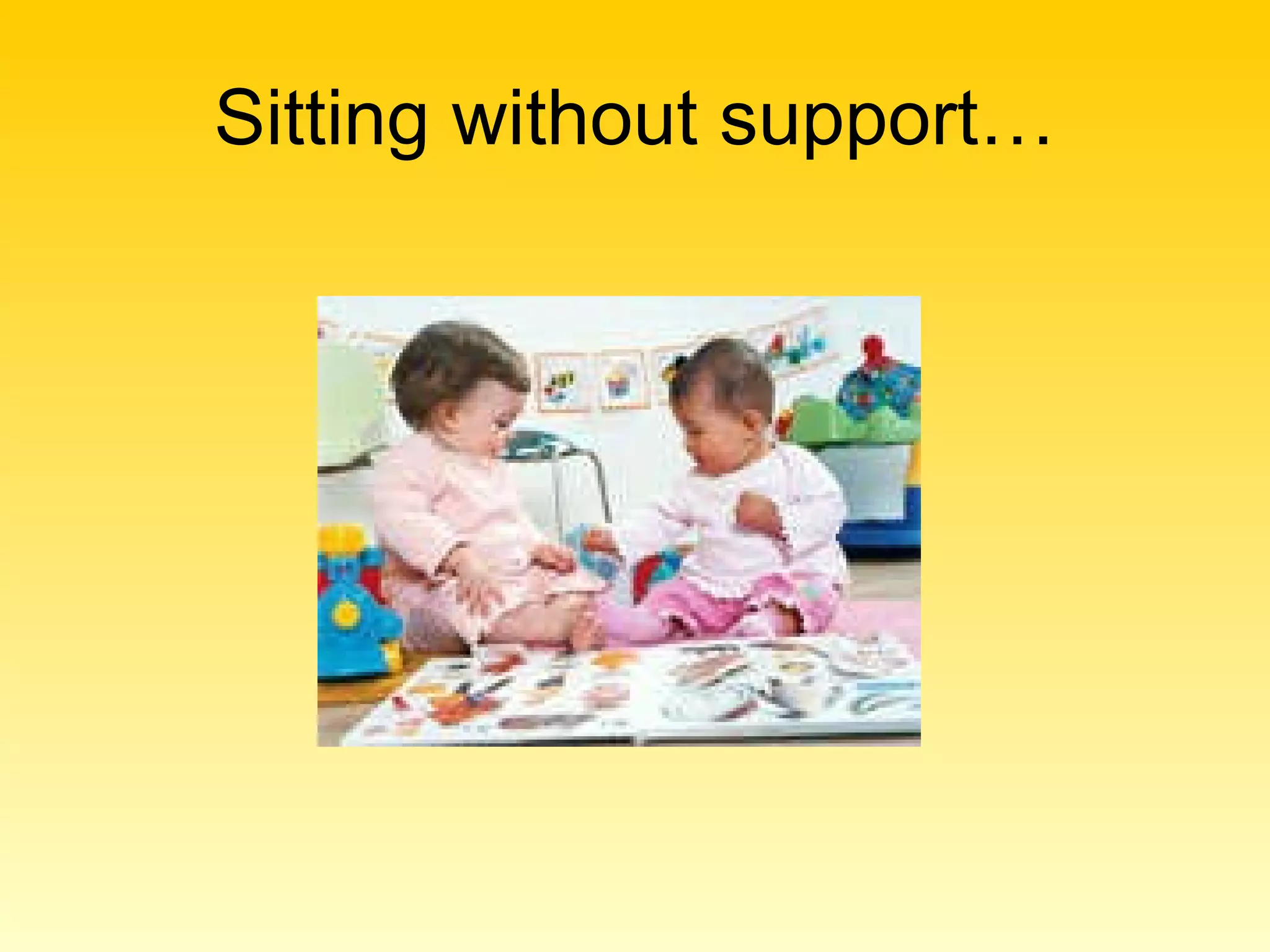
GROSS MOTOR (Devt.al maturation in posture) General movements Head balance (3/12) Rolling over (5/12) Sitting with support (4/12) Crawling & Creeping (8/12) Standing (10/12) Walking (1 yr)
Sitting without support…
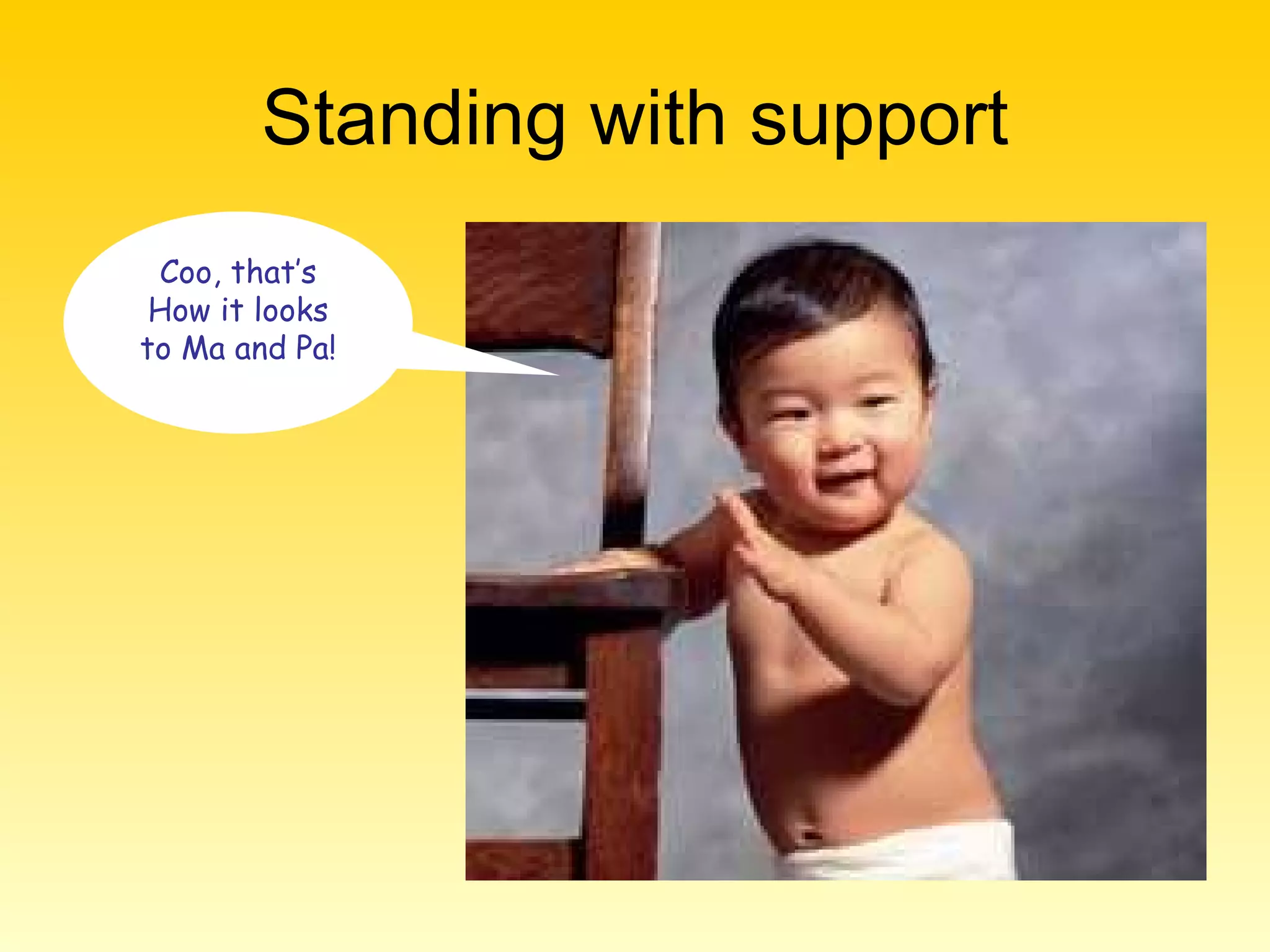
Standing with support Coo, that’s How it looks to Ma and Pa!
FINE MOTOR Use of hands and fingers in prehension Grasp reflex at 0 – 3months Palmar grasp Crude pincer grasp – 8-9 months Neat pincer grasp – 11 months Builds a tower of 2 blocks by 1 year
PSYCHOLOGICAL DEVELOPMENT
Psychosocial Development Reflex behaviour – parent, peer response 1 month – Social smile, 4 months – laughs aloud Play helps socialize Attachment- Indiscriminate response. cry, smile Vocalize more to mother, distinct preferences  6 months – ‘peekaboo’, asks to be carried -  Stranger anxiety & separation anxiety Eric Erickson- Trust Vs Mistrust - 3-4 months – Oral phase (pri narcissism)  - 5-12 months – Social phase
Language Cry – for displeasure and pleasure 2 months – ah, eh, uh…. 3 months – coos, gurg;es, laughs (n,k p, g) 8 months – Imitates sounds t,d,w 9-10 months – Understands ‘NO’, obeys simple commands 1 yr – 3-5 words with meaning Play  – Sensorimotor, narcissistic, dependant, solitary -  Laughs, peekaboo, pat-a-cake, repetition, imitation -  Selective after 6-8 months ( No strangers!)  Sleep  – 0-6 months – 18-20 hrs /day - 6-12 months – 16-18 hrs/day - 2-4 yrs  -  12-16 hrs/ day - 5-10 yrs  - 10-12 hrs/ day IMPORTANT – Not only ‘to play’, but to be ‘played with’.
Psycho- sexual development Sigmund Freud – Oral phase Cognitive ( Intellectual) development Jean Piaget – Sensorimotor Phase ( 0-2 yrs) - Use of reflexes, deliberate acts, repetitive acts(4-8 months), object permanence(10 months), develops self image by 1 yr
SUMMARY OF MILESTONES OF DEVELOPMENT 1 Month  - Social Smile 2 Months  - ah, eh, uh sounds 3 months - Head holding 4 Months - Grasps objects, sits with support 5 Months - Rolls over 6 months - Sits without support 7 Months - Crawls & creeps 8 Months - Thumb- finger prehension 9 months - Pulls up to sit, stands with support 10 Months - Walks with support 11 Months - Stands with support 12 months - Takes a few steps by self
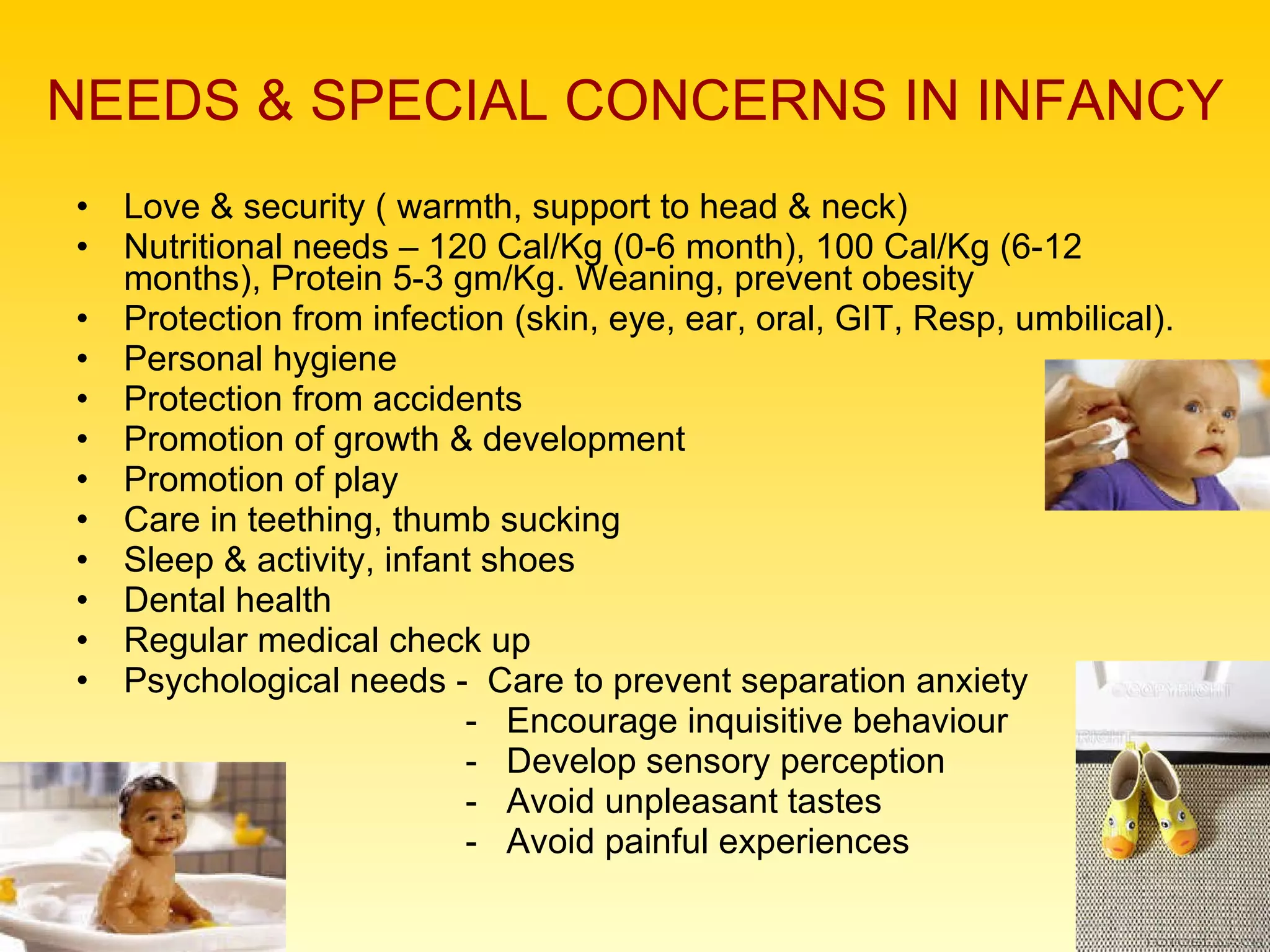
NEEDS & SPECIAL CONCERNS IN INFANCY Love & security ( warmth, support to head & neck) Nutritional needs – 120 Cal/Kg (0-6 month), 100 Cal/Kg (6-12 months), Protein 5-3 gm/Kg. Weaning, prevent obesity Protection from infection (skin, eye, ear, oral, GIT, Resp, umbilical). Personal hygiene Protection from accidents Promotion of growth & development Promotion of play Care in teething, thumb sucking Sleep & activity, infant shoes Dental health Regular medical check up Psychological needs -  Care to prevent separation anxiety -  Encourage inquisitive behaviour -  Develop sensory perception -  Avoid unpleasant tastes -  Avoid painful experiences
Thank you !

I N F A N C Y

  • 1.
  • 2.
    Growth and Development as a unit expresses th e sum of nu merou s changes that take p lace durin g the life c ycle of an indivi dual. The entire cour se is a dynamic p rocess that encom passes several int er-related d i mensions.
  • 3.
    WHY STUDY GROWTH& DEVELOPMENT? Know what to expect of a child at any age Know certain behaviours that are likely to emerge in mature forms Assess the sequence and norms of G & D of a child Know how to influence G & D favourably Diagnose undernutrition, infectious and other diseases affecting G & D Recognize the potential problems and strengths of individual children & their parents Plan for comprehensive care of the child Work with children effectively in health & disease
  • 4.
    STAGES OF GROWTH& DEVELOPMENT Prenatal period (Conception to Birth) Infancy ( Birth to 12 months of age ) Early Childhood ( 1 – 6 years) Middle Childhood (6 – 12 years) Late Childhood (12 – 19 years)
  • 5.
    PRENATAL GROWTH Zygote– Increased cell organization and differentiation into three basic layers – Ectoderm, Mesoderm, Endoderm. Embryo – Marked organization upto 8 weeks. Fetal phase – 8 weeks to 40 weeks (birth). - Increases in length and weight - Linear growth with maximum velocity at 4 months
  • 6.
  • 7.
    INFANCY Neonate –Birth – 28 days ( Early and late neonatal period) Infancy - 28 days – 12 months - Rapid motor, cognitive, and social development - Trust, physical adjustment to outside - Psychological adjustment of parents
  • 8.
  • 9.
    WEIGHT NBB –2.7 – 3.9 Kg ( Av 2.5 Kg ) 0 – 7 days – 10% loss of Birth weight 10 th day - Lost weight wt regained 0 – 6/12 yr - > by 30 gms / day OR 150 gms / wk 5 – 6/12 yr – Birth weight doubled 7 – 12 “ - > by 15 gms / day OR 75 gms / wk 1 year - Birth weight trebled There after - > by 2.2 Kg / year 2½ Year - Birth weight Quadrupled
  • 10.
    HEIGHT (LENGTH) NBB – 50 cms (20”) + 2 cms First 6 months - > by 2.5 cms / month Later 6 months- > by 1.25 cms / month 1 – 2 year - + 12.5 cms (5”) 2 – 12 years - 6.25 – 7.5 cms / yr 4 years - Birth height doubled 13 years - Birth height trebled
  • 11.
    OCCIPITO-FRONTAL CIRCUMFERENCE (OFC)NBB – 35 cms ( 1.25 – 2.5 cms > Chest Circumference) 0 – 3 months - > by 2 cms / month 3 – 12 months - > by 2 cms / 3 months 1 – 3 years - > by 1 cm / 6 month (Equals chest circumference 1 yr) 3 – 5 years - > by 1 cm / year 5 – 6 year - Adult head size Thus, OFC at - 1 year - 47 cms 2 years - 49 cms 3 years - 50 cms 4 years - 50.4 cms 5 years - 50.8 cms 10 years - 53 cms 15 years - 55 cms Fontanelle closure – Post - 6 – 8 wks Ant – 12 – 18 months Increase of brain weight – By 2½ times in the first year
  • 12.
    CALCULATION OF ANTHROPOMETRICALPARAMETERS WEIGHT – 3 – 12 MONTHS – Age ( months ) + 9 K g 2 1 – 6 YEARS - Age ( Years) x 2 + 8 Kg 7 – 12 YEARS - Age (Years) x 7 + 5 Kg 2 HEIGHT – 2 – 12 YEARS – Age (Years) x 6 + 77 (cms) Future (Adult) height – Girls – Ht at 2 yrs x 2 Boys – Ht at 2½ yrs x 2 OFC Infant - Length (cm) + 9.5 cms 2
  • 13.
    Mnemonic for Growthand Development 52 50 48 45 40 35 OFC 100 90 75 50 Ht (Cm) X 10 X 6 X 5 X 4 X 3 X 2 3 Wt (Kg) 10 7 5 4 3 2 1 5/12 3/12 0 Age (yrs)
  • 14.
    CHEST CIRCUMFERENCE &MUAC Chest Circumference - 33 cms at birth, barrel shaped - At 1 year Transverse diameter > AP diameter by 25 % - At 6 years transverse diameter > AP diameter by 33 % 6 months – 39 cms 1 year - 45 cms (Equals OFC) 2 years - 49 cms 5 years - 55 cms 10 years - 64 cms 15 years - 77 cms MUAC (Mid upper arm circumference) – NBB – 14.5 cms 1 year – 16 cms. Then > by 0.25 cm / yr
  • 15.
    BODY PROPORTIONS Bigheads, large trunk, short extremities upto 2 years Mid point of body - In infants - 1.8 cms above umbilicus - At 2 years - Just below umbilicus - In adults - At symphysis pubis Sitting Height - At Birth – 70% of total length - At 3 years – 57% - At Puberty - 53%
  • 16.
    CARDIO-CASCULAR SYSTEM Heart– Transversely placed, Apex beat at IV ICS H R – NBB – 140/mt, 5 yrs – 100/mt, 10 yrs – 90/mt, 12 yrs – 85/mt, 15 yrs – 80/mt Sleeping Pulse Rate – 10 – 20 beats lower BP – 80/50 …. 90/60 mm Hg Systole rises in the 2 nd month Diastole falls in the first 3 months, then gradually rises
  • 17.
    Hematological system HbF – The primary Hb for the first 2 -3 months ( >>> Physiological Anemia ) then Hb A increases upto 6 months Respiratory System Resp rate – 50 – 35/ mt Abdominal & diaphragmatic Trachea close to bronchi, narrow lumen Short straight eustachean tube < IgA in mucosal lining
  • 18.
    Lymphatic System – Hyperplastic in children. Resolves after puberty Nervous System – NBB – Brain wt – 10% of body weight Infancy – Rapid brain growth. 80% achieved by 4 yrs Myelination begins after 3 months, completed by 2 years Primitive reflexes replaced by righting reflexes & voluntary, purposeful movements
  • 19.
    GASTRO-INTESTINAL SYSTEM Salivationbegins at 3 months Stomach capacity – 90 ml at birth, 360 ml at 1 yr Enzyme amylase inadequate – Poor digestion of complex CHO Liver immature throughout infancy By 1 yr – 3 meals + 1 bed time feed - 1 or 2 bowel movements
  • 20.
    Immunologic System -Maternal IgG upto 3 months - Synthesizes IgG (40% of adult levels) by 1 year - IgM produced at birth. Adult levels by 9 months - IgA production gradual. Adult levels by puberty Skin – Absent shivering and sweating at birth - Accumulation of adipose tissue in 6 months ( helps insulation)
  • 21.
    Fluid & Electrolytes NBB – 75% of total body wt is water - ECF vol is 40% which <es to 20% in adulthood Renal System – Immature at birth Complete maturity in 18 to 24 months Urine Sp.Gr – 1000 – 1010 Dentition – Begins at 6 – 12 months By 3 yrs – all 20 teeth Rule – Age (months) -6 = No of teeth Permanent teeth by 6 – 12 years
  • 22.
    SPECIAL SENSES Hearing – Acuity at adult levels at infancy 6 months – can differentiate familiar voices 7 months – vestibular function begins Short ext auditory meatus & Eustachian canal Visual – Low acuity. Hypermetropic 6 wks – 4 months – Binocularity well estd. 7 -12 months – Stereopsis ( depth perception) begins to develop
  • 23.
  • 24.
    GROSS MOTOR (Devt.almaturation in posture) General movements Head balance (3/12) Rolling over (5/12) Sitting with support (4/12) Crawling & Creeping (8/12) Standing (10/12) Walking (1 yr)
  • 25.
  • 26.
    Standing with supportCoo, that’s How it looks to Ma and Pa!
  • 27.
    FINE MOTOR Useof hands and fingers in prehension Grasp reflex at 0 – 3months Palmar grasp Crude pincer grasp – 8-9 months Neat pincer grasp – 11 months Builds a tower of 2 blocks by 1 year
  • 28.
  • 29.
    Psychosocial Development Reflexbehaviour – parent, peer response 1 month – Social smile, 4 months – laughs aloud Play helps socialize Attachment- Indiscriminate response. cry, smile Vocalize more to mother, distinct preferences 6 months – ‘peekaboo’, asks to be carried - Stranger anxiety & separation anxiety Eric Erickson- Trust Vs Mistrust - 3-4 months – Oral phase (pri narcissism) - 5-12 months – Social phase
  • 30.
    Language Cry –for displeasure and pleasure 2 months – ah, eh, uh…. 3 months – coos, gurg;es, laughs (n,k p, g) 8 months – Imitates sounds t,d,w 9-10 months – Understands ‘NO’, obeys simple commands 1 yr – 3-5 words with meaning Play – Sensorimotor, narcissistic, dependant, solitary - Laughs, peekaboo, pat-a-cake, repetition, imitation - Selective after 6-8 months ( No strangers!) Sleep – 0-6 months – 18-20 hrs /day - 6-12 months – 16-18 hrs/day - 2-4 yrs - 12-16 hrs/ day - 5-10 yrs - 10-12 hrs/ day IMPORTANT – Not only ‘to play’, but to be ‘played with’.
  • 31.
    Psycho- sexual developmentSigmund Freud – Oral phase Cognitive ( Intellectual) development Jean Piaget – Sensorimotor Phase ( 0-2 yrs) - Use of reflexes, deliberate acts, repetitive acts(4-8 months), object permanence(10 months), develops self image by 1 yr
  • 32.
    SUMMARY OF MILESTONESOF DEVELOPMENT 1 Month - Social Smile 2 Months - ah, eh, uh sounds 3 months - Head holding 4 Months - Grasps objects, sits with support 5 Months - Rolls over 6 months - Sits without support 7 Months - Crawls & creeps 8 Months - Thumb- finger prehension 9 months - Pulls up to sit, stands with support 10 Months - Walks with support 11 Months - Stands with support 12 months - Takes a few steps by self
  • 33.
    NEEDS & SPECIALCONCERNS IN INFANCY Love & security ( warmth, support to head & neck) Nutritional needs – 120 Cal/Kg (0-6 month), 100 Cal/Kg (6-12 months), Protein 5-3 gm/Kg. Weaning, prevent obesity Protection from infection (skin, eye, ear, oral, GIT, Resp, umbilical). Personal hygiene Protection from accidents Promotion of growth & development Promotion of play Care in teething, thumb sucking Sleep & activity, infant shoes Dental health Regular medical check up Psychological needs - Care to prevent separation anxiety - Encourage inquisitive behaviour - Develop sensory perception - Avoid unpleasant tastes - Avoid painful experiences
  • 34.