1
Presentation
PERCEPTION
Group Members
1. Bilal Mehmood (41582)
2. Mir. Zahid (41965)
3. Rashid Zafar (40864)
4. Khalid Shah (42584)
5. M. Tahir (41102)
Organizational Behavior 16 - 08 – 2021 BS Civil Engg, 8th Sem
Topic :
2
 REFERENCES
 PERCEPTUAL
BARRIERS
 INFLUENCING
FACTORS
 INTRODUCTION
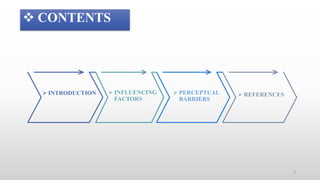
 CONTENTS
3
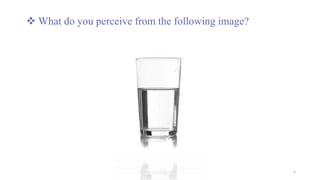
 What do you perceive from the following image?
4
• Perception: is a process by which people regard, analyze, retrieve and react to any
kind of information from the environment.
• For some of us, a particular thing is right where as for some it is totally wrong. It is all
because how you take things, what is your point of view, in a nut shell, how you
Perceive them.
• Perception in Organizational Behavior :
It is a process that takes place between the situation and the behavior and is most
relevant to the study of organizational behavior. E:g
• How Individuals view Others.
• How the person will behave within the organization.
 INTRODUCTION
5
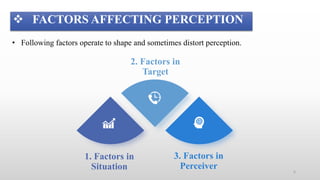
1. Factors in
Situation
2. Factors in
Target
3. Factors in
Perceiver
 FACTORS AFFECTING PERCEPTION
• Following factors operate to shape and sometimes distort perception.
6
1. Factors in Situation
Factors in the situation are outside the person and environment or situational in nature.
a) Time: It also affects the way we perceive the things. e.g. The way we perceive the phone
call in day time and at mid-night.
b) Work Setting: Co-operative, hospitable, friendly team spirit having group of
management are positive.
c) Social Setting: Each society has its own norms, values , ethics and culture. Anything that
deviates from social norms can be easily noticed. E:g In rural areas ,wearing of pants are
easily noticed.
7
2. Factors in Target
Target can also affect or influence our perception.
a) Appearance: Physically attractive people are readily perceived. Positive feelings and
responses are received while physically unattractive are usually negatively responded.
b) Size: Bigger targets are more noticeable than smaller ones.
c) Motion: Objects in motion are readily perceived.
d) Sound : Louder sounds are more easily perceived than low pitch sound.
e) Novelty : New, unique and distinct characteristics are easily perceived as they attract our
attention easily.
8
3. Factors in Perceiver
People are unique in nature and differ with each other in terms of perceptual activity.
a) Attitudes : It is the sum total belief & way of looking at things.
b) Motives: It refers to internal state that is goal directed. Motives and needs highly influence
emotion.
c) Interest: People give more attention to things that interest them.
d) Experience: It influences the way people perceive the world and shapes our attention,
behavior, interest and belief system from past experience.
e) Expectations: It is the estimation of the perceiver.
f) Emotions: It is the strong feeling towards someone or something. e.g. If a person is angry
then minor things may irritate him or her
9
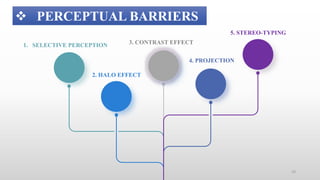
2. HALO EFFECT
1. SELECTIVE PERCEPTION
4. PROJECTION
3. CONTRAST EFFECT
5. STEREO-TYPING
 PERCEPTUAL BARRIERS
10
1) SELECTIVE PERCEPTION:
• This means a person sees, feels or hears what he wants to and skips other information
which are inconsistent to his view.
• It is a broad term to identify the behavior all people exhibit as we all tend to “see things”
based on our personal frame of reference.
• Example:
Take two people who witness a single event and ask them about what happened.
They will most likely share different versions of the same incident
11
2) HALO EFFECT:
It is the process of generalizing from a comprehensive analysis to a single attribute or trait
which affects the performance appraisal of employees in a company.
• Under the halo effect, the person is perceived on the basis of one trait.
• Example:
In the classroom, teachers are prone to the halo effect when evaluating their students.
For example, a teacher might assume that a well-behaved student is also bright and
motivated before they have objectively evaluated the student's capacity in these areas.
12
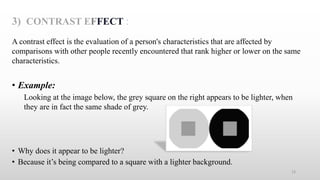
3) CONTRAST EFFECT :
A contrast effect is the evaluation of a person's characteristics that are affected by
comparisons with other people recently encountered that rank higher or lower on the same
characteristics.
• Example:
Looking at the image below, the grey square on the right appears to be lighter, when
they are in fact the same shade of grey.
• Why does it appear to be lighter?
• Because it’s being compared to a square with a lighter background.
13
4) PROJECTION:
It is a psychological defense mechanism which makes a person compare his negative traits
with other people and conclude that they are better off than others.
• It is easy to judge others if we assume they are similar to us. This tendency to attribute one's
own characteristics to other people is called projection.
• Projection can distort perceptions made about others. People who engage in projection tend
to perceive others.
• Example:
A man constantly talks throughout dinner, but he blames the other person for wanting
attention and being a bad listener when he is interrupted
14
5) STEREO-TYPING:
It is the effect caused by forming a certain belief about a certain group of people and
generalizing that notion to encounters with each member of that category, irrespective of
their personal characteristics, because of their affiliation with a certain group.
• In organizations, It may affect the interview process since, we frequently hear comments
that represent stereo types based on gender, age, nationality etc.
• Examples:
• All Arabs and Muslims are terrorists
• All Blacks are good at sports.
• Women aren't as smart as a man.
• Guys are messy and unclean
15
• Perception: Definition, Importance, Factors, Perceptual Process, Errors
(iedunote.com)
 REFERENCES
• What is Perception? | Introduction to Psychology (lumenlearning.com)
• Factors Influencing & Affecting Perception - Harappa Education
• factors influencing perception (perception process) - about factors influencing
perception (perception process) in tutorial (12852) | wisdom jobs india
• Factors Influencing & Affecting Perception - Harappa Education
16
17

Perception - Science of perceiving things

  • 1.
  • 2.
    Presentation PERCEPTION Group Members 1. BilalMehmood (41582) 2. Mir. Zahid (41965) 3. Rashid Zafar (40864) 4. Khalid Shah (42584) 5. M. Tahir (41102) Organizational Behavior 16 - 08 – 2021 BS Civil Engg, 8th Sem Topic : 2
  • 3.
     REFERENCES  PERCEPTUAL BARRIERS INFLUENCING FACTORS  INTRODUCTION  CONTENTS 3
  • 4.
     What doyou perceive from the following image? 4
  • 5.
    • Perception: isa process by which people regard, analyze, retrieve and react to any kind of information from the environment. • For some of us, a particular thing is right where as for some it is totally wrong. It is all because how you take things, what is your point of view, in a nut shell, how you Perceive them. • Perception in Organizational Behavior : It is a process that takes place between the situation and the behavior and is most relevant to the study of organizational behavior. E:g • How Individuals view Others. • How the person will behave within the organization.  INTRODUCTION 5
  • 6.
    1. Factors in Situation 2.Factors in Target 3. Factors in Perceiver  FACTORS AFFECTING PERCEPTION • Following factors operate to shape and sometimes distort perception. 6
  • 7.
    1. Factors inSituation Factors in the situation are outside the person and environment or situational in nature. a) Time: It also affects the way we perceive the things. e.g. The way we perceive the phone call in day time and at mid-night. b) Work Setting: Co-operative, hospitable, friendly team spirit having group of management are positive. c) Social Setting: Each society has its own norms, values , ethics and culture. Anything that deviates from social norms can be easily noticed. E:g In rural areas ,wearing of pants are easily noticed. 7
  • 8.
    2. Factors inTarget Target can also affect or influence our perception. a) Appearance: Physically attractive people are readily perceived. Positive feelings and responses are received while physically unattractive are usually negatively responded. b) Size: Bigger targets are more noticeable than smaller ones. c) Motion: Objects in motion are readily perceived. d) Sound : Louder sounds are more easily perceived than low pitch sound. e) Novelty : New, unique and distinct characteristics are easily perceived as they attract our attention easily. 8
  • 9.
    3. Factors inPerceiver People are unique in nature and differ with each other in terms of perceptual activity. a) Attitudes : It is the sum total belief & way of looking at things. b) Motives: It refers to internal state that is goal directed. Motives and needs highly influence emotion. c) Interest: People give more attention to things that interest them. d) Experience: It influences the way people perceive the world and shapes our attention, behavior, interest and belief system from past experience. e) Expectations: It is the estimation of the perceiver. f) Emotions: It is the strong feeling towards someone or something. e.g. If a person is angry then minor things may irritate him or her 9
  • 10.
    2. HALO EFFECT 1.SELECTIVE PERCEPTION 4. PROJECTION 3. CONTRAST EFFECT 5. STEREO-TYPING  PERCEPTUAL BARRIERS 10
  • 11.
    1) SELECTIVE PERCEPTION: •This means a person sees, feels or hears what he wants to and skips other information which are inconsistent to his view. • It is a broad term to identify the behavior all people exhibit as we all tend to “see things” based on our personal frame of reference. • Example: Take two people who witness a single event and ask them about what happened. They will most likely share different versions of the same incident 11
  • 12.
    2) HALO EFFECT: Itis the process of generalizing from a comprehensive analysis to a single attribute or trait which affects the performance appraisal of employees in a company. • Under the halo effect, the person is perceived on the basis of one trait. • Example: In the classroom, teachers are prone to the halo effect when evaluating their students. For example, a teacher might assume that a well-behaved student is also bright and motivated before they have objectively evaluated the student's capacity in these areas. 12
  • 13.
    3) CONTRAST EFFECT: A contrast effect is the evaluation of a person's characteristics that are affected by comparisons with other people recently encountered that rank higher or lower on the same characteristics. • Example: Looking at the image below, the grey square on the right appears to be lighter, when they are in fact the same shade of grey. • Why does it appear to be lighter? • Because it’s being compared to a square with a lighter background. 13
  • 14.
    4) PROJECTION: It isa psychological defense mechanism which makes a person compare his negative traits with other people and conclude that they are better off than others. • It is easy to judge others if we assume they are similar to us. This tendency to attribute one's own characteristics to other people is called projection. • Projection can distort perceptions made about others. People who engage in projection tend to perceive others. • Example: A man constantly talks throughout dinner, but he blames the other person for wanting attention and being a bad listener when he is interrupted 14
  • 15.
    5) STEREO-TYPING: It isthe effect caused by forming a certain belief about a certain group of people and generalizing that notion to encounters with each member of that category, irrespective of their personal characteristics, because of their affiliation with a certain group. • In organizations, It may affect the interview process since, we frequently hear comments that represent stereo types based on gender, age, nationality etc. • Examples: • All Arabs and Muslims are terrorists • All Blacks are good at sports. • Women aren't as smart as a man. • Guys are messy and unclean 15
  • 16.
    • Perception: Definition,Importance, Factors, Perceptual Process, Errors (iedunote.com)  REFERENCES • What is Perception? | Introduction to Psychology (lumenlearning.com) • Factors Influencing & Affecting Perception - Harappa Education • factors influencing perception (perception process) - about factors influencing perception (perception process) in tutorial (12852) | wisdom jobs india • Factors Influencing & Affecting Perception - Harappa Education 16
  • 17.