AWAKE
FIBEROPTIC
INTUBTION & TIVA
DR. MALAKA MUNASINGHE
SR-ANAESTHESIOLOGY
2018.09.27
AWAKE FIBEROPTIC INTUBATION
• First performed in 1967 where a surgical choledhoscope was used
• Gold standard method in predicted or known difficult airway intubations
• Still underused even in developed countries!!!
• Contraindicated when,
- Patient not giving informed consent
- Uncooperative or patients with learning disabilities
- Upper airway bleeding
- ? Upper airway obstruction
Procedure
• Patient comfortable, seated or supine
• Supplementary O2 provided
• AAGBI monitoring established and IV access obtained
• Two experienced anaesthetists
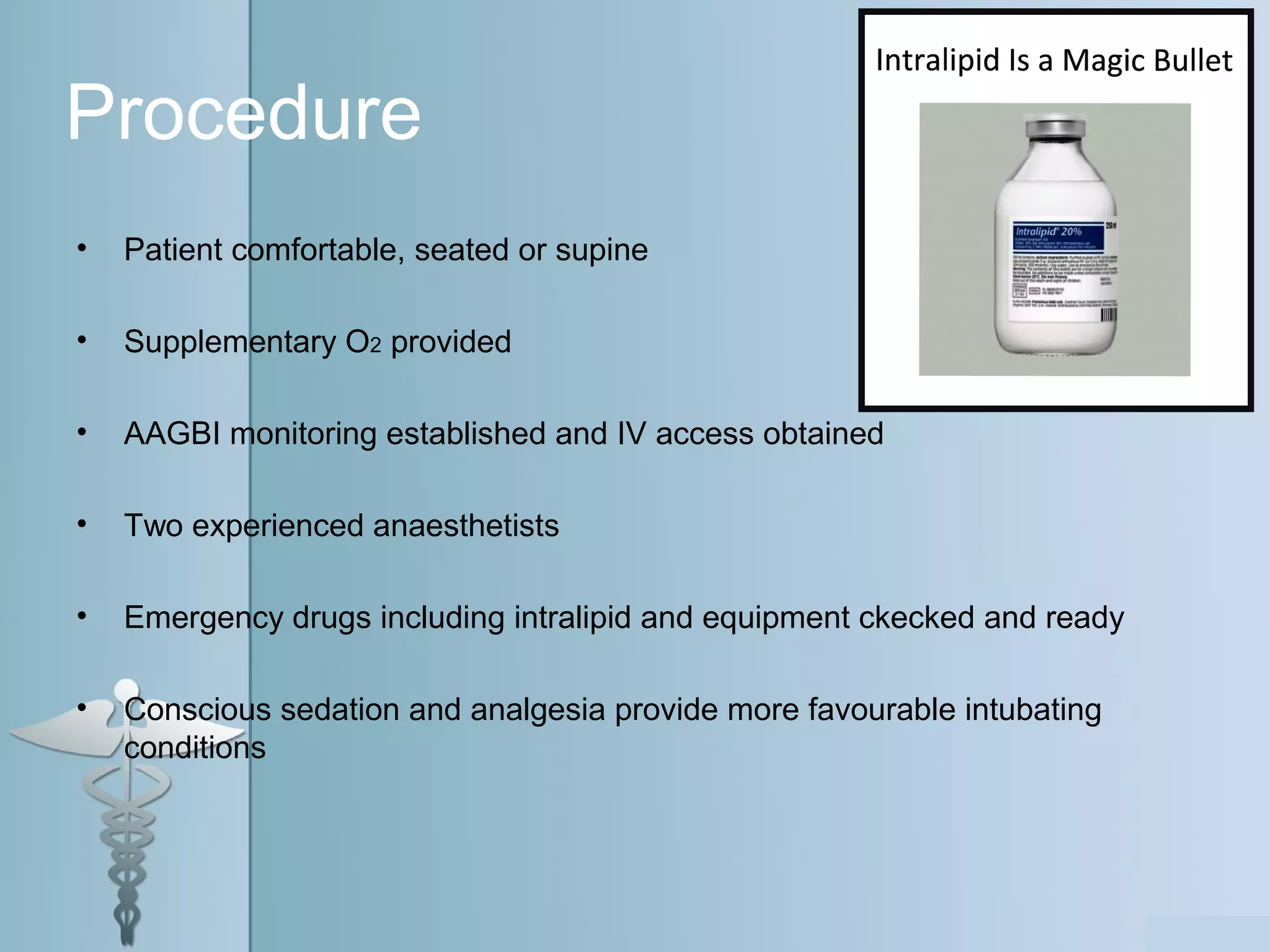
• Emergency drugs including intralipid and equipment ckecked and ready
• Conscious sedation and analgesia provide more favourable intubating
conditions
Sedation
• IV BDZ/ propofol/ketamine/ remifentanyl+propofol TCI
• IV dexmeditomidine boluses+ infusion
• Antisialogogues- IM atropine/ hyoscine 1 hour earlier
Analgesia
• Nasal cavity is innervated by trigeminal nerve
• Oro and nasopharynx – glossopharyngeal and trigeminal N.
• Larynx- above the cords- Superior laryngeal br. Of vagus
below the cords- Recurent laryngeal br. Of vagus N.
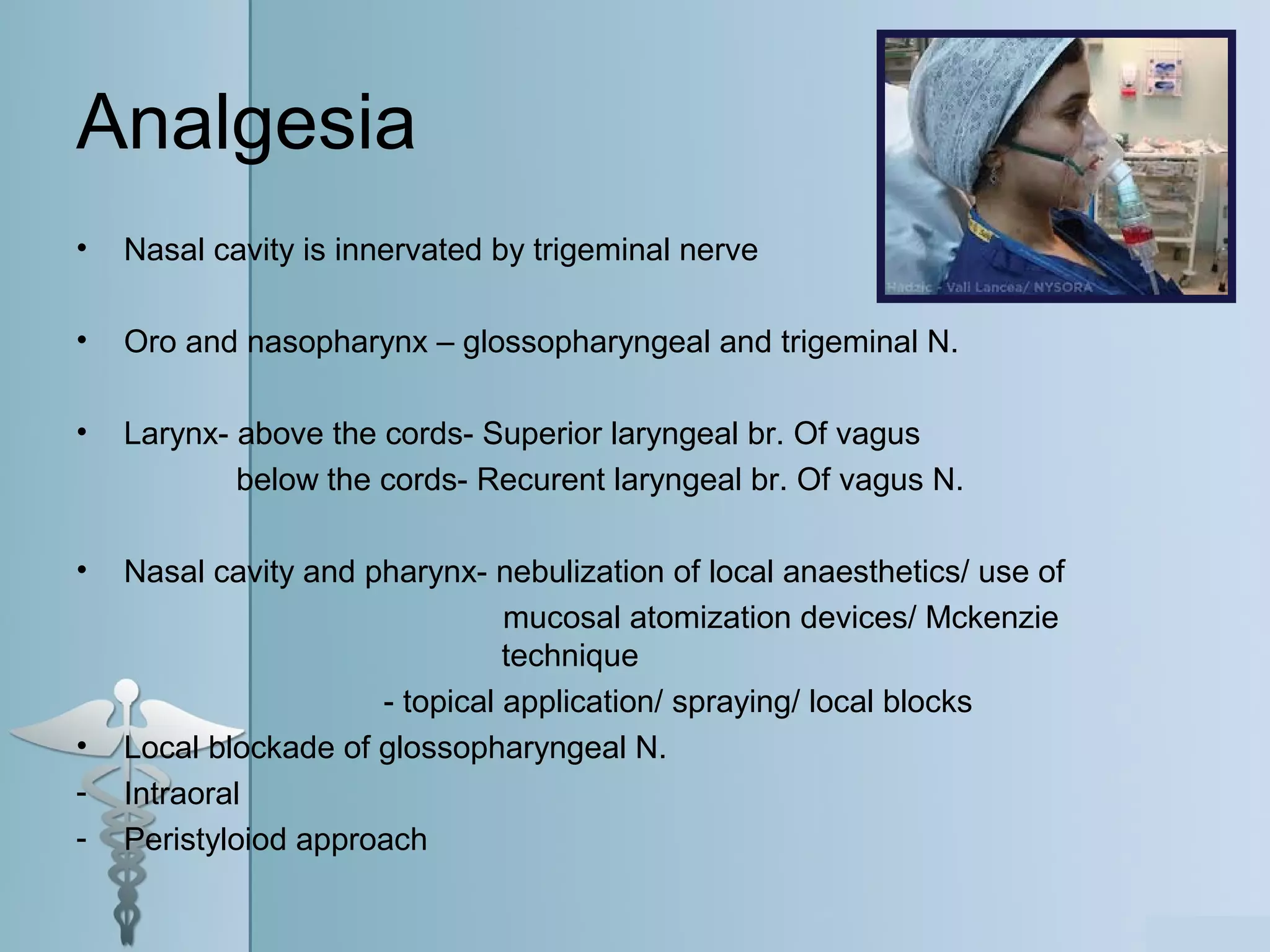
• Nasal cavity and pharynx- nebulization of local anaesthetics/ use of
mucosal atomization devices/ Mckenzie
technique
- topical application/ spraying/ local blocks
• Local blockade of glossopharyngeal N.
- Intraoral
- Peristyloiod approach
Analgeia ctd…
Larynx/ cords/ trachea
- nebulization
- placement of local anaesthetic( LA) soaked pellets in pyriform fossa
-Spraying LA through a 16 G epidural catheter via working channel of the
fiberoptic laryngoscope[ spray as you go technique]
-Local blocks
 Superior laryngeal branch – inferior to greater cornu of hyoid
 Recurrent laryngeal branch- translaryngeal throught cricothyroid membrane
using negative aspiration to air
-Ultrasound guidance- higher success rates
Local anaesthesia
• Cocaine-inherent vasoconstrictor properties/not commonly used now
• Lignocaine- vasoconstrictors like xylometazoline/ phenylephrine may be
added
• Less absorption through airways- higher doses( up to 9mg/kg) can be
used
• IV- 2% or 4%
• Spray- 10mg per dose
• Moffet’s solution
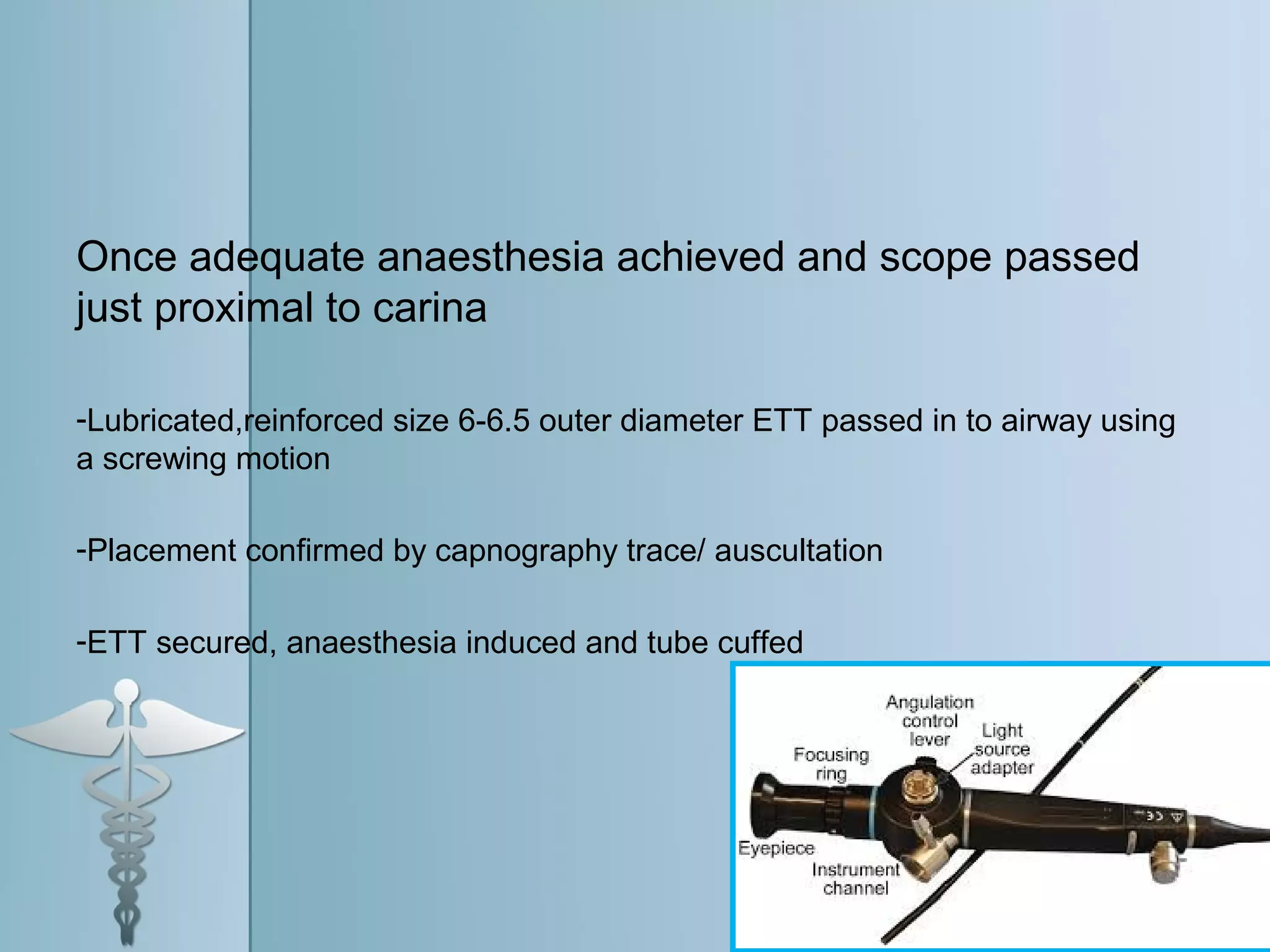
Once adequate anaesthesia achieved and scope passed
just proximal to carina
-Lubricated,reinforced size 6-6.5 outer diameter ETT passed in to airway using
a screwing motion
-Placement confirmed by capnography trace/ auscultation
-ETT secured, anaesthesia induced and tube cuffed
Problems
-Uncooperative patients
-Airway bleeding/Increased secreions obscuring the view
-ETT getting stuck in the scope
-LA toxicity
-Continuous use and practice increase the success rates
-So, pactice and practice!!!
TOTAL INTRAVENOUS ANAESTHESIA
( TIVA)
TIVA
• Use of IV propofol and remifentanyl boluses and infusion obtunding
response to noxious stimuli without the use of inhalational agents
• In TIVA, plasma or effect site drug concentrations of propofol and
remifentanyl are adopted compared to monitoring of MAC with inhalational
agents
- Effect site concentrations
- Propofol- 3-6mg/ml
- Remifentanyl 2-6ng/ml
TIVA
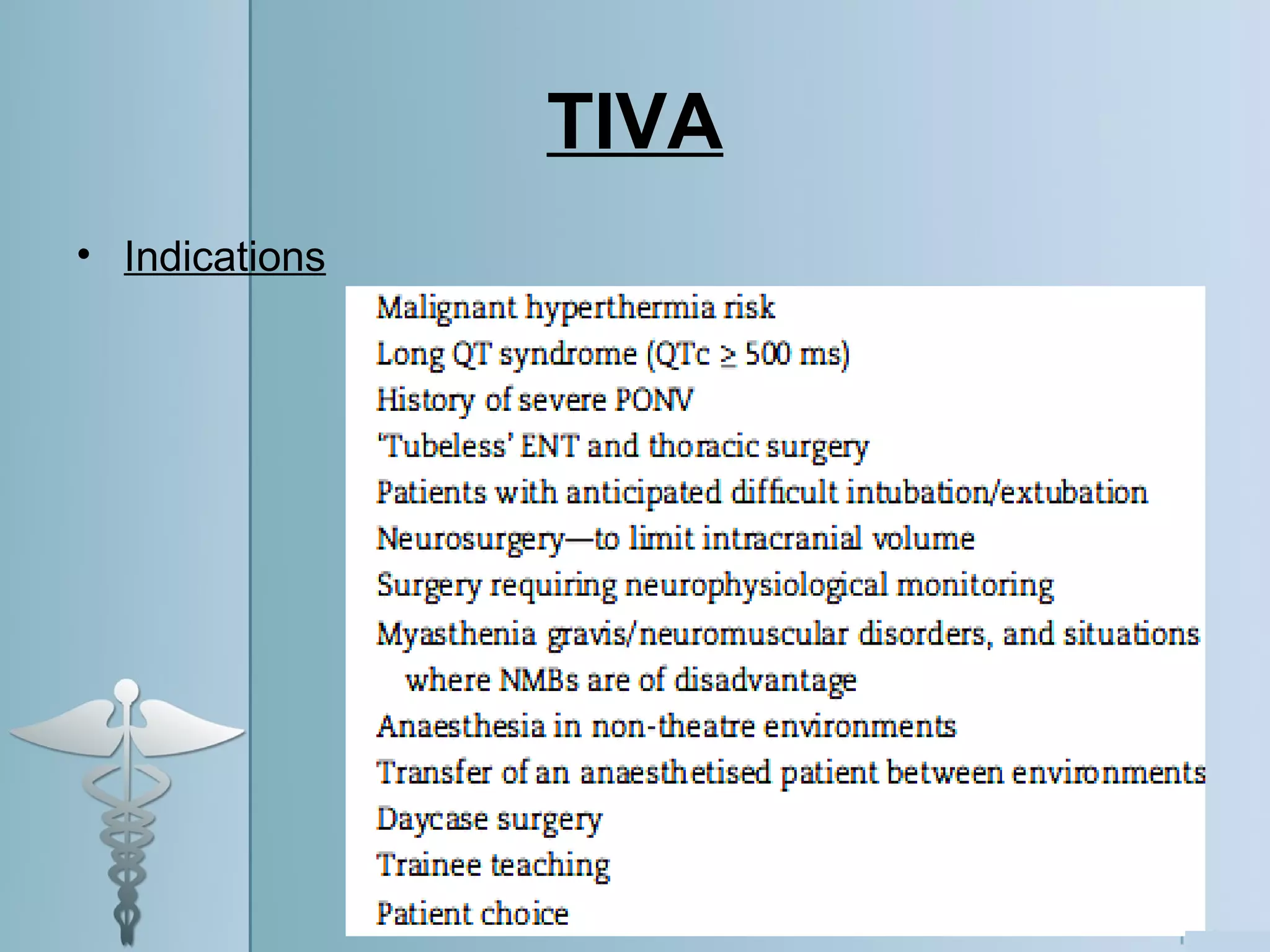
• Indications
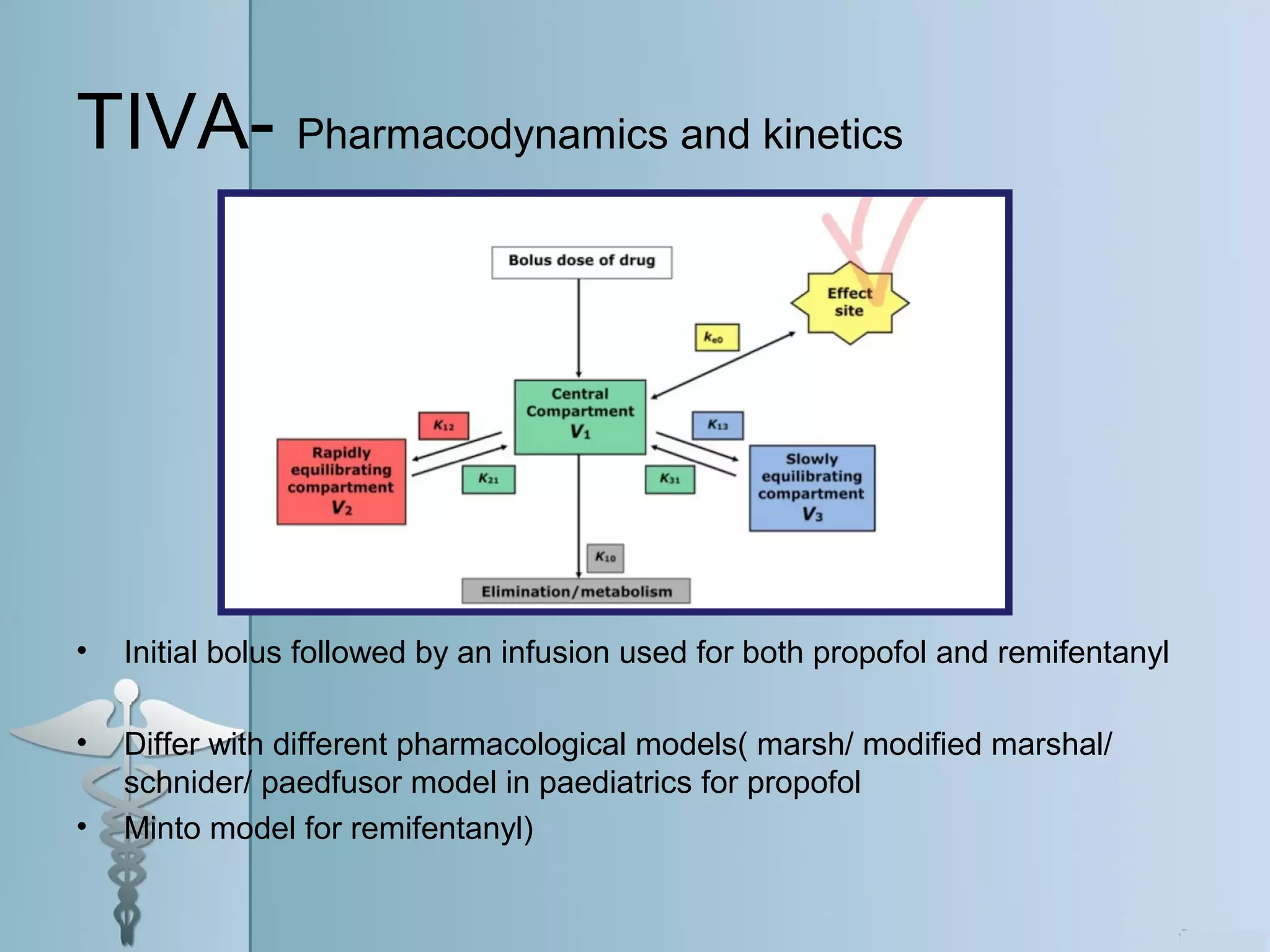
TIVA- Pharmacodynamics and kinetics
• Initial bolus followed by an infusion used for both propofol and remifentanyl
• Differ with different pharmacological models( marsh/ modified marshal/
schnider/ paedfusor model in paediatrics for propofol
• Minto model for remifentanyl)
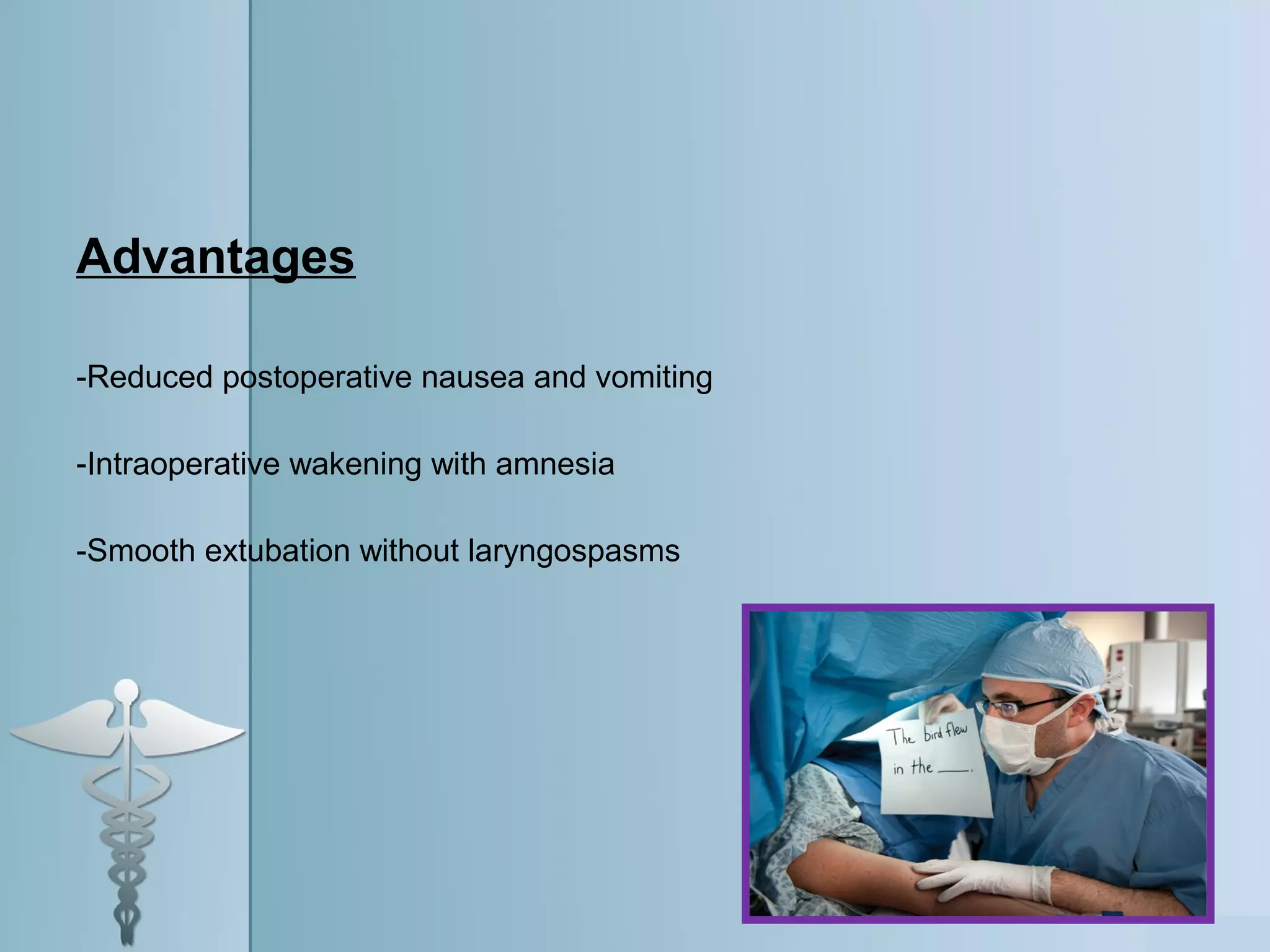
Advantages
-Reduced postoperative nausea and vomiting
-Intraoperative wakening with amnesia
-Smooth extubation without laryngospasms
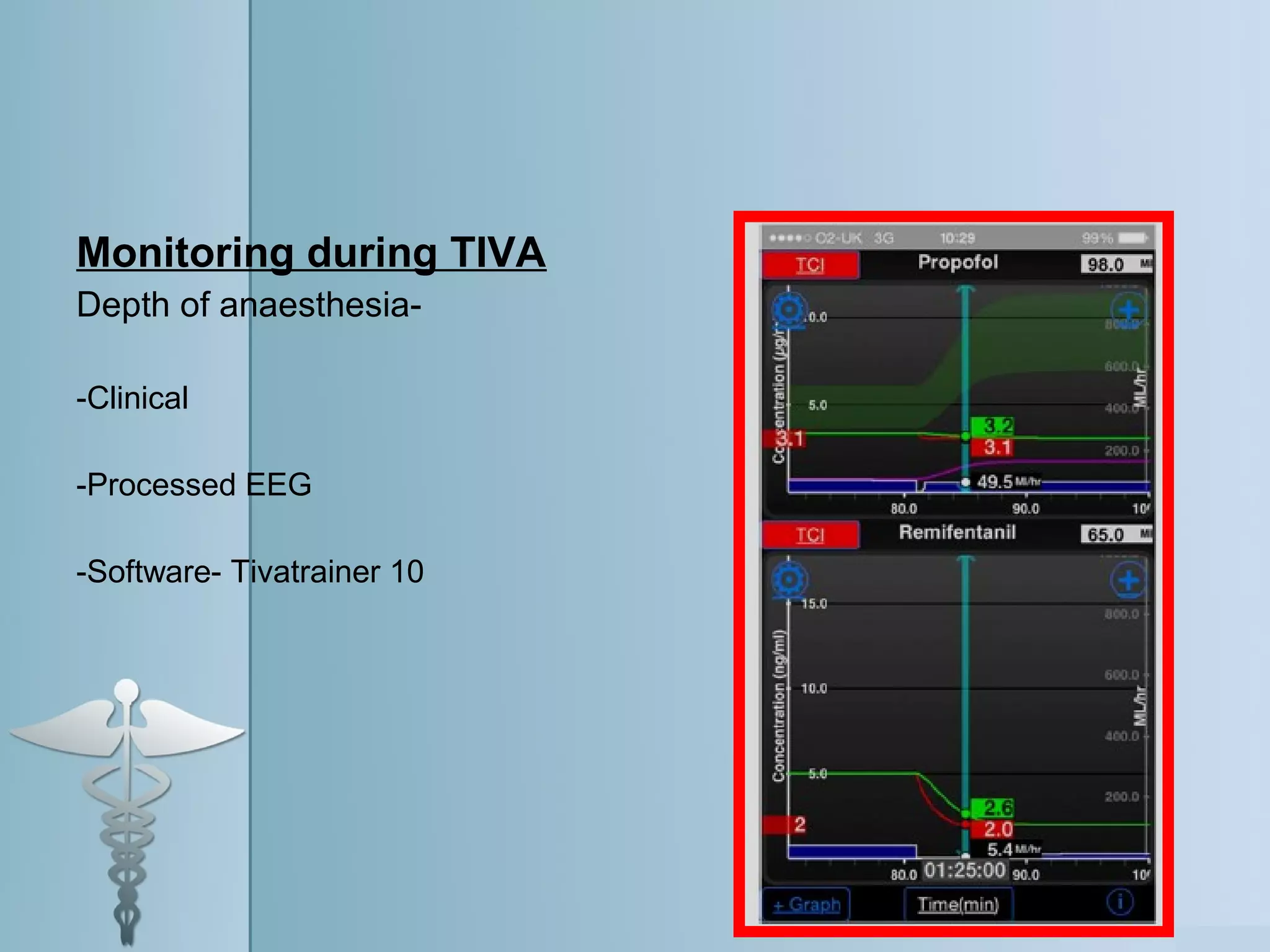
Monitoring during TIVA
Depth of anaesthesia-
-Clinical
-Processed EEG
-Software- Tivatrainer 10
Pump failure during TIVA
- Switching to conventional inhalational agents[ anticipate exaggerated
haemodynamic response]
-Restarting infusion manually with last flow rates[ ml/hr]
-Restarting TIVA from the beginning
Recovery
-Propofol infusion discontinued during last suture placement- not earlier
-Remifentanyl 1-2ng/ml effect site concentration continued for a smooth
extubation
-Remifentanyl – analgesia short lasting
- supplemented with locoregional analgesia/ opiates at
a dose of 0.15-0.3mg/kg
- Can cause postoperative apnoea thus need to be monitored
Problems
-Accidental awareness- mainly due to inadequate knowledge of the operator/
equipment malfunction
[ Association of Anaesthetists of Great Britain and Ireland (AAGBI) and the Society for Intravenous Anaesthesia (SIVA)
Total Intravenous Anaesthesia 2017: guidelines for safe practice]
-Post operative apnoea
-Hyperalgesia
-Morbid obesity
-Propofol related infusion syndrome( uncommon)
Prevention of TCI errors
1. Complete the TCI system checklist
2. Affix the i.v. cannula firmly to the patient's skin
3. Keep the site of TIVA infusion visible so that disconnection, leakage, or a ‘tissued’
cannula are readily detected
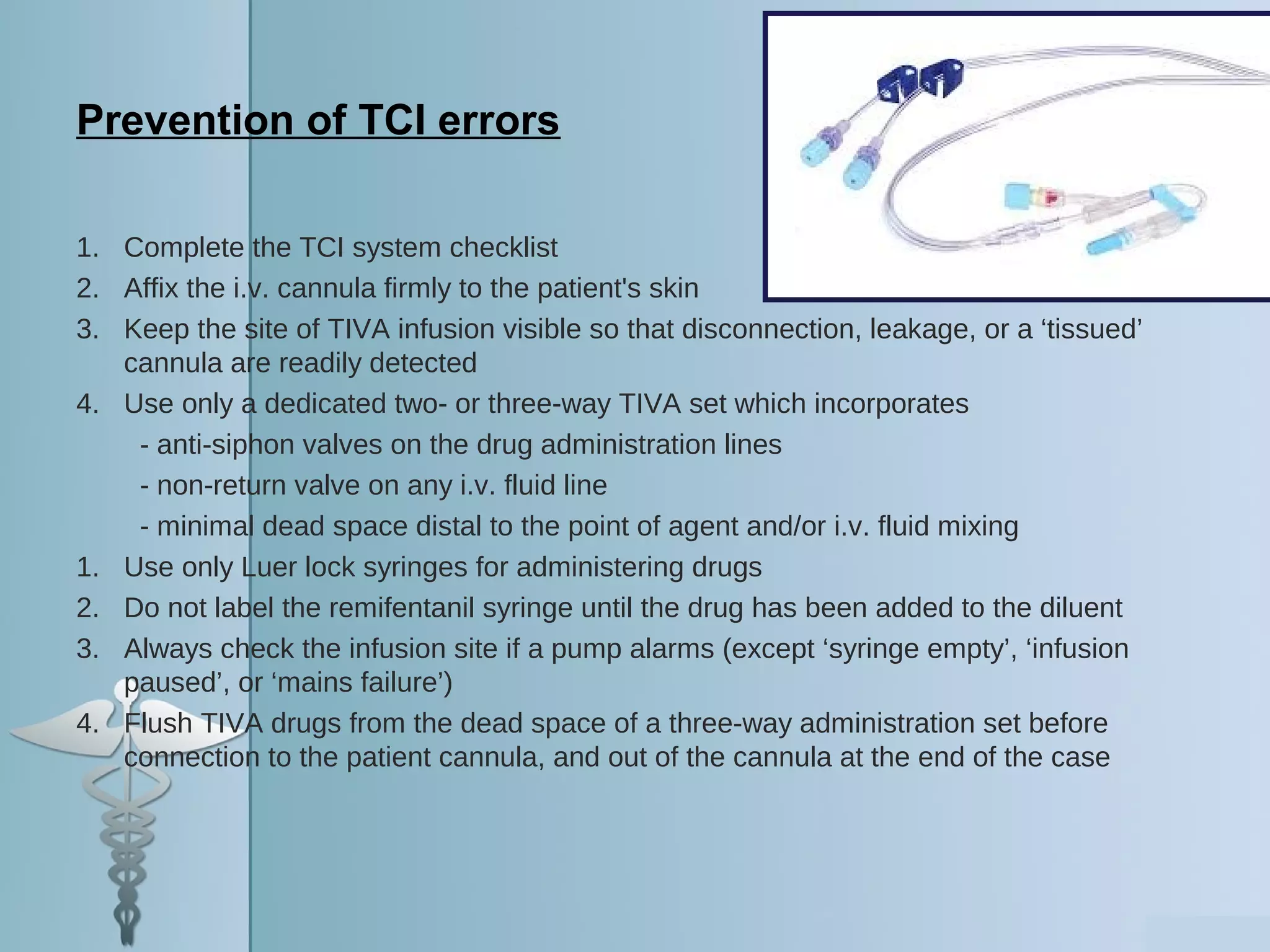
4. Use only a dedicated two- or three-way TIVA set which incorporates
- anti-siphon valves on the drug administration lines
- non-return valve on any i.v. fluid line
- minimal dead space distal to the point of agent and/or i.v. fluid mixing
1. Use only Luer lock syringes for administering drugs
2. Do not label the remifentanil syringe until the drug has been added to the diluent
3. Always check the infusion site if a pump alarms (except ‘syringe empty’, ‘infusion
paused’, or ‘mains failure’)
4. Flush TIVA drugs from the dead space of a three-way administration set before
connection to the patient cannula, and out of the cannula at the end of the case
Place of TIVA?
-Rapid sequence induction
-MRI
-ICU anaesthesia
AWAKE FIBEROPTIC INTUBATION & TIVA- simplified

AWAKE FIBEROPTIC INTUBATION & TIVA- simplified

  • 1.
    AWAKE FIBEROPTIC INTUBTION & TIVA DR.MALAKA MUNASINGHE SR-ANAESTHESIOLOGY 2018.09.27
  • 3.
    AWAKE FIBEROPTIC INTUBATION •First performed in 1967 where a surgical choledhoscope was used • Gold standard method in predicted or known difficult airway intubations • Still underused even in developed countries!!! • Contraindicated when, - Patient not giving informed consent - Uncooperative or patients with learning disabilities - Upper airway bleeding - ? Upper airway obstruction
  • 4.
    Procedure • Patient comfortable,seated or supine • Supplementary O2 provided • AAGBI monitoring established and IV access obtained • Two experienced anaesthetists • Emergency drugs including intralipid and equipment ckecked and ready • Conscious sedation and analgesia provide more favourable intubating conditions
  • 5.
    Sedation • IV BDZ/propofol/ketamine/ remifentanyl+propofol TCI • IV dexmeditomidine boluses+ infusion • Antisialogogues- IM atropine/ hyoscine 1 hour earlier
  • 6.
    Analgesia • Nasal cavityis innervated by trigeminal nerve • Oro and nasopharynx – glossopharyngeal and trigeminal N. • Larynx- above the cords- Superior laryngeal br. Of vagus below the cords- Recurent laryngeal br. Of vagus N. • Nasal cavity and pharynx- nebulization of local anaesthetics/ use of mucosal atomization devices/ Mckenzie technique - topical application/ spraying/ local blocks • Local blockade of glossopharyngeal N. - Intraoral - Peristyloiod approach
  • 7.
    Analgeia ctd… Larynx/ cords/trachea - nebulization - placement of local anaesthetic( LA) soaked pellets in pyriform fossa -Spraying LA through a 16 G epidural catheter via working channel of the fiberoptic laryngoscope[ spray as you go technique] -Local blocks  Superior laryngeal branch – inferior to greater cornu of hyoid  Recurrent laryngeal branch- translaryngeal throught cricothyroid membrane using negative aspiration to air -Ultrasound guidance- higher success rates
  • 8.
    Local anaesthesia • Cocaine-inherentvasoconstrictor properties/not commonly used now • Lignocaine- vasoconstrictors like xylometazoline/ phenylephrine may be added • Less absorption through airways- higher doses( up to 9mg/kg) can be used • IV- 2% or 4% • Spray- 10mg per dose • Moffet’s solution
  • 9.
    Once adequate anaesthesiaachieved and scope passed just proximal to carina -Lubricated,reinforced size 6-6.5 outer diameter ETT passed in to airway using a screwing motion -Placement confirmed by capnography trace/ auscultation -ETT secured, anaesthesia induced and tube cuffed
  • 10.
    Problems -Uncooperative patients -Airway bleeding/Increasedsecreions obscuring the view -ETT getting stuck in the scope -LA toxicity -Continuous use and practice increase the success rates -So, pactice and practice!!!
  • 11.
  • 12.
    TIVA • Use ofIV propofol and remifentanyl boluses and infusion obtunding response to noxious stimuli without the use of inhalational agents • In TIVA, plasma or effect site drug concentrations of propofol and remifentanyl are adopted compared to monitoring of MAC with inhalational agents - Effect site concentrations - Propofol- 3-6mg/ml - Remifentanyl 2-6ng/ml
  • 13.
  • 14.
    TIVA- Pharmacodynamics andkinetics • Initial bolus followed by an infusion used for both propofol and remifentanyl • Differ with different pharmacological models( marsh/ modified marshal/ schnider/ paedfusor model in paediatrics for propofol • Minto model for remifentanyl)
  • 15.
    Advantages -Reduced postoperative nauseaand vomiting -Intraoperative wakening with amnesia -Smooth extubation without laryngospasms
  • 16.
    Monitoring during TIVA Depthof anaesthesia- -Clinical -Processed EEG -Software- Tivatrainer 10
  • 17.
    Pump failure duringTIVA - Switching to conventional inhalational agents[ anticipate exaggerated haemodynamic response] -Restarting infusion manually with last flow rates[ ml/hr] -Restarting TIVA from the beginning
  • 18.
    Recovery -Propofol infusion discontinuedduring last suture placement- not earlier -Remifentanyl 1-2ng/ml effect site concentration continued for a smooth extubation -Remifentanyl – analgesia short lasting - supplemented with locoregional analgesia/ opiates at a dose of 0.15-0.3mg/kg - Can cause postoperative apnoea thus need to be monitored
  • 19.
    Problems -Accidental awareness- mainlydue to inadequate knowledge of the operator/ equipment malfunction [ Association of Anaesthetists of Great Britain and Ireland (AAGBI) and the Society for Intravenous Anaesthesia (SIVA) Total Intravenous Anaesthesia 2017: guidelines for safe practice] -Post operative apnoea -Hyperalgesia -Morbid obesity -Propofol related infusion syndrome( uncommon)
  • 20.
    Prevention of TCIerrors 1. Complete the TCI system checklist 2. Affix the i.v. cannula firmly to the patient's skin 3. Keep the site of TIVA infusion visible so that disconnection, leakage, or a ‘tissued’ cannula are readily detected 4. Use only a dedicated two- or three-way TIVA set which incorporates - anti-siphon valves on the drug administration lines - non-return valve on any i.v. fluid line - minimal dead space distal to the point of agent and/or i.v. fluid mixing 1. Use only Luer lock syringes for administering drugs 2. Do not label the remifentanil syringe until the drug has been added to the diluent 3. Always check the infusion site if a pump alarms (except ‘syringe empty’, ‘infusion paused’, or ‘mains failure’) 4. Flush TIVA drugs from the dead space of a three-way administration set before connection to the patient cannula, and out of the cannula at the end of the case
  • 21.
    Place of TIVA? -Rapidsequence induction -MRI -ICU anaesthesia