NON OPERATING ROOM
ANAESTHESIA
Presentor: Dr Kundan Kishor Ghimire
Resident Anaesthesia and Critical Care
Moderator: Dr. Dhiraj Kesari
Introduction
Encompasses all sedation and anaesthesia provided
by anesthesiology services outside of the operating
room environment.
Area remote from main operating room
Radiology Department
Endoscopy suites
MRI
Dental Clinics
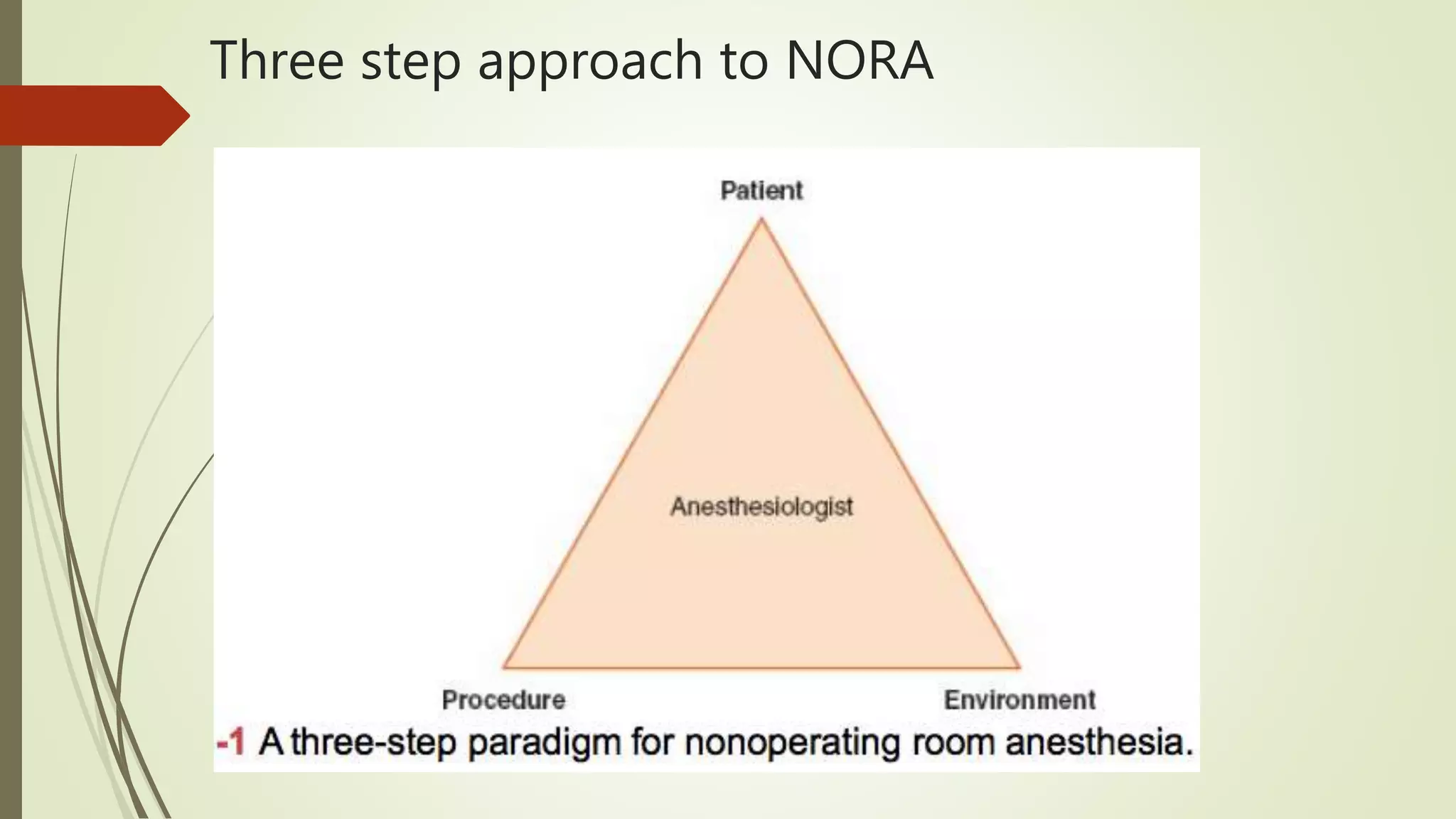
Three step approach to NORA
Patients
Most Patients tend to be older. (>50 yrs)
receive monitored anesthesia care (MAC) or sedation
Children commonly require sedation or anesthesia
diagnostic and therapeutic procedures.
thorough preanesthetic assessment, standard
preanesthetic care.
 sound anesthetic plan with approppriate level of
monitoring and appropriate postanesthetic care.
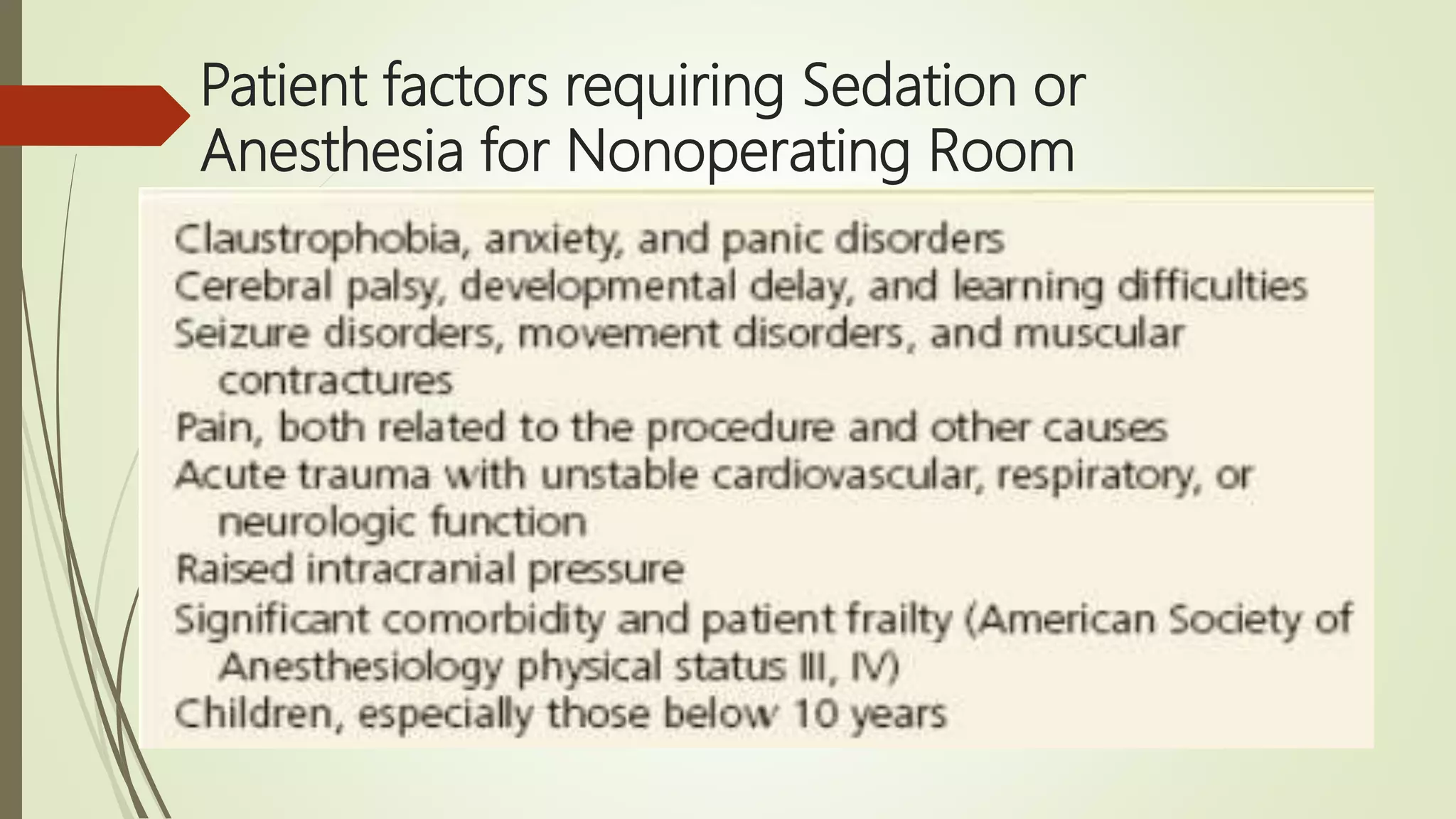
Patient factors requiring Sedation or
Anesthesia for Nonoperating Room
Procedures
Nature of the procedure, including patient position,
grade of painful procedure, and its duration.
Optimum anesthesia plan provides safe patient care
and facilitates the procedure.
Discussion with proceduralist for emergencies and
adverse outcomes
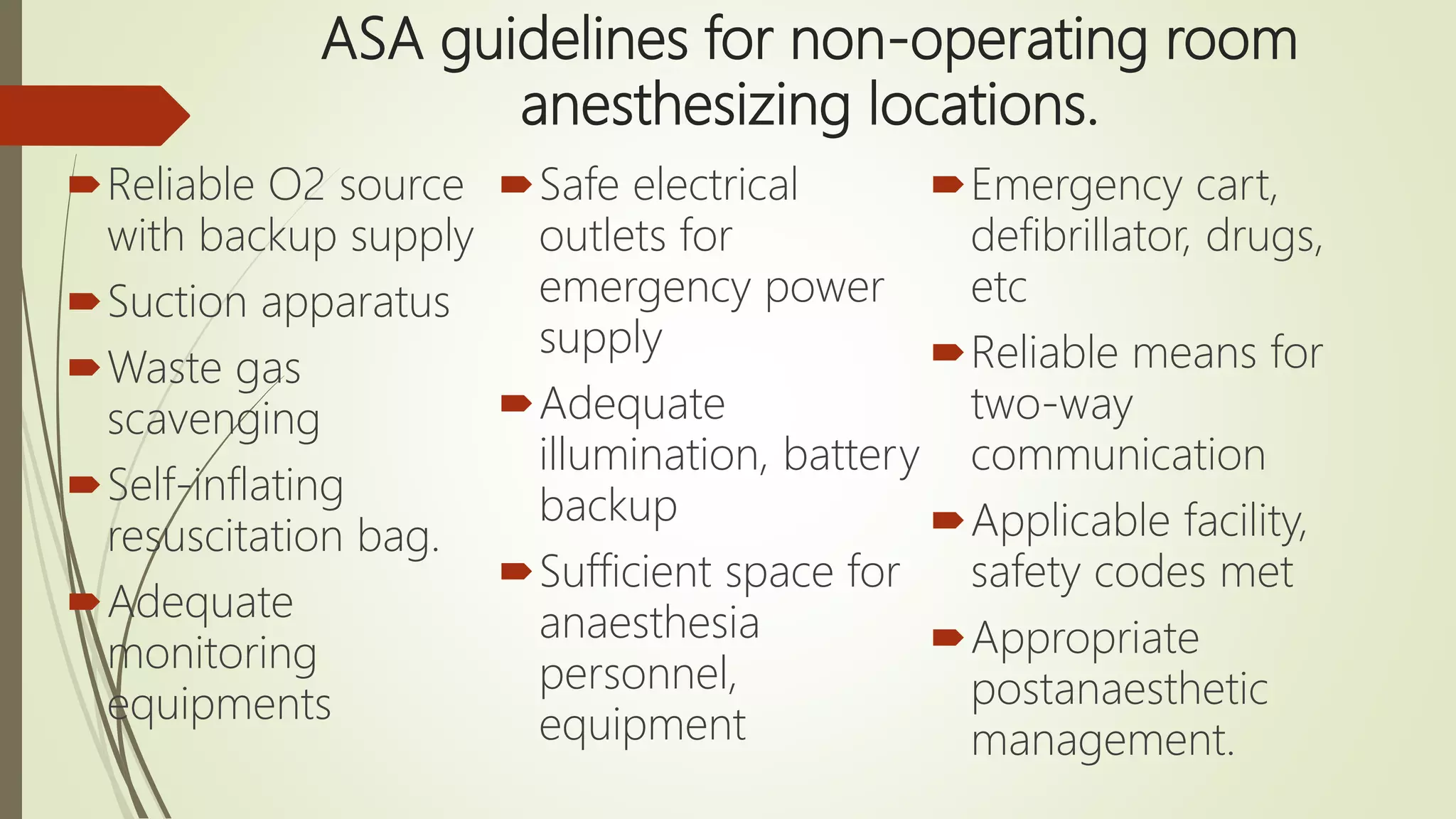
ASA guidelines for non-operating room
anesthesizing locations.
Reliable O2 source
with backup supply
Suction apparatus
Waste gas
scavenging
Self-inflating
resuscitation bag.
Adequate
monitoring
equipments
Safe electrical
outlets for
emergency power
supply
Adequate
illumination, battery
backup
Sufficient space for
anaesthesia
personnel,
equipment
Emergency cart,
defibrillator, drugs,
etc
Reliable means for
two-way
communication
Applicable facility,
safety codes met
Appropriate
postanaesthetic
management.
Patient Transfer
Sick, unstable patients are transferred back and forth
 between ICU, OR and NOR locations for imaging,
or diagnostic procedures.
Skilled personnel to evaluate, monitor and support he
medical condition.
Portable ventilators and adequate suppies of oxygen
Manual self inflating bag
Anesthetic and emergency drugs, equipment for intubation
intubation, portable suctions
Complication of NORA
Problems in providing NORA
Equipment might be old, not regularly serviced and not in
standard use as in the rest of the hospital
Monitoring standards may not adequate.
Piped gases may not be supplied.
Other personnel may be unaware of the problems facing the
anesthetist.
Space may be limited by bulky equipment making access to
patient difficult.
Poor environment conditions( e.g. Lightening, temperature)
Recovery facilities may not be available.
Inadequate ventilation/ scavenging causing pollution.
Problems related to transferring patients.
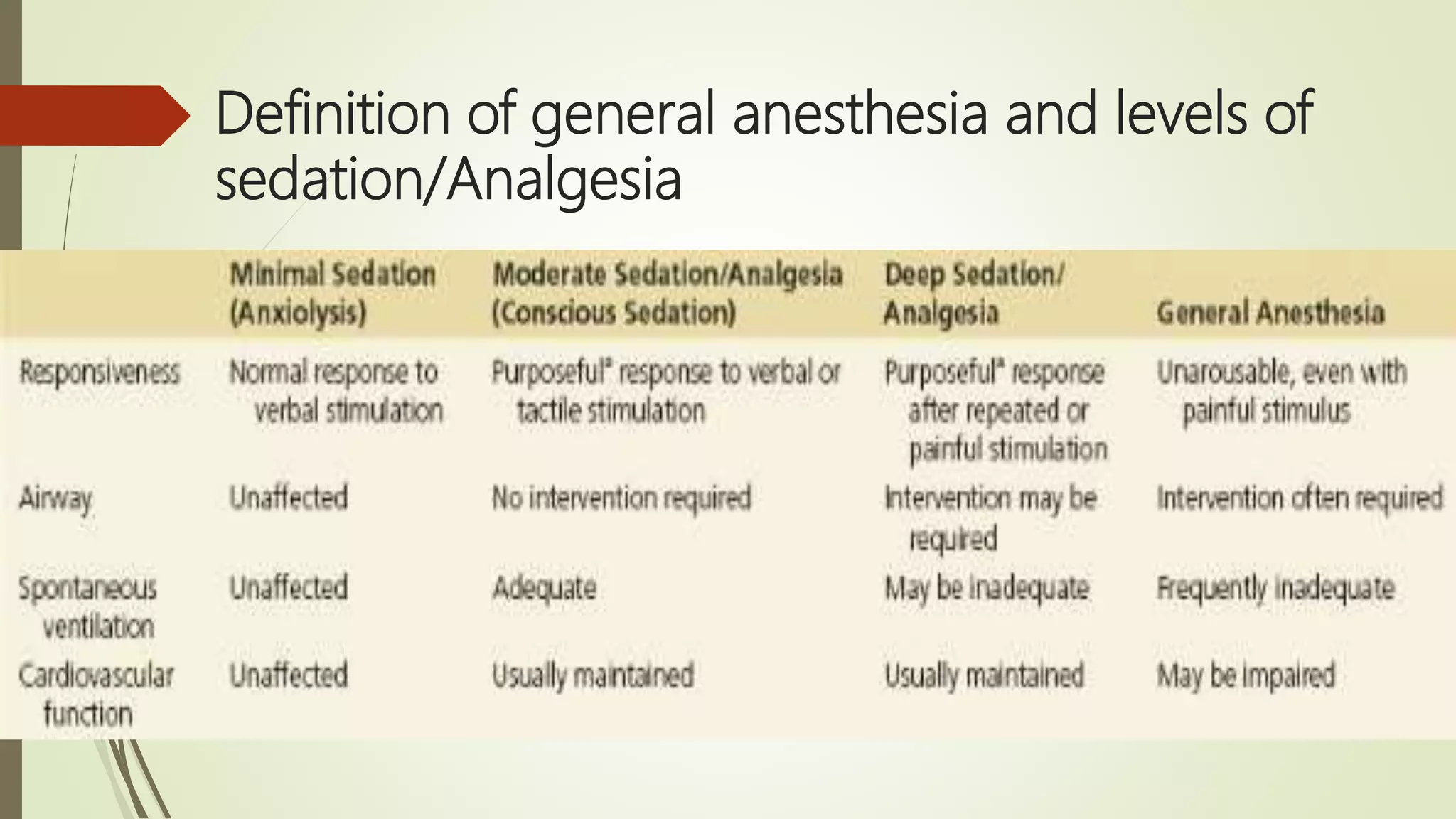
Definition of general anesthesia and levels of
sedation/Analgesia
Environmental consideration for NORA
X ray & Fluoroscopy
C arm moves back & forth takes large space &means of
dislodging IV and ETT.
 so,
 limit the time of exposure to radiation
 increase the distance from source or radiation.
 (> or < according to inverse square of distance from
source)
 use protective shielding
 using dosimeters ( limit of 50 mSv in any year & lifetime
limit of 10 mSv multiply age in year.
IV CONTRAST AGENTS
Are iodinated compounds
MRI contrast are ionic & nonionic.
chelated metal containg gadolinium , iron , manganese.
Renal
CIN (contrast induced nephropathy)
increase S.Creatinine of 0.5mg/dl or 25% from
baseline within 48 hrs to 72 hrs.
Risk factor for CIN
 Renal disease
 Prior renal surgery
 Proteinuria
 DM
 HTN
 Gout
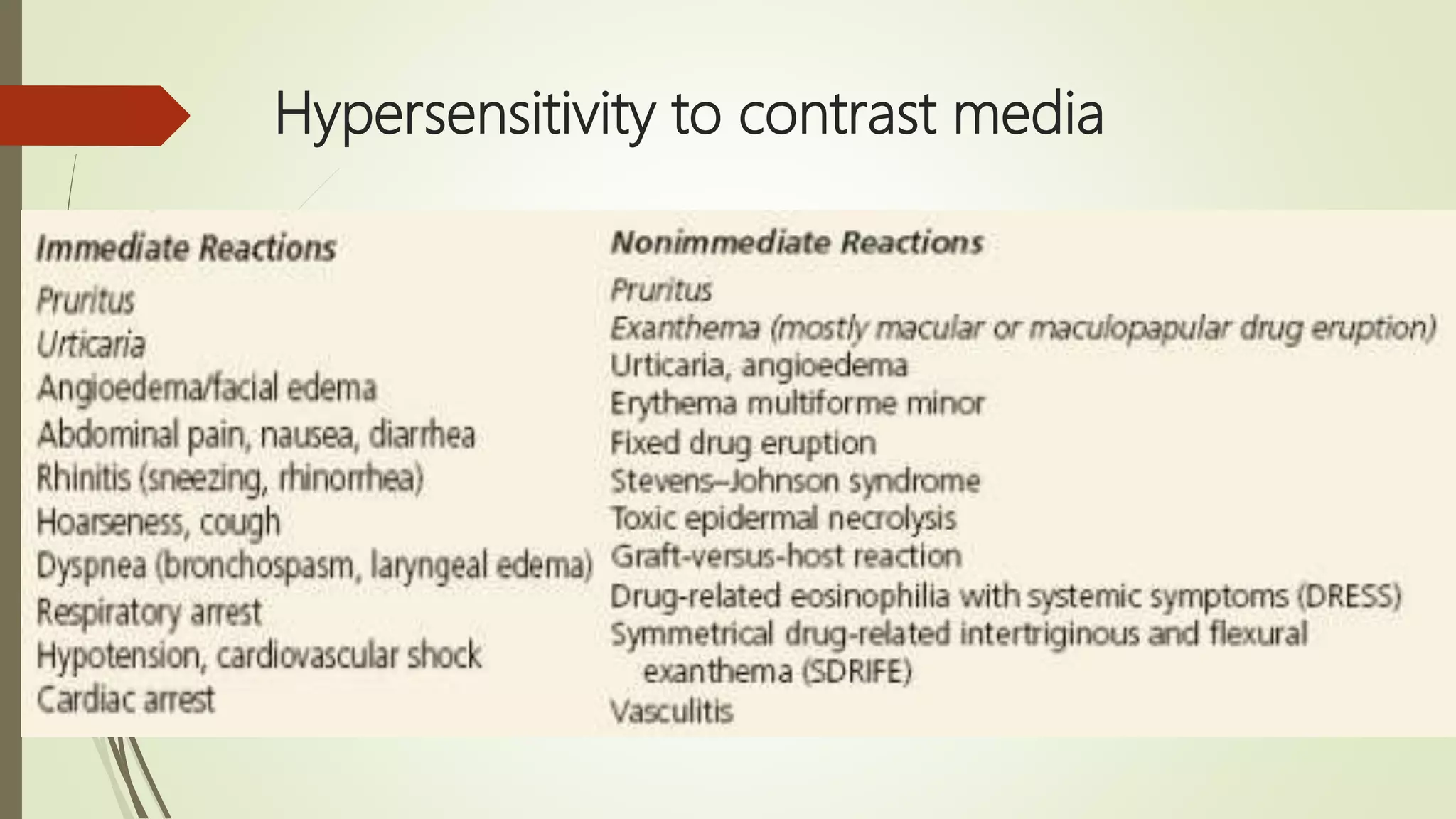
Hypersensitivity to contrast media
Magnetic Resonance Imaging
a noninvasive diagnostic technique that uses magnetic
properties of atomic nuclei
 to produce high-resolution, multiplanar cross-sectional
images of the body.
Strong magnetic field of 0.5-3.0 tesla.
So ferromagnetic materials should be excluded from the
area of magnet.
Implantable medical devices: pacemakers, vascular clips,
automatic implantable cardioverter-defribillators,
mechanical heart valves.
Radiofrequency noise: sound >85db from MRI scanners
Choice of anesthetic technique depends upon
 patient’s comorbidities,
duration,
 practioner preference and
 patient requirements.
Deep sedation or
 GA with intubation or supraglottic airways.
Sedation with oral route benzodiazepines or as intravenous
sedation or MAC.
Small infants: ” feed, wrap, and scan”
Oral chloral hydrate: 80-100mg/kg 30-60 min before
procedure.
Rectally administered barbiturates or
General anesthesia with propofol, ketamine or inhaled
anesthetics
Thank you

NON OPERATING ROOM ANAESTHESIA

  • 1.
    NON OPERATING ROOM ANAESTHESIA Presentor:Dr Kundan Kishor Ghimire Resident Anaesthesia and Critical Care Moderator: Dr. Dhiraj Kesari
  • 2.
    Introduction Encompasses all sedationand anaesthesia provided by anesthesiology services outside of the operating room environment. Area remote from main operating room Radiology Department Endoscopy suites MRI Dental Clinics
  • 3.
  • 4.
    Patients Most Patients tendto be older. (>50 yrs) receive monitored anesthesia care (MAC) or sedation Children commonly require sedation or anesthesia diagnostic and therapeutic procedures. thorough preanesthetic assessment, standard preanesthetic care.  sound anesthetic plan with approppriate level of monitoring and appropriate postanesthetic care.
  • 5.
    Patient factors requiringSedation or Anesthesia for Nonoperating Room
  • 6.
    Procedures Nature of theprocedure, including patient position, grade of painful procedure, and its duration. Optimum anesthesia plan provides safe patient care and facilitates the procedure. Discussion with proceduralist for emergencies and adverse outcomes
  • 8.
    ASA guidelines fornon-operating room anesthesizing locations. Reliable O2 source with backup supply Suction apparatus Waste gas scavenging Self-inflating resuscitation bag. Adequate monitoring equipments Safe electrical outlets for emergency power supply Adequate illumination, battery backup Sufficient space for anaesthesia personnel, equipment Emergency cart, defibrillator, drugs, etc Reliable means for two-way communication Applicable facility, safety codes met Appropriate postanaesthetic management.
  • 9.
    Patient Transfer Sick, unstablepatients are transferred back and forth  between ICU, OR and NOR locations for imaging, or diagnostic procedures. Skilled personnel to evaluate, monitor and support he medical condition. Portable ventilators and adequate suppies of oxygen Manual self inflating bag Anesthetic and emergency drugs, equipment for intubation intubation, portable suctions
  • 10.
  • 11.
    Problems in providingNORA Equipment might be old, not regularly serviced and not in standard use as in the rest of the hospital Monitoring standards may not adequate. Piped gases may not be supplied. Other personnel may be unaware of the problems facing the anesthetist. Space may be limited by bulky equipment making access to patient difficult. Poor environment conditions( e.g. Lightening, temperature) Recovery facilities may not be available. Inadequate ventilation/ scavenging causing pollution. Problems related to transferring patients.
  • 12.
    Definition of generalanesthesia and levels of sedation/Analgesia
  • 13.
    Environmental consideration forNORA X ray & Fluoroscopy C arm moves back & forth takes large space &means of dislodging IV and ETT.  so,  limit the time of exposure to radiation  increase the distance from source or radiation.  (> or < according to inverse square of distance from source)  use protective shielding  using dosimeters ( limit of 50 mSv in any year & lifetime limit of 10 mSv multiply age in year.
  • 14.
    IV CONTRAST AGENTS Areiodinated compounds MRI contrast are ionic & nonionic. chelated metal containg gadolinium , iron , manganese. Renal CIN (contrast induced nephropathy) increase S.Creatinine of 0.5mg/dl or 25% from baseline within 48 hrs to 72 hrs.
  • 15.
    Risk factor forCIN  Renal disease  Prior renal surgery  Proteinuria  DM  HTN  Gout
  • 16.
  • 17.
    Magnetic Resonance Imaging anoninvasive diagnostic technique that uses magnetic properties of atomic nuclei  to produce high-resolution, multiplanar cross-sectional images of the body. Strong magnetic field of 0.5-3.0 tesla. So ferromagnetic materials should be excluded from the area of magnet.
  • 18.
    Implantable medical devices:pacemakers, vascular clips, automatic implantable cardioverter-defribillators, mechanical heart valves. Radiofrequency noise: sound >85db from MRI scanners
  • 19.
    Choice of anesthetictechnique depends upon  patient’s comorbidities, duration,  practioner preference and  patient requirements. Deep sedation or  GA with intubation or supraglottic airways. Sedation with oral route benzodiazepines or as intravenous sedation or MAC.
  • 20.
    Small infants: ”feed, wrap, and scan” Oral chloral hydrate: 80-100mg/kg 30-60 min before procedure. Rectally administered barbiturates or General anesthesia with propofol, ketamine or inhaled anesthetics
  • 21.

Editor's Notes

  • #14 Dosimeter: to measure occupational exposure to radiation, mSv= millisieverts
  • #15 Used to enhance vascular imaging
  • #21 Rectal methohexital 20-30mg/kg, rapid onset: 5-10mins, prolonged action 30-60mins, unpredictable sedation