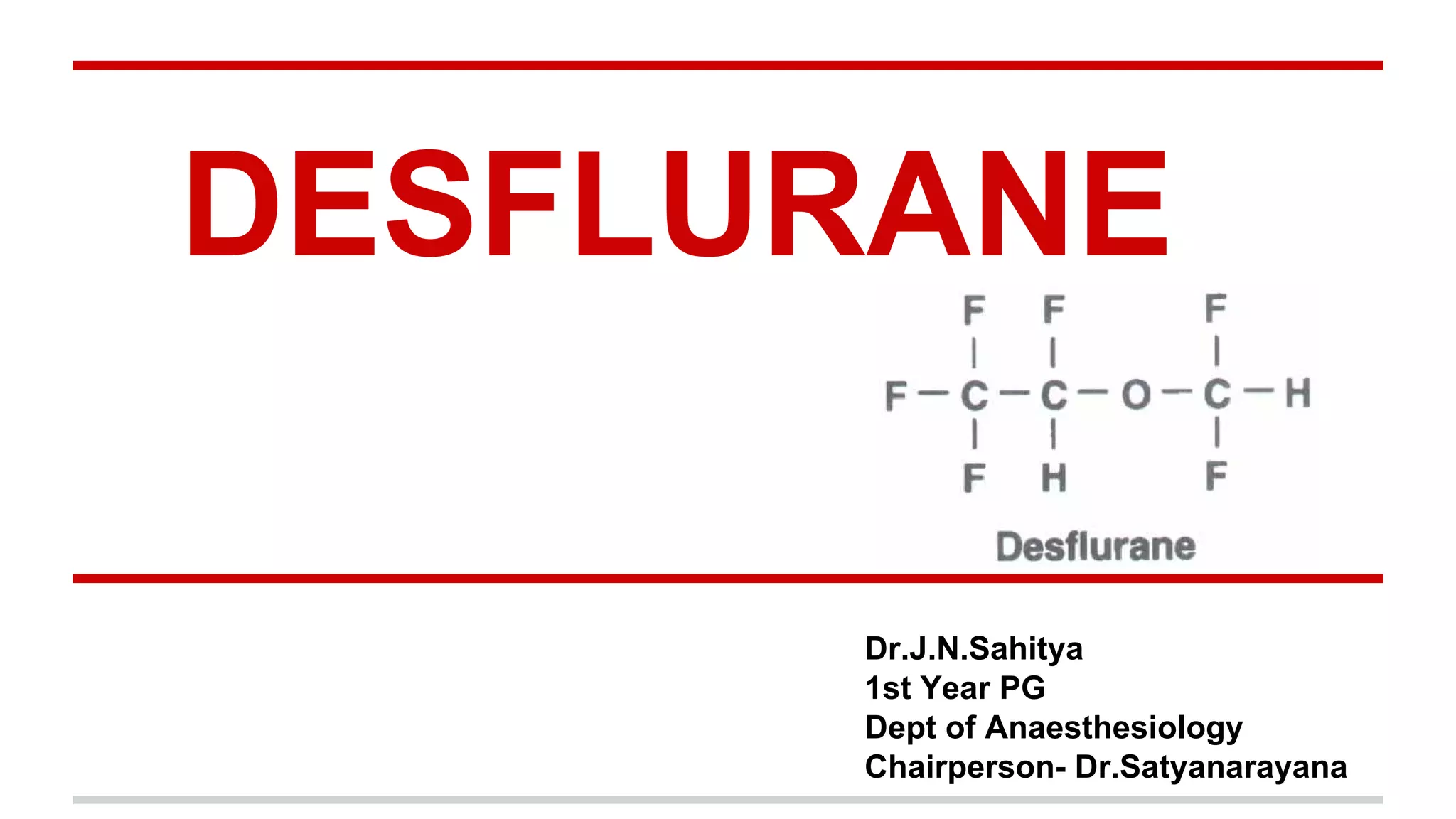
DESFLURANE
Dr.J.N.Sahitya
1st Year PG
Dept of Anaesthesiology
Chairperson- Dr.Satyanarayana
HISTORY AND PREPARATION
● Desflurane was produced by Dr.Ross Terell along with
isoflurane, sevoflurane and enflurane.
● Desflurane was approved for clinical use in the USA in
1992.
● Desflurane is prepared by reacting hexafluoropropene
epoxide with methanol to form methyl 2-
methoxytetrafluoropropionate which is hydrolyzed to the
corresponding acid.
How is it prepared?
● The acid is decarboxylated to form 1,2,2,2-
tetrafluoroethyl methyl ether which is then chlorinated to
form 1,2,2,2-tetrafluoroethyl dichloromethyl ether.
● Fluorine-chlorine exchange of the ether by conventional
fluorination produces desflurane.
Physical properties
● Desflurane has a pungent odour, which makes it irritating and
unpleasant to inhale and produces appreciable incidence of
salivation, breath-holding, coughing, or laryngospasm when given to
an awake patient.
● It has a boiling point of 22.8 °C, which is just above room
temperature, and its SVP of 88.3 kPa (664 mmHg) at 20°C. This
means that it cannot be administered using a standard vaporizer.
● To facilitate accurate delivery of desflurane, a new vaporizer
has been developed ,in which the anesthetic agent is
converted to a gas ,by heating it to a constant temperature
and maintaining it at a constant pressure [about 200kPa
/1500 mmHg].
● It is then mixed in a controlled fashion with the carrier gas.
● Unlike other vaporizers, this is a heated and pressurized
vaporizer that needs an external power source.
desflurane vaporiser
● Desflurane has a blood-gas solubility coefficient of 0.42,the
lowest of all the inhalational agents available with the
exception of xenon, which means equilibration and recovery
should occur quickly.
● It has a lower solubility in rubber and plastic than halothane,
isoflurane, or sevoflurane.
● The MAC of desflurane varies from 4.58% to 7.25%
depending on the stimulus used, and as with the other
agents the MAC decreases with increasing age.The MAC is
reduced by nitrous oxide.
Pharmacokinetics
● Desflurane has the lowest blood-gas solubility of all the
volatile anesthetic agents, and thus results in fastest
induction and recovery.
● The elimination of desflurane is also faster. It is almost
exclusively through the lungs, with metabolism by the liver
estimated to be less than 0.02%
● The distribution of desflurane follows a five-compartment
model which, may be as follows - the lungs, the vessel-rich
group of organs, muscle, fat around the vessel-rich organs,
and, finally peripheral fat.
● Desflurane undergoes minimal metabolism which is seen by
increased serum and urinary trifluoroacetate , but the levels
were only about 1/10th of the levels seen after exposure to
isoflurane.
● Desflurane is degraded by desiccated CO2 absorbent,
mainly Ba(OH)2 lime, into clinically significant levels of
carbon monoxide.
● Presence of carboxyhemoglobin may be detected by arterial
blood gas analysis
● Disposing dried out absorbent or use of Ca(OH)2 can
minimise the risk of CO poisoning.
Pharmacodynamics
● CVS Effects-
-Desflurane causes a dose-dependent tachycardia in
that is associated with a depression in myocardial
contractility and a decrease in the SVR resulting from
peripheral vasodilation. These changes occur at
concentrations ranging from 0.83-1.66 MAC.
-Desflurane is a direct coronary vasodilator and produces an
overall reduction in cardiac work.
- A rapid increase in the concentration of desflurane to greater
than 1 MAC will cause an increase in heart rate and blood
pressure .
- This transient cardiovascular stimulation
is greater with desflurane than with isoflurane, and it is
reduced by nitrous oxide. It can be significantly attenuated
by small doses of opioids, clonidine, or esmolol.
● CNS Effects-
-Desflurane causes dose-dependent cerebral vasodilation,thus
increasing CBF, cerebral blood volume and intracranial
pressure at normotension and normocapnia.
-There is marked reduction in cerebral metabolic rate of O2
that causes cerebral vasoconstriction and moderate any
increase in CBF.
-Cerebral oxygen consumption is decreased during desflurane
anaesthesia.
-Thus, during periods of desflurane-induced hypotension, CBF is
adequate to maintain aerobic metabolism despite a low
cerebral perfusion pressure.
- Desflurane produces a dose-dependent burst suppression of
the EEG at concentrations greater than 1.24 MAC, and at a
MAC of greater than 1.66 the EEG becomes isoelectric.
-The more rapid recovery associated with desflurane anesthesia
may offer a small advantage in patients undergoing prolonged
neurosurgical procedures.
● Respiratory Effects-
- Desflurane is a potent respiratory depressant.
- Desflurane causes a decrease in tidal volume and an
increase in respiratory rate with an overall reduction in
minute alveolar ventilation.
- Desflurane is unsuitable for an inhalation induction because it
is extremely irritating to the airway. Despite this fact, the
incidence of bronchospasm in asthmatics is not increased
during the induction of anesthesia with desflurane.
● Neuromuscular Effects-
-Desflurane is associated with dose-dependent decrease in
the response to train of four and tetanic peripheral nerve
stimulation.
-It can provide sufficient relaxation to allow tracheal
intubation. This effect is independent of the duration of
anaesthesia.
-It also potentiates the action of nondepolarizing muscle
relaxants to the same degree as isoflurane.
Clinical uses
● Desflurane has the lowest blood-gas solubility of the halogenated
anesthetic agents, and therefore provides the most rapid induction
and recovery.
● Desflurane is 1/4th as potent as other volatile agents, but 17 times
more potent than nitrous oxide.
● It undergoes minimal metabolism, and thus the risk of toxicity
from metabolites is expected to be very low, although it is
metabolized to TFA, which has been implicated in hepatotoxicity.
Disadvantages
● Desflurane is quite irritating to the airway and therefore it is
not suitable for an inhalation induction.
● Rapid changes in the inspired concentration are associated
with sympathetic stimulation, resulting in hypertension and
tachycardia, and there are also some concerns about its use
in patients with ischemic heart disease.
● It offers no advantage over sevoflurane except for a lower
blood-gas solubility coefficient, a property that may have no
significant clinical impact.
Properties Halothane Isoflurane Sevoflurane Desflurane
Boiling Point 50.2 ℃ 48.5 ℃ 58.5 ℃ 22.8 ℃
MAC 0.75 1.15 2.1 6 - 7.25
Saturated
Vapor
Pressure
243 239 160 678
Blood - Gas
Solubility
Coefficient
2.5 1.4 0.69 0.42
Oil - Gas
Solubility
Coefficient
60 45 48 27
Thank You

Desflurane

  • 1.
    DESFLURANE Dr.J.N.Sahitya 1st Year PG Deptof Anaesthesiology Chairperson- Dr.Satyanarayana
  • 2.
    HISTORY AND PREPARATION ●Desflurane was produced by Dr.Ross Terell along with isoflurane, sevoflurane and enflurane. ● Desflurane was approved for clinical use in the USA in 1992. ● Desflurane is prepared by reacting hexafluoropropene epoxide with methanol to form methyl 2- methoxytetrafluoropropionate which is hydrolyzed to the corresponding acid.
  • 3.
    How is itprepared? ● The acid is decarboxylated to form 1,2,2,2- tetrafluoroethyl methyl ether which is then chlorinated to form 1,2,2,2-tetrafluoroethyl dichloromethyl ether. ● Fluorine-chlorine exchange of the ether by conventional fluorination produces desflurane.
  • 4.
    Physical properties ● Desfluranehas a pungent odour, which makes it irritating and unpleasant to inhale and produces appreciable incidence of salivation, breath-holding, coughing, or laryngospasm when given to an awake patient. ● It has a boiling point of 22.8 °C, which is just above room temperature, and its SVP of 88.3 kPa (664 mmHg) at 20°C. This means that it cannot be administered using a standard vaporizer.
  • 5.
    ● To facilitateaccurate delivery of desflurane, a new vaporizer has been developed ,in which the anesthetic agent is converted to a gas ,by heating it to a constant temperature and maintaining it at a constant pressure [about 200kPa /1500 mmHg]. ● It is then mixed in a controlled fashion with the carrier gas. ● Unlike other vaporizers, this is a heated and pressurized vaporizer that needs an external power source.
  • 6.
  • 7.
    ● Desflurane hasa blood-gas solubility coefficient of 0.42,the lowest of all the inhalational agents available with the exception of xenon, which means equilibration and recovery should occur quickly. ● It has a lower solubility in rubber and plastic than halothane, isoflurane, or sevoflurane. ● The MAC of desflurane varies from 4.58% to 7.25% depending on the stimulus used, and as with the other agents the MAC decreases with increasing age.The MAC is reduced by nitrous oxide.
  • 8.
    Pharmacokinetics ● Desflurane hasthe lowest blood-gas solubility of all the volatile anesthetic agents, and thus results in fastest induction and recovery. ● The elimination of desflurane is also faster. It is almost exclusively through the lungs, with metabolism by the liver estimated to be less than 0.02% ● The distribution of desflurane follows a five-compartment model which, may be as follows - the lungs, the vessel-rich group of organs, muscle, fat around the vessel-rich organs, and, finally peripheral fat.
  • 9.
    ● Desflurane undergoesminimal metabolism which is seen by increased serum and urinary trifluoroacetate , but the levels were only about 1/10th of the levels seen after exposure to isoflurane. ● Desflurane is degraded by desiccated CO2 absorbent, mainly Ba(OH)2 lime, into clinically significant levels of carbon monoxide. ● Presence of carboxyhemoglobin may be detected by arterial blood gas analysis ● Disposing dried out absorbent or use of Ca(OH)2 can minimise the risk of CO poisoning.
  • 10.
    Pharmacodynamics ● CVS Effects- -Desfluranecauses a dose-dependent tachycardia in that is associated with a depression in myocardial contractility and a decrease in the SVR resulting from peripheral vasodilation. These changes occur at concentrations ranging from 0.83-1.66 MAC. -Desflurane is a direct coronary vasodilator and produces an overall reduction in cardiac work.
  • 11.
    - A rapidincrease in the concentration of desflurane to greater than 1 MAC will cause an increase in heart rate and blood pressure . - This transient cardiovascular stimulation is greater with desflurane than with isoflurane, and it is reduced by nitrous oxide. It can be significantly attenuated by small doses of opioids, clonidine, or esmolol.
  • 12.
    ● CNS Effects- -Desfluranecauses dose-dependent cerebral vasodilation,thus increasing CBF, cerebral blood volume and intracranial pressure at normotension and normocapnia. -There is marked reduction in cerebral metabolic rate of O2 that causes cerebral vasoconstriction and moderate any increase in CBF. -Cerebral oxygen consumption is decreased during desflurane anaesthesia.
  • 13.
    -Thus, during periodsof desflurane-induced hypotension, CBF is adequate to maintain aerobic metabolism despite a low cerebral perfusion pressure. - Desflurane produces a dose-dependent burst suppression of the EEG at concentrations greater than 1.24 MAC, and at a MAC of greater than 1.66 the EEG becomes isoelectric. -The more rapid recovery associated with desflurane anesthesia may offer a small advantage in patients undergoing prolonged neurosurgical procedures.
  • 14.
    ● Respiratory Effects- -Desflurane is a potent respiratory depressant. - Desflurane causes a decrease in tidal volume and an increase in respiratory rate with an overall reduction in minute alveolar ventilation. - Desflurane is unsuitable for an inhalation induction because it is extremely irritating to the airway. Despite this fact, the incidence of bronchospasm in asthmatics is not increased during the induction of anesthesia with desflurane.
  • 15.
    ● Neuromuscular Effects- -Desfluraneis associated with dose-dependent decrease in the response to train of four and tetanic peripheral nerve stimulation. -It can provide sufficient relaxation to allow tracheal intubation. This effect is independent of the duration of anaesthesia. -It also potentiates the action of nondepolarizing muscle relaxants to the same degree as isoflurane.
  • 16.
    Clinical uses ● Desfluranehas the lowest blood-gas solubility of the halogenated anesthetic agents, and therefore provides the most rapid induction and recovery. ● Desflurane is 1/4th as potent as other volatile agents, but 17 times more potent than nitrous oxide. ● It undergoes minimal metabolism, and thus the risk of toxicity from metabolites is expected to be very low, although it is metabolized to TFA, which has been implicated in hepatotoxicity.
  • 17.
    Disadvantages ● Desflurane isquite irritating to the airway and therefore it is not suitable for an inhalation induction. ● Rapid changes in the inspired concentration are associated with sympathetic stimulation, resulting in hypertension and tachycardia, and there are also some concerns about its use in patients with ischemic heart disease. ● It offers no advantage over sevoflurane except for a lower blood-gas solubility coefficient, a property that may have no significant clinical impact.
  • 18.
    Properties Halothane IsofluraneSevoflurane Desflurane Boiling Point 50.2 ℃ 48.5 ℃ 58.5 ℃ 22.8 ℃ MAC 0.75 1.15 2.1 6 - 7.25 Saturated Vapor Pressure 243 239 160 678 Blood - Gas Solubility Coefficient 2.5 1.4 0.69 0.42 Oil - Gas Solubility Coefficient 60 45 48 27
  • 20.