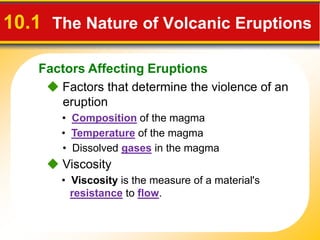
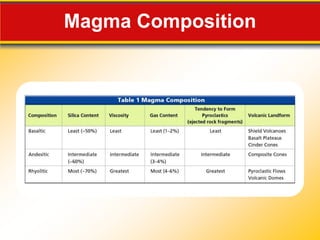
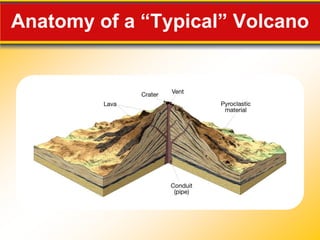
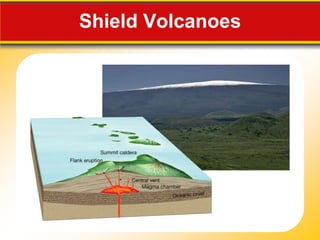
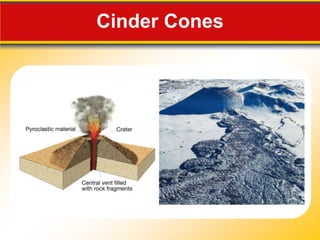
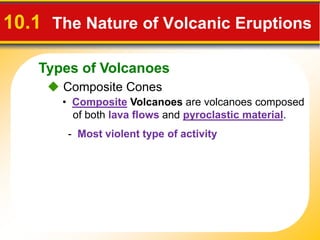
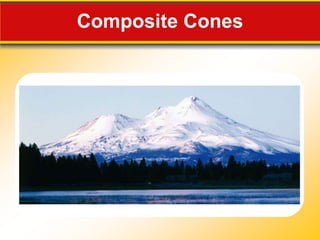
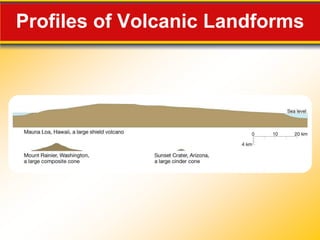
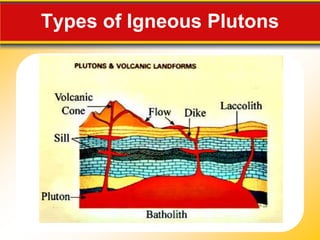
The document discusses factors that affect the violence of volcanic eruptions including the composition, temperature, and dissolved gases of magma. More viscous magma produces more violent eruptions as gases cannot escape as easily. There are three main types of volcanoes - shield volcanoes formed from fluid basaltic lava, cinder cones formed from pyroclastic material from a single vent, and composite cones which are the most violent type formed from both lava and pyroclastic material. The document also briefly mentions plutons, which are intrusive igneous rocks that form from cooling magma underground.

![Factors Affecting Eruptions
10.1 The Nature of Volcanic Eruptions
Dissolved gases
• Violence of an eruption is related to how easily
gases escape from magma
- Gases escape easily from fluid magma.
- Viscous [THICKER] magma produces a
more violent eruptions.](https://image.slidesharecdn.com/phesch10volcanoes-150612130028-lva1-app6891/85/Prentice-Hall-Earth-Science-ch10-volcanoes-4-320.jpg)


![谷歌留痕技术 [ 𝙩𝙤𝙥 𝟮𝟯𝟯. 𝙘 𝙤𝙢 ]](https://cdn.slidesharecdn.com/ss_thumbnails/top233-260130174328-3833018c-thumbnail.jpg?width=640&height=640&fit=bounds)