VOLCANISMIts Features
Glenn Kenneth A. Calugas
BSED General Science-4
CENTRAL MINDANAO UNIVERSITY
1
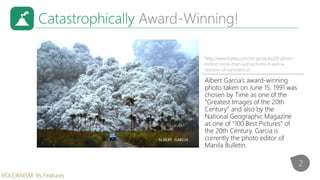
Albert Garcia’s award-winning
photo taken on June 15, 1991 was
chosen by Time as one of the
“Greatest Images of the 20th
Century” and also by the
National Geographic Magazine
as one of “100 Best Pictures” of
the 20th Century. Garcia is
currently the photo editor of
Manila Bulletin.
Catastrophically Award-Winning!
http://www.balita.com/mt-pinatubo20-photo-
exhibit-more-than-just-pictures-it-was-a-
reunion-of-survivors-2/
2
VOLCANISM: Its Features
VOLCANISM? Sounds familiar!
Volcanism is the eruption of molten rock (magma) onto the
surface of a planet. A volcano is the vent through which magma
and gases are discharged. Magma that reaches the surface is
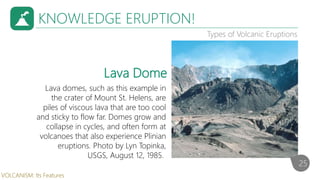
called lava. Volcanos are named for Vulcan the Roman god of
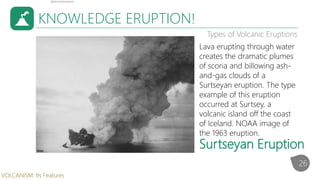
fire!
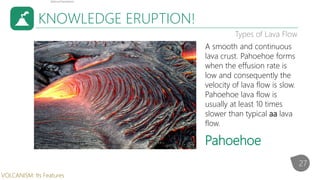
4
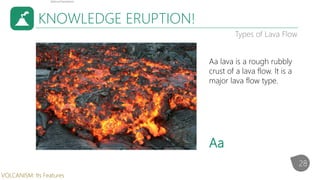
VOLCANISM: Its Features
LET’S PUSH THESE!
6
How do volcanoes form?
What causes volcanoes to erupt?
Where do most volcanoes occur?
What are the different types of volcanoes?
What determines the degree of violence associated
with volcanic activity?
VOLCANISM: Its Features
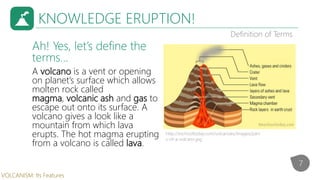
Ah! Yes, let’s define the
terms…
A volcano is a vent or opening
on planet’s surface which allows
molten rock called
magma, volcanic ash and gas to
escape out onto its surface. A
volcano gives a look like a
mountain from which lava
erupts. The hot magma erupting
from a volcano is called lava.
KNOWLEDGE ERUPTION!
Definition of Terms
http://eschooltoday.com/volcanoes/images/part
s-of-a-volcano.jpg
7
VOLCANISM: Its Features
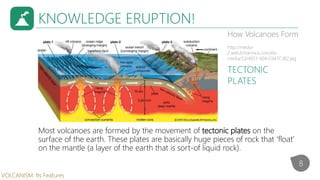
Most volcanoes are formed by the movement of tectonic plates on the
surface of the earth. These plates are basically huge pieces of rock that ‘float’
on the mantle (a layer of the earth that is sort-of liquid rock).
KNOWLEDGE ERUPTION!
How Volcanoes Form
http://media-
2.web.britannica.com/eb-
media/53/4953-004-C647C3B2.jpg
TECTONIC
PLATES
8
VOLCANISM: Its Features
KNOWLEDGE ERUPTION!
Origin of Volcanoes
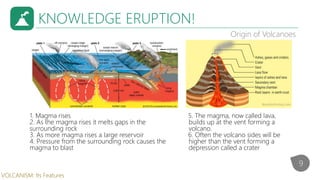
1. Magma rises
2. As the magma rises it melts gaps in the
surrounding rock
3. As more magma rises a large reservoir
4. Pressure from the surrounding rock causes the
magma to blast
5. The magma, now called lava,
builds up at the vent forming a
volcano.
6. Often the volcano sides will be
higher than the vent forming a
depression called a crater
9
VOLCANISM: Its Features
KNOWLEDGE ERUPTION!
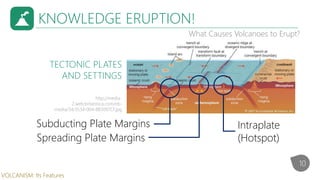
What Causes Volcanoes to Erupt?
http://media-
2.web.britannica.com/eb-
media/34/3534-004-8B3097CF.jpg
TECTONIC PLATES
AND SETTINGS
Subducting Plate Margins
Spreading Plate Margins
Intraplate
(Hotspot)
10
VOLCANISM: Its Features
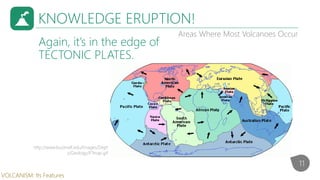
Again, it’s in the edge of
TECTONIC PLATES.
KNOWLEDGE ERUPTION!
Areas Where Most Volcanoes Occur
http://www.bucknell.edu/Images/Dept
s/Geology/PTmap.gif
11
VOLCANISM: Its Features
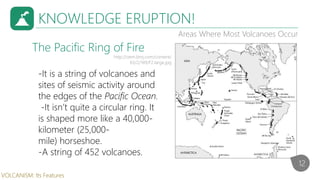
The Pacific Ring of Fire
KNOWLEDGE ERUPTION!
Areas Where Most Volcanoes Occur
http://oem.bmj.com/content/
63/2/149/F2.large.jpg
-It is a string of volcanoes and
sites of seismic activity around
the edges of the Pacific Ocean.
-It isn’t quite a circular ring. It
is shaped more like a 40,000-
kilometer (25,000-
mile) horseshoe.
-A string of 452 volcanoes.
12
VOLCANISM: Its Features
KNOWLEDGE ERUPTION!
What determines the degree of violence associated
with volcanic activity?
Magma – molten rock or liquid that is mostly silica
Lava – solidified magma
Pyroclasts – from the Greek pyro, “fire”, and clast “broken”
– rock fragments (pyroclastic debris is also called tephra)
Lava flows – fissures in the ground
Extrusive rock - surface rock resulting from volcanic activity (rock
formed by solidification of lava)
13
VOLCANISM: Its Features
KNOWLEDGE ERUPTION!
What determines the degree of violence associated
with volcanic activity?
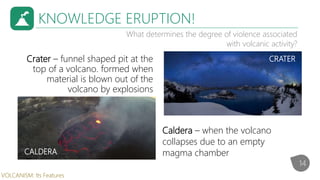
Crater – funnel shaped pit at the
top of a volcano. formed when
material is blown out of the
volcano by explosions
Caldera – when the volcano
collapses due to an empty
magma chamber
CRATER
CALDERA
14
VOLCANISM: Its Features
KNOWLEDGE ERUPTION!
What determines the degree of violence associated
with volcanic activity?
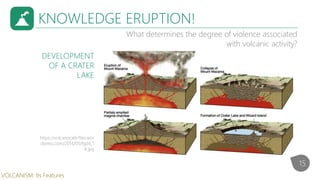
DEVELOPMENT
OF A CRATER
LAKE
https://volcanocafe.files.wor
dpress.com/2014/05/fg04_1
8.jpg
15
VOLCANISM: Its Features
KNOWLEDGE ERUPTION!
What determines the degree of violence associated
with volcanic activity?
Whether eruptions are very explosive or
relatively "quiet" is largely determined by two
factors:
(1) the amount of gas in the lava or magma
(2) the ease or difficulty with which the gas
can escape to the atmosphere
Viscosity – resistance to flow
PHYSICAL
CHARACTERISTICS
OF LAVA
16
VOLCANISM: Its Features
KNOWLEDGE ERUPTION!
What determines the degree of violence associated
with volcanic activity?
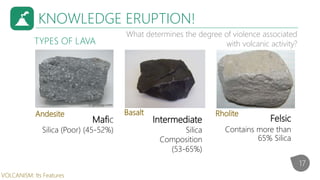
Felsic
Contains more than
65% Silica
TYPES OF LAVA
Mafic
Silica (Poor) (45-52%)
RholiteBasaltAndesite
Intermediate
Silica
Composition
(53-65%)
17
VOLCANISM: Its Features
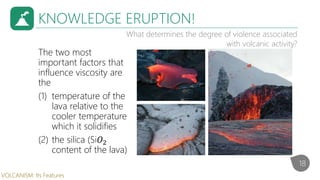
The two most
important factors that
influence viscosity are
the
(1) temperature of the
lava relative to the
cooler temperature
which it solidifies
(2) the silica (Si𝑂2
content of the lava)
KNOWLEDGE ERUPTION!
What determines the degree of violence associated
with volcanic activity?
18
VOLCANISM: Its Features
KNOWLEDGE ERUPTION!
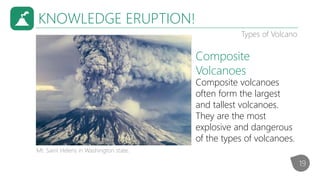
Composite volcanoes
often form the largest
and tallest volcanoes.
They are the most
explosive and dangerous
of the types of volcanoes.
Types of Volcano
Composite
Volcanoes
Mt. Saint Helens in Washington state.
19
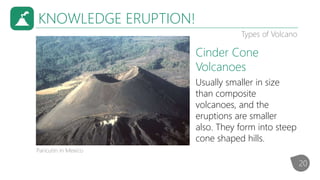
KNOWLEDGE ERUPTION!
Usually smaller in size
than composite
volcanoes, and the
eruptions are smaller
also. They form into steep
cone shaped hills.
Types of Volcano
Cinder Cone
Volcanoes
Paricutin in Mexico
20
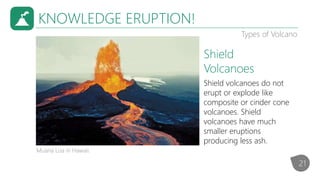
KNOWLEDGE ERUPTION!
Shield volcanoes do not
erupt or explode like
composite or cinder cone
volcanoes. Shield
volcanoes have much
smaller eruptions
producing less ash.
Types of Volcano
Shield
Volcanoes
Muana Loa in Hawaii.
21
KNOWLEDGE ERUPTION!
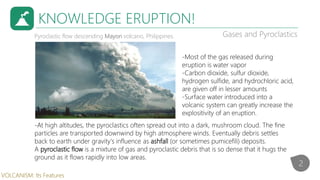
Pyroclastic flow descending Mayon volcano, Philippines.
-Most of the gas released during
eruption is water vapor
-Carbon dioxide, sulfur dioxide,
hydrogen sulfide, and hydrochloric acid,
are given off in lesser amounts
-Surface water introduced into a
volcanic system can greatly increase the
explositivity of an eruption.
-At high altitudes, the pyroclastics often spread out into a dark, mushroom cloud. The fine
particles are transported downwind by high atmosphere winds. Eventually debris settles
back to earth under gravity's influence as ashfall (or sometimes pumicefili) deposits.
A pyroclastic flow is a mixture of gas and pyroclastic debris that is so dense that it hugs the
ground as it flows rapidly into low areas.
Gases and Pyroclastics
2
VOLCANISM: Its Features
KNOWLEDGE ERUPTION!
Types of Volcanic Eruptions
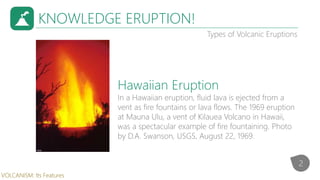
In a Hawaiian eruption, fluid lava is ejected from a
vent as fire fountains or lava flows. The 1969 eruption
at Mauna Ulu, a vent of Kilauea Volcano in Hawaii,
was a spectacular example of fire fountaining. Photo
by D.A. Swanson, USGS, August 22, 1969.
Hawaiian Eruption
2
VOLCANISM: Its Features
KNOWLEDGE ERUPTION!
Types of Volcanic Eruptions
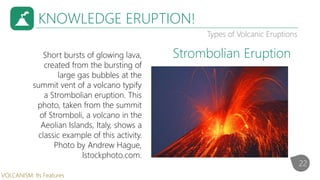
Short bursts of glowing lava,
created from the bursting of
large gas bubbles at the
summit vent of a volcano typify
a Strombolian eruption. This
photo, taken from the summit
of Stromboli, a volcano in the
Aeolian Islands, Italy, shows a
classic example of this activity.
Photo by Andrew Hague,
Istockphoto.com.
Strombolian Eruption
22
VOLCANISM: Its Features
KNOWLEDGE ERUPTION!
Types of Volcanic Eruptions
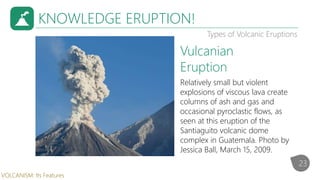
Relatively small but violent
explosions of viscous lava create
columns of ash and gas and
occasional pyroclastic flows, as
seen at this eruption of the
Santiaguito volcanic dome
complex in Guatemala. Photo by
Jessica Ball, March 15, 2009.
Vulcanian
Eruption
23
VOLCANISM: Its Features
KNOWLEDGE ERUPTION!
Types of Volcanic Eruptions
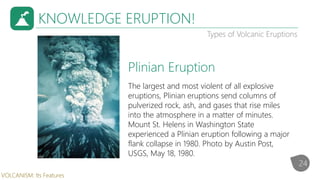
The largest and most violent of all explosive
eruptions, Plinian eruptions send columns of
pulverized rock, ash, and gases that rise miles
into the atmosphere in a matter of minutes.
Mount St. Helens in Washington State
experienced a Plinian eruption following a major
flank collapse in 1980. Photo by Austin Post,
USGS, May 18, 1980.
Plinian Eruption
24
VOLCANISM: Its Features
KNOWLEDGE ERUPTION!
Types of Volcanic Eruptions
Lava domes, such as this example in
the crater of Mount St. Helens, are
piles of viscous lava that are too cool
and sticky to flow far. Domes grow and
collapse in cycles, and often form at
volcanoes that also experience Plinian
eruptions. Photo by Lyn Topinka,
USGS, August 12, 1985.
Lava Dome
25
VOLCANISM: Its Features
KNOWLEDGE ERUPTION!
Types of Volcanic Eruptions
Lava erupting through water
creates the dramatic plumes
of scoria and billowing ash-
and-gas clouds of a
Surtseyan eruption. The type
example of this eruption
occurred at Surtsey, a
volcanic island off the coast
of Iceland. NOAA image of
the 1963 eruption.
Surtseyan Eruption
26
VOLCANISM: Its Features
KNOWLEDGE ERUPTION!
Types of Lava Flow
A smooth and continuous
lava crust. Pahoehoe forms
when the effusion rate is
low and consequently the
velocity of lava flow is slow.
Pahoehoe lava flow is
usually at least 10 times
slower than typical aa lava
flow.
Pahoehoe
27
VOLCANISM: Its Features
KNOWLEDGE ERUPTION!
Types of Lava Flow
Aa lava is a rough rubbly
crust of a lava flow. It is a
major lava flow type.
Aa
28
VOLCANISM: Its Features
KNOWLEDGE ERUPTION!
Types of Lava Flow
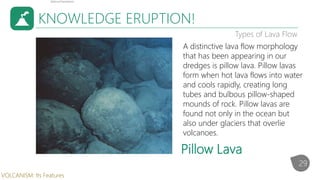
A distinctive lava flow morphology
that has been appearing in our
dredges is pillow lava. Pillow lavas
form when hot lava flows into water
and cools rapidly, creating long
tubes and bulbous pillow-shaped
mounds of rock. Pillow lavas are
found not only in the ocean but
also under glaciers that overlie
volcanoes.
Pillow Lava
29
VOLCANISM: Its Features
KNOWLEDGE ERUPTION!
Types of Lava Flow
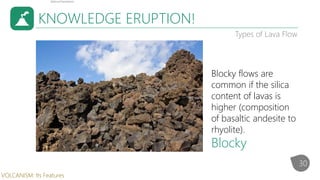
Blocky flows are
common if the silica
content of lavas is
higher (composition
of basaltic andesite to
rhyolite).
Blocky
30
VOLCANISM: Its Features
KNOWLEDGE ERUPTION!
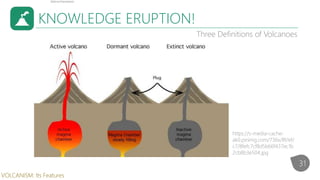
Three Definitions of Volcanoes
https://s-media-cache-
ak0.pinimg.com/736x/8f/ef/
c7/8fefc7cf8d5b66f437ec1b
2cb8b3e504.jpg
31
VOLCANISM: Its Features
Thanks!
32
VOLCANISM: Its Features

Volcanism

  • 1.
    VOLCANISMIts Features Glenn KennethA. Calugas BSED General Science-4 CENTRAL MINDANAO UNIVERSITY 1
  • 2.
    Albert Garcia’s award-winning phototaken on June 15, 1991 was chosen by Time as one of the “Greatest Images of the 20th Century” and also by the National Geographic Magazine as one of “100 Best Pictures” of the 20th Century. Garcia is currently the photo editor of Manila Bulletin. Catastrophically Award-Winning! http://www.balita.com/mt-pinatubo20-photo- exhibit-more-than-just-pictures-it-was-a- reunion-of-survivors-2/ 2 VOLCANISM: Its Features
  • 3.
    VOLCANISM? Sounds familiar! Volcanismis the eruption of molten rock (magma) onto the surface of a planet. A volcano is the vent through which magma and gases are discharged. Magma that reaches the surface is called lava. Volcanos are named for Vulcan the Roman god of fire! 4 VOLCANISM: Its Features
  • 4.
    LET’S PUSH THESE! 6 Howdo volcanoes form? What causes volcanoes to erupt? Where do most volcanoes occur? What are the different types of volcanoes? What determines the degree of violence associated with volcanic activity? VOLCANISM: Its Features
  • 5.
    Ah! Yes, let’sdefine the terms… A volcano is a vent or opening on planet’s surface which allows molten rock called magma, volcanic ash and gas to escape out onto its surface. A volcano gives a look like a mountain from which lava erupts. The hot magma erupting from a volcano is called lava. KNOWLEDGE ERUPTION! Definition of Terms http://eschooltoday.com/volcanoes/images/part s-of-a-volcano.jpg 7 VOLCANISM: Its Features
  • 6.
    Most volcanoes areformed by the movement of tectonic plates on the surface of the earth. These plates are basically huge pieces of rock that ‘float’ on the mantle (a layer of the earth that is sort-of liquid rock). KNOWLEDGE ERUPTION! How Volcanoes Form http://media- 2.web.britannica.com/eb- media/53/4953-004-C647C3B2.jpg TECTONIC PLATES 8 VOLCANISM: Its Features
  • 7.
    KNOWLEDGE ERUPTION! Origin ofVolcanoes 1. Magma rises 2. As the magma rises it melts gaps in the surrounding rock 3. As more magma rises a large reservoir 4. Pressure from the surrounding rock causes the magma to blast 5. The magma, now called lava, builds up at the vent forming a volcano. 6. Often the volcano sides will be higher than the vent forming a depression called a crater 9 VOLCANISM: Its Features
  • 8.
    KNOWLEDGE ERUPTION! What CausesVolcanoes to Erupt? http://media- 2.web.britannica.com/eb- media/34/3534-004-8B3097CF.jpg TECTONIC PLATES AND SETTINGS Subducting Plate Margins Spreading Plate Margins Intraplate (Hotspot) 10 VOLCANISM: Its Features
  • 9.
    Again, it’s inthe edge of TECTONIC PLATES. KNOWLEDGE ERUPTION! Areas Where Most Volcanoes Occur http://www.bucknell.edu/Images/Dept s/Geology/PTmap.gif 11 VOLCANISM: Its Features
  • 10.
    The Pacific Ringof Fire KNOWLEDGE ERUPTION! Areas Where Most Volcanoes Occur http://oem.bmj.com/content/ 63/2/149/F2.large.jpg -It is a string of volcanoes and sites of seismic activity around the edges of the Pacific Ocean. -It isn’t quite a circular ring. It is shaped more like a 40,000- kilometer (25,000- mile) horseshoe. -A string of 452 volcanoes. 12 VOLCANISM: Its Features
  • 11.
    KNOWLEDGE ERUPTION! What determinesthe degree of violence associated with volcanic activity? Magma – molten rock or liquid that is mostly silica Lava – solidified magma Pyroclasts – from the Greek pyro, “fire”, and clast “broken” – rock fragments (pyroclastic debris is also called tephra) Lava flows – fissures in the ground Extrusive rock - surface rock resulting from volcanic activity (rock formed by solidification of lava) 13 VOLCANISM: Its Features
  • 12.
    KNOWLEDGE ERUPTION! What determinesthe degree of violence associated with volcanic activity? Crater – funnel shaped pit at the top of a volcano. formed when material is blown out of the volcano by explosions Caldera – when the volcano collapses due to an empty magma chamber CRATER CALDERA 14 VOLCANISM: Its Features
  • 13.
    KNOWLEDGE ERUPTION! What determinesthe degree of violence associated with volcanic activity? DEVELOPMENT OF A CRATER LAKE https://volcanocafe.files.wor dpress.com/2014/05/fg04_1 8.jpg 15 VOLCANISM: Its Features
  • 14.
    KNOWLEDGE ERUPTION! What determinesthe degree of violence associated with volcanic activity? Whether eruptions are very explosive or relatively "quiet" is largely determined by two factors: (1) the amount of gas in the lava or magma (2) the ease or difficulty with which the gas can escape to the atmosphere Viscosity – resistance to flow PHYSICAL CHARACTERISTICS OF LAVA 16 VOLCANISM: Its Features
  • 15.
    KNOWLEDGE ERUPTION! What determinesthe degree of violence associated with volcanic activity? Felsic Contains more than 65% Silica TYPES OF LAVA Mafic Silica (Poor) (45-52%) RholiteBasaltAndesite Intermediate Silica Composition (53-65%) 17 VOLCANISM: Its Features
  • 16.
    The two most importantfactors that influence viscosity are the (1) temperature of the lava relative to the cooler temperature which it solidifies (2) the silica (Si𝑂2 content of the lava) KNOWLEDGE ERUPTION! What determines the degree of violence associated with volcanic activity? 18 VOLCANISM: Its Features
  • 17.
    KNOWLEDGE ERUPTION! Composite volcanoes oftenform the largest and tallest volcanoes. They are the most explosive and dangerous of the types of volcanoes. Types of Volcano Composite Volcanoes Mt. Saint Helens in Washington state. 19
  • 18.
    KNOWLEDGE ERUPTION! Usually smallerin size than composite volcanoes, and the eruptions are smaller also. They form into steep cone shaped hills. Types of Volcano Cinder Cone Volcanoes Paricutin in Mexico 20
  • 19.
    KNOWLEDGE ERUPTION! Shield volcanoesdo not erupt or explode like composite or cinder cone volcanoes. Shield volcanoes have much smaller eruptions producing less ash. Types of Volcano Shield Volcanoes Muana Loa in Hawaii. 21
  • 20.
    KNOWLEDGE ERUPTION! Pyroclastic flowdescending Mayon volcano, Philippines. -Most of the gas released during eruption is water vapor -Carbon dioxide, sulfur dioxide, hydrogen sulfide, and hydrochloric acid, are given off in lesser amounts -Surface water introduced into a volcanic system can greatly increase the explositivity of an eruption. -At high altitudes, the pyroclastics often spread out into a dark, mushroom cloud. The fine particles are transported downwind by high atmosphere winds. Eventually debris settles back to earth under gravity's influence as ashfall (or sometimes pumicefili) deposits. A pyroclastic flow is a mixture of gas and pyroclastic debris that is so dense that it hugs the ground as it flows rapidly into low areas. Gases and Pyroclastics 2 VOLCANISM: Its Features
  • 21.
    KNOWLEDGE ERUPTION! Types ofVolcanic Eruptions In a Hawaiian eruption, fluid lava is ejected from a vent as fire fountains or lava flows. The 1969 eruption at Mauna Ulu, a vent of Kilauea Volcano in Hawaii, was a spectacular example of fire fountaining. Photo by D.A. Swanson, USGS, August 22, 1969. Hawaiian Eruption 2 VOLCANISM: Its Features
  • 22.
    KNOWLEDGE ERUPTION! Types ofVolcanic Eruptions Short bursts of glowing lava, created from the bursting of large gas bubbles at the summit vent of a volcano typify a Strombolian eruption. This photo, taken from the summit of Stromboli, a volcano in the Aeolian Islands, Italy, shows a classic example of this activity. Photo by Andrew Hague, Istockphoto.com. Strombolian Eruption 22 VOLCANISM: Its Features
  • 23.
    KNOWLEDGE ERUPTION! Types ofVolcanic Eruptions Relatively small but violent explosions of viscous lava create columns of ash and gas and occasional pyroclastic flows, as seen at this eruption of the Santiaguito volcanic dome complex in Guatemala. Photo by Jessica Ball, March 15, 2009. Vulcanian Eruption 23 VOLCANISM: Its Features
  • 24.
    KNOWLEDGE ERUPTION! Types ofVolcanic Eruptions The largest and most violent of all explosive eruptions, Plinian eruptions send columns of pulverized rock, ash, and gases that rise miles into the atmosphere in a matter of minutes. Mount St. Helens in Washington State experienced a Plinian eruption following a major flank collapse in 1980. Photo by Austin Post, USGS, May 18, 1980. Plinian Eruption 24 VOLCANISM: Its Features
  • 25.
    KNOWLEDGE ERUPTION! Types ofVolcanic Eruptions Lava domes, such as this example in the crater of Mount St. Helens, are piles of viscous lava that are too cool and sticky to flow far. Domes grow and collapse in cycles, and often form at volcanoes that also experience Plinian eruptions. Photo by Lyn Topinka, USGS, August 12, 1985. Lava Dome 25 VOLCANISM: Its Features
  • 26.
    KNOWLEDGE ERUPTION! Types ofVolcanic Eruptions Lava erupting through water creates the dramatic plumes of scoria and billowing ash- and-gas clouds of a Surtseyan eruption. The type example of this eruption occurred at Surtsey, a volcanic island off the coast of Iceland. NOAA image of the 1963 eruption. Surtseyan Eruption 26 VOLCANISM: Its Features
  • 27.
    KNOWLEDGE ERUPTION! Types ofLava Flow A smooth and continuous lava crust. Pahoehoe forms when the effusion rate is low and consequently the velocity of lava flow is slow. Pahoehoe lava flow is usually at least 10 times slower than typical aa lava flow. Pahoehoe 27 VOLCANISM: Its Features
  • 28.
    KNOWLEDGE ERUPTION! Types ofLava Flow Aa lava is a rough rubbly crust of a lava flow. It is a major lava flow type. Aa 28 VOLCANISM: Its Features
  • 29.
    KNOWLEDGE ERUPTION! Types ofLava Flow A distinctive lava flow morphology that has been appearing in our dredges is pillow lava. Pillow lavas form when hot lava flows into water and cools rapidly, creating long tubes and bulbous pillow-shaped mounds of rock. Pillow lavas are found not only in the ocean but also under glaciers that overlie volcanoes. Pillow Lava 29 VOLCANISM: Its Features
  • 30.
    KNOWLEDGE ERUPTION! Types ofLava Flow Blocky flows are common if the silica content of lavas is higher (composition of basaltic andesite to rhyolite). Blocky 30 VOLCANISM: Its Features
  • 31.
    KNOWLEDGE ERUPTION! Three Definitionsof Volcanoes https://s-media-cache- ak0.pinimg.com/736x/8f/ef/ c7/8fefc7cf8d5b66f437ec1b 2cb8b3e504.jpg 31 VOLCANISM: Its Features
  • 32.

Editor's Notes

  • #6 Why do volcanoes erupt? The heat from the inside of the earth creates pressure and pushes up through weak spots in the crust like at the edge of plates or in hot spots and causes volcanoes to erupt.
  • #7 The tectonic plates are in constant motion, albeit very slow motion. They sometimes move toward each other, other times they’ll move apart, and still other times one will sink while the other rises above it. When a tectonic plate sinks, it sinks down into the mantle and becomes very hot. So hot, in fact, that the rock melts. This molten rock will gradually make its way up to the surface of the earth through a series of cracks. When it reaches the surface of the earth, we refer to it as lava. As layer upon layer of lava builds up, a volcano is formed.
  • #8 1.- Magma 50-100 miles below the earth’s surface slowly begins to rise to the surface. 2.- As the magma rises it melts gaps in the surrounding rock. 3.- As more magma rises a large reservoir forms as close as 2 miles below the surface (magma chamber) 4.- Pressure from the surrounding rock causes the magma to blast or melt a conduit (channel) to the surface where magma erupts onto the surface through a vent (opening). 5.- The magma, now called lava, builds up at the vent forming a volcano. 6.- Often the volcano sides will be higher than the vent forming a depression called a crater
  • #9 A few volcanoes are formed by hot spots. Hot spots are incredibly hot places in the mantle where it has melted a hole through the crust. •When the plates move over the hot spot it can form new volcanoes like the Hawaiian Islands.
  • #11 Roughly 90% of all earthquakes occur along the Ring of Fire, and the ring is dotted with 75% of all active volcanoes on Earth.  A string of 452 volstretches from the southern tip of South America, up along the coast of North America, across the Bering Strait, down through Japan, and into New Zealand
  • #12 At least some of the magma (molten rock or liquid that is mostly silica) works its way upward to the earth's surface to erupt. Magma does not always reach the earth's surface before solidifying, but when it does it is called lava. At Mount St. Helens the lava solidified quickly as it was blasted explosively by gases into the air, producing rock fragments known as pyroclasts (from the Greekpyro, "fire," and clart, "broken"). Pyroclastic debris is also known as tcphra. Elsewhere in the world (notably Hawaii) lava extrudes out of fissures in the ground as lava flows. Pyrodastic debris and rock formed by solidification of lava are collectively regarded as extrusive rock, surface rock resulting from volcanic acrivity.
  • #13 At least some of the magma (molten rock or liquid that is mostly silica) works its way upward to the earth's surface to erupt. Magma does not always reach the earth's surface before solidifying, but when it does it is called lava. At Mount St. Helens the lava solidified quickly as it was blasted explosively by gases into the air, producing rock fragments known as pyroclasts (from the Greekpyro, "fire," and clart, "broken"). Pyroclastic debris is also known as tcphra. Elsewhere in the world (notably Hawaii) lava extrudes out of fissures in the ground as lava flows. Pyrodastic debris and rock formed by solidification of lava are collectively regarded as extrusive rock, surface rock resulting from volcanic acrivity.
  • #15 At least some of the magma (molten rock or liquid that is mostly silica) works its way upward to the earth's surface to erupt. Magma does not always reach the earth's surface before solidifying, but when it does it is called lava. At Mount St. Helens the lava solidified quickly as it was blasted explosively by gases into the air, producing rock fragments known as pyroclasts (from the Greekpyro, "fire," and clart, "broken"). Pyroclastic debris is also known as tcphra. Elsewhere in the world (notably Hawaii) lava extrudes out of fissures in the ground as lava flows. Pyrodastic debris and rock formed by solidification of lava are collectively regarded as extrusive rock, surface rock resulting from volcanic acrivity.
  • #16 Volcanic rocks, and the magma from which they formed, have a silica content that ranges from 45% to 75% by weight. Felsic rocks are silica-rich (65% or more SiO2) rocks. Rhyolite is the most abundant silica volcanic rock. Mafic rocks are silica-diffecient rocks. Their silica content is close to 50%. Basalt is the most common mafic rock. Intermediate rocks have a chemical content between that of felsic and mafic rocks. The most common intermediate rock is andesite.
  • #17 Mafic, intermediate, felic
  • #18 A famous composite volcano is Mt. Saint Helens in Washington state. In 1980, it erupted destroying most of the life around it and sending ash across much of the western United States.
  • #19 A famous cinder cone volcano is Paricutin in Mexico.
  • #20 However they pour out a lot more lava over a long period of time. One of the most famous shield volcanoes is MuanaLoa in Hawaii.
  • #21 During an eruption, expanding, hot gases may propel pyroclastics high into the atmosphere as a column rising from a volcano.
  • #27 Scoria - cindery, vesicular basaltic lava, typically having a frothy texture. Fume- gas, smoke, or vapor that smells strongly or is dangerous to inhale. Plume-a long, soft feather or arrangement of feathers used by a bird for display or worn by a person for ornament. NOAA-National Oceanic and Atmospheric Administration
  • #28 Pahoehoe and aa lava are strikingly different in appearance but their composition may be identical or very similar. Lava flow that was originally pahoehoe may transform into aa lava but the reverse is impossible — once lava crust is broken it can not return back to smooth and continuous form3.
  • #29 Aa and pahoehoe are terms that were brought to geological terminology from the Hawaiian language. Aa is according to native Hawaiians a sound one makes if he or she tries to walk barefoot on such a lava flow. There are different spelling versions, ‘a’a, a’a, a-aa are used as well as simple aa. Pahoehoe means in Hawaiian “on which one can walk”6. Walking on it is very slow and potentially dangerous even if one has good hiking boots. It is such a miserable experience because the uppermost part of aa lava is composed of loose clinkery unstable blocks. You can never be sure that the rocks you are stepping on do not move. They often do. This means that ground beneath your feet is unstable and you may easily lose balance. 
  • #30 They are a classic geological indicator that the area you are standing in was once under water. Pillow lavas are a very common eruption product, especially on seamounts, so understanding something about the conditions under which they form can help us understand how seamounts form.
  • #31 Blocky lava flows resemble aa lavas. They also have highly irregular surfaces covered with debris but they contain larger lava blocks with smoother sides and angular edges with common dimensions from few decimeters to several meters. Blocky flows grow higher as they advance and may reach more than 100 meters in height3.
  • #32 An active volcano is a volcano that has had at least one eruption during the past 10,000 years. An active volcano might be erupting or dormant. An erupting volcano is an active volcano that is having an eruption... A dormant volcano is an active volcano that is not erupting, but supposed to erupt again. An extinct volcano has not had an eruption for at least 10,000 years and is not expected to erupt again in a comparable time scale of the future.