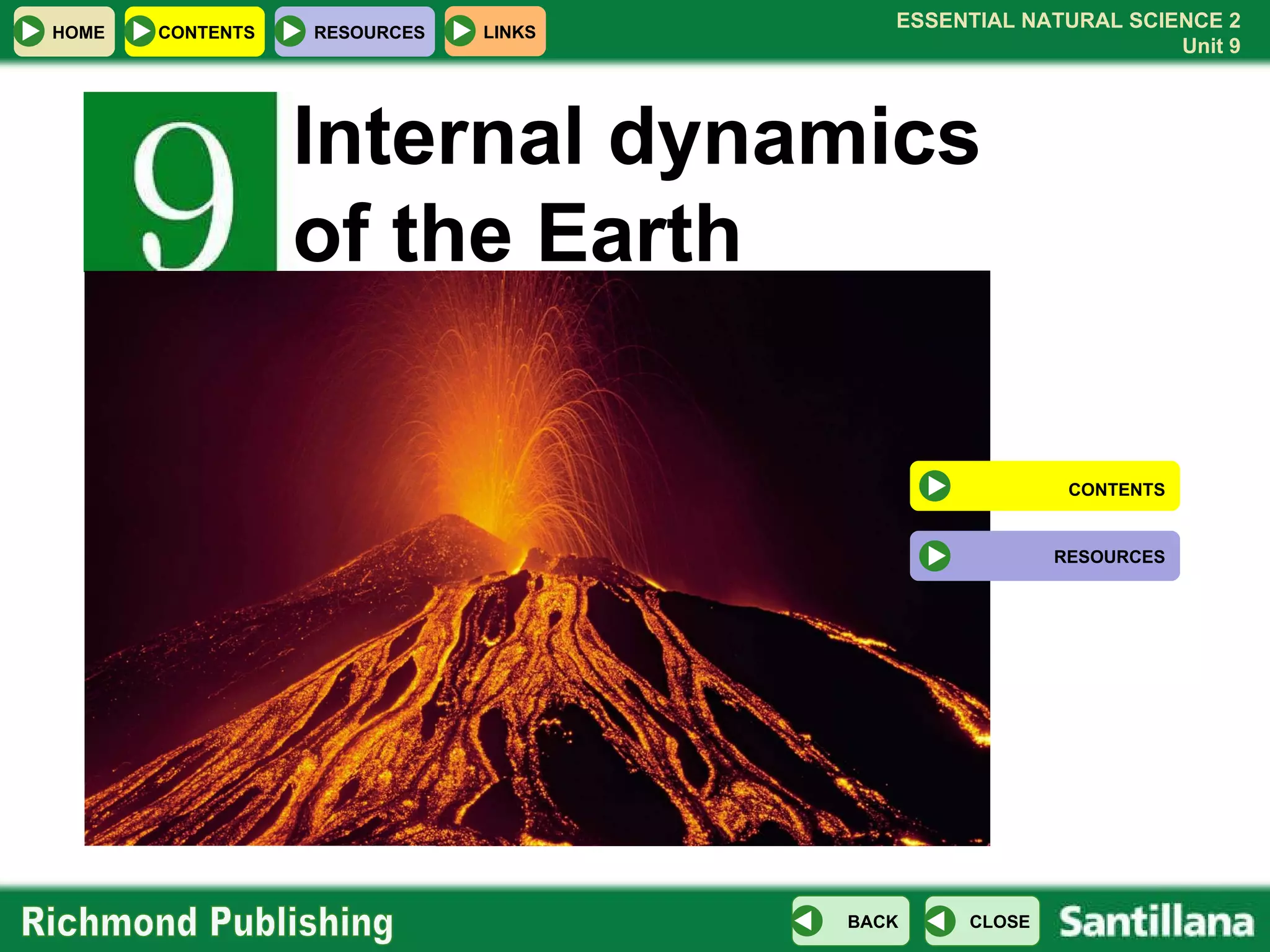
Internal dynamics of the Earth CONTENTS RESOURCES
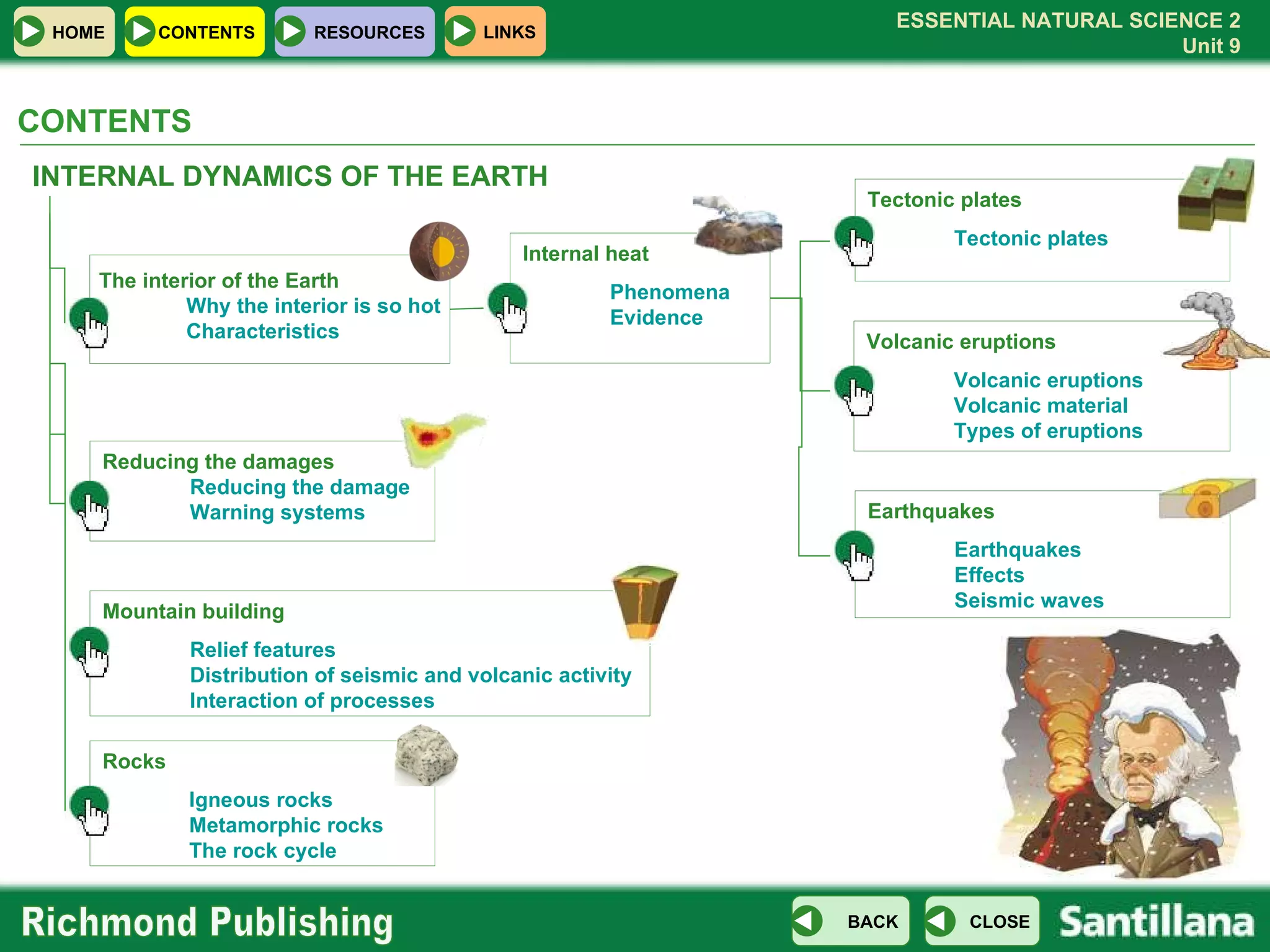
CONTENTS INTERNAL DYNAMICS OF THE EARTH The interior of the Earth Why the interior is so hot Characteristics Volcanic eruptions Volcanic eruptions  Volcanic material Types of eruptions Earthquakes Earthquakes Effects Seismic waves Reducing the damages Reducing the damage Warning systems Mountain building Relief features Distribution of seismic and volcanic activity Interaction of processes Rocks Igneous rocks Metamorphic rocks   The rock cycle Internal heat Phenomena Evidence Tectonic plates Tectonic plates
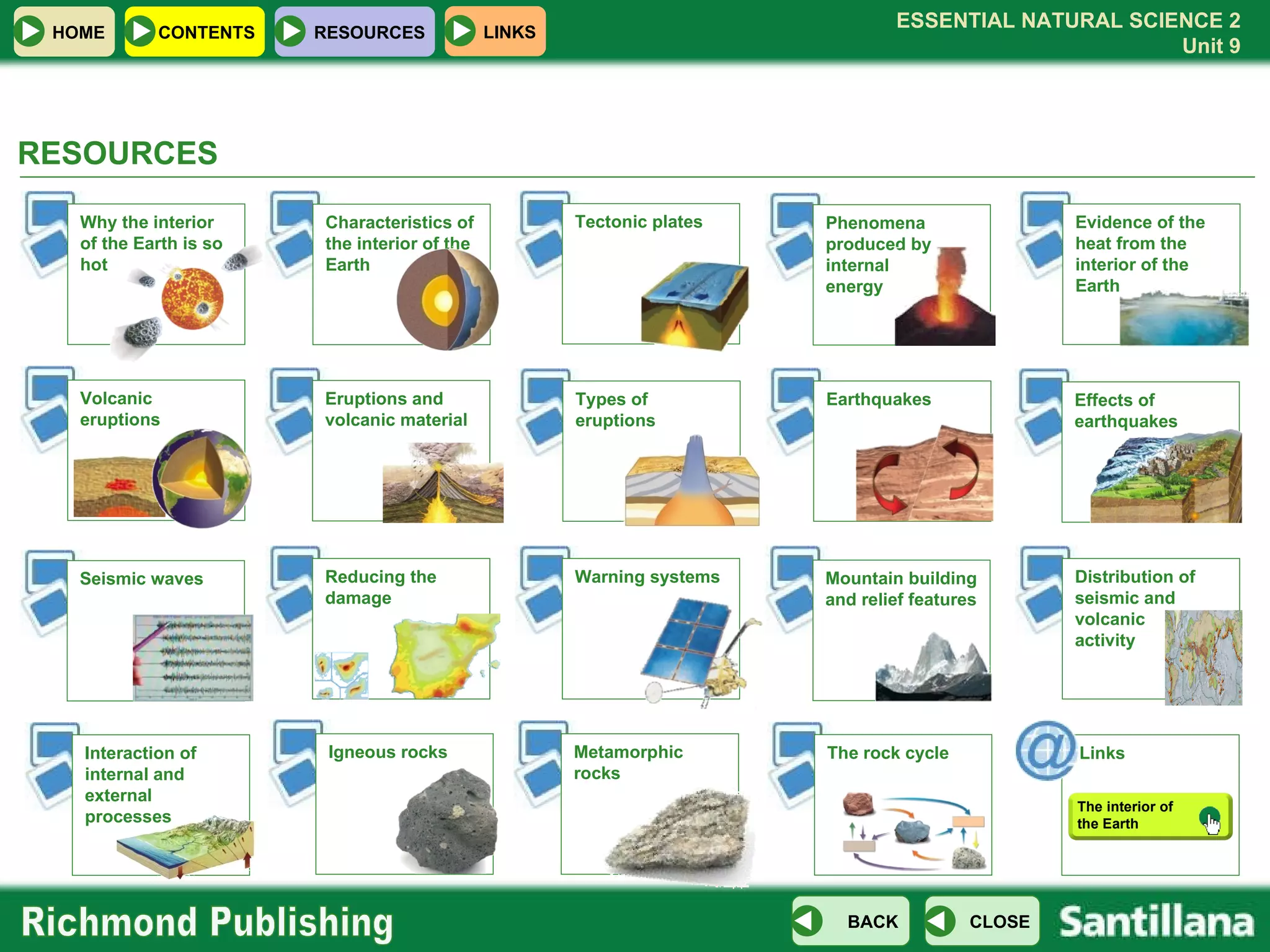
RESOURCES  Evidence of the heat from the interior of the Earth Why the interior of the Earth is so hot Characteristics of the interior of the Earth Phenomena produced by internal energy Volcanic eruptions Eruptions and volcanic material Types of eruptions Earthquakes Effects of earthquakes Reducing the damage Warning systems Mountain building and relief features Interaction of internal and external processes Igneous rocks Metamorphic rocks Seismic waves  Tectonic plates Distribution of seismic and volcanic activity The rock cycle Links The interior of the Earth
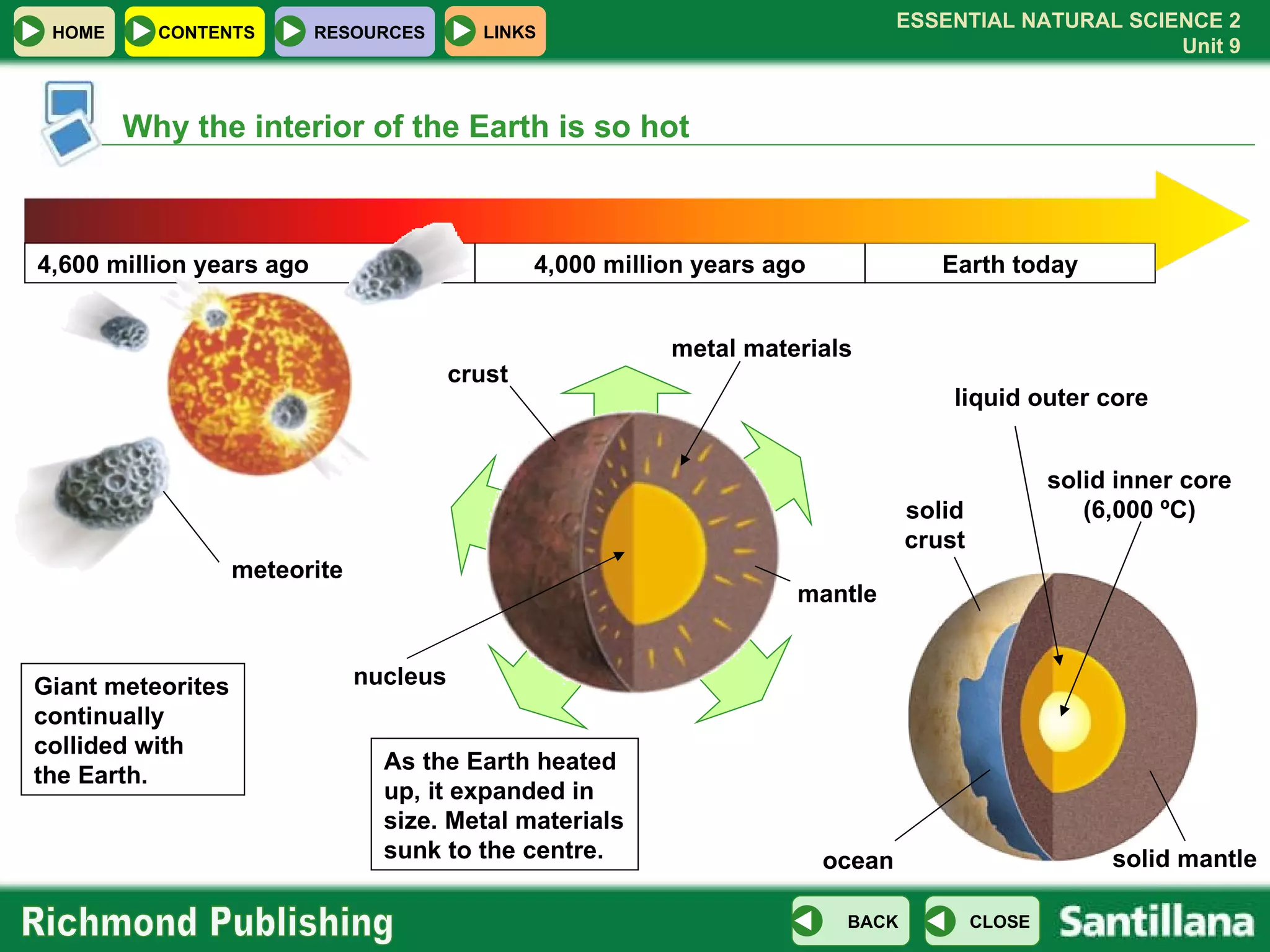
Why the interior of the Earth is so hot meteorite Giant meteorites continually collided with  the Earth. As the Earth heated up, it expanded in size. Metal materials sunk to the centre. Earth today 4,000 million years ago 4,600 million years ago solid crust ocean liquid outer core solid inner core (6,000 ºC) solid mantle metal materials crust mantle nucleus
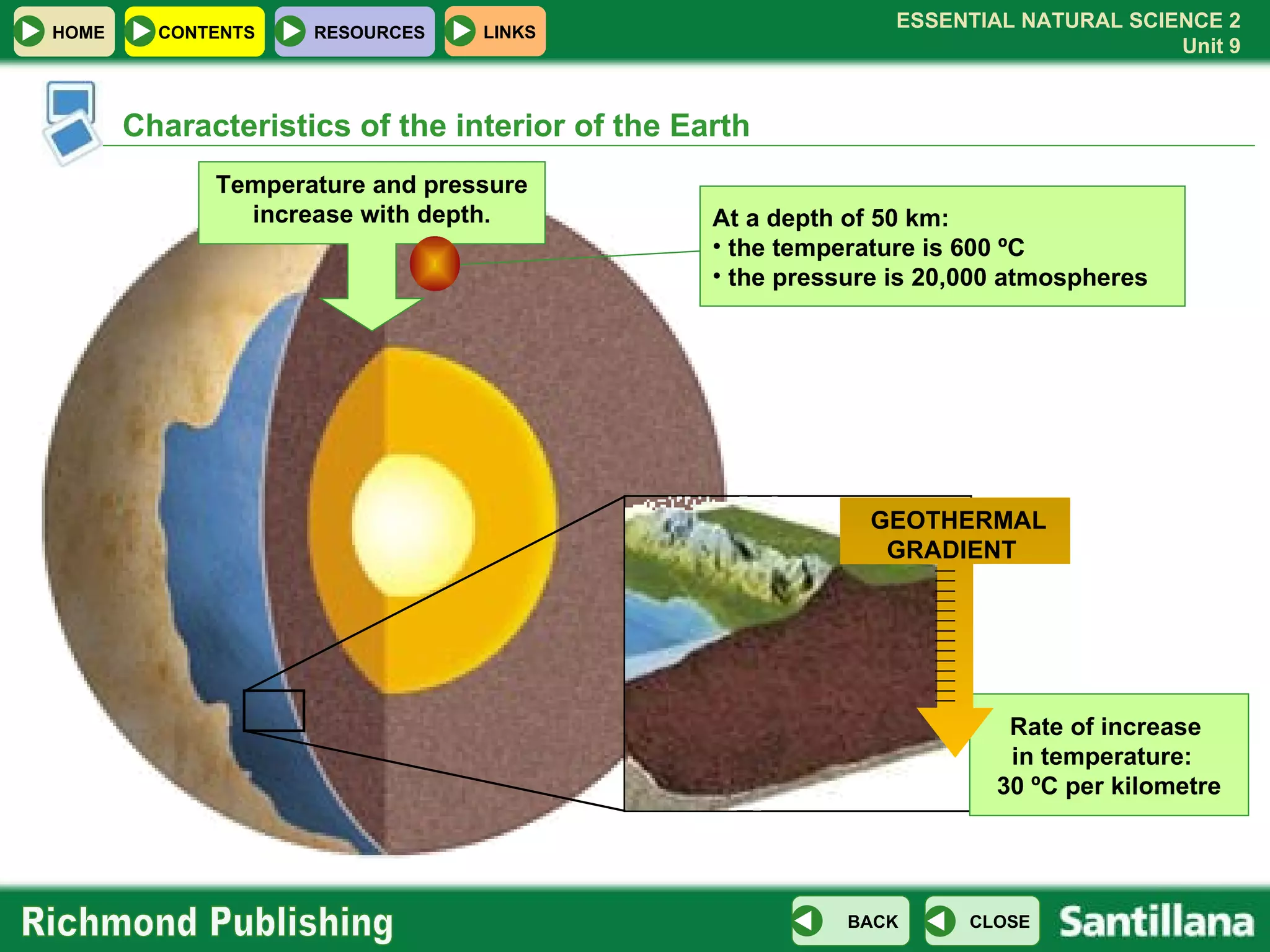
Characteristics of the interior of the Earth At a depth of 50 km: the temperature is 600 ºC the pressure is 20,000 atmospheres Temperature and pressure increase with depth. Rate of increase  in temperature:  30 ºC per kilometre GEOTHERMAL GRADIENT
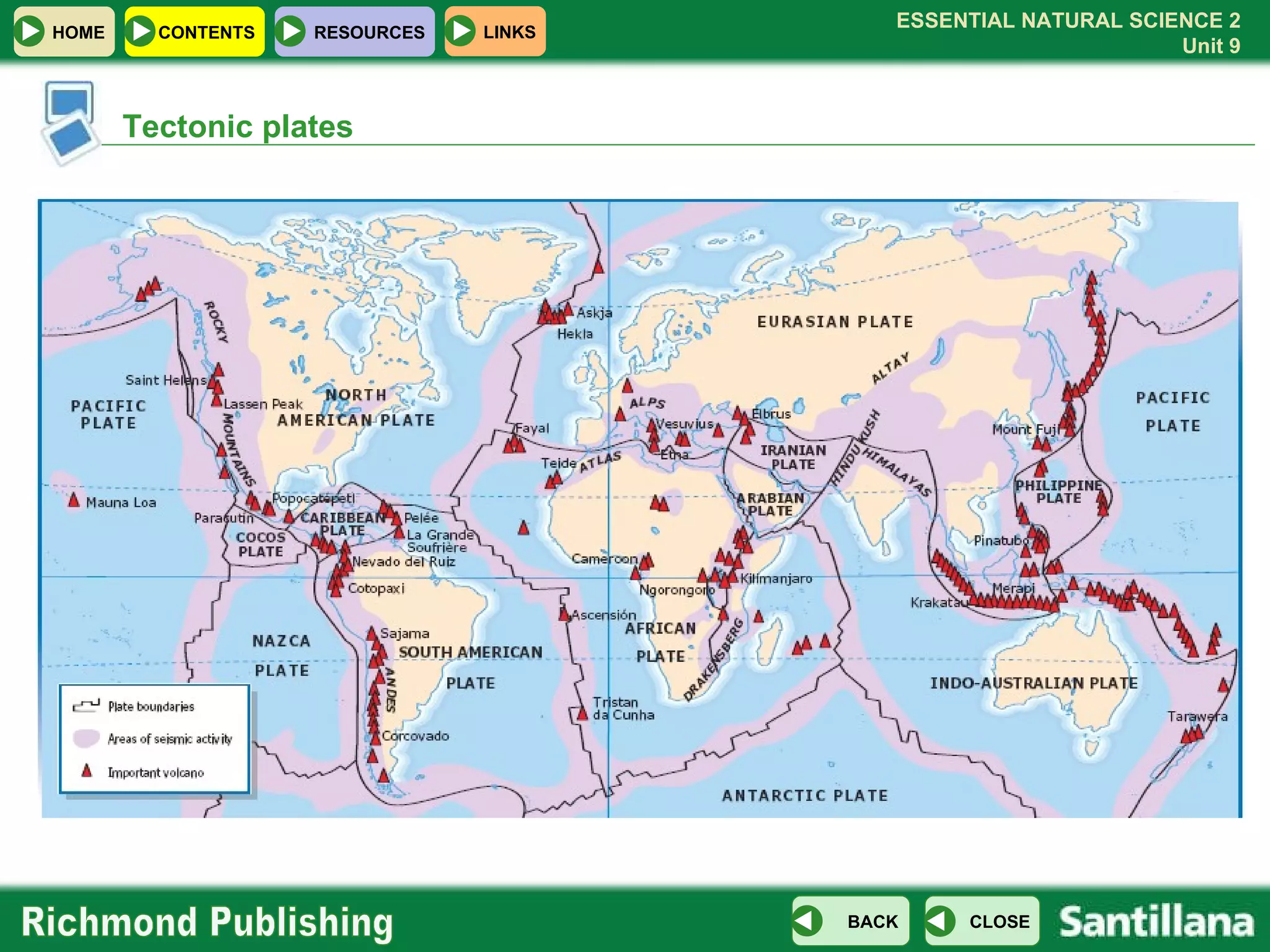
Tectonic plates
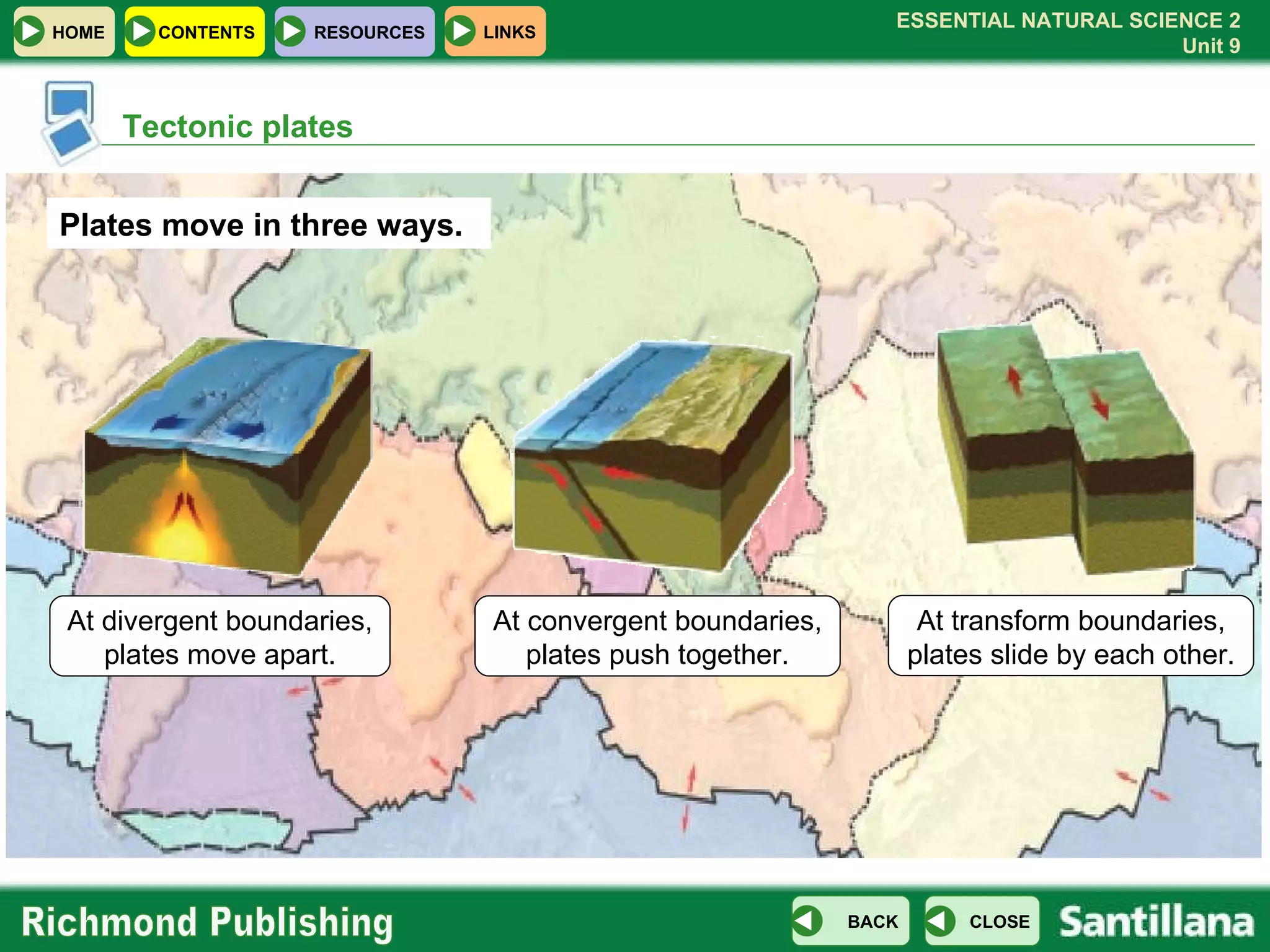
Tectonic plates At divergent boundaries, plates move apart. At convergent boundaries, plates push together. At transform boundaries, plates slide by each other. Plates move in three ways.
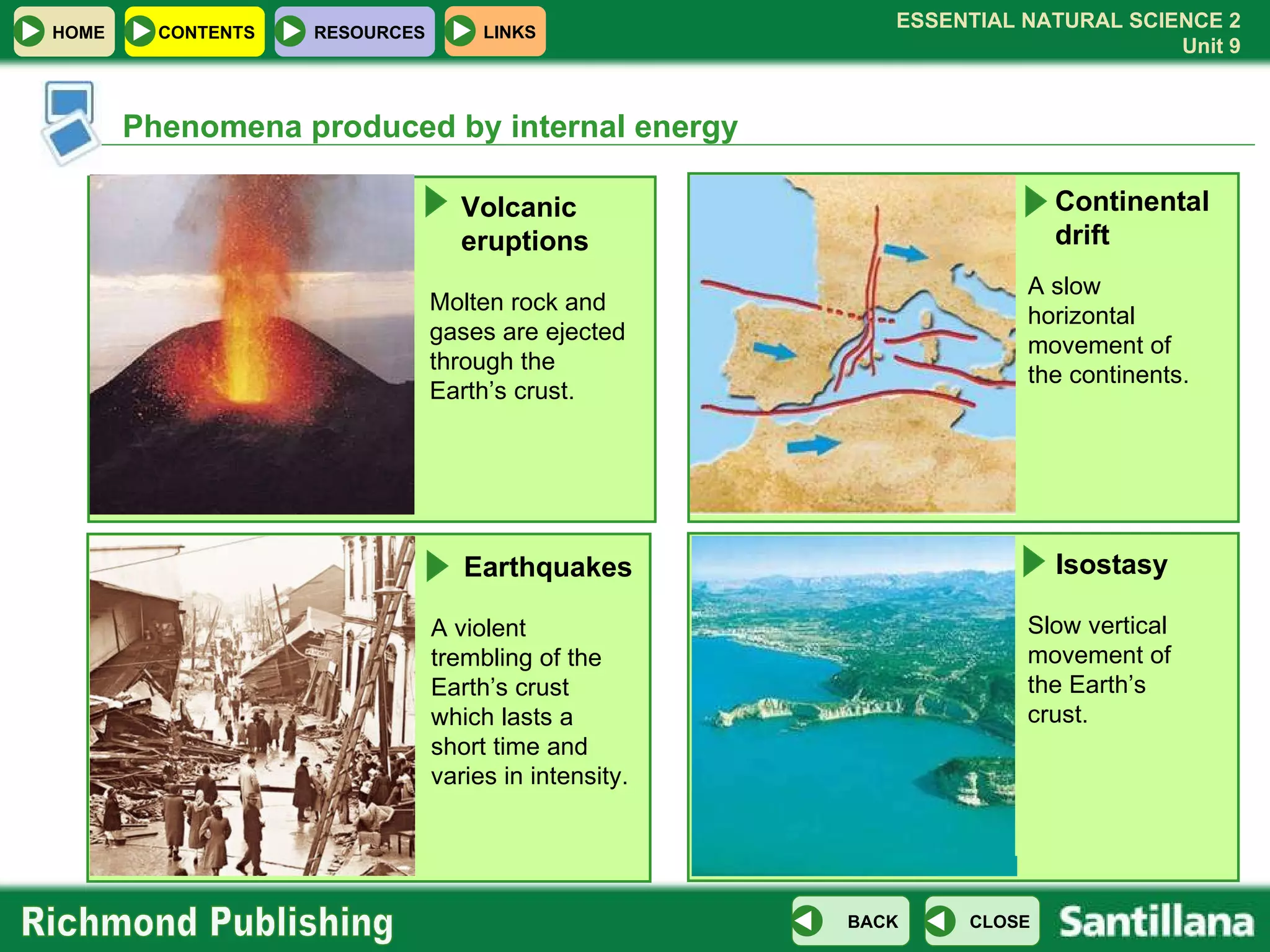
Volcanic  eruptions Molten rock and gases are ejected through the Earth’s crust. Phenomena produced by internal energy Earthquakes A violent trembling of the Earth’s crust which lasts a short time and varies in intensity. Continental drift Isostasy Slow vertical movement of the Earth’s crust. A slow horizontal movement of the continents.
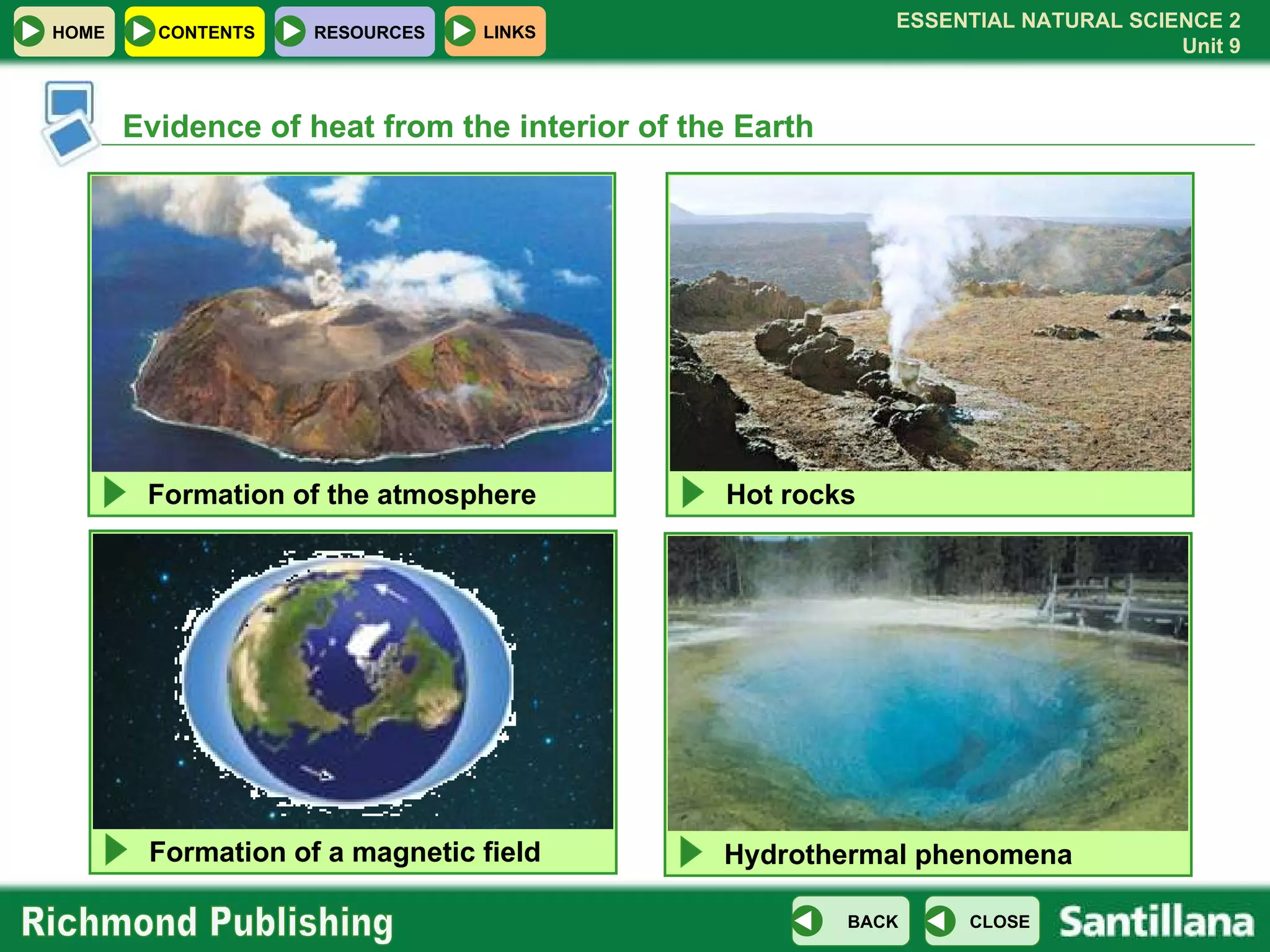
Formation of a magnetic field Evidence of heat from the interior of the Earth Formation of the atmosphere Hot rocks Hydrothermal phenomena
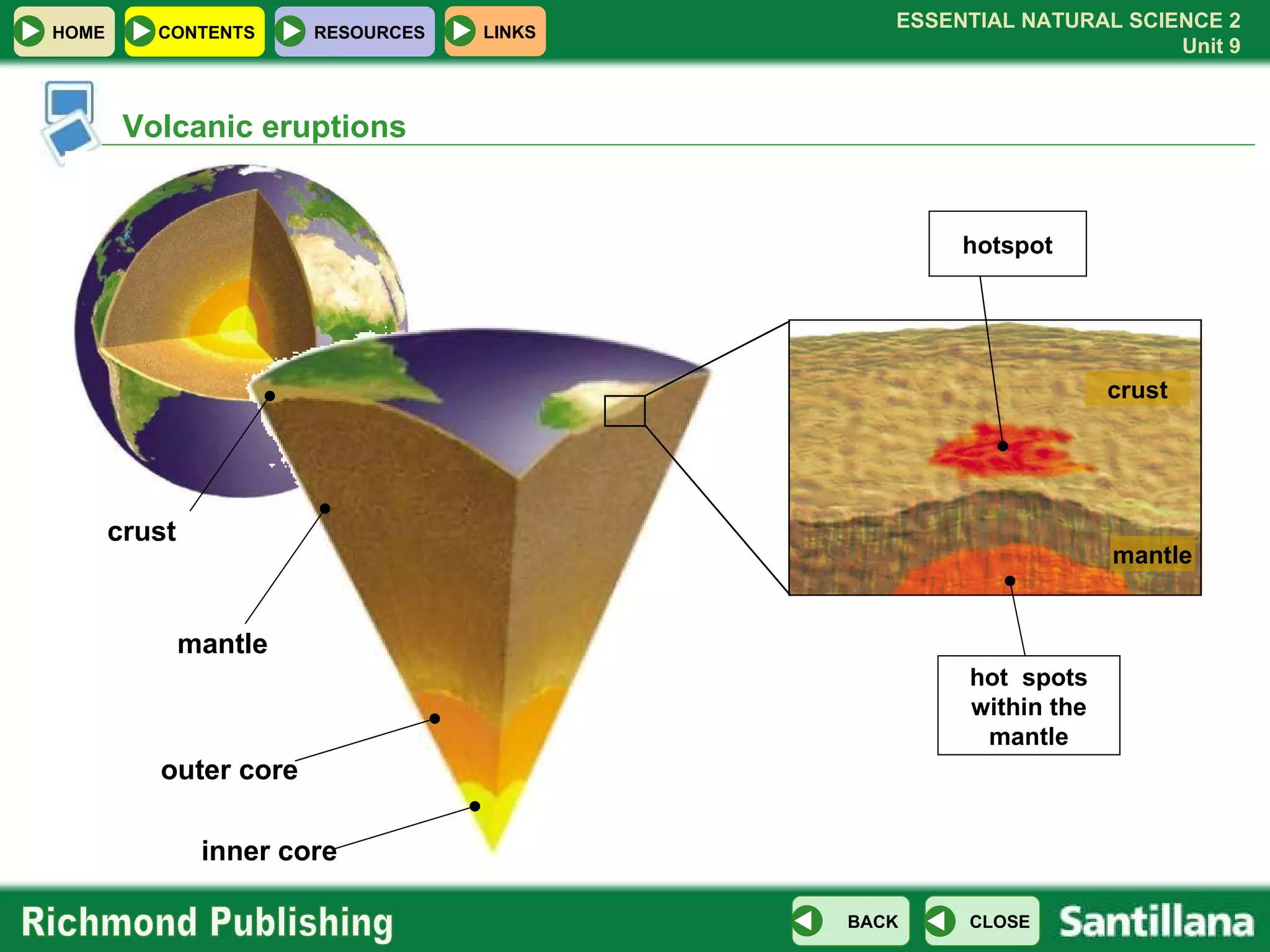
Volcanic eruptions crust mantle outer core inner core crust mantle hotspot hot  spots within the mantle
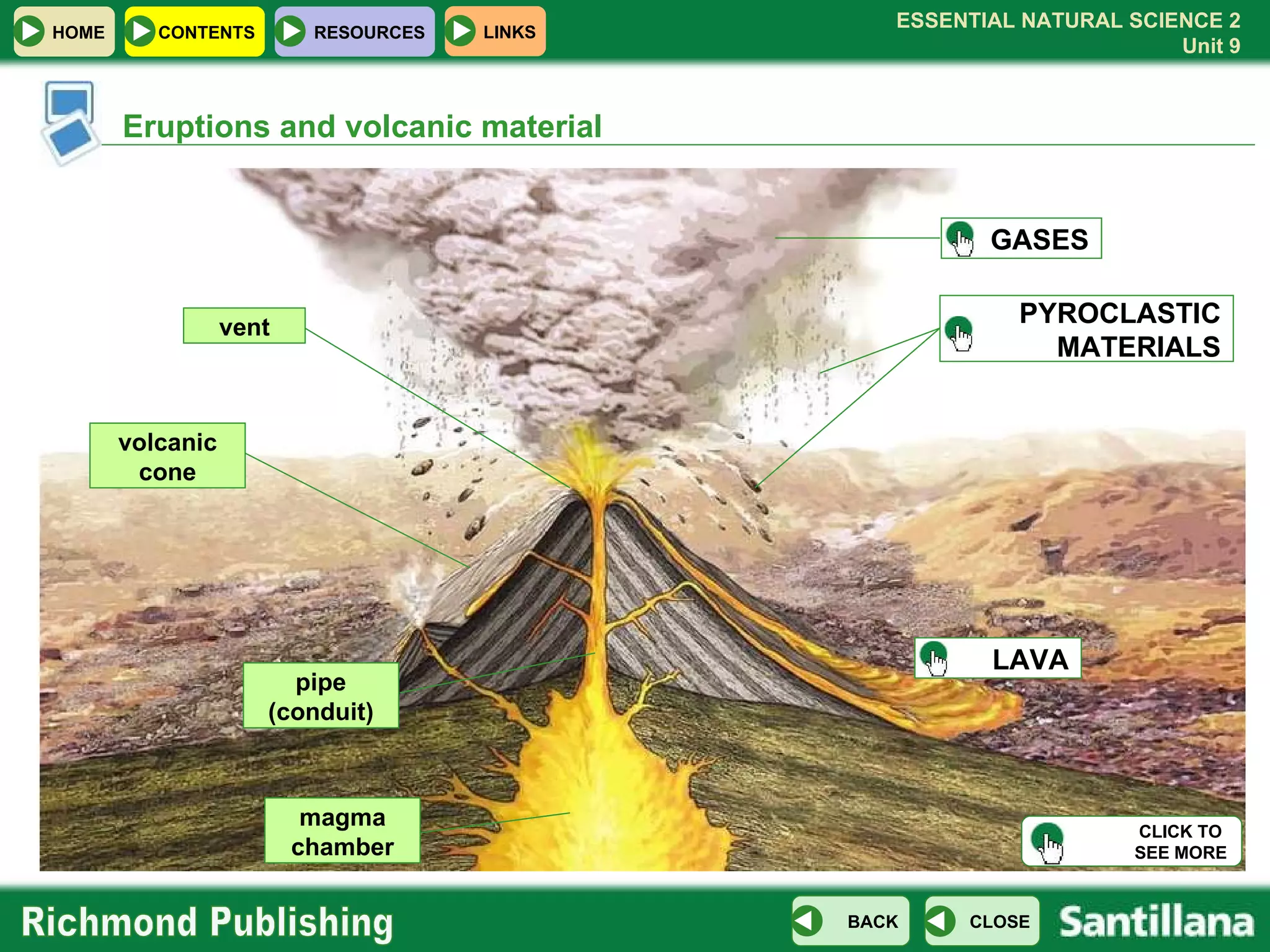
Eruptions and volcanic material vent volcanic cone PYROCLASTIC MATERIALS GASES LAVA magma chamber pipe (conduit) CLICK TO  SEE MORE
Eruptions and volcanic material vent volcanic cone PYROCLASTIC MATERIALS GASES LAVA magma chamber pipe (conduit) CLICK TO  SEE MORE GASES carbon dioxde water vapour sulphur gases carbon monoxide X [close]
Eruptions and volcanic material vent volcanic cone PYROCLASTIC MATERIALS GASES LAVA magma chamber pipe (conduit) CLICK TO  SEE MORE PYROCLASTIC MATERIAL ash lapilli volcanic bombs X [close]
Eruptions and volcanic material Bubbles of gas escape gently. Bubbles of gas splatter and cause explosions. vent volcanic cone PYROCLASTIC MATERIALS GASES LAVA magma chamber pipe (conduit) CLICK TO  SEE MORE HOME CONTENTS RESOURCES LAVA At more than 1,000 ºC,  lava is very liquid and flows easily. At less than 700 ºC,  lava is thick and flows slowly. X [close]
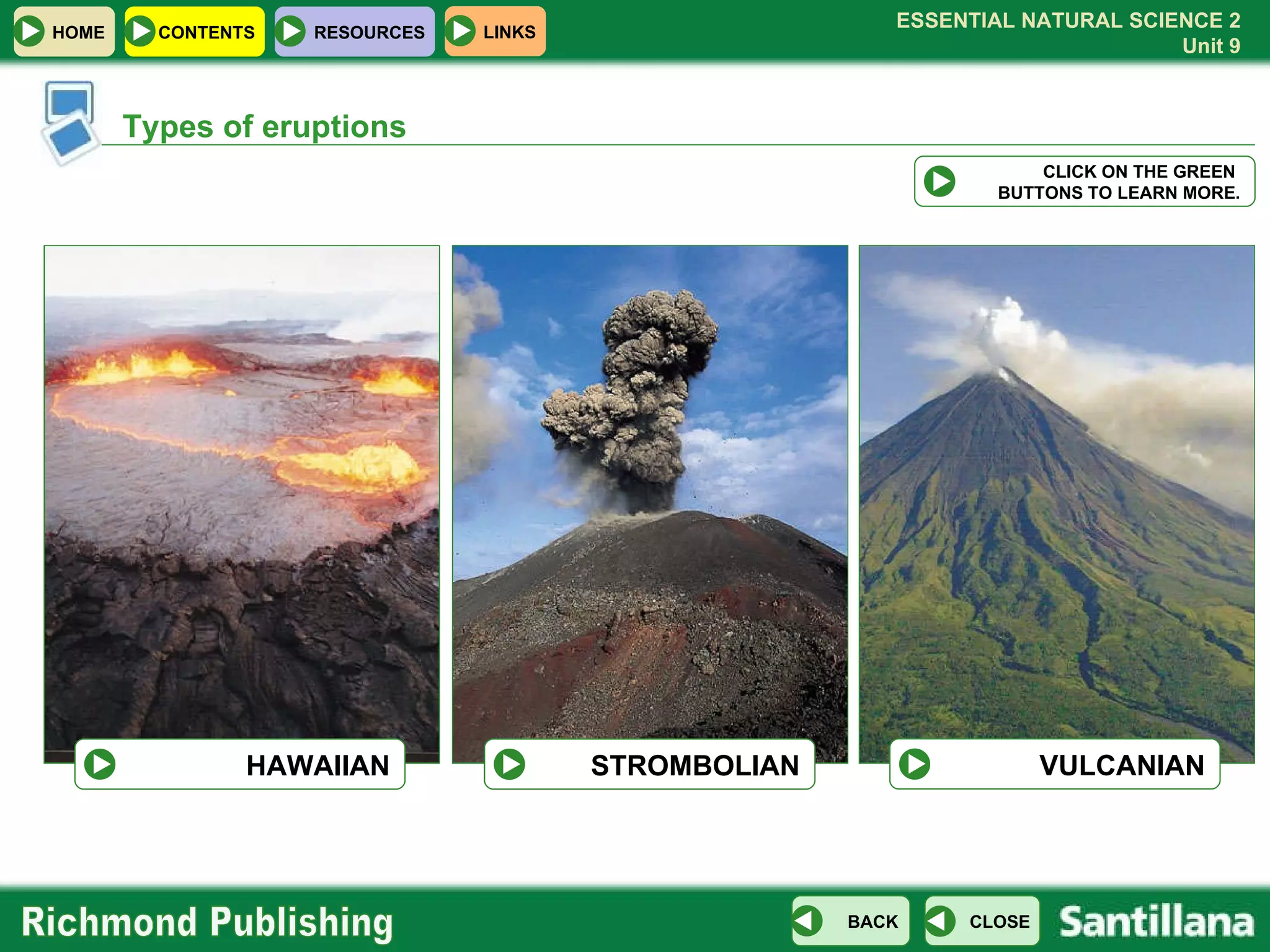
Types of eruptions CLICK ON THE GREEN  BUTTONS TO LEARN MORE. HAWAIIAN STROMBOLIAN VULCANIAN
Types of eruptions HAWAIIAN CLICK ON THE GREEN  BUTTONS TO LEARN MORE. STROMBOLIAN VULCANIAN magma temperature: very high (over 1,000 ºC) very liquid lava not very destructive nor explosive Shield volcano magma chamber central vent pipe (conduit) X [close]
Types of eruptions CLICK ON THE GREEN  BUTTONS TO LEARN MORE. HAWAIIAN STROMBOLIAN VULCANIAN STROMBOLIAN magma temperature:  moderate (700 - 1,000 ºC) thick lava explosive pyroclastic material pipe (conduit) Stratovolcano (composite volcano) magma chamber volcanic cone central vent X [close]
Types of eruptions CLICK ON THE GREEN  BUTTONS TO LEARN MORE. HAWAIIAN STROMBOLIAN VULCANIAN VULCANIAN magma temperature: low (less than 700 ºC) violent, destructive explosions generally gases and ash are expelled magma chamber Dome volcano volcanic pipe of  solidified lava X [close]
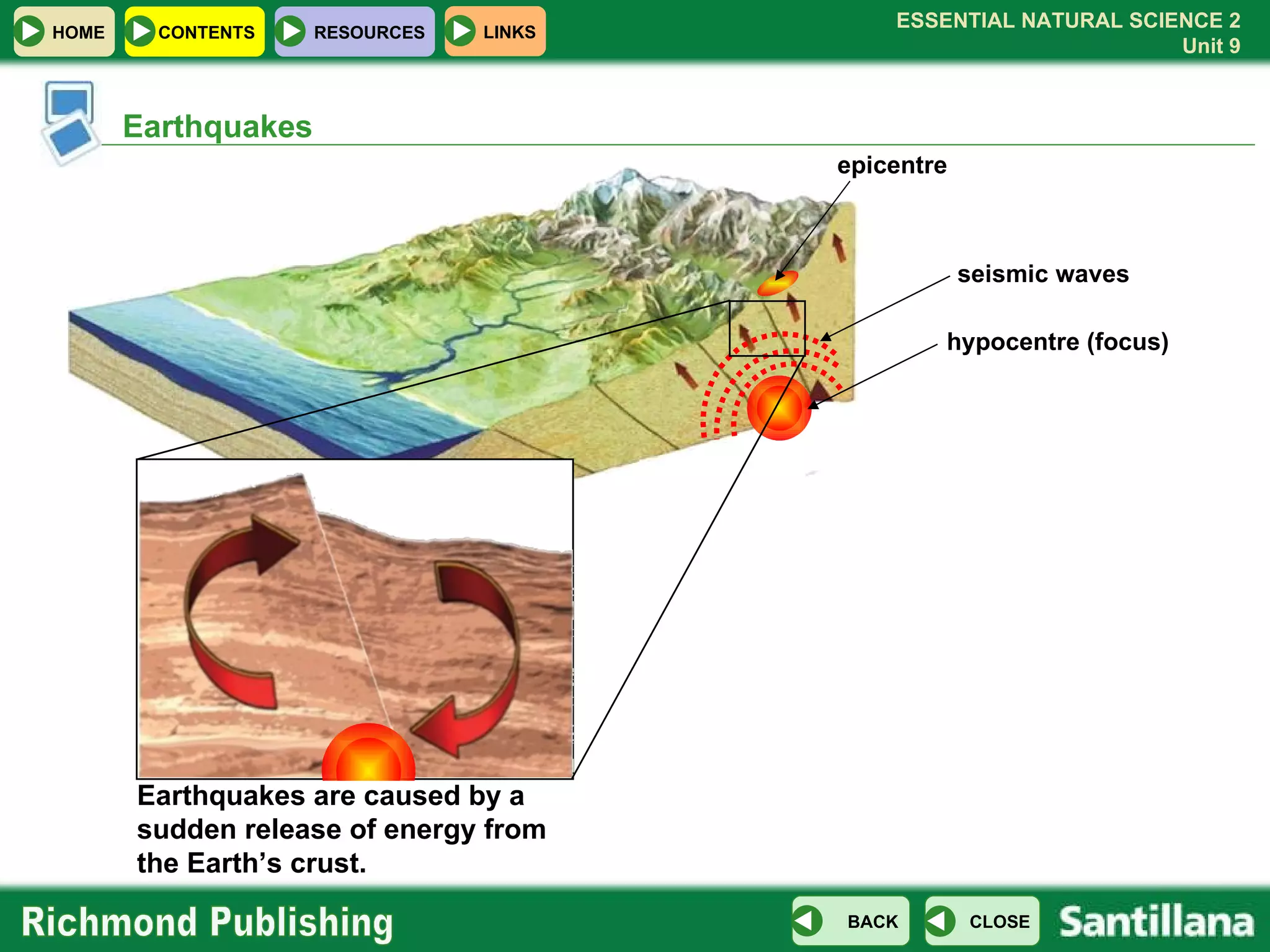
Earthquakes seismic waves epicentre hypocentre (focus) Earthquakes are caused by a sudden release of energy from  the Earth’s crust.
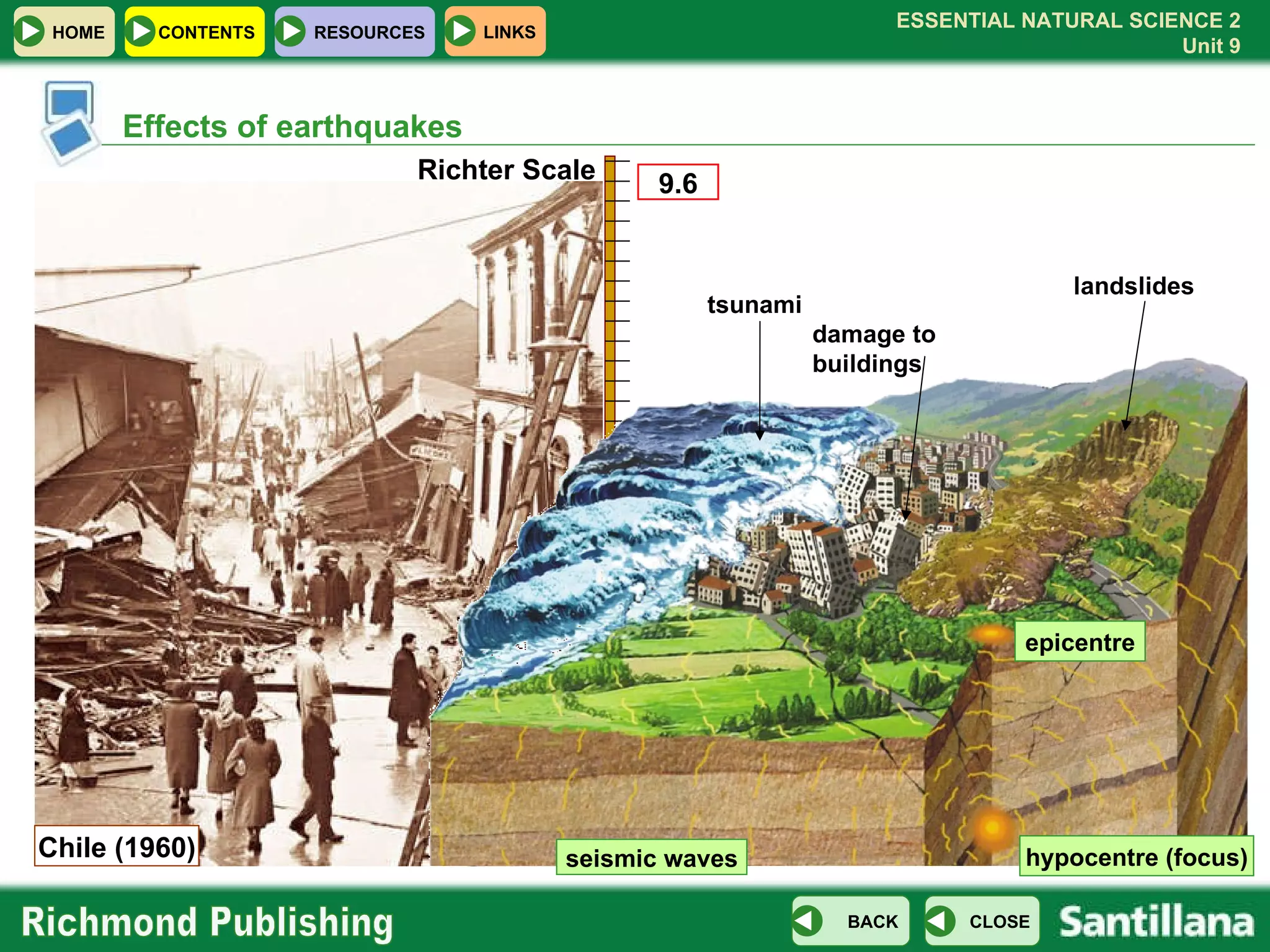
Effects of earthquakes 9.6 Richter Scale Chile (1960) hypocentre (focus) epicentre landslides damage to buildings tsunami seismic waves
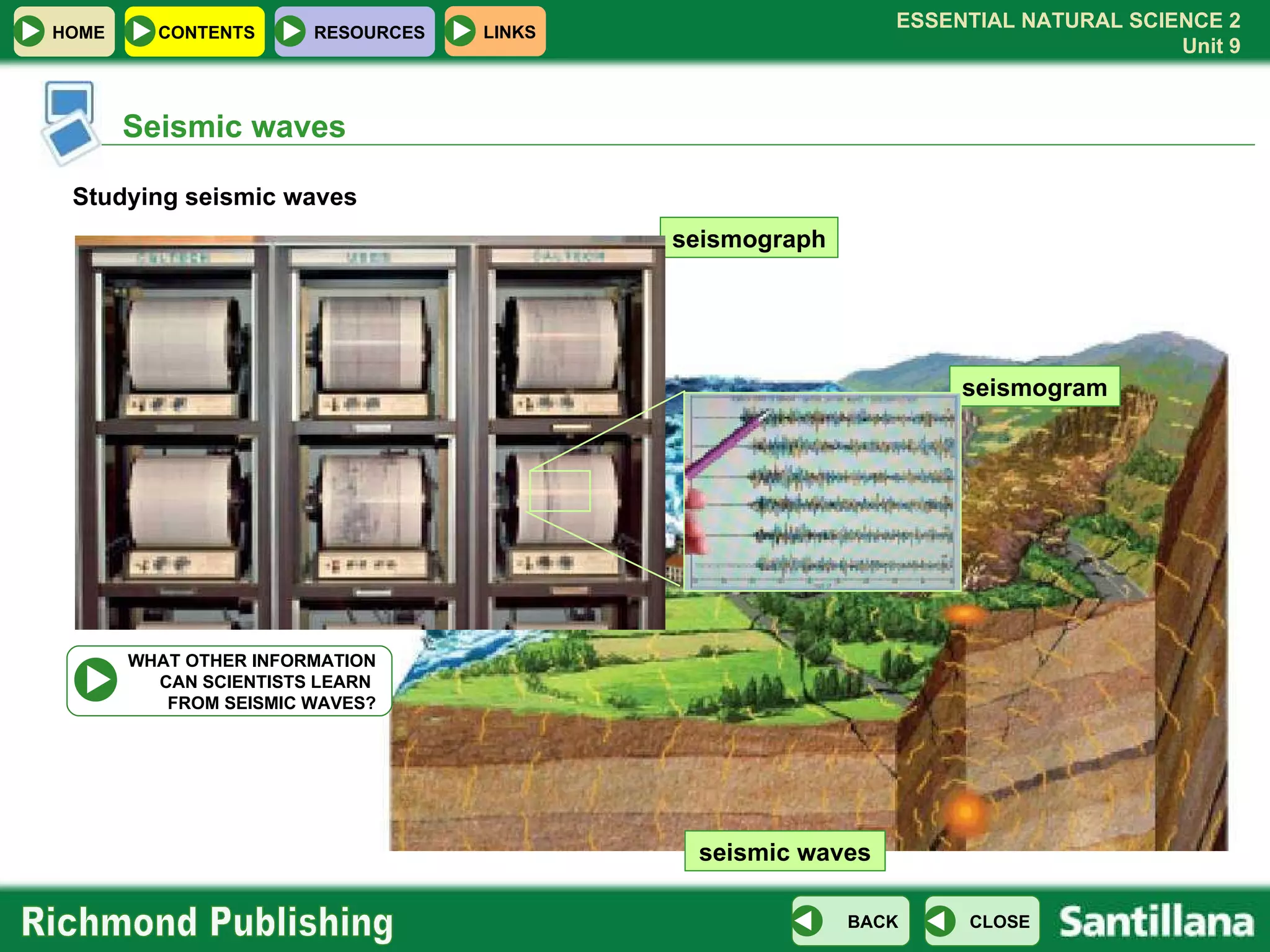
seismogram seismograph Seismic waves Studying seismic waves seismic waves WHAT OTHER INFORMATION CAN SCIENTISTS LEARN  FROM SEISMIC WAVES?
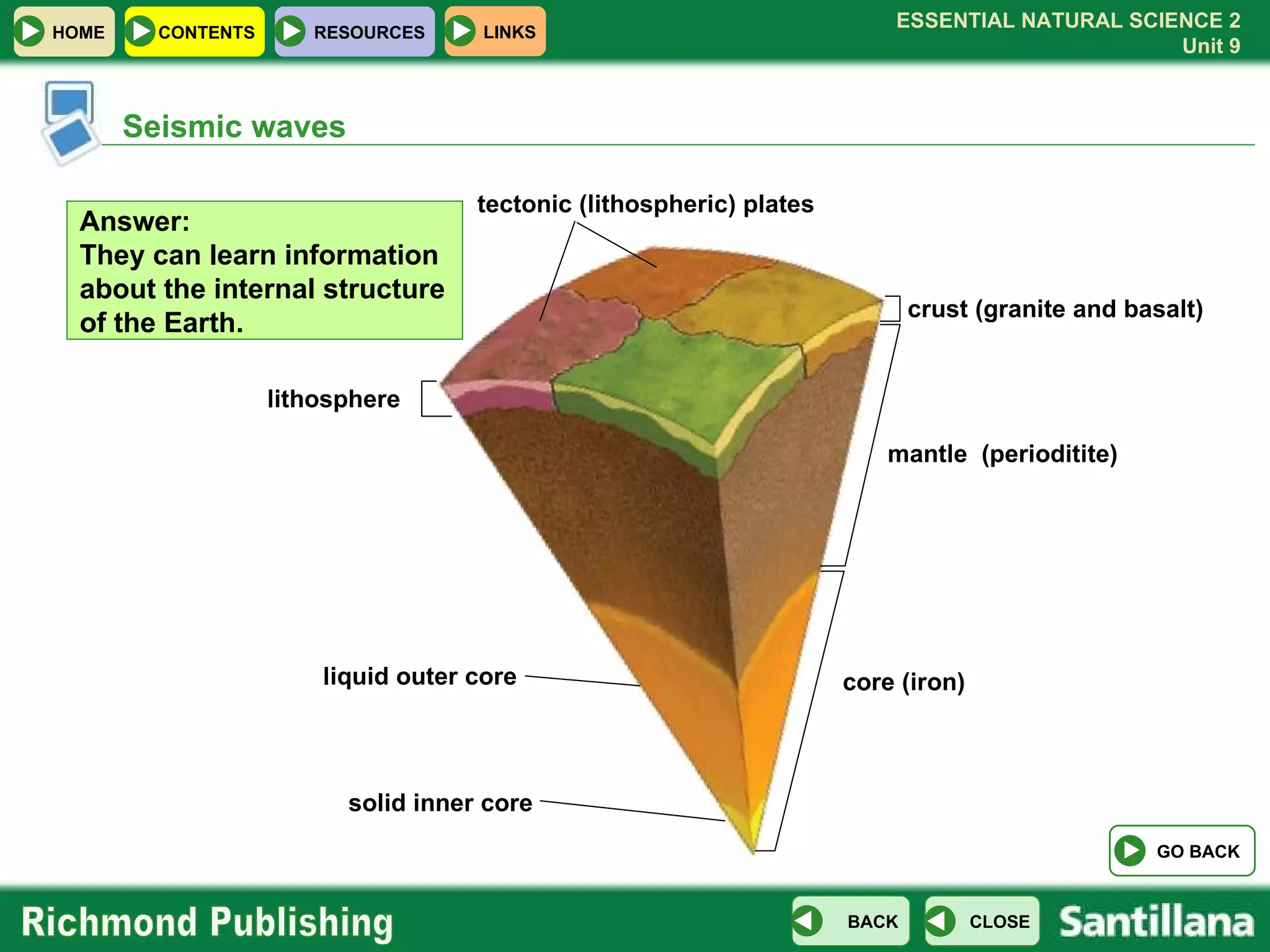
Seismic waves Answer:  They can learn information about the internal structure of the Earth. liquid outer core solid inner core lithosphere tectonic (lithospheric) plates crust (granite and basalt) mantle  (perioditite) core (iron) GO BACK
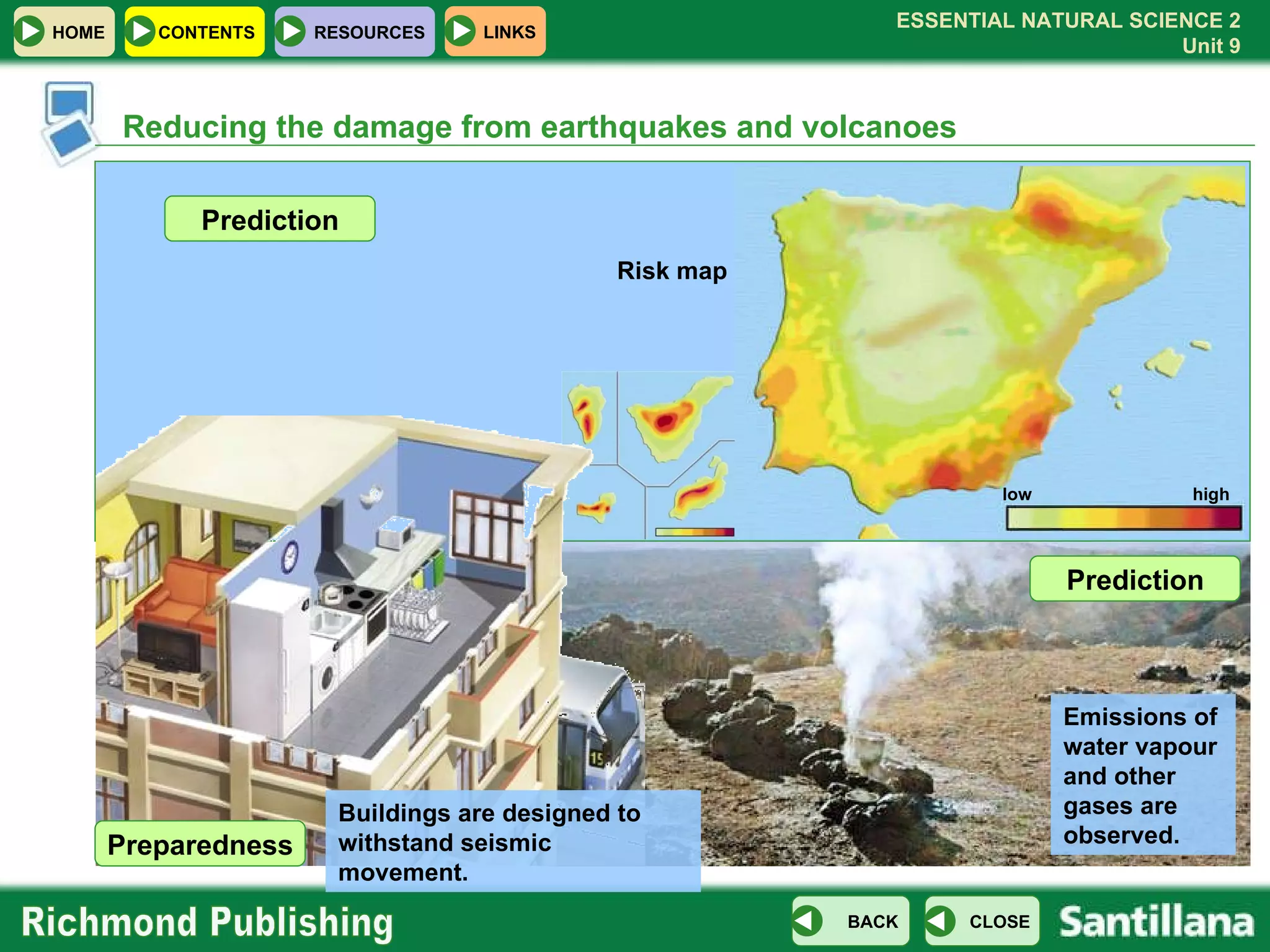
Reducing the damage from earthquakes and volcanoes Preparedness Prediction Emissions of water vapour and other gases are observed. Buildings are designed to withstand seismic movement. low  high Prediction Risk map
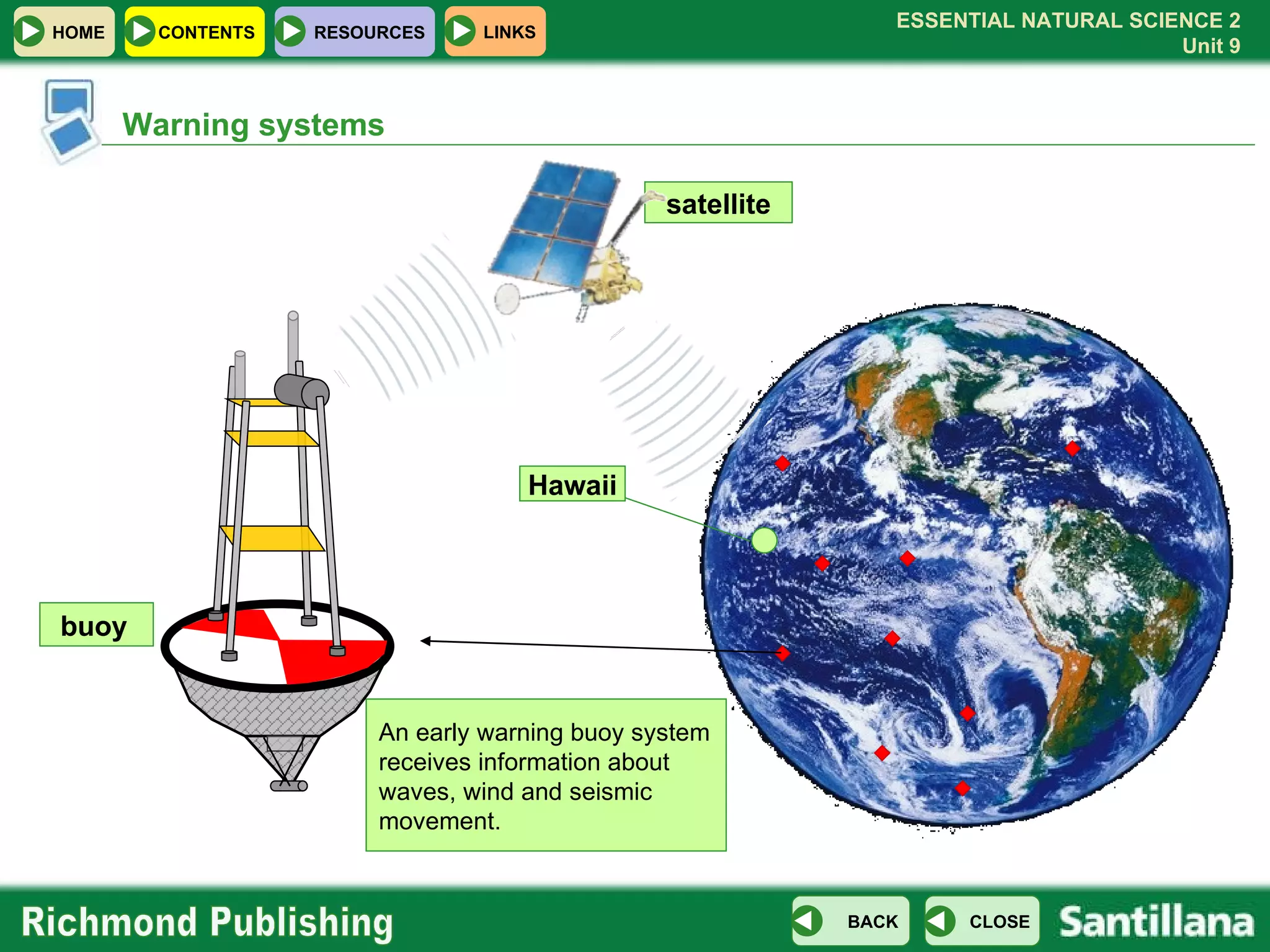
satellite An early warning buoy system receives information about waves, wind and seismic movement. Warning systems buoy Hawaii
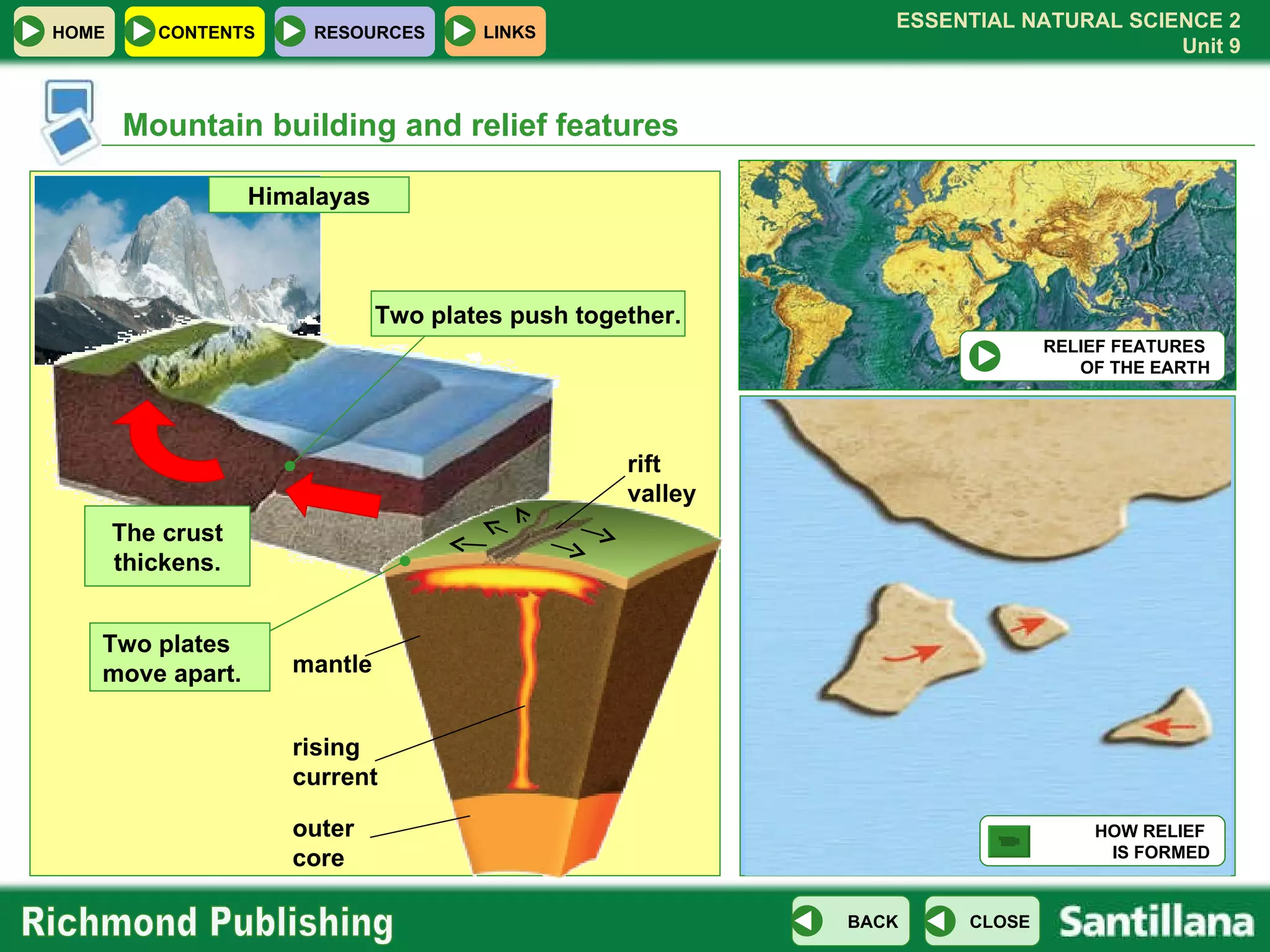
Mountain building and relief features RELIEF FEATURES  OF THE EARTH HOW RELIEF  IS FORMED The crust thickens. outer core mantle rift valley Two plates  move apart. rising current Himalayas Two plates push together.
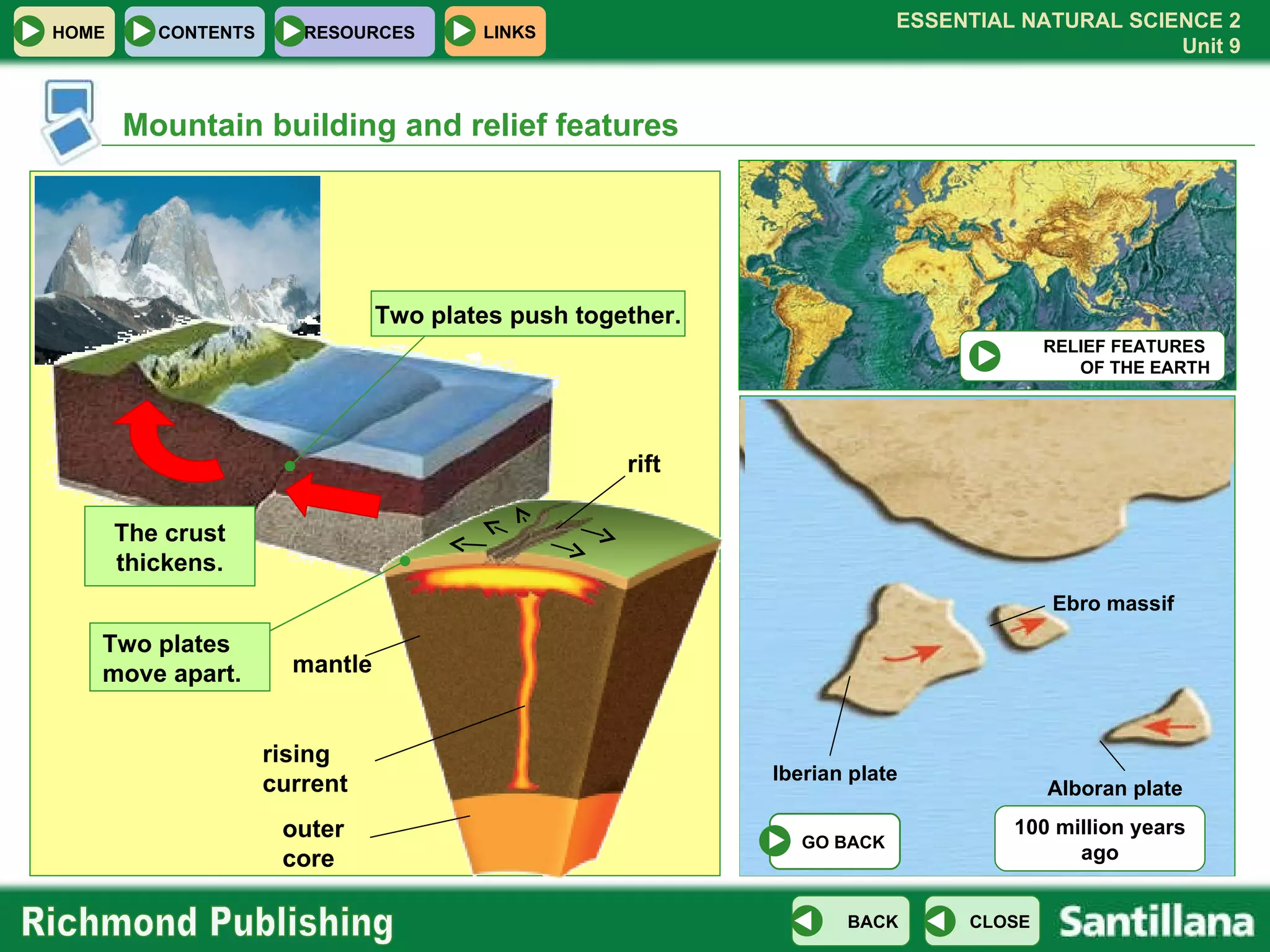
20 million years ago 60 million years ago 100 million years ago Mountain building and relief features Two plates push together. outer core mantle rift rising current The crust thickens. Two plates  move apart. Pyrenees Betic ranges Alboran  plate Iberian plate Eurasia Iberian plate Alboran plate Ebro massif HOME CONTENTS RESOURCES RELIEF FEATURES  OF THE EARTH GO BACK
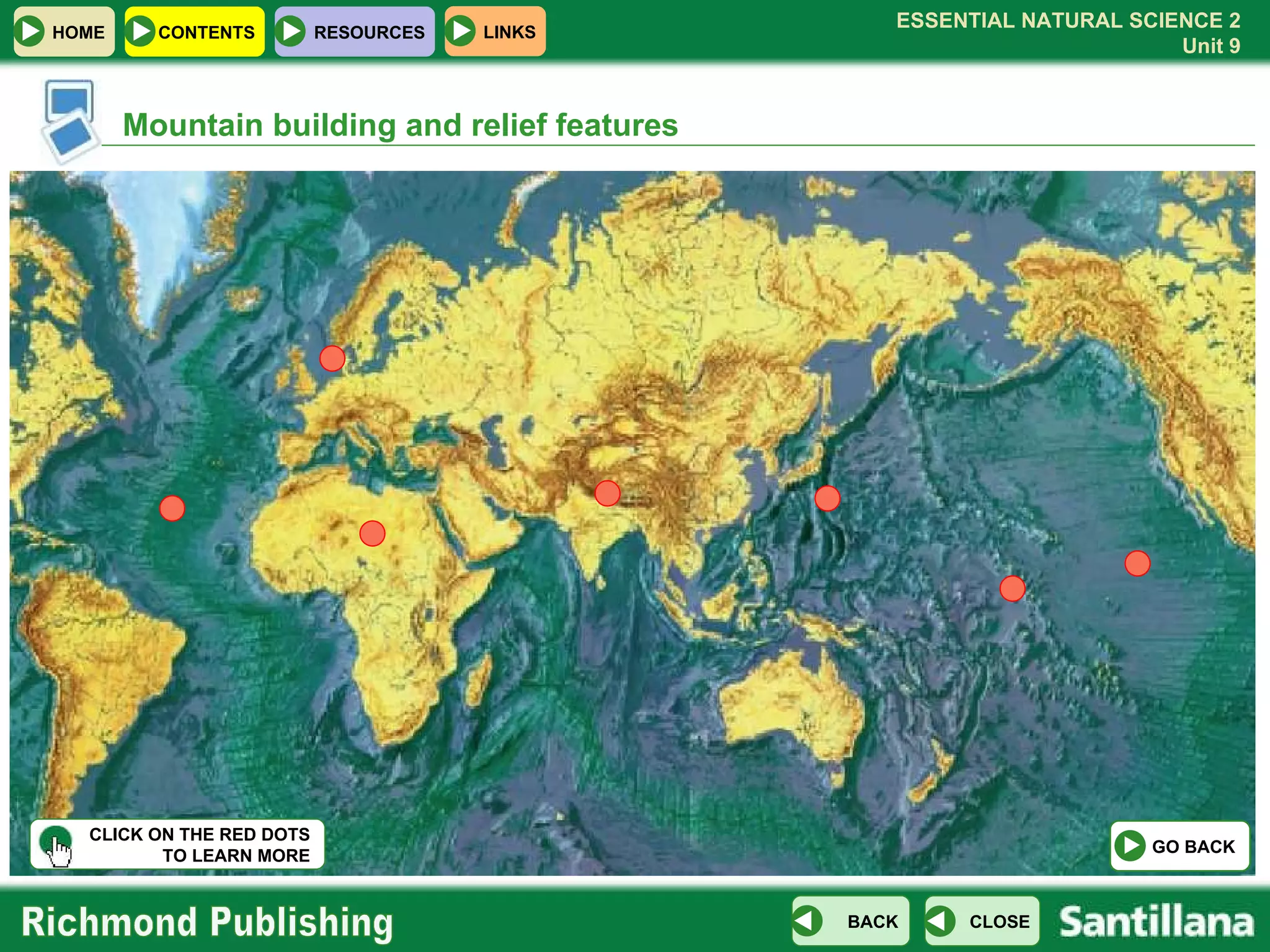
Mountain building and relief features CLICK ON THE RED DOTS TO LEARN MORE GO BACK
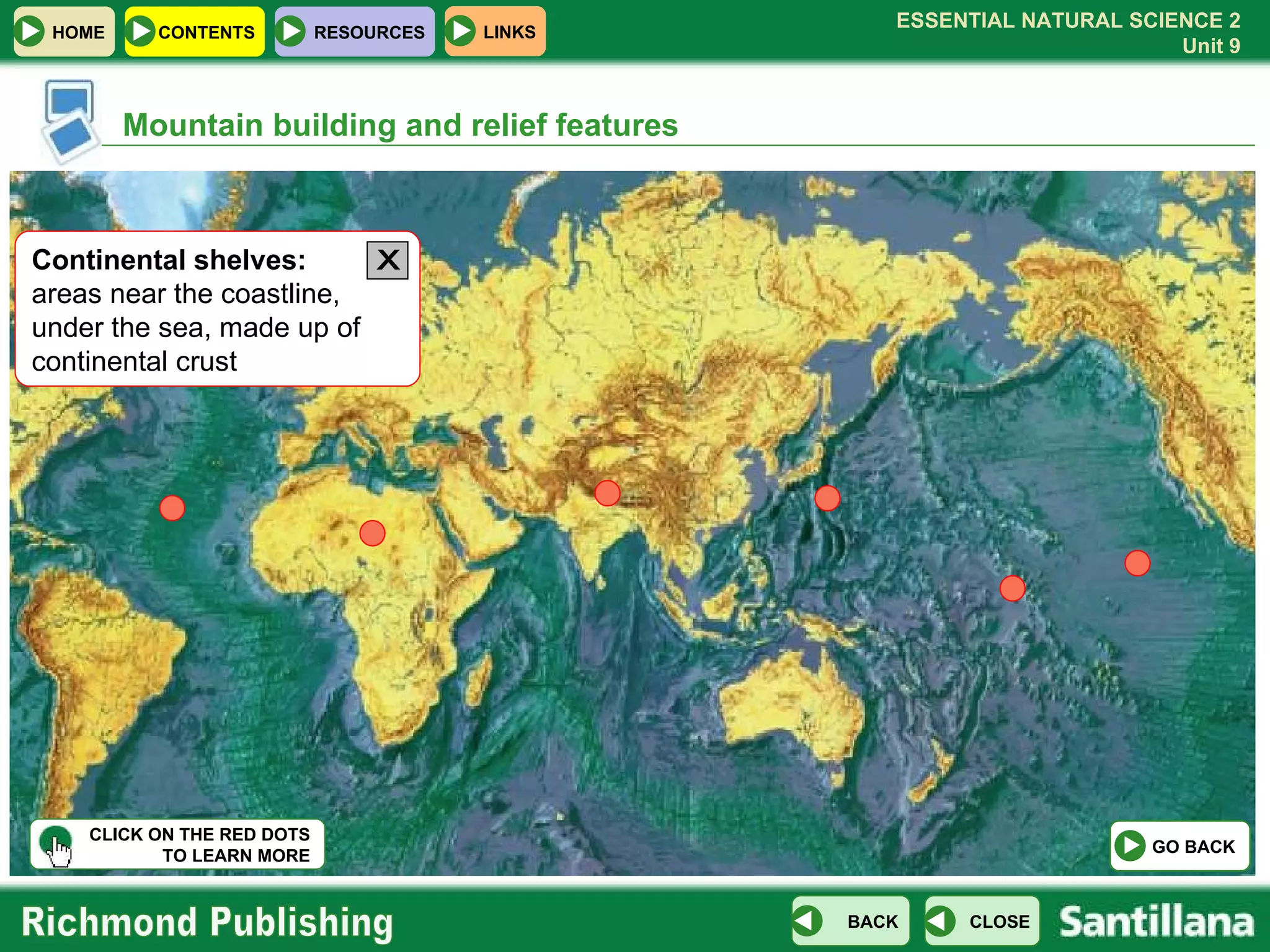
Mountain building and relief features Continental shelves:  areas near the coastline, under the sea, made up of continental crust CLICK ON THE RED DOTS TO LEARN MORE X GO BACK
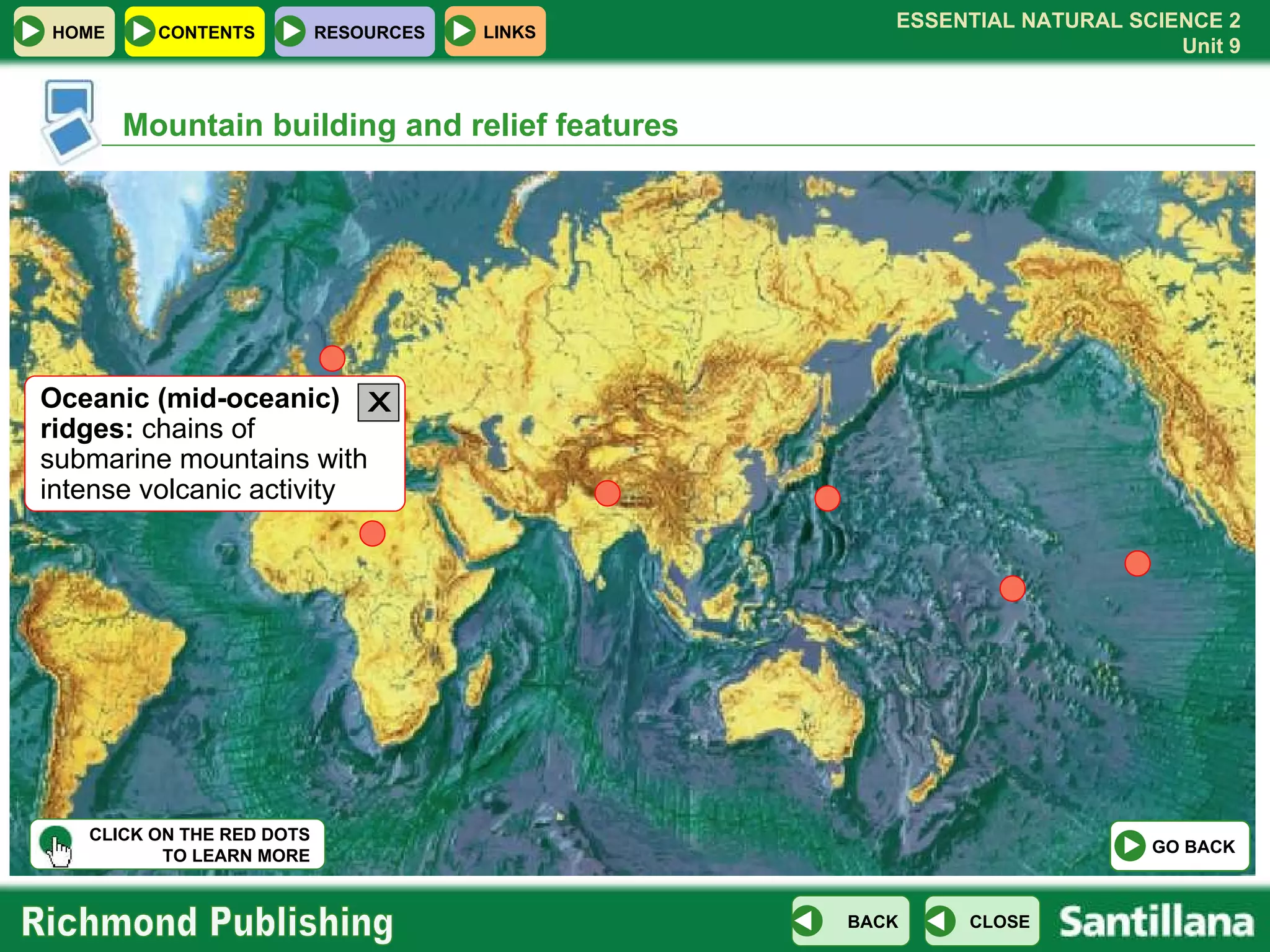
Mountain building and relief features Oceanic (mid-oceanic) ridges:  chains of submarine mountains with intense volcanic activity CLICK ON THE RED DOTS TO LEARN MORE X GO BACK
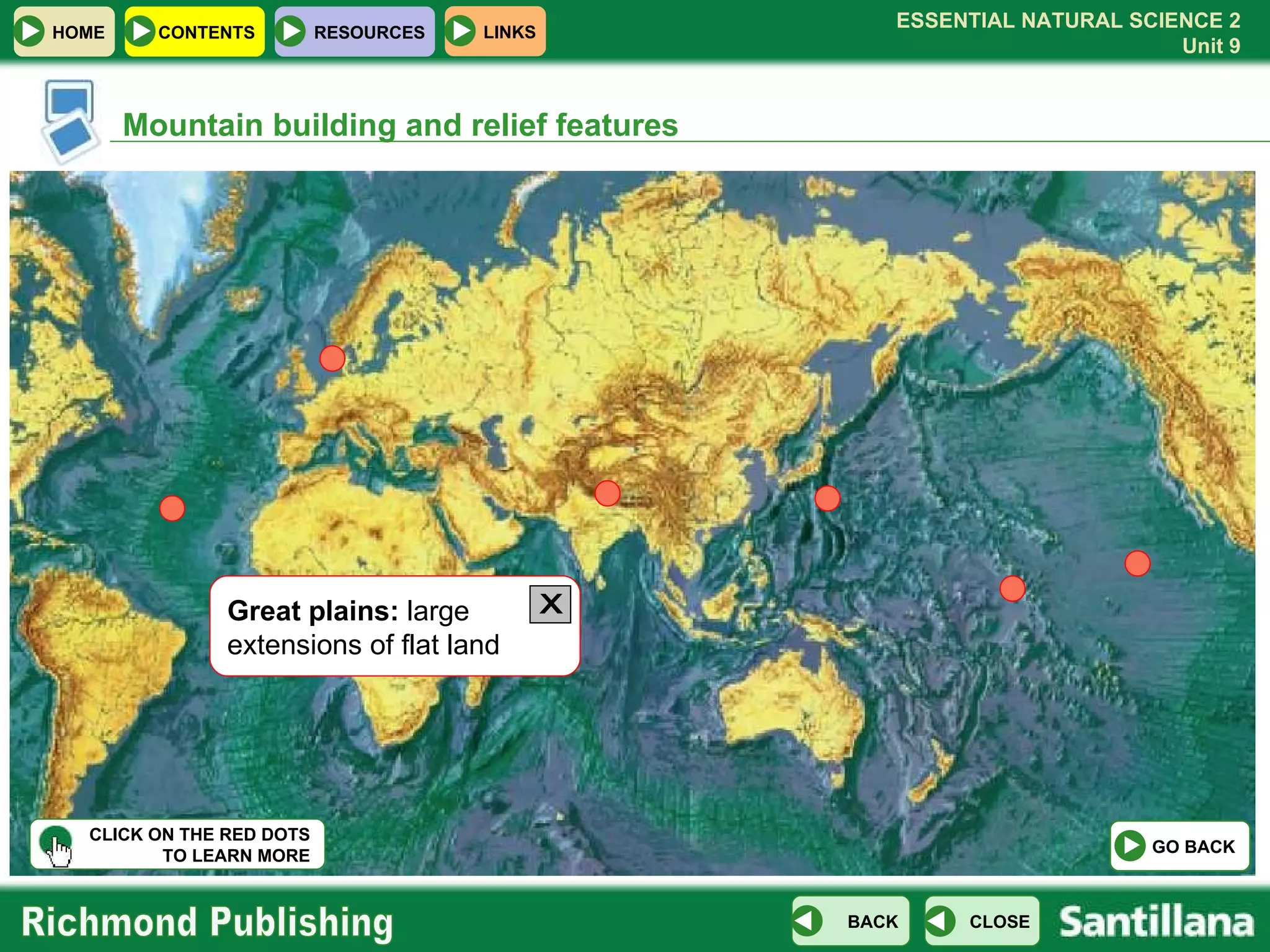
Mountain building and relief features Great plains:  large extensions of flat land CLICK ON THE RED DOTS TO LEARN MORE X GO BACK
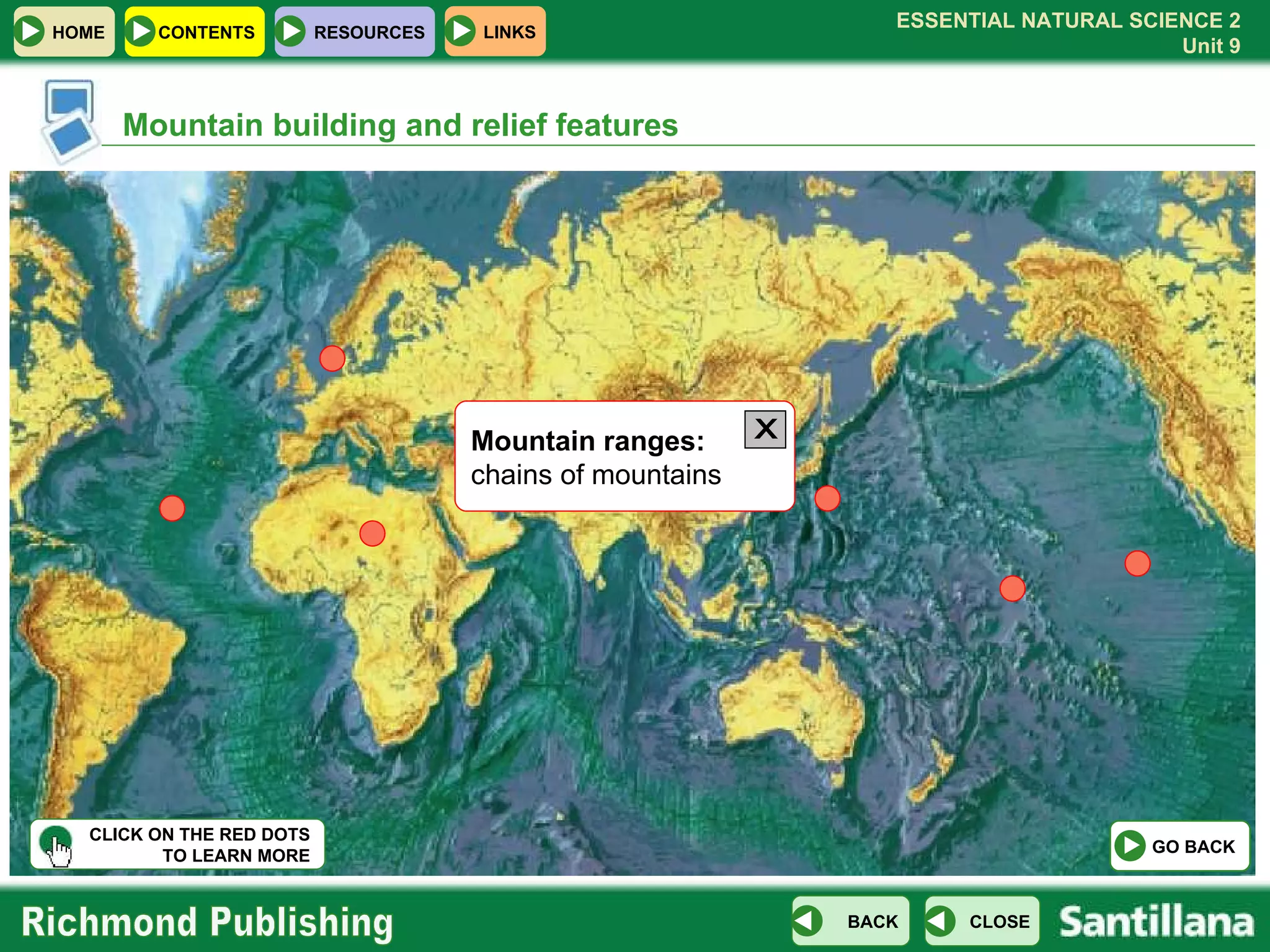
Mountain building and relief features Mountain ranges: chains of mountains CLICK ON THE RED DOTS TO LEARN MORE X GO BACK
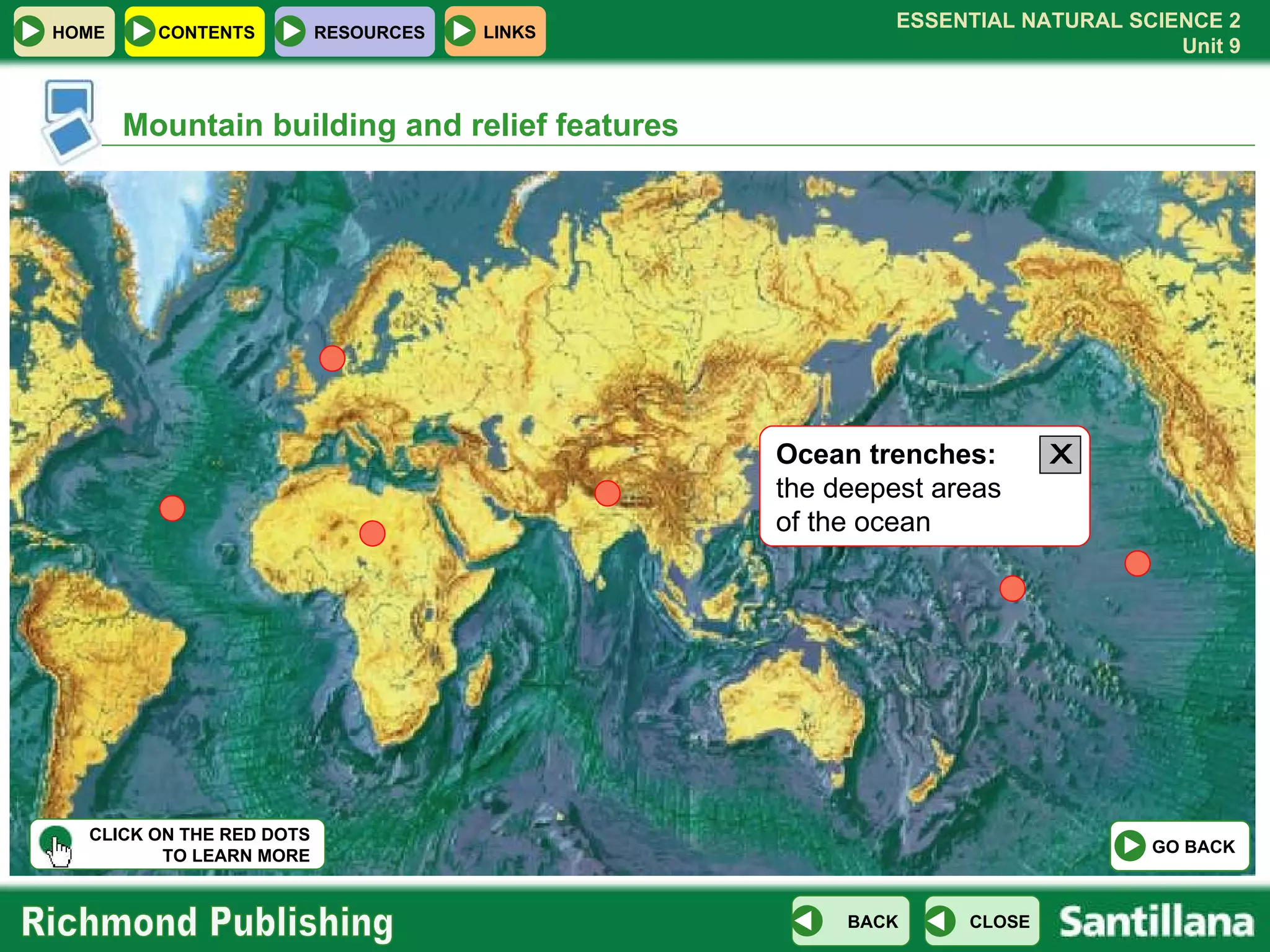
Mountain building and relief features Ocean trenches:  the deepest areas  of the ocean CLICK ON THE RED DOTS TO LEARN MORE X GO BACK
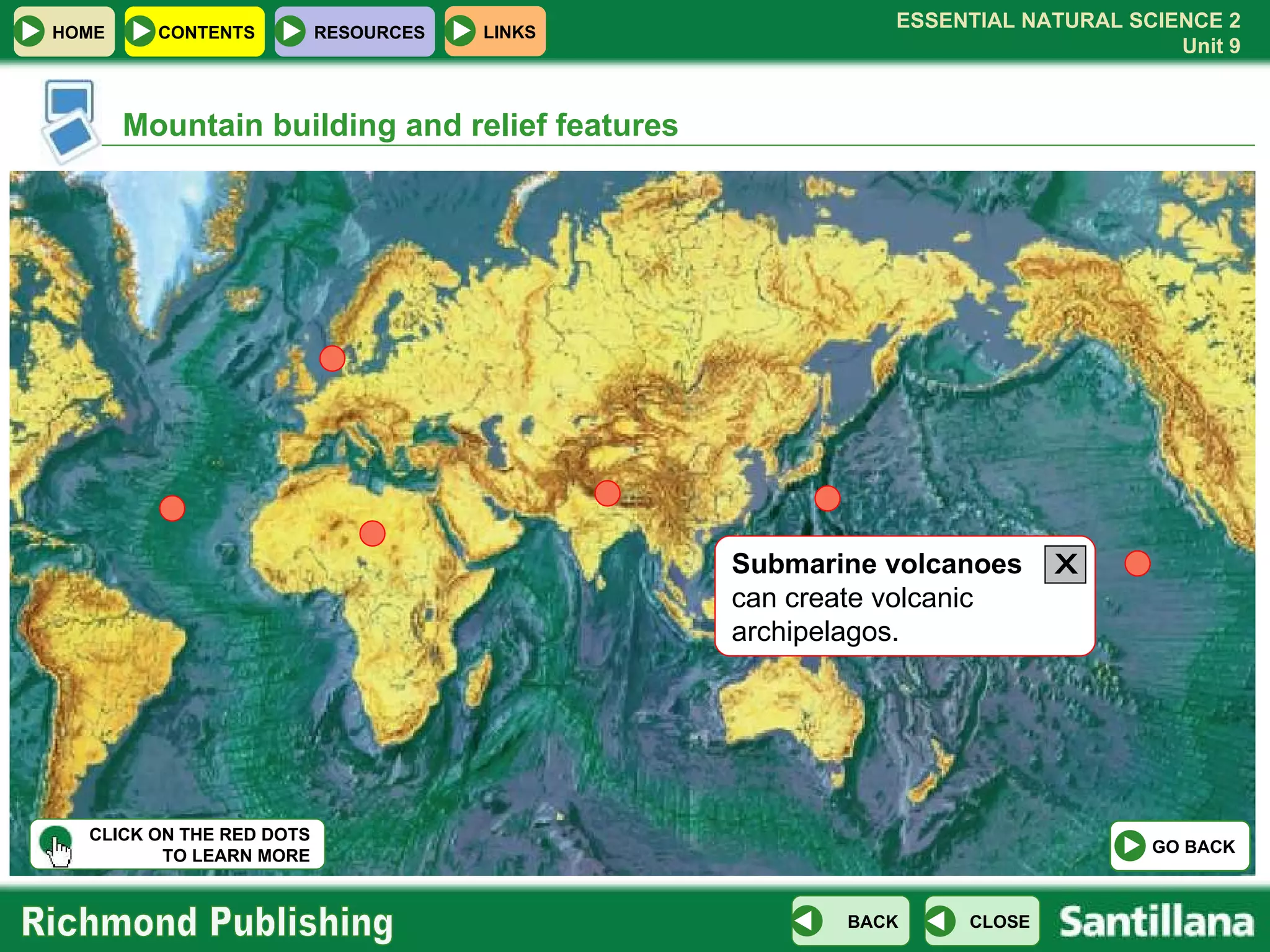
Mountain building and relief features Submarine volcanoes can create volcanic archipelagos. CLICK ON THE RED DOTS TO LEARN MORE X GO BACK
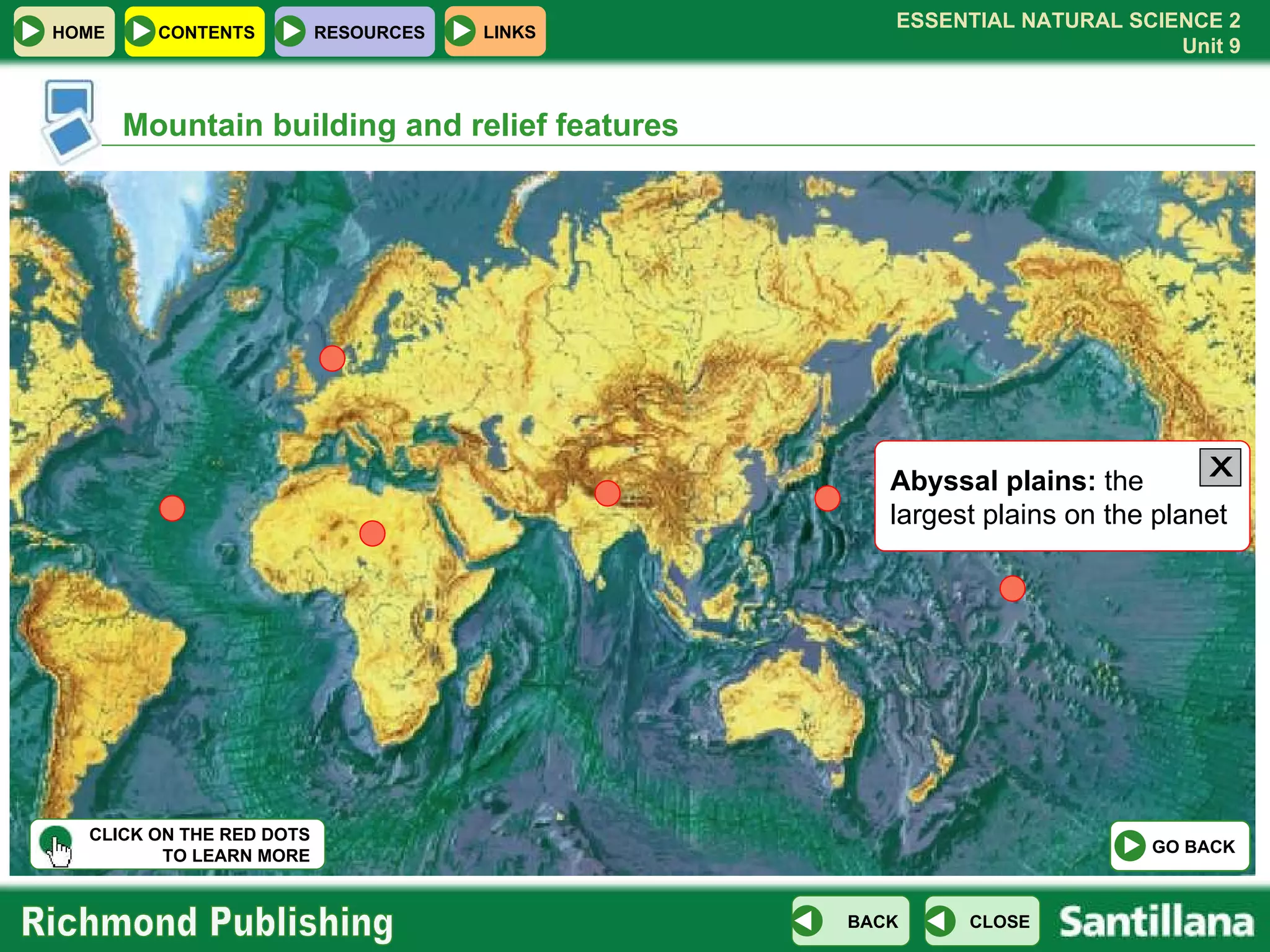
Mountain building and relief features Abyssal plains:  the largest plains on the planet CLICK ON THE RED DOTS TO LEARN MORE X GO BACK
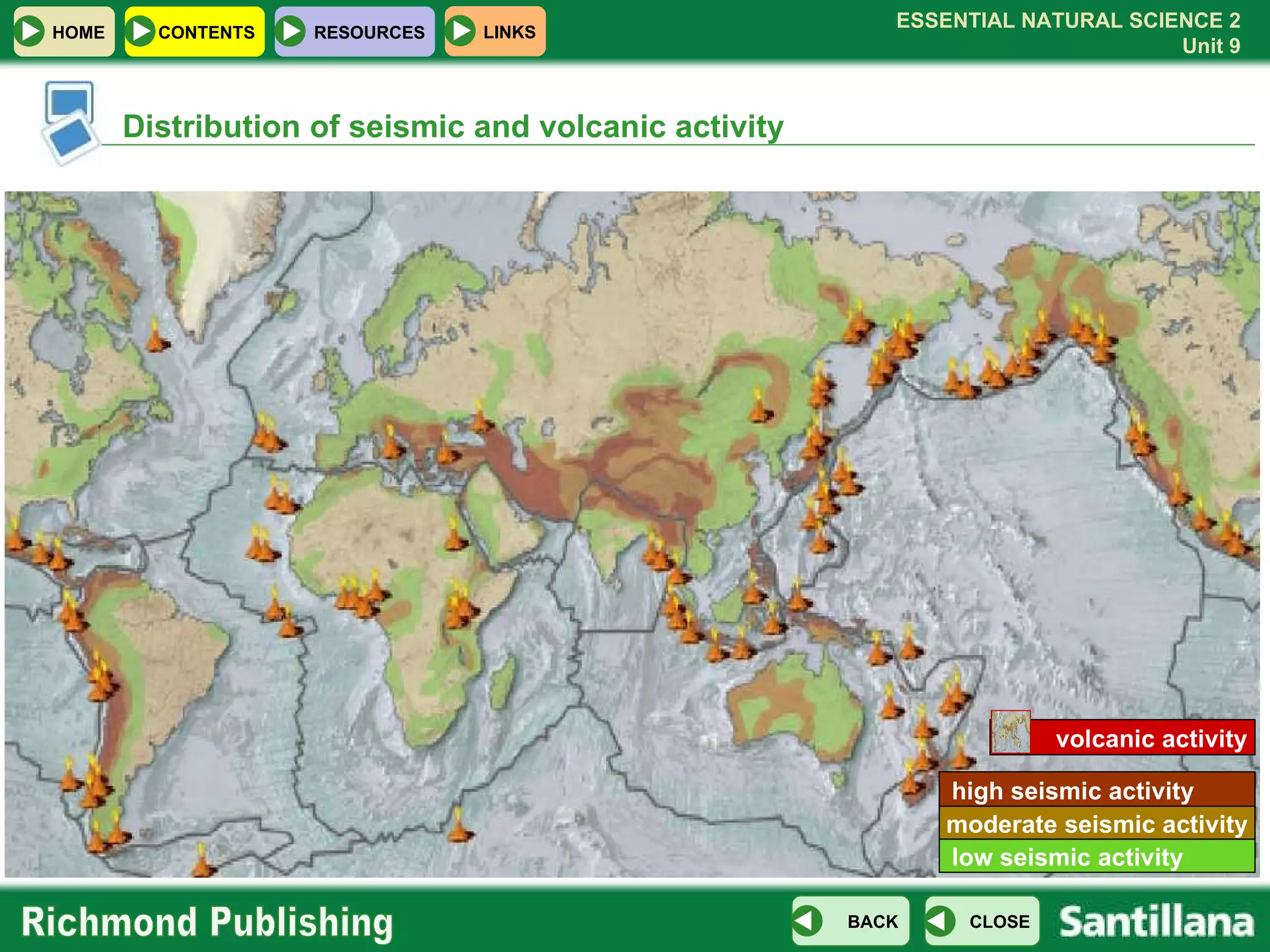
Distribution of seismic and volcanic activity high seismic activity moderate seismic activity low seismic activity volcanic activity
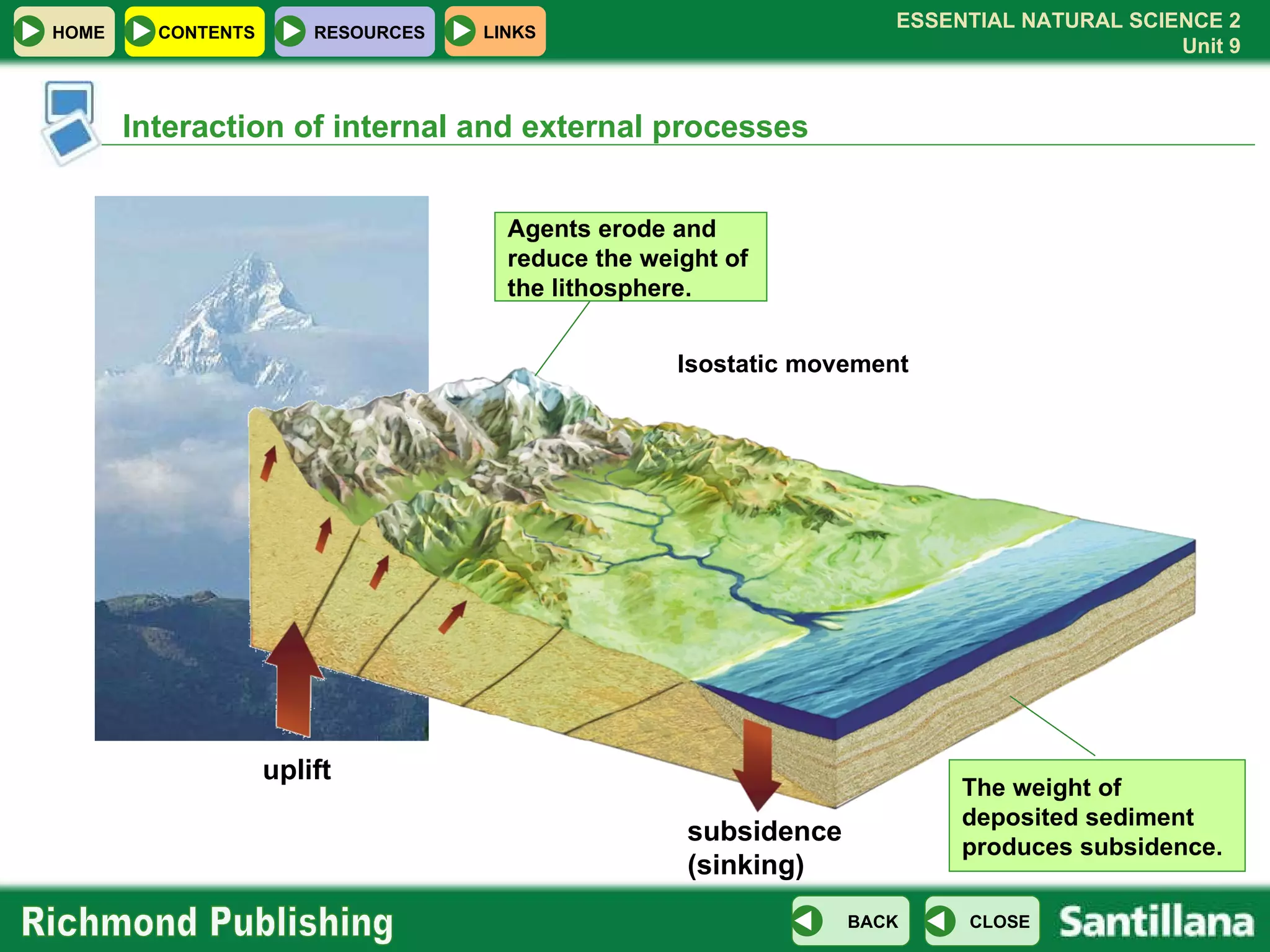
Interaction of internal and external processes Isostatic movement subsidence (sinking) uplift The weight of deposited sediment produces subsidence. Agents erode and reduce the weight of the lithosphere.
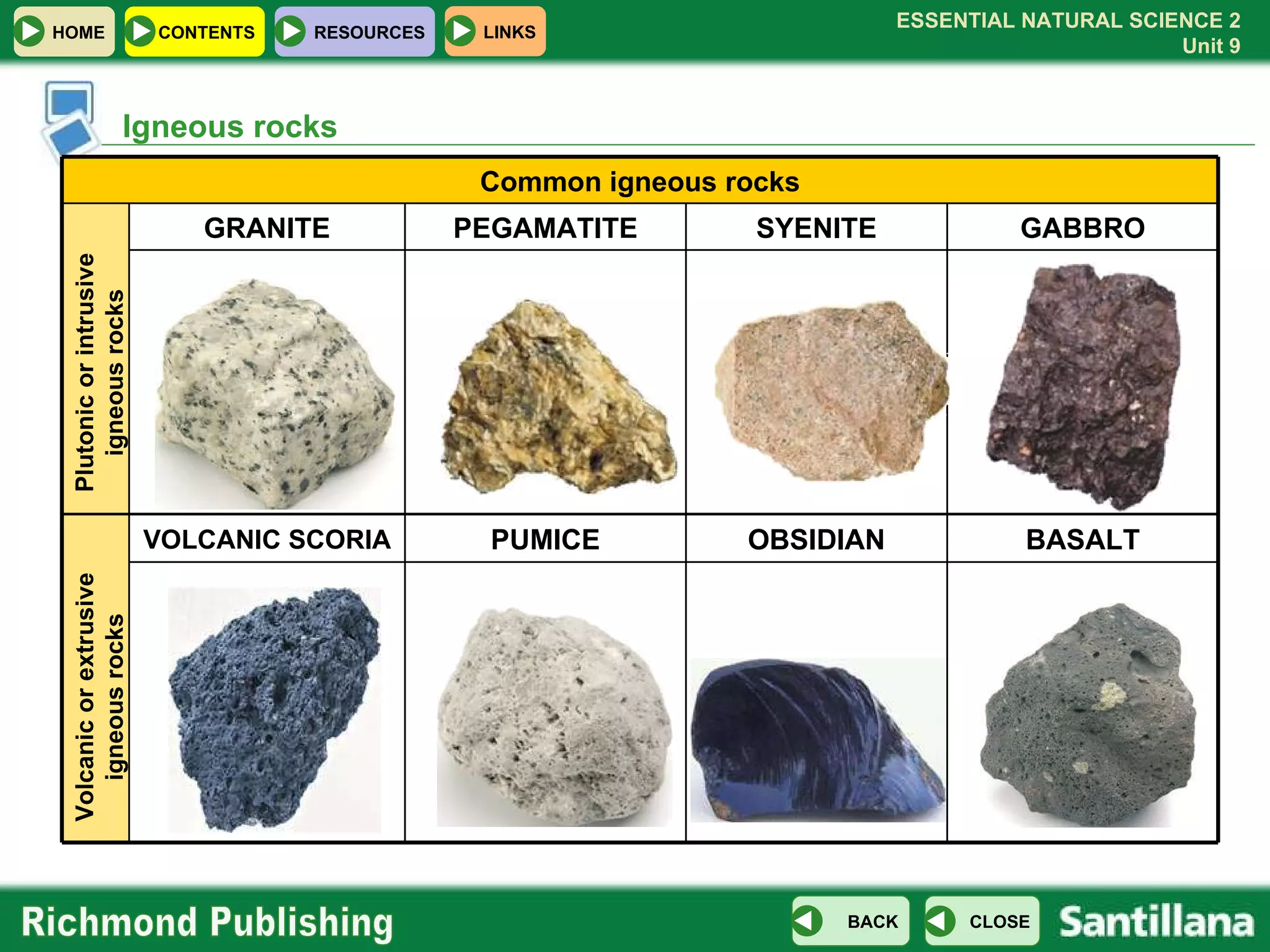
Igneous rocks Plutonic or intrusive igneous rocks Volcanic or extrusive igneous rocks Common igneous rocks GRANITE PEGAMATITE SYENITE GABBRO VOLCANIC SCORIA PUMICE OBSIDIAN BASALT
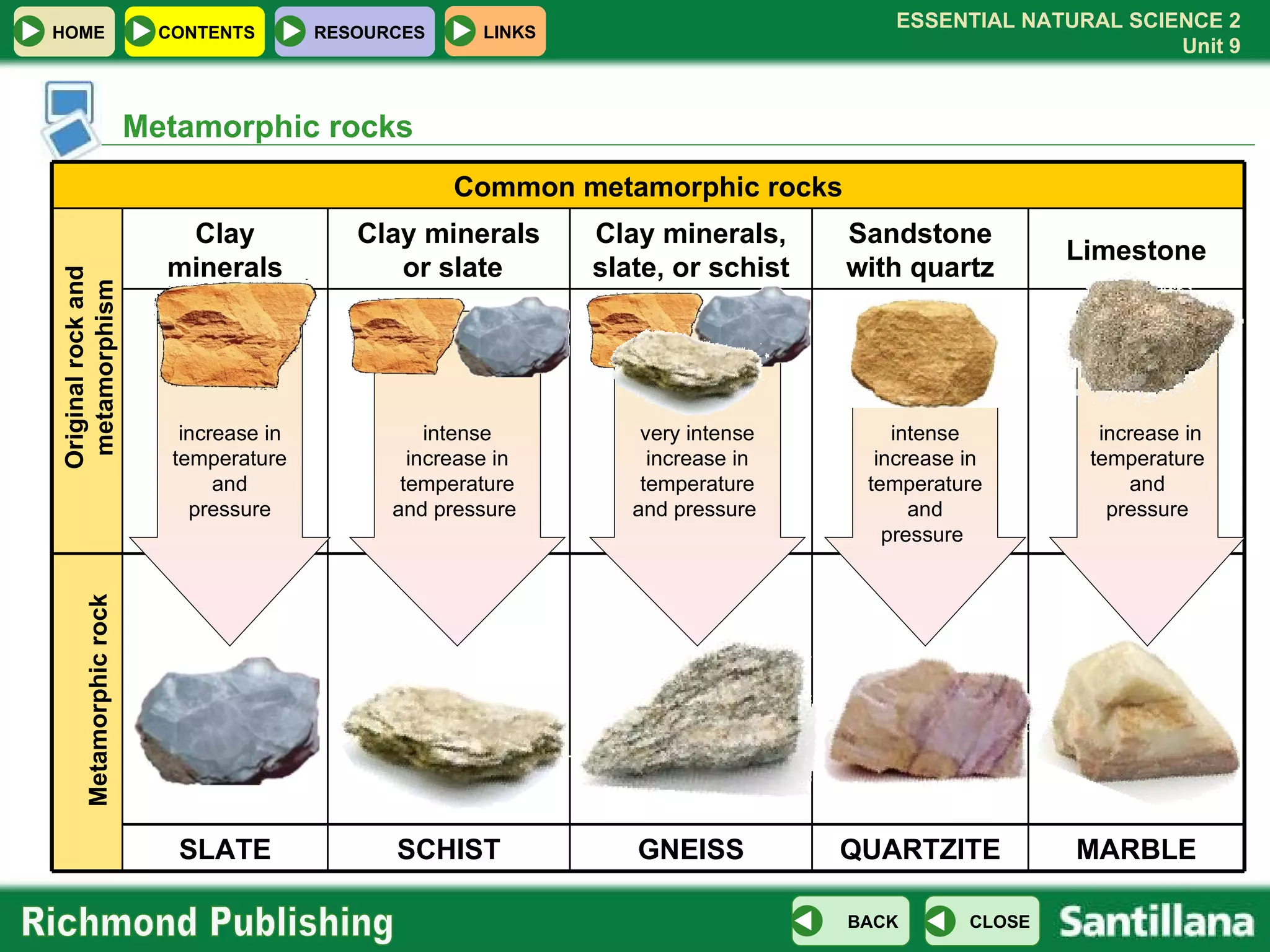
Metamorphic rocks Original rock and metamorphism Metamorphic rock increase in temperature and pressure intense increase in temperature and pressure  very intense increase in temperature and pressure  intense increase in temperature and pressure intense increase in temperature and pressure  Common metamorphic rocks Clay minerals Clay minerals or slate Clay minerals, slate, or schist Sandstone with quartz Limestone SLATE SCHIST GNEISS QUARTZITE MARBLE
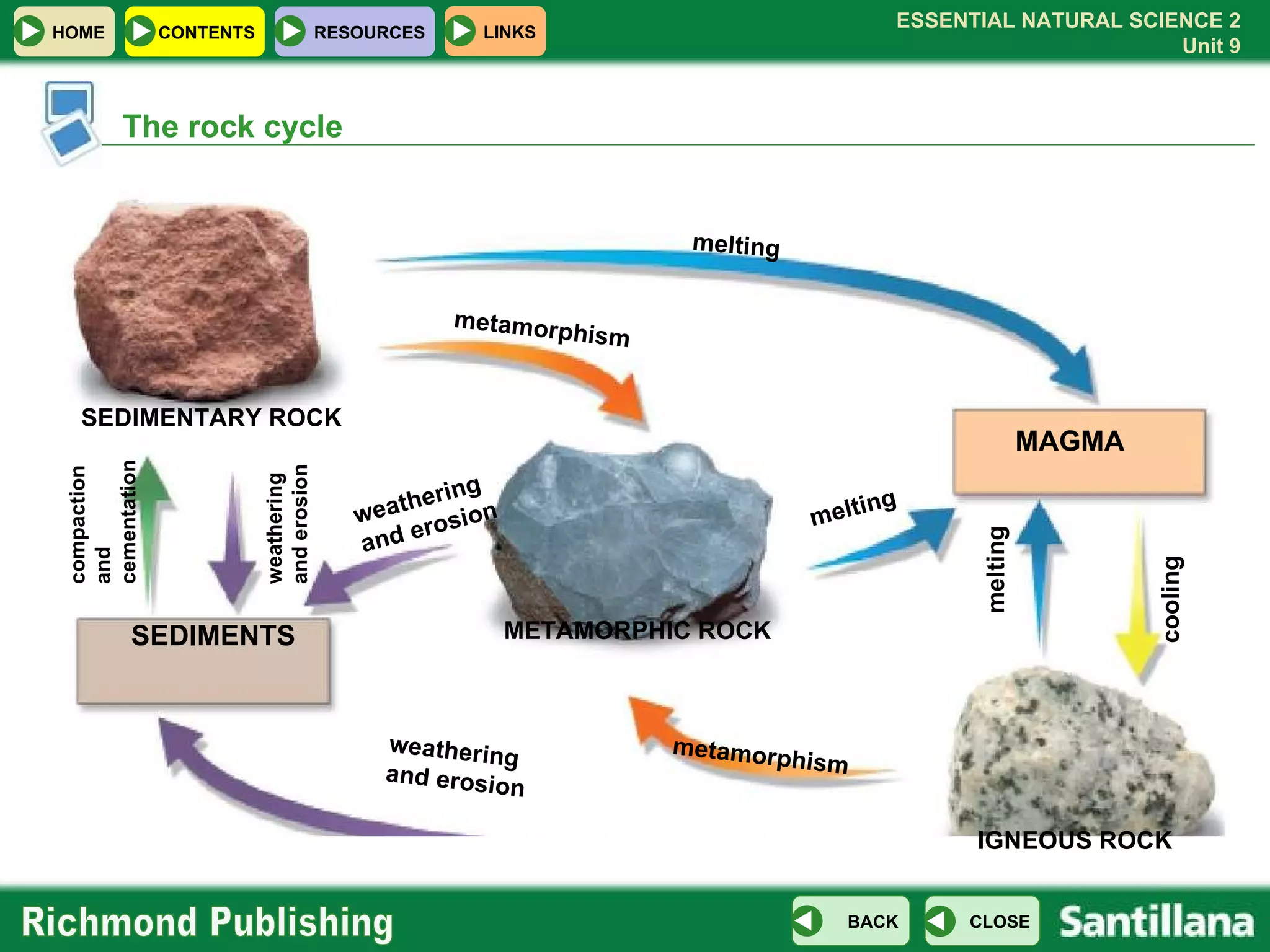
The rock cycle SEDIMENTS MAGMA SEDIMENTARY ROCK IGNEOUS ROCK METAMORPHIC ROCK melting metamorphism metamorphism weathering and erosion weathering and erosion weathering  and erosion compaction and cementation melting melting cooling
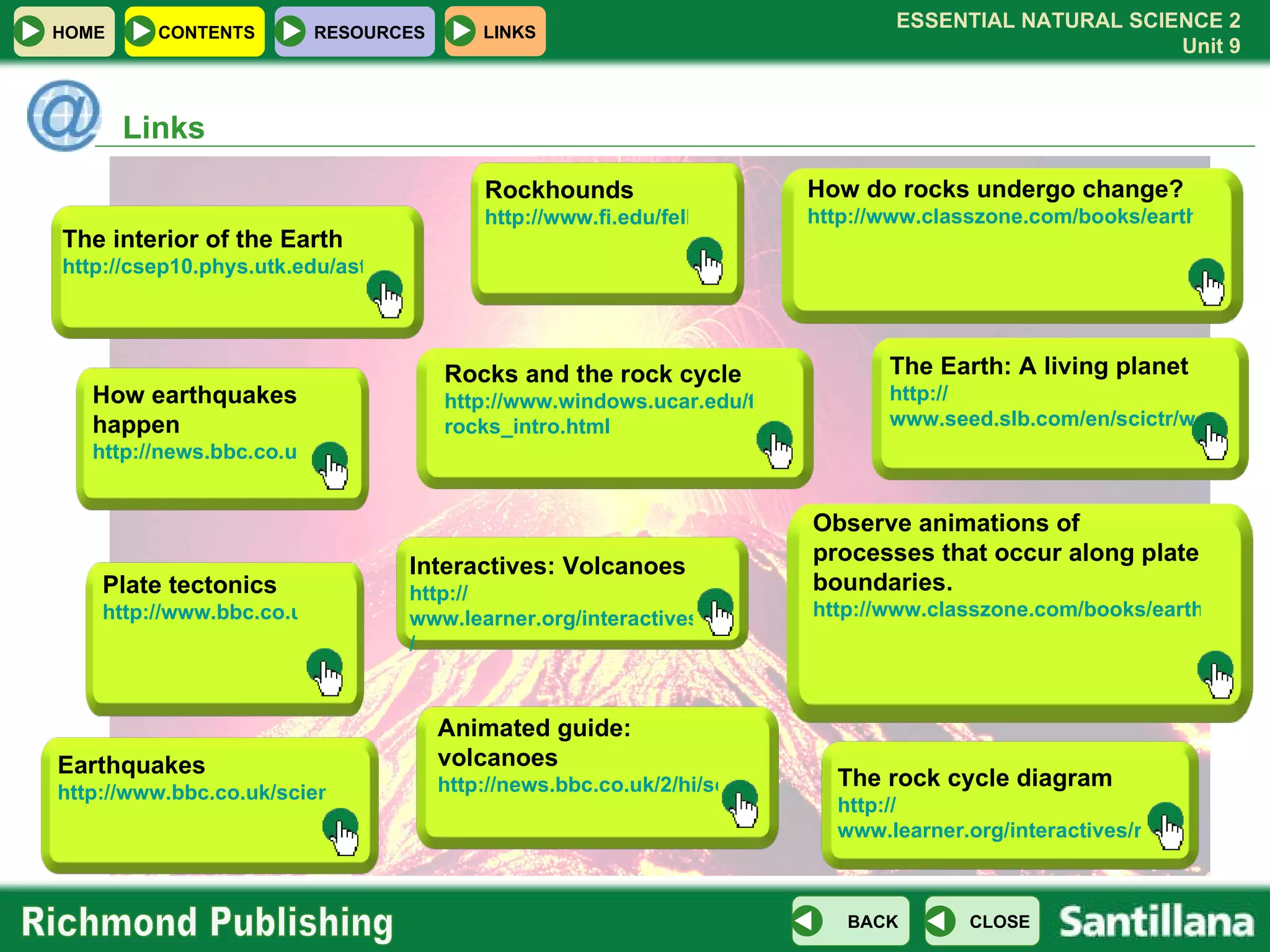
Links How do rocks undergo change? http://www.classzone.com/books/earth_science/terc/content/investigations/es0602/es0602page01.cfm?chapter_no=investigation Observe animations of processes that occur along plate boundaries.   http://www.classzone.com/books/earth_science/terc/content/visualizations/es0804/es0804page01.cfm?chapter_no=visualization The Earth: A living planet http:// www.seed.slb.com/en/scictr/watch/living_planet/index.htm The rock cycle diagram http:// www.learner.org/interactives/rockcycle/diagram.html Animated guide: volcanoes http://news.bbc.co.uk/2/hi/science/nature/4972366.stm Interactives: Volcanoes http:// www.learner.org/interactives/volcanoes / Earthquakes  http://www.bbc.co.uk/science/hottopics/naturaldisasters/earthquakes.shtml Rocks and the rock cycle http://www.windows.ucar.edu/tour/link=/earth/geology/ rocks_intro.html How earthquakes happen http://news.bbc.co.uk/2/hi/4126809.stm Rockhounds http://www.fi.edu/fellows/fellow1/oct98/expert/index.html Plate tectonics http://www.bbc.co.uk/schools/gcsebitesize/geography/platetectonics/ The interior of the Earth http://csep10.phys.utk.edu/astr161/lect/earth/interior.html

U09 Internal Dynamics

  • 1.
    Internal dynamics ofthe Earth CONTENTS RESOURCES
  • 2.
    CONTENTS INTERNAL DYNAMICSOF THE EARTH The interior of the Earth Why the interior is so hot Characteristics Volcanic eruptions Volcanic eruptions Volcanic material Types of eruptions Earthquakes Earthquakes Effects Seismic waves Reducing the damages Reducing the damage Warning systems Mountain building Relief features Distribution of seismic and volcanic activity Interaction of processes Rocks Igneous rocks Metamorphic rocks The rock cycle Internal heat Phenomena Evidence Tectonic plates Tectonic plates
  • 3.
    RESOURCES Evidenceof the heat from the interior of the Earth Why the interior of the Earth is so hot Characteristics of the interior of the Earth Phenomena produced by internal energy Volcanic eruptions Eruptions and volcanic material Types of eruptions Earthquakes Effects of earthquakes Reducing the damage Warning systems Mountain building and relief features Interaction of internal and external processes Igneous rocks Metamorphic rocks Seismic waves Tectonic plates Distribution of seismic and volcanic activity The rock cycle Links The interior of the Earth
  • 4.
    Why the interiorof the Earth is so hot meteorite Giant meteorites continually collided with the Earth. As the Earth heated up, it expanded in size. Metal materials sunk to the centre. Earth today 4,000 million years ago 4,600 million years ago solid crust ocean liquid outer core solid inner core (6,000 ºC) solid mantle metal materials crust mantle nucleus
  • 5.
    Characteristics of theinterior of the Earth At a depth of 50 km: the temperature is 600 ºC the pressure is 20,000 atmospheres Temperature and pressure increase with depth. Rate of increase in temperature: 30 ºC per kilometre GEOTHERMAL GRADIENT
  • 6.
  • 7.
    Tectonic plates Atdivergent boundaries, plates move apart. At convergent boundaries, plates push together. At transform boundaries, plates slide by each other. Plates move in three ways.
  • 8.
    Volcanic eruptionsMolten rock and gases are ejected through the Earth’s crust. Phenomena produced by internal energy Earthquakes A violent trembling of the Earth’s crust which lasts a short time and varies in intensity. Continental drift Isostasy Slow vertical movement of the Earth’s crust. A slow horizontal movement of the continents.
  • 9.
    Formation of amagnetic field Evidence of heat from the interior of the Earth Formation of the atmosphere Hot rocks Hydrothermal phenomena
  • 10.
    Volcanic eruptions crustmantle outer core inner core crust mantle hotspot hot spots within the mantle
  • 11.
    Eruptions and volcanicmaterial vent volcanic cone PYROCLASTIC MATERIALS GASES LAVA magma chamber pipe (conduit) CLICK TO SEE MORE
  • 12.
    Eruptions and volcanicmaterial vent volcanic cone PYROCLASTIC MATERIALS GASES LAVA magma chamber pipe (conduit) CLICK TO SEE MORE GASES carbon dioxde water vapour sulphur gases carbon monoxide X [close]
  • 13.
    Eruptions and volcanicmaterial vent volcanic cone PYROCLASTIC MATERIALS GASES LAVA magma chamber pipe (conduit) CLICK TO SEE MORE PYROCLASTIC MATERIAL ash lapilli volcanic bombs X [close]
  • 14.
    Eruptions and volcanicmaterial Bubbles of gas escape gently. Bubbles of gas splatter and cause explosions. vent volcanic cone PYROCLASTIC MATERIALS GASES LAVA magma chamber pipe (conduit) CLICK TO SEE MORE HOME CONTENTS RESOURCES LAVA At more than 1,000 ºC, lava is very liquid and flows easily. At less than 700 ºC, lava is thick and flows slowly. X [close]
  • 15.
    Types of eruptionsCLICK ON THE GREEN BUTTONS TO LEARN MORE. HAWAIIAN STROMBOLIAN VULCANIAN
  • 16.
    Types of eruptionsHAWAIIAN CLICK ON THE GREEN BUTTONS TO LEARN MORE. STROMBOLIAN VULCANIAN magma temperature: very high (over 1,000 ºC) very liquid lava not very destructive nor explosive Shield volcano magma chamber central vent pipe (conduit) X [close]
  • 17.
    Types of eruptionsCLICK ON THE GREEN BUTTONS TO LEARN MORE. HAWAIIAN STROMBOLIAN VULCANIAN STROMBOLIAN magma temperature: moderate (700 - 1,000 ºC) thick lava explosive pyroclastic material pipe (conduit) Stratovolcano (composite volcano) magma chamber volcanic cone central vent X [close]
  • 18.
    Types of eruptionsCLICK ON THE GREEN BUTTONS TO LEARN MORE. HAWAIIAN STROMBOLIAN VULCANIAN VULCANIAN magma temperature: low (less than 700 ºC) violent, destructive explosions generally gases and ash are expelled magma chamber Dome volcano volcanic pipe of solidified lava X [close]
  • 19.
    Earthquakes seismic wavesepicentre hypocentre (focus) Earthquakes are caused by a sudden release of energy from the Earth’s crust.
  • 20.
    Effects of earthquakes9.6 Richter Scale Chile (1960) hypocentre (focus) epicentre landslides damage to buildings tsunami seismic waves
  • 21.
    seismogram seismograph Seismicwaves Studying seismic waves seismic waves WHAT OTHER INFORMATION CAN SCIENTISTS LEARN FROM SEISMIC WAVES?
  • 22.
    Seismic waves Answer: They can learn information about the internal structure of the Earth. liquid outer core solid inner core lithosphere tectonic (lithospheric) plates crust (granite and basalt) mantle (perioditite) core (iron) GO BACK
  • 23.
    Reducing the damagefrom earthquakes and volcanoes Preparedness Prediction Emissions of water vapour and other gases are observed. Buildings are designed to withstand seismic movement. low high Prediction Risk map
  • 24.
    satellite An earlywarning buoy system receives information about waves, wind and seismic movement. Warning systems buoy Hawaii
  • 25.
    Mountain building andrelief features RELIEF FEATURES OF THE EARTH HOW RELIEF IS FORMED The crust thickens. outer core mantle rift valley Two plates move apart. rising current Himalayas Two plates push together.
  • 26.
    20 million yearsago 60 million years ago 100 million years ago Mountain building and relief features Two plates push together. outer core mantle rift rising current The crust thickens. Two plates move apart. Pyrenees Betic ranges Alboran plate Iberian plate Eurasia Iberian plate Alboran plate Ebro massif HOME CONTENTS RESOURCES RELIEF FEATURES OF THE EARTH GO BACK
  • 27.
    Mountain building andrelief features CLICK ON THE RED DOTS TO LEARN MORE GO BACK
  • 28.
    Mountain building andrelief features Continental shelves: areas near the coastline, under the sea, made up of continental crust CLICK ON THE RED DOTS TO LEARN MORE X GO BACK
  • 29.
    Mountain building andrelief features Oceanic (mid-oceanic) ridges: chains of submarine mountains with intense volcanic activity CLICK ON THE RED DOTS TO LEARN MORE X GO BACK
  • 30.
    Mountain building andrelief features Great plains: large extensions of flat land CLICK ON THE RED DOTS TO LEARN MORE X GO BACK
  • 31.
    Mountain building andrelief features Mountain ranges: chains of mountains CLICK ON THE RED DOTS TO LEARN MORE X GO BACK
  • 32.
    Mountain building andrelief features Ocean trenches: the deepest areas of the ocean CLICK ON THE RED DOTS TO LEARN MORE X GO BACK
  • 33.
    Mountain building andrelief features Submarine volcanoes can create volcanic archipelagos. CLICK ON THE RED DOTS TO LEARN MORE X GO BACK
  • 34.
    Mountain building andrelief features Abyssal plains: the largest plains on the planet CLICK ON THE RED DOTS TO LEARN MORE X GO BACK
  • 35.
    Distribution of seismicand volcanic activity high seismic activity moderate seismic activity low seismic activity volcanic activity
  • 36.
    Interaction of internaland external processes Isostatic movement subsidence (sinking) uplift The weight of deposited sediment produces subsidence. Agents erode and reduce the weight of the lithosphere.
  • 37.
    Igneous rocks Plutonicor intrusive igneous rocks Volcanic or extrusive igneous rocks Common igneous rocks GRANITE PEGAMATITE SYENITE GABBRO VOLCANIC SCORIA PUMICE OBSIDIAN BASALT
  • 38.
    Metamorphic rocks Originalrock and metamorphism Metamorphic rock increase in temperature and pressure intense increase in temperature and pressure very intense increase in temperature and pressure intense increase in temperature and pressure intense increase in temperature and pressure Common metamorphic rocks Clay minerals Clay minerals or slate Clay minerals, slate, or schist Sandstone with quartz Limestone SLATE SCHIST GNEISS QUARTZITE MARBLE
  • 39.
    The rock cycleSEDIMENTS MAGMA SEDIMENTARY ROCK IGNEOUS ROCK METAMORPHIC ROCK melting metamorphism metamorphism weathering and erosion weathering and erosion weathering and erosion compaction and cementation melting melting cooling
  • 40.
    Links How dorocks undergo change? http://www.classzone.com/books/earth_science/terc/content/investigations/es0602/es0602page01.cfm?chapter_no=investigation Observe animations of processes that occur along plate boundaries. http://www.classzone.com/books/earth_science/terc/content/visualizations/es0804/es0804page01.cfm?chapter_no=visualization The Earth: A living planet http:// www.seed.slb.com/en/scictr/watch/living_planet/index.htm The rock cycle diagram http:// www.learner.org/interactives/rockcycle/diagram.html Animated guide: volcanoes http://news.bbc.co.uk/2/hi/science/nature/4972366.stm Interactives: Volcanoes http:// www.learner.org/interactives/volcanoes / Earthquakes http://www.bbc.co.uk/science/hottopics/naturaldisasters/earthquakes.shtml Rocks and the rock cycle http://www.windows.ucar.edu/tour/link=/earth/geology/ rocks_intro.html How earthquakes happen http://news.bbc.co.uk/2/hi/4126809.stm Rockhounds http://www.fi.edu/fellows/fellow1/oct98/expert/index.html Plate tectonics http://www.bbc.co.uk/schools/gcsebitesize/geography/platetectonics/ The interior of the Earth http://csep10.phys.utk.edu/astr161/lect/earth/interior.html