Chapter 14: Volcanic and Tectonic Processes and Landforms Physical Geography Ninth Edition Robert E. Gabler James. F. Petersen L. Michael Trapasso Dorothy Sack
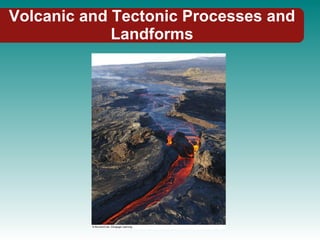
Volcanic and Tectonic Processes and Landforms
Volcanic and Tectonic Processes and Landforms Topography: distribution of landscape (mountains, plains, hills, valleys, plateaus) Landforms: surface terrain features Geomorphology Understanding landforms and landscapes Seek explanations for the shape, origin, spatial distribution, and development of terrain features Igneous processes and tectonic processes
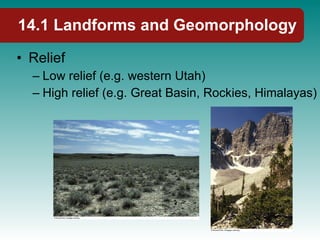
14.1 Landforms and Geomorphology Relief Low relief (e.g. western Utah) High relief (e.g. Great Basin, Rockies, Himalayas)
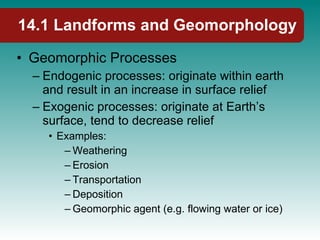
14.1 Landforms and Geomorphology Geomorphic Processes Endogenic processes: originate within earth and result in an increase in surface relief Exogenic processes: originate at Earth’s surface, tend to decrease relief Examples:  Weathering Erosion Transportation Deposition Geomorphic agent (e.g. flowing water or ice)
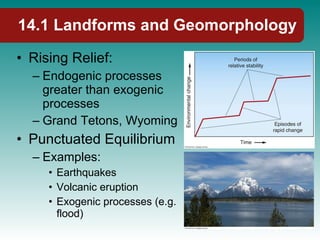
14.1 Landforms and Geomorphology Rising Relief: Endogenic processes greater than exogenic processes Grand Tetons, Wyoming Punctuated Equilibrium Examples: Earthquakes Volcanic eruption Exogenic processes (e.g. flood)
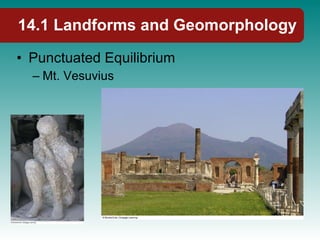
14.1 Landforms and Geomorphology Punctuated Equilibrium Mt. Vesuvius
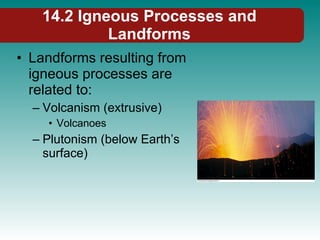
14.2 Igneous Processes and Landforms Landforms resulting from igneous processes are related to: Volcanism (extrusive) Volcanoes Plutonism (below Earth’s surface)
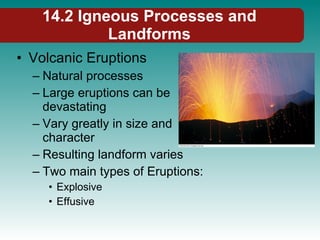
14.2 Igneous Processes and Landforms Volcanic Eruptions Natural processes Large eruptions can be devastating Vary greatly in size and character Resulting landform varies Two main types of Eruptions: Explosive Effusive
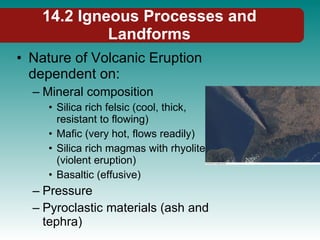
14.2 Igneous Processes and Landforms Nature of Volcanic Eruption dependent on: Mineral composition Silica rich felsic (cool, thick, resistant to flowing) Mafic (very hot, flows readily) Silica rich magmas with rhyolite (violent eruption) Basaltic (effusive) Pressure Pyroclastic materials (ash and tephra)
14.2 Igneous Processes and Landforms Volcanic Landforms Depends primarily on explosiveness  6 major kinds (least explosive to most explosive) Lava flows Shield Volcanoes Cinder Cones Composite Cones Plug Domes Calderas
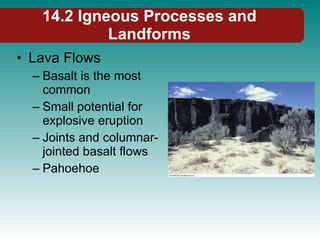
14.2 Igneous Processes and Landforms Lava Flows Basalt is the most common Small potential for explosive eruption Joints and columnar-jointed basalt flows Pahoehoe
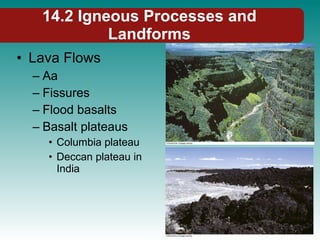
14.2 Igneous Processes and Landforms Lava Flows Aa Fissures Flood basalts Basalt plateaus Columbia plateau Deccan plateau in India
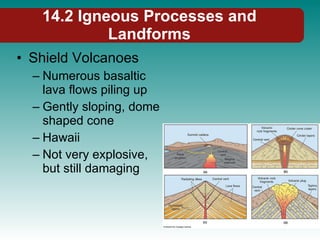
14.2 Igneous Processes and Landforms Shield Volcanoes Numerous basaltic lava flows piling up Gently sloping, dome shaped cone Hawaii Not very explosive, but still damaging
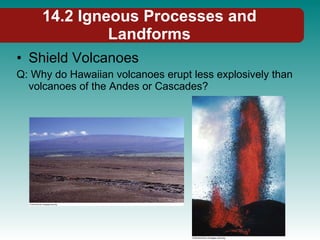
14.2 Igneous Processes and Landforms Shield Volcanoes Q: Why do Hawaiian volcanoes erupt less explosively than volcanoes of the Andes or Cascades?
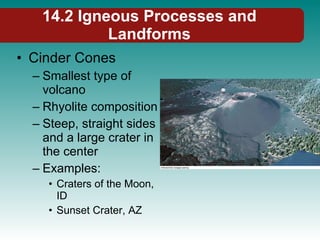
14.2 Igneous Processes and Landforms Cinder Cones Smallest type of volcano Rhyolite composition Steep, straight sides and a large crater in the center Examples: Craters of the Moon, ID Sunset Crater, AZ
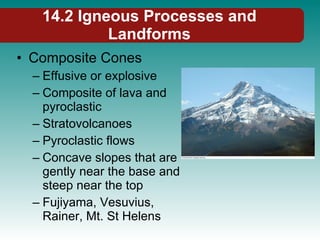
14.2 Igneous Processes and Landforms Composite Cones Effusive or explosive Composite of lava and pyroclastic Stratovolcanoes Pyroclastic flows Concave slopes that are gently near the base and steep near the top Fujiyama, Vesuvius, Rainer, Mt. St Helens
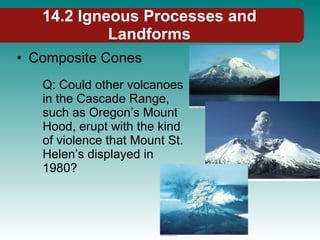
14.2 Igneous Processes and Landforms Composite Cones Q: Could other volcanoes in the Cascade Range, such as Oregon’s Mount Hood, erupt with the kind of violence that Mount St. Helen’s displayed in 1980?
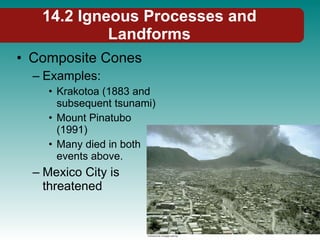
14.2 Igneous Processes and Landforms Composite Cones Examples: Krakotoa (1883 and subsequent tsunami) Mount Pinatubo (1991) Many died in both events above. Mexico City is threatened
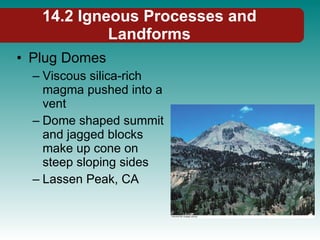
14.2 Igneous Processes and Landforms Plug Domes Viscous silica-rich magma pushed into a vent Dome shaped summit and jagged blocks make up cone on steep sloping sides Lassen Peak, CA
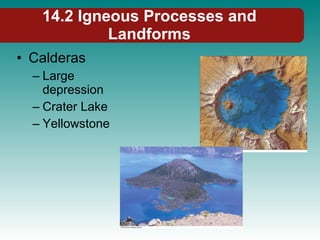
14.2 Igneous Processes and Landforms Calderas Large depression Crater Lake Yellowstone
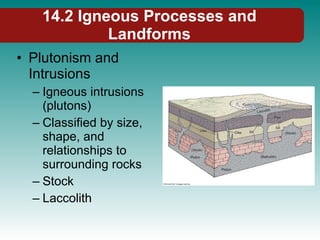
14.2 Igneous Processes and Landforms Plutonism and Intrusions Igneous intrusions (plutons) Classified by size, shape, and relationships to surrounding rocks Stock Laccolith
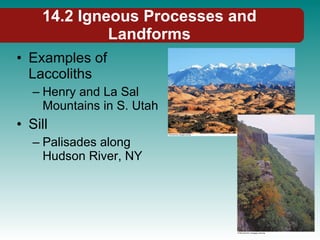
14.2 Igneous Processes and Landforms Examples of Laccoliths Henry and La Sal Mountains in S. Utah Sill Palisades along Hudson River, NY
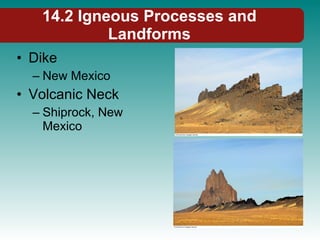
14.2 Igneous Processes and Landforms Dike New Mexico Volcanic Neck Shiprock, New Mexico
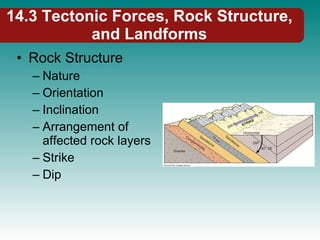
14.3 Tectonic Forces, Rock Structure, and Landforms Rock Structure Nature Orientation Inclination Arrangement of affected rock layers Strike Dip
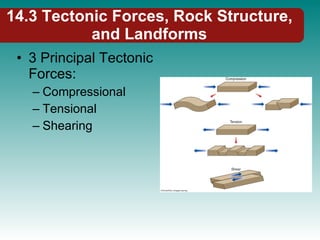
14.3 Tectonic Forces, Rock Structure, and Landforms 3 Principal Tectonic Forces: Compressional Tensional Shearing
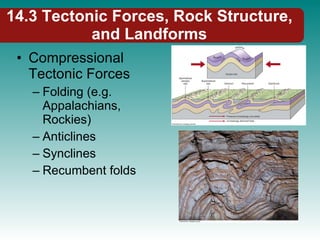
14.3 Tectonic Forces, Rock Structure, and Landforms Compressional Tectonic Forces Folding (e.g. Appalachians, Rockies) Anticlines Synclines Recumbent folds
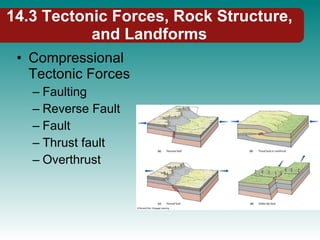
14.3 Tectonic Forces, Rock Structure, and Landforms Compressional Tectonic Forces Faulting Reverse Fault Fault Thrust fault Overthrust
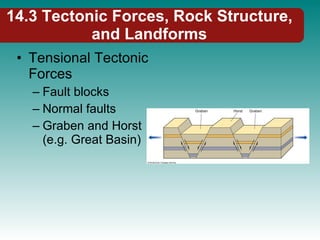
14.3 Tectonic Forces, Rock Structure, and Landforms Tensional Tectonic Forces Fault blocks Normal faults Graben and Horst (e.g. Great Basin)
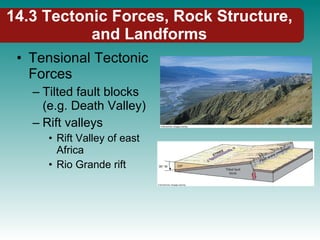
14.3 Tectonic Forces, Rock Structure, and Landforms Tensional Tectonic Forces Tilted fault blocks (e.g. Death Valley) Rift valleys Rift Valley of east Africa Rio Grande rift
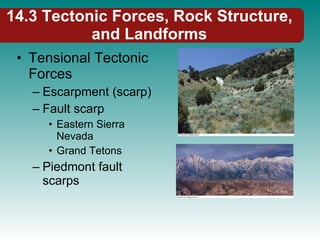
14.3 Tectonic Forces, Rock Structure, and Landforms Tensional Tectonic Forces Escarpment (scarp) Fault scarp Eastern Sierra Nevada Grand Tetons Piedmont fault scarps
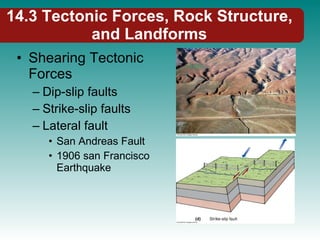
14.3 Tectonic Forces, Rock Structure, and Landforms Shearing Tectonic Forces Dip-slip faults Strike-slip faults Lateral fault San Andreas Fault 1906 san Francisco Earthquake
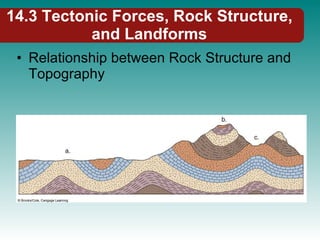
14.3 Tectonic Forces, Rock Structure, and Landforms Relationship between Rock Structure and Topography
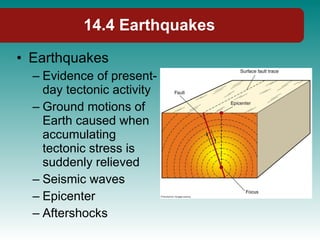
14.4 Earthquakes Earthquakes Evidence of present-day tectonic activity Ground motions of Earth caused when accumulating tectonic stress is suddenly relieved Seismic waves Epicenter  Aftershocks
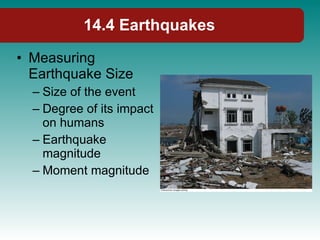
14.4 Earthquakes Measuring Earthquake Size Size of the event Degree of its impact on humans Earthquake magnitude Moment magnitude
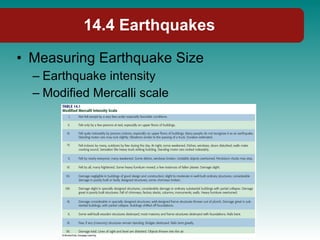
14.4 Earthquakes Measuring Earthquake Size Earthquake intensity Modified Mercalli scale
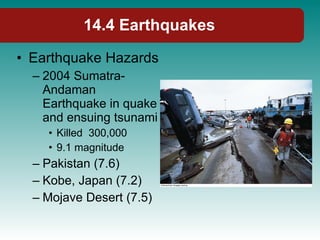
14.4 Earthquakes Earthquake Hazards 2004 Sumatra-Andaman Earthquake in quake and ensuing tsunami Killed  300,000 9.1 magnitude Pakistan (7.6) Kobe, Japan (7.2) Mojave Desert (7.5)
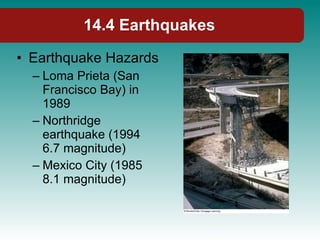
14.4 Earthquakes Earthquake Hazards Loma Prieta (San Francisco Bay) in 1989 Northridge earthquake (1994 6.7 magnitude) Mexico City (1985 8.1 magnitude)
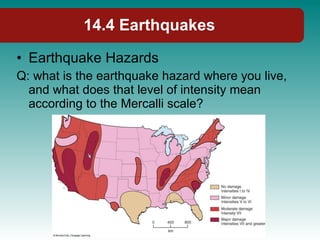
14.4 Earthquakes Earthquake Hazards Q: what is the earthquake hazard where you live, and what does that level of intensity mean according to the Mercalli scale?
Physical Geography End of Chapter 14: Volcanic and Tectonic Processes and Landforms

14

  • 1.
    Chapter 14: Volcanicand Tectonic Processes and Landforms Physical Geography Ninth Edition Robert E. Gabler James. F. Petersen L. Michael Trapasso Dorothy Sack
  • 2.
    Volcanic and TectonicProcesses and Landforms
  • 3.
    Volcanic and TectonicProcesses and Landforms Topography: distribution of landscape (mountains, plains, hills, valleys, plateaus) Landforms: surface terrain features Geomorphology Understanding landforms and landscapes Seek explanations for the shape, origin, spatial distribution, and development of terrain features Igneous processes and tectonic processes
  • 4.
    14.1 Landforms andGeomorphology Relief Low relief (e.g. western Utah) High relief (e.g. Great Basin, Rockies, Himalayas)
  • 5.
    14.1 Landforms andGeomorphology Geomorphic Processes Endogenic processes: originate within earth and result in an increase in surface relief Exogenic processes: originate at Earth’s surface, tend to decrease relief Examples: Weathering Erosion Transportation Deposition Geomorphic agent (e.g. flowing water or ice)
  • 6.
    14.1 Landforms andGeomorphology Rising Relief: Endogenic processes greater than exogenic processes Grand Tetons, Wyoming Punctuated Equilibrium Examples: Earthquakes Volcanic eruption Exogenic processes (e.g. flood)
  • 7.
    14.1 Landforms andGeomorphology Punctuated Equilibrium Mt. Vesuvius
  • 8.
    14.2 Igneous Processesand Landforms Landforms resulting from igneous processes are related to: Volcanism (extrusive) Volcanoes Plutonism (below Earth’s surface)
  • 9.
    14.2 Igneous Processesand Landforms Volcanic Eruptions Natural processes Large eruptions can be devastating Vary greatly in size and character Resulting landform varies Two main types of Eruptions: Explosive Effusive
  • 10.
    14.2 Igneous Processesand Landforms Nature of Volcanic Eruption dependent on: Mineral composition Silica rich felsic (cool, thick, resistant to flowing) Mafic (very hot, flows readily) Silica rich magmas with rhyolite (violent eruption) Basaltic (effusive) Pressure Pyroclastic materials (ash and tephra)
  • 11.
    14.2 Igneous Processesand Landforms Volcanic Landforms Depends primarily on explosiveness 6 major kinds (least explosive to most explosive) Lava flows Shield Volcanoes Cinder Cones Composite Cones Plug Domes Calderas
  • 12.
    14.2 Igneous Processesand Landforms Lava Flows Basalt is the most common Small potential for explosive eruption Joints and columnar-jointed basalt flows Pahoehoe
  • 13.
    14.2 Igneous Processesand Landforms Lava Flows Aa Fissures Flood basalts Basalt plateaus Columbia plateau Deccan plateau in India
  • 14.
    14.2 Igneous Processesand Landforms Shield Volcanoes Numerous basaltic lava flows piling up Gently sloping, dome shaped cone Hawaii Not very explosive, but still damaging
  • 15.
    14.2 Igneous Processesand Landforms Shield Volcanoes Q: Why do Hawaiian volcanoes erupt less explosively than volcanoes of the Andes or Cascades?
  • 16.
    14.2 Igneous Processesand Landforms Cinder Cones Smallest type of volcano Rhyolite composition Steep, straight sides and a large crater in the center Examples: Craters of the Moon, ID Sunset Crater, AZ
  • 17.
    14.2 Igneous Processesand Landforms Composite Cones Effusive or explosive Composite of lava and pyroclastic Stratovolcanoes Pyroclastic flows Concave slopes that are gently near the base and steep near the top Fujiyama, Vesuvius, Rainer, Mt. St Helens
  • 18.
    14.2 Igneous Processesand Landforms Composite Cones Q: Could other volcanoes in the Cascade Range, such as Oregon’s Mount Hood, erupt with the kind of violence that Mount St. Helen’s displayed in 1980?
  • 19.
    14.2 Igneous Processesand Landforms Composite Cones Examples: Krakotoa (1883 and subsequent tsunami) Mount Pinatubo (1991) Many died in both events above. Mexico City is threatened
  • 20.
    14.2 Igneous Processesand Landforms Plug Domes Viscous silica-rich magma pushed into a vent Dome shaped summit and jagged blocks make up cone on steep sloping sides Lassen Peak, CA
  • 21.
    14.2 Igneous Processesand Landforms Calderas Large depression Crater Lake Yellowstone
  • 22.
    14.2 Igneous Processesand Landforms Plutonism and Intrusions Igneous intrusions (plutons) Classified by size, shape, and relationships to surrounding rocks Stock Laccolith
  • 23.
    14.2 Igneous Processesand Landforms Examples of Laccoliths Henry and La Sal Mountains in S. Utah Sill Palisades along Hudson River, NY
  • 24.
    14.2 Igneous Processesand Landforms Dike New Mexico Volcanic Neck Shiprock, New Mexico
  • 25.
    14.3 Tectonic Forces,Rock Structure, and Landforms Rock Structure Nature Orientation Inclination Arrangement of affected rock layers Strike Dip
  • 26.
    14.3 Tectonic Forces,Rock Structure, and Landforms 3 Principal Tectonic Forces: Compressional Tensional Shearing
  • 27.
    14.3 Tectonic Forces,Rock Structure, and Landforms Compressional Tectonic Forces Folding (e.g. Appalachians, Rockies) Anticlines Synclines Recumbent folds
  • 28.
    14.3 Tectonic Forces,Rock Structure, and Landforms Compressional Tectonic Forces Faulting Reverse Fault Fault Thrust fault Overthrust
  • 29.
    14.3 Tectonic Forces,Rock Structure, and Landforms Tensional Tectonic Forces Fault blocks Normal faults Graben and Horst (e.g. Great Basin)
  • 30.
    14.3 Tectonic Forces,Rock Structure, and Landforms Tensional Tectonic Forces Tilted fault blocks (e.g. Death Valley) Rift valleys Rift Valley of east Africa Rio Grande rift
  • 31.
    14.3 Tectonic Forces,Rock Structure, and Landforms Tensional Tectonic Forces Escarpment (scarp) Fault scarp Eastern Sierra Nevada Grand Tetons Piedmont fault scarps
  • 32.
    14.3 Tectonic Forces,Rock Structure, and Landforms Shearing Tectonic Forces Dip-slip faults Strike-slip faults Lateral fault San Andreas Fault 1906 san Francisco Earthquake
  • 33.
    14.3 Tectonic Forces,Rock Structure, and Landforms Relationship between Rock Structure and Topography
  • 34.
    14.4 Earthquakes EarthquakesEvidence of present-day tectonic activity Ground motions of Earth caused when accumulating tectonic stress is suddenly relieved Seismic waves Epicenter Aftershocks
  • 35.
    14.4 Earthquakes MeasuringEarthquake Size Size of the event Degree of its impact on humans Earthquake magnitude Moment magnitude
  • 36.
    14.4 Earthquakes MeasuringEarthquake Size Earthquake intensity Modified Mercalli scale
  • 37.
    14.4 Earthquakes EarthquakeHazards 2004 Sumatra-Andaman Earthquake in quake and ensuing tsunami Killed 300,000 9.1 magnitude Pakistan (7.6) Kobe, Japan (7.2) Mojave Desert (7.5)
  • 38.
    14.4 Earthquakes EarthquakeHazards Loma Prieta (San Francisco Bay) in 1989 Northridge earthquake (1994 6.7 magnitude) Mexico City (1985 8.1 magnitude)
  • 39.
    14.4 Earthquakes EarthquakeHazards Q: what is the earthquake hazard where you live, and what does that level of intensity mean according to the Mercalli scale?
  • 40.
    Physical Geography Endof Chapter 14: Volcanic and Tectonic Processes and Landforms

Editor's Notes