Prentice   Hall   EARTH SCIENCE Tarbuck   Lutgens  
Chapter   22 Origin of Modern Astronomy
22.1   Early Astronomy     Astronomy  is the science that studies the universe. It includes the observation and interpretation of celestial bodies and phenomena.    The Greeks used philosophical arguments to explain natural phenomena.    The Greeks also used some observational data. Ancient Greeks
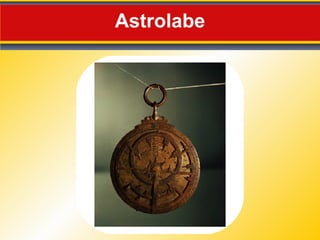
Astrolabe
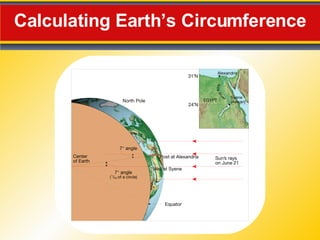
Calculating Earth’s Circumference
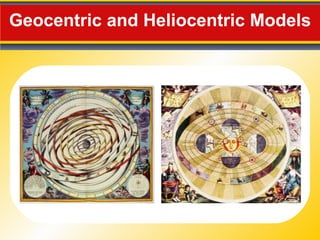
22.1   Early Astronomy     Geocentric Model •  In the ancient Greeks’  geocentric  model, the moon, sun, and the known planets—Mercury, Venus, Mars, and Jupiter—orbit Earth.    Heliocentric Model •  In the  heliocentric  model, Earth and the other planets orbit the sun. Ancient Greeks
Geocentric and Heliocentric Models
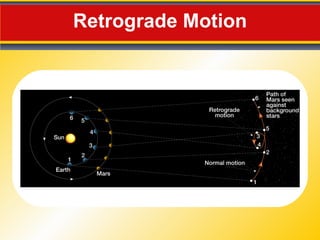
22.1  Early Astronomy     Ptolemaic System •  Ptolemy created a model of the universe that accounted for the movement of the planets. •  Retrograde motion  is the apparent westward motion of the planets with respect to the stars. Ancient Greeks
Retrograde Motion
22.1  Early Astronomy     Nicolaus Copernicus •  Copernicus concluded that Earth is a planet. He proposed a model of the solar system with the sun at the center. The Birth of Modern Astronomy
22.1   Early Astronomy     Tycho Brahe •  Tycho Brahe designed and built instruments to measure the locations of the heavenly bodies.  Brahe’s observations, especially of Mars, were far more precise than any made previously. The Birth of Modern Astronomy
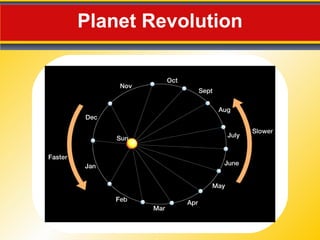
22.1  Early Astronomy     Johannes Kepler •  Kepler discovered three laws of planetary motion: 1.  Orbits of the planets are elliptical. 2.  Planets revolve around the sun at varying speed. 3.  There is a proportional relationship between a planet’s orbital period and its distance to the sun. The Birth of Modern Astronomy
22.1   Early Astronomy     Johannes Kepler •  An  ellipse   is an oval-shaped path . •  An  astronomical unit (AU)   is the average distance between Earth and the sun; it is about 150 million kilometers . The Birth of Modern Astronomy
Planet Revolution
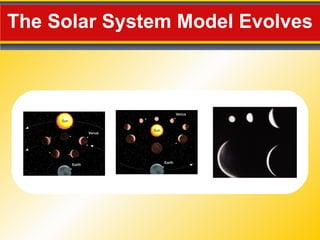
22.1  Early Astronomy     Galileo Galilei •  Galileo’s most important contributions were his descriptions of the behavior of moving objects. •  He developed his own telescope and made important discoveries:  1.  Four satellites, or moons, orbit Jupiter.  2.  Planets are circular disks, not just points of light. 3.  Venus has phases just like the moon. 4.  The moon’s surface is not smooth. 5.  The sun has sunspots, or dark regions. The Birth of Modern Astronomy
The Solar System Model Evolves
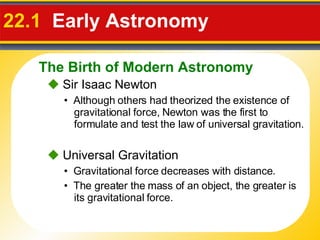
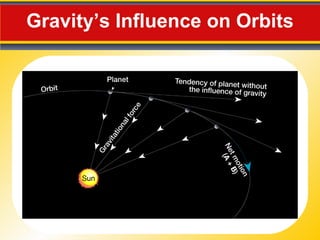
22.1   Early Astronomy     Sir Isaac Newton •  Although others had theorized the existence of gravitational force, Newton was the first to formulate and test the law of universal gravitation.    Universal Gravitation •  Gravitational force decreases with distance. •  The greater the mass of an object, the greater is its gravitational force. The Birth of Modern Astronomy
Gravity’s Influence on Orbits
22.2   The Earth–Moon–Sun System     The two main motions of Earth are rotation and revolution. Precession is a third and very slow motion of Earth’s axis.  Motions of Earth
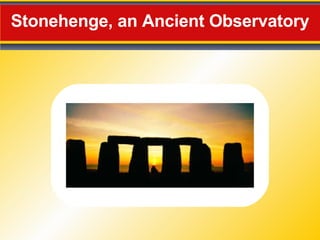
Stonehenge, an Ancient Observatory
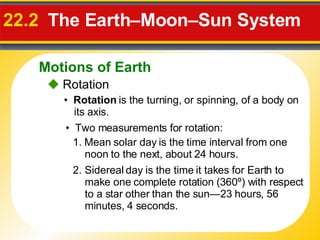
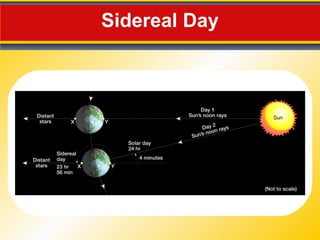
22.2   The Earth–Moon–Sun System     Rotation •  Rotation  is the turning, or spinning, of a body on its axis. •  Two measurements for rotation: 1. Mean solar day  is the time interval from one noon to the next, about 24 hours. 2. Sidereal day  is the time it takes for Earth to make one complete rotation (360º) with respect to a star other than the sun—23 hours, 56 minutes, 4 seconds. Motions of Earth
Sidereal Day
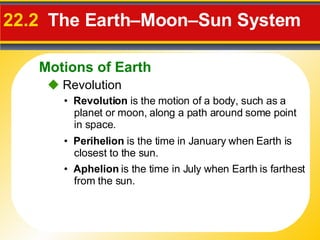
22.2   The Earth–Moon–Sun System     Revolution •  Revolution  is the motion of a body, such as a planet or moon, along a path around some point in space. •  Perihelion  is the time in January when Earth is closest to the sun. •  Aphelion  is the time in July when Earth is farthest from the sun. Motions of Earth
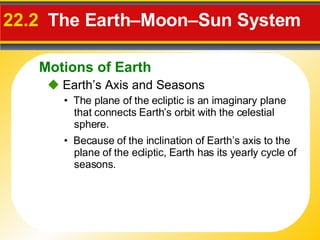
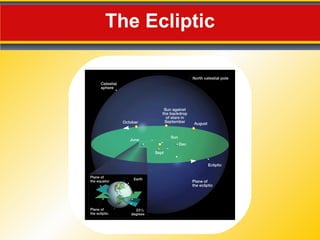
22.2   The Earth–Moon–Sun System     Earth’s Axis and Seasons •  Because of the inclination of Earth’s axis to the plane of the ecliptic, Earth has its yearly cycle of seasons. •  The plane of the  ecliptic  is an imaginary plane that connects Earth’s orbit with the celestial sphere. Motions of Earth
The Ecliptic
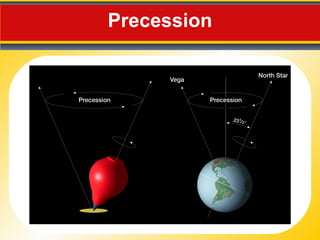
22.2  The Earth–Moon–Sun System     Precession •  Precession  traces out a cone over a period of 26,000 years.    Earth–Sun Motion •  The solar system speeds in the direction of the star Vega. •  The sun revolves around the galaxy. •  Earth is presently approaching one of its nearest galactic neighbors, the Great Galaxy in Andromeda. Motions of Earth
Precession
22.2  The Earth–Moon–Sun System    Perigee  is the point at which the moon is closest to Earth.    Apogee  is the point at which the moon is farthest from Earth. Motions of the Earth–Moon System
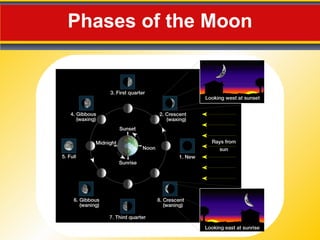
22.2   The Earth–Moon–Sun System    Phases of the Moon •  The  phases of the moon  are the progression of changes in the moon’s appearance during the month. •  Lunar phases are a result of the motion of the moon and the sunlight that is reflected from its surface. Motions of the Earth–Moon System
Phases of the Moon
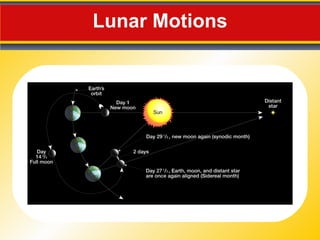
22.2   The Earth–Moon–Sun System    Lunar Motions •  The synodic month is based on the  cycle of the moon’s phases. It lasts 29 1/2 days. •  The sidereal month is the  true period of the moon’s revolution around Earth. It lasts 27 1/3 days. Motions of the Earth–Moon System
22.2  The Earth–Moon–Sun System •  The difference of two days between the synodic and sidereal cycles is due to the Earth–moon system also moving in an orbit around the sun.    Lunar Motions •  The moon’s period of rotation about its axis and its revolution around Earth are the same, 27 1/3 days. It causes the same lunar hemisphere to always face Earth. Motions of the Earth–Moon System
Lunar Motions
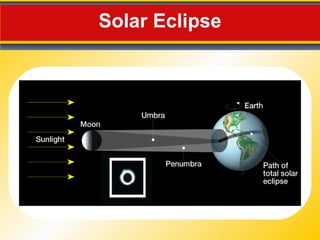
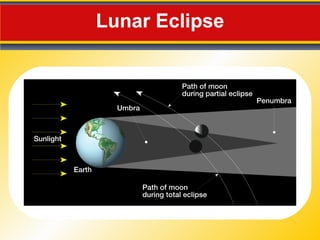
22.2  The Earth–Moon–Sun System    Solar eclipses  occur when the moon moves in a line directly between Earth and the sun, casting a shadow on Earth.    During a new-moon or full-moon phase, the moon’s orbit must cross the plane of the ecliptic for an eclipse to take place.    Lunar eclipses  occur when the moon passes through Earth’s shadow. Eclipses
Solar Eclipse
Lunar Eclipse
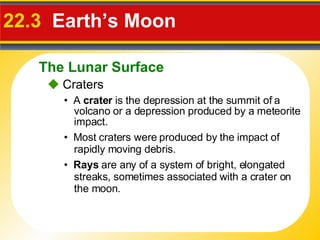
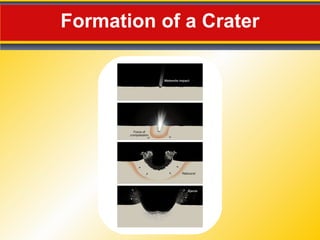
22.3  Earth’s Moon •  A  crater  is the depression at the summit of a volcano or a depression produced by a meteorite impact.    Craters •  Most craters were produced by the impact of rapidly moving debris. •  Rays  are any of a system of bright, elongated streaks, sometimes associated with a crater on the moon. The Lunar Surface
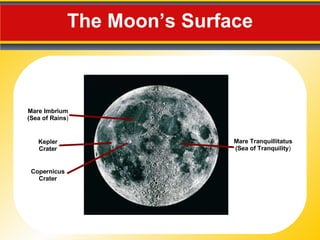
The Moon’s Surface Mare Tranquillitatus (Sea of Tranquility )‏ Mare Imbrium (Sea of Rains )‏ Kepler Crater Copernicus Crater
Formation of a Crater
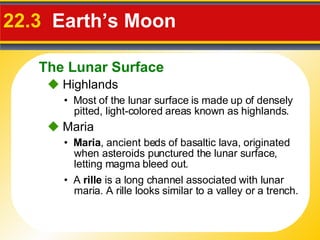
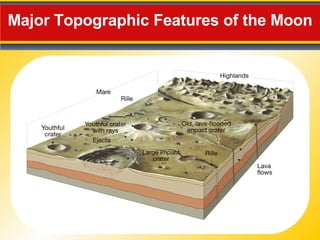
22.3  Earth’s Moon •  Most of the lunar surface is made up of densely pitted, light-colored areas known as highlands.    Highlands •  Maria , ancient beds of basaltic lava, originated when asteroids punctured the lunar surface, letting magma bleed out.    Maria •  A  rille  is a long channel associated with lunar maria. A rille looks similar to a valley or a trench. The Lunar Surface
22.3  Earth’s Moon •  The  lunar regolith  is a thin, gray layer on the surface of the moon, consisting of loosely compacted, fragmented material believed to have been formed by repeated impacts of meteorites.    Regolith The Lunar Surface
Major Topographic Features of the Moon
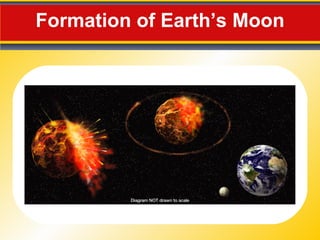
22.3   Earth’s Moon    The most widely accepted model for the origin of the moon is that when the solar system was forming, a body the size of Mars impacted Earth. The resulting debris was ejected into space, began orbiting around Earth, and eventually united to form the moon. Lunar History
Formation of Earth’s Moon
Nicolaus Copernicus He was born in 1473 and died in 1543 He started studies in 1492 His Ideas and concepts: He was the first astronomer to prove that the earth was a planet and not the center of the solar system, he gave birth to the concept of Heliocentrism: that the sun was the center of the solar system.
Copernicus cont. He oppressed by many social and religious figures. He wanted to prove what was going on in the heavens better than a church doctrine could, so he was a bother to religious leaders. He faced charges of heresy for contradicting church beliefs
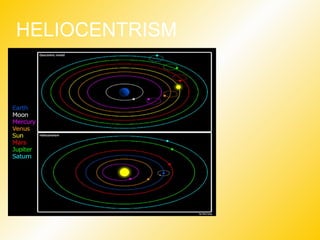
Copernicus cont. He believed in heliocentrism: that the sun was the center of the solar system, no the earth, and that all other planets orbited around it. A picture of his views can be seen on the next slide
HELIOCENTRISM
Citations Websites used:  http://en.wikipedia.org/wiki/Image:Geoz_wb_en.jpg http://en.wikipedia.org/wiki/Nicolaus_Copernicus http://atheism.about.com/library/weekly/aa101498.htm Mrs. Jensen's one slide of her power point.

Earth Science

  • 1.
    Prentice Hall EARTH SCIENCE Tarbuck Lutgens 
  • 2.
    Chapter 22 Origin of Modern Astronomy
  • 3.
    22.1 Early Astronomy  Astronomy is the science that studies the universe. It includes the observation and interpretation of celestial bodies and phenomena.  The Greeks used philosophical arguments to explain natural phenomena.  The Greeks also used some observational data. Ancient Greeks
  • 4.
  • 5.
  • 6.
    22.1 Early Astronomy  Geocentric Model • In the ancient Greeks’ geocentric model, the moon, sun, and the known planets—Mercury, Venus, Mars, and Jupiter—orbit Earth.  Heliocentric Model • In the heliocentric model, Earth and the other planets orbit the sun. Ancient Greeks
  • 7.
  • 8.
    22.1 EarlyAstronomy  Ptolemaic System • Ptolemy created a model of the universe that accounted for the movement of the planets. • Retrograde motion is the apparent westward motion of the planets with respect to the stars. Ancient Greeks
  • 9.
  • 10.
    22.1 EarlyAstronomy  Nicolaus Copernicus • Copernicus concluded that Earth is a planet. He proposed a model of the solar system with the sun at the center. The Birth of Modern Astronomy
  • 11.
    22.1 Early Astronomy  Tycho Brahe • Tycho Brahe designed and built instruments to measure the locations of the heavenly bodies. Brahe’s observations, especially of Mars, were far more precise than any made previously. The Birth of Modern Astronomy
  • 12.
    22.1 EarlyAstronomy  Johannes Kepler • Kepler discovered three laws of planetary motion: 1. Orbits of the planets are elliptical. 2. Planets revolve around the sun at varying speed. 3. There is a proportional relationship between a planet’s orbital period and its distance to the sun. The Birth of Modern Astronomy
  • 13.
    22.1 Early Astronomy  Johannes Kepler • An ellipse is an oval-shaped path . • An astronomical unit (AU) is the average distance between Earth and the sun; it is about 150 million kilometers . The Birth of Modern Astronomy
  • 14.
  • 15.
    22.1 EarlyAstronomy  Galileo Galilei • Galileo’s most important contributions were his descriptions of the behavior of moving objects. • He developed his own telescope and made important discoveries: 1. Four satellites, or moons, orbit Jupiter. 2. Planets are circular disks, not just points of light. 3. Venus has phases just like the moon. 4. The moon’s surface is not smooth. 5. The sun has sunspots, or dark regions. The Birth of Modern Astronomy
  • 16.
    The Solar SystemModel Evolves
  • 17.
    22.1 Early Astronomy  Sir Isaac Newton • Although others had theorized the existence of gravitational force, Newton was the first to formulate and test the law of universal gravitation.  Universal Gravitation • Gravitational force decreases with distance. • The greater the mass of an object, the greater is its gravitational force. The Birth of Modern Astronomy
  • 18.
  • 19.
    22.2 The Earth–Moon–Sun System  The two main motions of Earth are rotation and revolution. Precession is a third and very slow motion of Earth’s axis. Motions of Earth
  • 20.
  • 21.
    22.2 The Earth–Moon–Sun System  Rotation • Rotation is the turning, or spinning, of a body on its axis. • Two measurements for rotation: 1. Mean solar day is the time interval from one noon to the next, about 24 hours. 2. Sidereal day is the time it takes for Earth to make one complete rotation (360º) with respect to a star other than the sun—23 hours, 56 minutes, 4 seconds. Motions of Earth
  • 22.
  • 23.
    22.2 The Earth–Moon–Sun System  Revolution • Revolution is the motion of a body, such as a planet or moon, along a path around some point in space. • Perihelion is the time in January when Earth is closest to the sun. • Aphelion is the time in July when Earth is farthest from the sun. Motions of Earth
  • 24.
    22.2 The Earth–Moon–Sun System  Earth’s Axis and Seasons • Because of the inclination of Earth’s axis to the plane of the ecliptic, Earth has its yearly cycle of seasons. • The plane of the ecliptic is an imaginary plane that connects Earth’s orbit with the celestial sphere. Motions of Earth
  • 25.
  • 26.
    22.2 TheEarth–Moon–Sun System  Precession • Precession traces out a cone over a period of 26,000 years.  Earth–Sun Motion • The solar system speeds in the direction of the star Vega. • The sun revolves around the galaxy. • Earth is presently approaching one of its nearest galactic neighbors, the Great Galaxy in Andromeda. Motions of Earth
  • 27.
  • 28.
    22.2 TheEarth–Moon–Sun System  Perigee is the point at which the moon is closest to Earth.  Apogee is the point at which the moon is farthest from Earth. Motions of the Earth–Moon System
  • 29.
    22.2 The Earth–Moon–Sun System  Phases of the Moon • The phases of the moon are the progression of changes in the moon’s appearance during the month. • Lunar phases are a result of the motion of the moon and the sunlight that is reflected from its surface. Motions of the Earth–Moon System
  • 30.
  • 31.
    22.2 The Earth–Moon–Sun System  Lunar Motions • The synodic month is based on the cycle of the moon’s phases. It lasts 29 1/2 days. • The sidereal month is the true period of the moon’s revolution around Earth. It lasts 27 1/3 days. Motions of the Earth–Moon System
  • 32.
    22.2 TheEarth–Moon–Sun System • The difference of two days between the synodic and sidereal cycles is due to the Earth–moon system also moving in an orbit around the sun.  Lunar Motions • The moon’s period of rotation about its axis and its revolution around Earth are the same, 27 1/3 days. It causes the same lunar hemisphere to always face Earth. Motions of the Earth–Moon System
  • 33.
  • 34.
    22.2 TheEarth–Moon–Sun System  Solar eclipses occur when the moon moves in a line directly between Earth and the sun, casting a shadow on Earth.  During a new-moon or full-moon phase, the moon’s orbit must cross the plane of the ecliptic for an eclipse to take place.  Lunar eclipses occur when the moon passes through Earth’s shadow. Eclipses
  • 35.
  • 36.
  • 37.
    22.3 Earth’sMoon • A crater is the depression at the summit of a volcano or a depression produced by a meteorite impact.  Craters • Most craters were produced by the impact of rapidly moving debris. • Rays are any of a system of bright, elongated streaks, sometimes associated with a crater on the moon. The Lunar Surface
  • 38.
    The Moon’s SurfaceMare Tranquillitatus (Sea of Tranquility )‏ Mare Imbrium (Sea of Rains )‏ Kepler Crater Copernicus Crater
  • 39.
  • 40.
    22.3 Earth’sMoon • Most of the lunar surface is made up of densely pitted, light-colored areas known as highlands.  Highlands • Maria , ancient beds of basaltic lava, originated when asteroids punctured the lunar surface, letting magma bleed out.  Maria • A rille is a long channel associated with lunar maria. A rille looks similar to a valley or a trench. The Lunar Surface
  • 41.
    22.3 Earth’sMoon • The lunar regolith is a thin, gray layer on the surface of the moon, consisting of loosely compacted, fragmented material believed to have been formed by repeated impacts of meteorites.  Regolith The Lunar Surface
  • 42.
  • 43.
    22.3 Earth’s Moon  The most widely accepted model for the origin of the moon is that when the solar system was forming, a body the size of Mars impacted Earth. The resulting debris was ejected into space, began orbiting around Earth, and eventually united to form the moon. Lunar History
  • 44.
  • 45.
    Nicolaus Copernicus Hewas born in 1473 and died in 1543 He started studies in 1492 His Ideas and concepts: He was the first astronomer to prove that the earth was a planet and not the center of the solar system, he gave birth to the concept of Heliocentrism: that the sun was the center of the solar system.
  • 46.
    Copernicus cont. Heoppressed by many social and religious figures. He wanted to prove what was going on in the heavens better than a church doctrine could, so he was a bother to religious leaders. He faced charges of heresy for contradicting church beliefs
  • 47.
    Copernicus cont. Hebelieved in heliocentrism: that the sun was the center of the solar system, no the earth, and that all other planets orbited around it. A picture of his views can be seen on the next slide
  • 48.
  • 49.
    Citations Websites used: http://en.wikipedia.org/wiki/Image:Geoz_wb_en.jpg http://en.wikipedia.org/wiki/Nicolaus_Copernicus http://atheism.about.com/library/weekly/aa101498.htm Mrs. Jensen's one slide of her power point.