



FAULTS
&
CRITERIA FOR FAULTING
GROUP MEMBERS
•ALI IMTIAZ
•MUNEEB-UR-REHMAN
•UMER ABDUR REHMAN
WHAT IS A FAULT?
A fault is a fracture, along which a
rock on one side move relative to the
rock on other side.
The real question is,
What is a fracture?
FAULT TERMINOLOGIES
• Fault plane
Planer surface along which rocks on opposite
side move.
• The walls:
1) Hanging wall
2) Foot wall
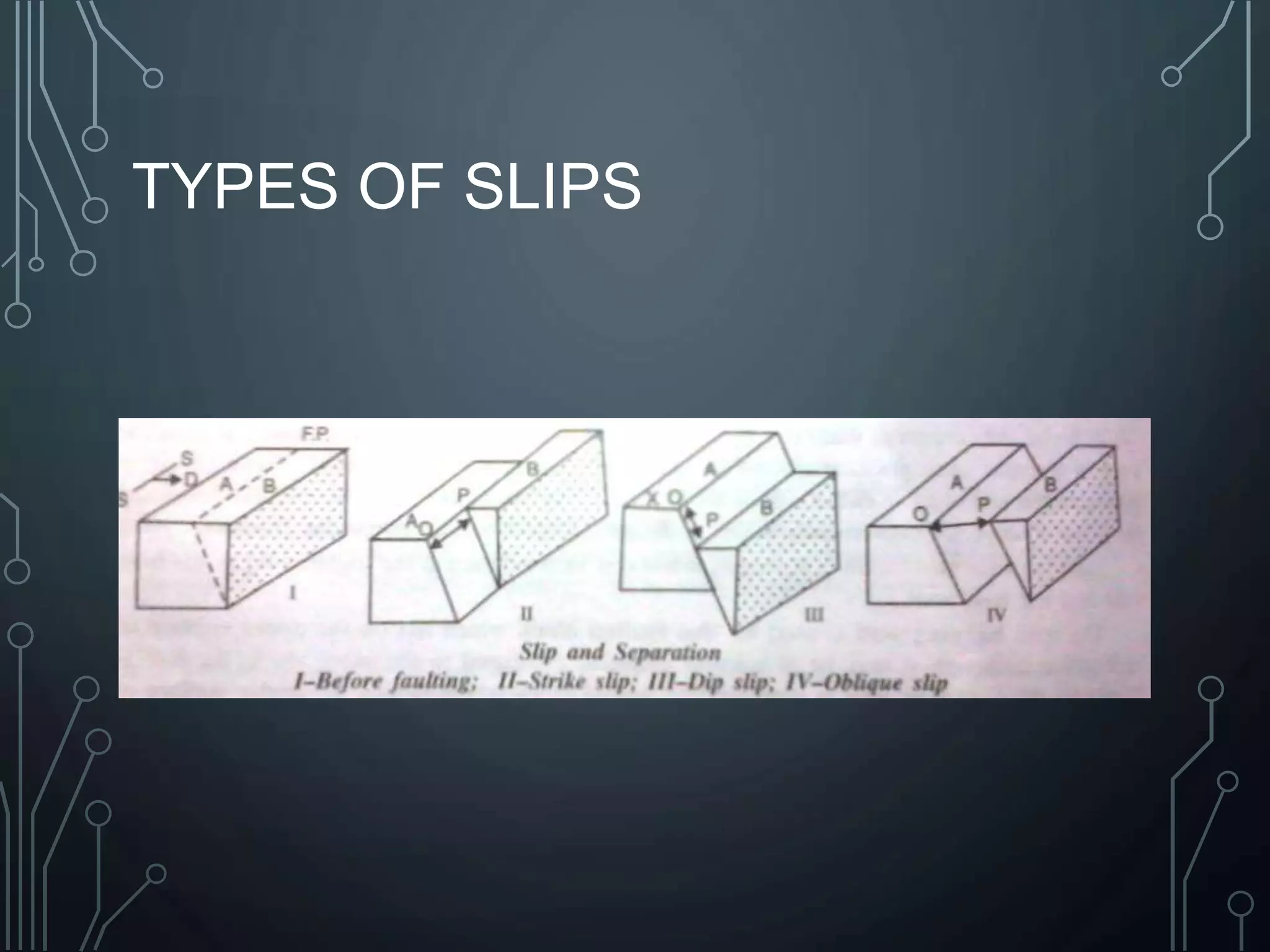
• Slips
1) strike slip
2) dip slip
3) oblique slip
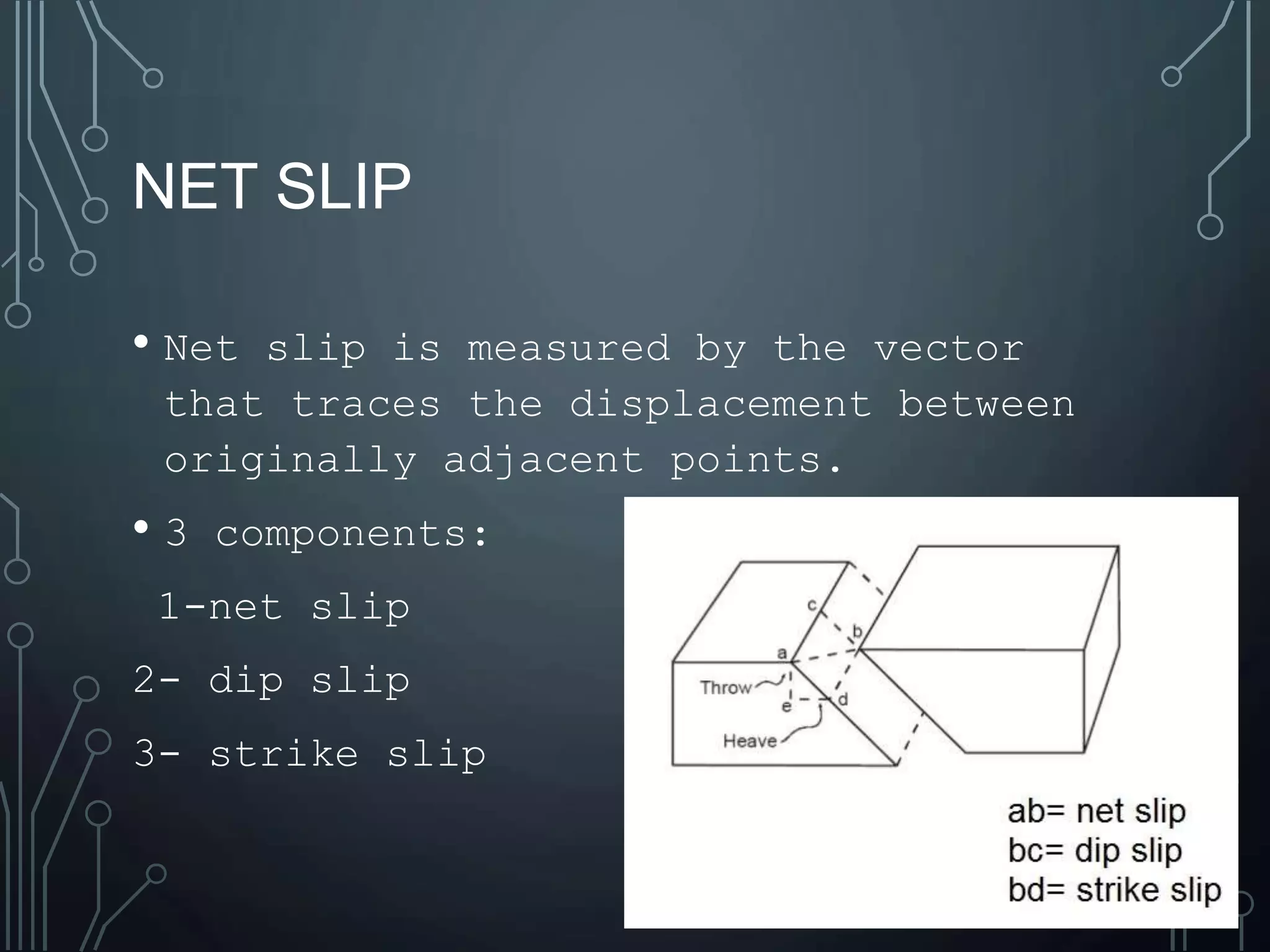
NET SLIP
• Net slip is measured by the vector
that traces the displacement between
originally adjacent points.
• 3 components:
1-net slip
2- dip slip
3- strike slip
TYPES OF SLIPS
THROW & HEAVE
Throw:
Horizontal component of
seperation.
Heave:
Vertical component of seperation.
GENETIC CLASSIFICATION OF
FAULTS
1) Normal Faults
2) Thrust Faults
3) strike slip Faults
4) Net slip Faults
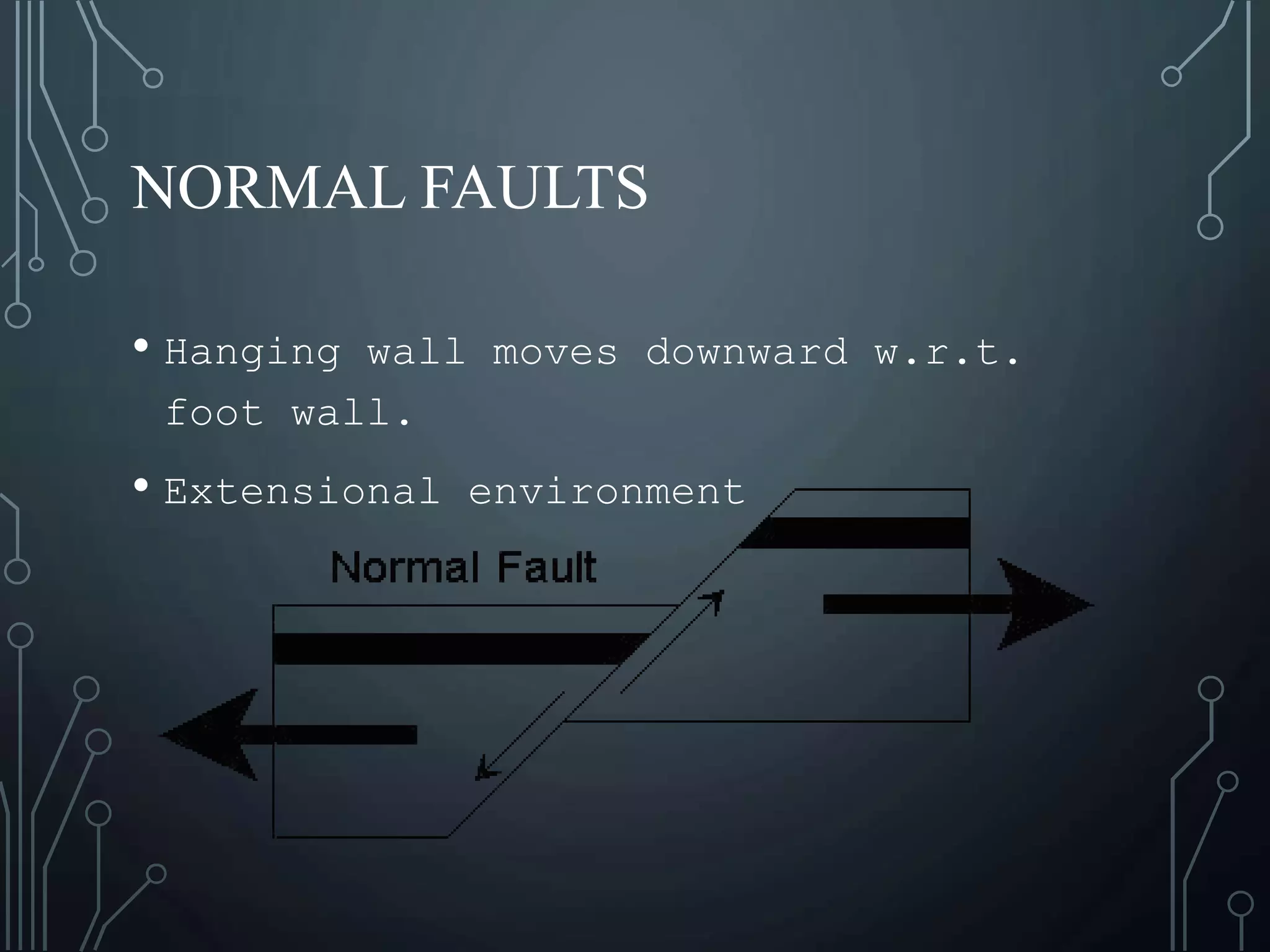
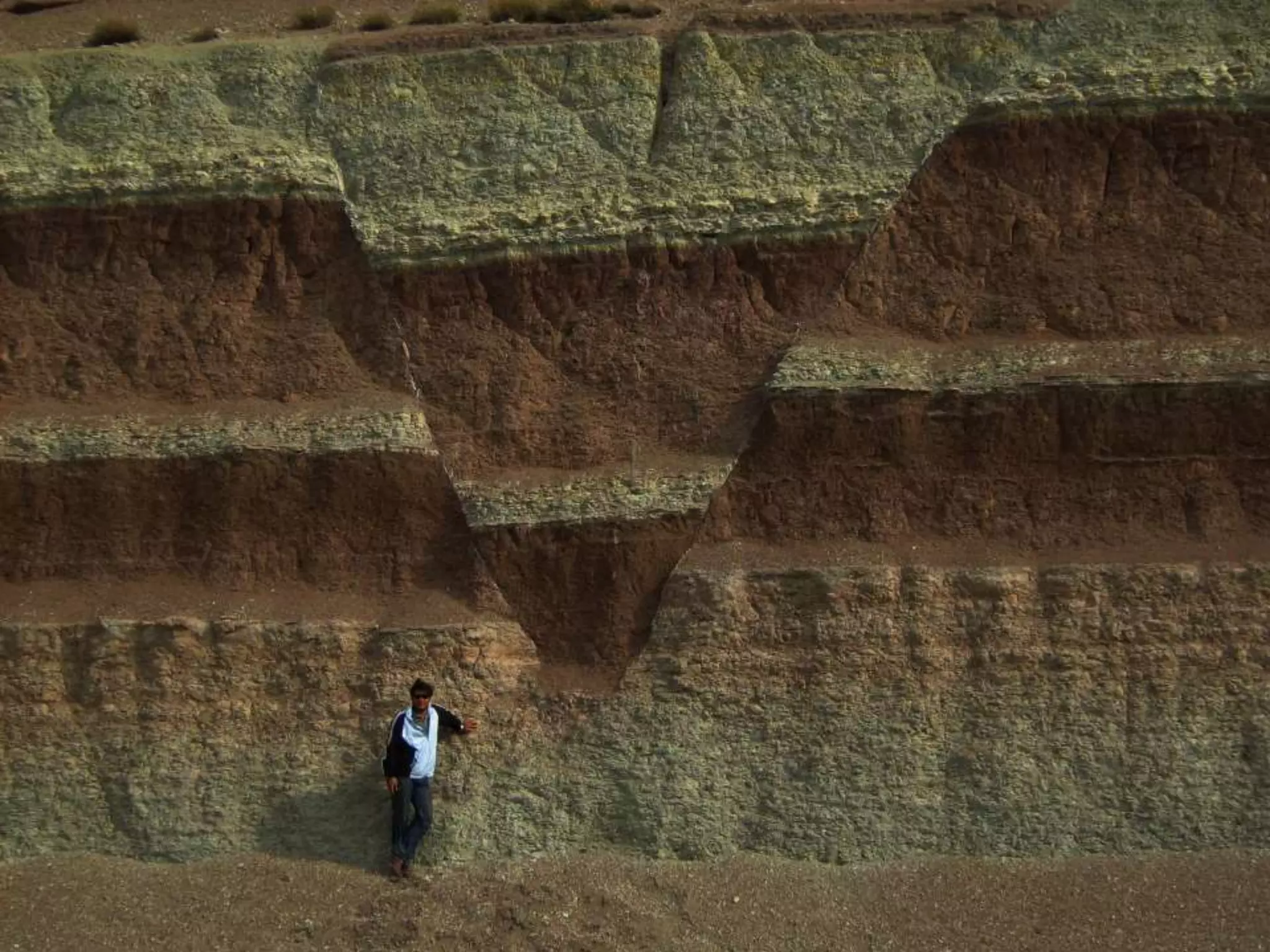
NORMAL FAULTS
• Hanging wall moves downward w.r.t.
foot wall.
• Extensional environment
NORMAL FAULTS
• Also known as gravity faults by some geologist
• A detechmant fault is a special category of low
angle normal faults due to downhill sliding of rocks
from an uplifted region.
EXAMPLE
• Amorgos fault:
Location: greece
Length: >100km
Type: normal fault
Status: active
THRUST FAULT
• Thrust fault is a fault along which the
hanging wall moves up relative to foot wall
• Further classified into 3 types:
• Reverse fault: is thrust that dips > 45’
• Thrust: that dips <45’
• Overthrust: that dips < 10’ and has large net-
slip,
For example,
Longmen shan fault
Location: china
Status: active
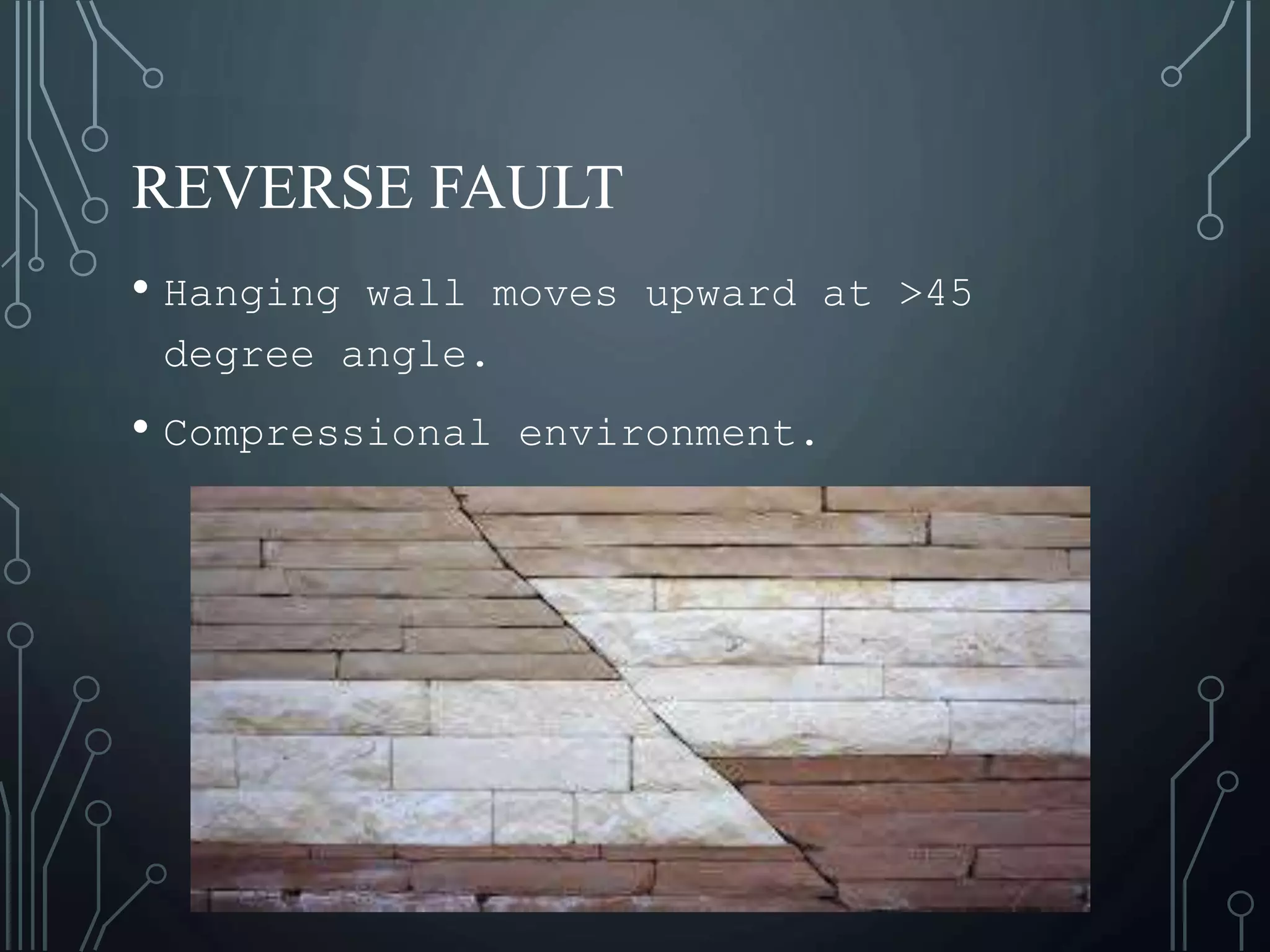
REVERSE FAULT
• Hanging wall moves upward at >45
degree angle.
• Compressional environment.
STRIKE SLIP FAULTS
• Also called as wrench faults.
• walls slide pass each other or displacement
parallel to the strike.
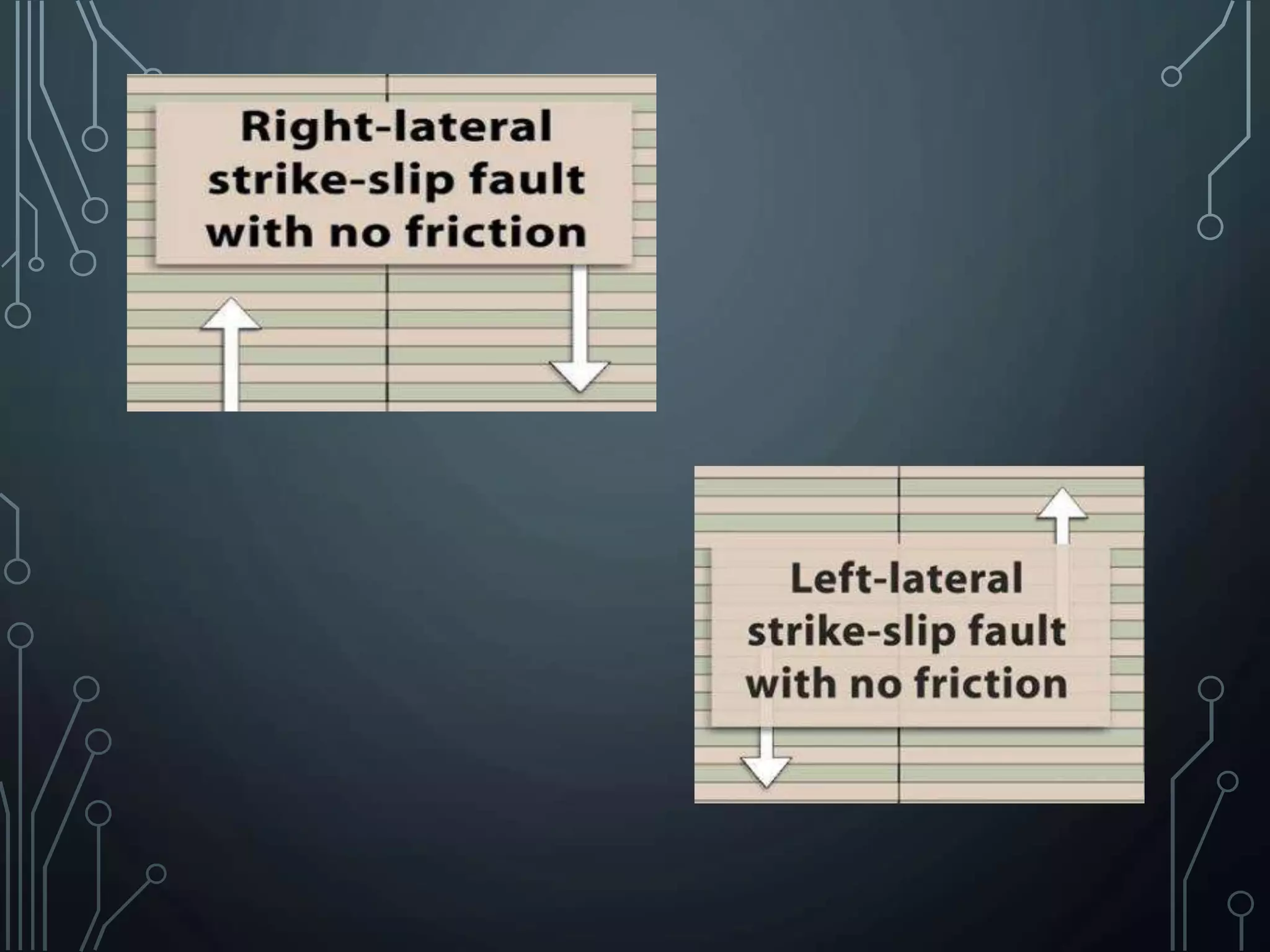
• Further classify into 2 types:
• 1-Sinistral:Left lateral strike-slip fault (sinistral): Where
the side opposite the observer moves to the left.
• 2-dextral: Right lateral strike-slip fault (dextral): Where
the side opposite the observer moves to the right
Example is: an Andreas Fault..
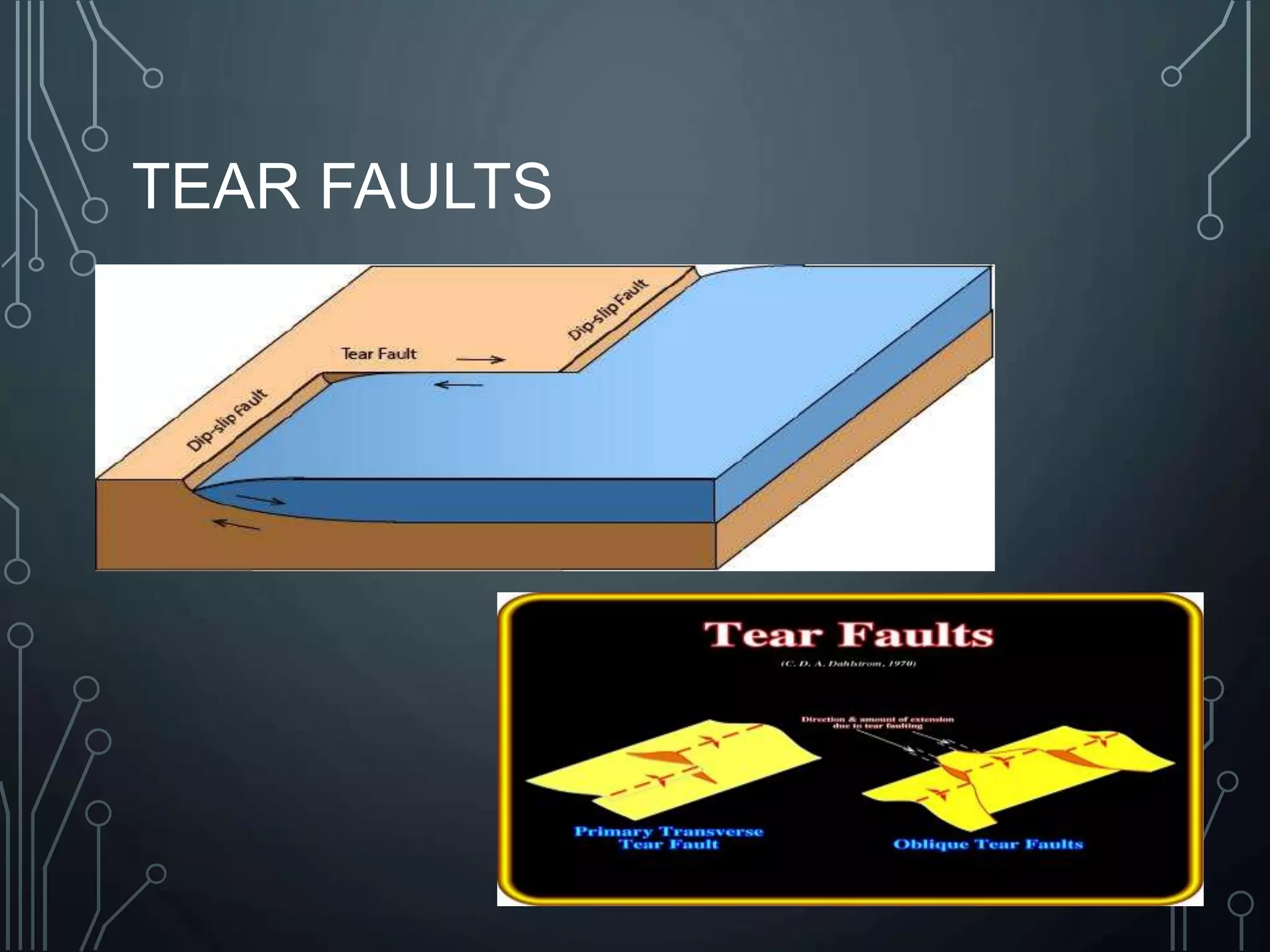
TEAR FAULTS
• Tear faults can be be defined as relatively small-scale,
local strike-slip faults that are associated with other
structures such as folds, thrust faults and normal faults
(Twiss and Moore 1992). The tear faults may be a result
of drastic lateral changes when the thrust front advances
or by differential shortening of the thrustal sheet. For
example as one part of the thrust sheet is shortened by
faulting and the other is shortened by folding, the
displacement is taken up by the tear fault. The
Jacksboro fault in the Appalachians is a good example
of a tear fault that segments the Pine Mountain Thrust
Belt (Twiss and Moores 1992).
TEAR FAULTS
STRIKE SLIP FAULTS
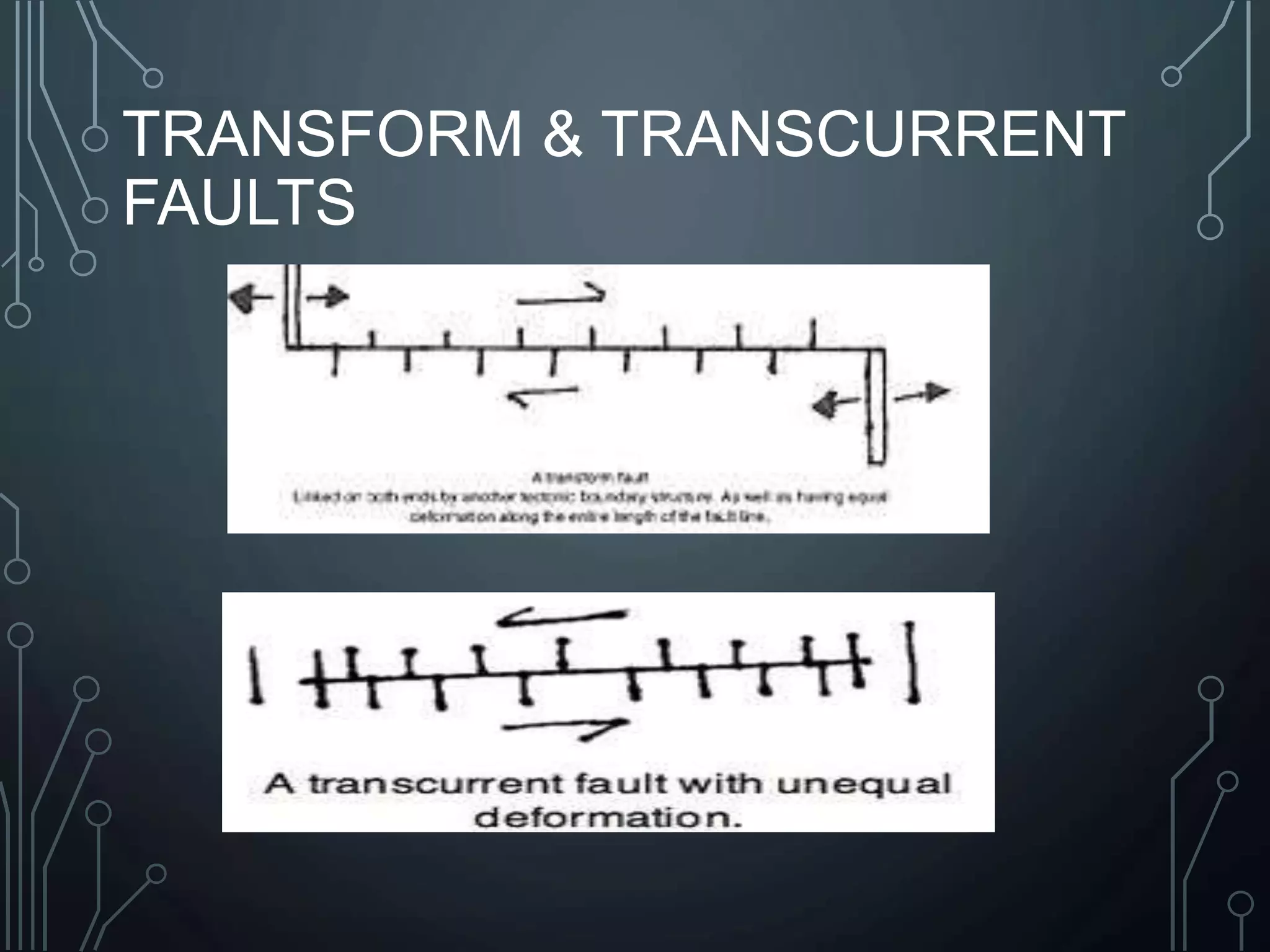
• It is also classified into transform faults and transcurrent
faults. Transform faults end at the junction of another
plate boundary or fault type, while transcurrent faults die
out without a junction. In addition, transform faults have
equal deformation across the entire fault line, while
transcurrent faults have greater displacement in the
middle of the fault zone and less on the margins. Finally,
transform faults can form a tectonic plate boundary,
while transcurrent faults cannot.
TRANSFORM & TRANSCURRENT
FAULTS
GEOMETRICAL CLASSIFICATION
i- rake of net slip
ii- attitude of fault w.r.t adjacent
beds.
iii- fault pattern
iv- apparent movement
v- dip of the fault
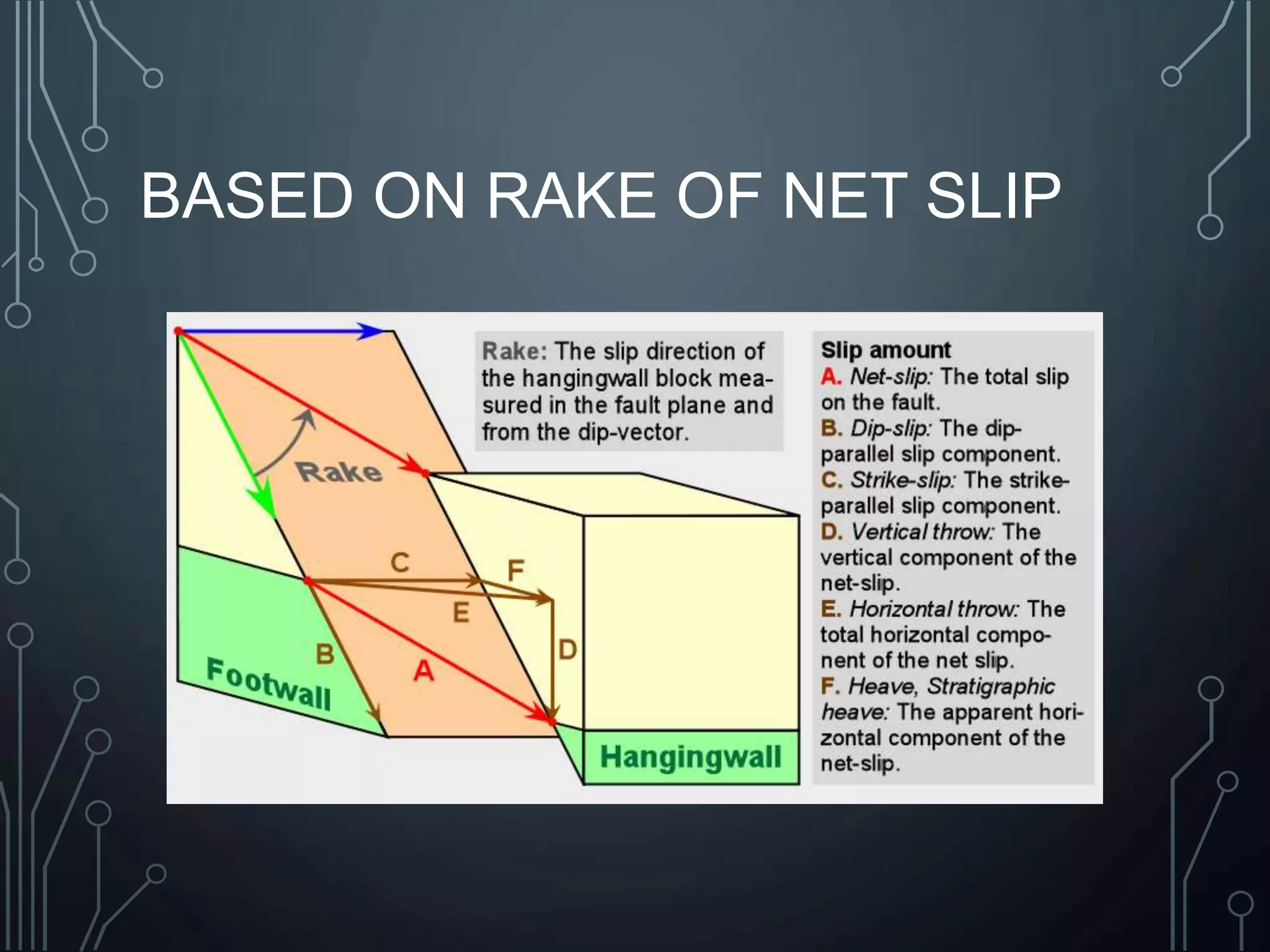
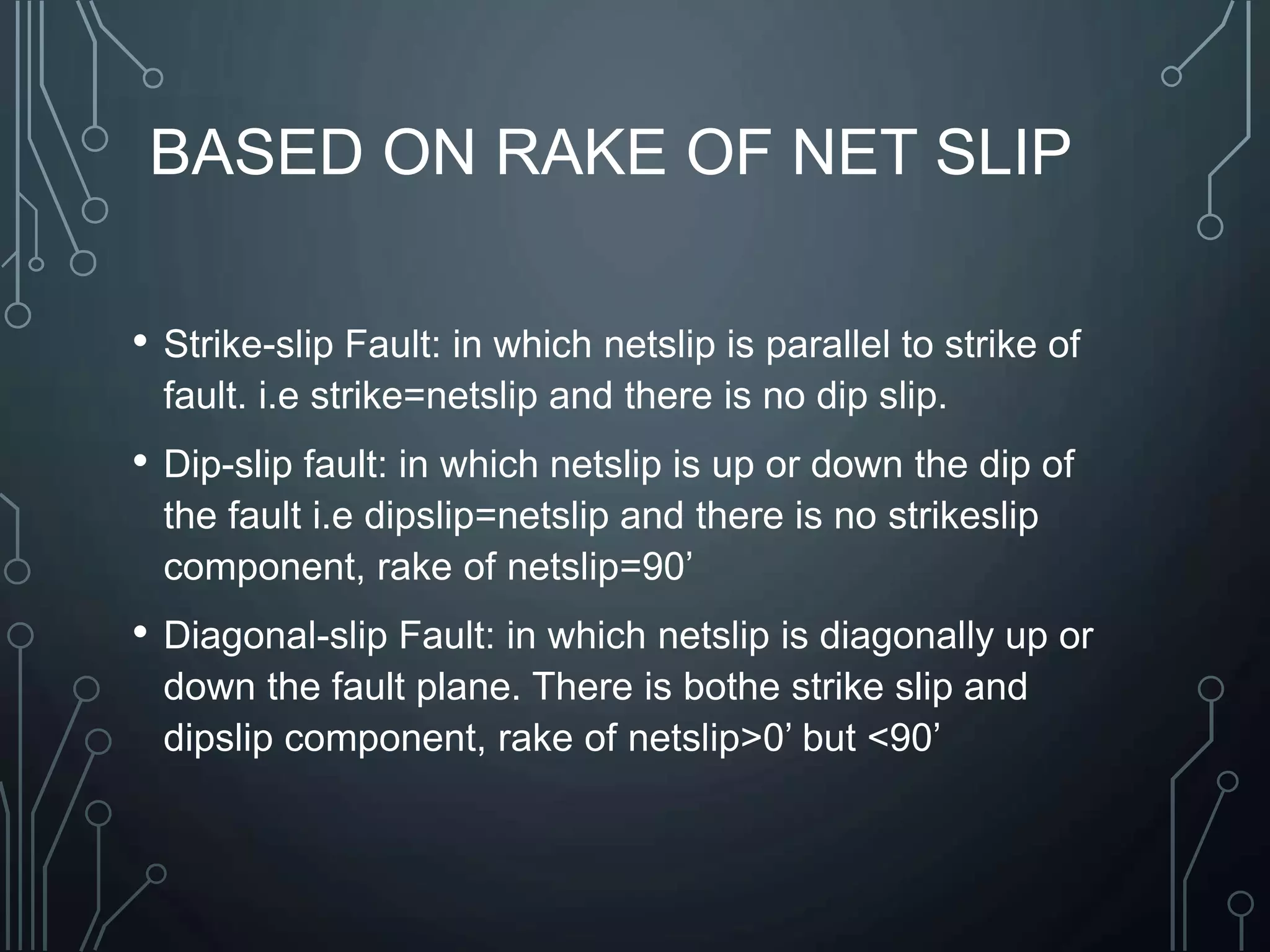
BASED ON RAKE OF NET SLIP
• Strike-slip Fault: in which netslip is parallel to strike of
fault. i.e strike=netslip and there is no dip slip.
• Dip-slip fault: in which netslip is up or down the dip of
the fault i.e dipslip=netslip and there is no strikeslip
component, rake of netslip=90’
• Diagonal-slip Fault: in which netslip is diagonally up or
down the fault plane. There is bothe strike slip and
dipslip component, rake of netslip>0’ but <90’
BASED ON ATTITUDE OF FAULT
REALATIVE TO ATTITUDE OF
ADJACENT BEDS
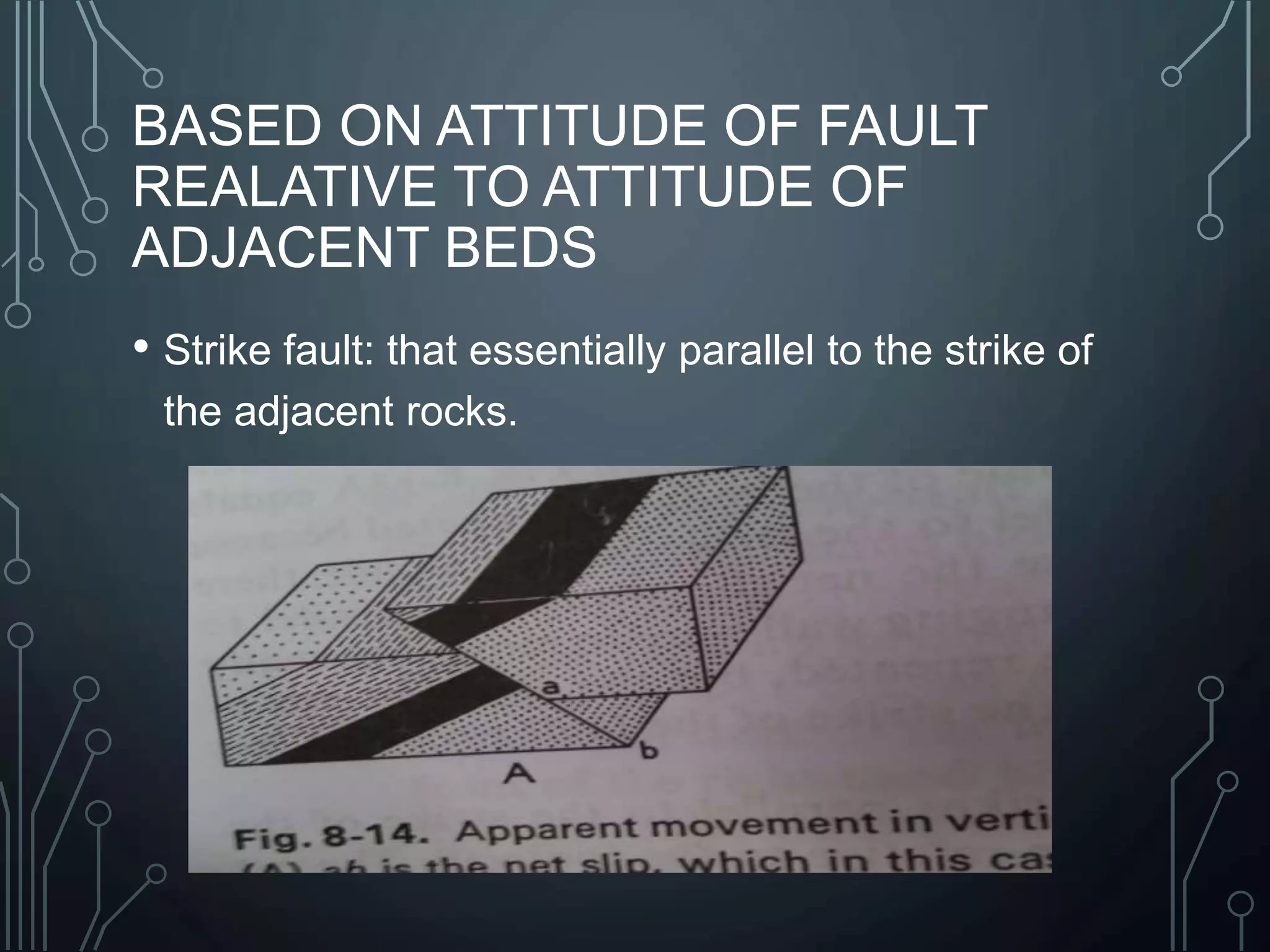
• Strike fault: that essentially parallel to the strike of
the adjacent rocks.
BASED ON ATTITUDE OF FAULT
REALATIVE TO ATTITUDE OF
ADJACENT BEDS
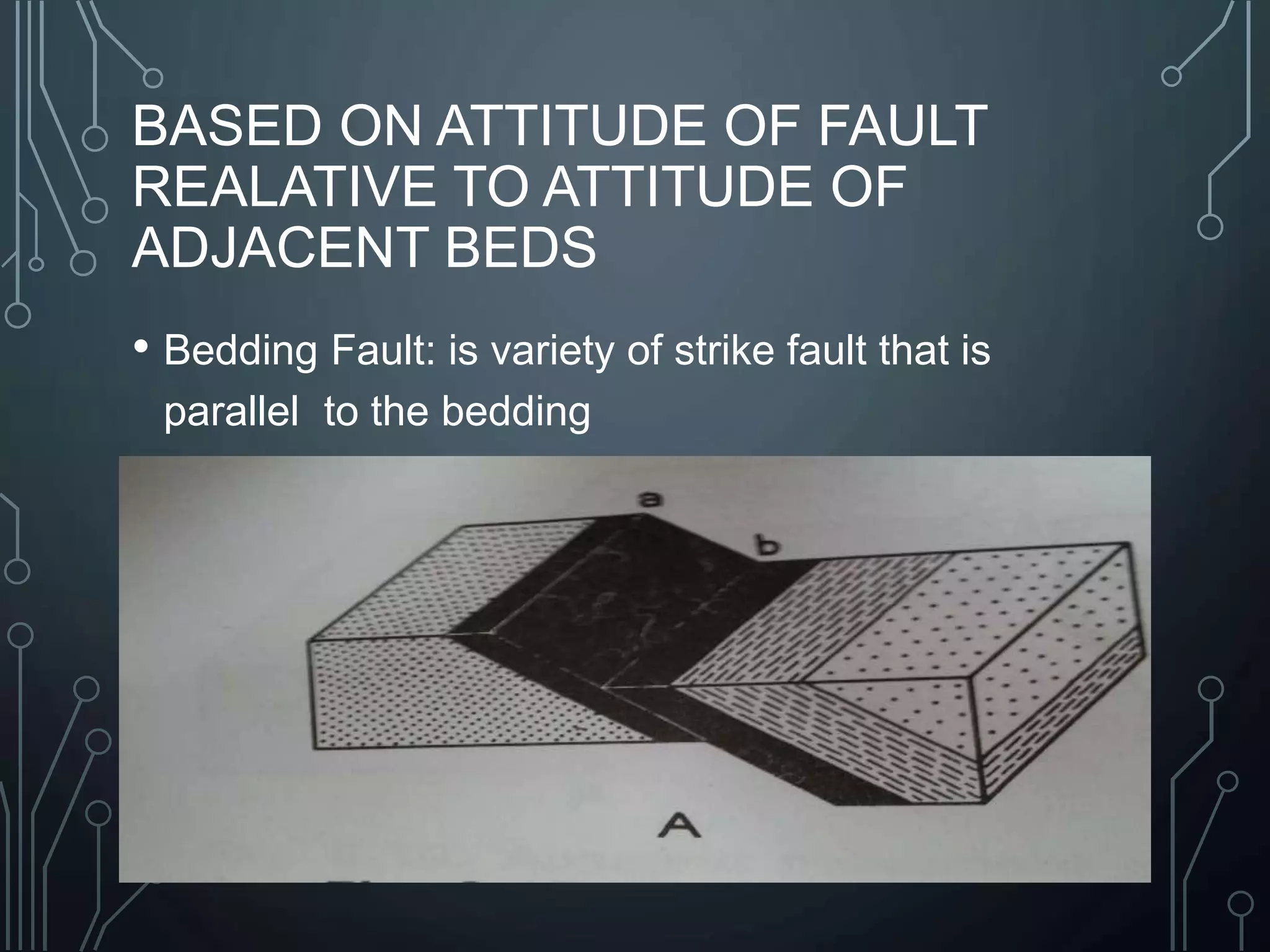
• Bedding Fault: is variety of strike fault that is
parallel to the bedding
BASED ON ATTITUDE OF FAULT
REALATIVE TO ATTITUDE OF
ADJACENT BEDS
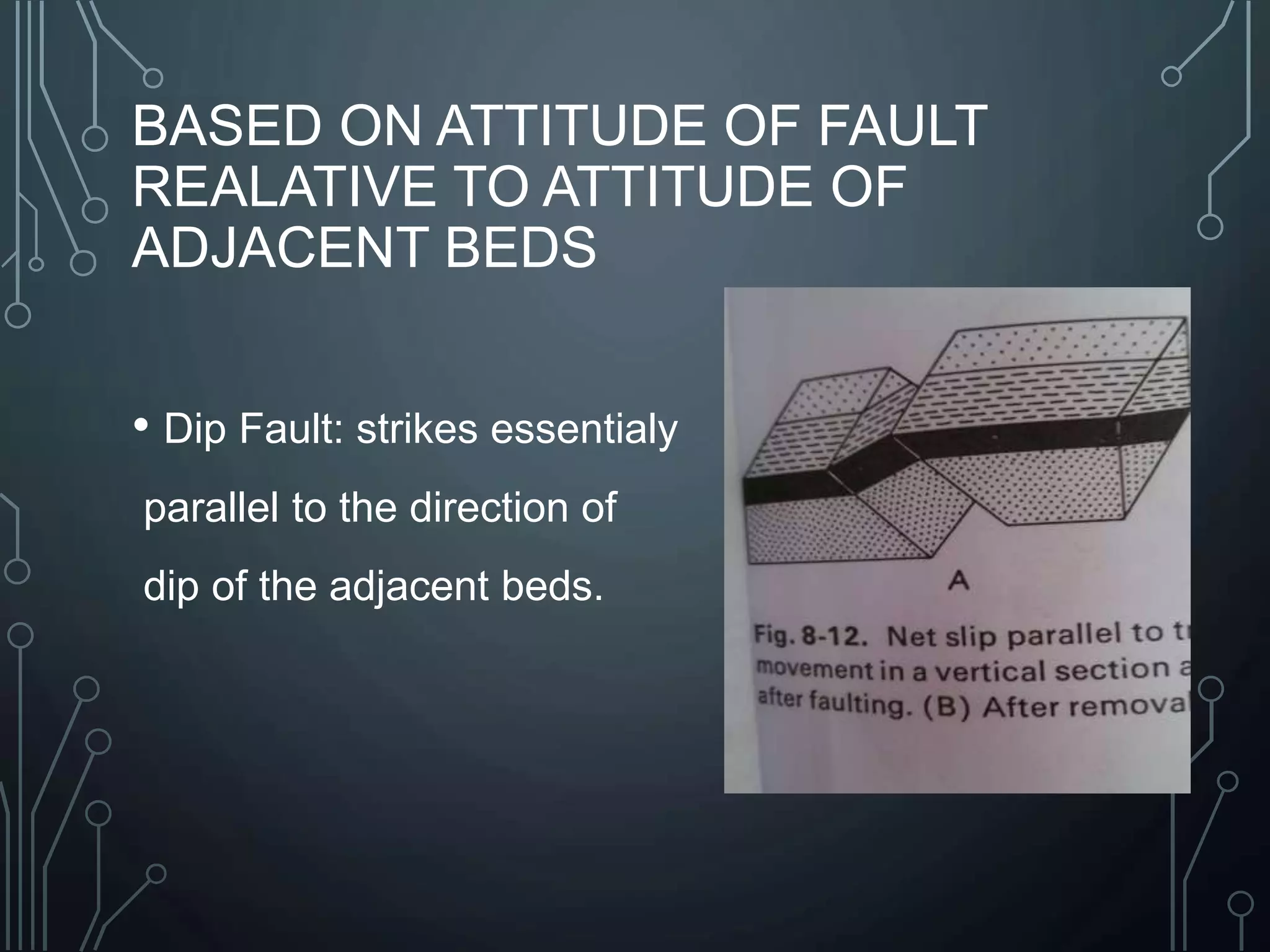
• Dip Fault: strikes essentialy
parallel to the direction of
dip of the adjacent beds.
BASED ON ATTITUDE OF FAULT
REALATIVE TO ATTITUDE OF
ADJACENT BEDS
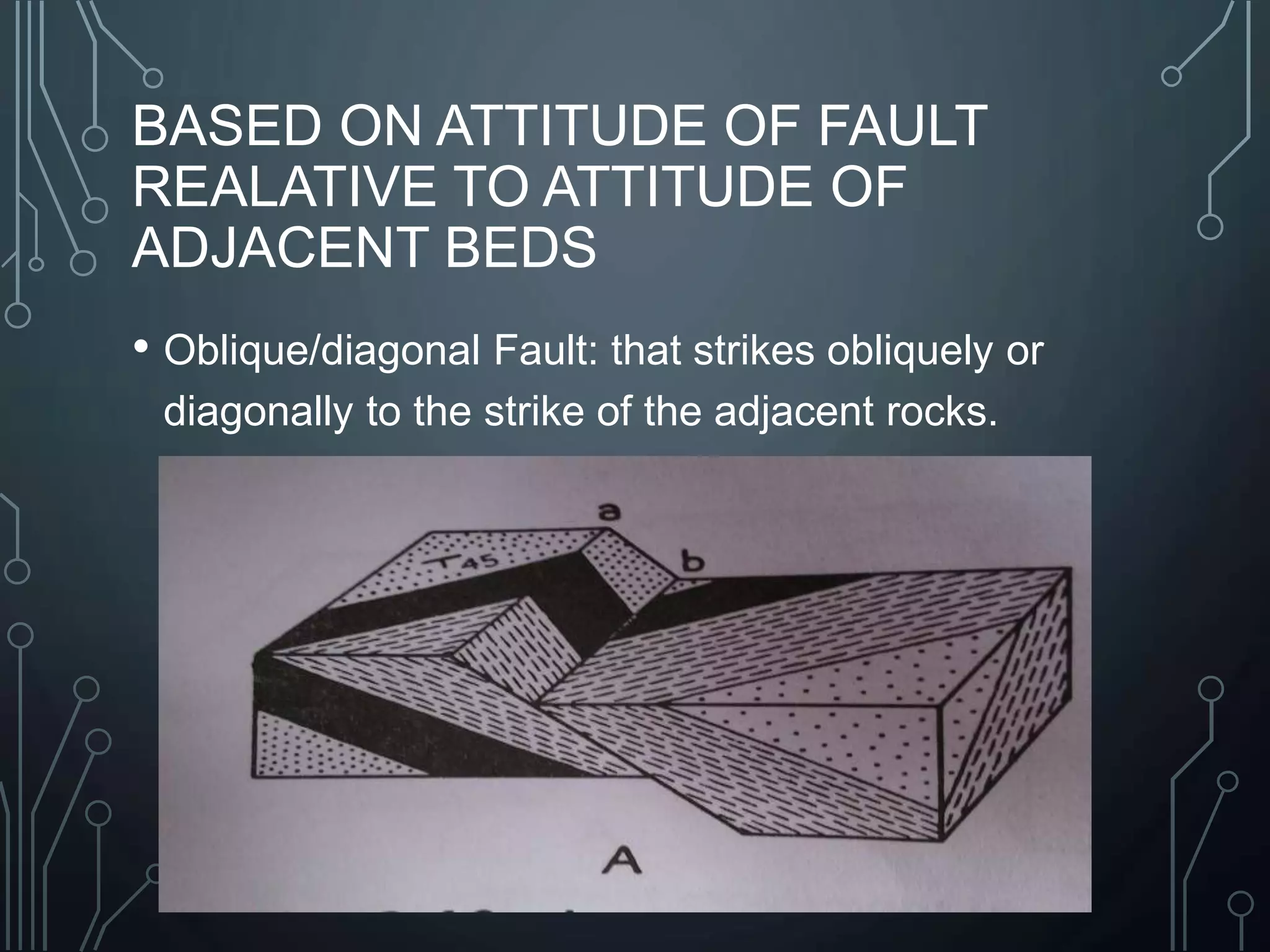
• Oblique/diagonal Fault: that strikes obliquely or
diagonally to the strike of the adjacent rocks.
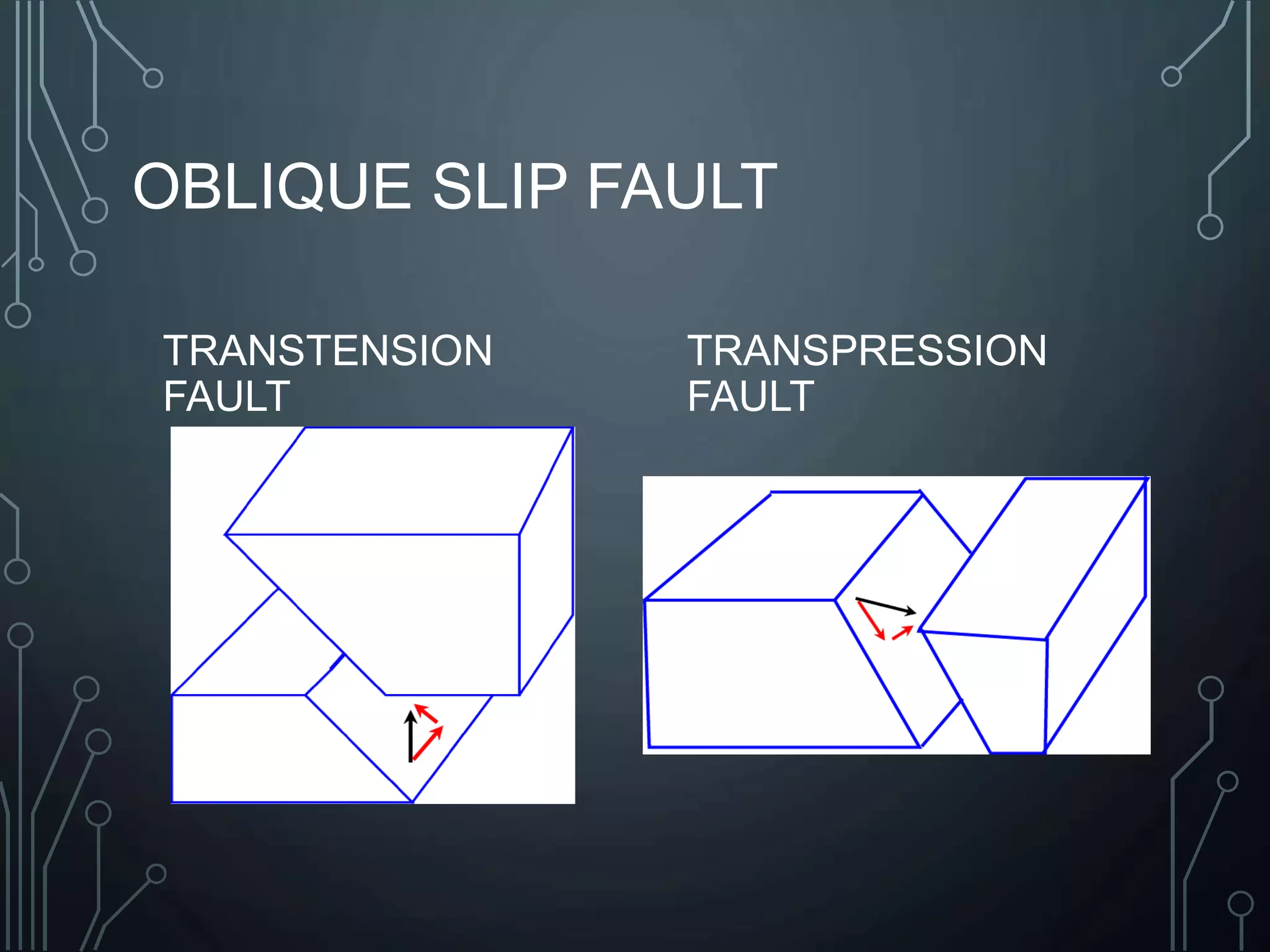
OBLIQUE SLIP FAULT
TRANSTENSION
FAULT
TRANSPRESSION
FAULT
BASED ON ATTITUDE OF FAULT
REALATIVE TO ATTITUDE OF
ADJACENT BEDS
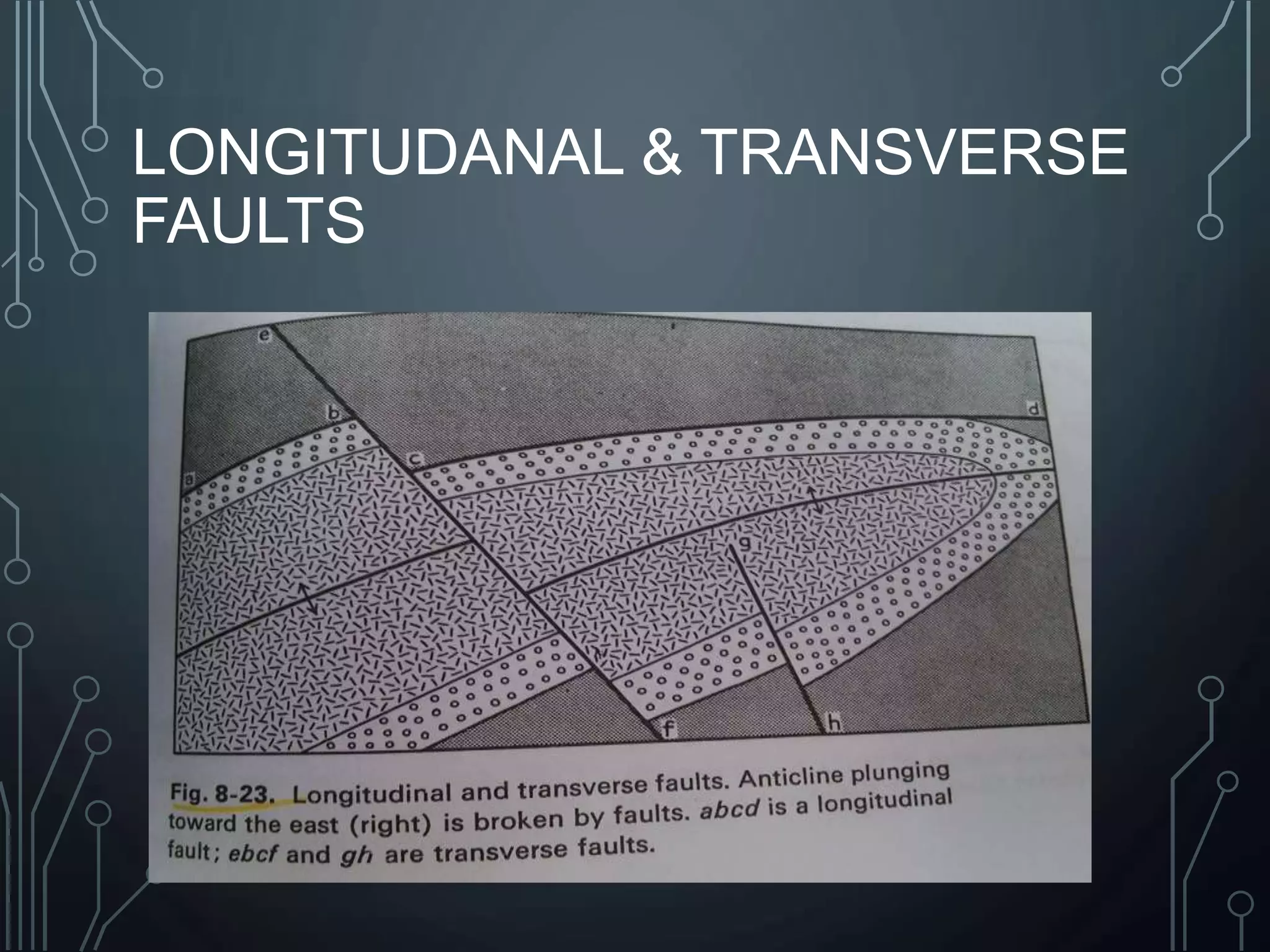
• Longitudinal Fault: is parallel to the strikes of the
regional structure.
• Transverse Fault: strikes perpendicularly or
diagonally to the strike of the regional structure.
LONGITUDANAL & TRANSVERSE
FAULTS
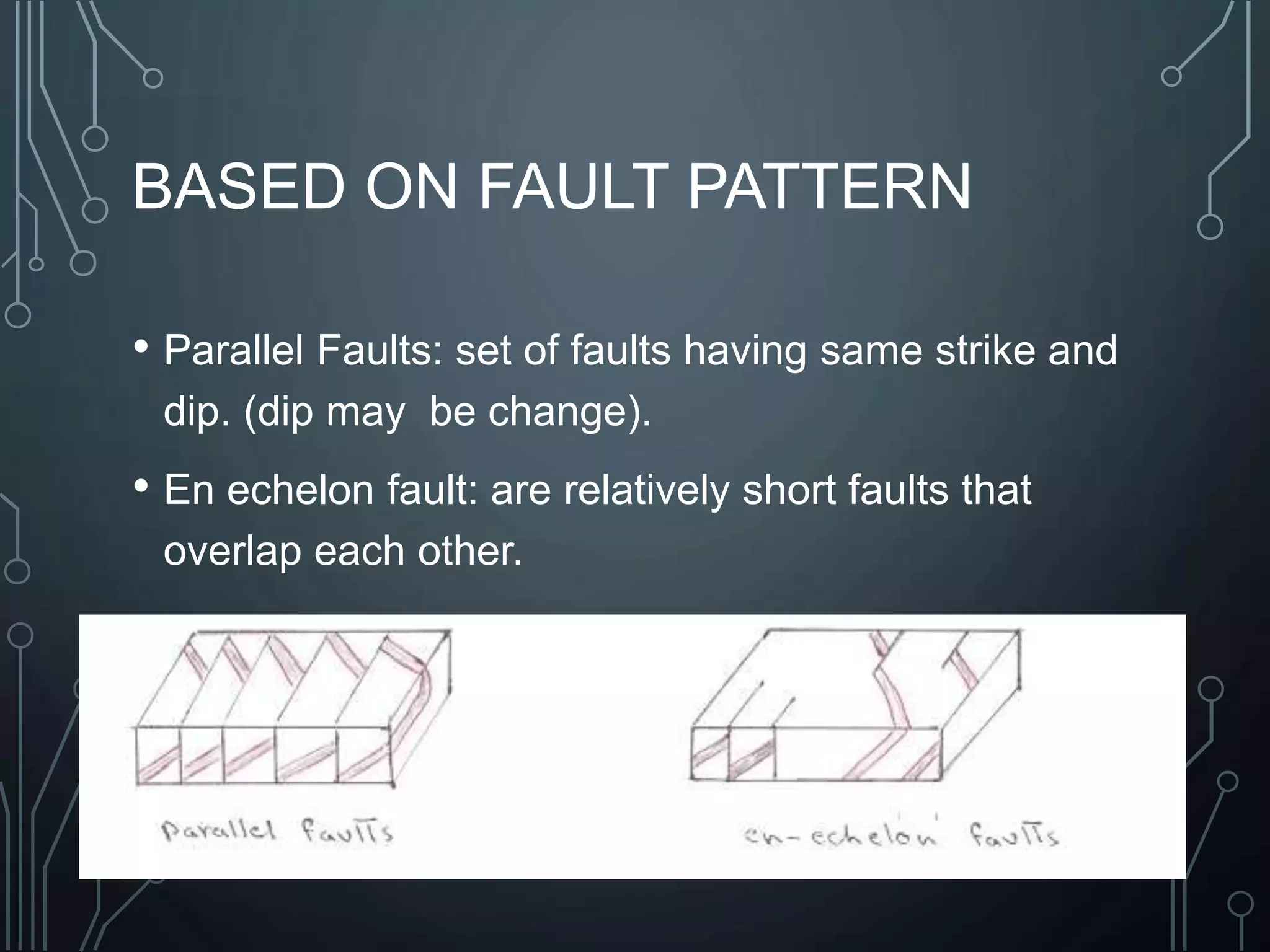
BASED ON FAULT PATTERN
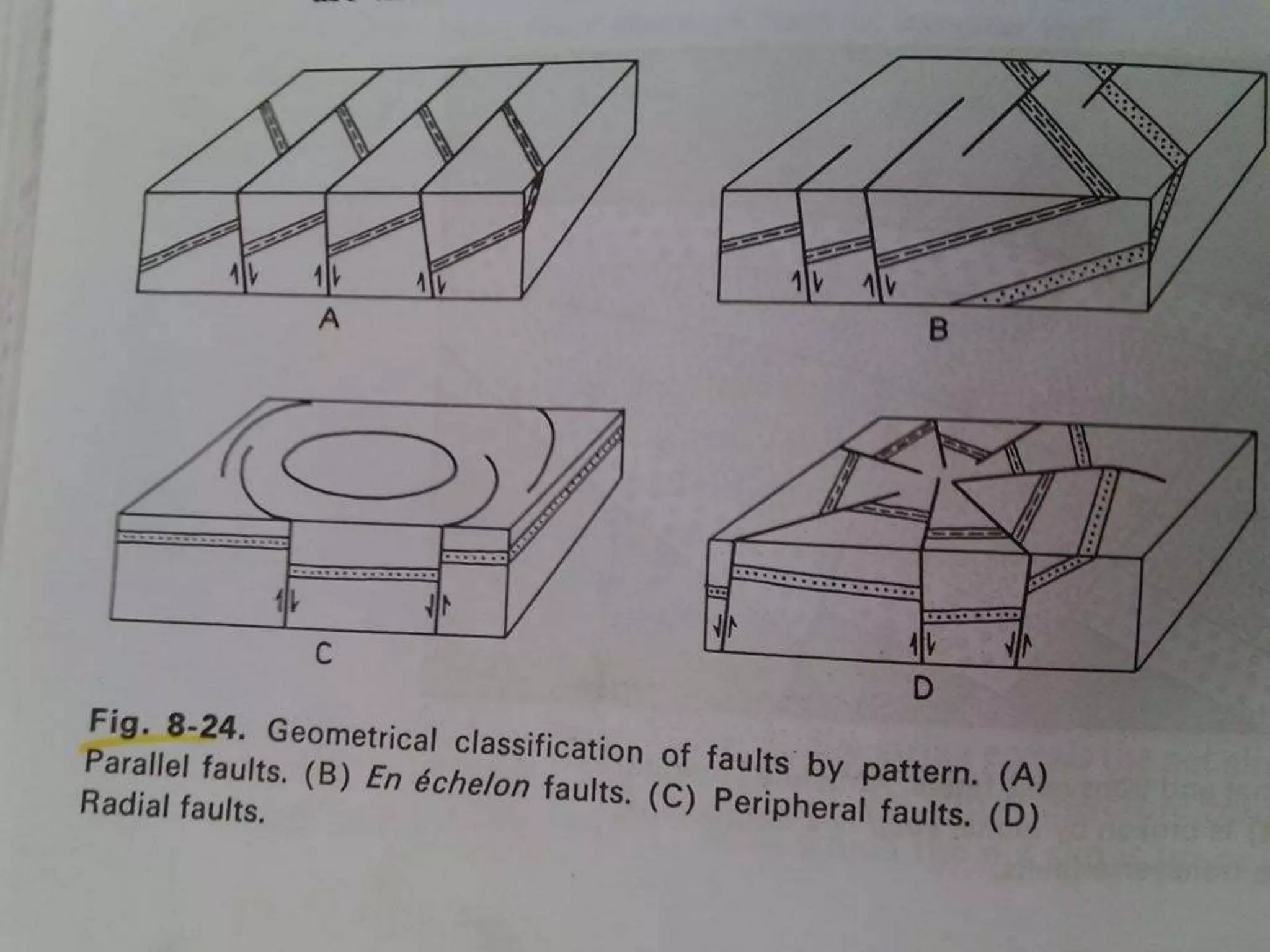
• Parallel Faults: set of faults having same strike and
dip. (dip may be change).
• En echelon fault: are relatively short faults that
overlap each other.
BASED ON FAULT PATTERN
• Peripheral Faults: are circular or arcuate faults that
bounds a circular area.
• Radial Faults: belongs to a system of faults that
radiates out from a point.
BASED ON VALUE OF DIP OF
FAULT
This is based on the angle of the dip
of the fault.
a- high angle faults: that dips greater
than 45’
b- low angle faults: that dips less
than 45’
BASED UPON APPARENT
MOVEMENT
• Apparent Normal Fault: in which hanging wall
appears to have gone downward relative to
footwall.
• Apparent Thrust Fault: in which hanging wall
appears to have gone upward relative to footwall.
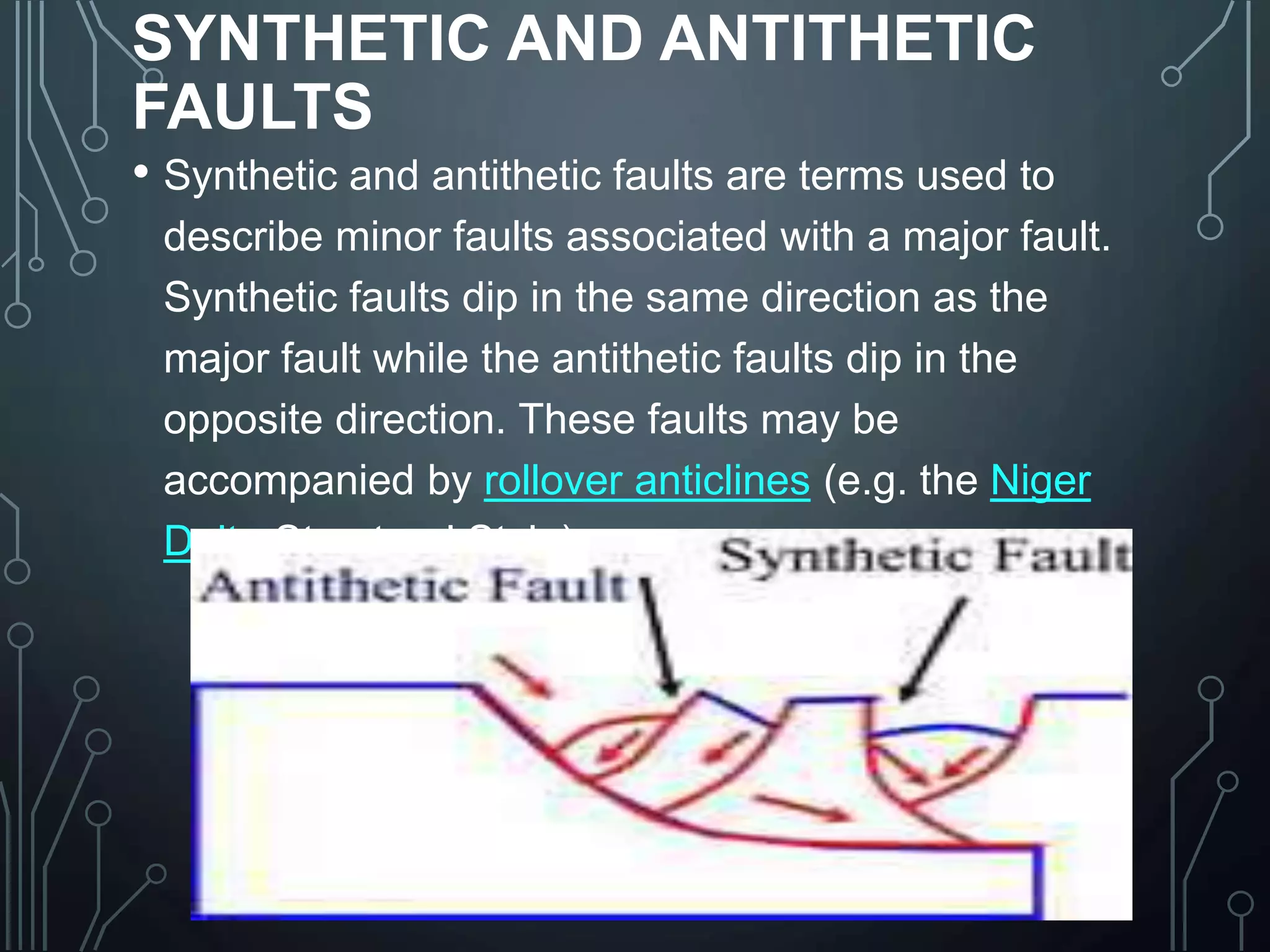
SYNTHETIC AND ANTITHETIC
FAULTS
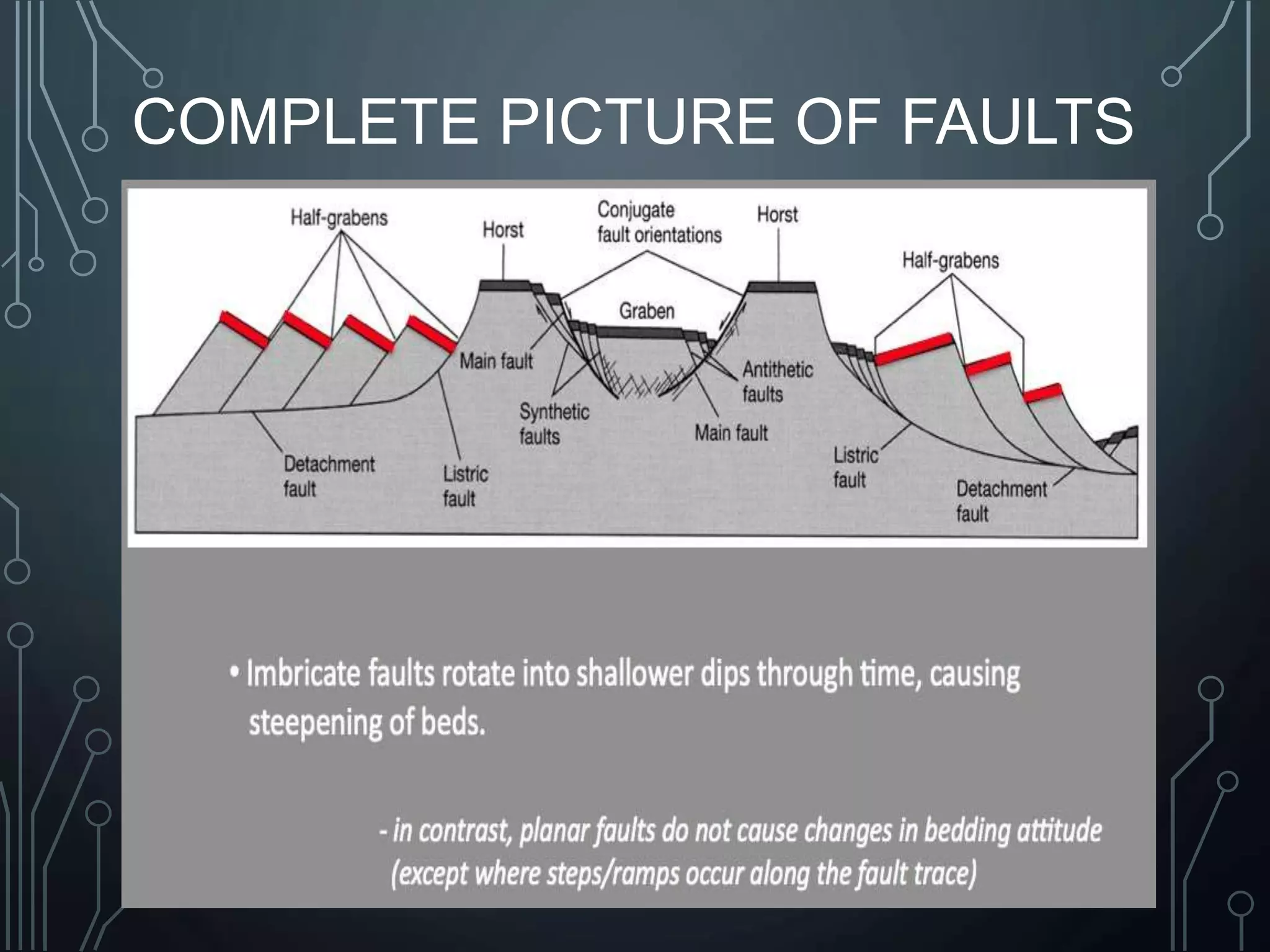
• Synthetic and antithetic faults are terms used to
describe minor faults associated with a major fault.
Synthetic faults dip in the same direction as the
major fault while the antithetic faults dip in the
opposite direction. These faults may be
accompanied by rollover anticlines (e.g. the Niger
Delta Structural Style).
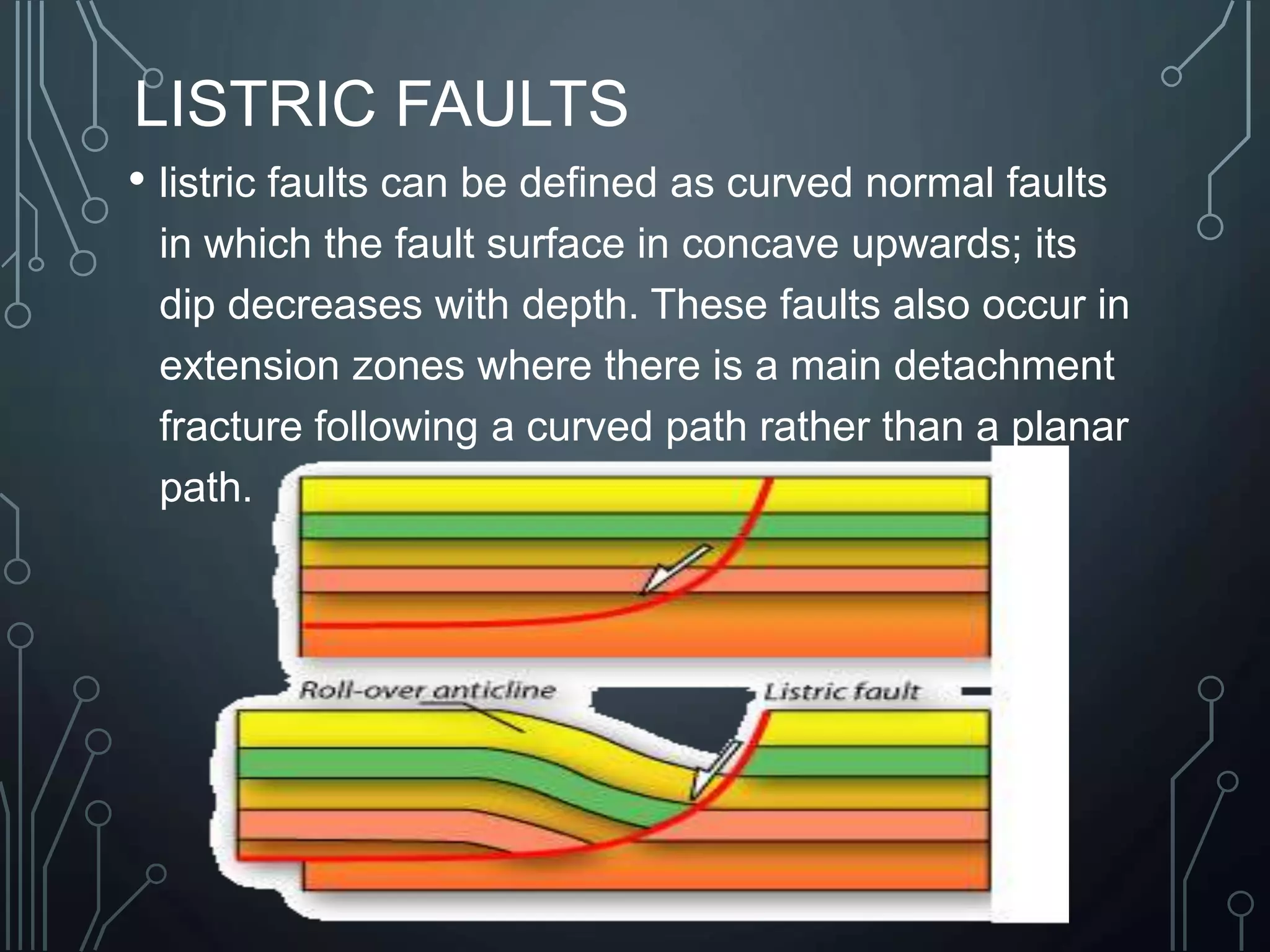
LISTRIC FAULTS
• listric faults can be defined as curved normal faults
in which the fault surface in concave upwards; its
dip decreases with depth. These faults also occur in
extension zones where there is a main detachment
fracture following a curved path rather than a planar
path.
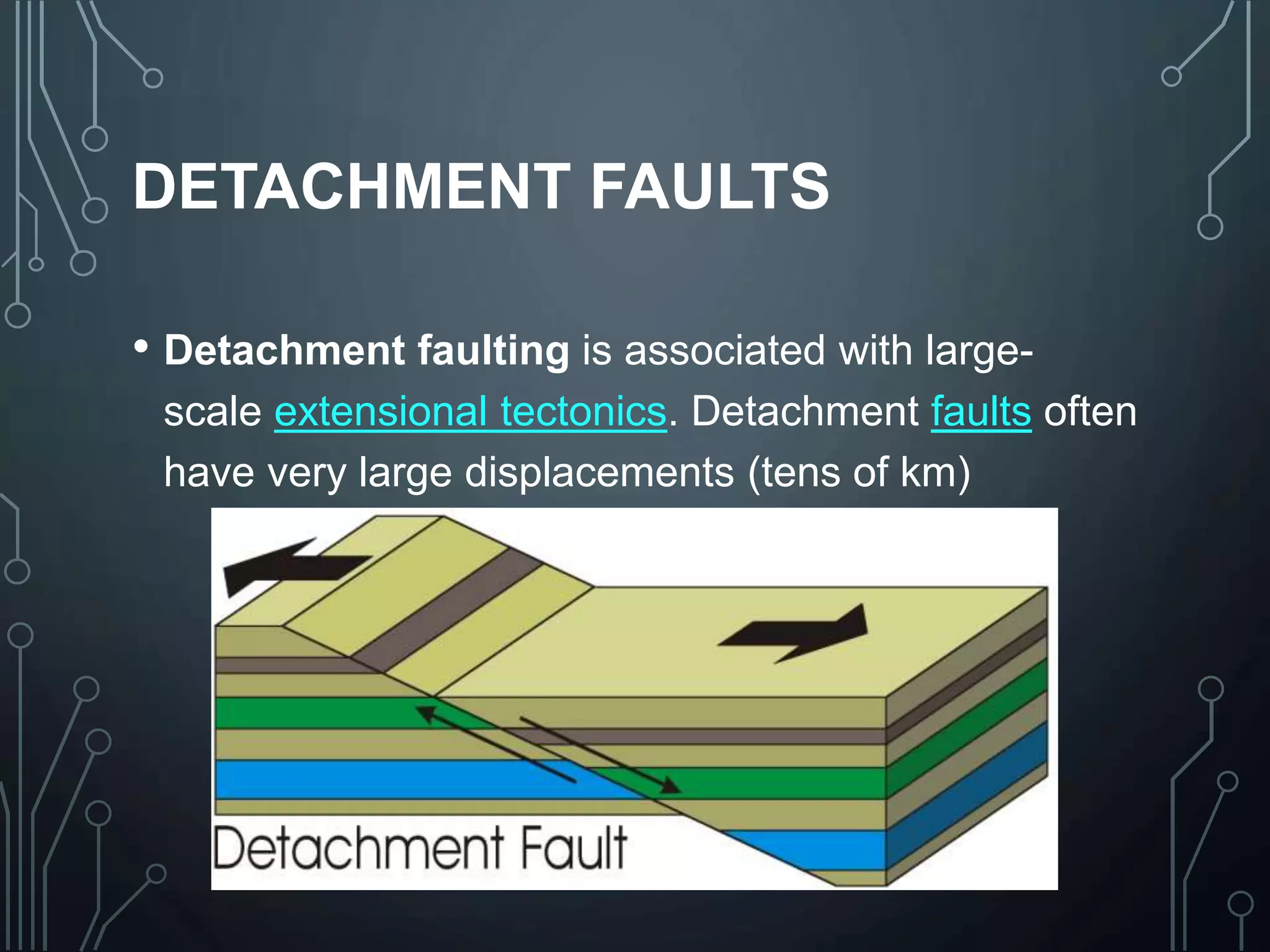
DETACHMENT FAULTS
• Detachment faulting is associated with large-
scale extensional tectonics. Detachment faults often
have very large displacements (tens of km)
COMPLETE PICTURE OF FAULTS
CRITERIA FOR FAULTING
• Several criteria are there, some of them
are discussed here:
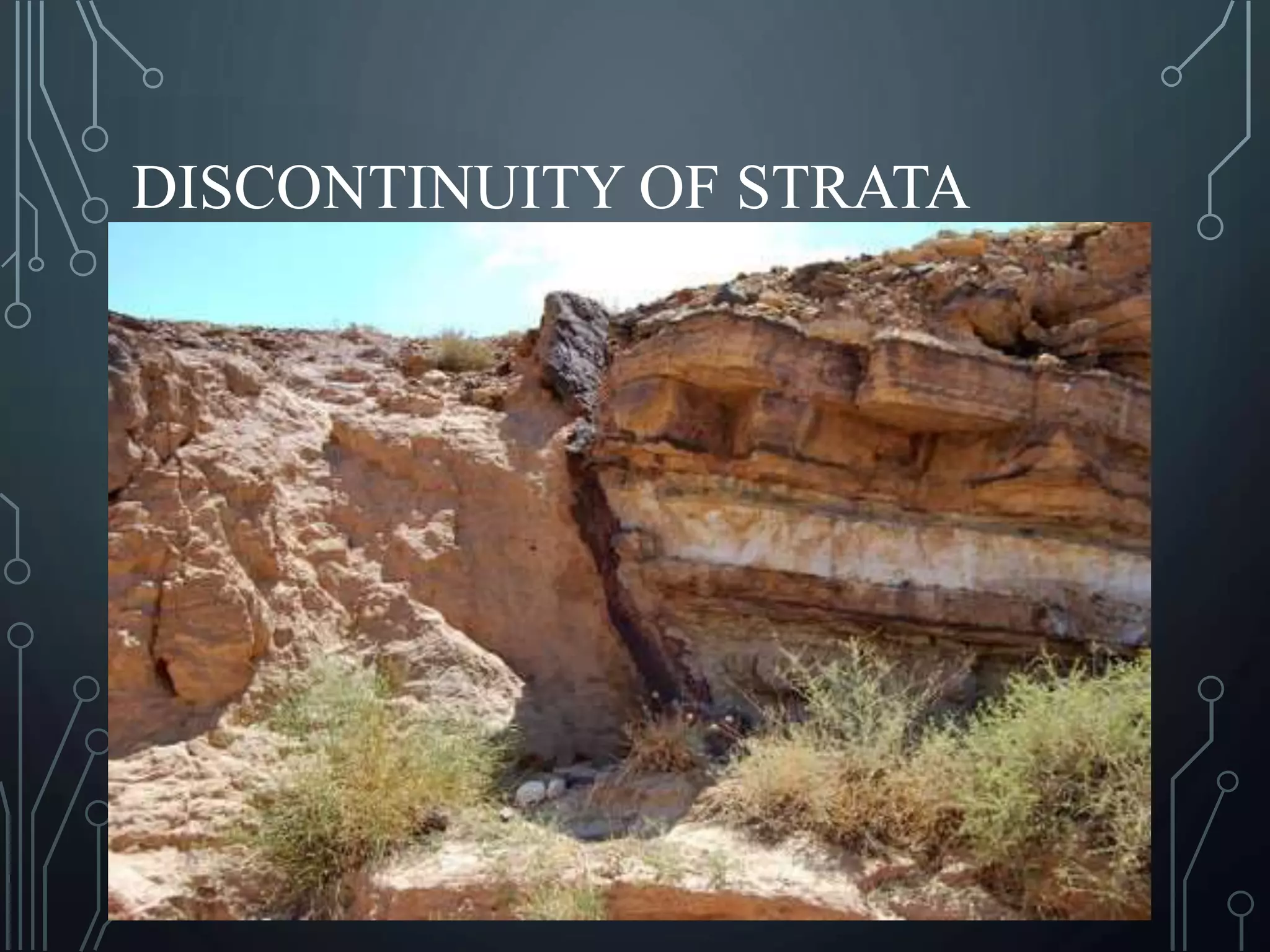
1- discontinuity of structure
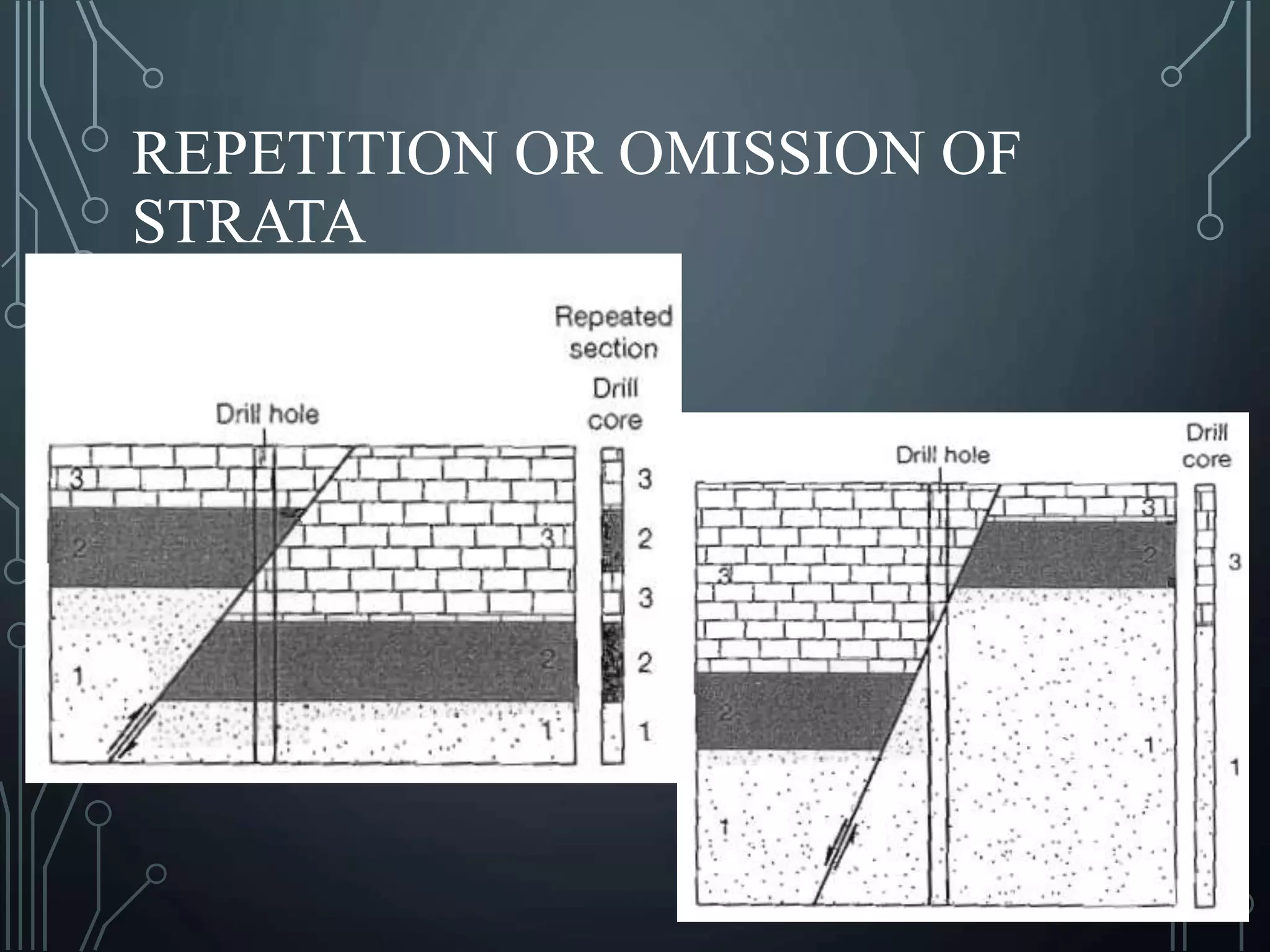
2- repetition or omission of strata
3- feature/characteristics of fault plane
4- silicification and mineralization
5- sudden change in sedimentary facies
6- physiographic data
DISCONTINUITY OF STRATA
REPETITION OR OMISSION OF
STRATA
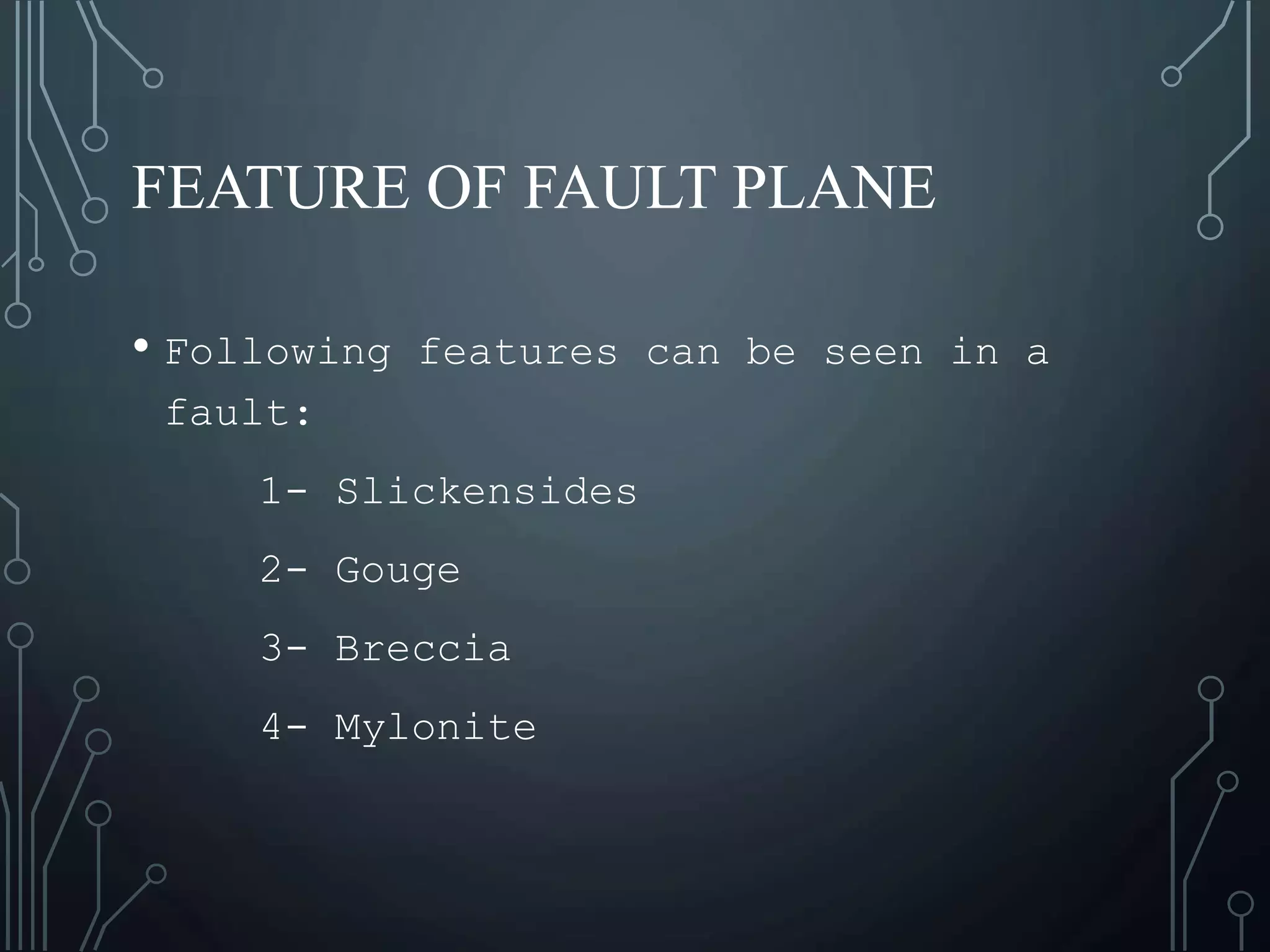
FEATURE OF FAULT PLANE
• Following features can be seen in a
fault:
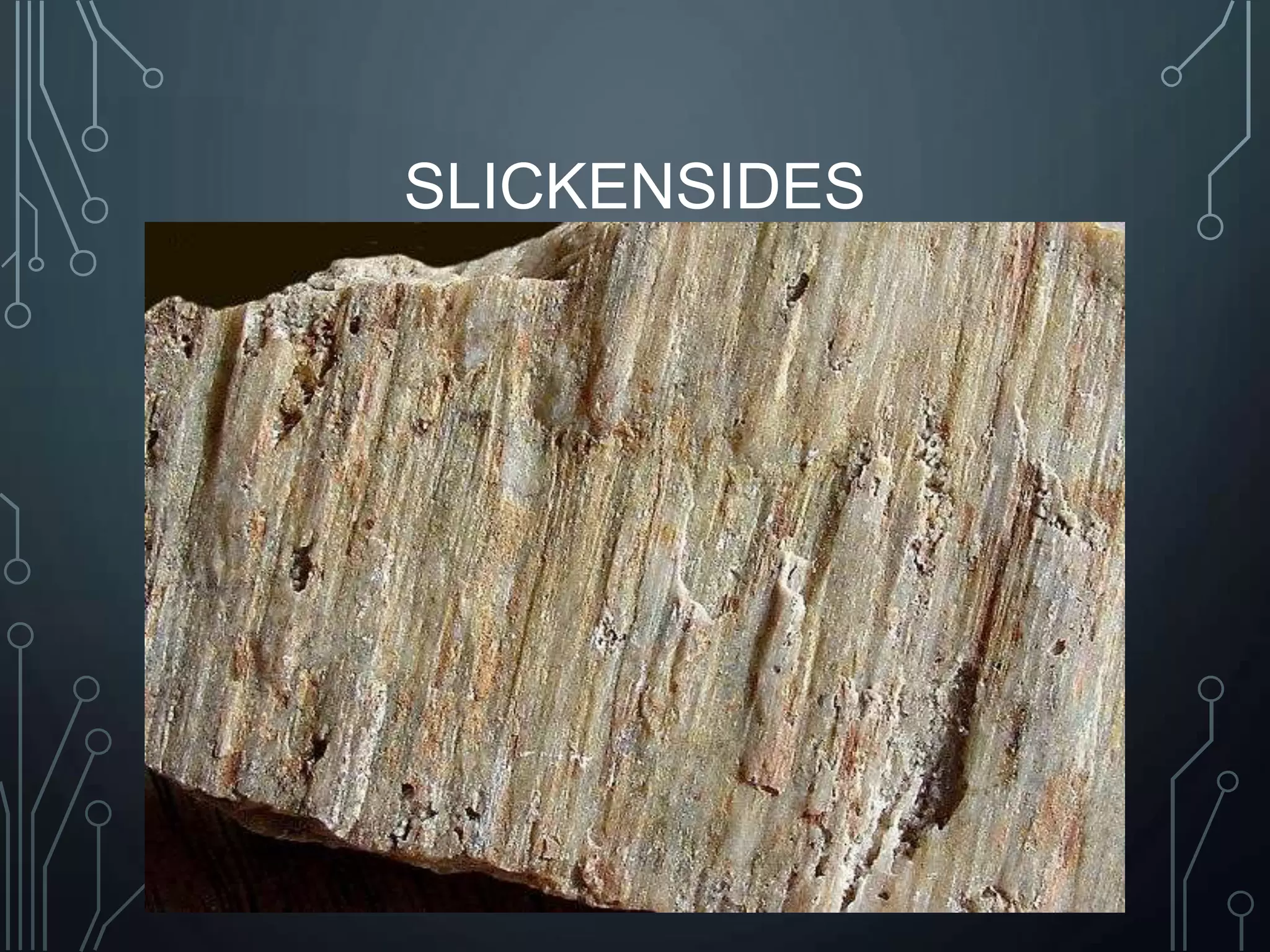
1- Slickensides
2- Gouge
3- Breccia
4- Mylonite
SLICKENSIDES
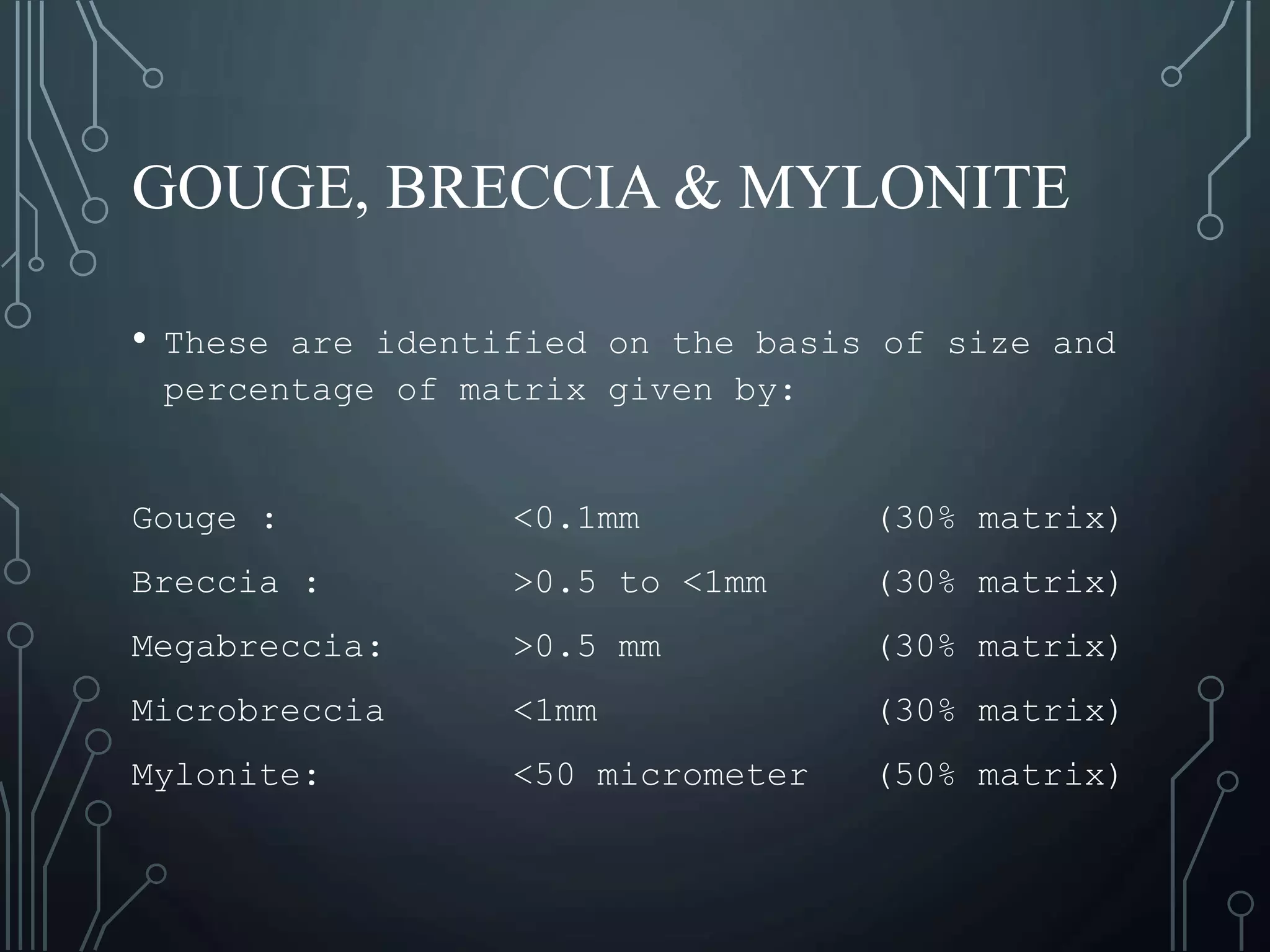
GOUGE, BRECCIA & MYLONITE
• These are identified on the basis of size and
percentage of matrix given by:
Gouge : <0.1mm (30% matrix)
Breccia : >0.5 to <1mm (30% matrix)
Megabreccia: >0.5 mm (30% matrix)
Microbreccia <1mm (30% matrix)
Mylonite: <50 micrometer (50% matrix)
SILICIFICATION AND
MINERALIZATION
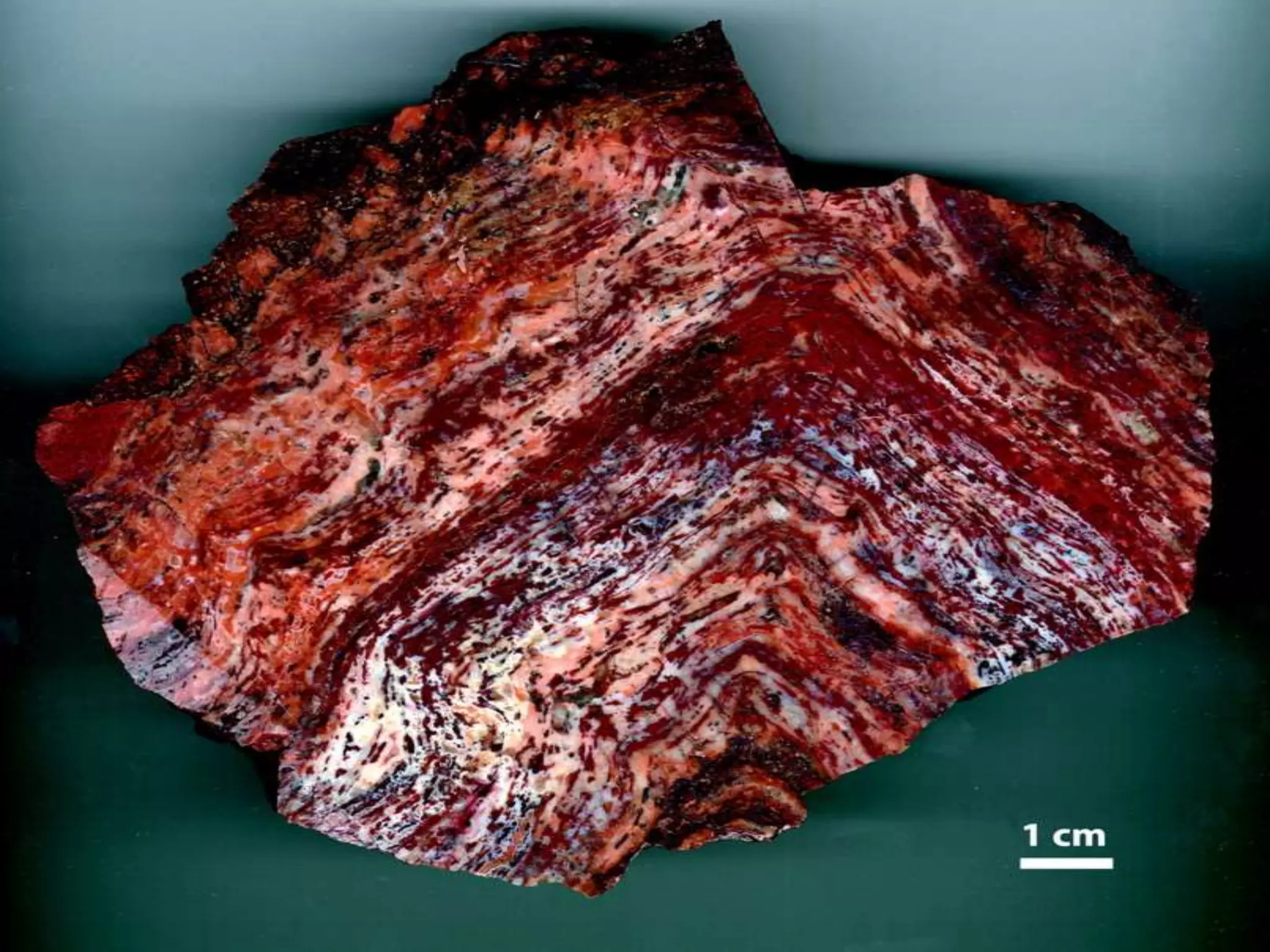
• Silicification is the process in which
a rock’s part is replaced due to
solution passage from the fractures.
• Due to different type of solution
precipetation, mineralization may also
found in faults.
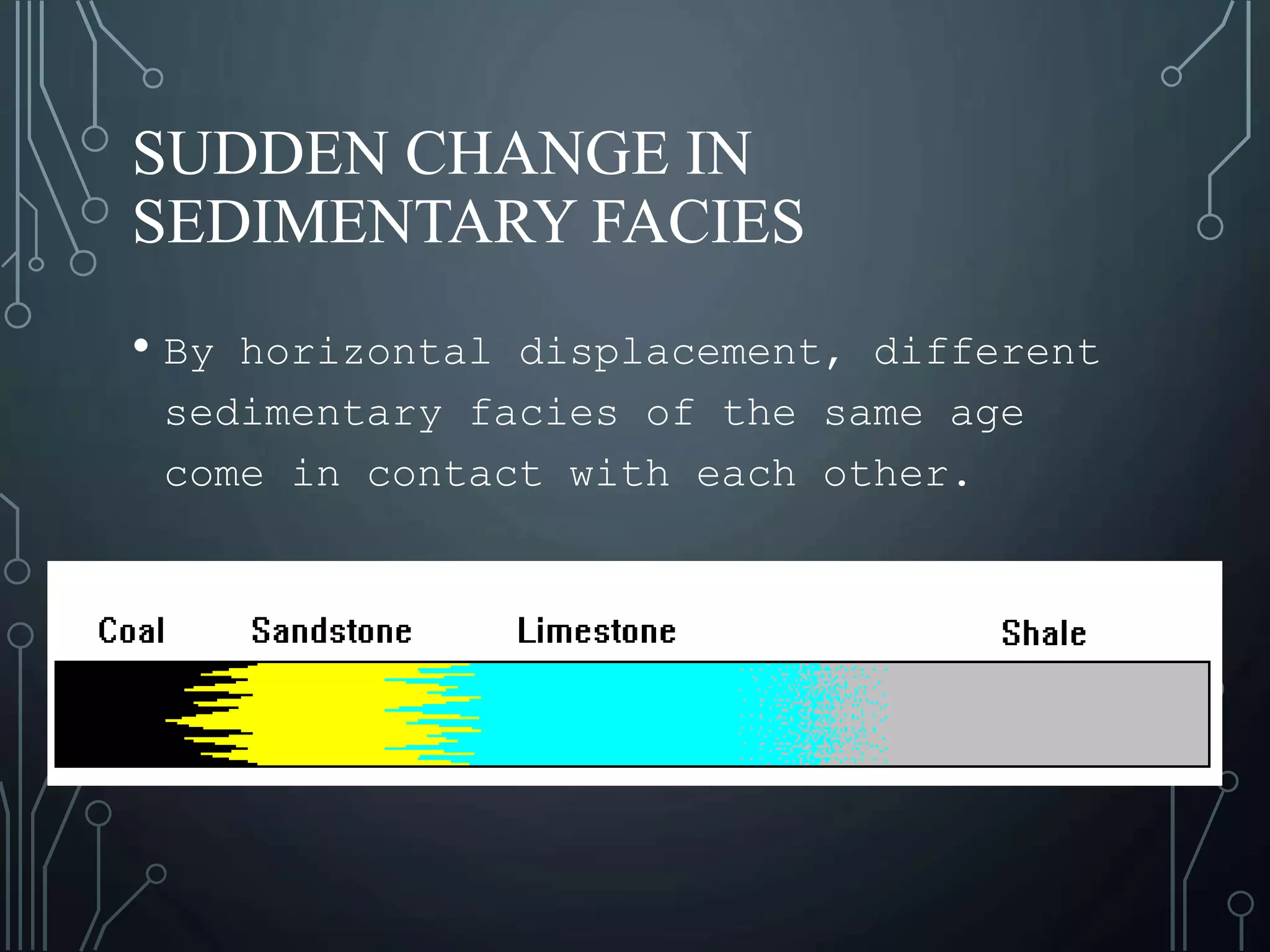
SUDDEN CHANGE IN
SEDIMENTARY FACIES
• By horizontal displacement, different
sedimentary facies of the same age
come in contact with each other.
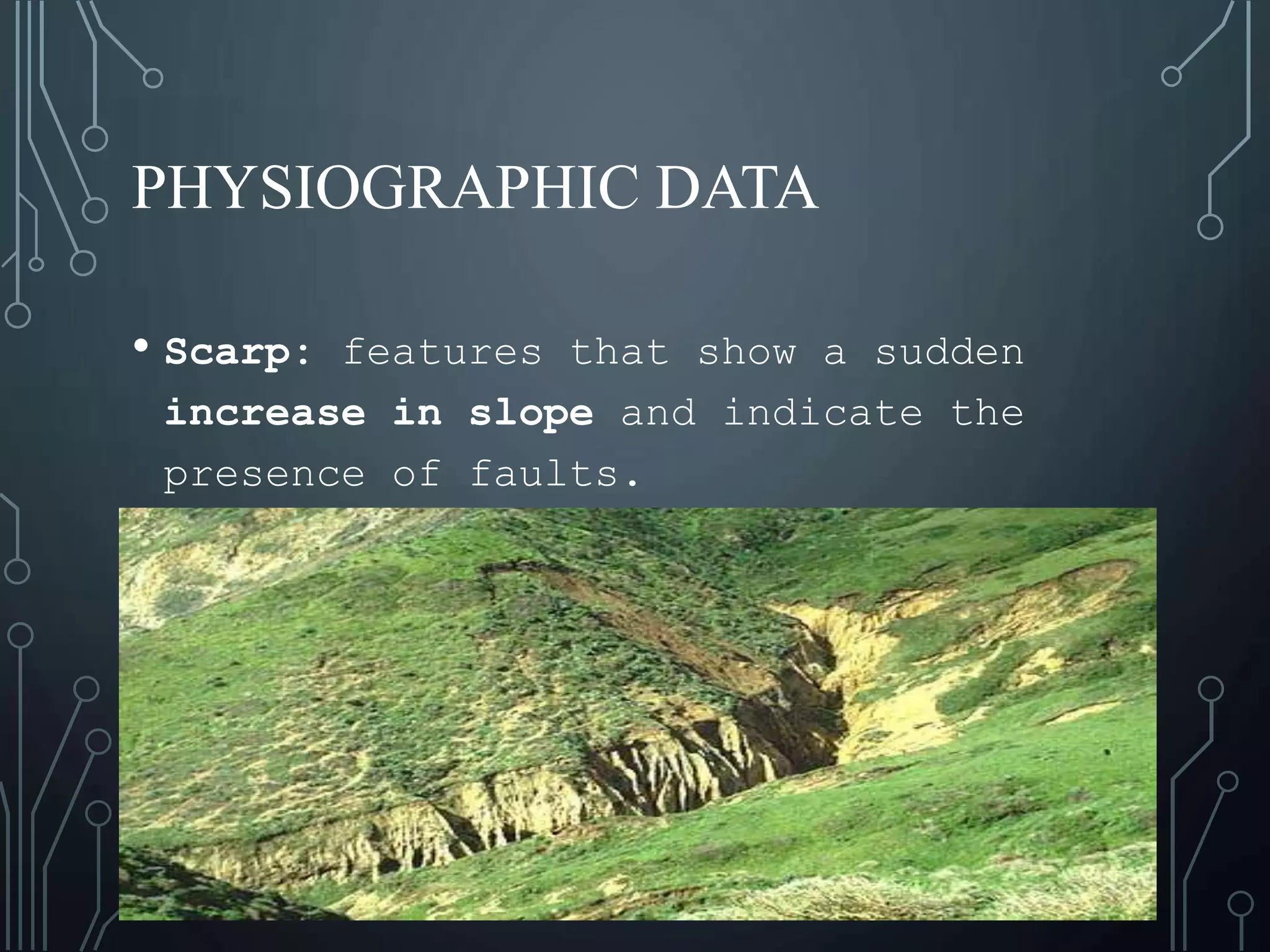
PHYSIOGRAPHIC DATA
• Scarp: features that show a sudden
increase in slope and indicate the
presence of faults.
IMPORTANCE OF FAULTS
• This trap is formed by the movement
of permeable and impermeable layers of rock along
a fault line. The permeable reservoir rock faults
such that it is now adjacent to an impermeable rock,
preventing hydrocarbons from further migration.
MAJOR FAULTS OF PAKISTAN
• 1. Main Karakoram Thrust
• 2. Raikot Fault
• 3. Panjal-Khairabad Thrust
• 4. Riasi Thrust
• 5. Salt Range Thrust
• 6. Bannu Fault
• 7. Chaman Transform Fault
• 8. Quetta-Chiltan Fault
• 9. Pab Fault
THANK YOU
PRESENTED BY: MUNEEB UR
REHMAN
QAU ISLAMABAD
MUNEEBURREHMAN424@YAHOO.C
OM

Fault presentation by muneeb

  • 1.
  • 2.
  • 3.
    WHAT IS AFAULT? A fault is a fracture, along which a rock on one side move relative to the rock on other side. The real question is, What is a fracture?
  • 4.
    FAULT TERMINOLOGIES • Faultplane Planer surface along which rocks on opposite side move. • The walls: 1) Hanging wall 2) Foot wall • Slips 1) strike slip 2) dip slip 3) oblique slip
  • 5.
    NET SLIP • Netslip is measured by the vector that traces the displacement between originally adjacent points. • 3 components: 1-net slip 2- dip slip 3- strike slip
  • 6.
  • 7.
    THROW & HEAVE Throw: Horizontalcomponent of seperation. Heave: Vertical component of seperation.
  • 8.
    GENETIC CLASSIFICATION OF FAULTS 1)Normal Faults 2) Thrust Faults 3) strike slip Faults 4) Net slip Faults
  • 9.
    NORMAL FAULTS • Hangingwall moves downward w.r.t. foot wall. • Extensional environment
  • 10.
    NORMAL FAULTS • Alsoknown as gravity faults by some geologist • A detechmant fault is a special category of low angle normal faults due to downhill sliding of rocks from an uplifted region.
  • 12.
    EXAMPLE • Amorgos fault: Location:greece Length: >100km Type: normal fault Status: active
  • 13.
    THRUST FAULT • Thrustfault is a fault along which the hanging wall moves up relative to foot wall • Further classified into 3 types: • Reverse fault: is thrust that dips > 45’ • Thrust: that dips <45’ • Overthrust: that dips < 10’ and has large net- slip, For example, Longmen shan fault Location: china Status: active
  • 14.
    REVERSE FAULT • Hangingwall moves upward at >45 degree angle. • Compressional environment.
  • 15.
    STRIKE SLIP FAULTS •Also called as wrench faults. • walls slide pass each other or displacement parallel to the strike. • Further classify into 2 types: • 1-Sinistral:Left lateral strike-slip fault (sinistral): Where the side opposite the observer moves to the left. • 2-dextral: Right lateral strike-slip fault (dextral): Where the side opposite the observer moves to the right Example is: an Andreas Fault..
  • 17.
    TEAR FAULTS • Tearfaults can be be defined as relatively small-scale, local strike-slip faults that are associated with other structures such as folds, thrust faults and normal faults (Twiss and Moore 1992). The tear faults may be a result of drastic lateral changes when the thrust front advances or by differential shortening of the thrustal sheet. For example as one part of the thrust sheet is shortened by faulting and the other is shortened by folding, the displacement is taken up by the tear fault. The Jacksboro fault in the Appalachians is a good example of a tear fault that segments the Pine Mountain Thrust Belt (Twiss and Moores 1992).
  • 18.
  • 19.
    STRIKE SLIP FAULTS •It is also classified into transform faults and transcurrent faults. Transform faults end at the junction of another plate boundary or fault type, while transcurrent faults die out without a junction. In addition, transform faults have equal deformation across the entire fault line, while transcurrent faults have greater displacement in the middle of the fault zone and less on the margins. Finally, transform faults can form a tectonic plate boundary, while transcurrent faults cannot.
  • 20.
  • 21.
    GEOMETRICAL CLASSIFICATION i- rakeof net slip ii- attitude of fault w.r.t adjacent beds. iii- fault pattern iv- apparent movement v- dip of the fault
  • 22.
    BASED ON RAKEOF NET SLIP
  • 23.
    BASED ON RAKEOF NET SLIP • Strike-slip Fault: in which netslip is parallel to strike of fault. i.e strike=netslip and there is no dip slip. • Dip-slip fault: in which netslip is up or down the dip of the fault i.e dipslip=netslip and there is no strikeslip component, rake of netslip=90’ • Diagonal-slip Fault: in which netslip is diagonally up or down the fault plane. There is bothe strike slip and dipslip component, rake of netslip>0’ but <90’
  • 24.
    BASED ON ATTITUDEOF FAULT REALATIVE TO ATTITUDE OF ADJACENT BEDS • Strike fault: that essentially parallel to the strike of the adjacent rocks.
  • 25.
    BASED ON ATTITUDEOF FAULT REALATIVE TO ATTITUDE OF ADJACENT BEDS • Bedding Fault: is variety of strike fault that is parallel to the bedding
  • 26.
    BASED ON ATTITUDEOF FAULT REALATIVE TO ATTITUDE OF ADJACENT BEDS • Dip Fault: strikes essentialy parallel to the direction of dip of the adjacent beds.
  • 27.
    BASED ON ATTITUDEOF FAULT REALATIVE TO ATTITUDE OF ADJACENT BEDS • Oblique/diagonal Fault: that strikes obliquely or diagonally to the strike of the adjacent rocks.
  • 28.
  • 29.
    BASED ON ATTITUDEOF FAULT REALATIVE TO ATTITUDE OF ADJACENT BEDS • Longitudinal Fault: is parallel to the strikes of the regional structure. • Transverse Fault: strikes perpendicularly or diagonally to the strike of the regional structure.
  • 30.
  • 31.
    BASED ON FAULTPATTERN • Parallel Faults: set of faults having same strike and dip. (dip may be change). • En echelon fault: are relatively short faults that overlap each other.
  • 32.
    BASED ON FAULTPATTERN • Peripheral Faults: are circular or arcuate faults that bounds a circular area. • Radial Faults: belongs to a system of faults that radiates out from a point.
  • 34.
    BASED ON VALUEOF DIP OF FAULT This is based on the angle of the dip of the fault. a- high angle faults: that dips greater than 45’ b- low angle faults: that dips less than 45’
  • 35.
    BASED UPON APPARENT MOVEMENT •Apparent Normal Fault: in which hanging wall appears to have gone downward relative to footwall. • Apparent Thrust Fault: in which hanging wall appears to have gone upward relative to footwall.
  • 36.
    SYNTHETIC AND ANTITHETIC FAULTS •Synthetic and antithetic faults are terms used to describe minor faults associated with a major fault. Synthetic faults dip in the same direction as the major fault while the antithetic faults dip in the opposite direction. These faults may be accompanied by rollover anticlines (e.g. the Niger Delta Structural Style).
  • 37.
    LISTRIC FAULTS • listricfaults can be defined as curved normal faults in which the fault surface in concave upwards; its dip decreases with depth. These faults also occur in extension zones where there is a main detachment fracture following a curved path rather than a planar path.
  • 38.
    DETACHMENT FAULTS • Detachmentfaulting is associated with large- scale extensional tectonics. Detachment faults often have very large displacements (tens of km)
  • 39.
  • 40.
    CRITERIA FOR FAULTING •Several criteria are there, some of them are discussed here: 1- discontinuity of structure 2- repetition or omission of strata 3- feature/characteristics of fault plane 4- silicification and mineralization 5- sudden change in sedimentary facies 6- physiographic data
  • 41.
  • 42.
  • 43.
    FEATURE OF FAULTPLANE • Following features can be seen in a fault: 1- Slickensides 2- Gouge 3- Breccia 4- Mylonite
  • 44.
  • 45.
    GOUGE, BRECCIA &MYLONITE • These are identified on the basis of size and percentage of matrix given by: Gouge : <0.1mm (30% matrix) Breccia : >0.5 to <1mm (30% matrix) Megabreccia: >0.5 mm (30% matrix) Microbreccia <1mm (30% matrix) Mylonite: <50 micrometer (50% matrix)
  • 46.
    SILICIFICATION AND MINERALIZATION • Silicificationis the process in which a rock’s part is replaced due to solution passage from the fractures. • Due to different type of solution precipetation, mineralization may also found in faults.
  • 50.
    SUDDEN CHANGE IN SEDIMENTARYFACIES • By horizontal displacement, different sedimentary facies of the same age come in contact with each other.
  • 51.
    PHYSIOGRAPHIC DATA • Scarp:features that show a sudden increase in slope and indicate the presence of faults.
  • 52.
    IMPORTANCE OF FAULTS •This trap is formed by the movement of permeable and impermeable layers of rock along a fault line. The permeable reservoir rock faults such that it is now adjacent to an impermeable rock, preventing hydrocarbons from further migration.
  • 53.
    MAJOR FAULTS OFPAKISTAN • 1. Main Karakoram Thrust • 2. Raikot Fault • 3. Panjal-Khairabad Thrust • 4. Riasi Thrust • 5. Salt Range Thrust • 6. Bannu Fault • 7. Chaman Transform Fault • 8. Quetta-Chiltan Fault • 9. Pab Fault
  • 55.
    THANK YOU PRESENTED BY:MUNEEB UR REHMAN QAU ISLAMABAD MUNEEBURREHMAN424@YAHOO.C OM