Prentice Hall
EARTH SCIENCEEARTH SCIENCE
Tarbuck Lutgens
Chapter
55 Erosion and weathering are major forces
that shape Earth’s surface.
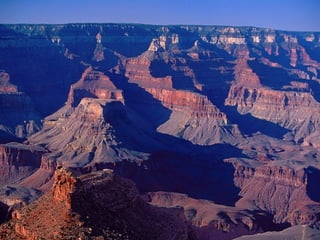
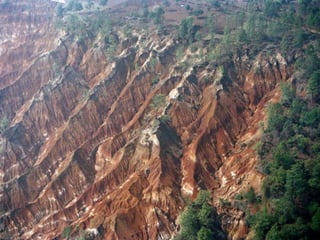
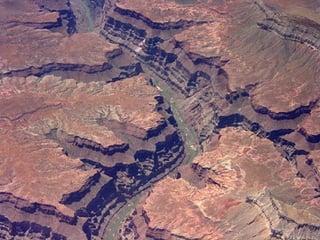
 For example, the Grand Canyon was
formed through erosion by the Colorado
River running through it!
Weathering, Soil, and
Mass Movements
Mechanical Weathering
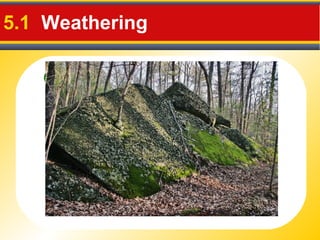
5.1 Weathering
 Mechanical weathering occurs when
physical forces break rock into smaller and
smaller pieces without changing the rock’s
mineral composition.
 In nature three physical process are
especially important causes of weathering:
frost wedging, unloading, and biological
activity.
What is weathering?
Weathering: The breaking down
of rocks into smaller pieces.
1. Mechanical /Physical
2. Chemical
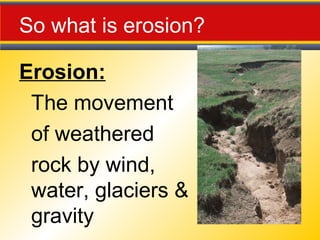
So what is erosion?
Erosion:
The movement
of weathered
rock by wind,
water, glaciers &
gravity
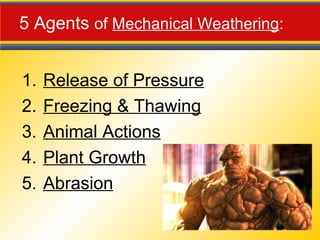
5 Agents of Mechanical Weathering:
1. Release of Pressure
2. Freezing & Thawing
3. Animal Actions
4. Plant Growth
5. Abrasion
Mechanical Weathering
5.1 Weathering
• Reduced pressure on igneous rock
causes it to expand and allows slabs of
outer rock to break off in layers in a
process called exfoliation.
1. Release of Pressure
Unloading and Exfoliation
of Igneous Rocks
Mechanical Weathering
5.1 Weathering
2. Frost wedging
• The mechanical breakup of rock caused
by the expansion of freezing water in
cracks and crevices
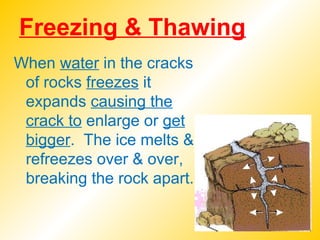
Freezing & Thawing
When water in the cracks
of rocks freezes it
expands causing the
crack to enlarge or get
bigger. The ice melts &
refreezes over & over,
breaking the rock apart.
Frost Wedging
Mechanical Weathering
5.1 Weathering
3. Biological activity
• The activity of organisms, including plants,
burrowing animals, and humans, can also
cause mechanical weathering.
Mechanical Weathering
5.1 Weathering
3. Biological - Plant growth
• Plants roots can grow into cracks in the rock,
slowly breaking them apart.
Plant Root Growth
Weathering and
Biological Activity
Mechanical Weathering
5.1 Weathering
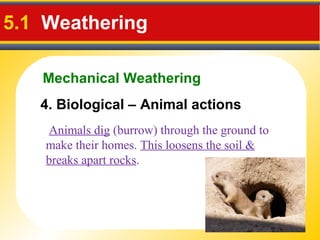
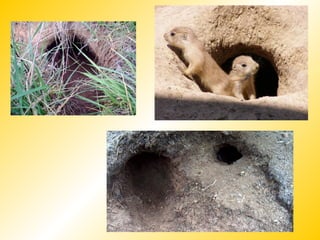
4. Biological – Animal actions
Animals dig (burrow) through the ground to
make their homes. This loosens the soil &
breaks apart rocks.
5.1 Weathering
5. Abrasion
Sand and other rock particles in wind,
water or ice can wear away exposed
rock surfaces.
Like sandblasting or sandpaper on
wood
Sand-Blasting
Chemical Weathering
5.1 Weathering
 Chemical weathering is the breaking
down of rock through chemical reactions.
Chemical Weathering
5.1 Weathering
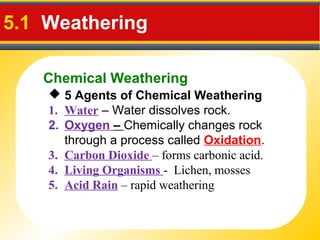
 5 Agents of Chemical Weathering
1. Water
2. Oxygen
3. Carbon Dioxide
4. Living Organisms
5. Acid Rain
Chemical Weathering
5.1 Weathering
 5 Agents of Chemical Weathering
1. Water – Water dissolves rock.
Chemical Weathering
5.1 Weathering
 5 Agents of Chemical Weathering
1. Water – Water dissolves rock.
2. Oxygen – Chemically changes rock
through a process called Oxidation.
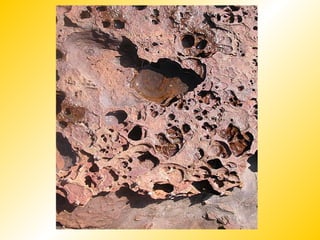
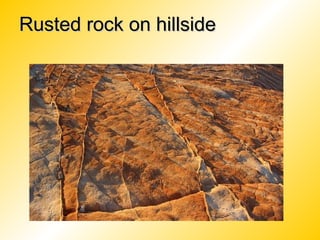
Oxygen + Water + Iron = RustOxygen + Water + Iron = Rust
Rusted rock on hillsideRusted rock on hillside
Chemical Weathering
5.1 Weathering
 5 Agents of Chemical Weathering
1. Water – Water dissolves rock.
2. Oxygen – Chemically changes rock
through a process called Oxidation.
3. Carbon Dioxide – forms carbonic acid.
Chemical Weathering
5.1 Weathering
CO2 + rainwater = Carbonic Acid
Carbonic Acid weathers softer rock like
limestone & marble as it seeps into spaces in
rock.
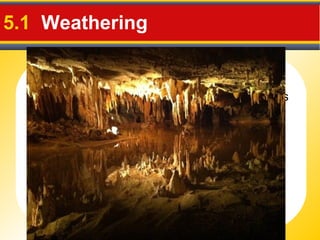
Examples: Karst topography – caves, sinkholes
Chemical Weathering
5.1 Weathering
Examples: Karst topography – caves, sinkholes
Chemical Weathering
5.1 Weathering
 5 Agents of Chemical Weathering
1. Water – Water dissolves rock.
2. Oxygen – Chemically changes rock
through a process called Oxidation.
3. Carbon Dioxide – forms carbonic acid.
4. Living Organisms -
The roots of plants make a weak acid that slowly
dissolves rocks around the plant.
Chemical Weathering
5.1 Weathering
 5 Agents of Chemical Weathering
1. Water – Water dissolves rock.
2. Oxygen – Chemically changes rock
through a process called Oxidation.
3. Carbon Dioxide – forms carbonic acid.
4. Living Organisms -
Chemical Weathering
5.1 Weathering
 5 Agents of Chemical Weathering
1. Water – Water dissolves rock.
2. Oxygen – Chemically changes rock
through a process called Oxidation.
3. Carbon Dioxide – forms carbonic acid.
4. Living Organisms - Lichen, mosses
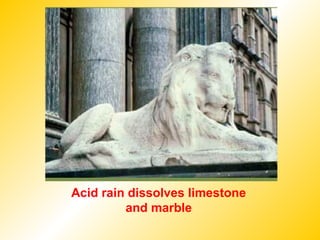
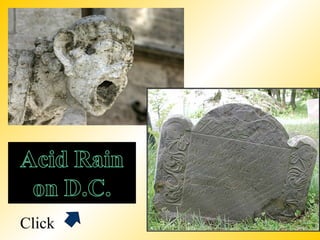
5. Acid Rain – rapid weathering
5.1 How does Acid Rain form?
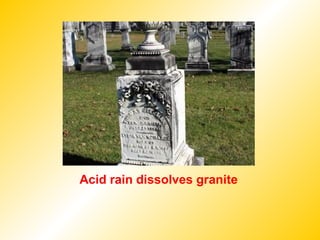
Acid rain dissolves granite
Acid rain dissolves limestone
and marble
Click
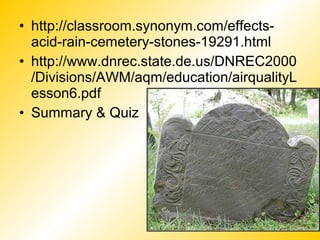
• http://classroom.synonym.com/effects-
acid-rain-cemetery-stones-19291.html
• http://www.dnrec.state.de.us/DNREC2000
/Divisions/AWM/aqm/education/airqualityL
esson6.pdf
• Summary & Quiz
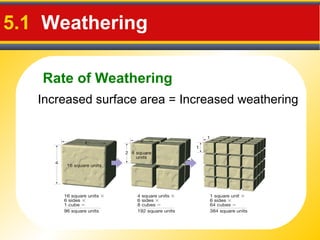
Rate of Weathering
5.1 Weathering
Increased surface area = Increased weathering

Prentice Hall Earth Science ch05 Weathering & Erosion