Prentice   Hall   EARTH SCIENCE Tarbuck   Lutgens  
Chapter   10 Volcanoes and Other Igneous Activity
10.1  The Nature of Volcanic Eruptions      Factors that determine the violence of an eruption  •  Composition of the magma •  Temperature of the magma •  Dissolved gases in the magma    Viscosity •  Viscosity  is the measure of a material's resistance to flow. Factors Affecting Eruptions
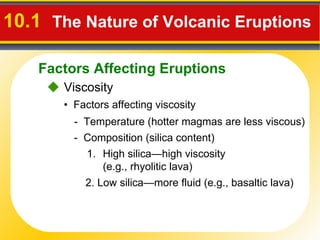
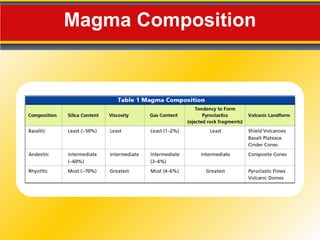
10.1   The Nature of Volcanic Eruptions      Viscosity •  Factors affecting viscosity -  Temperature (hotter magmas are less viscous) -  Composition ( silica content ) High silica—high viscosity  (e.g., rhyolitic lava)  2. Low silica—more fluid (e.g., basaltic lava) Factors Affecting Eruptions
10.1  The Nature of Volcanic Eruptions   Dissolved gases  •  Mainly water vapor and carbon dioxide •  Gases expand near the surface •  A  vent  is an opening in the surface of Earth through which molten rock and gases are released. •  Provide the force to extrude lava Factors Affecting Eruptions
10.1  The Nature of Volcanic Eruptions   Dissolved gases  •  Violence of an eruption is related to how easily gases escape from magma -  Gases escape easily from fluid magma.  -  Viscous magma produces a more violent    eruption. Factors Affecting Eruptions
Magma Composition
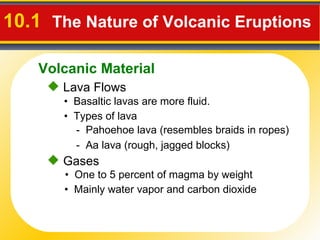
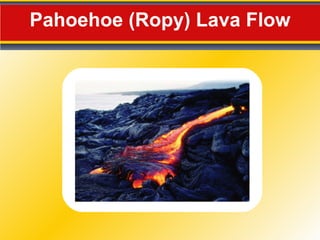
10.1  The Nature of Volcanic Eruptions   Lava Flows •  Basaltic lavas are more fluid. -  Pahoehoe lava  (resembles braids in ropes)  -  Aa lava  (rough, jagged blocks)  •  Types of lava Gases •  One to 5 percent of magma by weight •  Mainly water vapor and carbon dioxide Volcanic Material
Pahoehoe (Ropy) Lava Flow
Slow-Moving Aa Flow
10.1   The Nature of Volcanic Eruptions   Pyroclastic Materials •  Pyroclastic materials  is the name given to particles produced in volcanic eruptions. •  The fragments ejected during eruptions range in size from very fine duct and volcanic ash (less than 2 millimeters) to pieces that weigh several tons. Volcanic Material
10.1   The Nature of Volcanic Eruptions   Pyroclastic Materials •  Types of pyroclastic material -  Ash  and dust—fine, glassy fragments  -  Pumice —frothy, air-filled lava  -  Lapilli —walnut-sized particles -  Cinders —pea-sized particles •  Particles larger than lapilli -  Blocks —hardened lava -  Bombs —ejected as hot lava  Volcanic Material
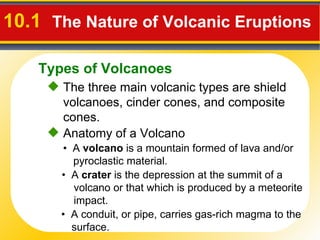
10.1  The Nature of Volcanic Eruptions   The three main volcanic types are shield volcanoes, cinder cones, and composite cones. •  A  volcano  is a mountain formed of lava and/or pyroclastic material. •  A conduit, or  pipe,  carries gas-rich magma to the surface.  Anatomy of a Volcano •  A  crater  is the depression at the summit of a volcano or that which is produced by a meteorite impact. Types of Volcanoes
Anatomy of a “Typical” Volcano
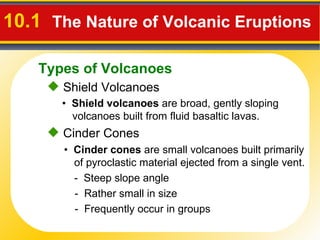
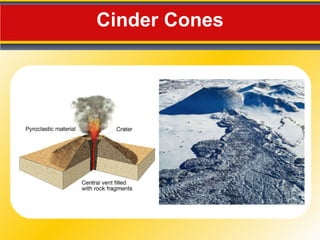
10.1  The Nature of Volcanic Eruptions   Shield Volcanoes •  Shield volcanoes  are broad, gently sloping volcanoes built from fluid basaltic lavas. •  Cinder cones  are small volcanoes built primarily of pyroclastic material ejected from a single vent. -  Steep slope angle  -  Rather small in size  -  Frequently occur in groups Cinder Cones Types of Volcanoes
Shield Volcanoes
Cinder Cones
10.1   The Nature of Volcanic Eruptions   Composite Cones •  Composite cones  are volcanoes composed of both lava flows and pyroclastic material.  -  Most are adjacent to the Pacific Ocean    (e.g., Mt. Rainier).  -  Large size  -  Interbedded lavas and pyroclastics  -  Most violent type of activity  Types of Volcanoes
Composite Cones
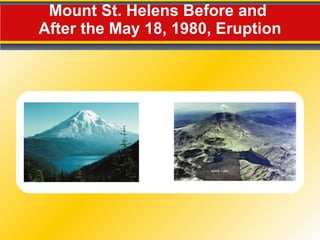
Mount St. Helens Before and  After the May 18, 1980, Eruption
Profiles of Volcanic Landforms
10.1   The Nature of Volcanic Eruptions   Calderas •  Calderas  are large depressions in volcanoes.  •  Formed by collapse  •  Nearly circular  •  Size exceeds one kilometer in diameter   Other Volcanic Landforms
10.1   The Nature of Volcanic Eruptions   •  Fluid basaltic lava extruded from crustal fractures called  fissures. Lava Plateaus Other Volcanic Landforms
10.2   Intrusive Igneous Activity   Geologists conclude that magma originates when essentially solid rock, located in the crust and upper mantle, partially melts. The most obvious way to generate magma from solid rock is to raise the temperature above the level at which the rock begins to melt. Origin of Magma
10.2   Intrusive Igneous Activity   Role of Heat •  Additional heat is generated by •  The  g eothermal gradient —Earth’s natural temperature increases with depth but is not  sufficient to melt rock in the lower crust  and upper mantle -  friction in subduction zones -  crustal rocks heated during subduction -  rising, hot mantle rocks Origin of Magma
10.2   Intrusive Igneous Activity   Role of Water •  Causes rock to melt at a lower temperature •  Plays an important role in subducting   ocean plates Origin of Magma
Basaltic Magma at the Surface
10.3   Plate Tectonics and Igneous Activity   The basic connection between plate tectonics and volcanism is that plate motions provide the mechanisms by which mantle rocks melt to generate magma. •  Rising magma can form  continental volcanic arcs  (Andes Mountains). Ocean-Ocean Ocean-Continent •  Rising magma can form  volcanic island arcs  in an ocean (Aleutian Islands). Convergent Plate Boundaries
Convergent Boundary Volcano
10.3   Plate Tectonics and Igneous Activity   The greatest volume of volcanic rock is produced along the  oceanic ridge system.   •  Less pressure on underlying rocks  •  Lithosphere pulls apart.  •  Large quantities of fluid basaltic magma are produced. •  Partial melting occurs Divergent Plate Boundaries
10.3   Plate Tectonics and Igneous Activity   Intraplate volcanism  is igneous activity that occurs within a tectonic plate away from plate boundaries.  •  The activity forms localized volcanic regions called  hot spots.   •  Most intraplate   volcanism occurs where a mass of hotter than normal mantle material called a mantle plume rises toward the surface. •  Examples include the Hawaiian Islands and the Columbia Plateau. Intraplate Igneous Activity
Kilauea, an Intraplate Volcano

Volcanoes

  • 1.
    Prentice Hall EARTH SCIENCE Tarbuck Lutgens 
  • 2.
    Chapter 10 Volcanoes and Other Igneous Activity
  • 3.
    10.1 TheNature of Volcanic Eruptions  Factors that determine the violence of an eruption • Composition of the magma • Temperature of the magma • Dissolved gases in the magma  Viscosity • Viscosity is the measure of a material's resistance to flow. Factors Affecting Eruptions
  • 4.
    10.1 The Nature of Volcanic Eruptions  Viscosity • Factors affecting viscosity - Temperature (hotter magmas are less viscous) - Composition ( silica content ) High silica—high viscosity (e.g., rhyolitic lava) 2. Low silica—more fluid (e.g., basaltic lava) Factors Affecting Eruptions
  • 5.
    10.1 TheNature of Volcanic Eruptions Dissolved gases • Mainly water vapor and carbon dioxide • Gases expand near the surface • A vent is an opening in the surface of Earth through which molten rock and gases are released. • Provide the force to extrude lava Factors Affecting Eruptions
  • 6.
    10.1 TheNature of Volcanic Eruptions Dissolved gases • Violence of an eruption is related to how easily gases escape from magma - Gases escape easily from fluid magma. - Viscous magma produces a more violent eruption. Factors Affecting Eruptions
  • 7.
  • 8.
    10.1 TheNature of Volcanic Eruptions Lava Flows • Basaltic lavas are more fluid. - Pahoehoe lava (resembles braids in ropes) - Aa lava (rough, jagged blocks) • Types of lava Gases • One to 5 percent of magma by weight • Mainly water vapor and carbon dioxide Volcanic Material
  • 9.
  • 10.
  • 11.
    10.1 The Nature of Volcanic Eruptions Pyroclastic Materials • Pyroclastic materials is the name given to particles produced in volcanic eruptions. • The fragments ejected during eruptions range in size from very fine duct and volcanic ash (less than 2 millimeters) to pieces that weigh several tons. Volcanic Material
  • 12.
    10.1 The Nature of Volcanic Eruptions Pyroclastic Materials • Types of pyroclastic material - Ash and dust—fine, glassy fragments - Pumice —frothy, air-filled lava - Lapilli —walnut-sized particles - Cinders —pea-sized particles • Particles larger than lapilli - Blocks —hardened lava - Bombs —ejected as hot lava Volcanic Material
  • 13.
    10.1 TheNature of Volcanic Eruptions The three main volcanic types are shield volcanoes, cinder cones, and composite cones. • A volcano is a mountain formed of lava and/or pyroclastic material. • A conduit, or pipe, carries gas-rich magma to the surface. Anatomy of a Volcano • A crater is the depression at the summit of a volcano or that which is produced by a meteorite impact. Types of Volcanoes
  • 14.
    Anatomy of a“Typical” Volcano
  • 15.
    10.1 TheNature of Volcanic Eruptions Shield Volcanoes • Shield volcanoes are broad, gently sloping volcanoes built from fluid basaltic lavas. • Cinder cones are small volcanoes built primarily of pyroclastic material ejected from a single vent. - Steep slope angle - Rather small in size - Frequently occur in groups Cinder Cones Types of Volcanoes
  • 16.
  • 17.
  • 18.
    10.1 The Nature of Volcanic Eruptions Composite Cones • Composite cones are volcanoes composed of both lava flows and pyroclastic material. - Most are adjacent to the Pacific Ocean (e.g., Mt. Rainier). - Large size - Interbedded lavas and pyroclastics - Most violent type of activity Types of Volcanoes
  • 19.
  • 20.
    Mount St. HelensBefore and After the May 18, 1980, Eruption
  • 21.
  • 22.
    10.1 The Nature of Volcanic Eruptions Calderas • Calderas are large depressions in volcanoes. • Formed by collapse • Nearly circular • Size exceeds one kilometer in diameter Other Volcanic Landforms
  • 23.
    10.1 The Nature of Volcanic Eruptions • Fluid basaltic lava extruded from crustal fractures called fissures. Lava Plateaus Other Volcanic Landforms
  • 24.
    10.2 Intrusive Igneous Activity Geologists conclude that magma originates when essentially solid rock, located in the crust and upper mantle, partially melts. The most obvious way to generate magma from solid rock is to raise the temperature above the level at which the rock begins to melt. Origin of Magma
  • 25.
    10.2 Intrusive Igneous Activity Role of Heat • Additional heat is generated by • The g eothermal gradient —Earth’s natural temperature increases with depth but is not sufficient to melt rock in the lower crust and upper mantle - friction in subduction zones - crustal rocks heated during subduction - rising, hot mantle rocks Origin of Magma
  • 26.
    10.2 Intrusive Igneous Activity Role of Water • Causes rock to melt at a lower temperature • Plays an important role in subducting ocean plates Origin of Magma
  • 27.
    Basaltic Magma atthe Surface
  • 28.
    10.3 Plate Tectonics and Igneous Activity The basic connection between plate tectonics and volcanism is that plate motions provide the mechanisms by which mantle rocks melt to generate magma. • Rising magma can form continental volcanic arcs (Andes Mountains). Ocean-Ocean Ocean-Continent • Rising magma can form volcanic island arcs in an ocean (Aleutian Islands). Convergent Plate Boundaries
  • 29.
  • 30.
    10.3 Plate Tectonics and Igneous Activity The greatest volume of volcanic rock is produced along the oceanic ridge system. • Less pressure on underlying rocks • Lithosphere pulls apart. • Large quantities of fluid basaltic magma are produced. • Partial melting occurs Divergent Plate Boundaries
  • 31.
    10.3 Plate Tectonics and Igneous Activity Intraplate volcanism is igneous activity that occurs within a tectonic plate away from plate boundaries. • The activity forms localized volcanic regions called hot spots. • Most intraplate volcanism occurs where a mass of hotter than normal mantle material called a mantle plume rises toward the surface. • Examples include the Hawaiian Islands and the Columbia Plateau. Intraplate Igneous Activity
  • 32.