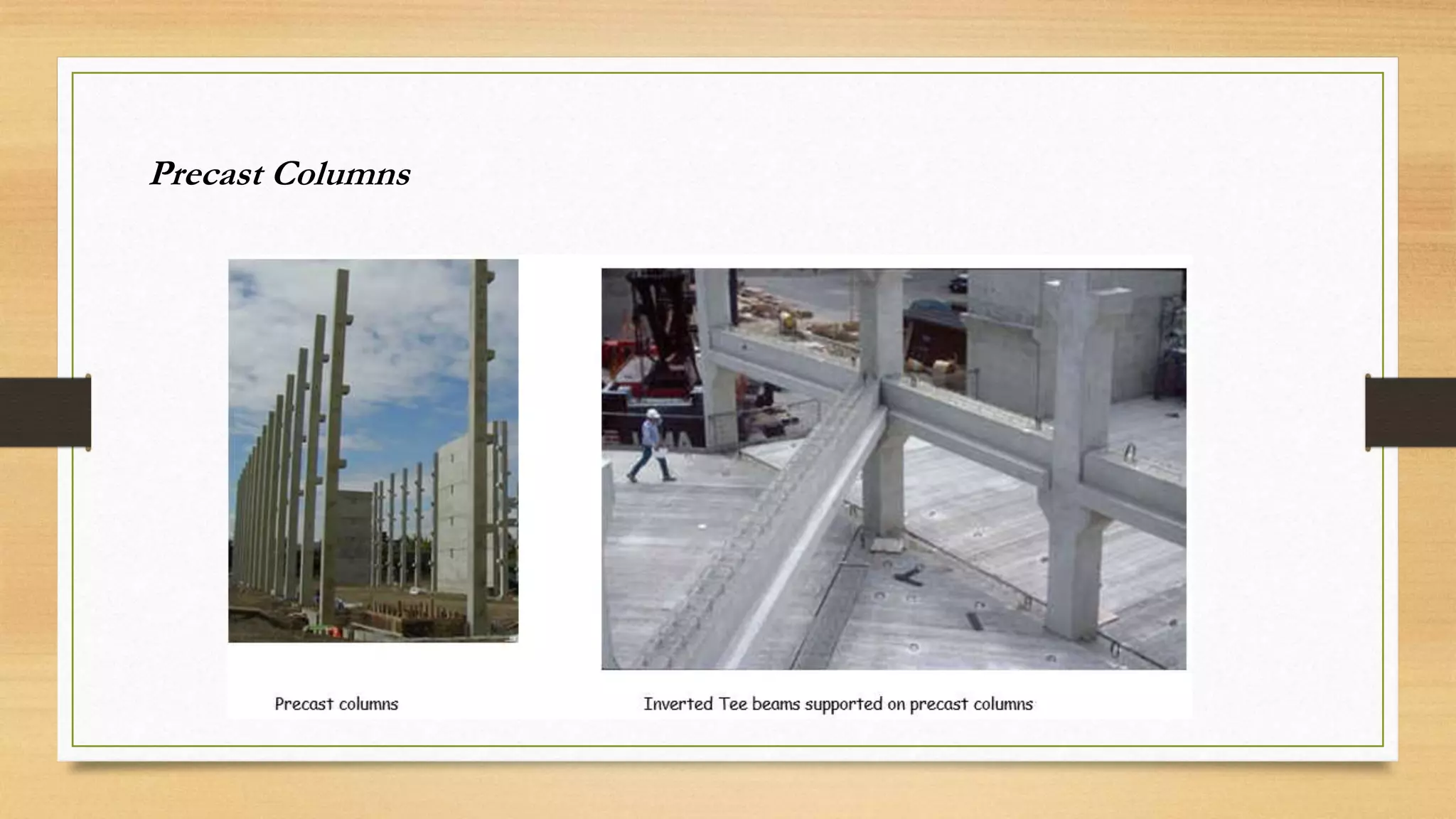
Precast concrete is a construction method involving the casting of concrete in controlled environments, allowing for better quality control and safety compared to onsite casting. It offers significant advantages, including energy efficiency, rapid construction, and versatility in design for various building types. The precast concrete market is increasingly used in government infrastructure projects and commercial constructions due to its cost-effectiveness and sustainability.
PRECAST CONCRETE STRUCTURES
Precastconcrete is a construction product produced by casting concrete in a
reusable mold or "form" which is then cured in a controlled environment,
transported to the construction site and lifted into place ("tilt up").
In contrast, standard concrete is poured into site-specific forms and cured on site.
Precast stone is distinguished from precast concrete using a fine aggregate in the
mixture, so the final product approaches the appearance of naturally occurring rock
or stone. More recently expanded polystyrene is being used as the cores to precast
wall panels. This is lightweight and has better thermal insulation.
3.
Precast is usedwithin exterior and interior walls. By producing precast concrete in
a controlled environment (typically referred to as a precast plant), the precast
concrete is afforded the opportunity to properly cure and be closely monitored by
plant employees.
Using a precast concrete system offers many potential advantages over onsite
casting.
Precast concrete production can performed on ground level, which helps with
safety throughout a project.
4.
There is greatercontrol over material quality and workmanship in a precast
plant compared to a construction site.
The forms used in a precast plant can be reused hundreds to thousands of
times before they have to be replaced, often making it cheaper than onsite
casting when looking at the cost per unit of formwork.
APPLICATIONS AND BENEFITS
Precast concrete wall panels have been used on virtually every type of building, including schools,
office buildings, apartment buildings, townhouses, condominiums, hotels, motels, dormitories, and
single-family homes.
Although typically considered part of a building's enclosure or "envelope," they can be designed to
also serve as part of the building's structural system, eliminating the need for beams and columns
on the building perimeter.
Besides their energy efficiency and aesthetic versatility, they also provide excellent noise attenuation,
outstanding durability (resistant to rot, mold, etc.), and rapid construction.
In addition to the good insulation properties, sandwich panels require fewer work phases to
complete. Compared to double-walls, for example, which have to be insulated and filled with
concrete on site, sandwich panels require much less labor and scaffolding
7.
PRECAST CONCRETE MARKET
Theprecast concrete industry is largely dominated by Government initiated projects for
infrastructural development and also being extensively used for residential (low and high
rise) and commercial constructions because of their various favourable attributes.
The efficiency, durability, ease, cost effectiveness, and sustainable properties of these
products have brought a revolutionary shift in the time consumed in construction of any
structure.
Construction industry is a huge energy consuming industry, and precast concrete products
are and will continue to be more energy efficient than its counterparts.
The wide range of designs, colours, and structural options that these products provide is
also making it a favourable choice for its consumers.