PRECAST
CONCRETE
GROUP8
GROUPMEMBERS: RIYA
PRANAVSATHE
SHREYAKUMBHAR
SAMRUDDHISASANE
SNEHAKOTHARI
CLASS: S.Y.B.ARCH( C )
SUBJECT: BUILDINGCONSTRUCTION& MATERIAL-III
FACULTY: AR.SNEHASHARMA
AR.PURNIMACHITALE
AR.SUNITAKOTHARI
content
HISTORY OF PRECAST CONCRETE
WHAT IS PRECAST CONCRETE?
Different agencies supplying precast construction in india
Market survey
why the precast concrete is used
DISADVANTAGES OF PRECAST CONCRETE
ADVANTAGES OF PRECAST CONCRETE
PRECAST CONCRETE V/S SITE CAST CONCRETE
TYPES OF PRECAST SYSTEMS
PRECAST CONCRETE STRUCTURAL ELEMENTS
WHY IT IS CALLED SO?
WHY PRECAST CONCRETE?
PROPERTIES OF PRECAST CONCRETE
FEATURES OF PRECAST CONCRETE
HISTORY OF PRECAST CONCRETE
Ancient Roman builders made use of concrete and
soon poured the material into moulds to build their
complex network of aqueducts, culverts, and tunnels.
Modern uses for pre-cast technology include a variety
of architectural and structural applications — including
individual parts, or even entire building systems. In
the modern world, precast panelled buildings were
pioneered in Liverpool, England, in 1905. The process
was invented by city engineer John Alexander Brodie,
a creative genius who also invented the idea of the
football goal net. The tram stables at Walton in
Liverpool followed in 1906. The idea was not taken
up extensively in Britain. However, it was adopted all
over the world, particularly in Eastern Europe[4] and
Scandinavia. In the US, precast concrete has evolved
as two subindustries, each represented by a major
association.
The precast concrete products industry focuses
on utility, underground and other non-
prestressed products, and is represented
primarily by the National Precast Concrete
Association (NPCA). The precast concrete
structures industry focuses on prestressed
concrete elements and on other precast
concrete elements used in above-ground
structures such as buildings, parking structures,
and bridges. This industry is represented
primarily by of the Precast/Prestressed
Concrete Institute (PCI).
WHY IT IS CALLED SO?
WHAT IS PRECAST CONCRETE?
• Precast concrete is a construction product produced by
casting concrete in a reusable mold or "form" which is
then cured in a controlled environment, transported
to the construction site and lifted and set into place
• These concrete structures are
casted off-site much before
they are put into actual use
and thus are known as precast
(pre-casted) concrete.
WHY PRECAST CONCRETE?
• Precast concrete structures provide
superior resistance to fires, natural
disasters, insects and mold.
• Precast concrete is made up of coarse and fine
aggregates, cement, water, and admixtures. It is
mixed in the factory’s batch plant according to the
concrete mix design specified by the engineer.
PROPERTIES OF PRECAST CONCRETE
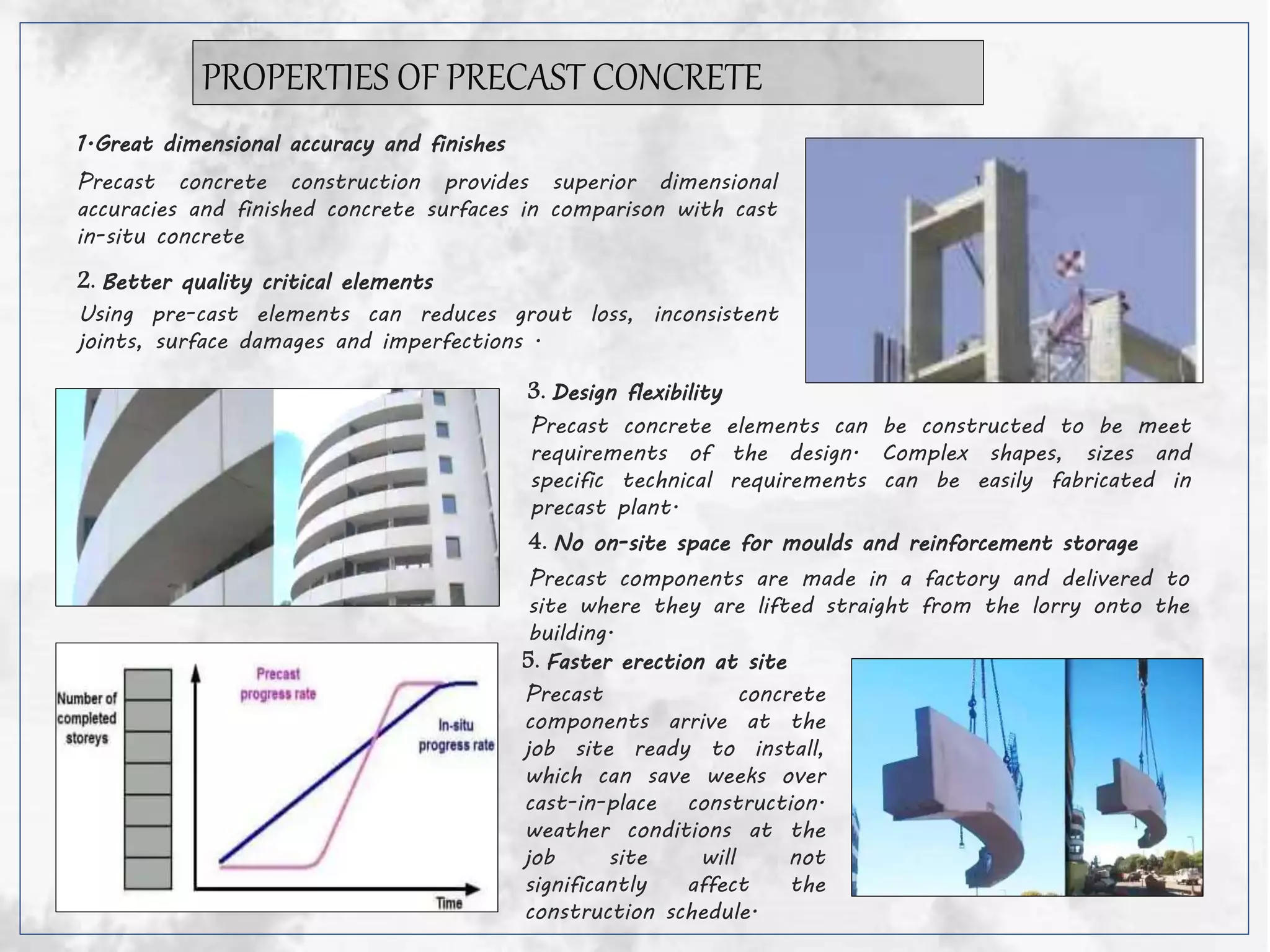
1.Great dimensional accuracy and finishes
Precast concrete construction provides superior dimensional
accuracies and finished concrete surfaces in comparison with cast
in-situ concrete
2. Better quality critical elements
Using pre-cast elements can reduces grout loss, inconsistent
joints, surface damages and imperfections .
Precast concrete elements can be constructed to be meet
requirements of the design. Complex shapes, sizes and
specific technical requirements can be easily fabricated in
precast plant.
3. Design flexibility
4. No on-site space for moulds and reinforcement storage
Precast components are made in a factory and delivered to
site where they are lifted straight from the lorry onto the
building.
5. Faster erection at site
Precast concrete
components arrive at the
job site ready to install,
which can save weeks over
cast-in-place construction.
weather conditions at the
job site will not
significantly affect the
construction schedule.
• The division and specialization of the human workforce.
• The use of tools, machinery, and other equipment, usually automated, in the production
of standard, interchangeable parts and products.
• Compared to site-cast concrete , precast concrete erection is faster and less affected by
adverse weather conditions.
• Plant casting allows increased efficiency, high quality control and greater control on
finishes.
FEATURES OF PRECAST CONCRETE
DESIGN CONSIDERATIONS
• Final position and loads
• transportation requirements – self load and position during transportation
• storing requirements – self load and position during storing – (avoid or store in the same
position as it transported / built in)
• lifting loads – distribution of lifting points – optimal way of lifting (selection of lifting
and rigging tools)
• vulnerable points (e.g. edges) – reduction of risk (e.g. rounded edges)
PRECAST CONCRETE STRUCTURAL ELEMENTS
A precast building is constructed by assembling and connecting
various prefabricated elements required in the building
structure. These elements are:
1. Precast slabs
2. Precast beams
3. Precast columns
4. Precast walls
5. Precast foundation
6. Precast stairs
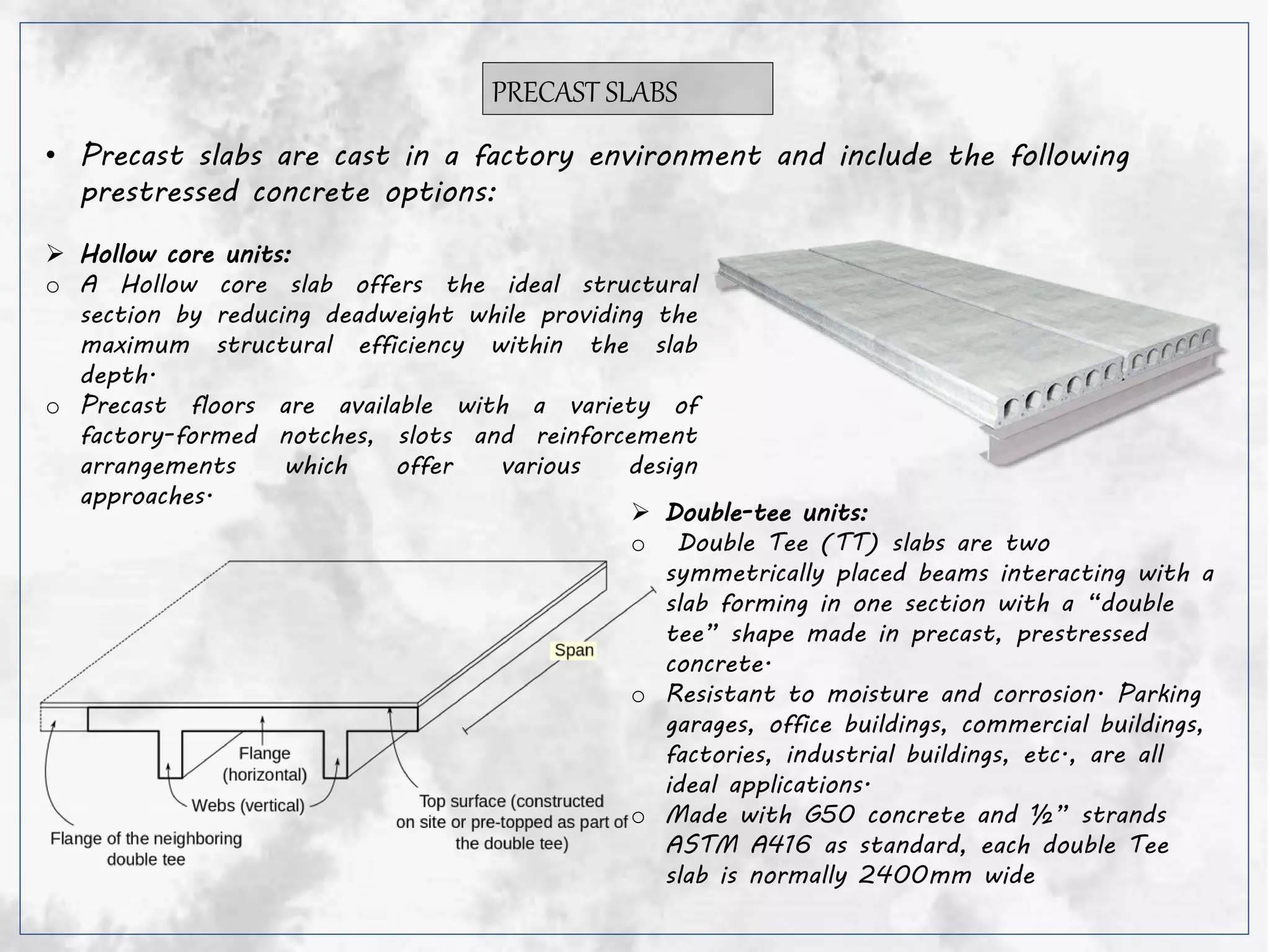
• Precast slabs are cast in a factory environment and include the following
prestressed concrete options:
PRECAST SLABS
 Hollow core units:
o A Hollow core slab offers the ideal structural
section by reducing deadweight while providing the
maximum structural efficiency within the slab
depth.
o Precast floors are available with a variety of
factory-formed notches, slots and reinforcement
arrangements which offer various design
approaches.
 Double-tee units:
o Double Tee (TT) slabs are two
symmetrically placed beams interacting with a
slab forming in one section with a “double
tee” shape made in precast, prestressed
concrete.
o Resistant to moisture and corrosion. Parking
garages, office buildings, commercial buildings,
factories, industrial buildings, etc., are all
ideal applications.
o Made with G50 concrete and ½” strands
ASTM A416 as standard, each double Tee
slab is normally 2400mm wide
PRECAST BEAMS
 Beams and beam shells are both used for suspended flooring.
 Beams are typically used as ledges for other forms of precast flooring
to sit on, but can also be used as a flooring option in their own
right. They are generally manufactured to suit each particular
situation and profiles can include :
• Tee-beams
• L-beams
• Rectangular beams
• U-beams
• Beamshells.
 Beams can be either
reinforced or prestressed
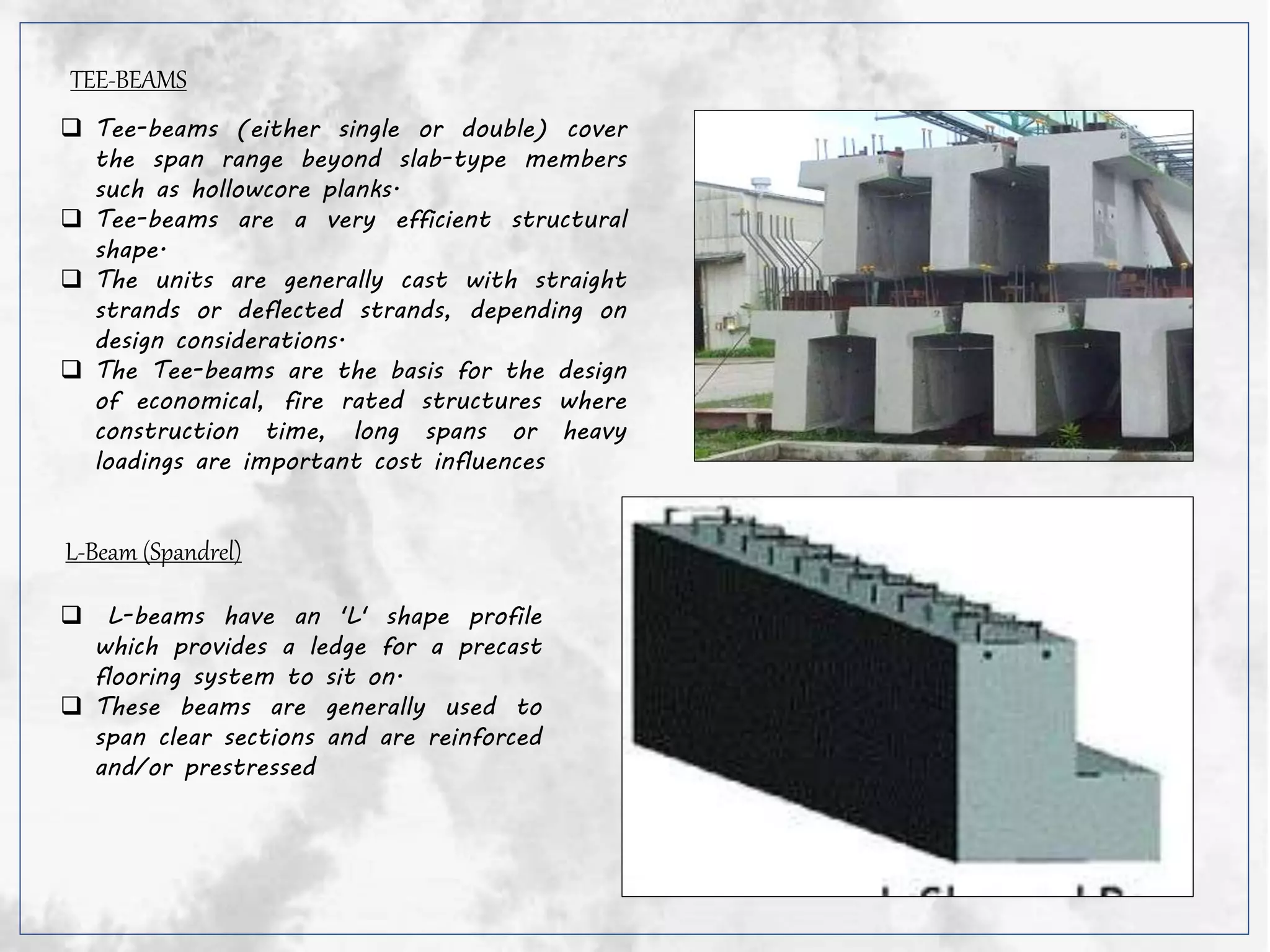
TEE-BEAMS
 Tee-beams (either single or double) cover
the span range beyond slab-type members
such as hollowcore planks.
 Tee-beams are a very efficient structural
shape.
 The units are generally cast with straight
strands or deflected strands, depending on
design considerations.
 The Tee-beams are the basis for the design
of economical, fire rated structures where
construction time, long spans or heavy
loadings are important cost influences
L-Beam (Spandrel)
 L-beams have an 'L' shape profile
which provides a ledge for a precast
flooring system to sit on.
 These beams are generally used to
span clear sections and are reinforced
and/or prestressed
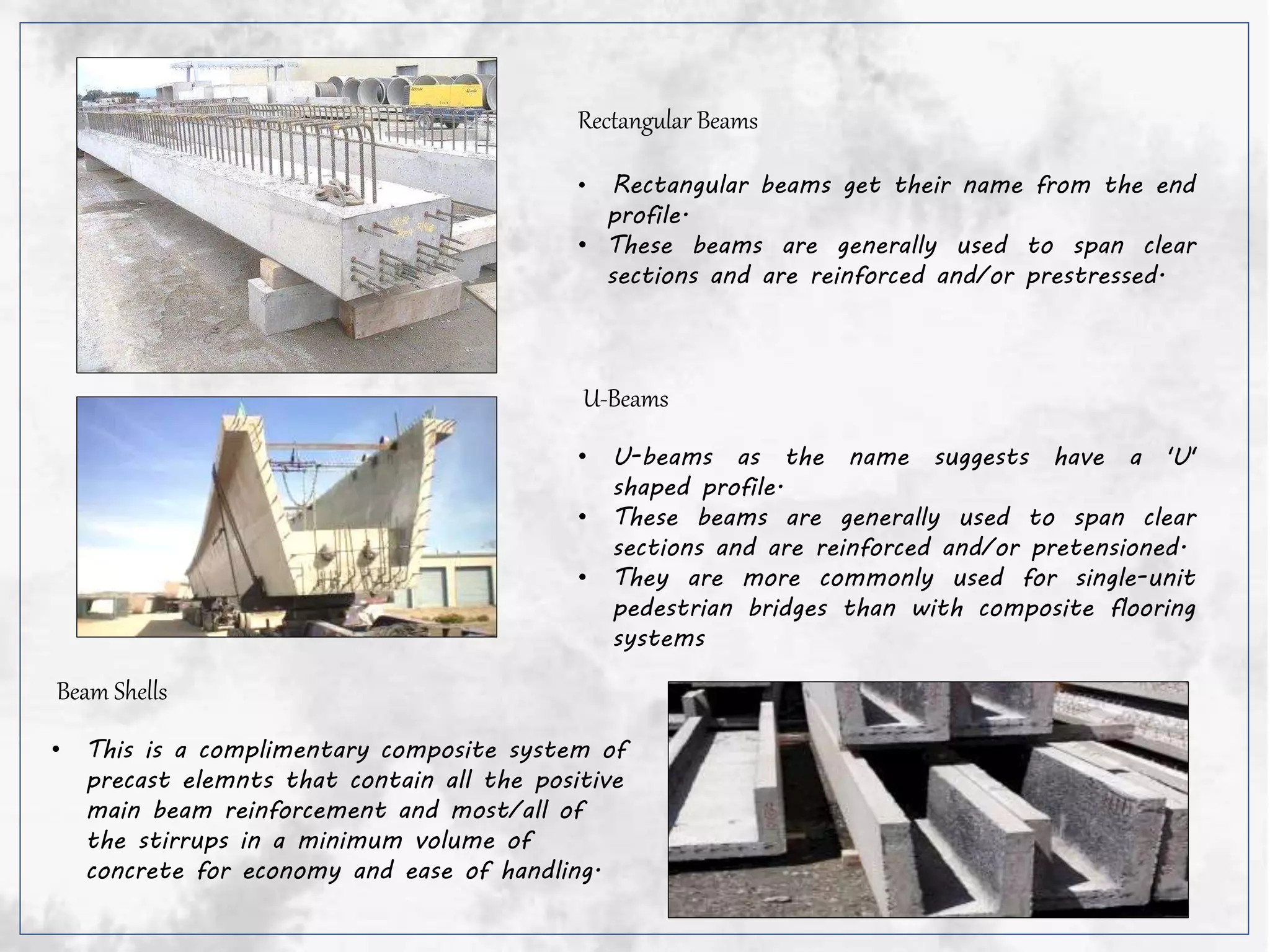
Rectangular Beams
• Rectangular beams get their name from the end
profile.
• These beams are generally used to span clear
sections and are reinforced and/or prestressed.
U-Beams
• U-beams as the name suggests have a 'U'
shaped profile.
• These beams are generally used to span clear
sections and are reinforced and/or pretensioned.
• They are more commonly used for single-unit
pedestrian bridges than with composite flooring
systems
Beam Shells
• This is a complimentary composite system of
precast elemnts that contain all the positive
main beam reinforcement and most/all of
the stirrups in a minimum volume of
concrete for economy and ease of handling.
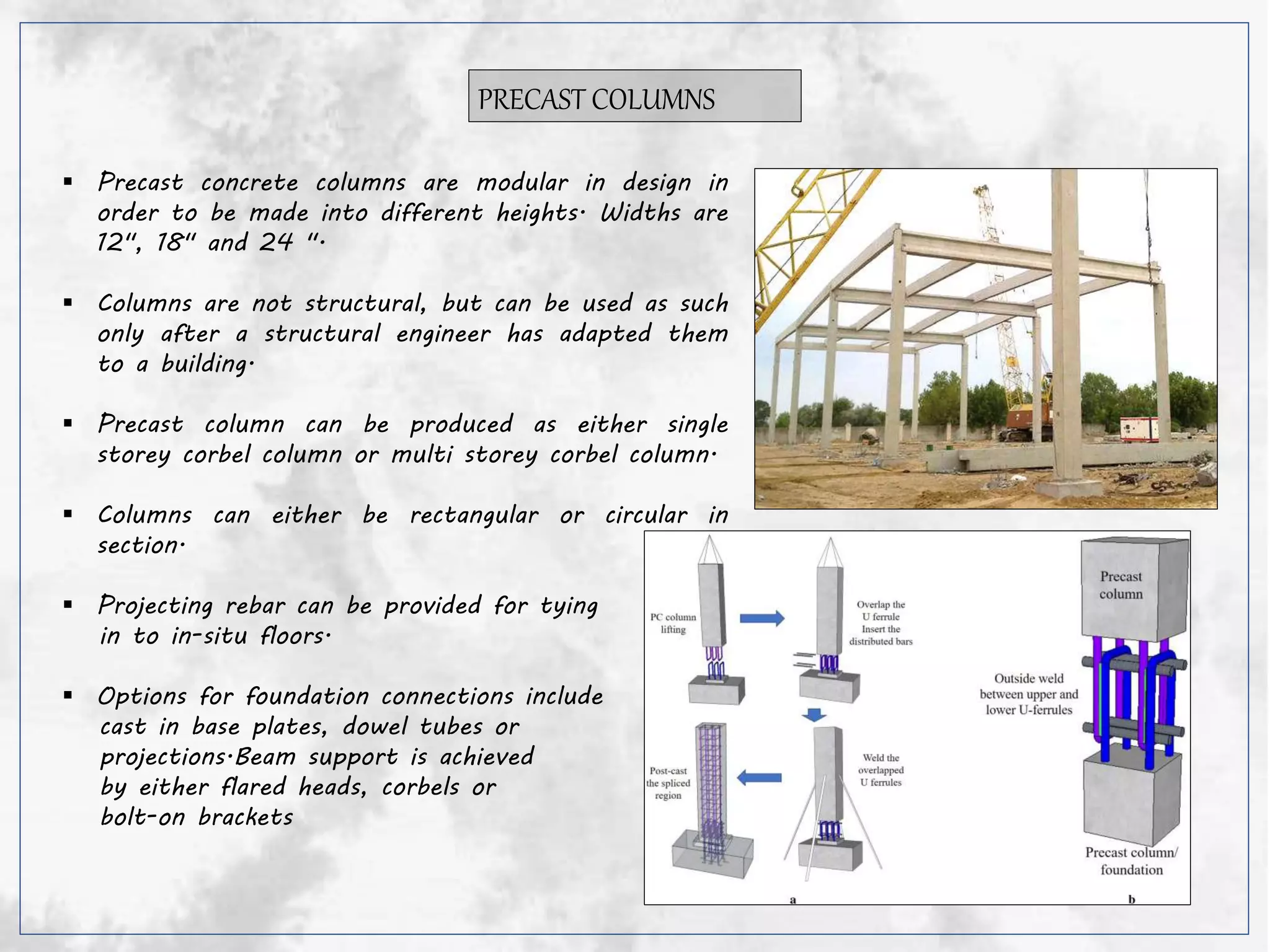
PRECAST COLUMNS
 Precast concrete columns are modular in design in
order to be made into different heights. Widths are
12", 18" and 24 ".
 Columns are not structural, but can be used as such
only after a structural engineer has adapted them
to a building.
 Precast column can be produced as either single
storey corbel column or multi storey corbel column.
 Columns can either be rectangular or circular in
section.
 Projecting rebar can be provided for tying
in to in-situ floors.
 Options for foundation connections include
cast in base plates, dowel tubes or
projections.Beam support is achieved
by either flared heads, corbels or
bolt-on brackets
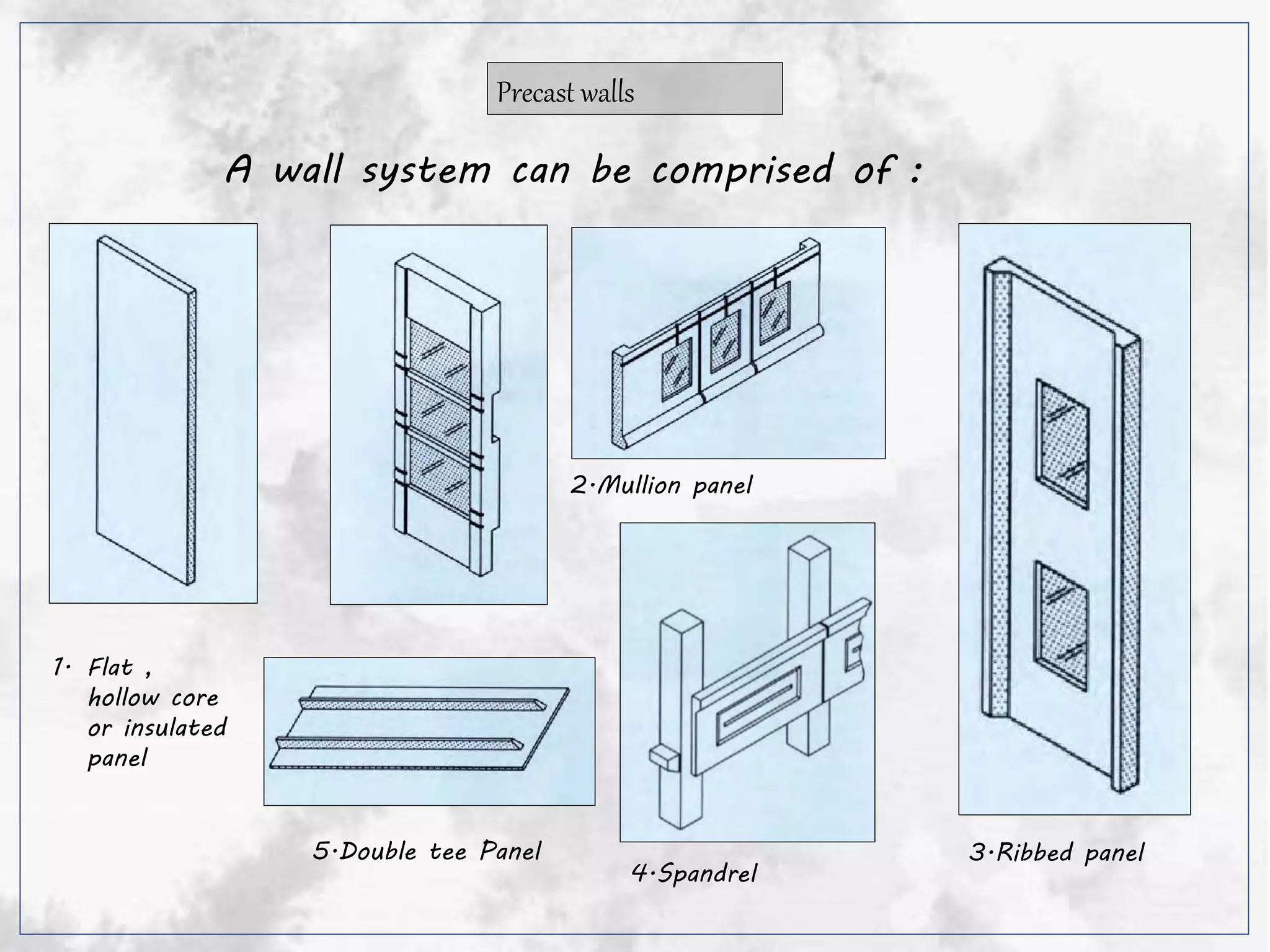
Precast walls
A wall system can be comprised of :
1. Flat ,
hollow core
or insulated
panel
2.Mullion panel
3.Ribbed panel
4.Spandrel
5.Double tee Panel
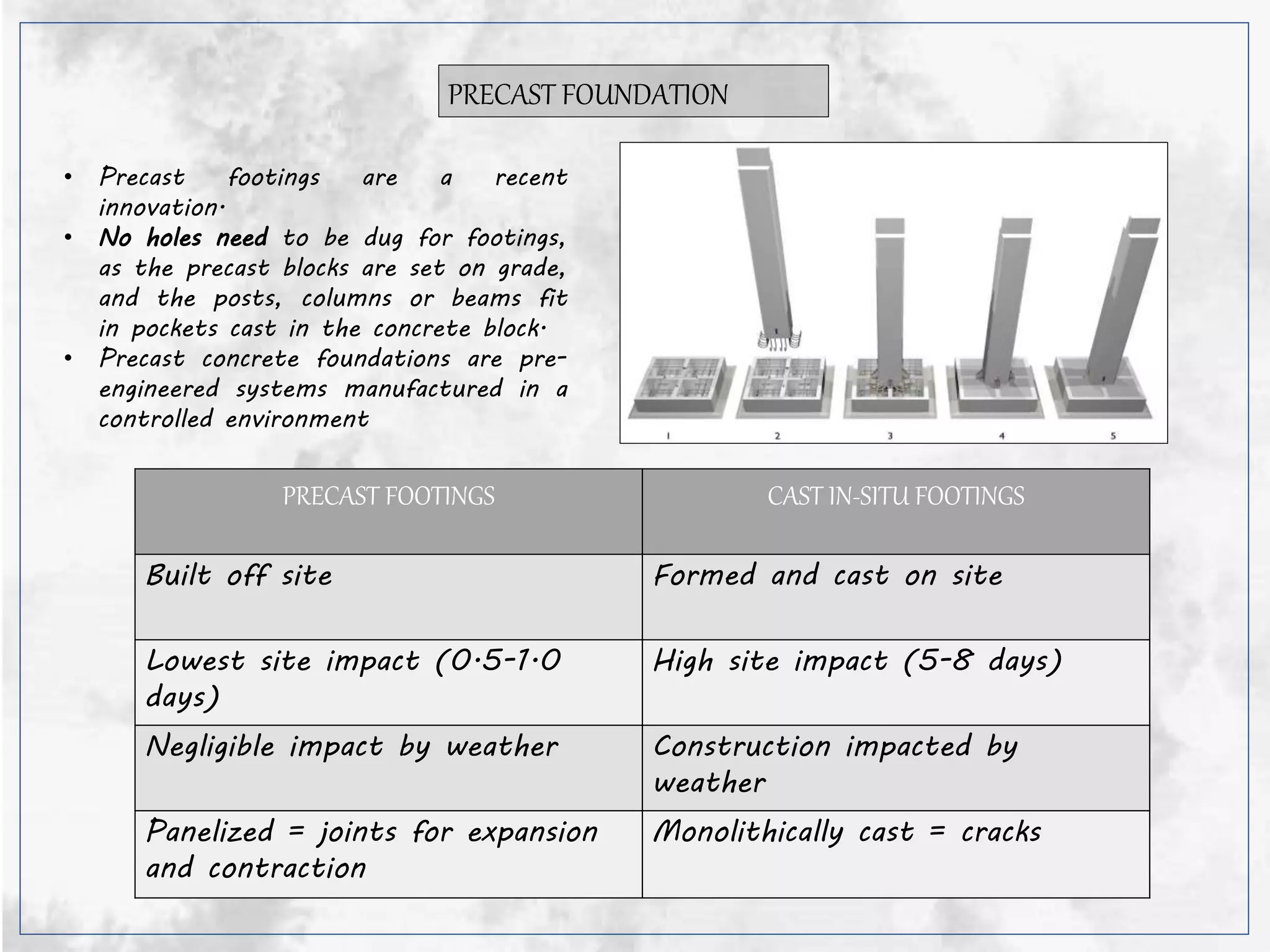
PRECAST FOUNDATION
• Precast footings are a recent
innovation.
• No holes need to be dug for footings,
as the precast blocks are set on grade,
and the posts, columns or beams fit
in pockets cast in the concrete block.
• Precast concrete foundations are pre-
engineered systems manufactured in a
controlled environment
PRECAST FOOTINGS CAST IN-SITU FOOTINGS
Built off site Formed and cast on site
Lowest site impact (0.5-1.0
days)
High site impact (5-8 days)
Negligible impact by weather Construction impacted by
weather
Panelized = joints for expansion
and contraction
Monolithically cast = cracks
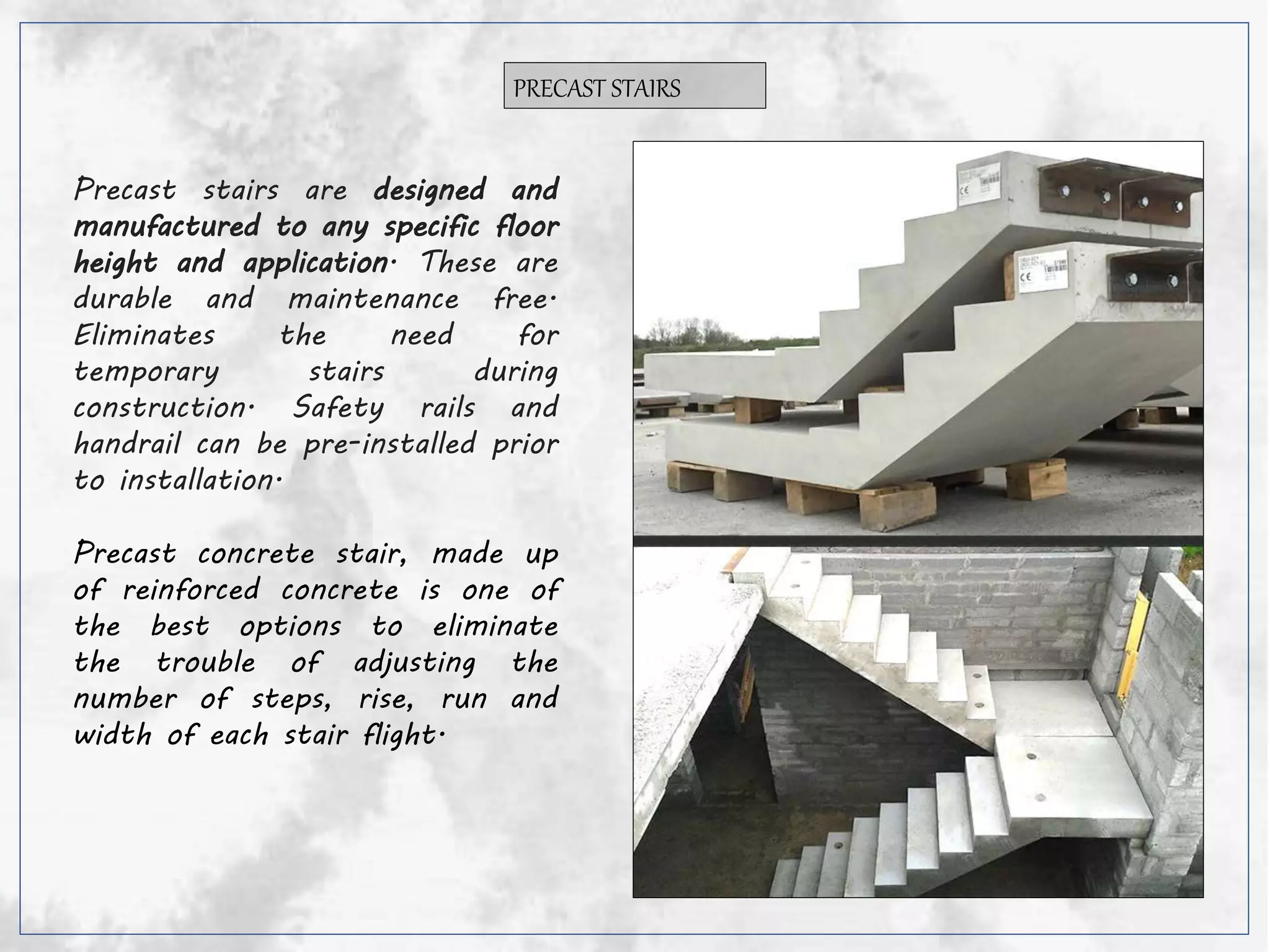
PRECAST STAIRS
Precast stairs are designed and
manufactured to any specific floor
height and application. These are
durable and maintenance free.
Eliminates the need for
temporary stairs during
construction. Safety rails and
handrail can be pre-installed prior
to installation.
Precast concrete stair, made up
of reinforced concrete is one of
the best options to eliminate
the trouble of adjusting the
number of steps, rise, run and
width of each stair flight.
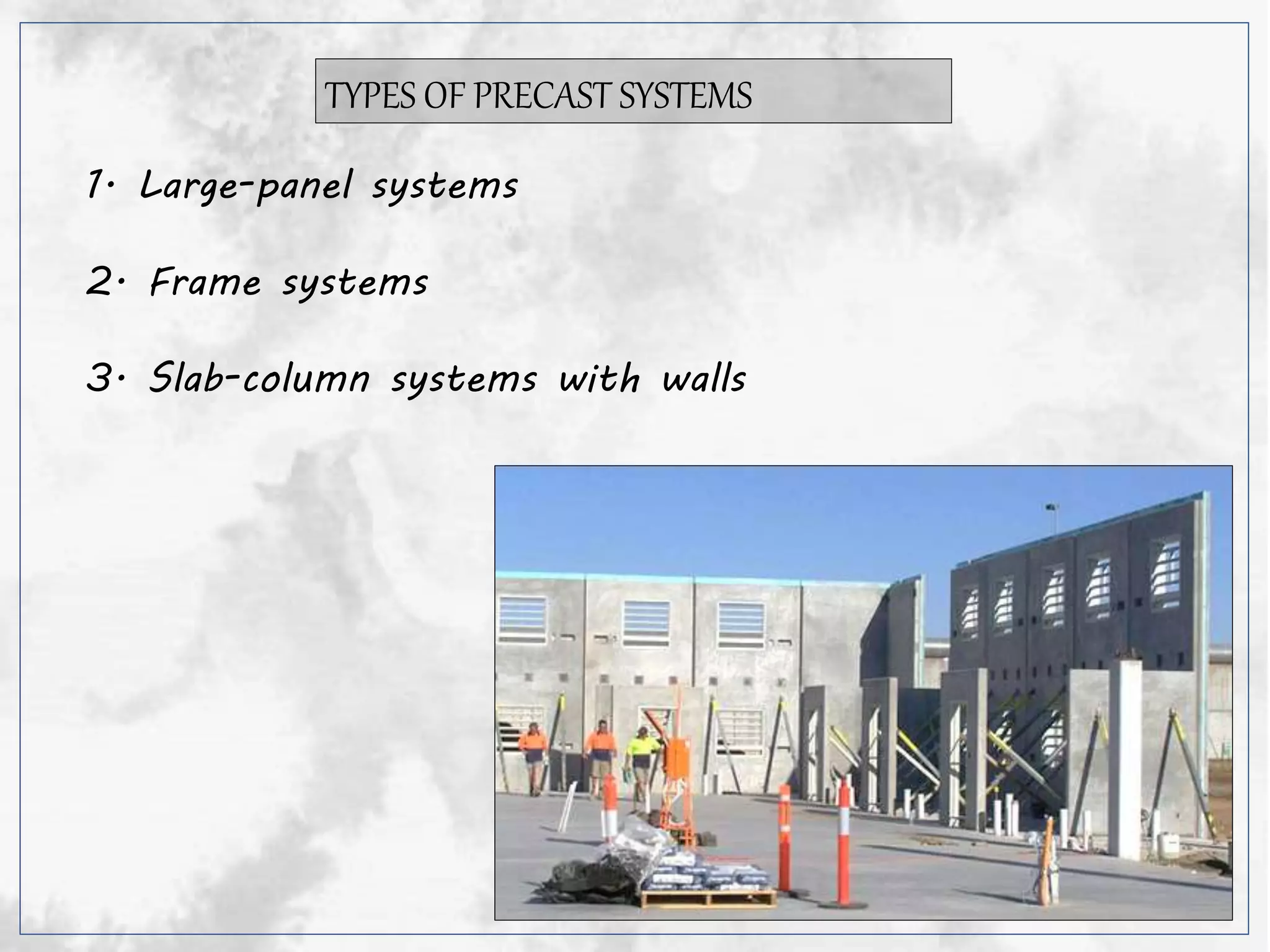
1. Large-panel systems
2. Frame systems
3. Slab-column systems with walls
TYPES OF PRECAST SYSTEMS
LARGE-PANEL SYSTEMS
• “Large-panel system” refers to multistory
structures composed of large wall and floor
concrete panels connected in the vertical
and horizontal directions so that the wall
panels enclose appropriate spaces for the
rooms within a building.
• These panels form a box-like structure.
• Both vertical and horizontal panels resist
gravity load.
• Wall panels are usually one storey high.
• Horizontal floor and roof panels span
either as one-way or two-way slabs.
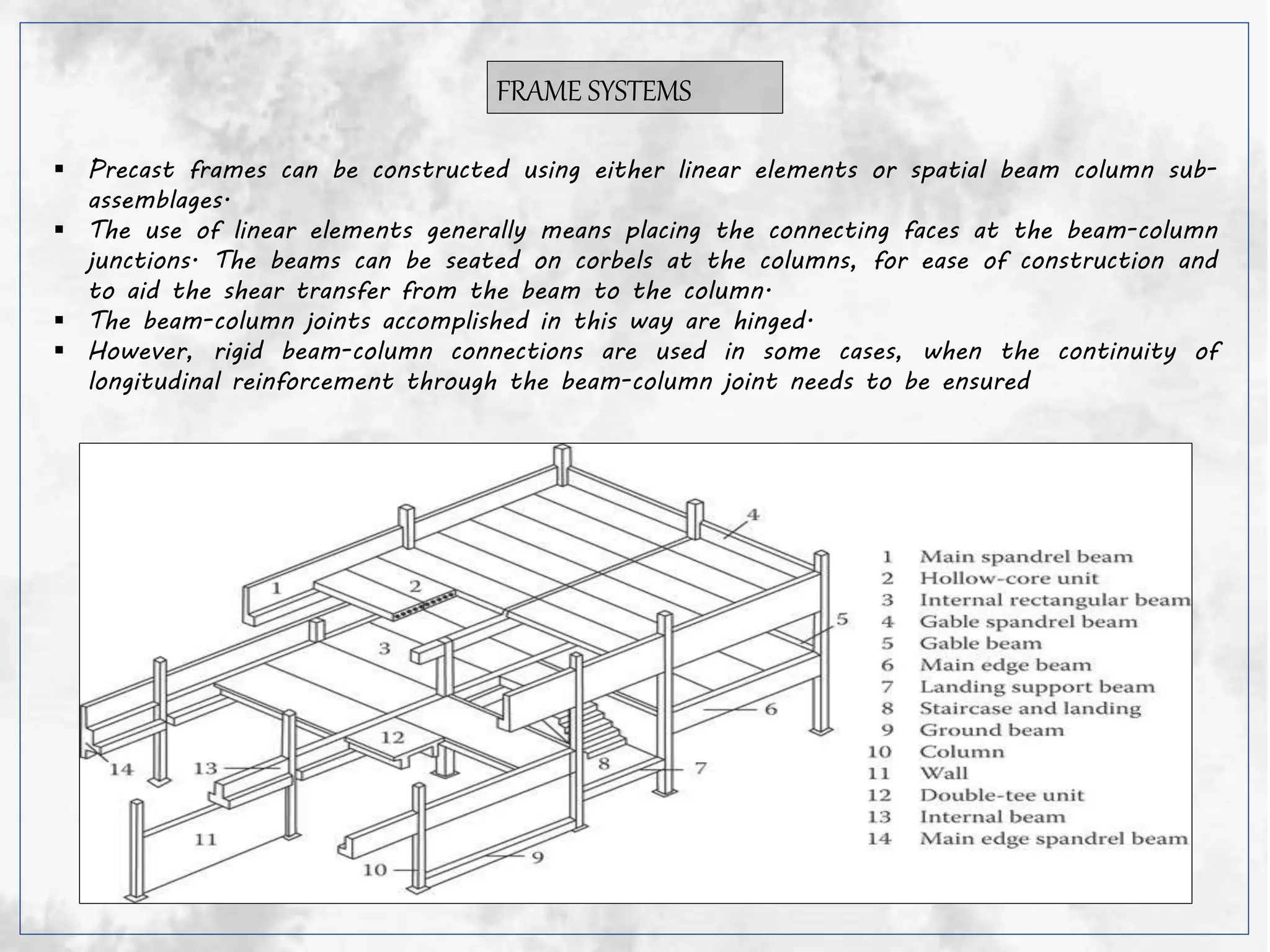
FRAME SYSTEMS
 Precast frames can be constructed using either linear elements or spatial beam column sub-
assemblages.
 The use of linear elements generally means placing the connecting faces at the beam-column
junctions. The beams can be seated on corbels at the columns, for ease of construction and
to aid the shear transfer from the beam to the column.
 The beam-column joints accomplished in this way are hinged.
 However, rigid beam-column connections are used in some cases, when the continuity of
longitudinal reinforcement through the beam-column joint needs to be ensured
SLAB-COLUMN SYSTEMS WITH WALLS
• These systems rely on shear walls to sustain lateral load effects, whereas
the slab-column structure resists mainly gravity loads.
• There are two main systems in this category:
 Lift-slab system with walls
The load-bearing structure
consists of precast reinforced
concrete columns and slabs.
Precast columns are usually
two stories high.
 Prestressed slab-column
system
Horizontal prestressing in
two orthogonal directions
to achieve continuity.
The precast concrete column
elements are 1 to 3 stories
high.
PRECAST SITE CAST
 Transportation and elevation
capacity limits the size-
 Higher, industrialized quality –
less affected by weather no
 Space requirement on the site
for fabrication
 Unlimited opportunities of
architectural appearance
 Option of standardized
components
 No transportation
 The size limitation is depending
on the elevation capacity only
 Lower quality because directly
affected by weather
 Proper, large free space
required
PRECAST CONCRETE V/S SITE CAST CONCRETE
ADVANTAGES OF PRECAST CONCRETE
Very rapid speed of erection
 Good quality control
 Entire building can be precast-walls, floors , beams , etc.
 Rapid construction on site
 High quality because of the controlled conditions in the factory.
 Prestressing is easily done which can reduce the size and number of the
structural members.
 Aesthetic versatility
 Durability
 Security
 Low maintenance
 Economy
DISADVANTAGES OF PRECAST CONCRETE
 Very heavy members
 Camber in beams and slabs
 Very small margin for error
 Connections may be difficult
 Somewhat limited building design flexibility.
 Because panel size is limited, precast concrete can not be used for two-way
structural systems.
 Economics of scale demand regularly shaped buildings.
 Need for repetition of forms will affect building design.
 Joints between panels are often expensive and complicated.
 Skilled workmanship is required in the application of the panel on site.
 Cranes are required to lift panels.
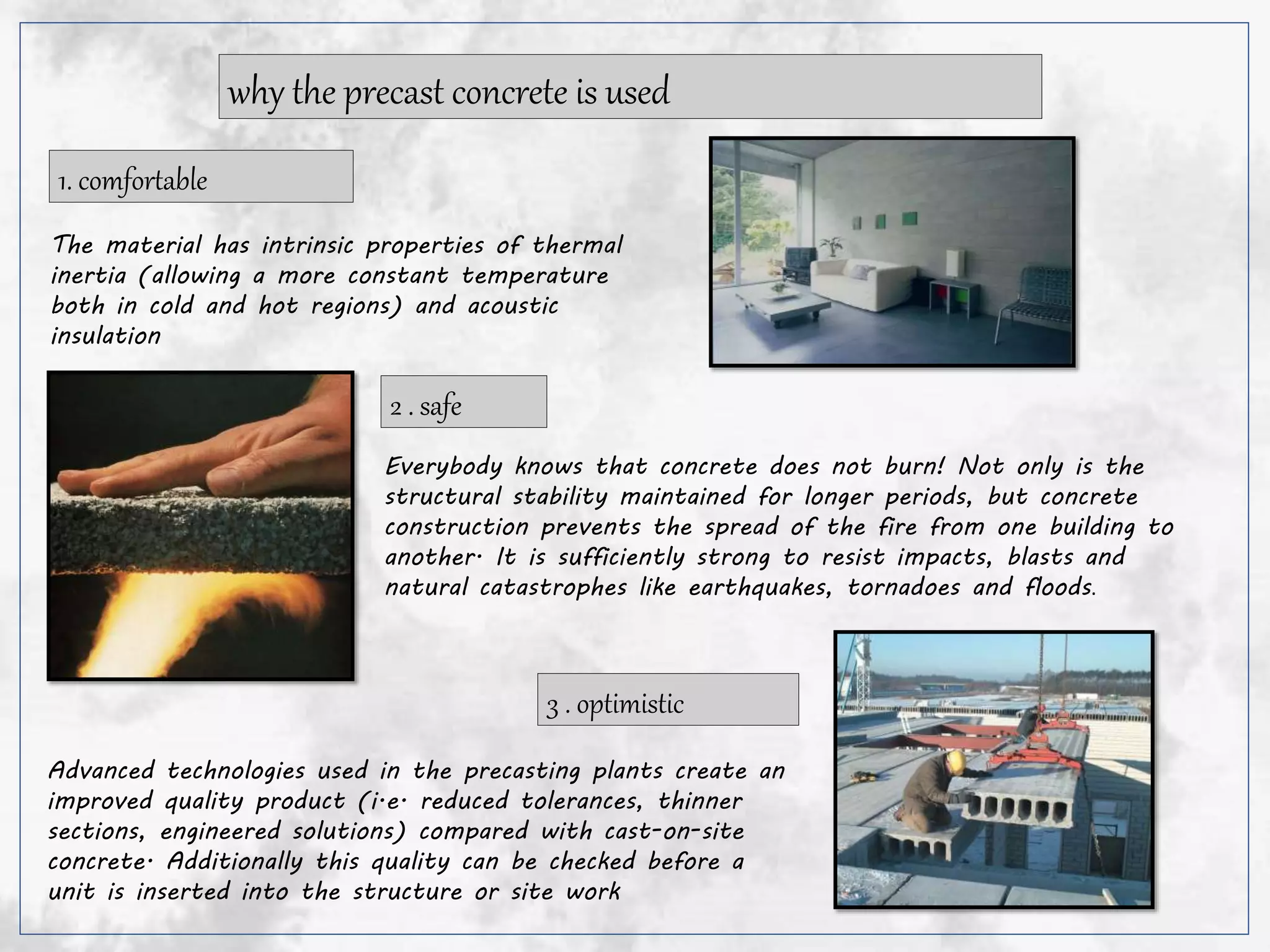
why the precast concrete is used
The material has intrinsic properties of thermal
inertia (allowing a more constant temperature
both in cold and hot regions) and acoustic
insulation
1. comfortable
2 . safe
Everybody knows that concrete does not burn! Not only is the
structural stability maintained for longer periods, but concrete
construction prevents the spread of the fire from one building to
another. It is sufficiently strong to resist impacts, blasts and
natural catastrophes like earthquakes, tornadoes and floods.
Advanced technologies used in the precasting plants create an
improved quality product (i.e. reduced tolerances, thinner
sections, engineered solutions) compared with cast-on-site
concrete. Additionally this quality can be checked before a
unit is inserted into the structure or site work
3 . optimistic
4 . versatile
Factory production allows a wide choice of surface
finishing, colour range and special shapes. Precast
concrete has another advantage: its mouldability
which entails designers to copy classical details like
keystones and capitals or match the finish of
materials like weathered stones. The precast
concrete industry can source a wide range of
aggregates locally and offer a tremendous variety of
colours and visual effects.
Indoor air quality is a concern for all of us.
Precast concrete is stable throughout its life and
does not need chemical treatment to protect it
against rot and insect attack: this means that
there are no emissions in the internal
environment.
5 . healthy
Concrete lasts for years. Egyptian and Chinese people used an
ancient form of concrete for buildings and structures that
still exist today. Concrete is used where the structural
stability has to be maintained for long periods. Effective
design detailing helps to lengthen the life of a concrete
building; precast manufacturers can offer guidance on
designing for durability.
6 . durable
Made of natural raw materials (stones, gravels, sand, cement),
locally available almost everywhere and in an enormous quantity,
precast concrete minimises the whole life cycle impact on the
environment when compared with other construction materials.
Precast concrete units can entirely be re-used or recycled (almost
100% of a concrete building can be recycled, no matter how heavily
reinforced).
Precast concrete combines the excellent quality of factory
production with a relatively inexpensive material. The costs to
repair and maintain a concrete structures are highly limited. There
is therefore no need to compromise on quality to reduce costs,
simply choose the best way to use locally available resources.
8 . affordable
7 . ecological
Precast concrete slab : RS 1200/square feet
Precast concrete column and beam:. RS 500/number
Precast concrete staircase : RS 17999/ cubic meter
Precast concrete Foundation : RS 30000/ cubic meter
Precast concrete compound wall : RS 100/square feet
Precast concrete wall: RS 1 Lakh / unit
Precast concrete septic tanks: RS 7000/ piece
Precast concrete toilets : RS 4500 / unit
Market survey
Different agencies supplying precast construction in india
 Arto Precast Concrete , Bengaluru
 India Precast , Gurugram
 Ultracore Solutions Pvt. Ltd. , Hyderabad
 Drsti Precast Pvt. Ltd. , Coimbatore
 MBM Precast India Pvt. Ltd. , Sanand , Gujarat
 Precast Buildcon India Pvt. Ltd. , Hyderabad
Thank you

Precast concrete

  • 1.
  • 2.
    GROUP8 GROUPMEMBERS: RIYA PRANAVSATHE SHREYAKUMBHAR SAMRUDDHISASANE SNEHAKOTHARI CLASS: S.Y.B.ARCH(C ) SUBJECT: BUILDINGCONSTRUCTION& MATERIAL-III FACULTY: AR.SNEHASHARMA AR.PURNIMACHITALE AR.SUNITAKOTHARI
  • 3.
    content HISTORY OF PRECASTCONCRETE WHAT IS PRECAST CONCRETE? Different agencies supplying precast construction in india Market survey why the precast concrete is used DISADVANTAGES OF PRECAST CONCRETE ADVANTAGES OF PRECAST CONCRETE PRECAST CONCRETE V/S SITE CAST CONCRETE TYPES OF PRECAST SYSTEMS PRECAST CONCRETE STRUCTURAL ELEMENTS WHY IT IS CALLED SO? WHY PRECAST CONCRETE? PROPERTIES OF PRECAST CONCRETE FEATURES OF PRECAST CONCRETE
  • 4.
    HISTORY OF PRECASTCONCRETE Ancient Roman builders made use of concrete and soon poured the material into moulds to build their complex network of aqueducts, culverts, and tunnels. Modern uses for pre-cast technology include a variety of architectural and structural applications — including individual parts, or even entire building systems. In the modern world, precast panelled buildings were pioneered in Liverpool, England, in 1905. The process was invented by city engineer John Alexander Brodie, a creative genius who also invented the idea of the football goal net. The tram stables at Walton in Liverpool followed in 1906. The idea was not taken up extensively in Britain. However, it was adopted all over the world, particularly in Eastern Europe[4] and Scandinavia. In the US, precast concrete has evolved as two subindustries, each represented by a major association. The precast concrete products industry focuses on utility, underground and other non- prestressed products, and is represented primarily by the National Precast Concrete Association (NPCA). The precast concrete structures industry focuses on prestressed concrete elements and on other precast concrete elements used in above-ground structures such as buildings, parking structures, and bridges. This industry is represented primarily by of the Precast/Prestressed Concrete Institute (PCI).
  • 5.
    WHY IT ISCALLED SO? WHAT IS PRECAST CONCRETE? • Precast concrete is a construction product produced by casting concrete in a reusable mold or "form" which is then cured in a controlled environment, transported to the construction site and lifted and set into place • These concrete structures are casted off-site much before they are put into actual use and thus are known as precast (pre-casted) concrete. WHY PRECAST CONCRETE? • Precast concrete structures provide superior resistance to fires, natural disasters, insects and mold. • Precast concrete is made up of coarse and fine aggregates, cement, water, and admixtures. It is mixed in the factory’s batch plant according to the concrete mix design specified by the engineer.
  • 6.
    PROPERTIES OF PRECASTCONCRETE 1.Great dimensional accuracy and finishes Precast concrete construction provides superior dimensional accuracies and finished concrete surfaces in comparison with cast in-situ concrete 2. Better quality critical elements Using pre-cast elements can reduces grout loss, inconsistent joints, surface damages and imperfections . Precast concrete elements can be constructed to be meet requirements of the design. Complex shapes, sizes and specific technical requirements can be easily fabricated in precast plant. 3. Design flexibility 4. No on-site space for moulds and reinforcement storage Precast components are made in a factory and delivered to site where they are lifted straight from the lorry onto the building. 5. Faster erection at site Precast concrete components arrive at the job site ready to install, which can save weeks over cast-in-place construction. weather conditions at the job site will not significantly affect the construction schedule.
  • 7.
    • The divisionand specialization of the human workforce. • The use of tools, machinery, and other equipment, usually automated, in the production of standard, interchangeable parts and products. • Compared to site-cast concrete , precast concrete erection is faster and less affected by adverse weather conditions. • Plant casting allows increased efficiency, high quality control and greater control on finishes. FEATURES OF PRECAST CONCRETE DESIGN CONSIDERATIONS • Final position and loads • transportation requirements – self load and position during transportation • storing requirements – self load and position during storing – (avoid or store in the same position as it transported / built in) • lifting loads – distribution of lifting points – optimal way of lifting (selection of lifting and rigging tools) • vulnerable points (e.g. edges) – reduction of risk (e.g. rounded edges)
  • 8.
    PRECAST CONCRETE STRUCTURALELEMENTS A precast building is constructed by assembling and connecting various prefabricated elements required in the building structure. These elements are: 1. Precast slabs 2. Precast beams 3. Precast columns 4. Precast walls 5. Precast foundation 6. Precast stairs
  • 9.
    • Precast slabsare cast in a factory environment and include the following prestressed concrete options: PRECAST SLABS  Hollow core units: o A Hollow core slab offers the ideal structural section by reducing deadweight while providing the maximum structural efficiency within the slab depth. o Precast floors are available with a variety of factory-formed notches, slots and reinforcement arrangements which offer various design approaches.  Double-tee units: o Double Tee (TT) slabs are two symmetrically placed beams interacting with a slab forming in one section with a “double tee” shape made in precast, prestressed concrete. o Resistant to moisture and corrosion. Parking garages, office buildings, commercial buildings, factories, industrial buildings, etc., are all ideal applications. o Made with G50 concrete and ½” strands ASTM A416 as standard, each double Tee slab is normally 2400mm wide
  • 10.
    PRECAST BEAMS  Beamsand beam shells are both used for suspended flooring.  Beams are typically used as ledges for other forms of precast flooring to sit on, but can also be used as a flooring option in their own right. They are generally manufactured to suit each particular situation and profiles can include : • Tee-beams • L-beams • Rectangular beams • U-beams • Beamshells.  Beams can be either reinforced or prestressed
  • 11.
    TEE-BEAMS  Tee-beams (eithersingle or double) cover the span range beyond slab-type members such as hollowcore planks.  Tee-beams are a very efficient structural shape.  The units are generally cast with straight strands or deflected strands, depending on design considerations.  The Tee-beams are the basis for the design of economical, fire rated structures where construction time, long spans or heavy loadings are important cost influences L-Beam (Spandrel)  L-beams have an 'L' shape profile which provides a ledge for a precast flooring system to sit on.  These beams are generally used to span clear sections and are reinforced and/or prestressed
  • 12.
    Rectangular Beams • Rectangularbeams get their name from the end profile. • These beams are generally used to span clear sections and are reinforced and/or prestressed. U-Beams • U-beams as the name suggests have a 'U' shaped profile. • These beams are generally used to span clear sections and are reinforced and/or pretensioned. • They are more commonly used for single-unit pedestrian bridges than with composite flooring systems Beam Shells • This is a complimentary composite system of precast elemnts that contain all the positive main beam reinforcement and most/all of the stirrups in a minimum volume of concrete for economy and ease of handling.
  • 13.
    PRECAST COLUMNS  Precastconcrete columns are modular in design in order to be made into different heights. Widths are 12", 18" and 24 ".  Columns are not structural, but can be used as such only after a structural engineer has adapted them to a building.  Precast column can be produced as either single storey corbel column or multi storey corbel column.  Columns can either be rectangular or circular in section.  Projecting rebar can be provided for tying in to in-situ floors.  Options for foundation connections include cast in base plates, dowel tubes or projections.Beam support is achieved by either flared heads, corbels or bolt-on brackets
  • 14.
    Precast walls A wallsystem can be comprised of : 1. Flat , hollow core or insulated panel 2.Mullion panel 3.Ribbed panel 4.Spandrel 5.Double tee Panel
  • 15.
    PRECAST FOUNDATION • Precastfootings are a recent innovation. • No holes need to be dug for footings, as the precast blocks are set on grade, and the posts, columns or beams fit in pockets cast in the concrete block. • Precast concrete foundations are pre- engineered systems manufactured in a controlled environment PRECAST FOOTINGS CAST IN-SITU FOOTINGS Built off site Formed and cast on site Lowest site impact (0.5-1.0 days) High site impact (5-8 days) Negligible impact by weather Construction impacted by weather Panelized = joints for expansion and contraction Monolithically cast = cracks
  • 16.
    PRECAST STAIRS Precast stairsare designed and manufactured to any specific floor height and application. These are durable and maintenance free. Eliminates the need for temporary stairs during construction. Safety rails and handrail can be pre-installed prior to installation. Precast concrete stair, made up of reinforced concrete is one of the best options to eliminate the trouble of adjusting the number of steps, rise, run and width of each stair flight.
  • 17.
    1. Large-panel systems 2.Frame systems 3. Slab-column systems with walls TYPES OF PRECAST SYSTEMS
  • 18.
    LARGE-PANEL SYSTEMS • “Large-panelsystem” refers to multistory structures composed of large wall and floor concrete panels connected in the vertical and horizontal directions so that the wall panels enclose appropriate spaces for the rooms within a building. • These panels form a box-like structure. • Both vertical and horizontal panels resist gravity load. • Wall panels are usually one storey high. • Horizontal floor and roof panels span either as one-way or two-way slabs.
  • 19.
    FRAME SYSTEMS  Precastframes can be constructed using either linear elements or spatial beam column sub- assemblages.  The use of linear elements generally means placing the connecting faces at the beam-column junctions. The beams can be seated on corbels at the columns, for ease of construction and to aid the shear transfer from the beam to the column.  The beam-column joints accomplished in this way are hinged.  However, rigid beam-column connections are used in some cases, when the continuity of longitudinal reinforcement through the beam-column joint needs to be ensured
  • 20.
    SLAB-COLUMN SYSTEMS WITHWALLS • These systems rely on shear walls to sustain lateral load effects, whereas the slab-column structure resists mainly gravity loads. • There are two main systems in this category:  Lift-slab system with walls The load-bearing structure consists of precast reinforced concrete columns and slabs. Precast columns are usually two stories high.  Prestressed slab-column system Horizontal prestressing in two orthogonal directions to achieve continuity. The precast concrete column elements are 1 to 3 stories high.
  • 21.
    PRECAST SITE CAST Transportation and elevation capacity limits the size-  Higher, industrialized quality – less affected by weather no  Space requirement on the site for fabrication  Unlimited opportunities of architectural appearance  Option of standardized components  No transportation  The size limitation is depending on the elevation capacity only  Lower quality because directly affected by weather  Proper, large free space required PRECAST CONCRETE V/S SITE CAST CONCRETE
  • 22.
    ADVANTAGES OF PRECASTCONCRETE Very rapid speed of erection  Good quality control  Entire building can be precast-walls, floors , beams , etc.  Rapid construction on site  High quality because of the controlled conditions in the factory.  Prestressing is easily done which can reduce the size and number of the structural members.  Aesthetic versatility  Durability  Security  Low maintenance  Economy
  • 23.
    DISADVANTAGES OF PRECASTCONCRETE  Very heavy members  Camber in beams and slabs  Very small margin for error  Connections may be difficult  Somewhat limited building design flexibility.  Because panel size is limited, precast concrete can not be used for two-way structural systems.  Economics of scale demand regularly shaped buildings.  Need for repetition of forms will affect building design.  Joints between panels are often expensive and complicated.  Skilled workmanship is required in the application of the panel on site.  Cranes are required to lift panels.
  • 24.
    why the precastconcrete is used The material has intrinsic properties of thermal inertia (allowing a more constant temperature both in cold and hot regions) and acoustic insulation 1. comfortable 2 . safe Everybody knows that concrete does not burn! Not only is the structural stability maintained for longer periods, but concrete construction prevents the spread of the fire from one building to another. It is sufficiently strong to resist impacts, blasts and natural catastrophes like earthquakes, tornadoes and floods. Advanced technologies used in the precasting plants create an improved quality product (i.e. reduced tolerances, thinner sections, engineered solutions) compared with cast-on-site concrete. Additionally this quality can be checked before a unit is inserted into the structure or site work 3 . optimistic
  • 25.
    4 . versatile Factoryproduction allows a wide choice of surface finishing, colour range and special shapes. Precast concrete has another advantage: its mouldability which entails designers to copy classical details like keystones and capitals or match the finish of materials like weathered stones. The precast concrete industry can source a wide range of aggregates locally and offer a tremendous variety of colours and visual effects. Indoor air quality is a concern for all of us. Precast concrete is stable throughout its life and does not need chemical treatment to protect it against rot and insect attack: this means that there are no emissions in the internal environment. 5 . healthy
  • 26.
    Concrete lasts foryears. Egyptian and Chinese people used an ancient form of concrete for buildings and structures that still exist today. Concrete is used where the structural stability has to be maintained for long periods. Effective design detailing helps to lengthen the life of a concrete building; precast manufacturers can offer guidance on designing for durability. 6 . durable Made of natural raw materials (stones, gravels, sand, cement), locally available almost everywhere and in an enormous quantity, precast concrete minimises the whole life cycle impact on the environment when compared with other construction materials. Precast concrete units can entirely be re-used or recycled (almost 100% of a concrete building can be recycled, no matter how heavily reinforced). Precast concrete combines the excellent quality of factory production with a relatively inexpensive material. The costs to repair and maintain a concrete structures are highly limited. There is therefore no need to compromise on quality to reduce costs, simply choose the best way to use locally available resources. 8 . affordable 7 . ecological
  • 27.
    Precast concrete slab: RS 1200/square feet Precast concrete column and beam:. RS 500/number Precast concrete staircase : RS 17999/ cubic meter Precast concrete Foundation : RS 30000/ cubic meter Precast concrete compound wall : RS 100/square feet Precast concrete wall: RS 1 Lakh / unit Precast concrete septic tanks: RS 7000/ piece Precast concrete toilets : RS 4500 / unit Market survey
  • 28.
    Different agencies supplyingprecast construction in india  Arto Precast Concrete , Bengaluru  India Precast , Gurugram  Ultracore Solutions Pvt. Ltd. , Hyderabad  Drsti Precast Pvt. Ltd. , Coimbatore  MBM Precast India Pvt. Ltd. , Sanand , Gujarat  Precast Buildcon India Pvt. Ltd. , Hyderabad
  • 29.