2/1/2015
1
COLLEGE OF ARCHITECTURE AND PLANNING
Department of Architecture and Building Sciences
Dr. Mohammed Ghonim
3. PRECAST CONCRETE IN DETAIL
ARCH 436
Contemporary Building Construction Methods
Lecture Objectives
Upon completion of this lecture, the student will be able to:
1. Differentiate between architectural precast and structural precast concrete.
2. Compare between total precast and mixed Precast Construction.
3. Explain how to connect precast structural elements.
4. Draw sketches for the connections between precast structural elements.
5. Describe the installation process of precast concrete structural elements.
2/1/2015
2
Lecture Content
• Introduction.
• Architectural Precast & Structural Precast Concrete.
• Total Precast Vs. Mixed Precast Construction.
• Precast Concrete Joints.
• Slab to Slab Connections.
• Slab to Beam Connections.
• Slab to Wall Connections.
• Beam to Column Connections.
• Panel to Panel Connections.
• Column to Column Connections.
• Column to Foundation Connections
• Precast Concrete Extra Details.
• Precast Concrete Construction Process.
Introduction
The considerations for design and
detailing of structural and non-
structural precast elements including
joints and connections for buildings
and building works are introduced in
this lecture.
Also, it is important to mention that
precast concrete buildings should be
designed wherever possible to utilize
standardized precast concrete
elements, while most buildings will be
unique and site specific.
At the conceptual design stage, a basic
layout plan should be developed which
achieves a balance between
architectural / aesthetic requirements
and a high degree of standardisation .
Therefore, close collaboration amongst
different design parties is essential
during conceptual design to achieve
the optimum standardisation.
2/1/2015
3
Architectural Precast & Structural Precast Concrete
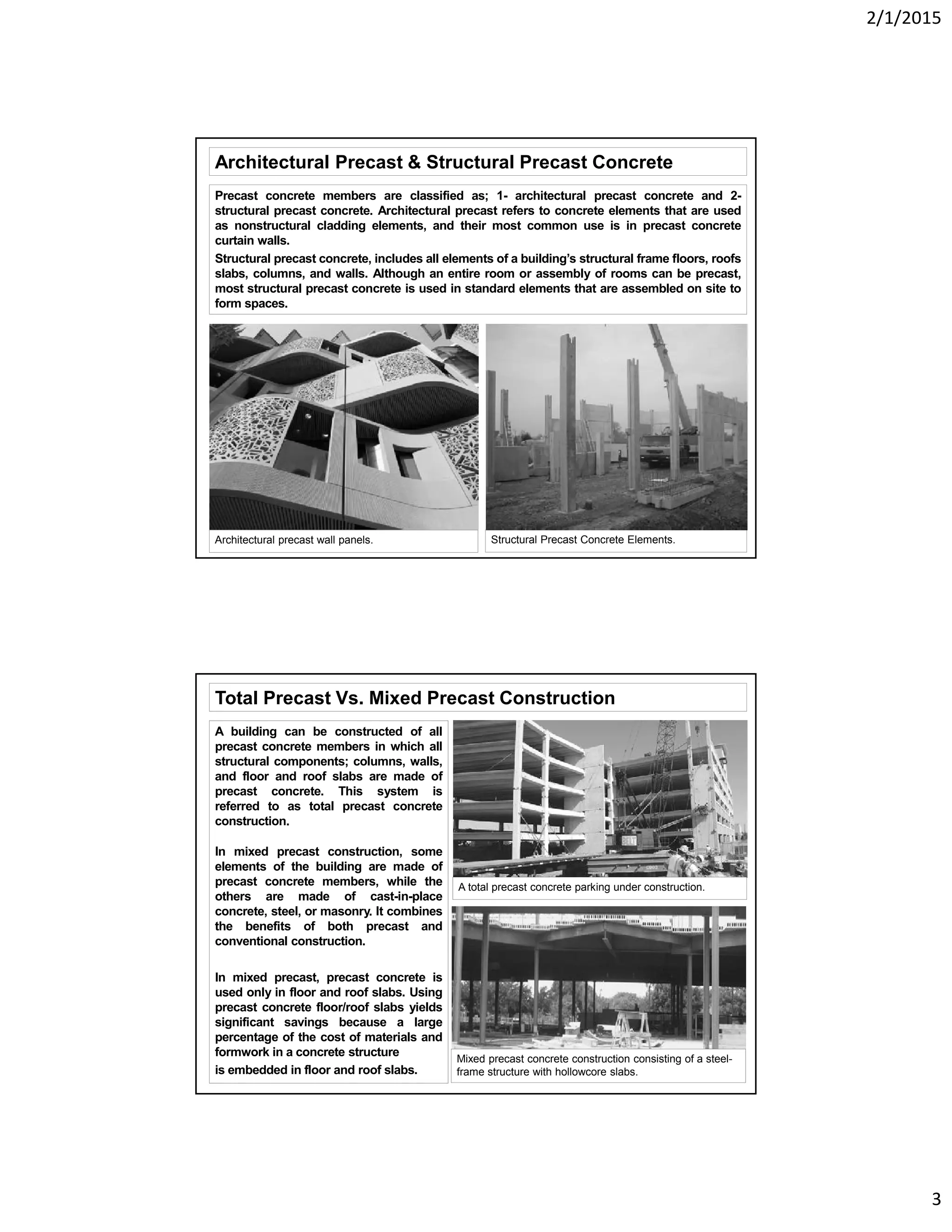
Precast concrete members are classified as; 1- architectural precast concrete and 2-
structural precast concrete. Architectural precast refers to concrete elements that are used
as nonstructural cladding elements, and their most common use is in precast concrete
curtain walls.
Structural precast concrete, includes all elements of a building’s structural frame floors, roofs
slabs, columns, and walls. Although an entire room or assembly of rooms can be precast,
most structural precast concrete is used in standard elements that are assembled on site to
form spaces.
Structural Precast Concrete Elements.Architectural precast wall panels.
Total Precast Vs. Mixed Precast Construction
A building can be constructed of all
precast concrete members in which all
structural components; columns, walls,
and floor and roof slabs are made of
precast concrete. This system is
referred to as total precast concrete
construction.
In mixed precast construction, some
elements of the building are made of
precast concrete members, while the
others are made of cast-in-place
concrete, steel, or masonry. It combines
the benefits of both precast and
conventional construction.
In mixed precast, precast concrete is
used only in floor and roof slabs. Using
precast concrete floor/roof slabs yields
significant savings because a large
percentage of the cost of materials and
formwork in a concrete structure
is embedded in floor and roof slabs.
A total precast concrete parking under construction.
Mixed precast concrete construction consisting of a steel-
frame structure with hollowcore slabs.
2/1/2015
4
Precast Concrete Joints
In precast concrete buildings, joint designs play a pivotal role in ensuring that concrete
components act as one piece. In most cases, sealing the joint space is necessary to prevent
infiltration of groundwater and exfiltration of liquids carried by the structure.
Well detailed and constructed joints play a vital part in maintaining the integrity of the
external envelope of the building, ensuring it is weatherproof and meeting any other
requirements such as fireresistance and acoustic performance.
The function of the joint between precast elements is to provide physical separation between
the units and prevent -in conjunction with joint sealants- the ingress of water and air into the
building; and, if required, fire resistance.
Slab to Slab Connections
Grout keys provide structural continuity
between floor slab units.
Connections between hollow-core slabs and
supporting members are made using site-cast
concrete fill and reinforcing steel. In addition to
the concrete fill used for connections, a site-cast
concrete topping is generally used over the slabs.
The topping provides structural integration of slab
units and increases the floor’s fire resistance and
sound insulation. It also functions as a leveling
bed, particularly with units with uneven camber.
Topping, when used, is generally about 2 inches
thick and reinforced with welded wire
reinforcement (WWR).
2/1/2015
5
Slab to Beam Connections
Precast hollow core slabs connected at
their ends to a rectangular precast beam
by steel ties.
Grout
H.C. slabs
Bearing
pads
Steel bars
through the
grout keys
Slab to Beam Connections
A double-tee floor unit being flown into position in a precast building.
The setbacks in double-tee stems reduces floor height.
Setback
Double tee slabs supported over a
rectangular beam.
2/1/2015
6
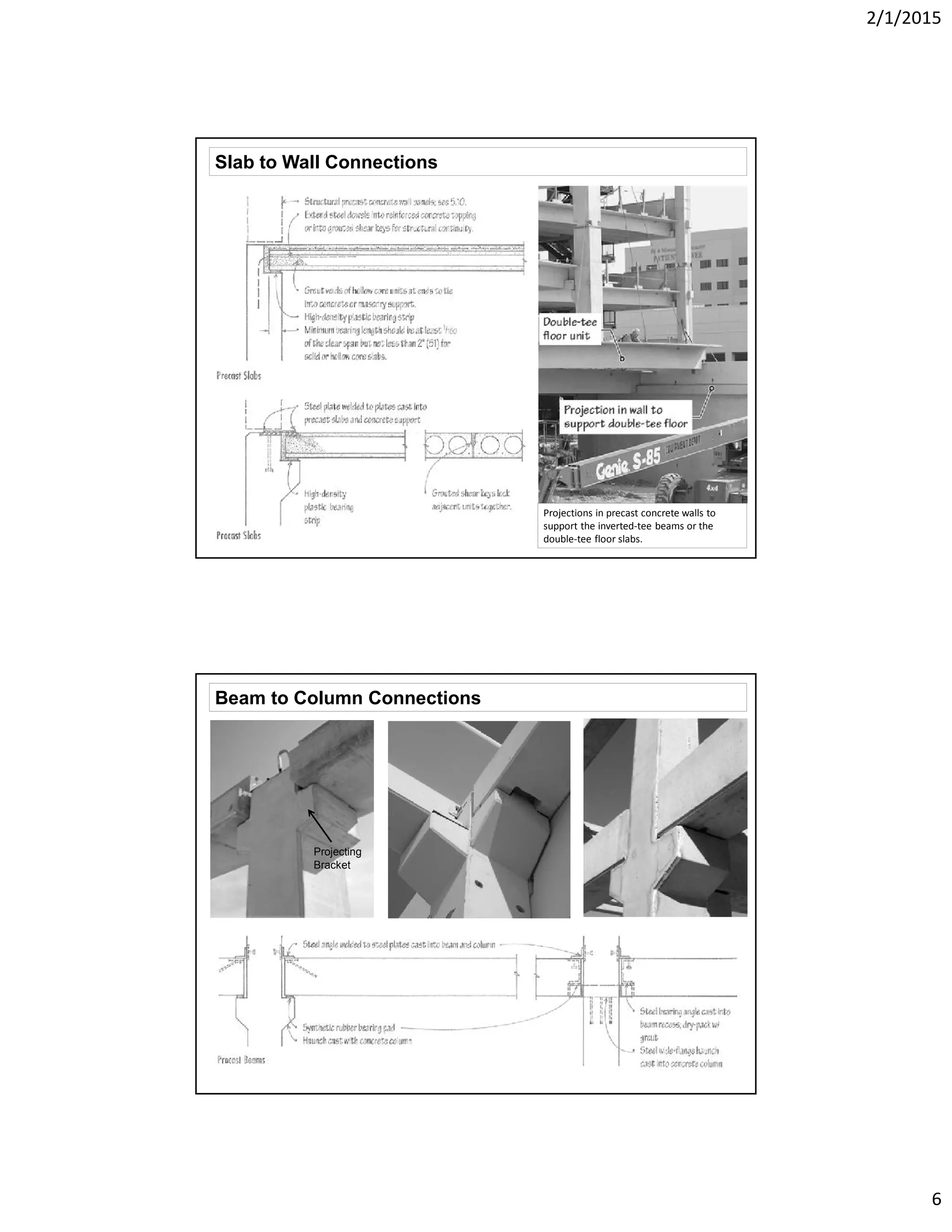
Slab to Wall Connections
Projections in precast concrete walls to
support the inverted-tee beams or the
double-tee floor slabs.
Beam to Column Connections
Projecting
Bracket
2/1/2015
7
Panel to Panel Connections
Precast panels are connected to each others or to floor and roof elements by using metal
plates and angels, they are fastened by welding or bolting. Connections may be projected or
recessed to provide flush finishing surface.
Different cases of precast panel to panel connections.
Column to Column Connections
Precast concrete columns are connected together
through bolting, the top of a lower-floor column
contains threaded bolts projecting out, while the
bottom of an upper-floor column has an embedded
base plate containing holes to engage the bolts. The
block-outs in the column above the holes are filled
with concrete after the connection has been made.
2/1/2015
8
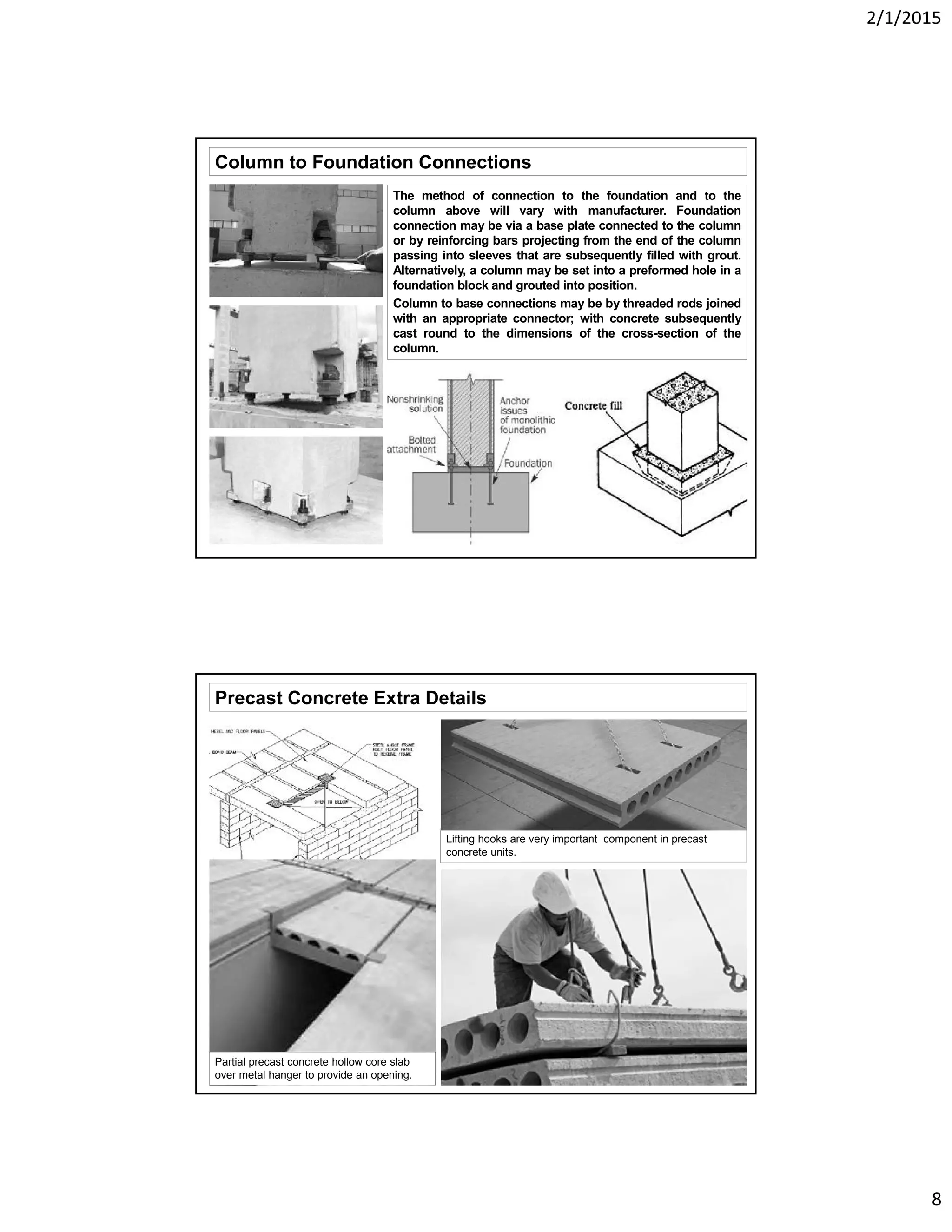
Column to Foundation Connections
The method of connection to the foundation and to the
column above will vary with manufacturer. Foundation
connection may be via a base plate connected to the column
or by reinforcing bars projecting from the end of the column
passing into sleeves that are subsequently filled with grout.
Alternatively, a column may be set into a preformed hole in a
foundation block and grouted into position.
Column to base connections may be by threaded rods joined
with an appropriate connector; with concrete subsequently
cast round to the dimensions of the cross-section of the
column.
Precast Concrete Extra Details
Partial precast concrete hollow core slab
over metal hanger to provide an opening.
Lifting hooks are very important component in precast
concrete units.
2/1/2015
9
Precast Concrete Extra Details
Precast panels installation process require
temporary support.
Precast double tee slab lifted by a crane to its position
over l-shaped precast beams.
Total precast construction
Temporary
Support
Temporary
Support
Precast Concrete Extra Details
Double tee slabs does not require temporary
support because they are stable.
Precast beams contain grooves to hold double tee ribs
to provide more neat beam to roof connection.
2/1/2015
10
Precast Concrete Extra Details
Various solutions for beam to column
connection.
Precast Concrete Construction
The construction process of a total precast building has much in common with structural
steel construction; that is, members are brought into position using a crane, and are
connected together either through welds or bolts. Steel embeds are included in precast
members to facilitate member bolting and/or welding.
2/1/2015
11
Summary
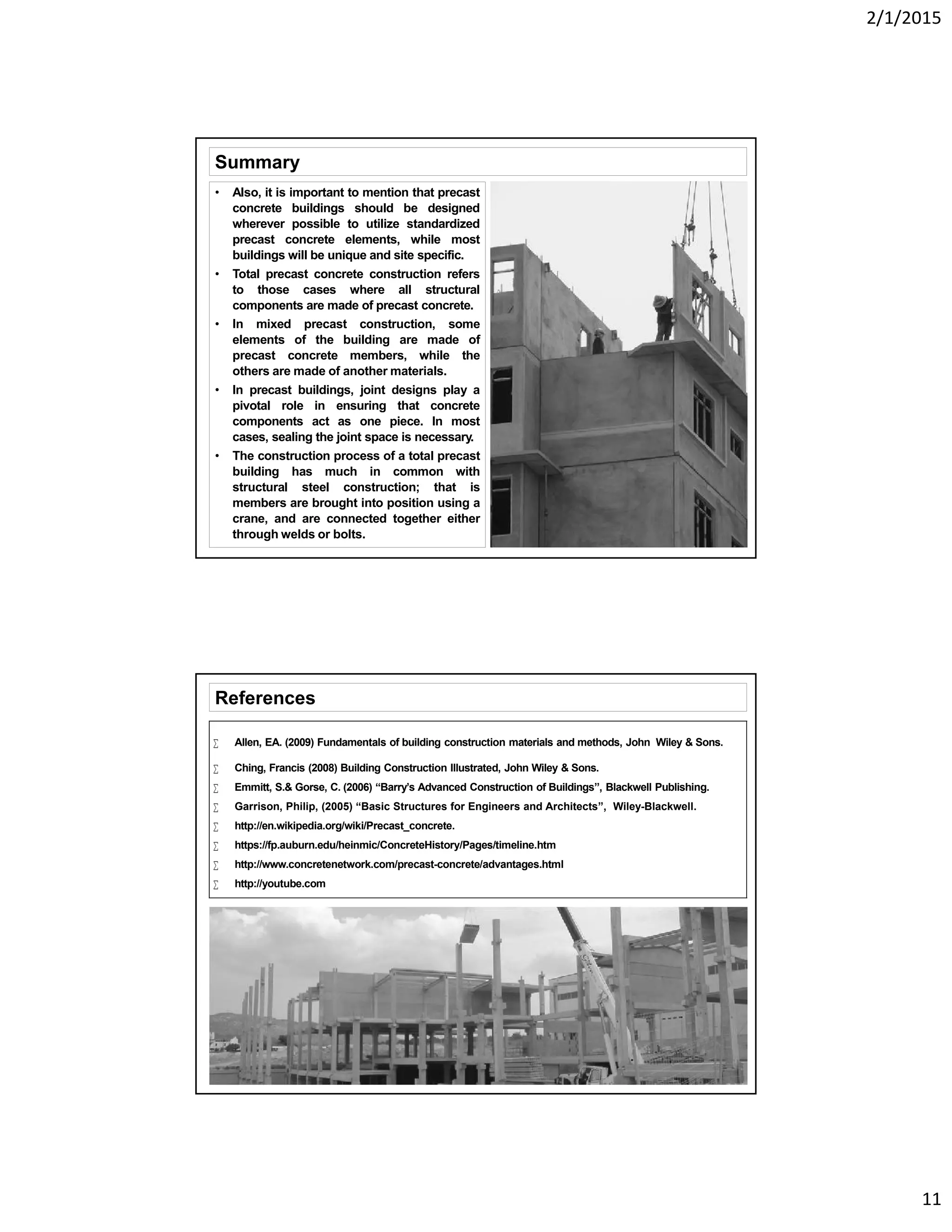
• Also, it is important to mention that precast
concrete buildings should be designed
wherever possible to utilize standardized
precast concrete elements, while most
buildings will be unique and site specific.
• Total precast concrete construction refers
to those cases where all structural
components are made of precast concrete.
• In mixed precast construction, some
elements of the building are made of
precast concrete members, while the
others are made of another materials.
• In precast buildings, joint designs play a
pivotal role in ensuring that concrete
components act as one piece. In most
cases, sealing the joint space is necessary.
• The construction process of a total precast
building has much in common with
structural steel construction; that is
members are brought into position using a
crane, and are connected together either
through welds or bolts.
References
 Allen, EA. (2009) Fundamentals of building construction materials and methods, John Wiley & Sons.
 Ching, Francis (2008) Building Construction Illustrated, John Wiley & Sons.
 Emmitt, S.& Gorse, C. (2006) “Barry’s Advanced Construction of Buildings”, Blackwell Publishing.
 Garrison, Philip, (2005) “Basic Structures for Engineers and Architects”, Wiley-Blackwell.
 http://en.wikipedia.org/wiki/Precast_concrete.
 https://fp.auburn.edu/heinmic/ConcreteHistory/Pages/timeline.htm
 http://www.concretenetwork.com/precast-concrete/advantages.html
 http://youtube.com
2/1/2015
12
Lecture Activity
Each student is required to prepare a brief but informative internet-based research about one of the topics
related to this lecture (Precast Concrete in Detail); i.e., new developments, successive and local case
studies or important details. The research should be presented in only one A4 sheet.

Precast-concrete Details

  • 1.
    2/1/2015 1 COLLEGE OF ARCHITECTUREAND PLANNING Department of Architecture and Building Sciences Dr. Mohammed Ghonim 3. PRECAST CONCRETE IN DETAIL ARCH 436 Contemporary Building Construction Methods Lecture Objectives Upon completion of this lecture, the student will be able to: 1. Differentiate between architectural precast and structural precast concrete. 2. Compare between total precast and mixed Precast Construction. 3. Explain how to connect precast structural elements. 4. Draw sketches for the connections between precast structural elements. 5. Describe the installation process of precast concrete structural elements.
  • 2.
    2/1/2015 2 Lecture Content • Introduction. •Architectural Precast & Structural Precast Concrete. • Total Precast Vs. Mixed Precast Construction. • Precast Concrete Joints. • Slab to Slab Connections. • Slab to Beam Connections. • Slab to Wall Connections. • Beam to Column Connections. • Panel to Panel Connections. • Column to Column Connections. • Column to Foundation Connections • Precast Concrete Extra Details. • Precast Concrete Construction Process. Introduction The considerations for design and detailing of structural and non- structural precast elements including joints and connections for buildings and building works are introduced in this lecture. Also, it is important to mention that precast concrete buildings should be designed wherever possible to utilize standardized precast concrete elements, while most buildings will be unique and site specific. At the conceptual design stage, a basic layout plan should be developed which achieves a balance between architectural / aesthetic requirements and a high degree of standardisation . Therefore, close collaboration amongst different design parties is essential during conceptual design to achieve the optimum standardisation.
  • 3.
    2/1/2015 3 Architectural Precast &Structural Precast Concrete Precast concrete members are classified as; 1- architectural precast concrete and 2- structural precast concrete. Architectural precast refers to concrete elements that are used as nonstructural cladding elements, and their most common use is in precast concrete curtain walls. Structural precast concrete, includes all elements of a building’s structural frame floors, roofs slabs, columns, and walls. Although an entire room or assembly of rooms can be precast, most structural precast concrete is used in standard elements that are assembled on site to form spaces. Structural Precast Concrete Elements.Architectural precast wall panels. Total Precast Vs. Mixed Precast Construction A building can be constructed of all precast concrete members in which all structural components; columns, walls, and floor and roof slabs are made of precast concrete. This system is referred to as total precast concrete construction. In mixed precast construction, some elements of the building are made of precast concrete members, while the others are made of cast-in-place concrete, steel, or masonry. It combines the benefits of both precast and conventional construction. In mixed precast, precast concrete is used only in floor and roof slabs. Using precast concrete floor/roof slabs yields significant savings because a large percentage of the cost of materials and formwork in a concrete structure is embedded in floor and roof slabs. A total precast concrete parking under construction. Mixed precast concrete construction consisting of a steel- frame structure with hollowcore slabs.
  • 4.
    2/1/2015 4 Precast Concrete Joints Inprecast concrete buildings, joint designs play a pivotal role in ensuring that concrete components act as one piece. In most cases, sealing the joint space is necessary to prevent infiltration of groundwater and exfiltration of liquids carried by the structure. Well detailed and constructed joints play a vital part in maintaining the integrity of the external envelope of the building, ensuring it is weatherproof and meeting any other requirements such as fireresistance and acoustic performance. The function of the joint between precast elements is to provide physical separation between the units and prevent -in conjunction with joint sealants- the ingress of water and air into the building; and, if required, fire resistance. Slab to Slab Connections Grout keys provide structural continuity between floor slab units. Connections between hollow-core slabs and supporting members are made using site-cast concrete fill and reinforcing steel. In addition to the concrete fill used for connections, a site-cast concrete topping is generally used over the slabs. The topping provides structural integration of slab units and increases the floor’s fire resistance and sound insulation. It also functions as a leveling bed, particularly with units with uneven camber. Topping, when used, is generally about 2 inches thick and reinforced with welded wire reinforcement (WWR).
  • 5.
    2/1/2015 5 Slab to BeamConnections Precast hollow core slabs connected at their ends to a rectangular precast beam by steel ties. Grout H.C. slabs Bearing pads Steel bars through the grout keys Slab to Beam Connections A double-tee floor unit being flown into position in a precast building. The setbacks in double-tee stems reduces floor height. Setback Double tee slabs supported over a rectangular beam.
  • 6.
    2/1/2015 6 Slab to WallConnections Projections in precast concrete walls to support the inverted-tee beams or the double-tee floor slabs. Beam to Column Connections Projecting Bracket
  • 7.
    2/1/2015 7 Panel to PanelConnections Precast panels are connected to each others or to floor and roof elements by using metal plates and angels, they are fastened by welding or bolting. Connections may be projected or recessed to provide flush finishing surface. Different cases of precast panel to panel connections. Column to Column Connections Precast concrete columns are connected together through bolting, the top of a lower-floor column contains threaded bolts projecting out, while the bottom of an upper-floor column has an embedded base plate containing holes to engage the bolts. The block-outs in the column above the holes are filled with concrete after the connection has been made.
  • 8.
    2/1/2015 8 Column to FoundationConnections The method of connection to the foundation and to the column above will vary with manufacturer. Foundation connection may be via a base plate connected to the column or by reinforcing bars projecting from the end of the column passing into sleeves that are subsequently filled with grout. Alternatively, a column may be set into a preformed hole in a foundation block and grouted into position. Column to base connections may be by threaded rods joined with an appropriate connector; with concrete subsequently cast round to the dimensions of the cross-section of the column. Precast Concrete Extra Details Partial precast concrete hollow core slab over metal hanger to provide an opening. Lifting hooks are very important component in precast concrete units.
  • 9.
    2/1/2015 9 Precast Concrete ExtraDetails Precast panels installation process require temporary support. Precast double tee slab lifted by a crane to its position over l-shaped precast beams. Total precast construction Temporary Support Temporary Support Precast Concrete Extra Details Double tee slabs does not require temporary support because they are stable. Precast beams contain grooves to hold double tee ribs to provide more neat beam to roof connection.
  • 10.
    2/1/2015 10 Precast Concrete ExtraDetails Various solutions for beam to column connection. Precast Concrete Construction The construction process of a total precast building has much in common with structural steel construction; that is, members are brought into position using a crane, and are connected together either through welds or bolts. Steel embeds are included in precast members to facilitate member bolting and/or welding.
  • 11.
    2/1/2015 11 Summary • Also, itis important to mention that precast concrete buildings should be designed wherever possible to utilize standardized precast concrete elements, while most buildings will be unique and site specific. • Total precast concrete construction refers to those cases where all structural components are made of precast concrete. • In mixed precast construction, some elements of the building are made of precast concrete members, while the others are made of another materials. • In precast buildings, joint designs play a pivotal role in ensuring that concrete components act as one piece. In most cases, sealing the joint space is necessary. • The construction process of a total precast building has much in common with structural steel construction; that is members are brought into position using a crane, and are connected together either through welds or bolts. References  Allen, EA. (2009) Fundamentals of building construction materials and methods, John Wiley & Sons.  Ching, Francis (2008) Building Construction Illustrated, John Wiley & Sons.  Emmitt, S.& Gorse, C. (2006) “Barry’s Advanced Construction of Buildings”, Blackwell Publishing.  Garrison, Philip, (2005) “Basic Structures for Engineers and Architects”, Wiley-Blackwell.  http://en.wikipedia.org/wiki/Precast_concrete.  https://fp.auburn.edu/heinmic/ConcreteHistory/Pages/timeline.htm  http://www.concretenetwork.com/precast-concrete/advantages.html  http://youtube.com
  • 12.
    2/1/2015 12 Lecture Activity Each studentis required to prepare a brief but informative internet-based research about one of the topics related to this lecture (Precast Concrete in Detail); i.e., new developments, successive and local case studies or important details. The research should be presented in only one A4 sheet.