

PRESENTED BY
AGLAIA
Outline
What goes Underground?
Why go Underground?
How is the Underground built?
Where are problems encountered?
When do risks get mitigated?
What Goes Underground?
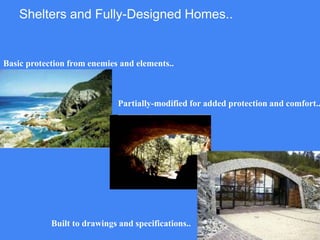
Shelters and Fully-Designed Homes..
Basic protection from enemies and elements..
Partially-modified for added protection and comfort..
Built to drawings and specifications..
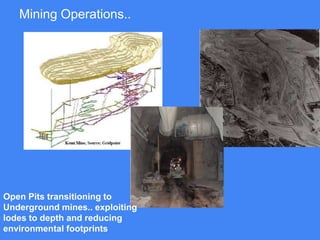
Mining Operations..
Open Pits transitioning to
Underground mines.. exploiting
lodes to depth and reducing
environmental footprints
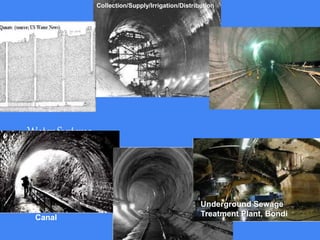
Water Systems..
Collection/Supply/Irrigation/Distribution
Underground Sewage
Treatment Plant, BondiCanal
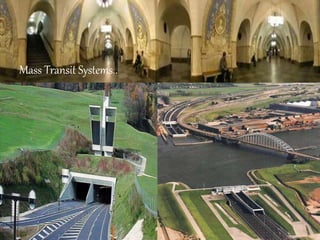
Mass Transit Systems..
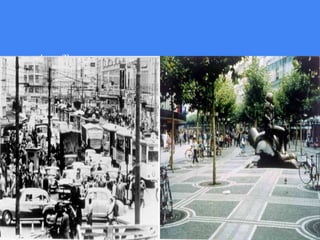
Road Traffic..
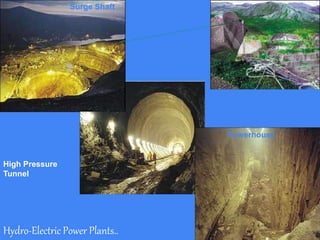
Hydro-Electric Power Plants..
Surge Shaft
Powerhouse
High Pressure
Tunnel
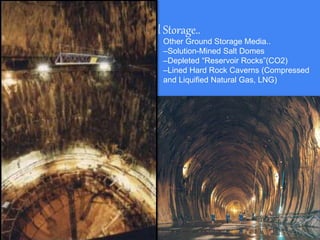
Fuel Storage..
Other Ground Storage Media..
–Solution-Mined Salt Domes
–Depleted “Reservoir Rocks”(CO2)
–Lined Hard Rock Caverns (Compressed
and Liquified Natural Gas, LNG)
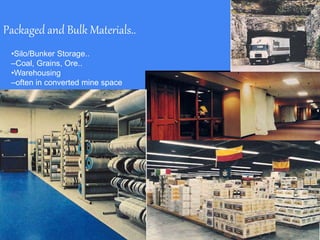
Packaged and Bulk Materials..
•Silo/Bunker Storage..
–Coal, Grains, Ore..
•Warehousing
–often in converted mine space
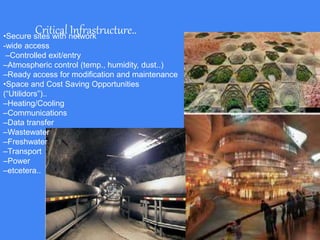
Critical Infrastructure..•Secure sites with network
-wide access
–Controlled exit/entry
–Atmospheric control (temp., humidity, dust..)
–Ready access for modification and maintenance
•Space and Cost Saving Opportunities
(“Utilidors”)..
–Heating/Cooling
–Communications
–Data transfer
–Wastewater
–Freshwater
–Transport
–Power
–etcetera..
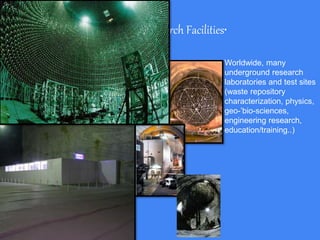
Research Facilities•
Worldwide, many
underground research
laboratories and test sites
(waste repository
characterization, physics,
geo-’bio-sciences,
engineering research,
education/training..)
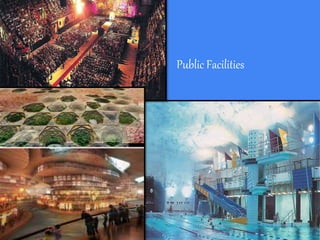
Public Facilities
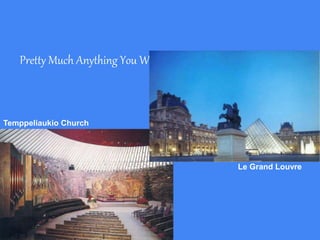
Pretty Much Anything You Want
Temppeliaukio Church
Le Grand Louvre
Why go underground?
Urban Congestion..● Go underground to avoid..
–Road pavement
–Buried infrastructure
–Basements & foundations
–Surface condemnations
–Right of way interruptions
–Minimize surface disruption
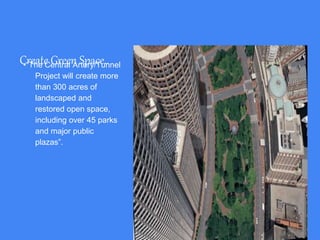
Create Green Space..•“The Central Artery/Tunnel
Project will create more
than 300 acres of
landscaped and
restored open space,
including over 45 parks
and major public
plazas”.
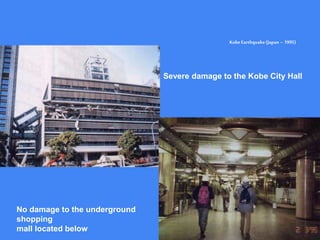
Protection..
KobeEarthquake(Japan – 1995)
Severe damage to the Kobe City Hall
No damage to the underground
shopping
mall located below
Isolation
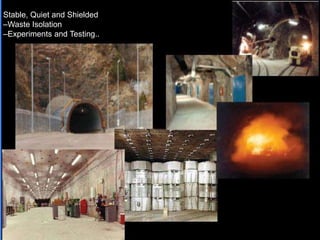
Stable, Quiet and Shielded
–Waste Isolation
–Experiments and Testing..
How is underground built?
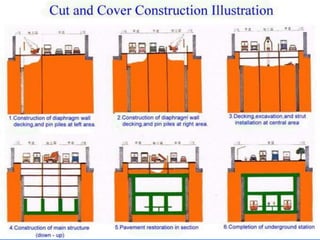
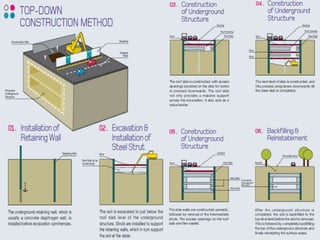
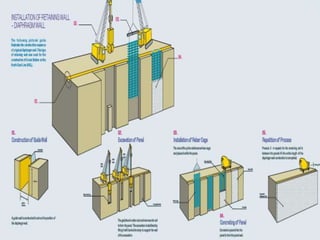
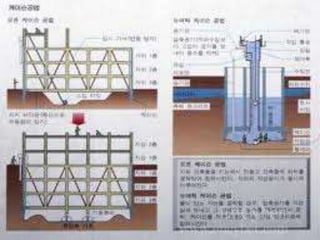
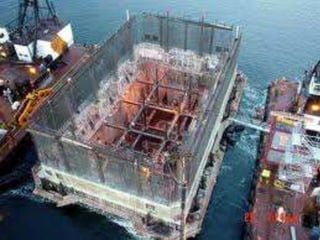
Methods for underground construction• Cut and cover method in open excavation;
• Cut and cover method between earth retaining walls with
lowering of the ground water levels;
• Cut and cover method between earth retaining walls without
lowering of the ground water levels;
• Wall and roof method;
• Pneumatic caisson method;
• Immersed tunnel method;
• Bored tunnel method;
• Top Down method.
EXCAVATION BY TUNNEL BORING MACHINE
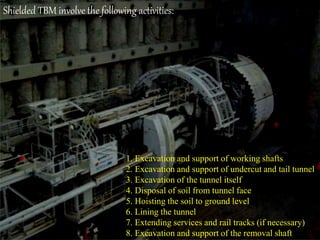
1. Excavation and support of working shafts
2. Excavation and support of undercut and tail tunnel
3. Excavation of the tunnel itself
4. Disposal of soil from tunnel face
5. Hoisting the soil to ground level
6. Lining the tunnel
7. Extending services and rail tracks (if necessary)
8. Excavation and support of the removal shaft
Shielded TBM involve the following activities:
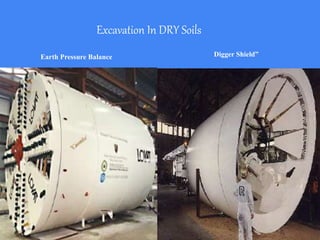
Excavation In DRY Soils
Earth Pressure Balance Digger Shield”
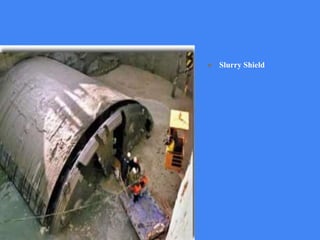
Excavation In WET Soils ● Slurry Shield
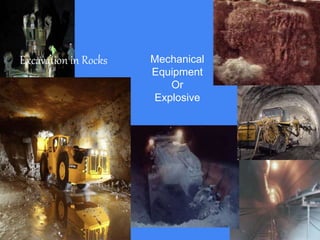
Excavation in Rocks Mechanical
Equipment
Or
Explosive
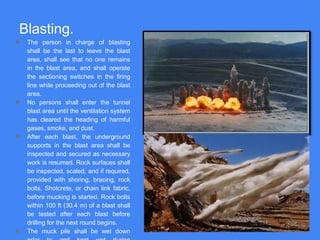
Blasting.
● The person in charge of blasting
shall be the last to leave the blast
area, shall see that no one remains
in the blast area, and shall operate
the sectioning switches in the firing
line while proceeding out of the blast
area.
● No persons shall enter the tunnel
blast area until the ventilation system
has cleared the heading of harmful
gases, smoke, and dust.
● After each blast, the underground
supports in the blast area shall be
inspected and secured as necessary
work is resumed. Rock surfaces shall
be inspected, scaled, and if required,
provided with shoring, bracing, rock
bolts, Shotcrete, or chain link fabric,
before mucking is started. Rock bolts
within 100 ft (30.4 m) of a blast shall
be tested after each blast before
drilling for the next round begins.
● The muck pile shall be wet down
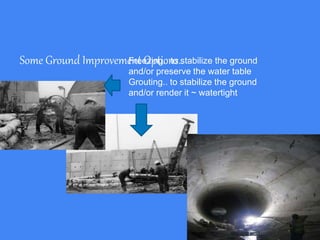
Some Ground Improvement Options..Freezing.. to stabilize the ground
and/or preserve the water table
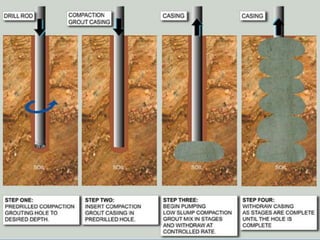
Grouting.. to stabilize the ground
and/or render it ~ watertight
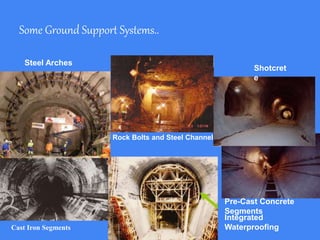
Some Ground Support Systems..
Rock Bolts and Steel Channel
Steel Arches
Pre-Cast Concrete
Segments
Shotcret
e
Integrated
WaterproofingCast Iron Segments
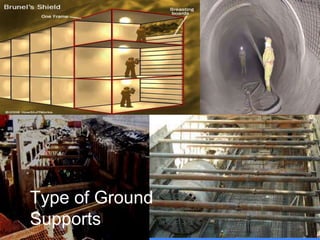
Type of Ground
Supports
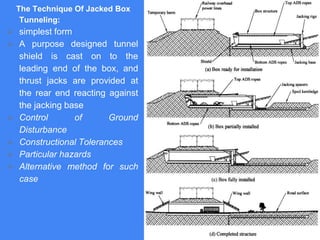
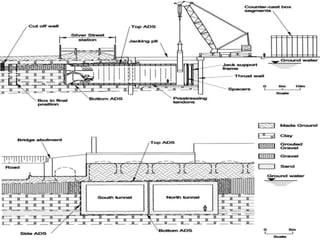
The Technique Of Jacked Box
Tunneling:
 simplest form
 A purpose designed tunnel
shield is cast on to the
leading end of the box, and
thrust jacks are provided at
the rear end reacting against
the jacking base
 Control of Ground
Disturbance
 Constructional Tolerances
 Particular hazards
 Alternative method for such
case
Where are Problems Encountered?
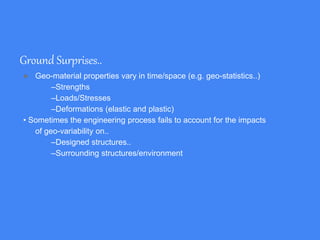
Ground Surprises..
● Geo-material properties vary in time/space (e.g. geo-statistics..)
–Strengths
–Loads/Stresses
–Deformations (elastic and plastic)
• Sometimes the engineering process fails to account for the impacts
of geo-variability on..
–Designed structures..
–Surrounding structures/environment
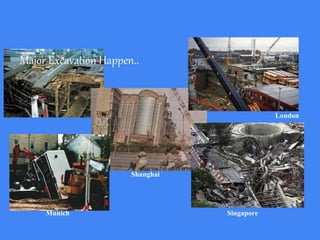
Major Excavation Happen..
Shanghai
Singapore
London
Munich
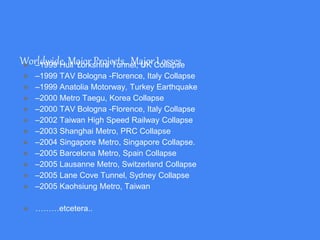
Worldwide, Major Projects.. Major Losses● –1999 Hull Yorkshire Tunnel, UK Collapse
● –1999 TAV Bologna -Florence, Italy Collapse
● –1999 Anatolia Motorway, Turkey Earthquake
● –2000 Metro Taegu, Korea Collapse
● –2000 TAV Bologna -Florence, Italy Collapse
● –2002 Taiwan High Speed Railway Collapse
● –2003 Shanghai Metro, PRC Collapse
● –2004 Singapore Metro, Singapore Collapse.
● –2005 Barcelona Metro, Spain Collapse
● –2005 Lausanne Metro, Switzerland Collapse
● –2005 Lane Cove Tunnel, Sydney Collapse
● –2005 Kaohsiung Metro, Taiwan
● ………etcetera..
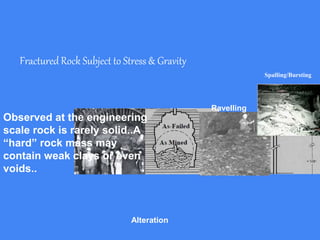
Fractured Rock Subject to Stress & Gravity
Observed at the engineering
scale rock is rarely solid..A
“hard” rock mass may
contain weak clays or even
voids..
Ravelling
Alteration
Spalling/Bursting
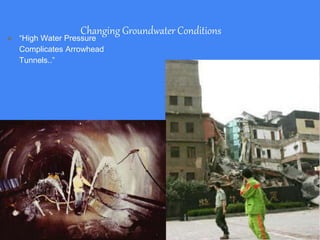
Changing Groundwater Conditions
● “High Water Pressure
Complicates Arrowhead
Tunnels..”
When Do Risks Get Mitigated?
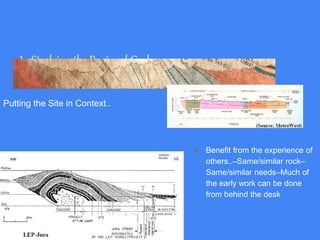
In Studying the Regional Geology
● Benefit from the experience of
others..–Same/similar rock–
Same/similar needs–Much of
the early work can be done
from behind the desk
Putting the Site in Context..
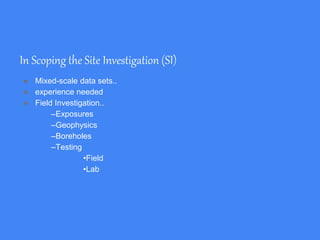
In Scoping the Site Investigation (SI)
● Mixed-scale data sets..
● experience needed
● Field Investigation..
–Exposures
–Geophysics
–Boreholes
–Testing
•Field
•Lab
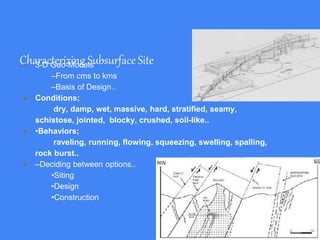
Characterizing Subsurface Site● 3-D Geo-Models
–From cms to kms
–Basis of Design..
● Conditions;
dry, damp, wet, massive, hard, stratified, seamy,
schistose, jointed, blocky, crushed, soil-like..
● •Behaviors;
raveling, running, flowing, squeezing, swelling, spalling,
rock burst..
● –Deciding between options..
•Siting
•Design
•Construction
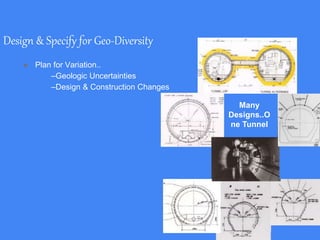
Design & Specify for Geo-Diversity
● Plan for Variation..
–Geologic Uncertainties
–Design & Construction Changes
Many
Designs..O
ne Tunnel
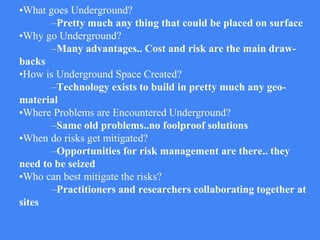
•What goes Underground?
–Pretty much any thing that could be placed on surface
•Why go Underground?
–Many advantages.. Cost and risk are the main draw-
backs
•How is Underground Space Created?
–Technology exists to build in pretty much any geo-
material
•Where Problems are Encountered Underground?
–Same old problems..no foolproof solutions
•When do risks get mitigated?
–Opportunities for risk management are there.. they
need to be seized
•Who can best mitigate the risks?
–Practitioners and researchers collaborating together at
sites
Reference
● American society of civil engineers - technical committee on contracting
practices of the underground technology research council. 1991.
● The equipment magazine for the underground construction industry
● Forensic engineering for underground construction-e. T. Brown
● Journal of geotechnical engineering, asce, 115(11): 1513-1531.
● Seismic analysis of underground structures-kazuhiko kawashima
● Underground structures engineering services for owners and contractors
● Geoengineering considerations in the optimum use of underground space -
raymond l. Sterling
● Godard, j.P., 1999. “Sub-surface development in the urban environment,”
proc. 10th australian tunnelling conference, “the race for space”,
melbourne.
● Ita, 1987. “Examples of benefits of underground urban public
transportation systems,” report of the working group on costs-benefits of
underground urban public transportation, tunnelling and underground
space technology, vol. 2, no. 1, pergamon press, oxford, u.K.
● Support in underground hard rock mines-evert hoek
● Drilling and blasting for underground space - R pesch1 and a robertson2
Thank you
For more…. Mail to
aglaiaconnect2018@gmail.com

Underground construction

  • 1.
  • 2.
    Outline What goes Underground? Whygo Underground? How is the Underground built? Where are problems encountered? When do risks get mitigated?
  • 3.
  • 4.
    Shelters and Fully-DesignedHomes.. Basic protection from enemies and elements.. Partially-modified for added protection and comfort.. Built to drawings and specifications..
  • 5.
    Mining Operations.. Open Pitstransitioning to Underground mines.. exploiting lodes to depth and reducing environmental footprints
  • 6.
  • 7.
  • 8.
  • 9.
    Hydro-Electric Power Plants.. SurgeShaft Powerhouse High Pressure Tunnel
  • 10.
    Fuel Storage.. Other GroundStorage Media.. –Solution-Mined Salt Domes –Depleted “Reservoir Rocks”(CO2) –Lined Hard Rock Caverns (Compressed and Liquified Natural Gas, LNG)
  • 11.
    Packaged and BulkMaterials.. •Silo/Bunker Storage.. –Coal, Grains, Ore.. •Warehousing –often in converted mine space
  • 12.
    Critical Infrastructure..•Secure siteswith network -wide access –Controlled exit/entry –Atmospheric control (temp., humidity, dust..) –Ready access for modification and maintenance •Space and Cost Saving Opportunities (“Utilidors”).. –Heating/Cooling –Communications –Data transfer –Wastewater –Freshwater –Transport –Power –etcetera..
  • 13.
    Research Facilities• Worldwide, many undergroundresearch laboratories and test sites (waste repository characterization, physics, geo-’bio-sciences, engineering research, education/training..)
  • 14.
  • 15.
    Pretty Much AnythingYou Want Temppeliaukio Church Le Grand Louvre
  • 16.
  • 17.
    Urban Congestion..● Gounderground to avoid.. –Road pavement –Buried infrastructure –Basements & foundations –Surface condemnations –Right of way interruptions –Minimize surface disruption
  • 18.
    Create Green Space..•“TheCentral Artery/Tunnel Project will create more than 300 acres of landscaped and restored open space, including over 45 parks and major public plazas”.
  • 19.
    Protection.. KobeEarthquake(Japan – 1995) Severedamage to the Kobe City Hall No damage to the underground shopping mall located below
  • 20.
    Isolation Stable, Quiet andShielded –Waste Isolation –Experiments and Testing..
  • 21.
  • 22.
    Methods for undergroundconstruction• Cut and cover method in open excavation; • Cut and cover method between earth retaining walls with lowering of the ground water levels; • Cut and cover method between earth retaining walls without lowering of the ground water levels; • Wall and roof method; • Pneumatic caisson method; • Immersed tunnel method; • Bored tunnel method; • Top Down method.
  • 28.
    EXCAVATION BY TUNNELBORING MACHINE
  • 29.
    1. Excavation andsupport of working shafts 2. Excavation and support of undercut and tail tunnel 3. Excavation of the tunnel itself 4. Disposal of soil from tunnel face 5. Hoisting the soil to ground level 6. Lining the tunnel 7. Extending services and rail tracks (if necessary) 8. Excavation and support of the removal shaft Shielded TBM involve the following activities:
  • 30.
    Excavation In DRYSoils Earth Pressure Balance Digger Shield”
  • 31.
    Excavation In WETSoils ● Slurry Shield
  • 34.
    Excavation in RocksMechanical Equipment Or Explosive
  • 35.
    Blasting. ● The personin charge of blasting shall be the last to leave the blast area, shall see that no one remains in the blast area, and shall operate the sectioning switches in the firing line while proceeding out of the blast area. ● No persons shall enter the tunnel blast area until the ventilation system has cleared the heading of harmful gases, smoke, and dust. ● After each blast, the underground supports in the blast area shall be inspected and secured as necessary work is resumed. Rock surfaces shall be inspected, scaled, and if required, provided with shoring, bracing, rock bolts, Shotcrete, or chain link fabric, before mucking is started. Rock bolts within 100 ft (30.4 m) of a blast shall be tested after each blast before drilling for the next round begins. ● The muck pile shall be wet down
  • 36.
    Some Ground ImprovementOptions..Freezing.. to stabilize the ground and/or preserve the water table Grouting.. to stabilize the ground and/or render it ~ watertight
  • 38.
    Some Ground SupportSystems.. Rock Bolts and Steel Channel Steel Arches Pre-Cast Concrete Segments Shotcret e Integrated WaterproofingCast Iron Segments
  • 39.
  • 41.
    The Technique OfJacked Box Tunneling:  simplest form  A purpose designed tunnel shield is cast on to the leading end of the box, and thrust jacks are provided at the rear end reacting against the jacking base  Control of Ground Disturbance  Constructional Tolerances  Particular hazards  Alternative method for such case
  • 43.
    Where are ProblemsEncountered?
  • 44.
    Ground Surprises.. ● Geo-materialproperties vary in time/space (e.g. geo-statistics..) –Strengths –Loads/Stresses –Deformations (elastic and plastic) • Sometimes the engineering process fails to account for the impacts of geo-variability on.. –Designed structures.. –Surrounding structures/environment
  • 45.
  • 46.
    Worldwide, Major Projects..Major Losses● –1999 Hull Yorkshire Tunnel, UK Collapse ● –1999 TAV Bologna -Florence, Italy Collapse ● –1999 Anatolia Motorway, Turkey Earthquake ● –2000 Metro Taegu, Korea Collapse ● –2000 TAV Bologna -Florence, Italy Collapse ● –2002 Taiwan High Speed Railway Collapse ● –2003 Shanghai Metro, PRC Collapse ● –2004 Singapore Metro, Singapore Collapse. ● –2005 Barcelona Metro, Spain Collapse ● –2005 Lausanne Metro, Switzerland Collapse ● –2005 Lane Cove Tunnel, Sydney Collapse ● –2005 Kaohsiung Metro, Taiwan ● ………etcetera..
  • 47.
    Fractured Rock Subjectto Stress & Gravity Observed at the engineering scale rock is rarely solid..A “hard” rock mass may contain weak clays or even voids.. Ravelling Alteration Spalling/Bursting
  • 48.
    Changing Groundwater Conditions ●“High Water Pressure Complicates Arrowhead Tunnels..”
  • 49.
    When Do RisksGet Mitigated?
  • 50.
    In Studying theRegional Geology ● Benefit from the experience of others..–Same/similar rock– Same/similar needs–Much of the early work can be done from behind the desk Putting the Site in Context..
  • 51.
    In Scoping theSite Investigation (SI) ● Mixed-scale data sets.. ● experience needed ● Field Investigation.. –Exposures –Geophysics –Boreholes –Testing •Field •Lab
  • 52.
    Characterizing Subsurface Site●3-D Geo-Models –From cms to kms –Basis of Design.. ● Conditions; dry, damp, wet, massive, hard, stratified, seamy, schistose, jointed, blocky, crushed, soil-like.. ● •Behaviors; raveling, running, flowing, squeezing, swelling, spalling, rock burst.. ● –Deciding between options.. •Siting •Design •Construction
  • 53.
    Design & Specifyfor Geo-Diversity ● Plan for Variation.. –Geologic Uncertainties –Design & Construction Changes Many Designs..O ne Tunnel
  • 54.
    •What goes Underground? –Prettymuch any thing that could be placed on surface •Why go Underground? –Many advantages.. Cost and risk are the main draw- backs •How is Underground Space Created? –Technology exists to build in pretty much any geo- material •Where Problems are Encountered Underground? –Same old problems..no foolproof solutions •When do risks get mitigated? –Opportunities for risk management are there.. they need to be seized •Who can best mitigate the risks? –Practitioners and researchers collaborating together at sites
  • 55.
    Reference ● American societyof civil engineers - technical committee on contracting practices of the underground technology research council. 1991. ● The equipment magazine for the underground construction industry ● Forensic engineering for underground construction-e. T. Brown ● Journal of geotechnical engineering, asce, 115(11): 1513-1531. ● Seismic analysis of underground structures-kazuhiko kawashima ● Underground structures engineering services for owners and contractors ● Geoengineering considerations in the optimum use of underground space - raymond l. Sterling ● Godard, j.P., 1999. “Sub-surface development in the urban environment,” proc. 10th australian tunnelling conference, “the race for space”, melbourne. ● Ita, 1987. “Examples of benefits of underground urban public transportation systems,” report of the working group on costs-benefits of underground urban public transportation, tunnelling and underground space technology, vol. 2, no. 1, pergamon press, oxford, u.K. ● Support in underground hard rock mines-evert hoek ● Drilling and blasting for underground space - R pesch1 and a robertson2
  • 56.
    Thank you For more….Mail to aglaiaconnect2018@gmail.com