https://www.eflm.eu/site/page/a/1194
Version 1.1 / 2018
WHY DO WE NEED GUIDELINES?
Case #1
7:30 a.m.
Patient arrives at the laboratory outpatient unit. His last meal
was at 21:00 on the previous day. In the morning he had
coffee with milk (without sugar) and one cigarette. Routine
chemistry and hematology tests are requested.
Is this patient properly prepared for blood tests?
a) Yes
b) No
Blood collection facts
Most common invasive procedure in the healthcare
Available worldwide (Hospitals, Primary Health Care, Home Based Care)
Huge variations in technique, use of safety devices, disposal methods,
reuse of devices and availability of post exposure prophylaxis.
Variations between countries, institutions, individuals
The most common source of preanalytical errors.
Errors often go unrecognized.
Why to test
(Indication)
What to test
(Parameter
selection)
Blood
Collection
Sample
Transport
Lab Sample handling
(Documentation,
Centrifugation,
Distribution)
Analysis
Result Validation
(Technical, Medical)
Interpretation
Lab Report
Interpretation
Medical
Decision
Preanalytica
l
Analytica
l
Postanalytica
l
Most preanalytical
steps occur outside of
the laboratory!
Topic of this
presentation
Errors within the total laboratory process
23 %
62 %
15 %
PREANALYTIC
ANALYTIC
POSTANALYTIC
Lippi G,et al Clin Chem Lab Med 2009; 47:143-153; Carraro P, Plebani M. Clin Chem 2007; 53:1338-1342.
Error rate within the total laboratory process:
0.05% - 10 % of all samples
At what stage in the total laboratory process do these
errors occur?
Consequences of preanalytical errors
Incorrect test results
Incorrect diagnosis
Unnecessary delays
Harm to the patient and phlebotomist
Unnecessary cost
Guidelines
CLSI GP41-A7 Procedures for the Collection of Diagnostic Blood Specimens
by Venipuncture
Clinical and Laboratory Standards Institute
WHO guidelines on drawing blood
World Health Organization
http://apps.who.int/iris/bitstream/10665/44294/1/9789241599221_eng.pdf
National - Only 7/28 European countries have guidelines
(Ireland, UK, Spain, Slovenia, Sweden, Italy and Croatia)
Results from a survey 2013
Different guidelines and different degrees of compliance
Simundic AM, et al. CCLM 2013;51(8):1585-93.
Case #2
7:00 a.m.
Patient is lying in his bed. Nurse arrives, asks the patient to
sit upright in his bed, and draws one tube of blood. Serum
proteins and cholesterol are requested.
Was it correct to ask the patient to sit upright?
a) yes
b) no
EFLM RECOMMENDED BLOOD COLLECTION
PROCESS
EFLM-Guideline 2016
Pre-
Sampling
Sampling
Post-
Sampling
Workplace
preparation
Test request
Communication
Patient identification
Patient preparation
Label tubes*
Assemble supplies
(Sanitize hands)
Put on gloves
Apply tourniquet
Select puncture
site
Clean sampling site
Puncture the vein
Draw first tube
Release tourniquet
Gently invert tubes
Draw tubes in order
Remove needle
Dispose of needle
Bandage puncture
site
Advise patient
Invert all tubes
Remove gloves
(Label tubes)*
Advise patient to
rest
Transport the sample
* Depending on local risk assesment – see respective slide in this presentation
Pre-
Sampling
Sampling
Post-
Sampling
Workplace
preparation
Test request
Communication
Patient identification
Patient preparation
Label tubes*
Assemble supplies
(Sanitize hands)
Put on gloves
Apply tourniquet
Select puncture
site
Clean sampling site
Puncture the vein
Draw first tube
Release tourniquet
Gently invert tubes
Draw tubes in order
Remove needle
Dispose of needle
Bandage puncture
site
Advise patient
Invert all tubes
Remove gloves
(Label tubes)*
Advise patient to
rest
Transport the sample
* Depending on local risk assesment – see respective slide in this presentation
Workplace preparation
Ensure
 patient privacy
 continuous workflow
 undisturbed access to all
necessary supplies.
 supplies within expiry date
Materials required
 blood collection tubes
 needles or winged blood
collection sets with safety
mechanism
 needle holders
 tourniquet
 gloves
 gauze pads, adhesive bandages, or
tape
 puncture-resistant sharps
container
 antiseptics: alcoholic and non-
alcoholic disinfectants
Pre-
Sampling
Sampling
Post-
Sampling
Workplace
preparation
Test request
Communication
Patient identification
Patient preparation
Label tubes*
Assemble supplies
(Sanitize hands)
Put on gloves
Apply tourniquet
Select puncture
site
Clean sampling site
Puncture the vein
Draw first tube
Release tourniquet
Gently invert tubes
Draw tubes in order
Remove needle
Dispose of needle
Bandage puncture
site
Advise patient
Invert all tubes
Remove gloves
(Label tubes)*
Advise patient to
rest
Transport the sample
* Depending on local risk assesment – see respective slide in this presentation
Patient Identification
ID errors are not rare!
– 0.1-1% in laboratory medicine
– 0.05% in transfusion medicine
Underreported (most go undetected)
Major healthcare issue
Potentially adverse consequences
ZERO TOLERANCE!
Any potentially mislabeled or misidentified specimen
must and will be rejected.
Lippi G, et al. CCLM 2011;49(7):1113–1126
Patient Identification
At least two independent identifiers:
Patient full name (the first and the last name )
Date of birth
Preferably one additional identifier:
Address
Health insurance number
Patient identification number
ID card details or any other personal identifier
Use open questions: “What is your name?” and “What is your date
of birth?”
EFLM WG-PRE – Recommendation on Venous Blood Sampling; CLSI-Guideline GP41-A6
Patient Identification
If any discrepancies are identified
do not collect samples
until issues are resolved!*
*Exceptions: Unconscious patients, Immigrants without ID number, etc.
Pre-
Sampling
Sampling
Post-
Sampling
Workplace
preparation
Test request
Communication
Patient identification
Patient preparation
Label tubes*
Assemble supplies
(Sanitize hands)
Put on gloves
Apply tourniquet
Select puncture
site
Clean sampling site
Puncture the vein
Draw first tube
Release tourniquet
Gently invert tubes
Draw tubes in order
Remove needle
Dispose of needle
Bandage puncture
site
Advise patient
Invert all tubes
Remove gloves
(Label tubes)*
Advise patient to
rest
Transport the sample
* Depending on local risk assesment – see respective slide in this presentation
Patient preparation
Consider:
• Has the patient fasted
• Has the patient been involved in recent physical
activity
• Patient positioning
• Patient medication / Infusion
• Time of day
• Test-specific requirements
Fasting
Blood for all tests should be drawn preferably
in the morning from 7 to 9 a.m. after fasting
(before breakfast / medication)
Simundic AM et al. Clin Chim Acta 2014;432:33-7
Fasting
Food and liquid
(except water)
Alcohol
Smoking
Caffeine
Simundic AM et al. Clin Chim Acta 2014;432:33-7
12 hours
24 hours
Refrain on the
day of blood
sampling
How long to wait before blood collection
Special Situations: e.g.
Pineapple, Avocado, Banana, Kiwi, Tomato, etc → Serotonin ↑
Protein-rich meals → Homocysteine ↑
Nikolac N et al. Biochem Med 2013;23(3):242-54.
Fasting
Nordestgaard BG et al.. Eur Heart J 2016.
Parameter Relative Change
1-6h after standard meal
Triglycerides 10 – 21%
Total Cholesterol 1 – 8%
LDL Cholesterol 4 – 9%
HDL Cholesterol 0 – 6%
Fasting
What to do if non-fasting blood collection is
impossible?
Document that the patient was not fasting to guide
later interpretation.
Kackov, S et al. Biochem Med 2013;23(3):326–31
Case #1
Result
7:30 a.m.
Patient arrives at the laboratory outpatient unit. His last meal
was at 21:00 on the previous day. In the morning he had
coffee with milk (without sugar) and one cigarette. Routine
chemistry and hematology tests are requested.
Is this patient properly prepared for blood tests?
a) Yes
b) No
Physical activity
Effects of marathon running
Blood collected 1-3 days before and 1 hour after finishing the race
Guder WG, Narayanan S, Wisser H, Zawta B: Diagnostic Samples: From the Patient to the Laboratory, 4th ed.2009
Copyright Wiley-VCH Verlag GmbH & Co. KGaA. Reproduced with permission.
Even moderate exercise
(e.g. running to the
doctor’s office) can
influence laboratory
parameters
What to ask the patient
When was your last meal?
When was your last drink?
What was it?
Have you performed any unusal physical activity in the
last 24 hours?
(„Unusual“ for that specific patient)
Patient Positioning
Patient should be sitting in a comfortable chair with
arms to provide support in case the patient faints
If necessary, patient may lie down
Do not change position
before blood sampling!
(if possible)
Patient Positioning
Guder WG, Narayanan S. Pre-Examination Procedures in Laboratory Diagnostics. 1st ed. DeGruyter, Berlin 2015
Change from supine to upright position
Blood collection preferably
after 15 minutes rest in one
position
Case #2
7:00 a.m.
Patient is lying in his bed. Nurse arrives, asks the patient to
sit upright in his bed, and draws one tube of blood. Serum
proteins and cholesterol are requested.
Was it correct to ask the patient to sit upright?
a) yes
b) no
Medication / Infusion
Therapeutic drug monitoring
Always after steady state has been reached
Always document / inform the lab:
WHAT (drug did the patient receive)?
HOW MUCH (of the drug did the patient receive)?
WHEN (was the last intake)?
Medication / Infusion
Many medications interfere (in-vivo / in-vitro) with
laboratory tests.
Examples:
If not avoidable: Blood collection immediately prior to
taking the next dose of the drug including information
on WHAT? / WHEN? / HOW MUCH?
Nikolac N et al. Biochem Med 2013;23(3):242-54.
Medication Parameter affected
Anticoagulant therapy Coagulation testing
Aspirin Platelet function
Supplements containing iron
within the last 10 days
Iron
Insulin Glucose
Levethyroxine T4/fT4
Blood collection using an IV catheter
Whenever possible avoid drawing blood through an
IV catheter.
Catheter collection can impact sample quality through the creation
of significantly more hemolysis in samples, sample dilution and
contamination of samples
If unavoidable only collect after from a newly inserted catheter,
and ideally not after/during infusion, use manual aspiration
technique or partial draw blood collection tubes*
*Partial draw tubes are tubes which are designed not be filled completely (e.g. 16x100mm / 4ml)
Medication / Infusion
Turn off any infusion before blood collection if possible
Blood collection always on the other arm or distal to
the infusion site
Recommendation:
Adapted from Guder W et al, Diagnostic Samples: From the Patient to the Laboratory, 4th ed.,Wiley-Blackwell, Weinheim, 2009
Infusion Earliest time of blood
sampling after infusion has
been stopped
Lipid 8 hours
Glucose 1 hour
Electrolytes 1 hour
Protein 1 hour
Medication / Infusion
Guder WG, Narayanan S, Wisser H, Zawta B: Diagnostic Samples: From the Patient to the Laboratory, 4th ed.2009
Copyright Wiley-VCH Verlag GmbH & Co. KGaA. Reproduced with permission.
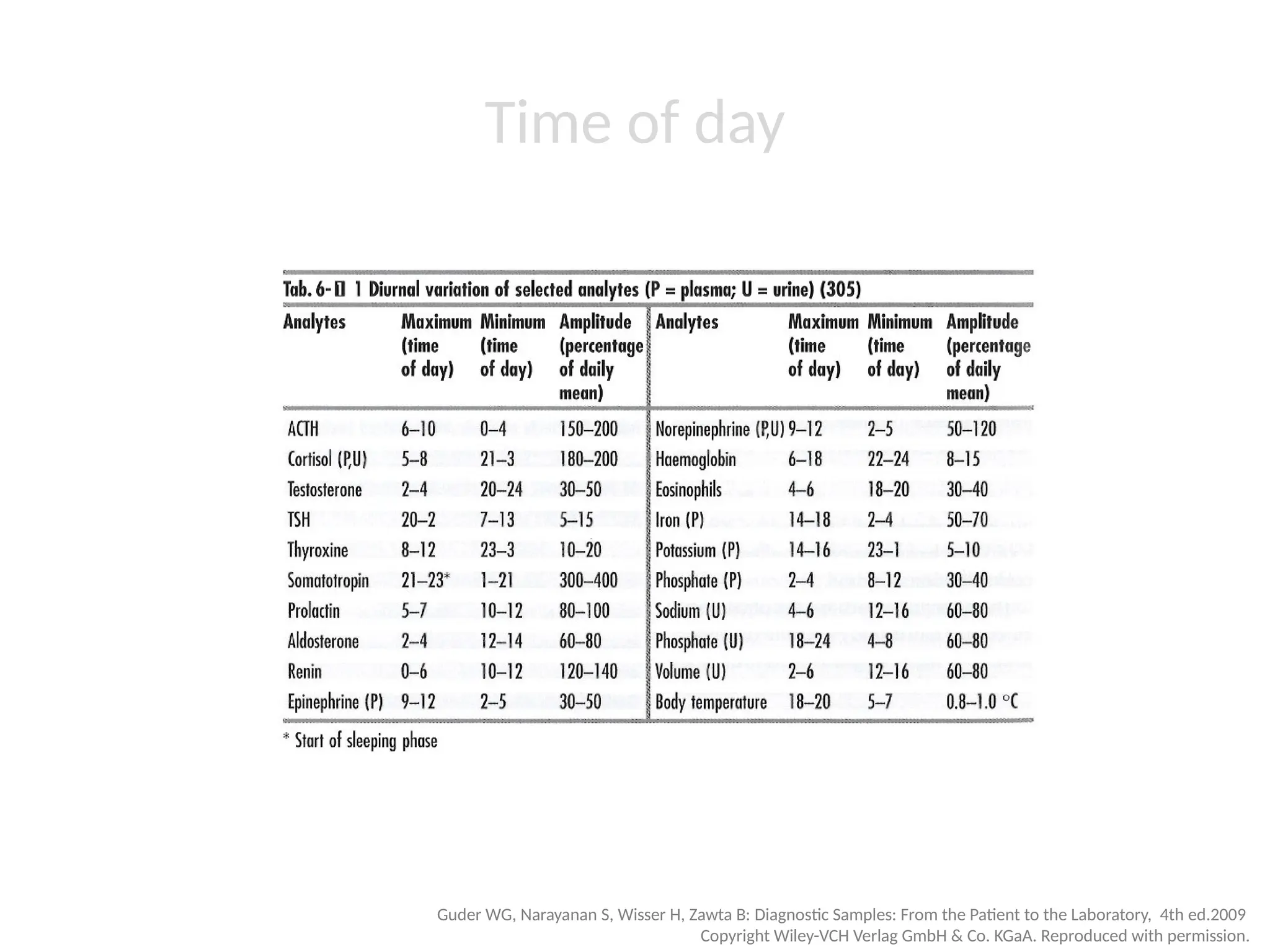
Time of day
Blood for all tests should be drawn preferably
in the morning from 7 to 9 a.m.
(before breakfast / medication)
Simundic AM et al. Clin Chim Acta 2014;432:33-7
Time of day
Guder WG, Narayanan S, Wisser H, Zawta B: Diagnostic Samples: From the Patient to the Laboratory, 4th ed.2009
Copyright Wiley-VCH Verlag GmbH & Co. KGaA. Reproduced with permission.
Pre-
Sampling
Sampling
Post-
Sampling
Workplace
preparation
Test request
Communication
Patient identification
Patient preparation
Label tubes*
Assemble supplies
(Sanitize hands)
Put on gloves
Apply tourniquet
Select puncture
site
Clean sampling site
Puncture the vein
Draw first tube
Release tourniquet
Gently invert tubes
Draw tubes in order
Remove needle
Dispose of needle
Bandage puncture
site
Advise patient
Invert all tubes
Remove gloves
(Label tubes)*
Advise patient to
rest
Transport the sample
* Depending on local risk assesment – see respective slide in this presentation
Label tubes
Tube labelling or tube cross-identification must be done in the presence of
the patient. Labelling before or after blood collection should be based on a
prospective risk analysis of the blood collection process in each institution.
Tube information should at least contain:
• Patient first and last name
• Date of birth
• ID number
Preferable additional information on the tube:
• Date
• Time (if necessary, e.g. for TDM)
• ID of the phlebotomist
(or there should be a mechanism to identify a phlebotomist)
If this information is not printed directly on the label, a mechanism must be
in place to identify this information for example through IT systems (e.g.
laboratory/hospital information systems)
EFLM WG-PRE – Recommendation on Venous Blood Sampling; CLSI-Guideline GP41-A6
Label tubes
 Visible fill line
 Labelled straight vertically
 Labelled high
Labelled all around
(Fill line not visible)
Labelled too low
Labelled askew
Labelled horizontally
 X X X X
Label tubes
Avoid contact of the label with disinfectant
+ =
Pre-
Sampling
Sampling
Post-
Sampling
Workplace
preparation
Test request
Communication
Patient identification
Patient preparation
Label tubes*
Assemble supplies
(Sanitize hands)
Put on gloves
Apply tourniquet
Select puncture
site
Clean sampling site
Puncture the vein
Draw first tube
Release tourniquet
Gently invert tubes
Draw tubes in order
Remove needle
Dispose of needle
Bandage puncture
site
Advise patient
Invert all tubes
Remove gloves
(Label tubes)*
Advise patient to
rest
Transport the sample
* Depending on local risk assesment – see respective slide in this presentation
Put on gloves / Sanitize hands
Cleaning of hands in front of patients is also important
in reassuring a patient.
To minimize blood stasis it is recommended putting on
gloves prior to tourniquet application.
Always use a new pair of gloves for each patient.
Lima-Oliveira G, et al. Biochemia Medica 2012;22(3):342-51.
Pre-
Sampling
Sampling
Post-
Sampling
Workplace
preparation
Test request
Communication
Patient identification
Patient preparation
Label tubes*
Assemble supplies
(Sanitize hands)
Put on gloves
Apply tourniquet
Select puncture
site
Clean sampling site
Puncture the vein
Draw first tube
Release tourniquet
Gently invert tubes
Draw tubes in order
Remove needle
Dispose of needle
Bandage puncture
site
Advise patient
Invert all tubes
Remove gloves
(Label tubes)*
Advise patient to
rest
Transport the sample
* Depending on local risk assesment – see respective slide in this presentation
Apply tourniquet
Apply tourniquet only if necessary.
EFLM-recommendation: Collect blood without tourniquet
whenever possible.
Try to minimize the use of a tourniquet for the following
collections:
– lactate
– ammonia
– albumin
– calcium
Tourniquets are a source of MRSA
(Through poor hand hygiene. Therefore use single-use devices!)
Apply tourniquet
When using a tourniquet:
7 - 10 cm (4–5 finger width)
proximal to the puncture site
Release ≤ 1 minute (If > 1 minute,
release and reapply after 2 min)
Pumping (fist clenching) should not
be done!
Apply tourniquet
Fist clenching leads to an
increase in potassium !!
Don BR et al. N Engl J Med 1990;322(18):1290-2.
Release Tourniquet
As soon as possible after the
blood begins to flow into tube
Helpful tools
Vein illumination device
for better vizualisation of the veins
Vein Viewer® Flex – Greiner BioOne
Pre-
Sampling
Sampling
Post-
Sampling
Workplace
preparation
Test request
Communication
Patient identification
Patient preparation
Label tubes*
Assemble supplies
(Sanitize hands)
Put on gloves
Apply tourniquet
Select puncture
site
Clean sampling site
Puncture the vein
Draw first tube
Release tourniquet
Gently invert tubes
Draw tubes in order
Remove needle
Dispose of needle
Bandage puncture
site
Advise patient
Invert all tubes
Remove gloves
(Label tubes)*
Advise patient to
rest
Transport the sample
* Depending on local risk assesment – see respective slide in this presentation
Select a puncture site
Putz R and Pabst R eds. Sobotta: Atlas of Human Anatomy. 20th ed. Munich, DE: Urban & Schwarzenberg/Elsevier, 1993.
Reprinted with kind permission of the Elsevier GmbH
Do not collect blood from:
 previously placed peripheral
venous catheters
 indurated veins
 paretic arm
 arms with lymphatic drain
disorders
Selecting the best vein for
venipuncture is important:
 sample quality,
 patient satisfaction,
 to avoid nerve damage,
 to avoid arterial puncture,
 ease and speed of collection
Pre-
Sampling
Sampling
Post-
Sampling
Workplace
preparation
Test request
Communication
Patient identification
Patient preparation
Label tubes*
Assemble supplies
(Sanitize hands)
Put on gloves
Apply tourniquet
Select puncture
site
Clean sampling site
Puncture the vein
Draw first tube
Release tourniquet
Gently invert tubes
Draw tubes in order
Remove needle
Dispose of needle
Bandage puncture
site
Advise patient
Invert all tubes
Remove gloves
(Label tubes)*
Advise patient to
rest
Transport the sample
* Depending on local risk assesment – see respective slide in this presentation
Clean sampling site
CLSI GP41-A7 guideline recommends that the puncture site must be cleaned
to prevent contamination of a patient or a sample
• Use 70% ethyl alcohol
• For blood culture collection let alcohol dry for a minimum of 60 seconds
• When collecting a sample for alcohol concentration measurements, the use
a non-alcoholic disinfectant is preferable.
Clean site with on wipe and let it dry.
• To prevent hemolysis
• To prevent patient experiencing a burning sensation during puncture
• To allow the alcohol to sterilise the puncture site
Salvagno GL et al. Biochem Med 2013;23(2):201-5.
Failure to let alcohol dry is not
associated with sample hemolysis !
Lippi G et al. Biochem Med 2017; 27(2):398-403
Pre-
Sampling
Sampling
Post-
Sampling
Workplace
preparation
Test request
Communication
Patient identification
Patient preparation
Label tubes*
Assemble supplies
(Sanitize hands)
Put on gloves
Apply tourniquet
Select puncture
site
Clean sampling site
Puncture the vein
Draw first tube
Release tourniquet
Gently invert tubes
Draw tubes in order
Remove needle
Dispose of needle
Bandage puncture
site
Advise patient
Invert all tubes
Remove gloves
(Label tubes)*
Advise patient to
rest
Transport the sample
* Depending on local risk assesment – see respective slide in this presentation
Puncture the vein - Vacuum System
1 Ensure appropriate
conditions and supplies
required for phlebotomy
2 Label and/or identify tubes
3 Clean hands in front of the
patient
4 Put on gloves
5 Assemble appliances
6 Apply tourniquet
7 Select venepuncture site
8 Clean sampling site
9 Puncture the vein
10 Draw first tube
12 Gently invert the tubes 1 time
immediately after collection
13 Draw additional tubes
following order of draw
14 Remove needle from the vein
15 Activate safety mechanism
16 Dispose of the needle
17 Ensure the bleeding has
stopped
18 Treat the puncture wound
19 Tell a patient to apply a
pressure on the wound
20 Invert all tubes 4 times
Puncture the vein - Aspiration System
1 Ensure appropriate
conditions and supplies
required for phlebotomy
2 Label and/or identify tubes
3 Clean hands in front of the
patient
4 Put on gloves
5 Assemble appliances
6 Apply tourniquet
7 Select venepuncture site
8 Clean sampling site
9 Puncture the vein
10 Draw first tube
12 Gently invert the tubes 1 time
immediately after collection
13 Draw additional tubes
following order of draw
14 Remove needle from the vein
15 Activate safety mechanism
16 Dispose of the needle
17 Ensure the bleeding has
stopped
18 Treat the puncture wound
19 Tell a patient to apply a
pressure on the wound
20 Invert all tubes 4 times
Puncture the vein
Puncture the vein with the bevel up, as it minimizes the
pain and reduces the risk of perforation of the back wall
of the vein
If the first blood collection attempt is unsuccessful, the
second attempt should be made on the other arm.
If a third attempt should be necessary, it should be
performed distal to the previous puncture sites. Also
consider calling a more experienced colleague.
Helpful tools
Sharps device with flash visualisation
Needle & wingsets are available that either through design or as part of the method of
operation that will provide a visible flash indication when the needle has penetrated
the vein
Image: With kind permission from Becton Dickinson ©
Blood borne pathogens
Possible transmission of a variety of pathogens including HIV,
Hepatitis B + C, and other
Use medical devices incorporating a safety-engineered
protection mechanism
Place effective disposal procedures and clearly marked and
technically safe sharps containers
Use Personal Protective Equipment (Gloves)
NEVER recap a used needle
Pre-
Sampling
Sampling
Post-
Sampling
Workplace
preparation
Test request
Communication
Patient identification
Patient preparation
Label tubes*
Assemble supplies
(Sanitize hands)
Put on gloves
Apply tourniquet
Select puncture
site
Clean sampling site
Puncture the vein
Draw first tube
Release tourniquet
Gently invert tubes
Draw tubes in order
Remove needle
Dispose of needle
Bandage puncture
site
Advise patient
Invert all tubes
Remove gloves
(Label tubes)*
Advise patient to
rest
Transport the sample
* Depending on local risk assesment – see respective slide in this presentation
Case #3
Nurse needs to draw EDTA, serum and citrate tubes
from a patient. Which is the correct order of draw?
a) Coagulation (citrate) > EDTA > Serum
b) EDTA > Coagulation (citrate) > Serum
c) Coagulation (citrate) > Serum > EDTA
d) The order of draw does not matter. It is not
important.
Order of draw
Important to:
• assure sample quality
• avoid cross-contamination of additives between
tubes
Evidence shows that it occurs and may affect the
quality of results
Cornes MP et al. Clin Chem Lab Med 2013; 51:e285 - e285.
Order of draw
Coagulation tube as first tube?
When using a winged safety blood collection set, a
discard tube must be used to prevent underfilling.
No discard tube is needed when
straight needles are used for
blood collection.
EFLM-Guideline on Venous blood collection; CLSI H21-A5 ; CLSI GP41-A6
Image with kind permission of Greiner Bio-One©
Order of draw
EFLM WG-PRE Recommendation
In agreement with ISO 6710:1995 Preview
Single-use containers for venous blood specimen collection
Cap colors in your hospital might differ, please refer to your laboratory
Blood culture
Citrate tube ESR*
Serum tube with or without barrier
Heparin tubes with or without barrier
EDTA tubes
Glucose tubes
Other tubes (e.g. trace elements)
*Erythrocyte sedimentation rate
Case #3
Nurse needs to draw EDTA, serum and citrate tubes
from a patient. Which is the correct order of draw?
a) Coagulation (citrate) > EDTA > Serum
b) EDTA > Coagulation (citrate) > Serum
c) Coagulation (citrate) > Serum > EDTA
d) The order of draw does not matter. It is not
important.
Tube filling
Consequence of underfilled
coagulation tube:
Too much citrate per ml blood
→ Incorrect coagulation results
Even slightly underfilled tubes may
lead to erroneous coagulation results
Minimum
Maximum
Images with kind permission of Becton Dickinson © , GBO © , Sarstedt ©
Minimum
Tube filling
Never transfer blood from a syringe or another blood
collection tube !!!!
Pre-
Sampling
Sampling
Post-
Sampling
Workplace
preparation
Test request
Communication
Patient identification
Patient preparation
Label tubes*
Assemble supplies
(Sanitize hands)
Put on gloves
Apply tourniquet
Select puncture
site
Clean sampling site
Puncture the vein
Draw first tube
Release tourniquet
Gently invert tubes
Draw tubes in order
Remove needle
Dispose of needle
Bandage puncture
site
Advise patient
Invert all tubes
Remove gloves
(Label tubes)*
Advise patient to
rest
Transport the sample
* Depending on local risk assesment – see respective slide in this presentation
Remove needle from the vein
1. After disconnecting the last tube place a gauze on
the venipuncture area, without applying pressure.
2. Gently remove the needle and immediately activate
the safety mechanism
3. Apply pressure to the puncture site with the gauze
to prevent bleeding
Activate Safety Device and dispose needle
Aspiration
system
Evacuated blood
collection
system
Butterfly
Images with kind permission of Sarstedt and Greiner Bio-One©
Pre-
Sampling
Sampling
Post-
Sampling
Workplace
preparation
Test request
Communication
Patient identification
Patient preparation
Label tubes*
Assemble supplies
(Sanitize hands)
Put on gloves
Apply tourniquet
Select puncture
site
Clean sampling site
Puncture the vein
Draw first tube
Release tourniquet
Gently invert tubes
Draw tubes in order
Remove needle
Dispose of needle
Bandage puncture
site
Advise patient
Invert all tubes
Remove gloves
(Label tubes)*
Advise patient to
rest
Transport the sample
* Depending on local risk assesment – see respective slide in this presentation
Bandage puncture site and advise Patient
• Check that the bleeding has stopped. Apply an
adhesive bandage securely over a dry pad/gauze
square.
• Ask the patient to apply pressure for at least 2
minutes for routine draws and up to 10 minutes for
patients on anticoagulation.
• If cephalic basilic vein is used, ask the patient not to
bend the arm
Pre-
Sampling
Sampling
Post-
Sampling
Workplace
preparation
Test request
Communication
Patient identification
Patient preparation
Label tubes*
Assemble supplies
(Sanitize hands)
Put on gloves
Apply tourniquet
Select puncture
site
Clean sampling site
Puncture the vein
Draw first tube
Release tourniquet
Gently invert tubes
Draw tubes in order
Remove needle
Dispose of needle
Bandage puncture
site
Advise patient
Invert all tubes
Remove gloves
(Label tubes)*
Advise patient to
rest
Transport the sample
* Depending on local risk assesment – see respective slide in this presentation
Invert tubes
Blood must be mixed with anticoagulant
Invert tubes gently 1x directly after collection
and
4x after collection of all tubes
If only one tube is collected, invert 5 x directly
after collection.
No mixing → Risk of clotted sample and latent
clotting in serum samples
Do NOT shake the sample → sample
hemolysis !
Sample hemolysis
Lippi G, et al. Clin Chem Lab Med 2008; 46:764-772.
Sample hemolysis
Consequences
• Interference with
chromatic
measurements
• Release of
intracellular
components after
erythrocyte rupture
Lippi G, et al. Clin Chem Lab Med 2008; 46:764-772.
Pre-
Sampling
Sampling
Post-
Sampling
Workplace
preparation
Test request
Communication
Patient identification
Patient preparation
Label tubes*
Assemble supplies
(Sanitize hands)
Put on gloves
Apply tourniquet
Select puncture
site
Clean sampling site
Puncture the vein
Draw first tube
Release tourniquet
Gently invert tubes
Draw tubes in order
Remove needle
Dispose of needle
Bandage puncture
site
Advise patient
Invert all tubes
Remove gloves
(Label tubes)*
Advise patient to
rest
Transport the sample
* Depending on local risk assesment – see respective slide in this presentation
Remove gloves
Always remove gloves by turning them inside out.
Before removing the second glove place the first one in your fist.
Thereby you should have one bundle with all potentially infectious
substances facing inwards.
Pre-
Sampling
Sampling
Post-
Sampling
Workplace
preparation
Test request
Communication
Patient identification
Patient preparation
Label tubes*
Assemble supplies
(Sanitize hands)
Put on gloves
Apply tourniquet
Select puncture
site
Clean sampling site
Puncture the vein
Draw first tube
Release tourniquet
Gently invert tubes
Draw tubes in order
Remove needle
Dispose of needle
Bandage puncture
site
Advise patient
Invert all tubes
Remove gloves
(Label tubes)*
Advise patient to
rest
Transport the sample
* Depending on local risk assesment – see respective slide in this presentation
Advise patient to rest
Advise patient to rest for 5 minutes and ensure
bleeding has stopped before leaving the area where
blood collection took place
Pre-
Sampling
Sampling
Post-
Sampling
Workplace
preparation
Test request
Communication
Patient identification
Patient preparation
Label tubes*
Assemble supplies
(Sanitize hands)
Put on gloves
Apply tourniquet
Select puncture
site
Clean sampling site
Puncture the vein
Draw first tube
Release tourniquet
Gently invert tubes
Draw tubes in order
Remove needle
Dispose of needle
Bandage puncture
site
Advise patient
Invert all tubes
Remove gloves
(Label tubes)*
Advise patient to
rest
Transport the sample
* Depending on local risk assesment – see respective slide in this presentation
Sample transportation
The laboratory should be asked for advice on proper
transport conditions.
You are in charge of the prompt and proper
transportation of the samples you collected.
Nikolac N et al. Biochem Med 2013;23(3):242-54.
The quality of laboratory analyses depends to a large
degree on correct preanalytical blood collection practices
and sample handling for which you are responsible.
Deviation from the proposed Guideline might lead to
false laboratory reports and potentially harms the
patient!
Contact your laboratory if you are in any doubt or if you
have any questions.
For more information (knowledge test, observation
sheet, videos, …) visit the website of the
EFLM Working Group „Preanalytical Phase“
https://www.eflm.eu/site/page/a/1156

EFML CURSO PRE de LABORATORIO CLÍNICO.pptx

  • 1.
  • 2.
    WHY DO WENEED GUIDELINES?
  • 3.
    Case #1 7:30 a.m. Patientarrives at the laboratory outpatient unit. His last meal was at 21:00 on the previous day. In the morning he had coffee with milk (without sugar) and one cigarette. Routine chemistry and hematology tests are requested. Is this patient properly prepared for blood tests? a) Yes b) No
  • 4.
    Blood collection facts Mostcommon invasive procedure in the healthcare Available worldwide (Hospitals, Primary Health Care, Home Based Care) Huge variations in technique, use of safety devices, disposal methods, reuse of devices and availability of post exposure prophylaxis. Variations between countries, institutions, individuals The most common source of preanalytical errors. Errors often go unrecognized.
  • 5.
    Why to test (Indication) Whatto test (Parameter selection) Blood Collection Sample Transport Lab Sample handling (Documentation, Centrifugation, Distribution) Analysis Result Validation (Technical, Medical) Interpretation Lab Report Interpretation Medical Decision Preanalytica l Analytica l Postanalytica l Most preanalytical steps occur outside of the laboratory! Topic of this presentation
  • 6.
    Errors within thetotal laboratory process 23 % 62 % 15 % PREANALYTIC ANALYTIC POSTANALYTIC Lippi G,et al Clin Chem Lab Med 2009; 47:143-153; Carraro P, Plebani M. Clin Chem 2007; 53:1338-1342. Error rate within the total laboratory process: 0.05% - 10 % of all samples At what stage in the total laboratory process do these errors occur?
  • 7.
    Consequences of preanalyticalerrors Incorrect test results Incorrect diagnosis Unnecessary delays Harm to the patient and phlebotomist Unnecessary cost
  • 8.
    Guidelines CLSI GP41-A7 Proceduresfor the Collection of Diagnostic Blood Specimens by Venipuncture Clinical and Laboratory Standards Institute WHO guidelines on drawing blood World Health Organization http://apps.who.int/iris/bitstream/10665/44294/1/9789241599221_eng.pdf National - Only 7/28 European countries have guidelines (Ireland, UK, Spain, Slovenia, Sweden, Italy and Croatia) Results from a survey 2013 Different guidelines and different degrees of compliance Simundic AM, et al. CCLM 2013;51(8):1585-93.
  • 9.
    Case #2 7:00 a.m. Patientis lying in his bed. Nurse arrives, asks the patient to sit upright in his bed, and draws one tube of blood. Serum proteins and cholesterol are requested. Was it correct to ask the patient to sit upright? a) yes b) no
  • 10.
    EFLM RECOMMENDED BLOODCOLLECTION PROCESS EFLM-Guideline 2016
  • 11.
    Pre- Sampling Sampling Post- Sampling Workplace preparation Test request Communication Patient identification Patientpreparation Label tubes* Assemble supplies (Sanitize hands) Put on gloves Apply tourniquet Select puncture site Clean sampling site Puncture the vein Draw first tube Release tourniquet Gently invert tubes Draw tubes in order Remove needle Dispose of needle Bandage puncture site Advise patient Invert all tubes Remove gloves (Label tubes)* Advise patient to rest Transport the sample * Depending on local risk assesment – see respective slide in this presentation
  • 12.
    Pre- Sampling Sampling Post- Sampling Workplace preparation Test request Communication Patient identification Patientpreparation Label tubes* Assemble supplies (Sanitize hands) Put on gloves Apply tourniquet Select puncture site Clean sampling site Puncture the vein Draw first tube Release tourniquet Gently invert tubes Draw tubes in order Remove needle Dispose of needle Bandage puncture site Advise patient Invert all tubes Remove gloves (Label tubes)* Advise patient to rest Transport the sample * Depending on local risk assesment – see respective slide in this presentation
  • 13.
    Workplace preparation Ensure  patientprivacy  continuous workflow  undisturbed access to all necessary supplies.  supplies within expiry date Materials required  blood collection tubes  needles or winged blood collection sets with safety mechanism  needle holders  tourniquet  gloves  gauze pads, adhesive bandages, or tape  puncture-resistant sharps container  antiseptics: alcoholic and non- alcoholic disinfectants
  • 14.
    Pre- Sampling Sampling Post- Sampling Workplace preparation Test request Communication Patient identification Patientpreparation Label tubes* Assemble supplies (Sanitize hands) Put on gloves Apply tourniquet Select puncture site Clean sampling site Puncture the vein Draw first tube Release tourniquet Gently invert tubes Draw tubes in order Remove needle Dispose of needle Bandage puncture site Advise patient Invert all tubes Remove gloves (Label tubes)* Advise patient to rest Transport the sample * Depending on local risk assesment – see respective slide in this presentation
  • 15.
    Patient Identification ID errorsare not rare! – 0.1-1% in laboratory medicine – 0.05% in transfusion medicine Underreported (most go undetected) Major healthcare issue Potentially adverse consequences ZERO TOLERANCE! Any potentially mislabeled or misidentified specimen must and will be rejected. Lippi G, et al. CCLM 2011;49(7):1113–1126
  • 16.
    Patient Identification At leasttwo independent identifiers: Patient full name (the first and the last name ) Date of birth Preferably one additional identifier: Address Health insurance number Patient identification number ID card details or any other personal identifier Use open questions: “What is your name?” and “What is your date of birth?” EFLM WG-PRE – Recommendation on Venous Blood Sampling; CLSI-Guideline GP41-A6
  • 17.
    Patient Identification If anydiscrepancies are identified do not collect samples until issues are resolved!* *Exceptions: Unconscious patients, Immigrants without ID number, etc.
  • 18.
    Pre- Sampling Sampling Post- Sampling Workplace preparation Test request Communication Patient identification Patientpreparation Label tubes* Assemble supplies (Sanitize hands) Put on gloves Apply tourniquet Select puncture site Clean sampling site Puncture the vein Draw first tube Release tourniquet Gently invert tubes Draw tubes in order Remove needle Dispose of needle Bandage puncture site Advise patient Invert all tubes Remove gloves (Label tubes)* Advise patient to rest Transport the sample * Depending on local risk assesment – see respective slide in this presentation
  • 19.
    Patient preparation Consider: • Hasthe patient fasted • Has the patient been involved in recent physical activity • Patient positioning • Patient medication / Infusion • Time of day • Test-specific requirements
  • 20.
    Fasting Blood for alltests should be drawn preferably in the morning from 7 to 9 a.m. after fasting (before breakfast / medication) Simundic AM et al. Clin Chim Acta 2014;432:33-7
  • 21.
    Fasting Food and liquid (exceptwater) Alcohol Smoking Caffeine Simundic AM et al. Clin Chim Acta 2014;432:33-7 12 hours 24 hours Refrain on the day of blood sampling How long to wait before blood collection Special Situations: e.g. Pineapple, Avocado, Banana, Kiwi, Tomato, etc → Serotonin ↑ Protein-rich meals → Homocysteine ↑ Nikolac N et al. Biochem Med 2013;23(3):242-54.
  • 22.
    Fasting Nordestgaard BG etal.. Eur Heart J 2016. Parameter Relative Change 1-6h after standard meal Triglycerides 10 – 21% Total Cholesterol 1 – 8% LDL Cholesterol 4 – 9% HDL Cholesterol 0 – 6%
  • 23.
    Fasting What to doif non-fasting blood collection is impossible? Document that the patient was not fasting to guide later interpretation. Kackov, S et al. Biochem Med 2013;23(3):326–31
  • 24.
    Case #1 Result 7:30 a.m. Patientarrives at the laboratory outpatient unit. His last meal was at 21:00 on the previous day. In the morning he had coffee with milk (without sugar) and one cigarette. Routine chemistry and hematology tests are requested. Is this patient properly prepared for blood tests? a) Yes b) No
  • 25.
    Physical activity Effects ofmarathon running Blood collected 1-3 days before and 1 hour after finishing the race Guder WG, Narayanan S, Wisser H, Zawta B: Diagnostic Samples: From the Patient to the Laboratory, 4th ed.2009 Copyright Wiley-VCH Verlag GmbH & Co. KGaA. Reproduced with permission. Even moderate exercise (e.g. running to the doctor’s office) can influence laboratory parameters
  • 26.
    What to askthe patient When was your last meal? When was your last drink? What was it? Have you performed any unusal physical activity in the last 24 hours? („Unusual“ for that specific patient)
  • 27.
    Patient Positioning Patient shouldbe sitting in a comfortable chair with arms to provide support in case the patient faints If necessary, patient may lie down Do not change position before blood sampling! (if possible)
  • 28.
    Patient Positioning Guder WG,Narayanan S. Pre-Examination Procedures in Laboratory Diagnostics. 1st ed. DeGruyter, Berlin 2015 Change from supine to upright position Blood collection preferably after 15 minutes rest in one position
  • 29.
    Case #2 7:00 a.m. Patientis lying in his bed. Nurse arrives, asks the patient to sit upright in his bed, and draws one tube of blood. Serum proteins and cholesterol are requested. Was it correct to ask the patient to sit upright? a) yes b) no
  • 30.
    Medication / Infusion Therapeuticdrug monitoring Always after steady state has been reached Always document / inform the lab: WHAT (drug did the patient receive)? HOW MUCH (of the drug did the patient receive)? WHEN (was the last intake)?
  • 31.
    Medication / Infusion Manymedications interfere (in-vivo / in-vitro) with laboratory tests. Examples: If not avoidable: Blood collection immediately prior to taking the next dose of the drug including information on WHAT? / WHEN? / HOW MUCH? Nikolac N et al. Biochem Med 2013;23(3):242-54. Medication Parameter affected Anticoagulant therapy Coagulation testing Aspirin Platelet function Supplements containing iron within the last 10 days Iron Insulin Glucose Levethyroxine T4/fT4
  • 32.
    Blood collection usingan IV catheter Whenever possible avoid drawing blood through an IV catheter. Catheter collection can impact sample quality through the creation of significantly more hemolysis in samples, sample dilution and contamination of samples If unavoidable only collect after from a newly inserted catheter, and ideally not after/during infusion, use manual aspiration technique or partial draw blood collection tubes* *Partial draw tubes are tubes which are designed not be filled completely (e.g. 16x100mm / 4ml)
  • 33.
    Medication / Infusion Turnoff any infusion before blood collection if possible Blood collection always on the other arm or distal to the infusion site Recommendation: Adapted from Guder W et al, Diagnostic Samples: From the Patient to the Laboratory, 4th ed.,Wiley-Blackwell, Weinheim, 2009 Infusion Earliest time of blood sampling after infusion has been stopped Lipid 8 hours Glucose 1 hour Electrolytes 1 hour Protein 1 hour
  • 34.
    Medication / Infusion GuderWG, Narayanan S, Wisser H, Zawta B: Diagnostic Samples: From the Patient to the Laboratory, 4th ed.2009 Copyright Wiley-VCH Verlag GmbH & Co. KGaA. Reproduced with permission.
  • 35.
    Time of day Bloodfor all tests should be drawn preferably in the morning from 7 to 9 a.m. (before breakfast / medication) Simundic AM et al. Clin Chim Acta 2014;432:33-7
  • 36.
    Time of day GuderWG, Narayanan S, Wisser H, Zawta B: Diagnostic Samples: From the Patient to the Laboratory, 4th ed.2009 Copyright Wiley-VCH Verlag GmbH & Co. KGaA. Reproduced with permission.
  • 37.
    Pre- Sampling Sampling Post- Sampling Workplace preparation Test request Communication Patient identification Patientpreparation Label tubes* Assemble supplies (Sanitize hands) Put on gloves Apply tourniquet Select puncture site Clean sampling site Puncture the vein Draw first tube Release tourniquet Gently invert tubes Draw tubes in order Remove needle Dispose of needle Bandage puncture site Advise patient Invert all tubes Remove gloves (Label tubes)* Advise patient to rest Transport the sample * Depending on local risk assesment – see respective slide in this presentation
  • 38.
    Label tubes Tube labellingor tube cross-identification must be done in the presence of the patient. Labelling before or after blood collection should be based on a prospective risk analysis of the blood collection process in each institution. Tube information should at least contain: • Patient first and last name • Date of birth • ID number Preferable additional information on the tube: • Date • Time (if necessary, e.g. for TDM) • ID of the phlebotomist (or there should be a mechanism to identify a phlebotomist) If this information is not printed directly on the label, a mechanism must be in place to identify this information for example through IT systems (e.g. laboratory/hospital information systems) EFLM WG-PRE – Recommendation on Venous Blood Sampling; CLSI-Guideline GP41-A6
  • 39.
    Label tubes  Visiblefill line  Labelled straight vertically  Labelled high Labelled all around (Fill line not visible) Labelled too low Labelled askew Labelled horizontally  X X X X
  • 40.
    Label tubes Avoid contactof the label with disinfectant + =
  • 41.
    Pre- Sampling Sampling Post- Sampling Workplace preparation Test request Communication Patient identification Patientpreparation Label tubes* Assemble supplies (Sanitize hands) Put on gloves Apply tourniquet Select puncture site Clean sampling site Puncture the vein Draw first tube Release tourniquet Gently invert tubes Draw tubes in order Remove needle Dispose of needle Bandage puncture site Advise patient Invert all tubes Remove gloves (Label tubes)* Advise patient to rest Transport the sample * Depending on local risk assesment – see respective slide in this presentation
  • 42.
    Put on gloves/ Sanitize hands Cleaning of hands in front of patients is also important in reassuring a patient. To minimize blood stasis it is recommended putting on gloves prior to tourniquet application. Always use a new pair of gloves for each patient. Lima-Oliveira G, et al. Biochemia Medica 2012;22(3):342-51.
  • 43.
    Pre- Sampling Sampling Post- Sampling Workplace preparation Test request Communication Patient identification Patientpreparation Label tubes* Assemble supplies (Sanitize hands) Put on gloves Apply tourniquet Select puncture site Clean sampling site Puncture the vein Draw first tube Release tourniquet Gently invert tubes Draw tubes in order Remove needle Dispose of needle Bandage puncture site Advise patient Invert all tubes Remove gloves (Label tubes)* Advise patient to rest Transport the sample * Depending on local risk assesment – see respective slide in this presentation
  • 44.
    Apply tourniquet Apply tourniquetonly if necessary. EFLM-recommendation: Collect blood without tourniquet whenever possible. Try to minimize the use of a tourniquet for the following collections: – lactate – ammonia – albumin – calcium Tourniquets are a source of MRSA (Through poor hand hygiene. Therefore use single-use devices!)
  • 45.
    Apply tourniquet When usinga tourniquet: 7 - 10 cm (4–5 finger width) proximal to the puncture site Release ≤ 1 minute (If > 1 minute, release and reapply after 2 min) Pumping (fist clenching) should not be done!
  • 46.
    Apply tourniquet Fist clenchingleads to an increase in potassium !! Don BR et al. N Engl J Med 1990;322(18):1290-2.
  • 47.
    Release Tourniquet As soonas possible after the blood begins to flow into tube
  • 48.
    Helpful tools Vein illuminationdevice for better vizualisation of the veins Vein Viewer® Flex – Greiner BioOne
  • 49.
    Pre- Sampling Sampling Post- Sampling Workplace preparation Test request Communication Patient identification Patientpreparation Label tubes* Assemble supplies (Sanitize hands) Put on gloves Apply tourniquet Select puncture site Clean sampling site Puncture the vein Draw first tube Release tourniquet Gently invert tubes Draw tubes in order Remove needle Dispose of needle Bandage puncture site Advise patient Invert all tubes Remove gloves (Label tubes)* Advise patient to rest Transport the sample * Depending on local risk assesment – see respective slide in this presentation
  • 50.
    Select a puncturesite Putz R and Pabst R eds. Sobotta: Atlas of Human Anatomy. 20th ed. Munich, DE: Urban & Schwarzenberg/Elsevier, 1993. Reprinted with kind permission of the Elsevier GmbH Do not collect blood from:  previously placed peripheral venous catheters  indurated veins  paretic arm  arms with lymphatic drain disorders Selecting the best vein for venipuncture is important:  sample quality,  patient satisfaction,  to avoid nerve damage,  to avoid arterial puncture,  ease and speed of collection
  • 51.
    Pre- Sampling Sampling Post- Sampling Workplace preparation Test request Communication Patient identification Patientpreparation Label tubes* Assemble supplies (Sanitize hands) Put on gloves Apply tourniquet Select puncture site Clean sampling site Puncture the vein Draw first tube Release tourniquet Gently invert tubes Draw tubes in order Remove needle Dispose of needle Bandage puncture site Advise patient Invert all tubes Remove gloves (Label tubes)* Advise patient to rest Transport the sample * Depending on local risk assesment – see respective slide in this presentation
  • 52.
    Clean sampling site CLSIGP41-A7 guideline recommends that the puncture site must be cleaned to prevent contamination of a patient or a sample • Use 70% ethyl alcohol • For blood culture collection let alcohol dry for a minimum of 60 seconds • When collecting a sample for alcohol concentration measurements, the use a non-alcoholic disinfectant is preferable. Clean site with on wipe and let it dry. • To prevent hemolysis • To prevent patient experiencing a burning sensation during puncture • To allow the alcohol to sterilise the puncture site Salvagno GL et al. Biochem Med 2013;23(2):201-5. Failure to let alcohol dry is not associated with sample hemolysis ! Lippi G et al. Biochem Med 2017; 27(2):398-403
  • 53.
    Pre- Sampling Sampling Post- Sampling Workplace preparation Test request Communication Patient identification Patientpreparation Label tubes* Assemble supplies (Sanitize hands) Put on gloves Apply tourniquet Select puncture site Clean sampling site Puncture the vein Draw first tube Release tourniquet Gently invert tubes Draw tubes in order Remove needle Dispose of needle Bandage puncture site Advise patient Invert all tubes Remove gloves (Label tubes)* Advise patient to rest Transport the sample * Depending on local risk assesment – see respective slide in this presentation
  • 54.
    Puncture the vein- Vacuum System 1 Ensure appropriate conditions and supplies required for phlebotomy 2 Label and/or identify tubes 3 Clean hands in front of the patient 4 Put on gloves 5 Assemble appliances 6 Apply tourniquet 7 Select venepuncture site 8 Clean sampling site 9 Puncture the vein 10 Draw first tube 12 Gently invert the tubes 1 time immediately after collection 13 Draw additional tubes following order of draw 14 Remove needle from the vein 15 Activate safety mechanism 16 Dispose of the needle 17 Ensure the bleeding has stopped 18 Treat the puncture wound 19 Tell a patient to apply a pressure on the wound 20 Invert all tubes 4 times
  • 55.
    Puncture the vein- Aspiration System 1 Ensure appropriate conditions and supplies required for phlebotomy 2 Label and/or identify tubes 3 Clean hands in front of the patient 4 Put on gloves 5 Assemble appliances 6 Apply tourniquet 7 Select venepuncture site 8 Clean sampling site 9 Puncture the vein 10 Draw first tube 12 Gently invert the tubes 1 time immediately after collection 13 Draw additional tubes following order of draw 14 Remove needle from the vein 15 Activate safety mechanism 16 Dispose of the needle 17 Ensure the bleeding has stopped 18 Treat the puncture wound 19 Tell a patient to apply a pressure on the wound 20 Invert all tubes 4 times
  • 56.
    Puncture the vein Puncturethe vein with the bevel up, as it minimizes the pain and reduces the risk of perforation of the back wall of the vein If the first blood collection attempt is unsuccessful, the second attempt should be made on the other arm. If a third attempt should be necessary, it should be performed distal to the previous puncture sites. Also consider calling a more experienced colleague.
  • 57.
    Helpful tools Sharps devicewith flash visualisation Needle & wingsets are available that either through design or as part of the method of operation that will provide a visible flash indication when the needle has penetrated the vein Image: With kind permission from Becton Dickinson ©
  • 58.
    Blood borne pathogens Possibletransmission of a variety of pathogens including HIV, Hepatitis B + C, and other Use medical devices incorporating a safety-engineered protection mechanism Place effective disposal procedures and clearly marked and technically safe sharps containers Use Personal Protective Equipment (Gloves) NEVER recap a used needle
  • 59.
    Pre- Sampling Sampling Post- Sampling Workplace preparation Test request Communication Patient identification Patientpreparation Label tubes* Assemble supplies (Sanitize hands) Put on gloves Apply tourniquet Select puncture site Clean sampling site Puncture the vein Draw first tube Release tourniquet Gently invert tubes Draw tubes in order Remove needle Dispose of needle Bandage puncture site Advise patient Invert all tubes Remove gloves (Label tubes)* Advise patient to rest Transport the sample * Depending on local risk assesment – see respective slide in this presentation
  • 60.
    Case #3 Nurse needsto draw EDTA, serum and citrate tubes from a patient. Which is the correct order of draw? a) Coagulation (citrate) > EDTA > Serum b) EDTA > Coagulation (citrate) > Serum c) Coagulation (citrate) > Serum > EDTA d) The order of draw does not matter. It is not important.
  • 61.
    Order of draw Importantto: • assure sample quality • avoid cross-contamination of additives between tubes Evidence shows that it occurs and may affect the quality of results Cornes MP et al. Clin Chem Lab Med 2013; 51:e285 - e285.
  • 62.
    Order of draw Coagulationtube as first tube? When using a winged safety blood collection set, a discard tube must be used to prevent underfilling. No discard tube is needed when straight needles are used for blood collection. EFLM-Guideline on Venous blood collection; CLSI H21-A5 ; CLSI GP41-A6 Image with kind permission of Greiner Bio-One©
  • 63.
    Order of draw EFLMWG-PRE Recommendation In agreement with ISO 6710:1995 Preview Single-use containers for venous blood specimen collection Cap colors in your hospital might differ, please refer to your laboratory Blood culture Citrate tube ESR* Serum tube with or without barrier Heparin tubes with or without barrier EDTA tubes Glucose tubes Other tubes (e.g. trace elements) *Erythrocyte sedimentation rate
  • 64.
    Case #3 Nurse needsto draw EDTA, serum and citrate tubes from a patient. Which is the correct order of draw? a) Coagulation (citrate) > EDTA > Serum b) EDTA > Coagulation (citrate) > Serum c) Coagulation (citrate) > Serum > EDTA d) The order of draw does not matter. It is not important.
  • 65.
    Tube filling Consequence ofunderfilled coagulation tube: Too much citrate per ml blood → Incorrect coagulation results Even slightly underfilled tubes may lead to erroneous coagulation results Minimum Maximum Images with kind permission of Becton Dickinson © , GBO © , Sarstedt © Minimum
  • 66.
    Tube filling Never transferblood from a syringe or another blood collection tube !!!!
  • 67.
    Pre- Sampling Sampling Post- Sampling Workplace preparation Test request Communication Patient identification Patientpreparation Label tubes* Assemble supplies (Sanitize hands) Put on gloves Apply tourniquet Select puncture site Clean sampling site Puncture the vein Draw first tube Release tourniquet Gently invert tubes Draw tubes in order Remove needle Dispose of needle Bandage puncture site Advise patient Invert all tubes Remove gloves (Label tubes)* Advise patient to rest Transport the sample * Depending on local risk assesment – see respective slide in this presentation
  • 68.
    Remove needle fromthe vein 1. After disconnecting the last tube place a gauze on the venipuncture area, without applying pressure. 2. Gently remove the needle and immediately activate the safety mechanism 3. Apply pressure to the puncture site with the gauze to prevent bleeding
  • 69.
    Activate Safety Deviceand dispose needle Aspiration system Evacuated blood collection system Butterfly Images with kind permission of Sarstedt and Greiner Bio-One©
  • 70.
    Pre- Sampling Sampling Post- Sampling Workplace preparation Test request Communication Patient identification Patientpreparation Label tubes* Assemble supplies (Sanitize hands) Put on gloves Apply tourniquet Select puncture site Clean sampling site Puncture the vein Draw first tube Release tourniquet Gently invert tubes Draw tubes in order Remove needle Dispose of needle Bandage puncture site Advise patient Invert all tubes Remove gloves (Label tubes)* Advise patient to rest Transport the sample * Depending on local risk assesment – see respective slide in this presentation
  • 71.
    Bandage puncture siteand advise Patient • Check that the bleeding has stopped. Apply an adhesive bandage securely over a dry pad/gauze square. • Ask the patient to apply pressure for at least 2 minutes for routine draws and up to 10 minutes for patients on anticoagulation. • If cephalic basilic vein is used, ask the patient not to bend the arm
  • 72.
    Pre- Sampling Sampling Post- Sampling Workplace preparation Test request Communication Patient identification Patientpreparation Label tubes* Assemble supplies (Sanitize hands) Put on gloves Apply tourniquet Select puncture site Clean sampling site Puncture the vein Draw first tube Release tourniquet Gently invert tubes Draw tubes in order Remove needle Dispose of needle Bandage puncture site Advise patient Invert all tubes Remove gloves (Label tubes)* Advise patient to rest Transport the sample * Depending on local risk assesment – see respective slide in this presentation
  • 73.
    Invert tubes Blood mustbe mixed with anticoagulant Invert tubes gently 1x directly after collection and 4x after collection of all tubes If only one tube is collected, invert 5 x directly after collection. No mixing → Risk of clotted sample and latent clotting in serum samples Do NOT shake the sample → sample hemolysis !
  • 74.
    Sample hemolysis Lippi G,et al. Clin Chem Lab Med 2008; 46:764-772.
  • 75.
    Sample hemolysis Consequences • Interferencewith chromatic measurements • Release of intracellular components after erythrocyte rupture Lippi G, et al. Clin Chem Lab Med 2008; 46:764-772.
  • 76.
    Pre- Sampling Sampling Post- Sampling Workplace preparation Test request Communication Patient identification Patientpreparation Label tubes* Assemble supplies (Sanitize hands) Put on gloves Apply tourniquet Select puncture site Clean sampling site Puncture the vein Draw first tube Release tourniquet Gently invert tubes Draw tubes in order Remove needle Dispose of needle Bandage puncture site Advise patient Invert all tubes Remove gloves (Label tubes)* Advise patient to rest Transport the sample * Depending on local risk assesment – see respective slide in this presentation
  • 77.
    Remove gloves Always removegloves by turning them inside out. Before removing the second glove place the first one in your fist. Thereby you should have one bundle with all potentially infectious substances facing inwards.
  • 78.
    Pre- Sampling Sampling Post- Sampling Workplace preparation Test request Communication Patient identification Patientpreparation Label tubes* Assemble supplies (Sanitize hands) Put on gloves Apply tourniquet Select puncture site Clean sampling site Puncture the vein Draw first tube Release tourniquet Gently invert tubes Draw tubes in order Remove needle Dispose of needle Bandage puncture site Advise patient Invert all tubes Remove gloves (Label tubes)* Advise patient to rest Transport the sample * Depending on local risk assesment – see respective slide in this presentation
  • 79.
    Advise patient torest Advise patient to rest for 5 minutes and ensure bleeding has stopped before leaving the area where blood collection took place
  • 80.
    Pre- Sampling Sampling Post- Sampling Workplace preparation Test request Communication Patient identification Patientpreparation Label tubes* Assemble supplies (Sanitize hands) Put on gloves Apply tourniquet Select puncture site Clean sampling site Puncture the vein Draw first tube Release tourniquet Gently invert tubes Draw tubes in order Remove needle Dispose of needle Bandage puncture site Advise patient Invert all tubes Remove gloves (Label tubes)* Advise patient to rest Transport the sample * Depending on local risk assesment – see respective slide in this presentation
  • 81.
    Sample transportation The laboratoryshould be asked for advice on proper transport conditions. You are in charge of the prompt and proper transportation of the samples you collected. Nikolac N et al. Biochem Med 2013;23(3):242-54.
  • 82.
    The quality oflaboratory analyses depends to a large degree on correct preanalytical blood collection practices and sample handling for which you are responsible. Deviation from the proposed Guideline might lead to false laboratory reports and potentially harms the patient! Contact your laboratory if you are in any doubt or if you have any questions.
  • 83.
    For more information(knowledge test, observation sheet, videos, …) visit the website of the EFLM Working Group „Preanalytical Phase“ https://www.eflm.eu/site/page/a/1156

Editor's Notes

  • #5 This slide shows how errors in every single step of the preanalytics may lead to wrong medical decisions It also shows, that most preanalytical steps occur outside of the laboratory
  • #37 “Label tubes”: Tube labelling must be done in presence of the patient. Labelling before or after blood collection should be based on a prospective risk analysis of the phlebotomy process in each institution.
  • #41 „sanitize hands“: Cleaning of hands in front of patients is also important in reassuring a patient, but is not necessary if gloves are worn.