Pragmatics


                            Frame
               Unused         s
Speech Act
               Section      Speec
  Theory                      h
               Space 1      events
                             and
                            Genres


  Speech                     Speech Acts
                              and Social
                             Interactions

 acts and
               Pragmatics                   References
 discourse                   Intention

  routines
Speech act theory
• Attempts to explain how speakers use
  language to accomplish intended actions
  and how hearers infer intended meaning
  from what is said.

• Has prompted researchers to investigate
  the ways people use the language to
  manage social interactions.
What is an speech act?
• A speech act is a minimal functional unit
  in human communication. Just as a
  word is the smallest free form found in
  language and a morpheme is the smallest
  unit of language that carries information
  about meaning, the basic unit of
  communication is a speech act.
In other words
Speech acts are:

• Any meaningful utterance
• Utterance that serves a function in
  communication
• What piece of language is doing or how
  the listener/reader is supposed to react
Speech act
It may contain:

• Just one word
  – Sorry


• Several words or sentences
  – I m sorry I forgot your bithday
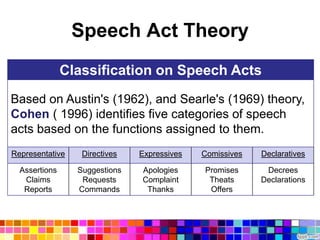
Speech Act Theory
               Classification on Speech Acts
Based on Austin's (1962), and Searle's (1969) theory,
Cohen ( 1996) identifies five categories of speech
acts based on the functions assigned to them.
Representative    Directives   Expressives   Comissives   Declaratives

  Assertions     Suggestions   Apologies     Promises      Decrees
   Claims         Requests     Complaint      Theats      Declarations
   Reports       Commands       Thanks        Offers
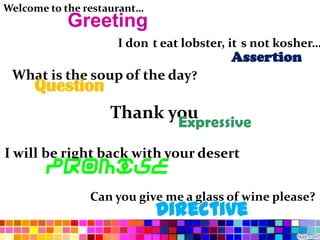
Welcome to the restaurant…
           Greeting
                     I don t eat lobster, it s not kosher…
                                         Assertion
 What is the soup of the day?
     Question
                   Thank you
                                Expressive
I will be right back with your desert
        Promise
                Can you give me a glass of wine please?
                             Directive
Pragmatics
• Is the study of the aspects of meaning and
  language use that are dependent on the
  speaker, the addressee and other features
  of the context of utterance.
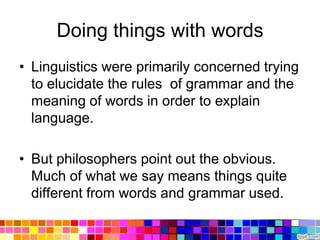
Doing things with words
• Linguistics were primarily concerned trying
  to elucidate the rules of grammar and the
  meaning of words in order to explain
  language.

• But philosophers point out the obvious.
  Much of what we say means things quite
  different from words and grammar used.
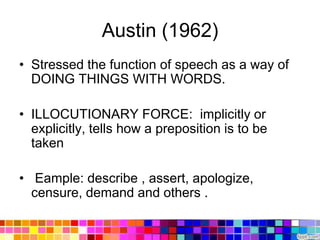
Austin (1962)
• Stressed the function of speech as a way of
  DOING THINGS WITH WORDS.

• ILLOCUTIONARY FORCE: implicitly or
  explicitly, tells how a preposition is to be
  taken

• Eample: describe , assert, apologize,
  censure, demand and others .
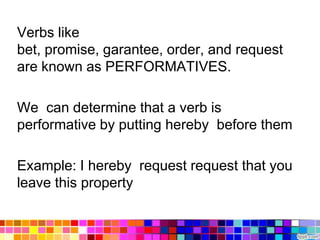
Verbs like
bet, promise, garantee, order, and request
are known as PERFORMATIVES.

We can determine that a verb is
performative by putting hereby before them

Example: I hereby request request that you
leave this property
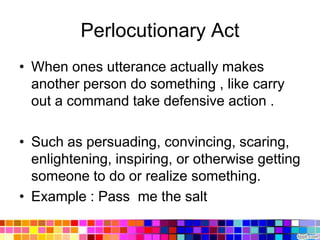
Perlocutionary Act
• When ones utterance actually makes
  another person do something , like carry
  out a command take defensive action .

• Such as persuading, convincing, scaring,
  enlightening, inspiring, or otherwise getting
  someone to do or realize something.
• Example : Pass me the salt
Speech Acts and the Law
The bill of rights protects freedom of speech
  as long as the speech is about personal
         opinion or statement of fact.

                    But

    It does not protect all speech acts.
Example

Like to crying FIRE in a crowded building.
                   Also
         Conspiring to bribe a jury.
                  Perjury
                   Libel
                  Slander
Speech acts and social
           interaction
• Threatening complimenting, commanding
  and questioning can be manipulative.

• Another person behavior may be affected
  from one may expect from the actual
  words used.
“See the belt?”
• This may be enough to restrain a child
  from misbehaving.

• This is an example given by Chaika (1990)
  that demonstrates how meaning is
  achieved regardless of what words are
  actually used.
Or…
Speaker 1: Would you like to have this
           ticket to the concert?
Speaker 2: Is the Pope Catholic?
___________________________________

Speaker A: Is that what you re wearing to
           the party?
Pragmatics
• The study of speech acts in daily
  interaction is called pragmatics.

• Speech acts carry social implications.

• The responses to this social implications
  are conventional.
Therefore
• We speak though discourse
  routines, such as questions and answers.

• Every day talk consist of discourse
  routines and cultures vary considerably in
  the modes of routines they prefer.
All of these are embedded in our
          daily conversation.
• The degree to which one request or order
  directly.
• The occasions on which one compliments
  and one s response.
• How one invites others to do something.
• Asking questions causes others to answer;
  therefore questions are speech acts. So
  are apologies and excuses.
Why should ESL Students Learn
  to Perform Speech Acts?
• Since cultures vary in how they carry out
  discourse routines, learning them is an
  important task if one is to become socialized.

• The mayor issue en ESL classrooms is that
  we are teach in how to speak directly, how to
  say what we mean. However, much
  interaction has to be effected by not speaking
  directly, but not saying what one means.
More important
• ESL learners also have to learn to make
  the proper responses in one s culture in
  discourse routines.

• This can also cause cross cultural
  difficulties.
Frames
• Frames, they are also known as scripts,
  schemata and structures of expectation.
  (Tannen 1979b; Gumperz 1982, p.12)

• We ESL use frames to make sense of the
  myriad expressions that assail us daily.
According to Chaika
• We use these to decide what is important.
• What inferences we can and should be
  getting from an interaction.
• Why someone is speaking the way he or
  she is.
• And, what our reaction should be.
• An obstacle in using frames to interpret is
  that they are based upon an individual s
  personal experiences.

• Another is that cultures differ in frames.
Speech events

• A speech event is :

• The situation calling forth particular ways
  of speaking (Gordon and Lakoff 1975).
Genre
Refers to the form of speaking .
  1.   Joke
  2.   Narrative
  3.   Promise
  4.   Riddle
  5.   Prayer
  6.   Greeting
• Members of a community recognize
  genres.

• Beginnings, Middles and ends.
  1. Did you hear the one about….. = joke.
  2. Once upon a time = child s story.
  3. And they lived happily ever after = ending.
• Sometimes the genre is the entire speech
  event.
• Church services are speech events for
  instance Sermons are a genre belonging
  to the church.
• Sermons do not cover the entire speech
  event.
• Prayers, readings, hymn singing also
  constitute the speech events of church
  services.
Intention
• In all interaction each person speaks with
  a purpose.

• Hearers get meaning partially by what they
  think the speaker s purpose is.
• One important aspect of interpretation
  intention is presequence.

• Are recognized opening sentences which
  signal that a particular kind of speech act
  will follow.

• Commands, demands or threats.
• A child who hears an adult s “who spilled
  this milk?”

• Perceive the question as command.

• “wipe it up”

Often intentions are not perceived correctly,
causing misunderstanding
• Harmless as hearing an honest question.
• Innocent comment as an insult.
• Example: A man who, in front of his
  slightly plump wife, looks admiringly at a
  model. “Wow! What a body on that one”.

The wife immediately bridles or dissolves in
tears, depending the personal style. She
assumes that is a complaining about her fat.
References
• Andrews, L. (2006). Discourse routines and social conventions. In
  Language exploration and awareness. A resource book for teachers.
  (pp. 167-192). New jersey: Lawrence Erlbaum Associates Inc.
  Publishers.

• Chaika, E. (1994). Pragmatics. En Language the Social Mirror (pp.
  152-158). Boston: Heinle & Heinle Publishers.

• Jaworowska, J. (6 de June de 2004). Speech Act Theory. Retrieved
  on October 6th, 2011, from Speech Act Theory :
  http://instructional1.calstatela.edu/lkamhis/tesl565_sp04/troy/spchac
  t.htm

Pragmatics

  • 1.
    Pragmatics Frame Unused s Speech Act Section Speec Theory h Space 1 events and Genres Speech Speech Acts and Social Interactions acts and Pragmatics References discourse Intention routines
  • 2.
    Speech act theory •Attempts to explain how speakers use language to accomplish intended actions and how hearers infer intended meaning from what is said. • Has prompted researchers to investigate the ways people use the language to manage social interactions.
  • 3.
    What is anspeech act? • A speech act is a minimal functional unit in human communication. Just as a word is the smallest free form found in language and a morpheme is the smallest unit of language that carries information about meaning, the basic unit of communication is a speech act.
  • 4.
    In other words Speechacts are: • Any meaningful utterance • Utterance that serves a function in communication • What piece of language is doing or how the listener/reader is supposed to react
  • 5.
    Speech act It maycontain: • Just one word – Sorry • Several words or sentences – I m sorry I forgot your bithday
  • 6.
    Speech Act Theory Classification on Speech Acts Based on Austin's (1962), and Searle's (1969) theory, Cohen ( 1996) identifies five categories of speech acts based on the functions assigned to them. Representative Directives Expressives Comissives Declaratives Assertions Suggestions Apologies Promises Decrees Claims Requests Complaint Theats Declarations Reports Commands Thanks Offers
  • 7.
    Welcome to therestaurant… Greeting I don t eat lobster, it s not kosher… Assertion What is the soup of the day? Question Thank you Expressive I will be right back with your desert Promise Can you give me a glass of wine please? Directive
  • 8.
    Pragmatics • Is thestudy of the aspects of meaning and language use that are dependent on the speaker, the addressee and other features of the context of utterance.
  • 9.
    Doing things withwords • Linguistics were primarily concerned trying to elucidate the rules of grammar and the meaning of words in order to explain language. • But philosophers point out the obvious. Much of what we say means things quite different from words and grammar used.
  • 10.
    Austin (1962) • Stressedthe function of speech as a way of DOING THINGS WITH WORDS. • ILLOCUTIONARY FORCE: implicitly or explicitly, tells how a preposition is to be taken • Eample: describe , assert, apologize, censure, demand and others .
  • 11.
    Verbs like bet, promise,garantee, order, and request are known as PERFORMATIVES. We can determine that a verb is performative by putting hereby before them Example: I hereby request request that you leave this property
  • 12.
    Perlocutionary Act • Whenones utterance actually makes another person do something , like carry out a command take defensive action . • Such as persuading, convincing, scaring, enlightening, inspiring, or otherwise getting someone to do or realize something. • Example : Pass me the salt
  • 13.
    Speech Acts andthe Law The bill of rights protects freedom of speech as long as the speech is about personal opinion or statement of fact. But It does not protect all speech acts.
  • 14.
    Example Like to cryingFIRE in a crowded building. Also Conspiring to bribe a jury. Perjury Libel Slander
  • 15.
    Speech acts andsocial interaction • Threatening complimenting, commanding and questioning can be manipulative. • Another person behavior may be affected from one may expect from the actual words used.
  • 16.
    “See the belt?” •This may be enough to restrain a child from misbehaving. • This is an example given by Chaika (1990) that demonstrates how meaning is achieved regardless of what words are actually used.
  • 17.
    Or… Speaker 1: Wouldyou like to have this ticket to the concert? Speaker 2: Is the Pope Catholic? ___________________________________ Speaker A: Is that what you re wearing to the party?
  • 18.
    Pragmatics • The studyof speech acts in daily interaction is called pragmatics. • Speech acts carry social implications. • The responses to this social implications are conventional.
  • 19.
    Therefore • We speakthough discourse routines, such as questions and answers. • Every day talk consist of discourse routines and cultures vary considerably in the modes of routines they prefer.
  • 20.
    All of theseare embedded in our daily conversation. • The degree to which one request or order directly. • The occasions on which one compliments and one s response. • How one invites others to do something. • Asking questions causes others to answer; therefore questions are speech acts. So are apologies and excuses.
  • 21.
    Why should ESLStudents Learn to Perform Speech Acts? • Since cultures vary in how they carry out discourse routines, learning them is an important task if one is to become socialized. • The mayor issue en ESL classrooms is that we are teach in how to speak directly, how to say what we mean. However, much interaction has to be effected by not speaking directly, but not saying what one means.
  • 22.
    More important • ESLlearners also have to learn to make the proper responses in one s culture in discourse routines. • This can also cause cross cultural difficulties.
  • 23.
    Frames • Frames, theyare also known as scripts, schemata and structures of expectation. (Tannen 1979b; Gumperz 1982, p.12) • We ESL use frames to make sense of the myriad expressions that assail us daily.
  • 24.
    According to Chaika •We use these to decide what is important. • What inferences we can and should be getting from an interaction. • Why someone is speaking the way he or she is. • And, what our reaction should be.
  • 25.
    • An obstaclein using frames to interpret is that they are based upon an individual s personal experiences. • Another is that cultures differ in frames.
  • 26.
    Speech events • Aspeech event is : • The situation calling forth particular ways of speaking (Gordon and Lakoff 1975).
  • 27.
    Genre Refers to theform of speaking . 1. Joke 2. Narrative 3. Promise 4. Riddle 5. Prayer 6. Greeting
  • 28.
    • Members ofa community recognize genres. • Beginnings, Middles and ends. 1. Did you hear the one about….. = joke. 2. Once upon a time = child s story. 3. And they lived happily ever after = ending.
  • 29.
    • Sometimes thegenre is the entire speech event. • Church services are speech events for instance Sermons are a genre belonging to the church. • Sermons do not cover the entire speech event. • Prayers, readings, hymn singing also constitute the speech events of church services.
  • 30.
    Intention • In allinteraction each person speaks with a purpose. • Hearers get meaning partially by what they think the speaker s purpose is.
  • 31.
    • One importantaspect of interpretation intention is presequence. • Are recognized opening sentences which signal that a particular kind of speech act will follow. • Commands, demands or threats.
  • 32.
    • A childwho hears an adult s “who spilled this milk?” • Perceive the question as command. • “wipe it up” Often intentions are not perceived correctly, causing misunderstanding
  • 33.
    • Harmless ashearing an honest question. • Innocent comment as an insult. • Example: A man who, in front of his slightly plump wife, looks admiringly at a model. “Wow! What a body on that one”. The wife immediately bridles or dissolves in tears, depending the personal style. She assumes that is a complaining about her fat.
  • 34.
    References • Andrews, L.(2006). Discourse routines and social conventions. In Language exploration and awareness. A resource book for teachers. (pp. 167-192). New jersey: Lawrence Erlbaum Associates Inc. Publishers. • Chaika, E. (1994). Pragmatics. En Language the Social Mirror (pp. 152-158). Boston: Heinle & Heinle Publishers. • Jaworowska, J. (6 de June de 2004). Speech Act Theory. Retrieved on October 6th, 2011, from Speech Act Theory : http://instructional1.calstatela.edu/lkamhis/tesl565_sp04/troy/spchac t.htm