 Defining Communicative Competence
 Language Functions
 Halliday’s Seven Functions of Language
 Functional Approaches to Language
Teaching
CHAPTER 8:
COMMUNICATIVE
COMPETENCE
Nurhazwani Abd Halim, Nurul Hanani Hasan & Noraisya Sofea Muhammad
Prepared by:
Instructor: Mr Suthagar Narasuman
SECONDLANGUAGE
ACQUISITION
Prepared by:
Nurhazwani Abd Halim
DEFINING
COMMUNICATIVE
COMPETENCE
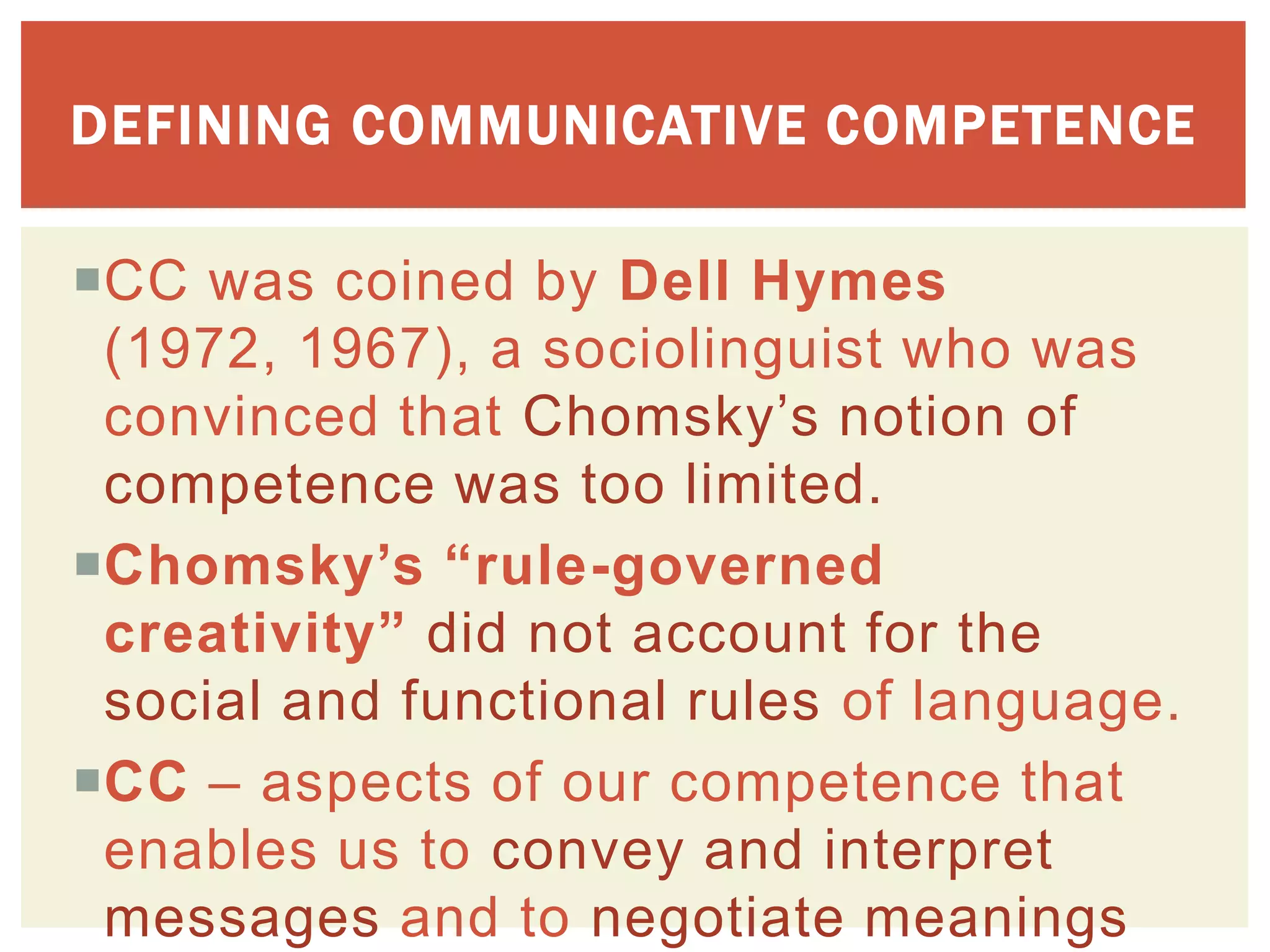
CC was coined by Dell Hymes
(1972, 1967), a sociolinguist who was
convinced that Chomsky’s notion of
competence was too limited.
Chomsky’s “rule-governed
creativity” did not account for the
social and functional rules of language.
CC – aspects of our competence that
enables us to convey and interpret
messages and to negotiate meanings
DEFINING COMMUNICATIVE COMPETENCE
LINGUISTIC VS COMMUNICATIVE
Linguistic Competence
- Knowledge “about”
language forms
Communicative
Competence -
Knowledge that enables a
person to communicate
functionally and
interactively
Cognitive/academic
language proficiency
(CALP) – often used in
classroom exercises and
tests that focus on form
Basic interpersonal
communicative skills
(BICS) – communicative
capacity acquired to
function in daily
interpersonal exchanges
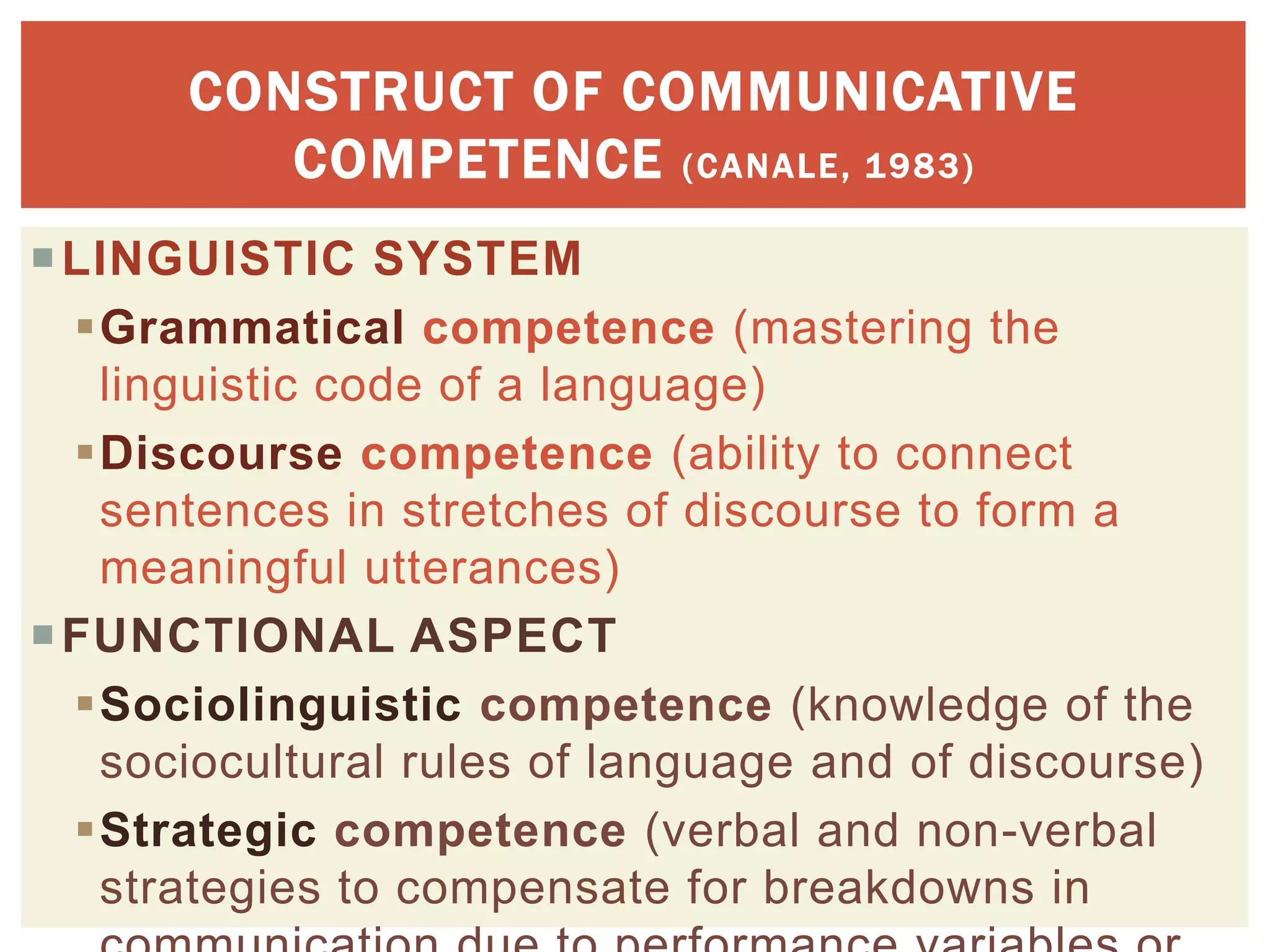
LINGUISTIC SYSTEM
Grammatical competence (mastering the
linguistic code of a language)
Discourse competence (ability to connect
sentences in stretches of discourse to form a
meaningful utterances)
FUNCTIONAL ASPECT
Sociolinguistic competence (knowledge of the
sociocultural rules of language and of discourse)
Strategic competence (verbal and non-verbal
strategies to compensate for breakdowns in
CONSTRUCT OF COMMUNICATIVE
COMPETENCE (CANALE, 1983)
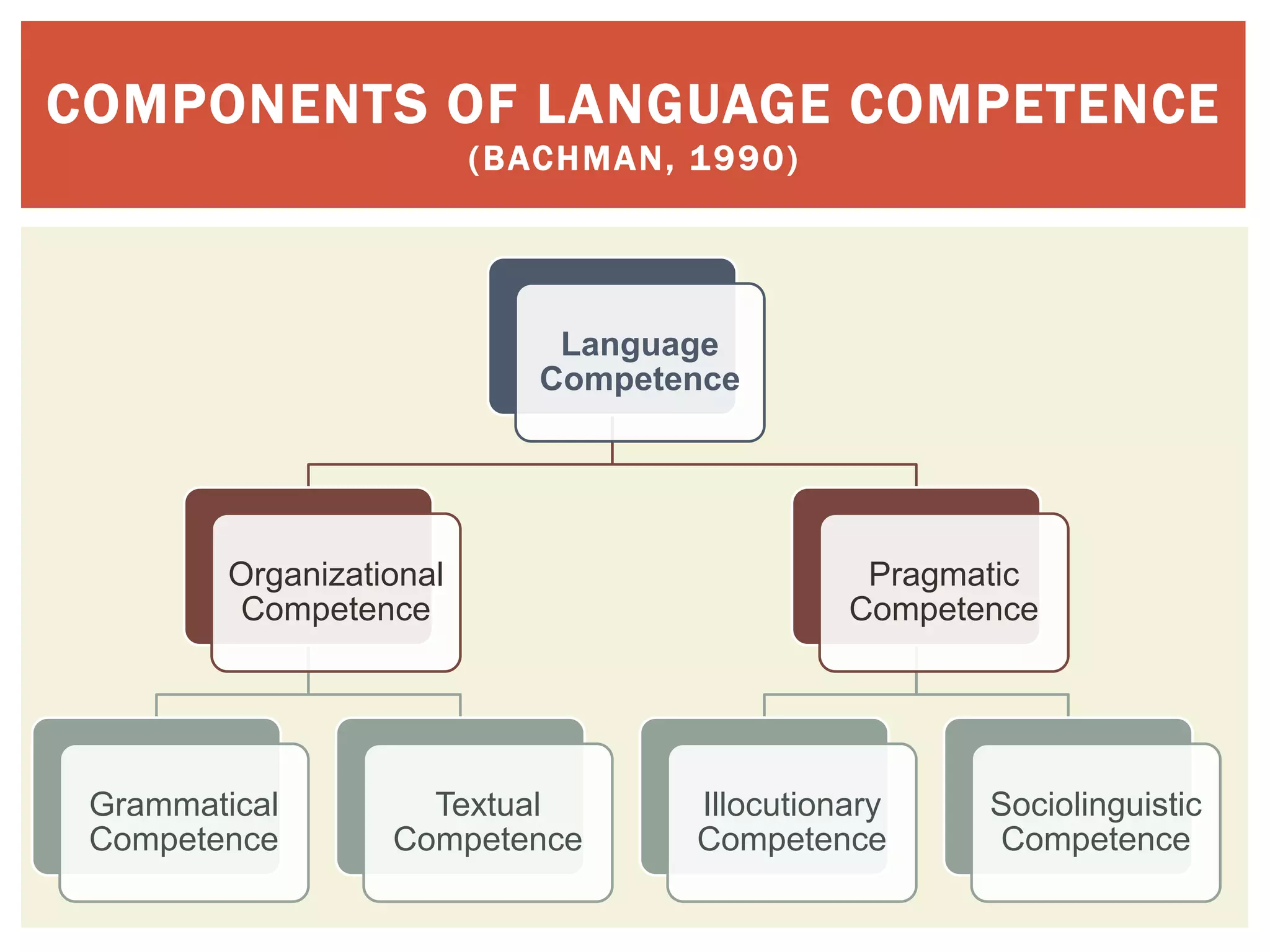
Language
Competence
Organizational
Competence
Grammatical
Competence
Textual
Competence
Pragmatic
Competence
Illocutionary
Competence
Sociolinguistic
Competence
COMPONENTS OF LANGUAGE COMPETENCE
(BACHMAN, 1990)
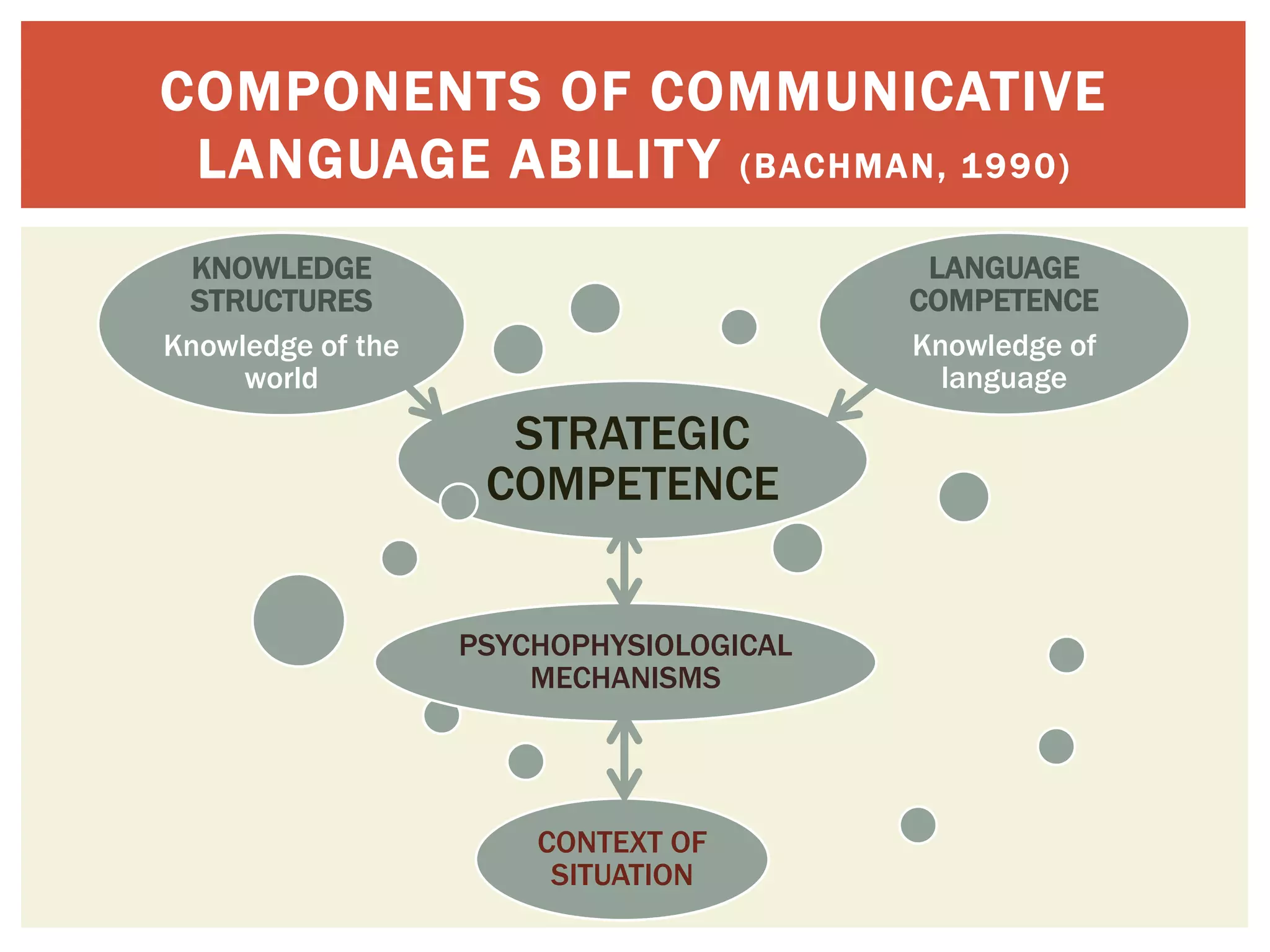
STRATEGIC
COMPETENCE
KNOWLEDGE
STRUCTURES
Knowledge of the
world
LANGUAGE
COMPETENCE
Knowledge of
language
PSYCHOPHYSIOLOGICAL
MECHANISMS
CONTEXT OF
SITUATION
COMPONENTS OF COMMUNICATIVE
LANGUAGE ABILITY (BACHMAN, 1990)
Prepared by:
Nurul Hanani Hasan
HALLIDAY’S SEVEN
FUNCTIONS OF
LANGUAGE
Instrumental function serves to manipulate the
environment, to cause certain events to happen.
Regulatory function of language
is the control of events.
Representational function is the use of
language to make statements, convey facts
and knowledge, explain, or report
Interactional functional serves to ensure social maintenance.
HALLIDAY’SSEVEN
FUNCTIONSOF
LANGUAGE
HALLIDAY’SSEVEN
FUNCTIONSOF
LANGUAGE
Personal function allows a speaker to express
feelings, emotions, personality, “gut-level” reactions.
Heuristic function involves language used to acquire
knowledge, to learn about the environment.
Imaginative function serves to create
imaginary systems or ideas.
Prepared by:
Noraisya Sofea Muhammad
FUNCTIONAL
APPROACHES TO
LANGUAGE TEACHING
FUNCTIONAL APPROACHES TO
LANGUAGE TEACHING
Notional-functional syllabuses
Attended to functions as organizing
elements of foreign language curriculum.
“Notions” referred to abstract concepts such
as existence, space, time, quantity, and
quality. Also, “contexts” or “situations”, such
as travel, health, education, shopping and
free time.
“Functional” is language functions such as
identifying, reporting, denying, declining and
NFS also known as functional
syllabuses.
(Example on page 225)
 A typical unit in this textbook includes
an eclectic blend of conversation
practice with a classmate, interactive
group work, role plays, grammar and
pronunciation focus
exercises, information-gap
techniques, Internet activities, and
FUNCTIONAL APPROACHES TO
LANGUAGE TEACHING (CONT.)
There was some controversy over their
effectiveness.
Berns (1984b, p15) warned teachers that
textbooks that claim to have a functional base
may be “sorely inadequate and even misleading
in their representation of language as
interaction”.
She went on to show how context is the real key
to giving meaning to both form and function.
Therefore, just because a function is “covered”
does not mean that learners have internalized it
for authentic, unrehearsed use in the real world.
FUNCTIONAL APPROACHES TO
LANGUAGE TEACHING (CONT.)

Communicative competence

  • 1.
     Defining CommunicativeCompetence  Language Functions  Halliday’s Seven Functions of Language  Functional Approaches to Language Teaching CHAPTER 8: COMMUNICATIVE COMPETENCE Nurhazwani Abd Halim, Nurul Hanani Hasan & Noraisya Sofea Muhammad Prepared by: Instructor: Mr Suthagar Narasuman SECONDLANGUAGE ACQUISITION
  • 2.
    Prepared by: Nurhazwani AbdHalim DEFINING COMMUNICATIVE COMPETENCE
  • 3.
    CC was coinedby Dell Hymes (1972, 1967), a sociolinguist who was convinced that Chomsky’s notion of competence was too limited. Chomsky’s “rule-governed creativity” did not account for the social and functional rules of language. CC – aspects of our competence that enables us to convey and interpret messages and to negotiate meanings DEFINING COMMUNICATIVE COMPETENCE
  • 4.
    LINGUISTIC VS COMMUNICATIVE LinguisticCompetence - Knowledge “about” language forms Communicative Competence - Knowledge that enables a person to communicate functionally and interactively Cognitive/academic language proficiency (CALP) – often used in classroom exercises and tests that focus on form Basic interpersonal communicative skills (BICS) – communicative capacity acquired to function in daily interpersonal exchanges
  • 5.
    LINGUISTIC SYSTEM Grammatical competence(mastering the linguistic code of a language) Discourse competence (ability to connect sentences in stretches of discourse to form a meaningful utterances) FUNCTIONAL ASPECT Sociolinguistic competence (knowledge of the sociocultural rules of language and of discourse) Strategic competence (verbal and non-verbal strategies to compensate for breakdowns in CONSTRUCT OF COMMUNICATIVE COMPETENCE (CANALE, 1983)
  • 6.
  • 7.
    STRATEGIC COMPETENCE KNOWLEDGE STRUCTURES Knowledge of the world LANGUAGE COMPETENCE Knowledgeof language PSYCHOPHYSIOLOGICAL MECHANISMS CONTEXT OF SITUATION COMPONENTS OF COMMUNICATIVE LANGUAGE ABILITY (BACHMAN, 1990)
  • 8.
    Prepared by: Nurul HananiHasan HALLIDAY’S SEVEN FUNCTIONS OF LANGUAGE
  • 9.
    Instrumental function servesto manipulate the environment, to cause certain events to happen. Regulatory function of language is the control of events. Representational function is the use of language to make statements, convey facts and knowledge, explain, or report Interactional functional serves to ensure social maintenance. HALLIDAY’SSEVEN FUNCTIONSOF LANGUAGE
  • 10.
    HALLIDAY’SSEVEN FUNCTIONSOF LANGUAGE Personal function allowsa speaker to express feelings, emotions, personality, “gut-level” reactions. Heuristic function involves language used to acquire knowledge, to learn about the environment. Imaginative function serves to create imaginary systems or ideas.
  • 11.
    Prepared by: Noraisya SofeaMuhammad FUNCTIONAL APPROACHES TO LANGUAGE TEACHING
  • 12.
    FUNCTIONAL APPROACHES TO LANGUAGETEACHING Notional-functional syllabuses Attended to functions as organizing elements of foreign language curriculum. “Notions” referred to abstract concepts such as existence, space, time, quantity, and quality. Also, “contexts” or “situations”, such as travel, health, education, shopping and free time. “Functional” is language functions such as identifying, reporting, denying, declining and
  • 13.
    NFS also knownas functional syllabuses. (Example on page 225)  A typical unit in this textbook includes an eclectic blend of conversation practice with a classmate, interactive group work, role plays, grammar and pronunciation focus exercises, information-gap techniques, Internet activities, and FUNCTIONAL APPROACHES TO LANGUAGE TEACHING (CONT.)
  • 14.
    There was somecontroversy over their effectiveness. Berns (1984b, p15) warned teachers that textbooks that claim to have a functional base may be “sorely inadequate and even misleading in their representation of language as interaction”. She went on to show how context is the real key to giving meaning to both form and function. Therefore, just because a function is “covered” does not mean that learners have internalized it for authentic, unrehearsed use in the real world. FUNCTIONAL APPROACHES TO LANGUAGE TEACHING (CONT.)