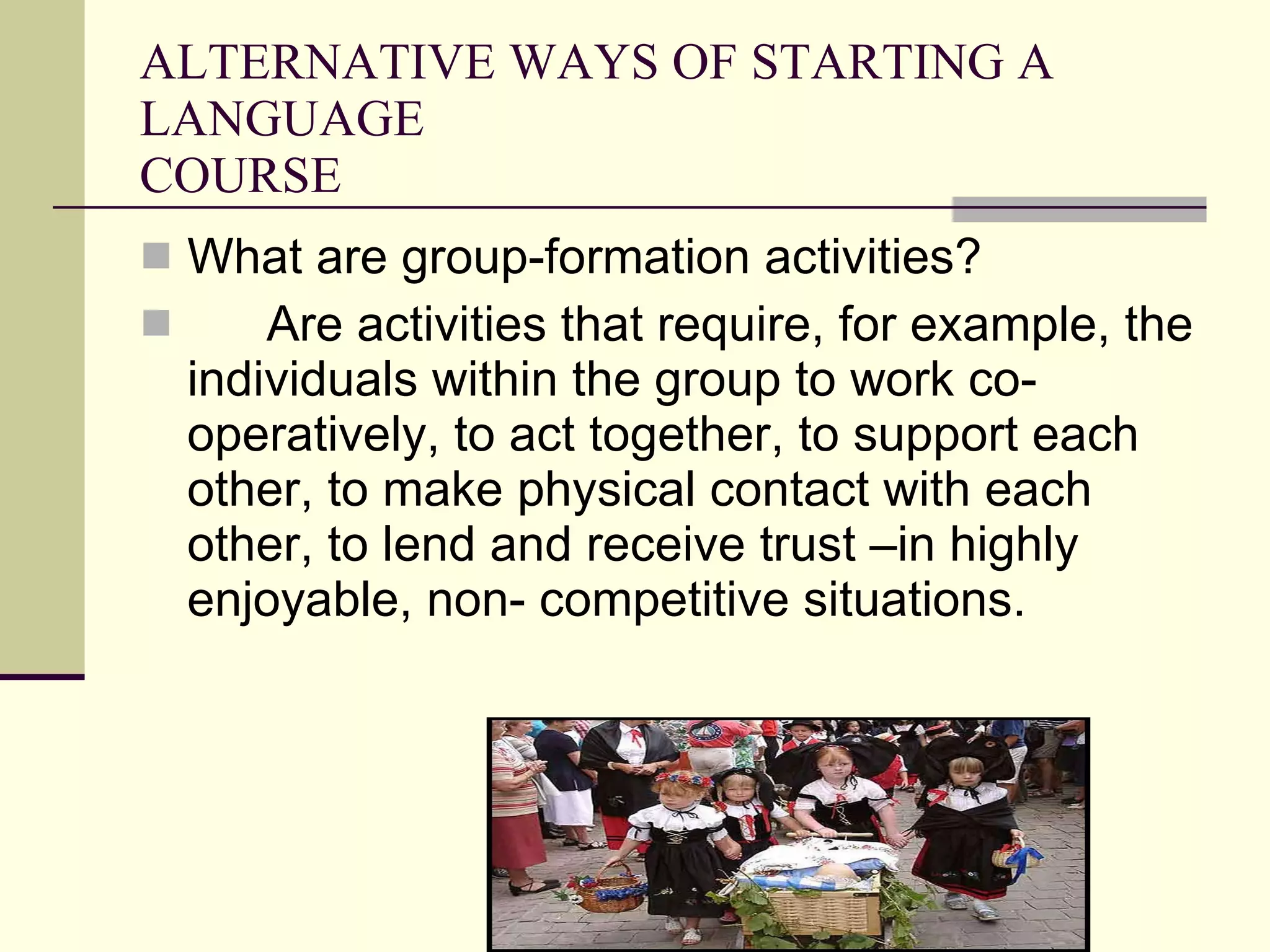
ALTERNATIVE WAYS OF STARTING A LANGUAGE  COURSE What are group-formation activities? Are activities that require, for example, the individuals within the group to work co-operatively, to act together, to support each other, to make physical contact with each other, to lend and receive trust –in highly enjoyable, non- competitive situations.
WHAT IS THE RELEVANCE OF GROUP FORMATION ACTIVITIES? Lower the affective barriers therefore learning is easier. When learners feel relaxed  then learners gain confidence to lend and receive support from peers, to take risks with new language in front of the class. Supportive atmosphere may led towards more co-operative work. Build up support and trust as a course progresses. Individuals within the class gain the confidence to take risks. Group formation activities within any learning community needs continual reinforcement, and  lead to a positive learning environment.
BUILDING UP A TEACHING SEQUENCE Group dynamics activities. Introducing new vocabulary   Hands-on experience  of topic-based group-dynamics.  Ex: games, songs, tongue  twisters, rhymes. Presentation techniques for teaching new words to children.
Building… Participation in a TPR activity. Telling a story   Reading tasks puppets   Playing  Bingo   Using ¨key¨ vocabulary  The concept of topic-based TPR. Storytelling , different techniques   Linking all the activities (including language focus to a theme/topic) Topic-based word games
TPR  Explanation / Introduction   Tell the sts they are going to do a TPR task.Confirm that the language involved is relevant to the story you will be telling. Presentation  Read out the text once through without stopping,demonstrating actions with gesture and mime as you say the text. Students watch and listen only.
TPR Controlled Practice 1 Say the text once more, demonstrating the asociated actions as you speak. Stop after each sentence. A leader of each group repeats the sentence and/or  does the actions, the rest of the sts do the actions without speaking.
TPR Controlled Practice 2 Say the text once without demonstrating the associated actions as you speak. Stop after each sentence. A leader of each group repeats the sentence and / or  does the actions, the rest of the sts  do the actions and repeat the sentence.

Tprgroup

  • 1.
    ALTERNATIVE WAYS OFSTARTING A LANGUAGE COURSE What are group-formation activities? Are activities that require, for example, the individuals within the group to work co-operatively, to act together, to support each other, to make physical contact with each other, to lend and receive trust –in highly enjoyable, non- competitive situations.
  • 2.
    WHAT IS THERELEVANCE OF GROUP FORMATION ACTIVITIES? Lower the affective barriers therefore learning is easier. When learners feel relaxed then learners gain confidence to lend and receive support from peers, to take risks with new language in front of the class. Supportive atmosphere may led towards more co-operative work. Build up support and trust as a course progresses. Individuals within the class gain the confidence to take risks. Group formation activities within any learning community needs continual reinforcement, and lead to a positive learning environment.
  • 3.
    BUILDING UP ATEACHING SEQUENCE Group dynamics activities. Introducing new vocabulary Hands-on experience of topic-based group-dynamics. Ex: games, songs, tongue twisters, rhymes. Presentation techniques for teaching new words to children.
  • 4.
    Building… Participation ina TPR activity. Telling a story Reading tasks puppets Playing Bingo Using ¨key¨ vocabulary The concept of topic-based TPR. Storytelling , different techniques Linking all the activities (including language focus to a theme/topic) Topic-based word games
  • 5.
    TPR Explanation/ Introduction Tell the sts they are going to do a TPR task.Confirm that the language involved is relevant to the story you will be telling. Presentation Read out the text once through without stopping,demonstrating actions with gesture and mime as you say the text. Students watch and listen only.
  • 6.
    TPR Controlled Practice1 Say the text once more, demonstrating the asociated actions as you speak. Stop after each sentence. A leader of each group repeats the sentence and/or does the actions, the rest of the sts do the actions without speaking.
  • 7.
    TPR Controlled Practice2 Say the text once without demonstrating the associated actions as you speak. Stop after each sentence. A leader of each group repeats the sentence and / or does the actions, the rest of the sts do the actions and repeat the sentence.