Downloaded 24 times





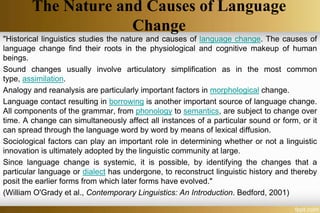
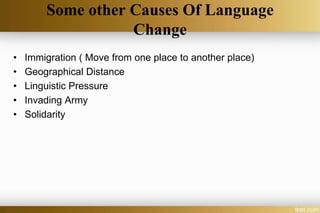
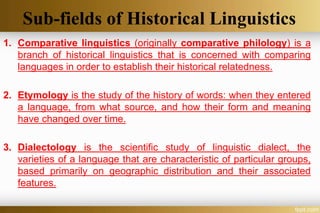


Historical linguistics studies how languages change over time through successive stages. It examines changes in languages from earlier forms to modern forms. The primary tool of historical linguistics is the comparative method, which is used to identify relationships among languages and reconstruct prehistoric proto-languages. Historical linguistics serves as the foundation for comparative linguistics. Some key causes of language change include sound changes through articulatory simplification, analogy and reanalysis in morphology, language contact and borrowing, and sociological factors influencing adoption of innovations. Subfields of historical linguistics include comparative linguistics, etymology, dialectology, phonology, morphology, and syntax.


