Discourse & Pragmatics
•Group 2:
• Anggi Febi
• Dinda Ladya
• Eliza Budi
• Erwinda
• Islahati Ainun
• Ujang Husni
 Pragmatics is an indispensable source for discourse analysis.
It is impossible to analyse any discourse without having a
solid basic knowledge of pragmatic phenomena and the
ways in which they work and interact (Alba-Juez, 2009:2).
 Discourse analysis, in turn, is composed of a wide range of
sub-disciplines, such as pragmatics, conversational analysis,
speech act theory and ethnography of speaking.
 Pragmatics assumes that when
people communicate with
each other they normally
follow some kind of co-
operative principle; that is,
they have a shared
understanding of how they
should co-operate in their
communication.
Action Performed By A Speaker
With An Utterance.
We use the term speech acts to describe actions such as:
Asking questions, Making requests, Giving orders
Making promises, Giving advice, Making threats
SPEECH ACT
Locutionary act
• Refers to the literal meaning of the actual words
Illocutionary act
• Refers to speaker’s intention in uttering words
Perlocutionary act
• Refers to the effect of the utterance has on the
thoughts or actions of the other person.
Whenever there is a direct relationship between a
structure and a function, we have a direct speech act.
Whenever there is an indirect relationship between a
structure and a function, we have an indirect speech
act.
DIRECT & INDIRECT
SPEECH ACTS
• I am telling
you that it is
cold outside.
Statement
(Direct Speech)
• I am asking
you to close
the door.
Request
(Indirect Speech)
General conditions for ALL speech acts:
1. The hearer must hear and understand the
language.
2. The speaker must not be pretending or play-acting.
(Seriousness)
FELICITY CONDITION
 Conditions specific to declarations and
directives:
1. The speaker must believe that it is
possible to carry out the action.
2. The speaker is performing the act in
the hearer’s best interests
3. The speaker is sincere about wanting to
do it.
4. The words count as the acts.
• refers to the common ground that is
assumed to exist between language
users such as assumed knowledge of
a situation and/or of the world.
PRESUPPOSITION
Conventional Pragmatics
COVENTIONAL
Conventional Presuppositions are less
context- dependent than Pragmatics
Presuppositions.
They are typically linked to particular
linguistic forms.
E.g. Would you like some coffee? ‘suggests
the coffee is already prepared’ whereas :
Would you like anything to drink? ‘does
not suggest a drink has already been
prepared’.
 Pragmatics Presuppositions are
context- dependent & arise
from the use of an utterance in
a particular context.
PRAGMATICS
A principle proposed by the philosopher paul grice
whereby those involved in communication assume that
both parties will normally seek to cooperate with each
other to establish agreed meaning.
It is composed of four maxims:
quality, quantity, relation, and manner.
THE CO-OPERATIVE
PRINCIPLE
Husband: Where are the car keys?
Wife:They’re on the table in the hall.
 The wife has answered clearly (Manner) and
truthfully (Quality), has given just the right
amount of information (Quantity) and has
directly addressed her husband’s goal in asking
the question (Relation). She has said precisely
what she meant, no more and no less.
It is speakers who communicate meaning via implicatures
& it is listeners who recognize those communicated
meanings via inference.
The inferences selected are those which will preserve the
assumption of cooperation.
But in fact, the speakers often flout the cooperative
principles and are still thought to be cooperative. What
they convey is the conversational implicatures.
FLOUTING
THE CO-OPERATIVE
 The flouting of the maxim of quality:
When we moved here, the room was 5x4,
now it is 3x4.
 The flouting of maxim of quantity:
A: Where does Mark live?
B: Somewhere in the South of France.
The flouting of the maxim of relation:
A: I’m out of petrol.
B: There is a garage round the corner.
The flouting of the maxim of manner:
A: Shall we get something for the kids?
B: But I veto I-C-E-C-R-E-A-M.
A task for japanese university students
In english: you are writing your graduation
thesis (in english). You want to ask your
(english) professor to read one of your
chapters for you. What would you say in an
email to your professor?
CROSS CULTURAL
PRAGMATICS
 Dear Jim
 Hello, I am currently working on my graduation
thesis, and would like to know if it is good or not.
Would you mind reading one of the chapters for
me? I would really appreciate it.
 Thanks
 Tetsuya Fujimoto
 In Japanese: You are writing your graduation
thesis (in Japanese). You want to ask your
(Japanese) professor to read one of your chapters
for you. What would you say in an email to your
professor?
Greetings, Professor Nakamura
Early spring, in this sizzling day, how are you spending
your day?This time, I would like you to do me a favor,
and this I why I take up my pen (In Japanese this
means ‘to write’ in a formal way).
I am now writing my graduation thesis, and even though
I am afraid to ask, would you mind seeing my work …
of course, as long as it does not bother you. If it is not
inconvenient for you, could you please consider it?
I beg you again
Sincerely
Tetsuya Fujimoto
• The basic assumption in conversation is that,
otherwise indicated, the participants are adhering
to the cooperative principle and the maxims.
• The following examples show a speaker
conveying more than he said via
conversational implicature
CONVERSATIONAL
IMPLICATURE
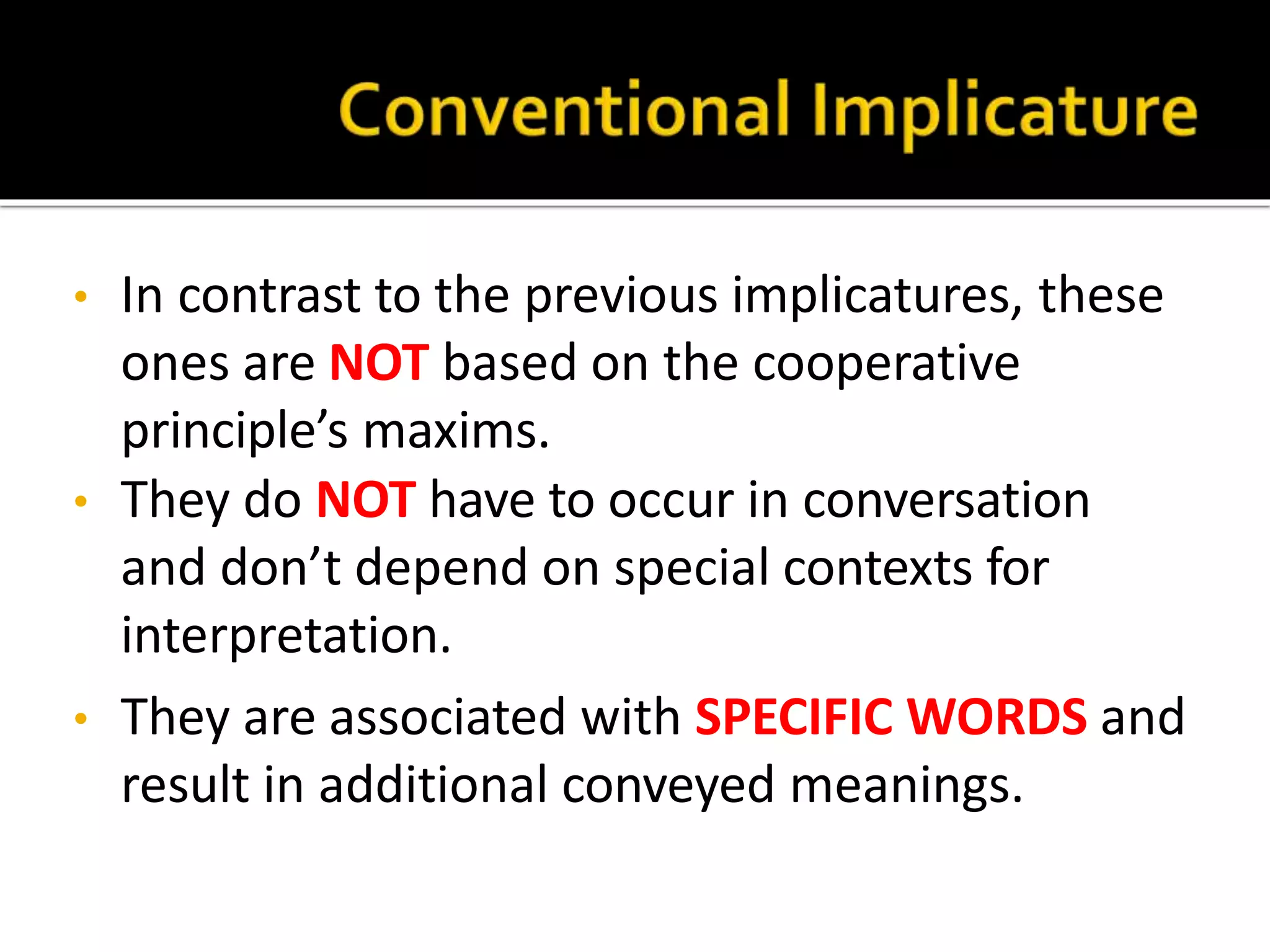
• In contrast to the previous implicatures, these
ones are NOT based on the cooperative
principle’s maxims.
• They do NOT have to occur in conversation
and don’t depend on special contexts for
interpretation.
• They are associated with SPECIFIC WORDS and
result in additional conveyed meanings.
 a: “I hope you brought the bread and cheese.”
 b: “Ah, I brought the bread.”
• Speaker B assumes that A infers
 that what is not mentioned was not brought.
 a: “Do you like ice-cream?”
b: “Is the Pope catholic?”
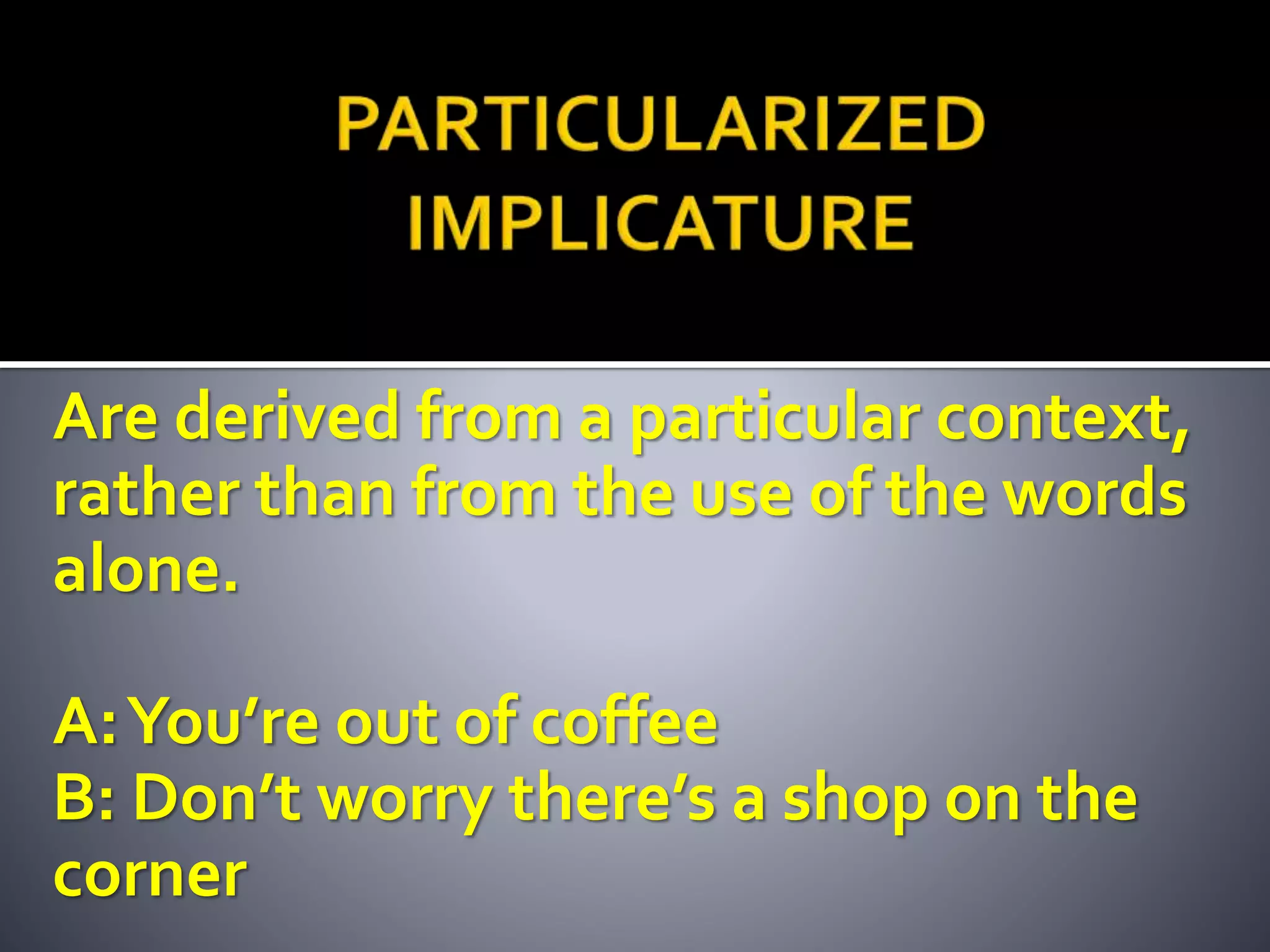
Are derived from a particular context,
rather than from the use of the words
alone.
A:You’re out of coffee
B: Don’t worry there’s a shop on the
corner
• “Polite social behaviour” within a culture. We assume
that participants in an interaction are generally aware
of such cultural norms and principles of politeness.
Face: the public self-image of a person. It refers to that
emotional and social sense of self that everyone has and
expects the other sto recognize.
Politeness in an interaction can be defined as the means
employed to show awareness of another person’s face.
POLITENESS
Face Wants: A person’s expectations
that their public self-image will be
respected.
• If a speaker says sth. that represents a threat to
another individual’s expectations, regarding self-
image, it’s described as a face- threatening act.
• When someone says an utterance that avoids a
potential threat t a person’s face, it’s called face-
saving act.
 A: “I’m going to tell him to stop that awful
noise right
 now!!” (Face-threatening act)
 B: “Perhaps you could just ask him if he’s going
to stop because it’s getting late and we need
to sleep…” (Face- saving act)
DISCOURSE AND PRAGMATICS

DISCOURSE AND PRAGMATICS

  • 1.
    Discourse & Pragmatics •Group2: • Anggi Febi • Dinda Ladya • Eliza Budi • Erwinda • Islahati Ainun • Ujang Husni
  • 2.
     Pragmatics isan indispensable source for discourse analysis. It is impossible to analyse any discourse without having a solid basic knowledge of pragmatic phenomena and the ways in which they work and interact (Alba-Juez, 2009:2).  Discourse analysis, in turn, is composed of a wide range of sub-disciplines, such as pragmatics, conversational analysis, speech act theory and ethnography of speaking.
  • 3.
     Pragmatics assumesthat when people communicate with each other they normally follow some kind of co- operative principle; that is, they have a shared understanding of how they should co-operate in their communication.
  • 4.
    Action Performed ByA Speaker With An Utterance. We use the term speech acts to describe actions such as: Asking questions, Making requests, Giving orders Making promises, Giving advice, Making threats SPEECH ACT
  • 5.
    Locutionary act • Refersto the literal meaning of the actual words Illocutionary act • Refers to speaker’s intention in uttering words Perlocutionary act • Refers to the effect of the utterance has on the thoughts or actions of the other person.
  • 6.
    Whenever there isa direct relationship between a structure and a function, we have a direct speech act. Whenever there is an indirect relationship between a structure and a function, we have an indirect speech act. DIRECT & INDIRECT SPEECH ACTS
  • 7.
    • I amtelling you that it is cold outside. Statement (Direct Speech) • I am asking you to close the door. Request (Indirect Speech)
  • 8.
    General conditions forALL speech acts: 1. The hearer must hear and understand the language. 2. The speaker must not be pretending or play-acting. (Seriousness) FELICITY CONDITION
  • 9.
     Conditions specificto declarations and directives: 1. The speaker must believe that it is possible to carry out the action. 2. The speaker is performing the act in the hearer’s best interests 3. The speaker is sincere about wanting to do it. 4. The words count as the acts.
  • 10.
    • refers tothe common ground that is assumed to exist between language users such as assumed knowledge of a situation and/or of the world. PRESUPPOSITION
  • 11.
  • 12.
    COVENTIONAL Conventional Presuppositions areless context- dependent than Pragmatics Presuppositions. They are typically linked to particular linguistic forms. E.g. Would you like some coffee? ‘suggests the coffee is already prepared’ whereas : Would you like anything to drink? ‘does not suggest a drink has already been prepared’.
  • 13.
     Pragmatics Presuppositionsare context- dependent & arise from the use of an utterance in a particular context. PRAGMATICS
  • 14.
    A principle proposedby the philosopher paul grice whereby those involved in communication assume that both parties will normally seek to cooperate with each other to establish agreed meaning. It is composed of four maxims: quality, quantity, relation, and manner. THE CO-OPERATIVE PRINCIPLE
  • 15.
    Husband: Where arethe car keys? Wife:They’re on the table in the hall.  The wife has answered clearly (Manner) and truthfully (Quality), has given just the right amount of information (Quantity) and has directly addressed her husband’s goal in asking the question (Relation). She has said precisely what she meant, no more and no less.
  • 16.
    It is speakerswho communicate meaning via implicatures & it is listeners who recognize those communicated meanings via inference. The inferences selected are those which will preserve the assumption of cooperation. But in fact, the speakers often flout the cooperative principles and are still thought to be cooperative. What they convey is the conversational implicatures. FLOUTING THE CO-OPERATIVE
  • 17.
     The floutingof the maxim of quality: When we moved here, the room was 5x4, now it is 3x4.  The flouting of maxim of quantity: A: Where does Mark live? B: Somewhere in the South of France.
  • 18.
    The flouting ofthe maxim of relation: A: I’m out of petrol. B: There is a garage round the corner. The flouting of the maxim of manner: A: Shall we get something for the kids? B: But I veto I-C-E-C-R-E-A-M.
  • 19.
    A task forjapanese university students In english: you are writing your graduation thesis (in english). You want to ask your (english) professor to read one of your chapters for you. What would you say in an email to your professor? CROSS CULTURAL PRAGMATICS
  • 20.
     Dear Jim Hello, I am currently working on my graduation thesis, and would like to know if it is good or not. Would you mind reading one of the chapters for me? I would really appreciate it.  Thanks  Tetsuya Fujimoto
  • 21.
     In Japanese:You are writing your graduation thesis (in Japanese). You want to ask your (Japanese) professor to read one of your chapters for you. What would you say in an email to your professor?
  • 22.
    Greetings, Professor Nakamura Earlyspring, in this sizzling day, how are you spending your day?This time, I would like you to do me a favor, and this I why I take up my pen (In Japanese this means ‘to write’ in a formal way). I am now writing my graduation thesis, and even though I am afraid to ask, would you mind seeing my work … of course, as long as it does not bother you. If it is not inconvenient for you, could you please consider it? I beg you again Sincerely Tetsuya Fujimoto
  • 23.
    • The basicassumption in conversation is that, otherwise indicated, the participants are adhering to the cooperative principle and the maxims. • The following examples show a speaker conveying more than he said via conversational implicature CONVERSATIONAL IMPLICATURE
  • 24.
    • In contrastto the previous implicatures, these ones are NOT based on the cooperative principle’s maxims. • They do NOT have to occur in conversation and don’t depend on special contexts for interpretation. • They are associated with SPECIFIC WORDS and result in additional conveyed meanings.
  • 25.
     a: “Ihope you brought the bread and cheese.”  b: “Ah, I brought the bread.” • Speaker B assumes that A infers  that what is not mentioned was not brought.  a: “Do you like ice-cream?” b: “Is the Pope catholic?”
  • 26.
    Are derived froma particular context, rather than from the use of the words alone. A:You’re out of coffee B: Don’t worry there’s a shop on the corner
  • 27.
    • “Polite socialbehaviour” within a culture. We assume that participants in an interaction are generally aware of such cultural norms and principles of politeness. Face: the public self-image of a person. It refers to that emotional and social sense of self that everyone has and expects the other sto recognize. Politeness in an interaction can be defined as the means employed to show awareness of another person’s face. POLITENESS
  • 28.
    Face Wants: Aperson’s expectations that their public self-image will be respected. • If a speaker says sth. that represents a threat to another individual’s expectations, regarding self- image, it’s described as a face- threatening act. • When someone says an utterance that avoids a potential threat t a person’s face, it’s called face- saving act.
  • 29.
     A: “I’mgoing to tell him to stop that awful noise right  now!!” (Face-threatening act)  B: “Perhaps you could just ask him if he’s going to stop because it’s getting late and we need to sleep…” (Face- saving act)