

SPEECH ACTS: Language as
Action
Introduction
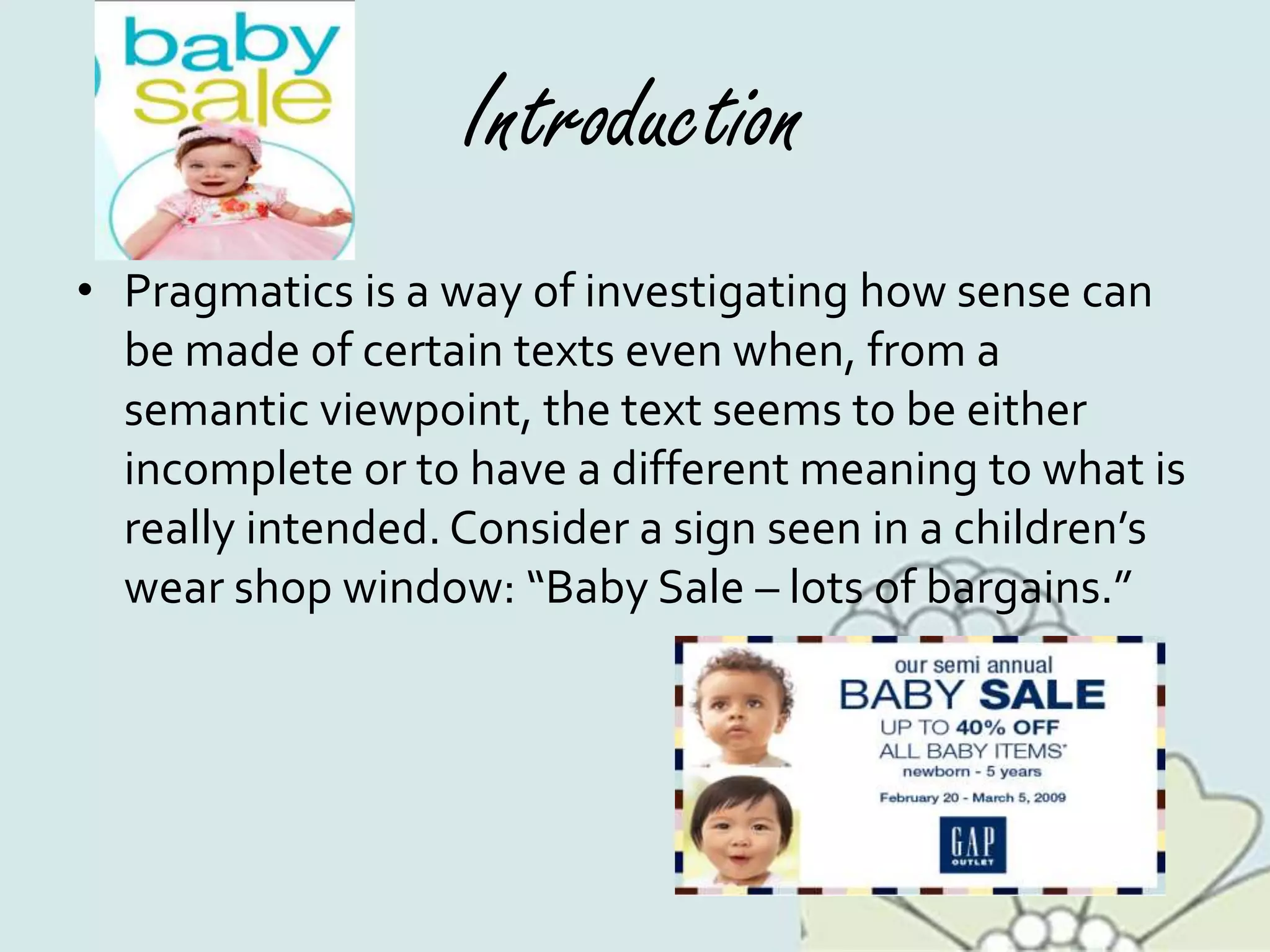
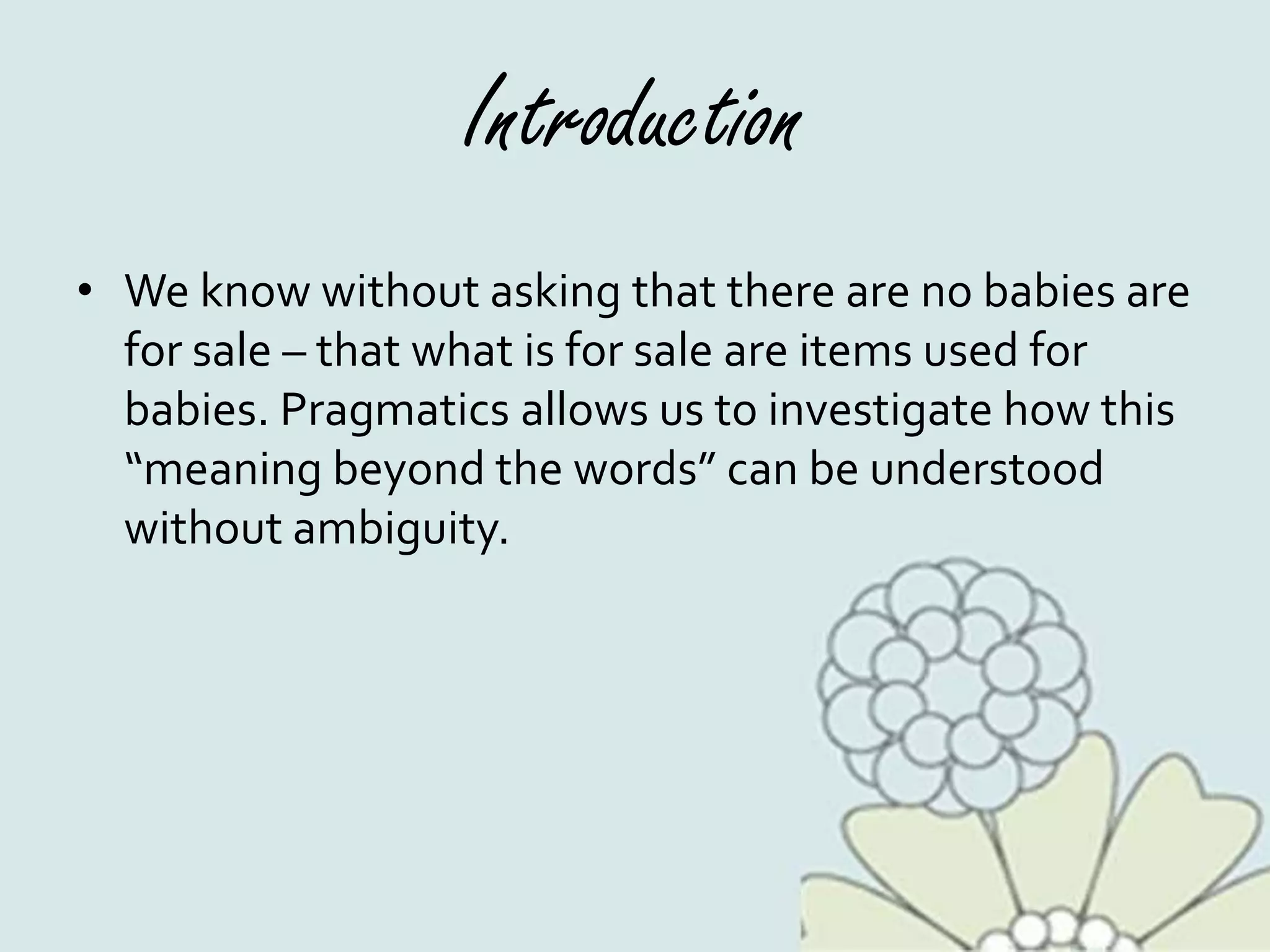
• Pragmatics is a way of investigating how sense can
be made of certain texts even when, from a
semantic viewpoint, the text seems to be either
incomplete or to have a different meaning to what is
really intended. Consider a sign seen in a children’s
wear shop window: “Baby Sale – lots of bargains.”
Introduction
• We know without asking that there are no babies are
for sale – that what is for sale are items used for
babies. Pragmatics allows us to investigate how this
“meaning beyond the words” can be understood
without ambiguity.
Examples
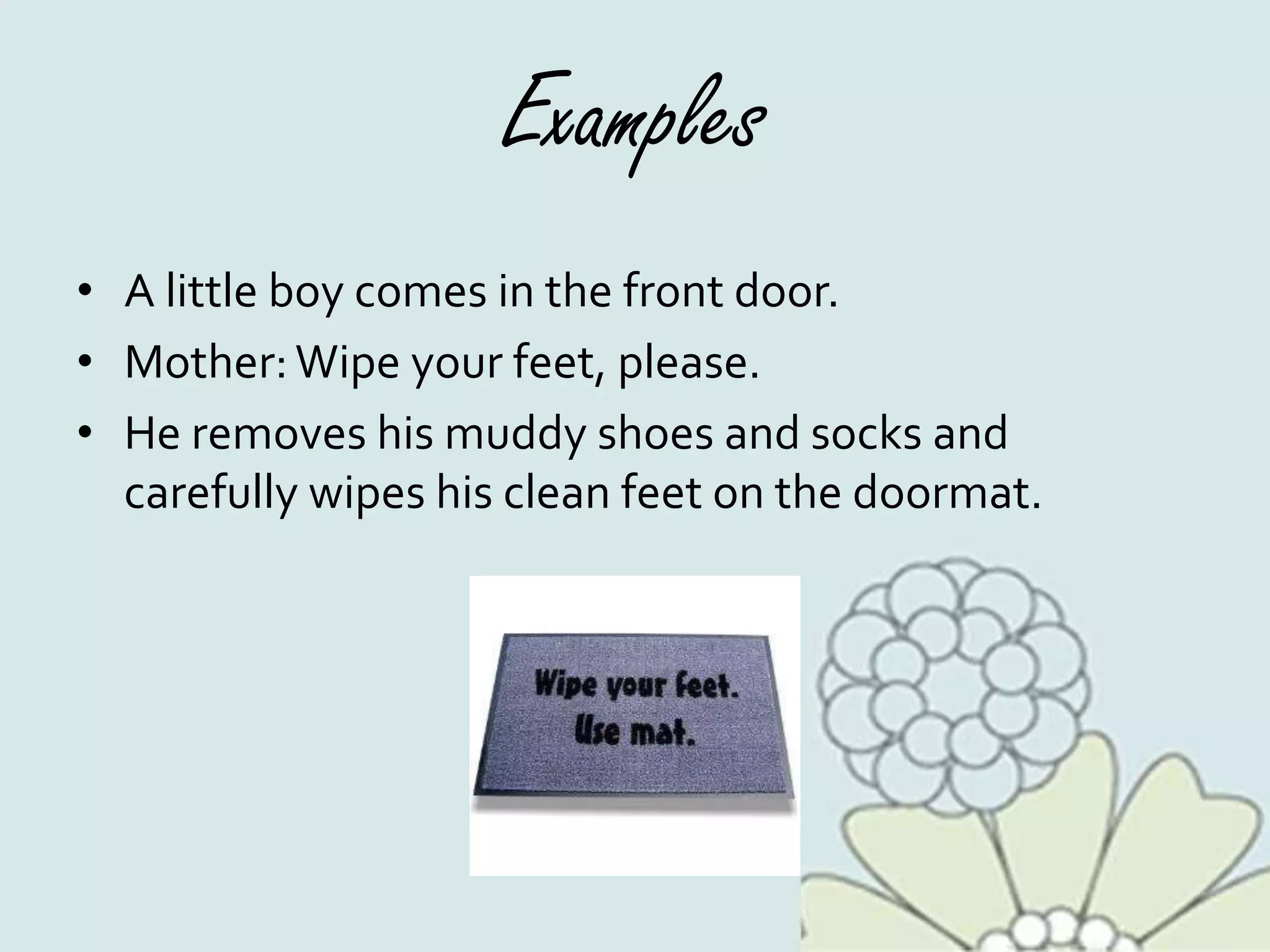
• A little boy comes in the front door.
• Mother:Wipe your feet, please.
• He removes his muddy shoes and socks and
carefully wipes his clean feet on the doormat.
• A father trying to get his 3-year-old daughter to stop
lifting up her dress to display her new underwear to
the assembled guests.
• Father:We don’t DO that.
• Daughter: I KNOW, Daddy. You don’tWEAR
dresses.
• What do these children still need to learn about
using language?
What does pragmatics include:
• Among the things you should know about are:
• Speech act theory
• The cooperative principle
• Conversational maxims
• Conversational implicature
• Deixis
• Politeness
• Utterances need not consist of complete sentences. Each
utterance is a unique physical event created at a particular
point of time for a particular communicative purpose.
Ex. Jane: Coffee?
Steve: Sure!
Jane:White?
Steve: Black.
• Utterance vs. Sentence
– Sentence: abstract units of the language system.
– Utterance: units of language in use.
Speech acts: introduction
• The philosopher J. L. Austin (1911-1960) claims that
many utterances (things people say) are equivalent
to actions.
• To communicate we must express propositions with
a particular illocutionary force, and in so doing we
perform particular kinds of action such as stating,
promising, warning, etc, which have come to be
called speech acts.
• It is important to distinguish between 3 things that
one doing in the course of producing an utterance.
• Sentences are often used to perform some acts.
• For ex., “Can you close the door?” is literally a
(yes/no) question, but it can be used as request.
• The locution of a sentence is the literal meaning and
the illocution of a sentence is its intended meaning.
• So the locution of a sentence “Can you close the
door?” is a question, but its illocution is a request.
Speech act theory
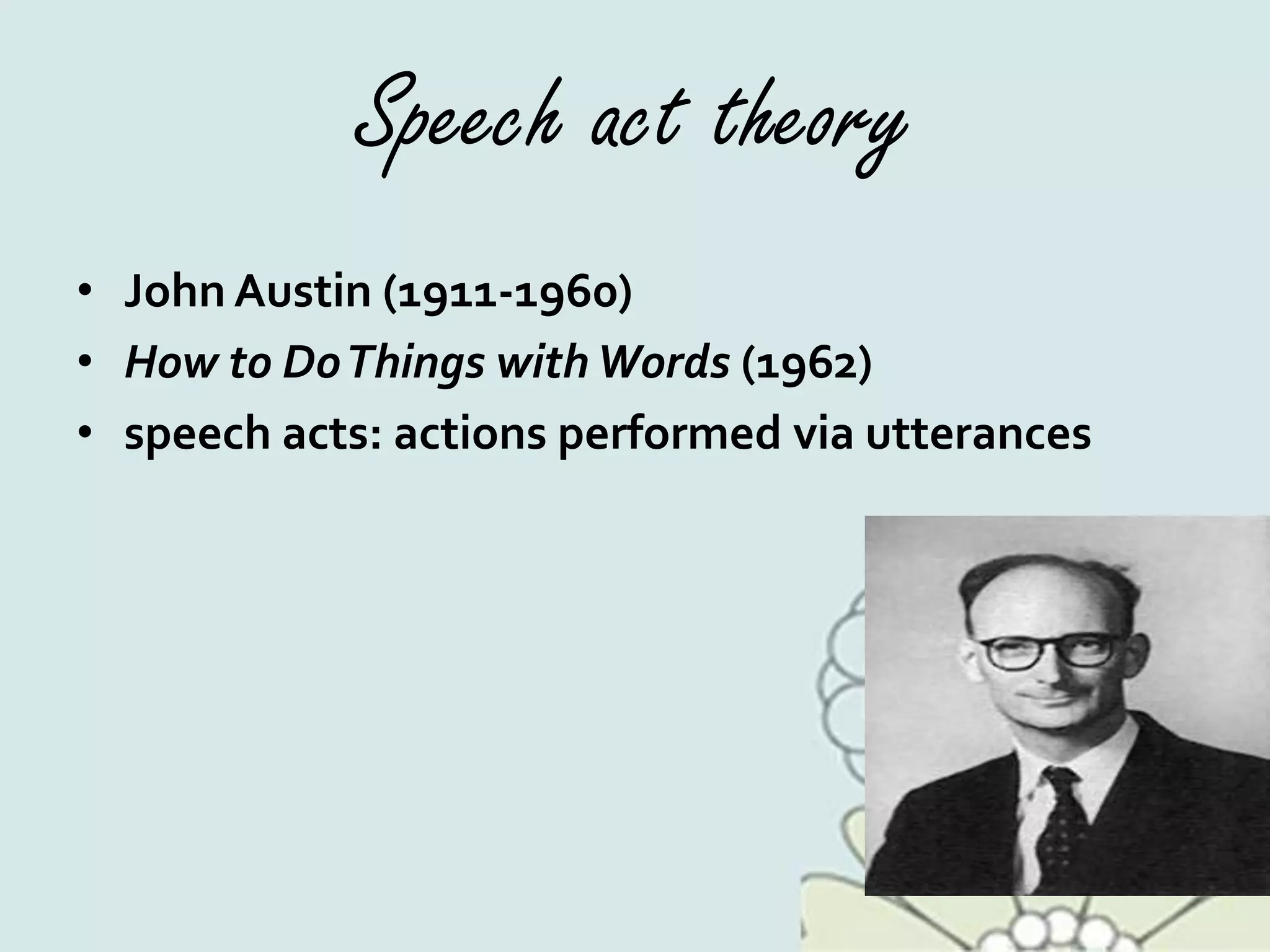
• John Austin (1911-1960)
• How to DoThings with Words (1962)
• speech acts: actions performed via utterances
• Austin (1962)
– An utterance in dialogue is an ACTION
– Speech acts
• Performative sentences uttered by an authority (they change
the state of the world)
– Any sentence in real speech contains
• Locutionary act – utterance with particular meaning
• Illocutionary act – asking, answering, promising, etc.
• Perlocutionary act – effect upon feelings, thoughts, etc.
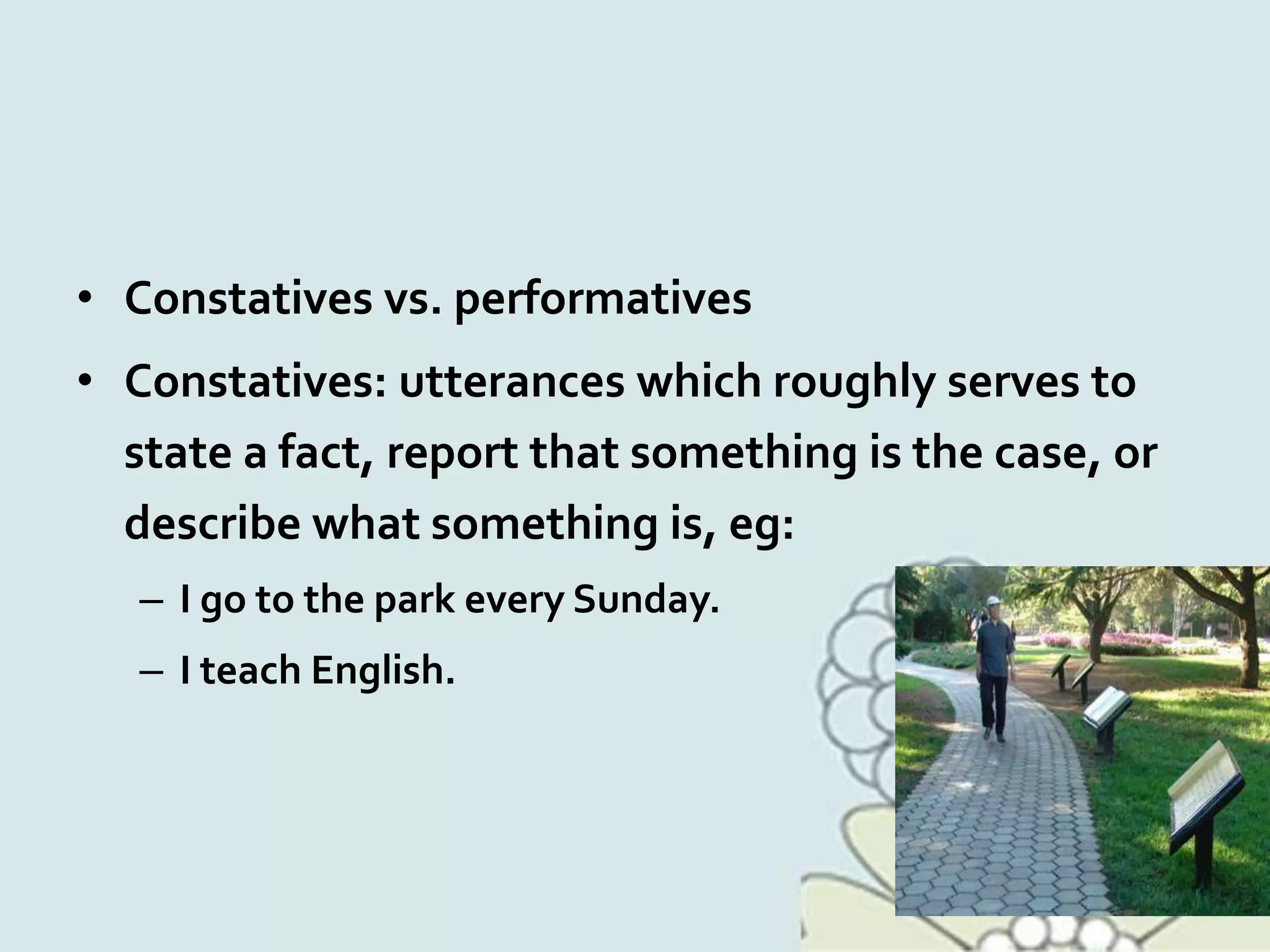
• Constatives vs. performatives
• Constatives: utterances which roughly serves to
state a fact, report that something is the case, or
describe what something is, eg:
– I go to the park every Sunday.
– I teach English.
Performatives
• Performatives: utterances which are used to
perform acts, do not describe or report anything
at all; the uttering of the sentence is the doing of
an action; they cannot be said to be true or false.
• Performative verbs: name, bet, etc.
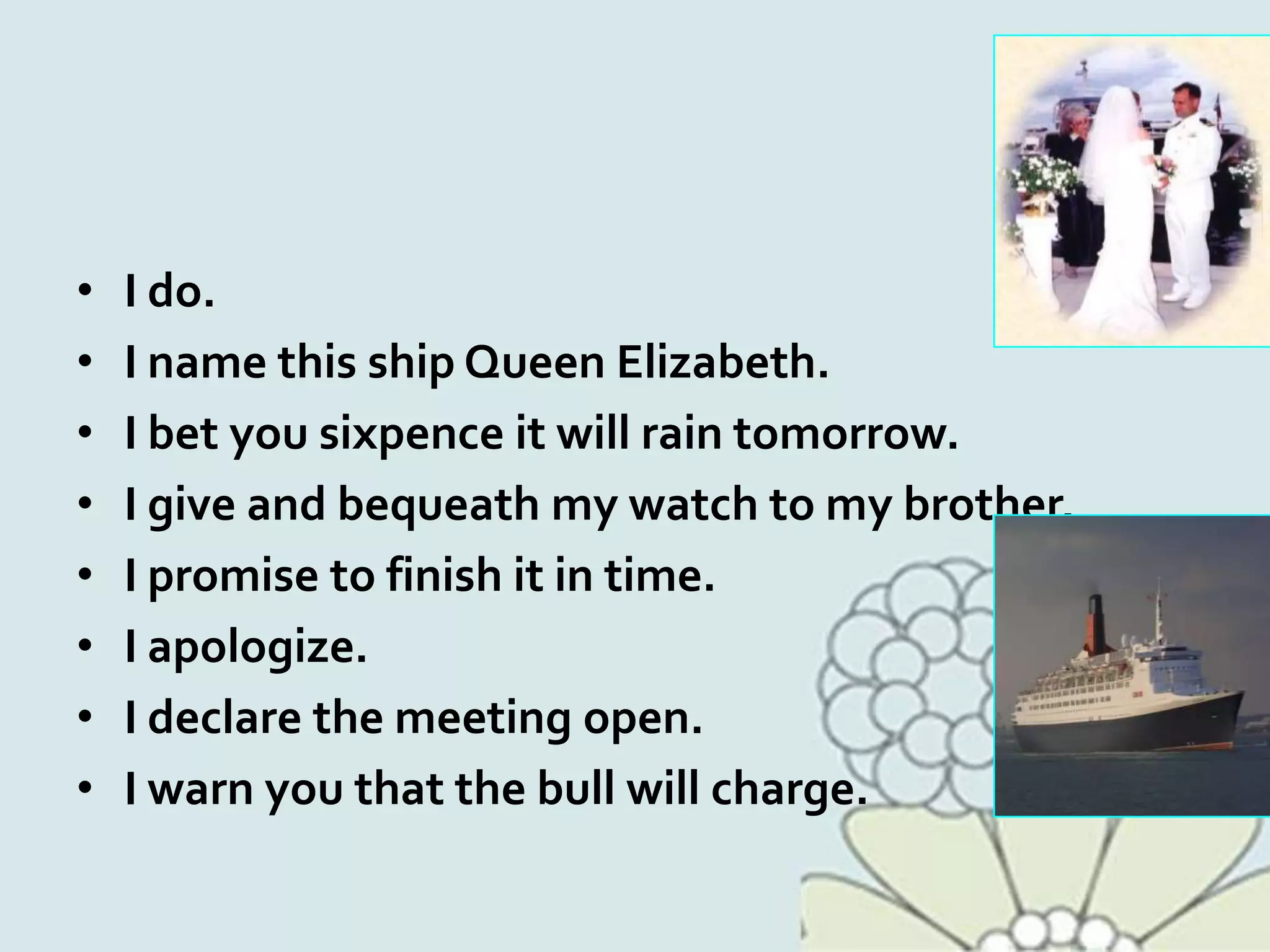
• I do.
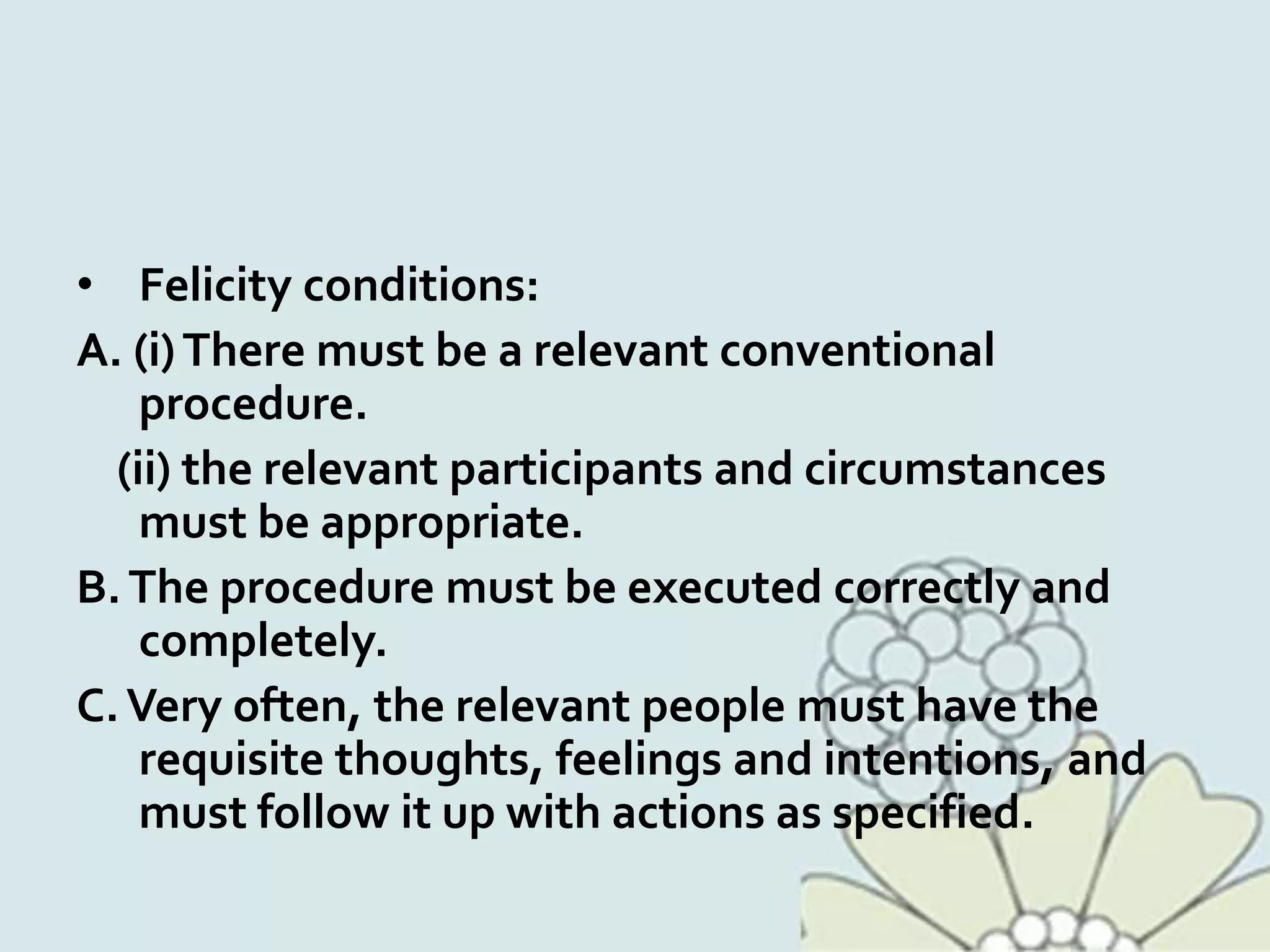
• I name this ship Queen Elizabeth.
• I bet you sixpence it will rain tomorrow.
• I give and bequeath my watch to my brother.
• I promise to finish it in time.
• I apologize.
• I declare the meeting open.
• I warn you that the bull will charge.
• Felicity conditions:
A. (i)There must be a relevant conventional
procedure.
(ii) the relevant participants and circumstances
must be appropriate.
B.The procedure must be executed correctly and
completely.
C.Very often, the relevant people must have the
requisite thoughts, feelings and intentions, and
must follow it up with actions as specified.
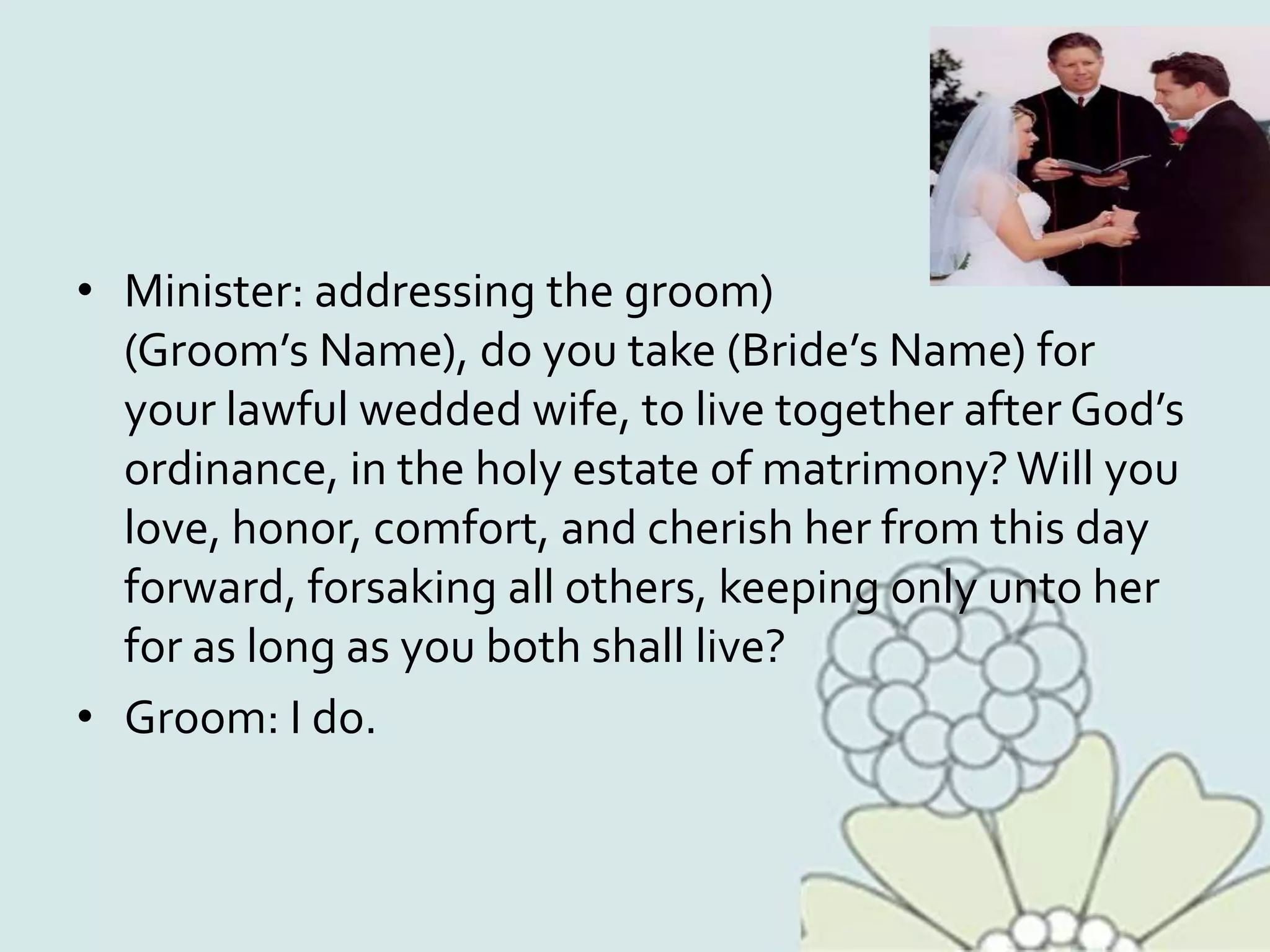
• Minister: addressing the groom)
(Groom’s Name), do you take (Bride’s Name) for
your lawful wedded wife, to live together after God’s
ordinance, in the holy estate of matrimony? Will you
love, honor, comfort, and cherish her from this day
forward, forsaking all others, keeping only unto her
for as long as you both shall live?
• Groom: I do.
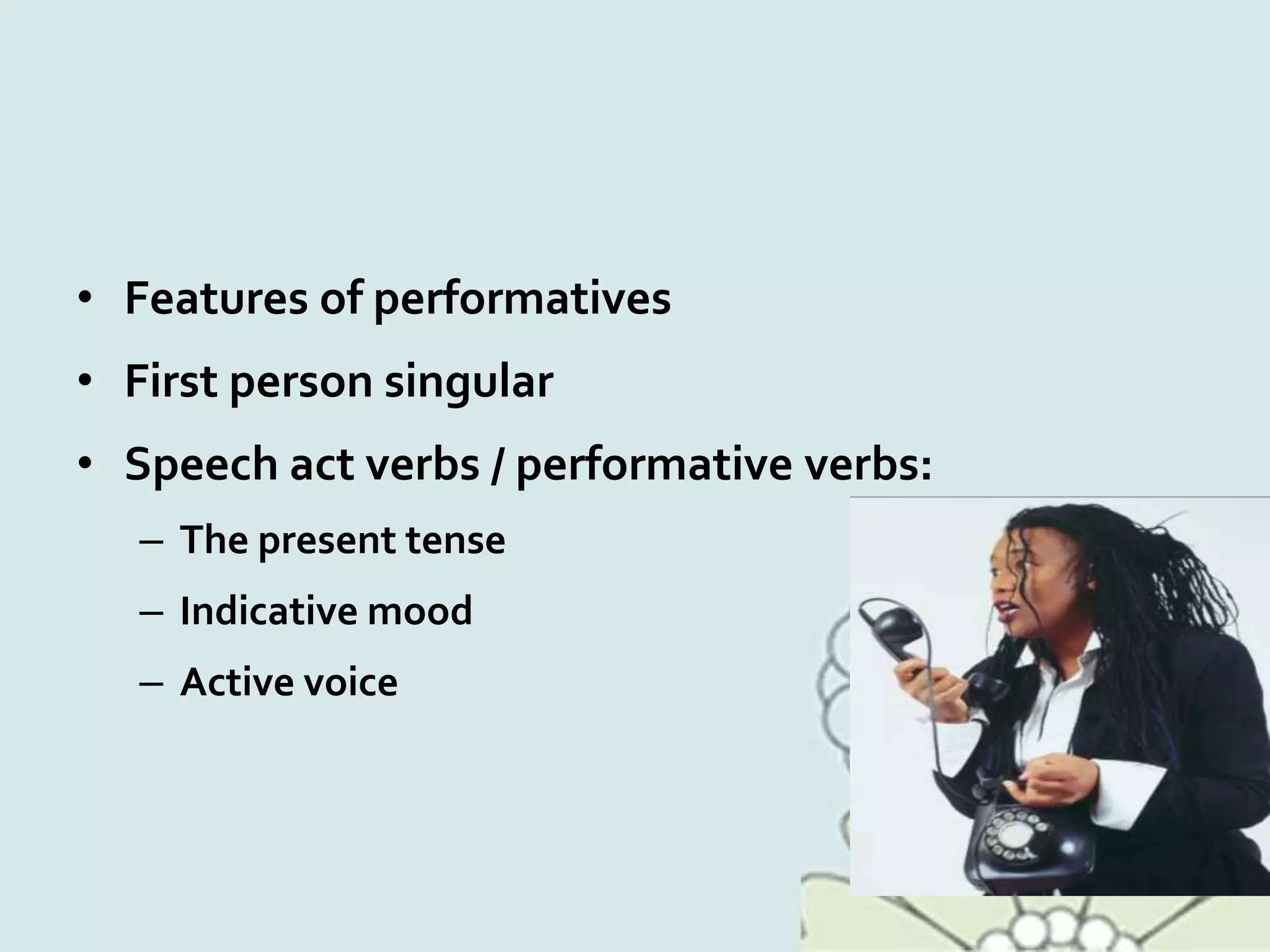
• Features of performatives
• First person singular
• Speech act verbs / performative verbs:
– The present tense
– Indicative mood
– Active voice
• I promise to be there.
– I’ll be there.
• I admit I was wrong.
– I was foolish.
• I warn you, this gun is loaded.
– This gun is loaded.
• I thank you.
– I’m very grateful.
• I apologize.
– I’m sorry.
• I order you to sit down.
– You must sit down.
3 facets of speech acts
• Austin proposed that communicating a speech act
consists of 3 elements:
• Locutionary act
- the act of saying something that makes sense in a
language, the literal meaning of the utterance
- Illocutionary act
- the extra meaning of the utterance produced on the
basis of its literal meaning
• Perlocutionary act
- the effect of the utterance on the hearer, depending
on specific circumstances
It’s stuffy in here.
• Austin proposed that communicating a speech act consists of
3 elements:
• Locutionary act
- the act of saying something that makes sense in a language,
the literal meaning of the utterance
- Illocutionary act
- the extra meaning of the utterance produced on the basis of
its literal meaning
• Perlocutionary act
- the effect of the utterance on the hearer, depending on
specific circumstances
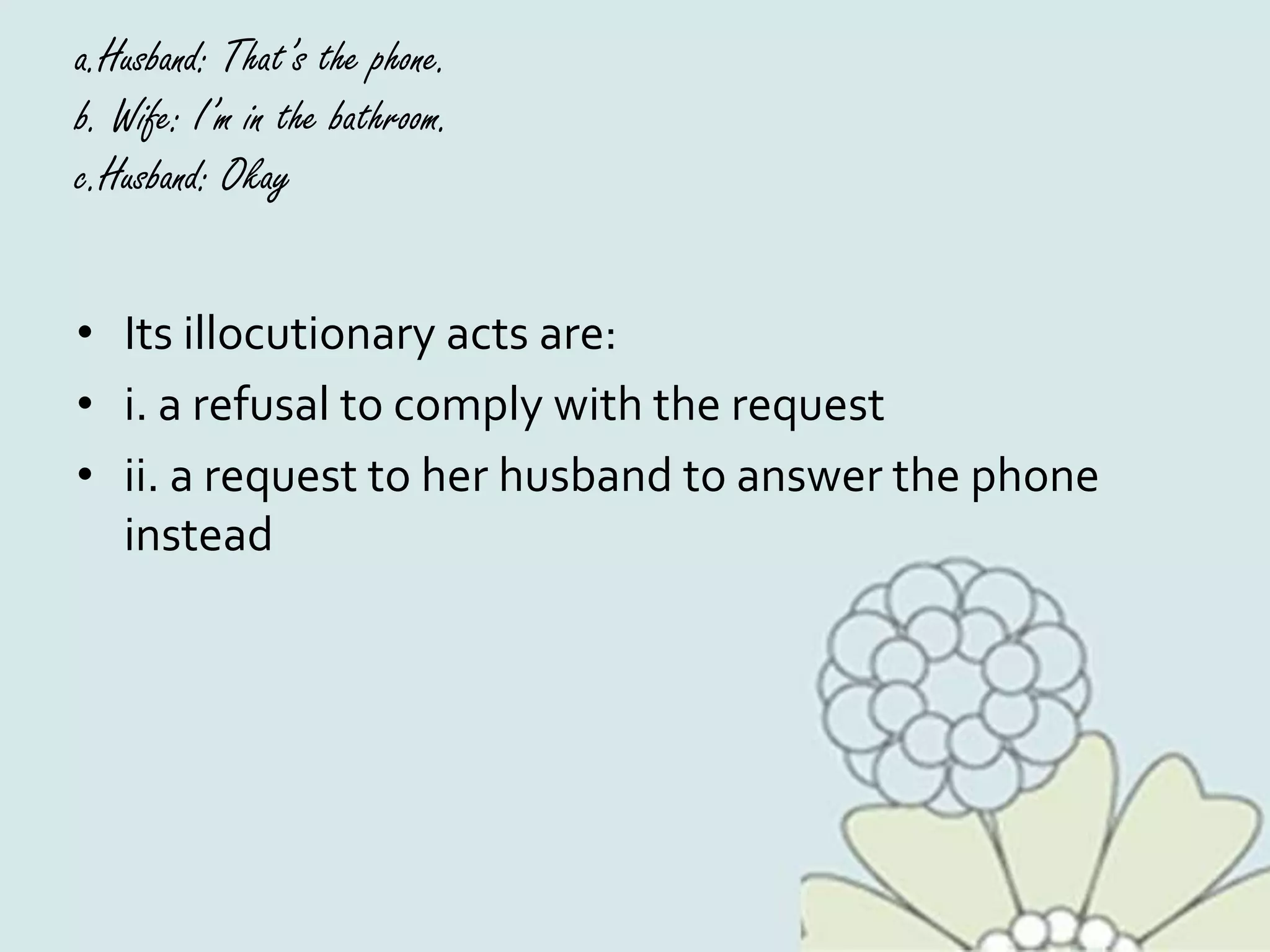
a.Husband: That’s the phone.
b. Wife: I’m in the bathroom.
c.Husband: Okay
• Its illocutionary acts are:
• i. a refusal to comply with the request
• ii. a request to her husband to answer the phone
instead
Speech act theory broadly explains these
utterances
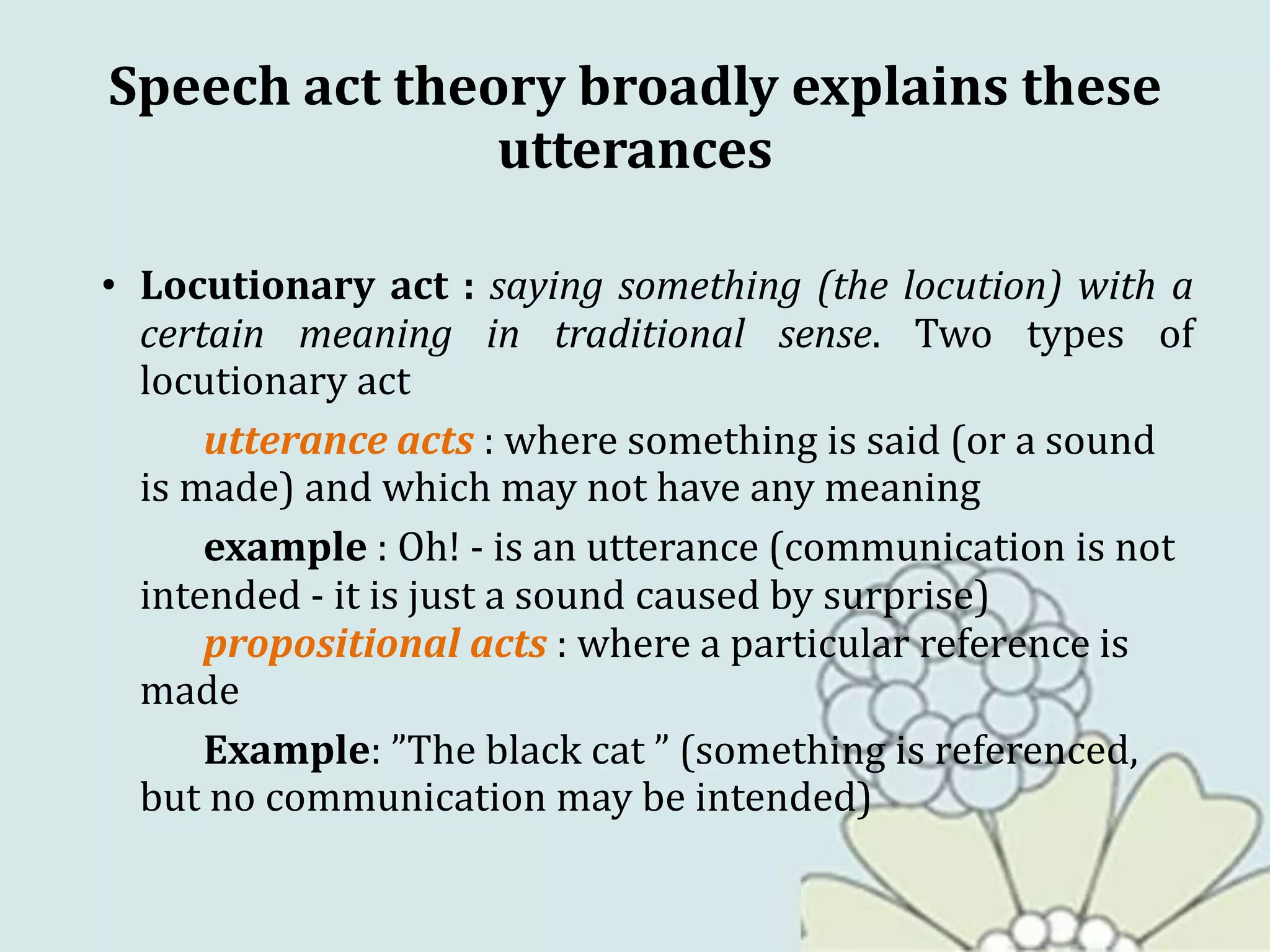
• Locutionary act : saying something (the locution) with a
certain meaning in traditional sense. Two types of
locutionary act
utterance acts : where something is said (or a sound
is made) and which may not have any meaning
example : Oh! - is an utterance (communication is not
intended - it is just a sound caused by surprise)
propositional acts : where a particular reference is
made
Example: ”The black cat ” (something is referenced,
but no communication may be intended)
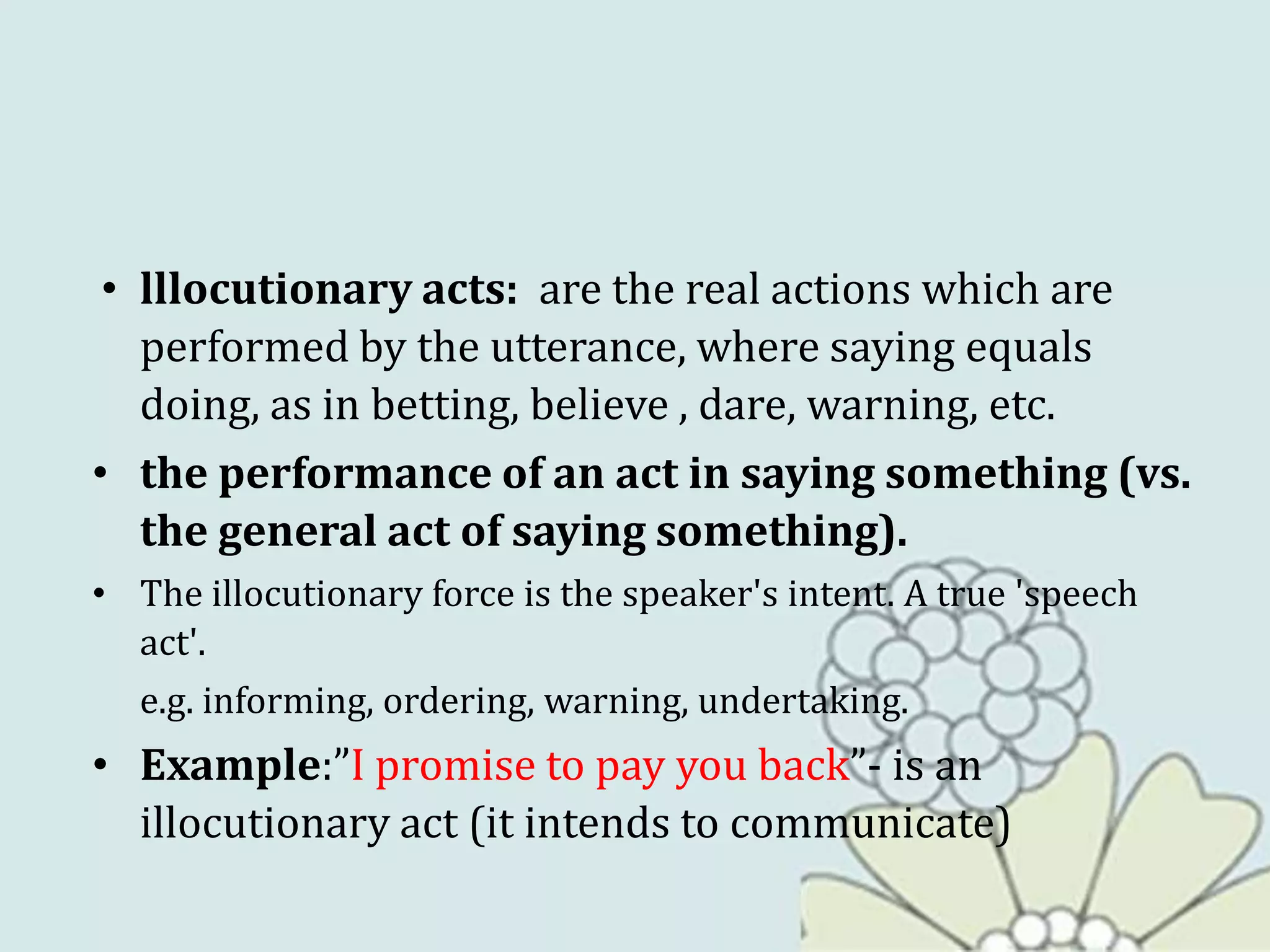
• lllocutionary acts: are the real actions which are
performed by the utterance, where saying equals
doing, as in betting, believe , dare, warning, etc.
• the performance of an act in saying something (vs.
the general act of saying something).
• The illocutionary force is the speaker's intent. A true 'speech
act'.
e.g. informing, ordering, warning, undertaking.
• Example:”I promise to pay you back”- is an
illocutionary act (it intends to communicate)
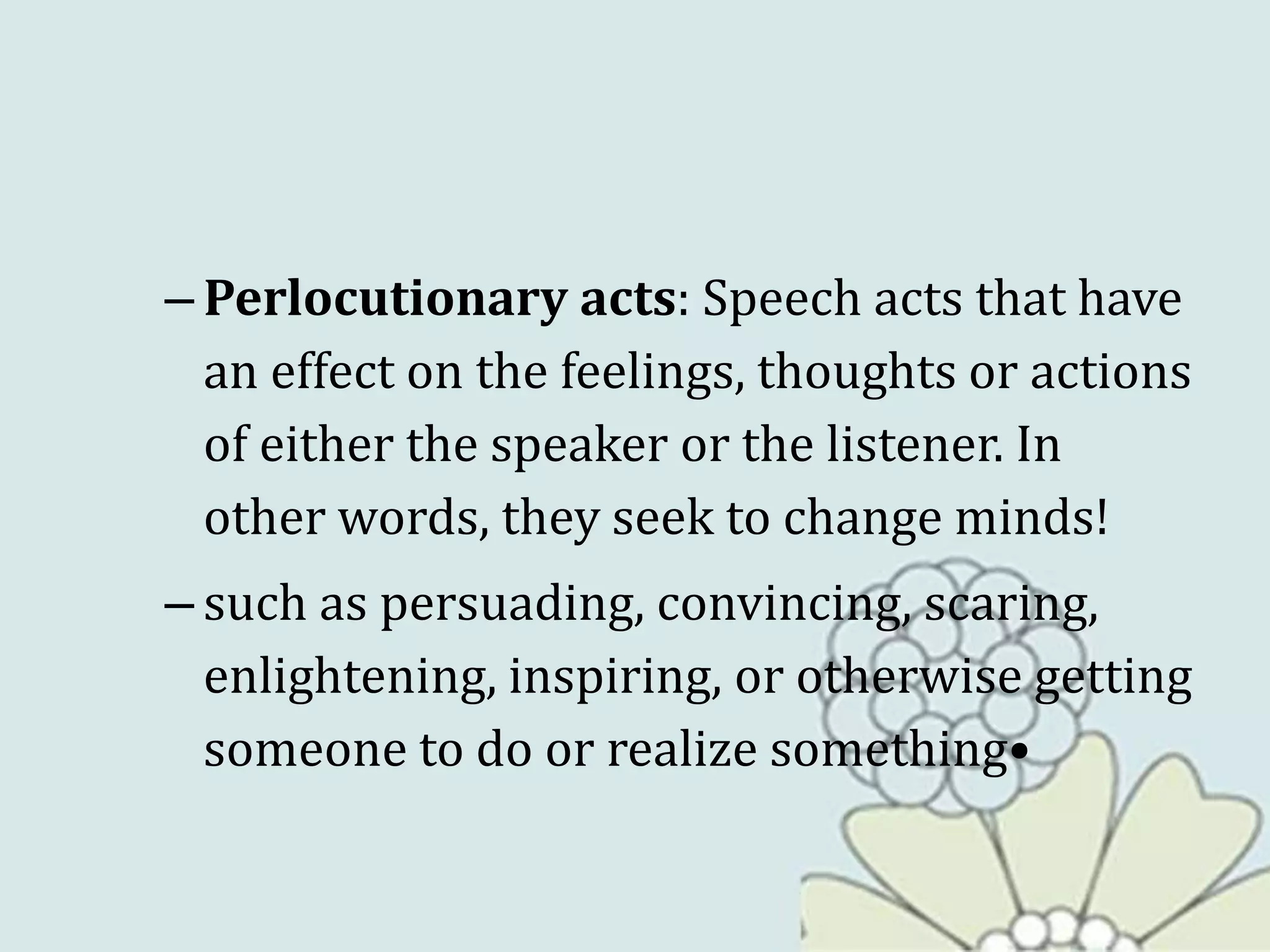
– Perlocutionary acts: Speech acts that have
an effect on the feelings, thoughts or actions
of either the speaker or the listener. In
other words, they seek to change minds!
– such as persuading, convincing, scaring,
enlightening, inspiring, or otherwise getting
someone to do or realize something•
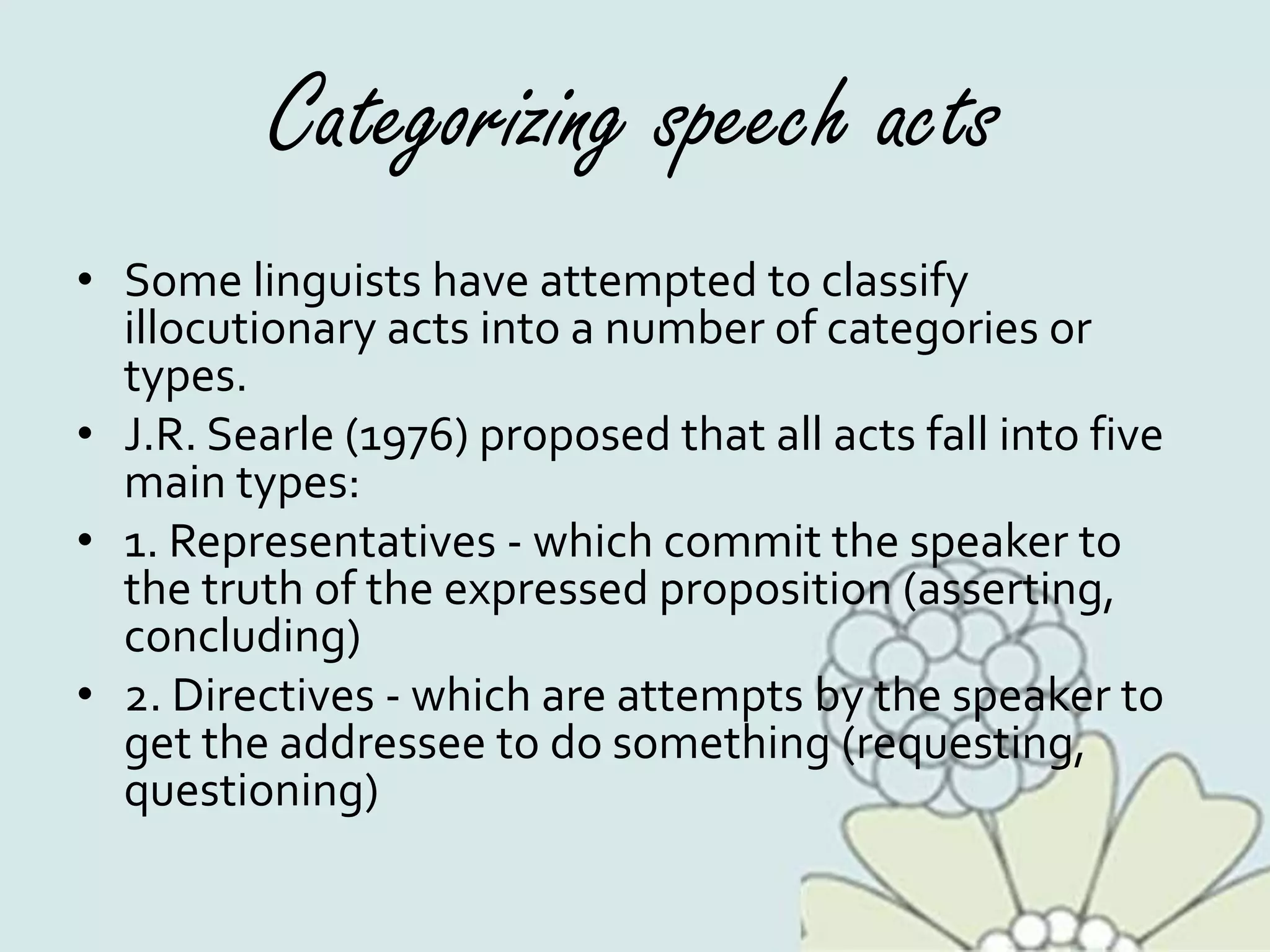
Categorizing speech acts
• Some linguists have attempted to classify
illocutionary acts into a number of categories or
types.
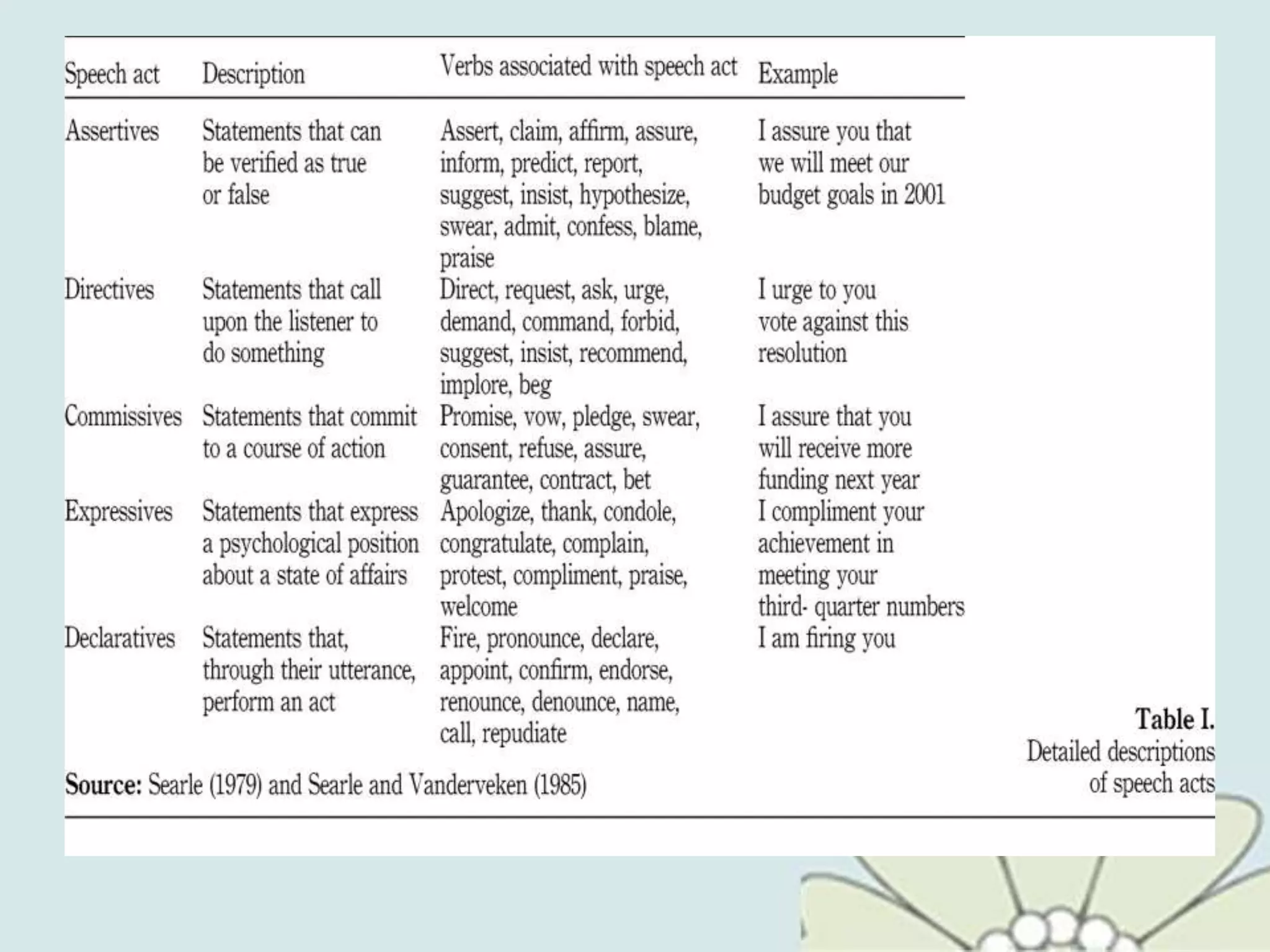
• J.R. Searle (1976) proposed that all acts fall into five
main types:
• 1. Representatives - which commit the speaker to
the truth of the expressed proposition (asserting,
concluding)
• 2. Directives - which are attempts by the speaker to
get the addressee to do something (requesting,
questioning)
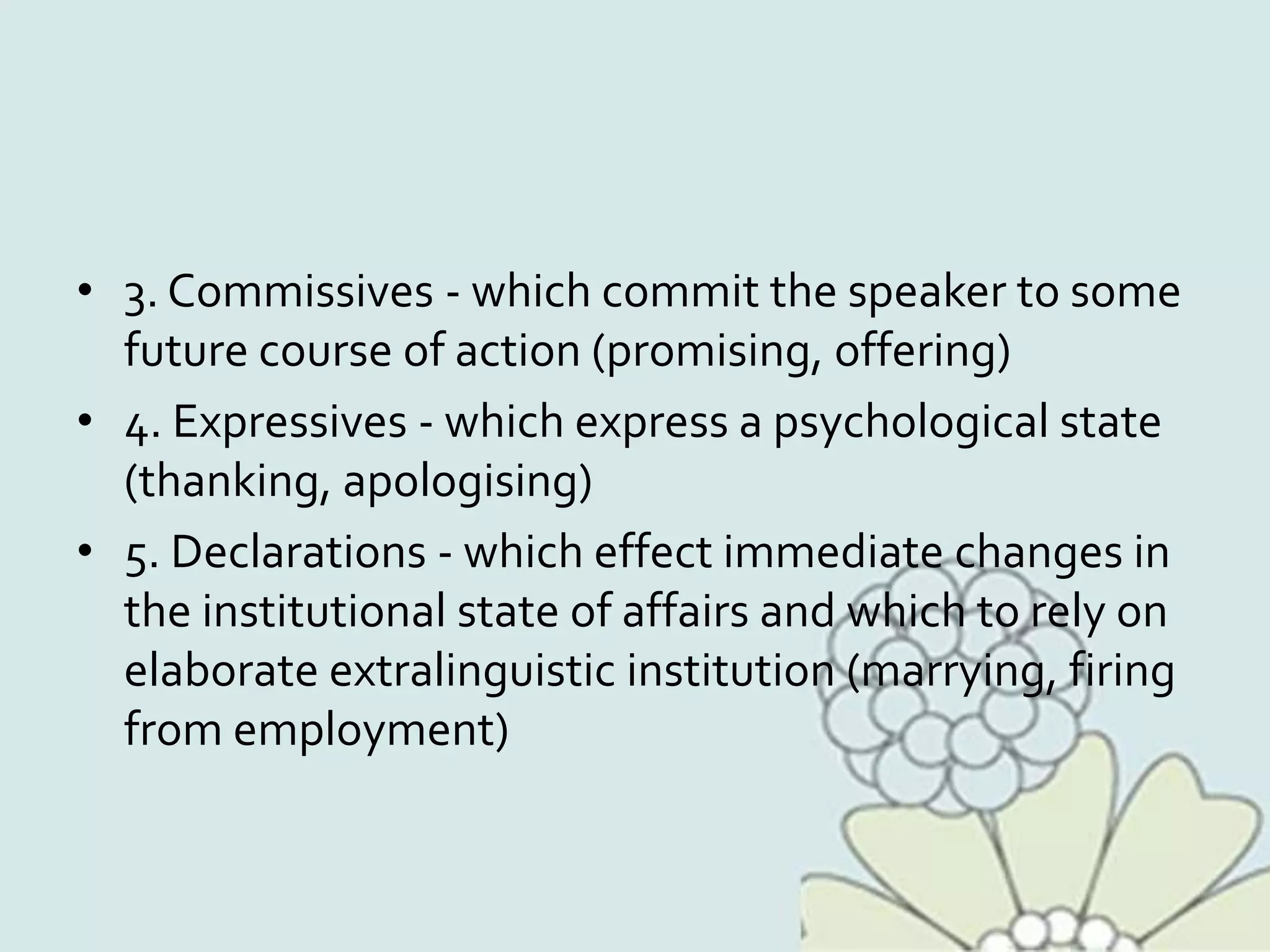
• 3. Commissives - which commit the speaker to some
future course of action (promising, offering)
• 4. Expressives - which express a psychological state
(thanking, apologising)
• 5. Declarations - which effect immediate changes in
the institutional state of affairs and which to rely on
elaborate extralinguistic institution (marrying, firing
from employment)
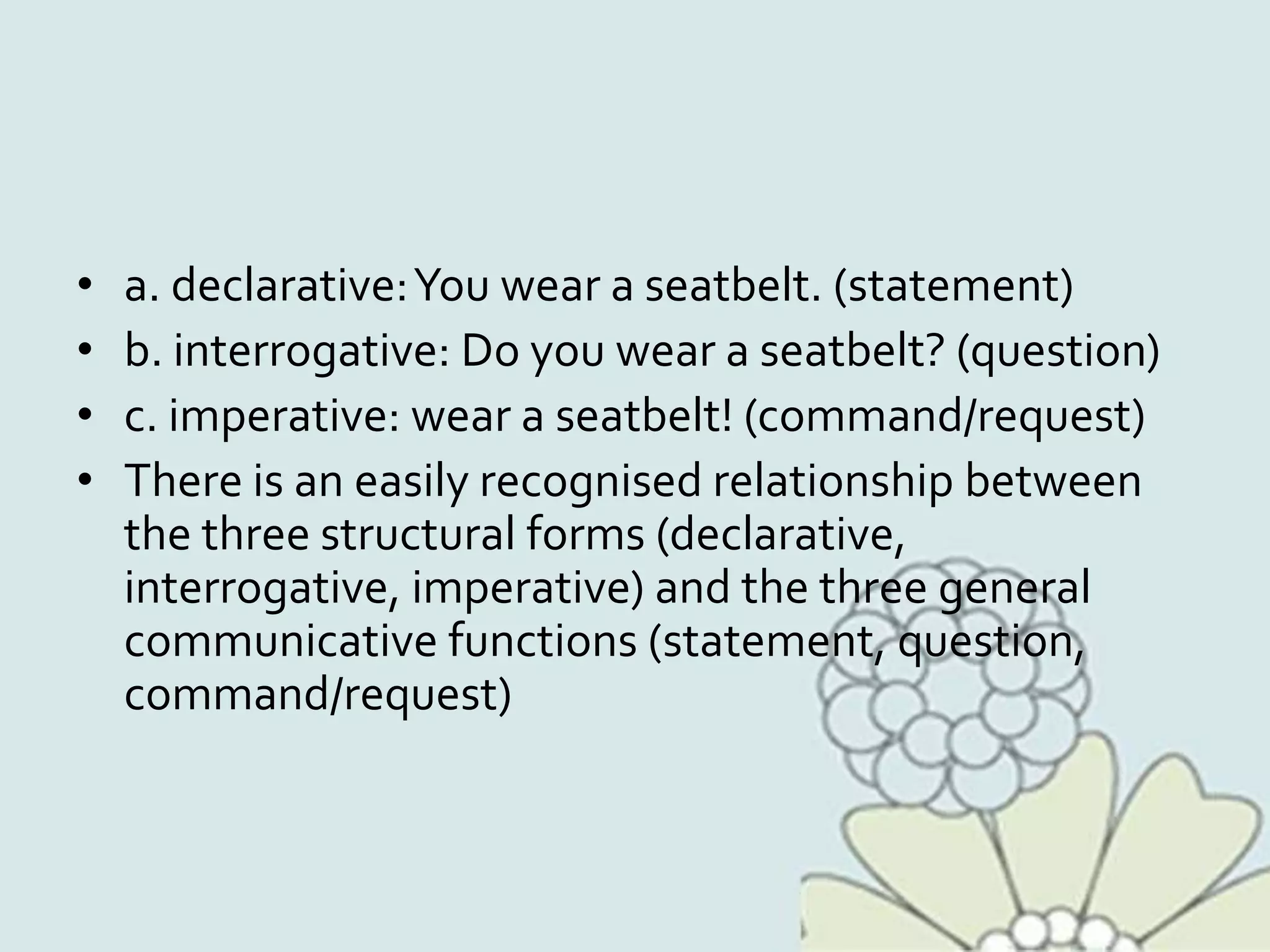
• a. declarative:You wear a seatbelt. (statement)
• b. interrogative: Do you wear a seatbelt? (question)
• c. imperative: wear a seatbelt! (command/request)
• There is an easily recognised relationship between
the three structural forms (declarative,
interrogative, imperative) and the three general
communicative functions (statement, question,
command/request)
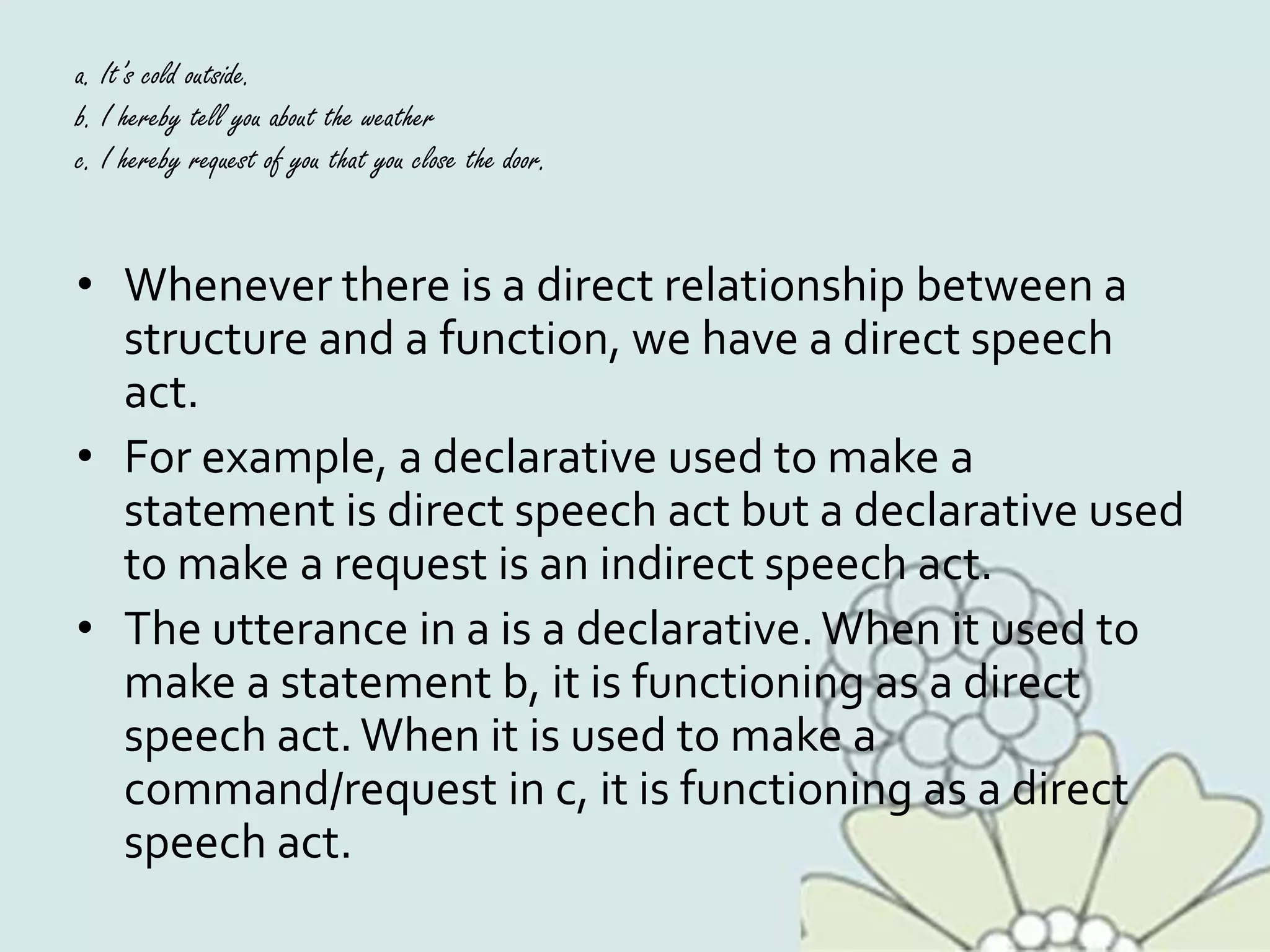
a. It’s cold outside.
b. I hereby tell you about the weather
c. I hereby request of you that you close the door.
• Whenever there is a direct relationship between a
structure and a function, we have a direct speech
act.
• For example, a declarative used to make a
statement is direct speech act but a declarative used
to make a request is an indirect speech act.
• The utterance in a is a declarative.When it used to
make a statement b, it is functioning as a direct
speech act. When it is used to make a
command/request in c, it is functioning as a direct
speech act.
THANK YOU.

Hxe302 speech acts (1)

  • 1.
  • 2.
    Introduction • Pragmatics isa way of investigating how sense can be made of certain texts even when, from a semantic viewpoint, the text seems to be either incomplete or to have a different meaning to what is really intended. Consider a sign seen in a children’s wear shop window: “Baby Sale – lots of bargains.”
  • 3.
    Introduction • We knowwithout asking that there are no babies are for sale – that what is for sale are items used for babies. Pragmatics allows us to investigate how this “meaning beyond the words” can be understood without ambiguity.
  • 4.
    Examples • A littleboy comes in the front door. • Mother:Wipe your feet, please. • He removes his muddy shoes and socks and carefully wipes his clean feet on the doormat.
  • 5.
    • A fathertrying to get his 3-year-old daughter to stop lifting up her dress to display her new underwear to the assembled guests. • Father:We don’t DO that. • Daughter: I KNOW, Daddy. You don’tWEAR dresses.
  • 6.
    • What dothese children still need to learn about using language?
  • 7.
    What does pragmaticsinclude: • Among the things you should know about are: • Speech act theory • The cooperative principle • Conversational maxims • Conversational implicature • Deixis • Politeness
  • 8.
    • Utterances neednot consist of complete sentences. Each utterance is a unique physical event created at a particular point of time for a particular communicative purpose. Ex. Jane: Coffee? Steve: Sure! Jane:White? Steve: Black. • Utterance vs. Sentence – Sentence: abstract units of the language system. – Utterance: units of language in use.
  • 9.
    Speech acts: introduction •The philosopher J. L. Austin (1911-1960) claims that many utterances (things people say) are equivalent to actions. • To communicate we must express propositions with a particular illocutionary force, and in so doing we perform particular kinds of action such as stating, promising, warning, etc, which have come to be called speech acts. • It is important to distinguish between 3 things that one doing in the course of producing an utterance.
  • 10.
    • Sentences areoften used to perform some acts. • For ex., “Can you close the door?” is literally a (yes/no) question, but it can be used as request. • The locution of a sentence is the literal meaning and the illocution of a sentence is its intended meaning. • So the locution of a sentence “Can you close the door?” is a question, but its illocution is a request.
  • 11.
    Speech act theory •John Austin (1911-1960) • How to DoThings with Words (1962) • speech acts: actions performed via utterances
  • 12.
    • Austin (1962) –An utterance in dialogue is an ACTION – Speech acts • Performative sentences uttered by an authority (they change the state of the world) – Any sentence in real speech contains • Locutionary act – utterance with particular meaning • Illocutionary act – asking, answering, promising, etc. • Perlocutionary act – effect upon feelings, thoughts, etc.
  • 13.
    • Constatives vs.performatives • Constatives: utterances which roughly serves to state a fact, report that something is the case, or describe what something is, eg: – I go to the park every Sunday. – I teach English.
  • 14.
    Performatives • Performatives: utteranceswhich are used to perform acts, do not describe or report anything at all; the uttering of the sentence is the doing of an action; they cannot be said to be true or false. • Performative verbs: name, bet, etc.
  • 15.
    • I do. •I name this ship Queen Elizabeth. • I bet you sixpence it will rain tomorrow. • I give and bequeath my watch to my brother. • I promise to finish it in time. • I apologize. • I declare the meeting open. • I warn you that the bull will charge.
  • 16.
    • Felicity conditions: A.(i)There must be a relevant conventional procedure. (ii) the relevant participants and circumstances must be appropriate. B.The procedure must be executed correctly and completely. C.Very often, the relevant people must have the requisite thoughts, feelings and intentions, and must follow it up with actions as specified.
  • 17.
    • Minister: addressingthe groom) (Groom’s Name), do you take (Bride’s Name) for your lawful wedded wife, to live together after God’s ordinance, in the holy estate of matrimony? Will you love, honor, comfort, and cherish her from this day forward, forsaking all others, keeping only unto her for as long as you both shall live? • Groom: I do.
  • 18.
    • Features ofperformatives • First person singular • Speech act verbs / performative verbs: – The present tense – Indicative mood – Active voice
  • 19.
    • I promiseto be there. – I’ll be there. • I admit I was wrong. – I was foolish. • I warn you, this gun is loaded. – This gun is loaded. • I thank you. – I’m very grateful. • I apologize. – I’m sorry. • I order you to sit down. – You must sit down.
  • 20.
    3 facets ofspeech acts • Austin proposed that communicating a speech act consists of 3 elements: • Locutionary act - the act of saying something that makes sense in a language, the literal meaning of the utterance - Illocutionary act - the extra meaning of the utterance produced on the basis of its literal meaning • Perlocutionary act - the effect of the utterance on the hearer, depending on specific circumstances
  • 21.
    It’s stuffy inhere. • Austin proposed that communicating a speech act consists of 3 elements: • Locutionary act - the act of saying something that makes sense in a language, the literal meaning of the utterance - Illocutionary act - the extra meaning of the utterance produced on the basis of its literal meaning • Perlocutionary act - the effect of the utterance on the hearer, depending on specific circumstances
  • 22.
    a.Husband: That’s thephone. b. Wife: I’m in the bathroom. c.Husband: Okay • Its illocutionary acts are: • i. a refusal to comply with the request • ii. a request to her husband to answer the phone instead
  • 23.
    Speech act theorybroadly explains these utterances • Locutionary act : saying something (the locution) with a certain meaning in traditional sense. Two types of locutionary act utterance acts : where something is said (or a sound is made) and which may not have any meaning example : Oh! - is an utterance (communication is not intended - it is just a sound caused by surprise) propositional acts : where a particular reference is made Example: ”The black cat ” (something is referenced, but no communication may be intended)
  • 24.
    • lllocutionary acts:are the real actions which are performed by the utterance, where saying equals doing, as in betting, believe , dare, warning, etc. • the performance of an act in saying something (vs. the general act of saying something). • The illocutionary force is the speaker's intent. A true 'speech act'. e.g. informing, ordering, warning, undertaking. • Example:”I promise to pay you back”- is an illocutionary act (it intends to communicate)
  • 25.
    – Perlocutionary acts:Speech acts that have an effect on the feelings, thoughts or actions of either the speaker or the listener. In other words, they seek to change minds! – such as persuading, convincing, scaring, enlightening, inspiring, or otherwise getting someone to do or realize something•
  • 26.
    Categorizing speech acts •Some linguists have attempted to classify illocutionary acts into a number of categories or types. • J.R. Searle (1976) proposed that all acts fall into five main types: • 1. Representatives - which commit the speaker to the truth of the expressed proposition (asserting, concluding) • 2. Directives - which are attempts by the speaker to get the addressee to do something (requesting, questioning)
  • 27.
    • 3. Commissives- which commit the speaker to some future course of action (promising, offering) • 4. Expressives - which express a psychological state (thanking, apologising) • 5. Declarations - which effect immediate changes in the institutional state of affairs and which to rely on elaborate extralinguistic institution (marrying, firing from employment)
  • 28.
    • a. declarative:Youwear a seatbelt. (statement) • b. interrogative: Do you wear a seatbelt? (question) • c. imperative: wear a seatbelt! (command/request) • There is an easily recognised relationship between the three structural forms (declarative, interrogative, imperative) and the three general communicative functions (statement, question, command/request)
  • 29.
    a. It’s coldoutside. b. I hereby tell you about the weather c. I hereby request of you that you close the door. • Whenever there is a direct relationship between a structure and a function, we have a direct speech act. • For example, a declarative used to make a statement is direct speech act but a declarative used to make a request is an indirect speech act. • The utterance in a is a declarative.When it used to make a statement b, it is functioning as a direct speech act. When it is used to make a command/request in c, it is functioning as a direct speech act.
  • 31.