


THE GRAMMAR-SYNTAX-
ORGANIZATION APPROACH
Team:
Chavez Ganillo Saratiel
Espinosa Camacho Karla
Tapia Fernández Diana
What is it?
• According to M. Scott (1996, p. 146) this
  approach requires students to focus on several
  features of writing at once.

• “The writing tasks are designed to make
  students to pay attention to grammar and syntax
  while also giving them words such as first, then,
  and finally to organize their text.” (M. Scott,
  1996, p.146)
Emphasis
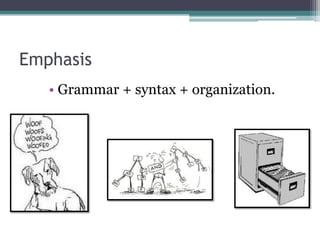
   • Grammar + syntax + organization.
Focus
• To make a link between:

 ▫ Purpose

 ▫ Form

 ▫ Message
Activities

• Organizing and also choosing appropriate
  grammar and vocabulary.
Simple Description with Visuals
• Have students examine a picture and ask
  them to name the objects in it.

• Then ask students to write a paragraph to
  describe the picture. The procedure for
  the activity may be as follows:
Simple Description with Visuals
1. Look at the picture.

2. Label the objects in the picture, then write a
   paragraph to describe the picture.

* Provide students with expressions and
  language structure, such as: “In the
  classroom there is” and have students complete
  the paragraph.
Completing a Description Paragraph
Function Words

• Give students a picture and have them
  complete a description by supplying the
  prepositions and expressions required by the
  context.

• The procedure for this activity may be as
  follows:
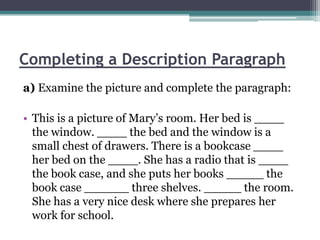
Completing a Description Paragraph
a) Examine the picture and complete the paragraph:

• This is a picture of Mary’s room. Her bed is ____
  the window. ____ the bed and the window is a
  small chest of drawers. There is a bookcase ____
  her bed on the ____. She has a radio that is ____
  the book case, and she puts her books _____ the
  book case ______ three shelves. _____ the room.
  She has a very nice desk where she prepares her
  work for school.
Writing a Description from Questions
• Have students examine a picture and use
  a set of questions as a guide to write a
  short description of the picture.

• The procedure for this activity may be as
  follows:
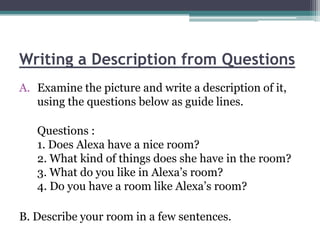
Writing a Description from Questions
A. Examine the picture and write a description of it,
   using the questions below as guide lines.

   Questions :
   1. Does Alexa have a nice room?
   2. What kind of things does she have in the room?
   3. What do you like in Alexa’s room?
   4. Do you have a room like Alexa’s room?

B. Describe your room in a few sentences.
• Show the picture of a group of people sitting
  somewhere and talking.

• Ask the following questions and ask them to
  form a conversation based on it.

a) Who do you think are talking?
b) Where are they sitting?
c) What are they talking about?

Make a conversation for the situation.
Slash Sentences
• Give students a set of sentence cues and
  have them write a short narrative
  paragraph.

• The procedure for this activity may be as
  follows:
Slash Sentences
A) Make complete sentences according to the model.

 Model: The Smiths / Summer / in the country/ spend
 The Smiths spend Summer in the country.

 1. all / family / In the morning / to get up / arround /
 8’oclock.
 2. Mr. Smith / the kitchen / coffee / to prepare / to go
 down strairs.
 3. his / wife / then / breakfast / to go outside / in / the
 garden.

B) Join the sentences into one single paragraph
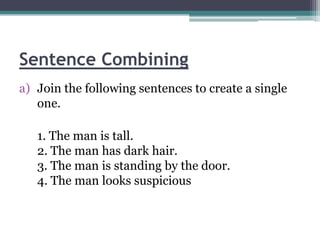
Sentence Combining
• Give students a set of propositions and have
  them combine them into complete sentences.
  The procedure for this activity may be as follows:

• Provide students with set of propositions:
     1. The man is tall.
     2. The man has dark hair.
     3. The man is standing by the door.
     4. The man looks suspicious

• Have students combine the propositions in one
  sentence.
Sentence Combining
a) Join the following sentences to create a single
   one.

   1. The man is tall.
   2. The man has dark hair.
   3. The man is standing by the door.
   4. The man looks suspicious
References
• M. Scott, V. (1996). Teaching foreing language
  writing. In Rethinking Foreign Language
  Teaching (p. 146). Boston: Heinle & Heinle
  Publishers.

• Ghaith, G. (February 11, 2002). Writing.
  Retrieved on September 19, 2011. From
  http://www.nadasisland.com/ghaith-
  writing.html#approaches

The grammar syntax-organization approach

  • 1.
    THE GRAMMAR-SYNTAX- ORGANIZATION APPROACH Team: ChavezGanillo Saratiel Espinosa Camacho Karla Tapia Fernández Diana
  • 2.
    What is it? •According to M. Scott (1996, p. 146) this approach requires students to focus on several features of writing at once. • “The writing tasks are designed to make students to pay attention to grammar and syntax while also giving them words such as first, then, and finally to organize their text.” (M. Scott, 1996, p.146)
  • 3.
    Emphasis • Grammar + syntax + organization.
  • 4.
    Focus • To makea link between: ▫ Purpose ▫ Form ▫ Message
  • 5.
    Activities • Organizing andalso choosing appropriate grammar and vocabulary.
  • 6.
    Simple Description withVisuals • Have students examine a picture and ask them to name the objects in it. • Then ask students to write a paragraph to describe the picture. The procedure for the activity may be as follows:
  • 8.
    Simple Description withVisuals 1. Look at the picture. 2. Label the objects in the picture, then write a paragraph to describe the picture. * Provide students with expressions and language structure, such as: “In the classroom there is” and have students complete the paragraph.
  • 9.
    Completing a DescriptionParagraph Function Words • Give students a picture and have them complete a description by supplying the prepositions and expressions required by the context. • The procedure for this activity may be as follows:
  • 10.
    Completing a DescriptionParagraph a) Examine the picture and complete the paragraph: • This is a picture of Mary’s room. Her bed is ____ the window. ____ the bed and the window is a small chest of drawers. There is a bookcase ____ her bed on the ____. She has a radio that is ____ the book case, and she puts her books _____ the book case ______ three shelves. _____ the room. She has a very nice desk where she prepares her work for school.
  • 11.
    Writing a Descriptionfrom Questions • Have students examine a picture and use a set of questions as a guide to write a short description of the picture. • The procedure for this activity may be as follows:
  • 12.
    Writing a Descriptionfrom Questions A. Examine the picture and write a description of it, using the questions below as guide lines. Questions : 1. Does Alexa have a nice room? 2. What kind of things does she have in the room? 3. What do you like in Alexa’s room? 4. Do you have a room like Alexa’s room? B. Describe your room in a few sentences.
  • 14.
    • Show thepicture of a group of people sitting somewhere and talking. • Ask the following questions and ask them to form a conversation based on it. a) Who do you think are talking? b) Where are they sitting? c) What are they talking about? Make a conversation for the situation.
  • 16.
    Slash Sentences • Givestudents a set of sentence cues and have them write a short narrative paragraph. • The procedure for this activity may be as follows:
  • 17.
    Slash Sentences A) Makecomplete sentences according to the model. Model: The Smiths / Summer / in the country/ spend The Smiths spend Summer in the country. 1. all / family / In the morning / to get up / arround / 8’oclock. 2. Mr. Smith / the kitchen / coffee / to prepare / to go down strairs. 3. his / wife / then / breakfast / to go outside / in / the garden. B) Join the sentences into one single paragraph
  • 18.
    Sentence Combining • Givestudents a set of propositions and have them combine them into complete sentences. The procedure for this activity may be as follows: • Provide students with set of propositions: 1. The man is tall. 2. The man has dark hair. 3. The man is standing by the door. 4. The man looks suspicious • Have students combine the propositions in one sentence.
  • 19.
    Sentence Combining a) Jointhe following sentences to create a single one. 1. The man is tall. 2. The man has dark hair. 3. The man is standing by the door. 4. The man looks suspicious
  • 20.
    References • M. Scott,V. (1996). Teaching foreing language writing. In Rethinking Foreign Language Teaching (p. 146). Boston: Heinle & Heinle Publishers. • Ghaith, G. (February 11, 2002). Writing. Retrieved on September 19, 2011. From http://www.nadasisland.com/ghaith- writing.html#approaches