Speech acts Concept proposed by John Langshaw Austin in 1962 one of the founders of pragmatic and later developed byJohn R. Searle in 1969, both philosophers of language. Speech acts refer to the moments in which statementsoccur in the communicative act within a given context.Speech Acts are group of utterances with a single interactional function.
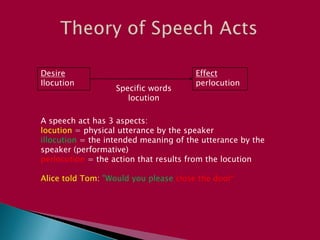
Theory of Speech ActsDesireIlocutionEffectperlocutionSpecific words locutionA speech act has 3 aspects:locution= physical utterance by the speaker illocution= the intended meaning of the utterance by the speaker (performative) perlocution= the action that results from the locution Alice told Tom: "Would you please close the door“
Levels of actionLocutionary act: is the basic act of utterance, or producing a meaningful linguistic expressions. Performing an act of saying something One sentence can be used to perform illocutionary acts of various types or with various contents. depending on the circumstances, do any one of several different things, so we can use a sentence with a given locutionary content in a variety of ways. Austin defines it "as belonging to a certain vocabulary...and as conforming to a certain grammar,...with a certain more or less definite sense and reference"
Ilocutionary act: are the real actions which are performed by the utterance. We form an utterance with some kind of function in mind. This communicative force of an utterance is known as illocutionary force.Performing an act in saying somethingLevels of ActionTypes of Ilocutionary  ActsILLOCUTIONARY ACT       ATTITUDE EXPRESSED        INTENDED HEARER ATTITUDE Statement                               belief that A            belief that Arequest               desire for A to do smth    intention to do smthpromisefirm intention to do smth  belief that A will do smthapologyregret for Doing smth     forgiveness of A                                          for Doing smth
Types of ilocutionary ActsConstatives: affirming, announcing, answering, confirming.“we find the defendant guilty” Directives: advising, asking, forbidding, ordering, permitting.“would you make some tea, please?
Types of Ilocutionary ActsCommissives: agreeing, inviting, offering, promising, “I promise to call you tonight” Acknowledgments: apologizing, congratulating, thanking.
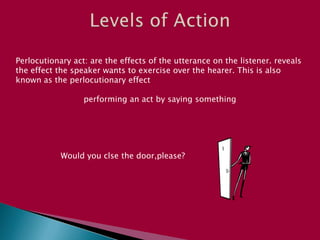
Levels of ActionPerlocutionary act: are the effects of the utterance on the listener. reveals the effect the speaker wants to exercise over the hearer. This is also known as the perlocutionary effectperforming an act by saying somethingWould you clse the door,please?
ExampleA bartender utters the words, "The bar will be closed in five minutes,“ The locutionary act of saying that the bar will be closed in five minutes , where what is said is reported by indirect quotation.The illocutionary act insaying this, the bartender is informing the patrons of the bar's imminent closing and perhaps also the act of urging them to order a last drink. The bartender intends to be performing the perlocutionary acts of causing the patrons to believe that the bar is about to close and of getting them to order one last drink.

Speech acts

  • 1.
    Speech acts Conceptproposed by John Langshaw Austin in 1962 one of the founders of pragmatic and later developed byJohn R. Searle in 1969, both philosophers of language. Speech acts refer to the moments in which statementsoccur in the communicative act within a given context.Speech Acts are group of utterances with a single interactional function.
  • 2.
    Theory of SpeechActsDesireIlocutionEffectperlocutionSpecific words locutionA speech act has 3 aspects:locution= physical utterance by the speaker illocution= the intended meaning of the utterance by the speaker (performative) perlocution= the action that results from the locution Alice told Tom: "Would you please close the door“
  • 3.
    Levels of actionLocutionaryact: is the basic act of utterance, or producing a meaningful linguistic expressions. Performing an act of saying something One sentence can be used to perform illocutionary acts of various types or with various contents. depending on the circumstances, do any one of several different things, so we can use a sentence with a given locutionary content in a variety of ways. Austin defines it "as belonging to a certain vocabulary...and as conforming to a certain grammar,...with a certain more or less definite sense and reference"
  • 4.
    Ilocutionary act: arethe real actions which are performed by the utterance. We form an utterance with some kind of function in mind. This communicative force of an utterance is known as illocutionary force.Performing an act in saying somethingLevels of ActionTypes of Ilocutionary ActsILLOCUTIONARY ACT ATTITUDE EXPRESSED INTENDED HEARER ATTITUDE Statement belief that A belief that Arequest desire for A to do smth intention to do smthpromisefirm intention to do smth belief that A will do smthapologyregret for Doing smth forgiveness of A for Doing smth
  • 5.
    Types of ilocutionaryActsConstatives: affirming, announcing, answering, confirming.“we find the defendant guilty” Directives: advising, asking, forbidding, ordering, permitting.“would you make some tea, please?
  • 6.
    Types of IlocutionaryActsCommissives: agreeing, inviting, offering, promising, “I promise to call you tonight” Acknowledgments: apologizing, congratulating, thanking.
  • 7.
    Levels of ActionPerlocutionaryact: are the effects of the utterance on the listener. reveals the effect the speaker wants to exercise over the hearer. This is also known as the perlocutionary effectperforming an act by saying somethingWould you clse the door,please?
  • 8.
    ExampleA bartender uttersthe words, "The bar will be closed in five minutes,“ The locutionary act of saying that the bar will be closed in five minutes , where what is said is reported by indirect quotation.The illocutionary act insaying this, the bartender is informing the patrons of the bar's imminent closing and perhaps also the act of urging them to order a last drink. The bartender intends to be performing the perlocutionary acts of causing the patrons to believe that the bar is about to close and of getting them to order one last drink.