29 International Journal of Research in Science & Technology
Volume: 2 | Issue: 2 | February 2015 | ISSN: 2349-0845IJRST
I. INTRODUCTION
One of the most popular non-conventional energy
sources is the solar energy. The Grid connected PV system is
the very popular way of utilizing solar energy. Photovoltaic
panels are used to convert the solar energy into electrical
energy. PV has nonlinear characteristics. The voltage-power
characteristics of the PV panel is varied which depends upon
insolation and temperature. Considering the high initial
installation cost of the PV system, it is always necessary to
operate PV at its Maximum Power Point (MPPT).In this
system, sunlight is captured by the PV array. Therefore, daily
and seasonal solar position changes are followed in order to
face the sun directly and capture the most available sunlight.
The output of the PV panel is connected to an inverter to
operate at the desired voltage to match the maximum
available power from the PV module. A sliding mode
controller is used to estimate the maximum power point as a
reference for it to track that point and force the PV system to
operate in this point. The load is composed of a battery bank.
It is obtained by controlling the duty cycle of an inverter
using sliding Mode control. This MPPT inverter for grid
connection or to supply power to the AC loads. It can also
store energywhen the PV module generates more power than
that demanded. In distribution system, these generated
powers are transmitted through grid to load. If the load
increased, the source side power demand occurs. In order to
maintain the power be constant in both grid and load side,
inject the additional power to grid by using PV module. The
PV plants, the voltage are controlled by using a voltage
control devices like on load tap changers, autonomous
Reactive Power Compensation in Distribution
Network with slide mode MPPT Control for
PV System
S.Rahumath Beevi 1
, A.Subanth Williams 2
and L.Yousuf Siddique 3
1
Electrical & Electronics Engineering, PET Engineering College, Tirunelveli, Tamilnadu, INDIA.
2
Electrical & Electronics Engineering, PET Engineering College, Tirunelveli, Tamilnadu, INDIA.
3
Electrical & Electronics Engineering, PET Engineering College, Tirunelveli, Tamilnadu, INDIA.
Article Info ABSTRACT
Article history:
Receive on 3rd
February 2015
Accepted on 09th
February 2015
Published on 21st
February 2015
The Grid connected PV system requires a proper voltage control controller.
In this paper an efficient voltage control by using slide mode controller with
Maximum Power Point Tracking (MPPT) is presented. The voltage
command is determined by the PV panel. Here the sliding mode controller is
designed so as to balance the power flow from PV panel to the grid and load
such that the PV power is utilized effectively. The design and simulation
using MATLAB is presented in this work.
Keyword:
PV- Grid connected system,
Slide mode controller,
MPPT,
MATLAB,
Copyright © 2015 International Journal of Research in Science & Technology
All rights reserved.
Corresponding Author:
S.Rahumath Beevi
Electrical & Electronics Engineering,
PET Engineering College,
Tirunelveli, INDIA.
Email Id: amzhapsncet@gmail.com
30 International Journal of Research in Science & Technology
A Compact Remote Switching With Efficient Monitoring For AC Plants
voltage regulators and capacitors. These voltage control
mechanisms are increased the tap operation and also reduces
the life time of the feeder circuit. So in advanced, byusing the
power electronic switching devices, the reactive power be
compensated and that improves the operation and
functionality of the power distribution system. Electricity
generated by a grid- connected photovoltaic power system
will reduce power bill and easily installed and do not need a
Battery system. Once installed, these systems are essentially
maintenance free, generate no pollution and are as silent as
the sun. Increasing evidence suggests installing a PV system
adds value to your property.
II. PRINCIPLE OF OPERATION
This project is about to carried out the optimization and
implementation of a slide mode maximum power point
controller for PV system, are presented. This controller is
used to estimate the maximum power point as a reference for
it to track that point and force the PV system to operate in this
point. Maximum power point tracking are used to integrate
with photovoltaic power systems so that the photovoltaic
arrays are able to deliver the maximum power available. In
general, PV generates megawatt power. In distribution
system, these generated powers are transmitted through grid
to load. If the load increased, the source side power demand
occurs. In order to maintain the power be constant in both
grid and load side, inject the additional power to grid by
using PV module. The PV plants, the voltage are controlled
by using voltage control devices like on load tap changers,
autonomous voltage regulators and capacitors. These voltage
control mechanisms are increased the tap operation and also
reduces the life time of the feeder circuit. The main objective
of this project is using the power electronic switching devices
instead of voltage control mechanisms, the reactive power be
compensated and that improves the operation and
functionality of the power distribution system.
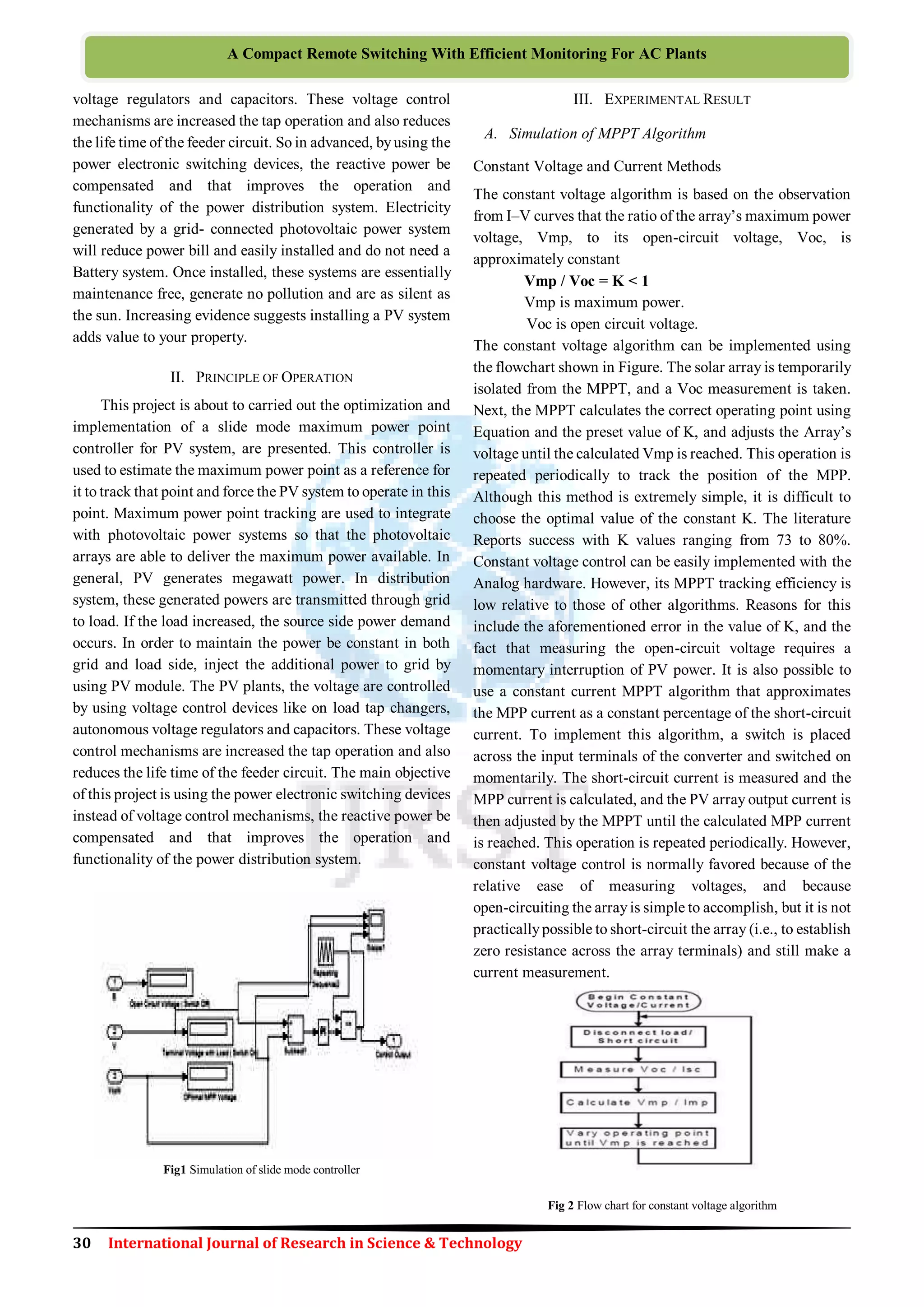
Fig1 Simulation of slide mode controller
III. EXPERIMENTAL RESULT
A. Simulation of MPPT Algorithm
Constant Voltage and Current Methods
The constant voltage algorithm is based on the observation
from I–V curves that the ratio of the array’s maximum power
voltage, Vmp, to its open-circuit voltage, Voc, is
approximately constant
Vmp / Voc = K < 1
Vmp is maximum power.
Voc is open circuit voltage.
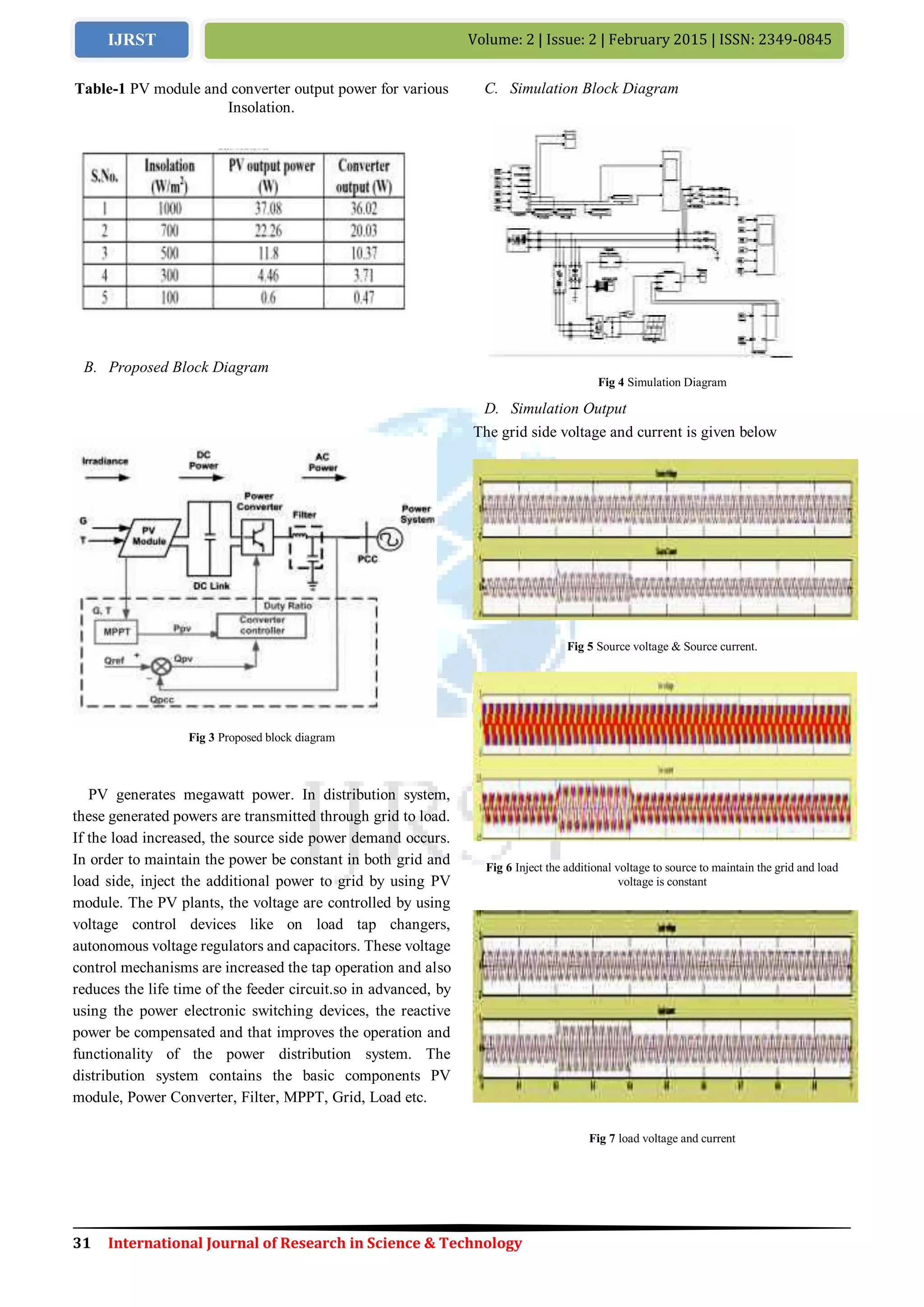
The constant voltage algorithm can be implemented using
the flowchart shown in Figure. The solar array is temporarily
isolated from the MPPT, and a Voc measurement is taken.
Next, the MPPT calculates the correct operating point using
Equation and the preset value of K, and adjusts the Array’s
voltage until the calculated Vmp is reached. This operation is
repeated periodically to track the position of the MPP.
Although this method is extremely simple, it is difficult to
choose the optimal value of the constant K. The literature
Reports success with K values ranging from 73 to 80%.
Constant voltage control can be easily implemented with the
Analog hardware. However, its MPPT tracking efficiency is
low relative to those of other algorithms. Reasons for this
include the aforementioned error in the value of K, and the
fact that measuring the open-circuit voltage requires a
momentary interruption of PV power. It is also possible to
use a constant current MPPT algorithm that approximates
the MPP current as a constant percentage of the short-circuit
current. To implement this algorithm, a switch is placed
across the input terminals of the converter and switched on
momentarily. The short-circuit current is measured and the
MPP current is calculated, and the PV array output current is
then adjusted by the MPPT until the calculated MPP current
is reached. This operation is repeated periodically. However,
constant voltage control is normally favored because of the
relative ease of measuring voltages, and because
open-circuiting the arrayis simple to accomplish, but it is not
practicallypossible to short-circuit the array (i.e., to establish
zero resistance across the array terminals) and still make a
current measurement.
Fig 2 Flow chart for constant voltage algorithm
31 International Journal of Research in Science & Technology
Volume: 2 | Issue: 2 | February 2015 | ISSN: 2349-0845IJRST
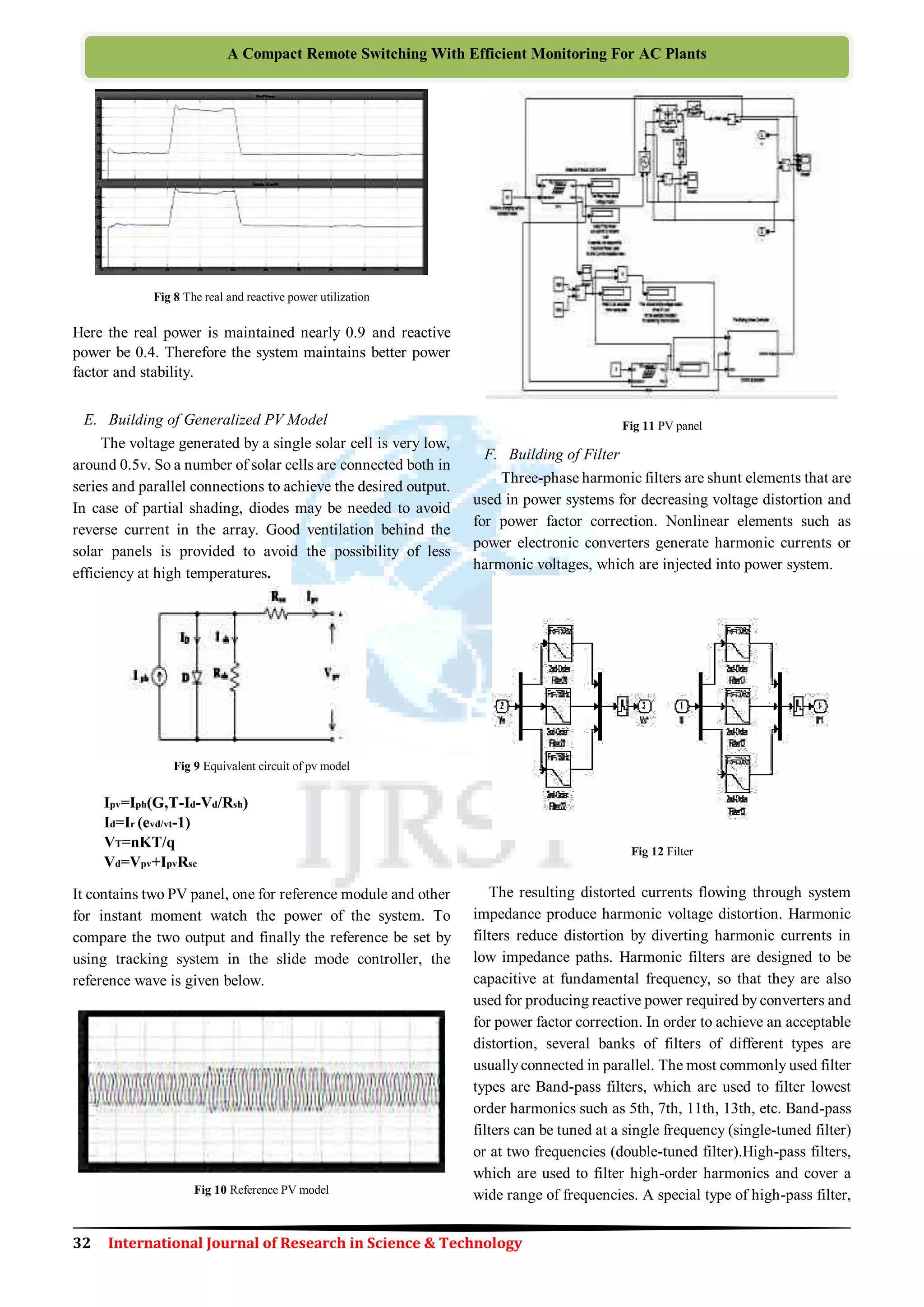
Table-1 PV module and converter output power for various
Insolation.
B. Proposed Block Diagram
Fig 3 Proposed block diagram
PV generates megawatt power. In distribution system,
these generated powers are transmitted through grid to load.
If the load increased, the source side power demand occurs.
In order to maintain the power be constant in both grid and
load side, inject the additional power to grid by using PV
module. The PV plants, the voltage are controlled by using
voltage control devices like on load tap changers,
autonomous voltage regulators and capacitors. These voltage
control mechanisms are increased the tap operation and also
reduces the life time of the feeder circuit.so in advanced, by
using the power electronic switching devices, the reactive
power be compensated and that improves the operation and
functionality of the power distribution system. The
distribution system contains the basic components PV
module, Power Converter, Filter, MPPT, Grid, Load etc.
C. Simulation Block Diagram
Fig 4 Simulation Diagram
D. Simulation Output
The grid side voltage and current is given below
Fig 5 Source voltage & Source current.
Fig 6 Inject the additional voltage to source to maintain the grid and load
voltage is constant
Fig 7 load voltage and current
32 International Journal of Research in Science & Technology
A Compact Remote Switching With Efficient Monitoring For AC Plants
Fig 8 The real and reactive power utilization
Here the real power is maintained nearly 0.9 and reactive
power be 0.4. Therefore the system maintains better power
factor and stability.
E. Building of Generalized PV Model
The voltage generated by a single solar cell is very low,
around 0.5v. So a number of solar cells are connected both in
series and parallel connections to achieve the desired output.
In case of partial shading, diodes may be needed to avoid
reverse current in the array. Good ventilation behind the
solar panels is provided to avoid the possibility of less
efficiency at high temperatures.
Fig 9 Equivalent circuit of pv model
Ipv=Iph(G,T-Id-Vd/Rsh)
Id=Ir (evd/vt-1)
VT=nKT/q
Vd=Vpv+IpvRsc
It contains two PV panel, one for reference module and other
for instant moment watch the power of the system. To
compare the two output and finally the reference be set by
using tracking system in the slide mode controller, the
reference wave is given below.
Fig 10 Reference PV model
Fig 11 PV panel
F. Building of Filter
Three-phase harmonic filters are shunt elements that are
used in power systems for decreasing voltage distortion and
for power factor correction. Nonlinear elements such as
power electronic converters generate harmonic currents or
harmonic voltages, which are injected into power system.
Fig 12 Filter
The resulting distorted currents flowing through system
impedance produce harmonic voltage distortion. Harmonic
filters reduce distortion by diverting harmonic currents in
low impedance paths. Harmonic filters are designed to be
capacitive at fundamental frequency, so that they are also
used for producing reactive power required by converters and
for power factor correction. In order to achieve an acceptable
distortion, several banks of filters of different types are
usuallyconnected in parallel. The most commonly used filter
types are Band-pass filters, which are used to filter lowest
order harmonics such as 5th, 7th, 11th, 13th, etc. Band-pass
filters can be tuned at a single frequency (single-tuned filter)
or at two frequencies (double-tuned filter).High-pass filters,
which are used to filter high-order harmonics and cover a
wide range of frequencies. A special type of high-pass filter,
33 International Journal of Research in Science & Technology
Volume: 2 | Issue: 2 | February 2015 | ISSN: 2349-0845IJRST
The C-type high-pass filter is used to provide reactive power
and avoid parallel resonances. It also allows filtering low
order harmonics (such as 3rd), while keeping zero losses at
fundamental frequency.
G. Subsystem
Fig 13 Subsystem
The subsystem contains the set point value as 1600. It
contains the input of the inverter (Vabc, Iabc, Vdc). It used to
rectifythe error byusing PI controller and finalized output be
produced and it is given to the gate terminal of the inverter
sections.
IV. CONCLUSION
Thus the simulation results are verified for the output
voltage is maintained constant for both grid side and load
side with the help of power electronics switches. The
effectiveness of the scheme is tested through simulations on a
realistic distribution network model. Proposed coordinated
reactive power dispatch, are reduced without detrimental
impact on the feeder voltage. By using the slide mode
controller, the constant voltage is maintained. By reducing
the voltage control mechanisms like on load tap changers
and autonomous regulators and capacitors etc. and also avoid
runaway condition and Life time of the system be improved.
REFERENCES
[1] Global market outlook for photovoltaic until 2016,” May 2012 [Online].
Available: http://www.epia.org/
[2] C. L. Masters, “Voltage rise: the big issue when connecting embedded
generation to long 11kv overhead lines,” Power Eng. J., vol. 16, no. 1, pp.
5–12, 2002.T.Stetz, Marten and Braun, “Improved low voltage
grid-integration of photovoltaic system in Germany” IEEE Trans Sustain
Energy, vol. 4, no. 2, pp. 534–542, Apr. 2013.
[3] A.G.Madureira and J. A. P. Lopes, “Voltage and reactive power control in
MV networks integrating micro grids,” Proc. ICREPQ, vol. 7, pp. 1–5,
2007.
[4] T. Basso, J. Ham brick, and D. DeBlasio, “Update and review of IEEE
p2030 smart grid IEEE 1547 inter connection standards,” Innovative
Smart Grid Technologies, pp. 1–7, 2012.
[5] “BDEW technical guideline for generating plants connected to the
medium-voltage network,” May 2012. [Online]. Available:
http://www.bdew.de
[6] F. Katiraei and J. R. Aguero, “Solar PV integration challenges,” IEEE
Power Energy Mag., vol. 9, no. 3, pp. 62–71, 2011.
[7] L. M. Cipcigan and P. C. Taylor, “Investigation of the reverse power flow
requirements of high penetrations of small-scale embedded generation,”
IET Renewable Power Gen., vol.1, no.3, pp.160–166, 2007.
[8] U.S. Dept. of Energy sun shot Initiative 2008 [Online]. Available:
https://solarhighpen.energy.gov/
[9] R. A. Walling, R. Saint, R. C. Dugan, J. Burke, and L. A. Kojovic,
“Summary of distributed resources impact on power delivery system,”
IEEE Trans. Power Del., vol. 23, no. 3, pp. 1636–1644, Jul. 2008
[10] R. H. Liang and C. K. Cheng, “Dispatch of main transformer ULTC and
capacitors in a distribution system,” IEEE Trans. Power Del., vol. 16, no.
4, pp. 625–630, Oct. 2001.
[11] R. A. Walling and K. Clark, “Grid support functions implemented in
utility-scale PV system,” in Proc. IEEE PES Trans, Distribution. Conf.
Expo., 2010, pp. 1–5.
[12] W. H. Ker sting, Distribution System Modeling and Analysis. Boca
Raton, FL, USA: CRC, 2002.
[13] “McGraw-Edison VR-32 regulators and CL-5 series control,” Cooper
Ind. [Online]. Available: http://www.cooperindustries.com.
[14] “MJ-4A(TM) AND MJ-4B(TM) voltage regulator control panel,”
Siemens [Online]. Available: http://www.energy.siemens.com/.
[15] P. A. N. Garcia, J. L. R. Pereira, S. C. Jr, V. M. daCosta, and N. Martins,
“Three-phase power flow calculations using the current injection
method,” , IEEE Trans. Power Syst., vol. 15, no. 2, pp. 508–514, May
2000.
[16] E. T. Jauch, “Possible effects of smart grid functions on LTC trans-
formers,” IEEE Trans. Ind. Appl., vol. 47, no. 2, pp. 1013–1021, Mar.
–Apr. 2011.
[17] R.A. Jabr, A.H. Coonick, and B.J.Cory,“A primal-dual interior point
method for optimal power flow dispatching,” IEEE Trans. Power Syst.,
vol. 17, no. 3, pp. 654–662, Aug. 2002.
[18] S. J. Wright, Primal-Dual Interior-Point Methods. Philadelphia, PA,
USA: Soc. for Ind. Appl. Math., 1997, vol. 54.
[19] W. J. Smolensk, “Equivalent circuit analysis of power system reactive
power and voltage control problems,” IEEE Trans. Power App. Syst, vol.
PAS-100, no. 2, pp. 837–842, 1981.
[20] M. B. Liu, C. A. Canizares, and W. Huang, “Reactive power and voltage
control in distribution system with limited switching operations,” IEEE
Trans. Power Syst., vol. 24, no. 2, pp. 889–899, May 2009.
[21] S. Paudyal, C. A. Canizares, and K. Bhattacharya, “Optimal operation of
distribution feeders in smart grids,” IEEE Trans. Ind. Electron.,vol. 58,
no. 10, pp. 4495–4503, Oct. 2011.
[22] T. E. McDermott, “Modeling PV for unbalanced, dynamic and quasistatic
distribution system analysis, ”in Proc. IEEE Power Energy Soc. Gen.
Meet., 2011, pp. 1–3.
[23] M. Fila, G. A. Taylor, M. R. Irving, J. His cock, P. Lang, and P. Aston,
“Systematic modeling and analysis of tap voltage control schemes,” in
Proc. IEEE 42nd Int. Universities Power Eng. Conf., 2007, pp.
349–356.A.Malekpour and A. Pahwa, “Reactive power and voltage
control in distribution system with photo voltaic generation,” in Proc.
IEEE North Amer. Power Sym., 2012, pp. 1–6.
S.RAHUMATH BEEVI received the B.E degree In
Electronics and communication engineering from PSN
College of engineering technology Tirunelveli in 2013.
And currently doing the Master degree in Power electronics
and Drives from PET engineering College valliyur,
Tirunelveli in 2015. And also interested in distribution &
transmission systems.
A.SUBANTH WILLIAMS received the B.E degree in
electrical and electronics engineering in Jeyamatha
engineering college, Aralvaimozhi and M.E degrees in
power electronics and drives. He is a Professor with the
Department of electrical Engineering in PET engineering
college, valliyur. His research interests include the area
under the Power Quality. And also he is the member of
MISTE.
L.YOUSUF SIDDIQUE received the B.E degree in electrical and electronics
engineering in National College of engineering, Maruthakulam, Tirunelveli
and M.E degrees in power system from ANNA University of Technology
Trichy. He is a Professor with the Department of electrical Engineering in PET
engineering college, valliyur.

Reactive Power Compensation in Distribution Network with Slide Mode MPPT Control for PV System

  • 1.
    29 International Journalof Research in Science & Technology Volume: 2 | Issue: 2 | February 2015 | ISSN: 2349-0845IJRST I. INTRODUCTION One of the most popular non-conventional energy sources is the solar energy. The Grid connected PV system is the very popular way of utilizing solar energy. Photovoltaic panels are used to convert the solar energy into electrical energy. PV has nonlinear characteristics. The voltage-power characteristics of the PV panel is varied which depends upon insolation and temperature. Considering the high initial installation cost of the PV system, it is always necessary to operate PV at its Maximum Power Point (MPPT).In this system, sunlight is captured by the PV array. Therefore, daily and seasonal solar position changes are followed in order to face the sun directly and capture the most available sunlight. The output of the PV panel is connected to an inverter to operate at the desired voltage to match the maximum available power from the PV module. A sliding mode controller is used to estimate the maximum power point as a reference for it to track that point and force the PV system to operate in this point. The load is composed of a battery bank. It is obtained by controlling the duty cycle of an inverter using sliding Mode control. This MPPT inverter for grid connection or to supply power to the AC loads. It can also store energywhen the PV module generates more power than that demanded. In distribution system, these generated powers are transmitted through grid to load. If the load increased, the source side power demand occurs. In order to maintain the power be constant in both grid and load side, inject the additional power to grid by using PV module. The PV plants, the voltage are controlled by using a voltage control devices like on load tap changers, autonomous Reactive Power Compensation in Distribution Network with slide mode MPPT Control for PV System S.Rahumath Beevi 1 , A.Subanth Williams 2 and L.Yousuf Siddique 3 1 Electrical & Electronics Engineering, PET Engineering College, Tirunelveli, Tamilnadu, INDIA. 2 Electrical & Electronics Engineering, PET Engineering College, Tirunelveli, Tamilnadu, INDIA. 3 Electrical & Electronics Engineering, PET Engineering College, Tirunelveli, Tamilnadu, INDIA. Article Info ABSTRACT Article history: Receive on 3rd February 2015 Accepted on 09th February 2015 Published on 21st February 2015 The Grid connected PV system requires a proper voltage control controller. In this paper an efficient voltage control by using slide mode controller with Maximum Power Point Tracking (MPPT) is presented. The voltage command is determined by the PV panel. Here the sliding mode controller is designed so as to balance the power flow from PV panel to the grid and load such that the PV power is utilized effectively. The design and simulation using MATLAB is presented in this work. Keyword: PV- Grid connected system, Slide mode controller, MPPT, MATLAB, Copyright © 2015 International Journal of Research in Science & Technology All rights reserved. Corresponding Author: S.Rahumath Beevi Electrical & Electronics Engineering, PET Engineering College, Tirunelveli, INDIA. Email Id: amzhapsncet@gmail.com
  • 2.
    30 International Journalof Research in Science & Technology A Compact Remote Switching With Efficient Monitoring For AC Plants voltage regulators and capacitors. These voltage control mechanisms are increased the tap operation and also reduces the life time of the feeder circuit. So in advanced, byusing the power electronic switching devices, the reactive power be compensated and that improves the operation and functionality of the power distribution system. Electricity generated by a grid- connected photovoltaic power system will reduce power bill and easily installed and do not need a Battery system. Once installed, these systems are essentially maintenance free, generate no pollution and are as silent as the sun. Increasing evidence suggests installing a PV system adds value to your property. II. PRINCIPLE OF OPERATION This project is about to carried out the optimization and implementation of a slide mode maximum power point controller for PV system, are presented. This controller is used to estimate the maximum power point as a reference for it to track that point and force the PV system to operate in this point. Maximum power point tracking are used to integrate with photovoltaic power systems so that the photovoltaic arrays are able to deliver the maximum power available. In general, PV generates megawatt power. In distribution system, these generated powers are transmitted through grid to load. If the load increased, the source side power demand occurs. In order to maintain the power be constant in both grid and load side, inject the additional power to grid by using PV module. The PV plants, the voltage are controlled by using voltage control devices like on load tap changers, autonomous voltage regulators and capacitors. These voltage control mechanisms are increased the tap operation and also reduces the life time of the feeder circuit. The main objective of this project is using the power electronic switching devices instead of voltage control mechanisms, the reactive power be compensated and that improves the operation and functionality of the power distribution system. Fig1 Simulation of slide mode controller III. EXPERIMENTAL RESULT A. Simulation of MPPT Algorithm Constant Voltage and Current Methods The constant voltage algorithm is based on the observation from I–V curves that the ratio of the array’s maximum power voltage, Vmp, to its open-circuit voltage, Voc, is approximately constant Vmp / Voc = K < 1 Vmp is maximum power. Voc is open circuit voltage. The constant voltage algorithm can be implemented using the flowchart shown in Figure. The solar array is temporarily isolated from the MPPT, and a Voc measurement is taken. Next, the MPPT calculates the correct operating point using Equation and the preset value of K, and adjusts the Array’s voltage until the calculated Vmp is reached. This operation is repeated periodically to track the position of the MPP. Although this method is extremely simple, it is difficult to choose the optimal value of the constant K. The literature Reports success with K values ranging from 73 to 80%. Constant voltage control can be easily implemented with the Analog hardware. However, its MPPT tracking efficiency is low relative to those of other algorithms. Reasons for this include the aforementioned error in the value of K, and the fact that measuring the open-circuit voltage requires a momentary interruption of PV power. It is also possible to use a constant current MPPT algorithm that approximates the MPP current as a constant percentage of the short-circuit current. To implement this algorithm, a switch is placed across the input terminals of the converter and switched on momentarily. The short-circuit current is measured and the MPP current is calculated, and the PV array output current is then adjusted by the MPPT until the calculated MPP current is reached. This operation is repeated periodically. However, constant voltage control is normally favored because of the relative ease of measuring voltages, and because open-circuiting the arrayis simple to accomplish, but it is not practicallypossible to short-circuit the array (i.e., to establish zero resistance across the array terminals) and still make a current measurement. Fig 2 Flow chart for constant voltage algorithm
  • 3.
    31 International Journalof Research in Science & Technology Volume: 2 | Issue: 2 | February 2015 | ISSN: 2349-0845IJRST Table-1 PV module and converter output power for various Insolation. B. Proposed Block Diagram Fig 3 Proposed block diagram PV generates megawatt power. In distribution system, these generated powers are transmitted through grid to load. If the load increased, the source side power demand occurs. In order to maintain the power be constant in both grid and load side, inject the additional power to grid by using PV module. The PV plants, the voltage are controlled by using voltage control devices like on load tap changers, autonomous voltage regulators and capacitors. These voltage control mechanisms are increased the tap operation and also reduces the life time of the feeder circuit.so in advanced, by using the power electronic switching devices, the reactive power be compensated and that improves the operation and functionality of the power distribution system. The distribution system contains the basic components PV module, Power Converter, Filter, MPPT, Grid, Load etc. C. Simulation Block Diagram Fig 4 Simulation Diagram D. Simulation Output The grid side voltage and current is given below Fig 5 Source voltage & Source current. Fig 6 Inject the additional voltage to source to maintain the grid and load voltage is constant Fig 7 load voltage and current
  • 4.
    32 International Journalof Research in Science & Technology A Compact Remote Switching With Efficient Monitoring For AC Plants Fig 8 The real and reactive power utilization Here the real power is maintained nearly 0.9 and reactive power be 0.4. Therefore the system maintains better power factor and stability. E. Building of Generalized PV Model The voltage generated by a single solar cell is very low, around 0.5v. So a number of solar cells are connected both in series and parallel connections to achieve the desired output. In case of partial shading, diodes may be needed to avoid reverse current in the array. Good ventilation behind the solar panels is provided to avoid the possibility of less efficiency at high temperatures. Fig 9 Equivalent circuit of pv model Ipv=Iph(G,T-Id-Vd/Rsh) Id=Ir (evd/vt-1) VT=nKT/q Vd=Vpv+IpvRsc It contains two PV panel, one for reference module and other for instant moment watch the power of the system. To compare the two output and finally the reference be set by using tracking system in the slide mode controller, the reference wave is given below. Fig 10 Reference PV model Fig 11 PV panel F. Building of Filter Three-phase harmonic filters are shunt elements that are used in power systems for decreasing voltage distortion and for power factor correction. Nonlinear elements such as power electronic converters generate harmonic currents or harmonic voltages, which are injected into power system. Fig 12 Filter The resulting distorted currents flowing through system impedance produce harmonic voltage distortion. Harmonic filters reduce distortion by diverting harmonic currents in low impedance paths. Harmonic filters are designed to be capacitive at fundamental frequency, so that they are also used for producing reactive power required by converters and for power factor correction. In order to achieve an acceptable distortion, several banks of filters of different types are usuallyconnected in parallel. The most commonly used filter types are Band-pass filters, which are used to filter lowest order harmonics such as 5th, 7th, 11th, 13th, etc. Band-pass filters can be tuned at a single frequency (single-tuned filter) or at two frequencies (double-tuned filter).High-pass filters, which are used to filter high-order harmonics and cover a wide range of frequencies. A special type of high-pass filter,
  • 5.
    33 International Journalof Research in Science & Technology Volume: 2 | Issue: 2 | February 2015 | ISSN: 2349-0845IJRST The C-type high-pass filter is used to provide reactive power and avoid parallel resonances. It also allows filtering low order harmonics (such as 3rd), while keeping zero losses at fundamental frequency. G. Subsystem Fig 13 Subsystem The subsystem contains the set point value as 1600. It contains the input of the inverter (Vabc, Iabc, Vdc). It used to rectifythe error byusing PI controller and finalized output be produced and it is given to the gate terminal of the inverter sections. IV. CONCLUSION Thus the simulation results are verified for the output voltage is maintained constant for both grid side and load side with the help of power electronics switches. The effectiveness of the scheme is tested through simulations on a realistic distribution network model. Proposed coordinated reactive power dispatch, are reduced without detrimental impact on the feeder voltage. By using the slide mode controller, the constant voltage is maintained. By reducing the voltage control mechanisms like on load tap changers and autonomous regulators and capacitors etc. and also avoid runaway condition and Life time of the system be improved. REFERENCES [1] Global market outlook for photovoltaic until 2016,” May 2012 [Online]. Available: http://www.epia.org/ [2] C. L. Masters, “Voltage rise: the big issue when connecting embedded generation to long 11kv overhead lines,” Power Eng. J., vol. 16, no. 1, pp. 5–12, 2002.T.Stetz, Marten and Braun, “Improved low voltage grid-integration of photovoltaic system in Germany” IEEE Trans Sustain Energy, vol. 4, no. 2, pp. 534–542, Apr. 2013. [3] A.G.Madureira and J. A. P. Lopes, “Voltage and reactive power control in MV networks integrating micro grids,” Proc. ICREPQ, vol. 7, pp. 1–5, 2007. [4] T. Basso, J. Ham brick, and D. DeBlasio, “Update and review of IEEE p2030 smart grid IEEE 1547 inter connection standards,” Innovative Smart Grid Technologies, pp. 1–7, 2012. [5] “BDEW technical guideline for generating plants connected to the medium-voltage network,” May 2012. [Online]. Available: http://www.bdew.de [6] F. Katiraei and J. R. Aguero, “Solar PV integration challenges,” IEEE Power Energy Mag., vol. 9, no. 3, pp. 62–71, 2011. [7] L. M. Cipcigan and P. C. Taylor, “Investigation of the reverse power flow requirements of high penetrations of small-scale embedded generation,” IET Renewable Power Gen., vol.1, no.3, pp.160–166, 2007. [8] U.S. Dept. of Energy sun shot Initiative 2008 [Online]. Available: https://solarhighpen.energy.gov/ [9] R. A. Walling, R. Saint, R. C. Dugan, J. Burke, and L. A. Kojovic, “Summary of distributed resources impact on power delivery system,” IEEE Trans. Power Del., vol. 23, no. 3, pp. 1636–1644, Jul. 2008 [10] R. H. Liang and C. K. Cheng, “Dispatch of main transformer ULTC and capacitors in a distribution system,” IEEE Trans. Power Del., vol. 16, no. 4, pp. 625–630, Oct. 2001. [11] R. A. Walling and K. Clark, “Grid support functions implemented in utility-scale PV system,” in Proc. IEEE PES Trans, Distribution. Conf. Expo., 2010, pp. 1–5. [12] W. H. Ker sting, Distribution System Modeling and Analysis. Boca Raton, FL, USA: CRC, 2002. [13] “McGraw-Edison VR-32 regulators and CL-5 series control,” Cooper Ind. [Online]. Available: http://www.cooperindustries.com. [14] “MJ-4A(TM) AND MJ-4B(TM) voltage regulator control panel,” Siemens [Online]. Available: http://www.energy.siemens.com/. [15] P. A. N. Garcia, J. L. R. Pereira, S. C. Jr, V. M. daCosta, and N. Martins, “Three-phase power flow calculations using the current injection method,” , IEEE Trans. Power Syst., vol. 15, no. 2, pp. 508–514, May 2000. [16] E. T. Jauch, “Possible effects of smart grid functions on LTC trans- formers,” IEEE Trans. Ind. Appl., vol. 47, no. 2, pp. 1013–1021, Mar. –Apr. 2011. [17] R.A. Jabr, A.H. Coonick, and B.J.Cory,“A primal-dual interior point method for optimal power flow dispatching,” IEEE Trans. Power Syst., vol. 17, no. 3, pp. 654–662, Aug. 2002. [18] S. J. Wright, Primal-Dual Interior-Point Methods. Philadelphia, PA, USA: Soc. for Ind. Appl. Math., 1997, vol. 54. [19] W. J. Smolensk, “Equivalent circuit analysis of power system reactive power and voltage control problems,” IEEE Trans. Power App. Syst, vol. PAS-100, no. 2, pp. 837–842, 1981. [20] M. B. Liu, C. A. Canizares, and W. Huang, “Reactive power and voltage control in distribution system with limited switching operations,” IEEE Trans. Power Syst., vol. 24, no. 2, pp. 889–899, May 2009. [21] S. Paudyal, C. A. Canizares, and K. Bhattacharya, “Optimal operation of distribution feeders in smart grids,” IEEE Trans. Ind. Electron.,vol. 58, no. 10, pp. 4495–4503, Oct. 2011. [22] T. E. McDermott, “Modeling PV for unbalanced, dynamic and quasistatic distribution system analysis, ”in Proc. IEEE Power Energy Soc. Gen. Meet., 2011, pp. 1–3. [23] M. Fila, G. A. Taylor, M. R. Irving, J. His cock, P. Lang, and P. Aston, “Systematic modeling and analysis of tap voltage control schemes,” in Proc. IEEE 42nd Int. Universities Power Eng. Conf., 2007, pp. 349–356.A.Malekpour and A. Pahwa, “Reactive power and voltage control in distribution system with photo voltaic generation,” in Proc. IEEE North Amer. Power Sym., 2012, pp. 1–6. S.RAHUMATH BEEVI received the B.E degree In Electronics and communication engineering from PSN College of engineering technology Tirunelveli in 2013. And currently doing the Master degree in Power electronics and Drives from PET engineering College valliyur, Tirunelveli in 2015. And also interested in distribution & transmission systems. A.SUBANTH WILLIAMS received the B.E degree in electrical and electronics engineering in Jeyamatha engineering college, Aralvaimozhi and M.E degrees in power electronics and drives. He is a Professor with the Department of electrical Engineering in PET engineering college, valliyur. His research interests include the area under the Power Quality. And also he is the member of MISTE. L.YOUSUF SIDDIQUE received the B.E degree in electrical and electronics engineering in National College of engineering, Maruthakulam, Tirunelveli and M.E degrees in power system from ANNA University of Technology Trichy. He is a Professor with the Department of electrical Engineering in PET engineering college, valliyur.