SEMINAR PRESENTATION ON
PHARMACOLOGY-IB
TOPIC:-PROSTAGLANDINS
Name:- Mridul Hussain
Class:- 6th semester.
Roll no:- 08
Session:- 2016-17
Contents
 Introduction.
 Synthesis of Prostaglandins.
 Inhibition of Prostaglandins synthesis.
 Degradation of Prostaglandins.
 Biochemical action of Prostaglandins.
 Physiological effects.
 Biomedical applications of
Prostaglandins.
 Reference.
INTRODUCTION
•These are a class of eicosanoids and were discovered through their
effect on smooth muscle.
•Produced and released by nearly all mammalian cells.(Except
RBCs).
•It performs a variety of functions.
•These are produced in minute amounts and are not stored.
•Prostaglandins are derivatives of 20-C fatty acid. Hence it is known
as prostanoids.
•It has a cyclopentane ring and two side chains, with carboxyl group
on one side.
•Prostaglandins are differ in their structure due to substituent group
and double bond on cyclopentane ring.
SYNTHESIS OF PROSTAGLANDINS
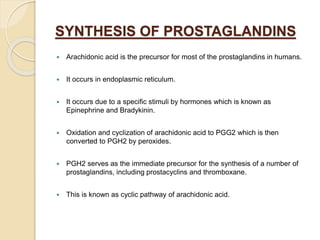
 Arachidonic acid is the precursor for most of the prostaglandins in humans.
 It occurs in endoplasmic reticulum.
 It occurs due to a specific stimuli by hormones which is known as
Epinephrine and Bradykinin.
 Oxidation and cyclization of arachidonic acid to PGG2 which is then
converted to PGH2 by peroxides.
 PGH2 serves as the immediate precursor for the synthesis of a number of
prostaglandins, including prostacyclins and thromboxane.
 This is known as cyclic pathway of arachidonic acid.
INHIBITION OF PROSTAGLANDIN SYNTHESIS
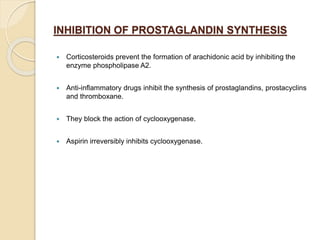
 Corticosteroids prevent the formation of arachidonic acid by inhibiting the
enzyme phospholipase A2.
 Anti-inflammatory drugs inhibit the synthesis of prostaglandins, prostacyclins
and thromboxane.
 They block the action of cyclooxygenase.
 Aspirin irreversibly inhibits cyclooxygenase.
DEGRADATION OF PROSTAGLANDINS
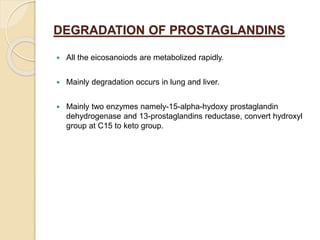
 All the eicosanoiods are metabolized rapidly.
 Mainly degradation occurs in lung and liver.
 Mainly two enzymes namely-15-alpha-hydoxy prostaglandin
dehydrogenase and 13-prostaglandins reductase, convert hydroxyl
group at C15 to keto group.
Biochemical actions of
Prostaglandins
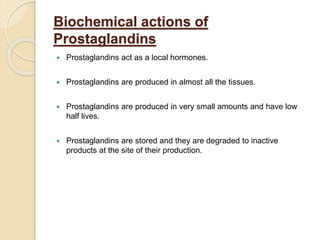
 Prostaglandins act as a local hormones.
 Prostaglandins are produced in almost all the tissues.
 Prostaglandins are produced in very small amounts and have low
half lives.
 Prostaglandins are stored and they are degraded to inactive
products at the site of their production.
PHYSIOLOGICAL EFFECT
 Regulation of blood pressure:-
 The prostaglandins are vasodilator in function.
 This results in increased blood flow and decreased peripheral
resistance to lower the blood pressure.
 Prostaglandins serve as agents in the treatment of hypertension.
 Inflammation:-
 It also induces the symptoms of inflammation due to arteriolar
vasodilation.
 Prostaglandins are natural mediators of inflammatory reactions of
rheumatoid arthritis, psoriasis, conjunctives.
 Corticosteriods are used to treat these inflammatory reactions, since
they inhibit prostaglandin synthesis.
• Reproduction:-
 It is also used for the medical termination of pregnancy and
induction of labor.
 Pain and fever:-
 Pyrogens promote prostaglandin synthesis leading to the formation
of PGE2 in hypothalamus-regulation of body temperature.
 Histamine and bradykinin cause pain.
 Aspirin and other non-steroidal drugs inhibit prostaglandin synthesis
and thus control fever and relieve pain.
 Regulation of gastric secretion:-
 Prostaglandins inhibit gastric secretion.
 Prostaglandins are used for the treatment of gastric ulcers.
 Prostaglandins stimulate pancreatic secretion and increase the
motility of intestine which often causes diarrhea.
 Influence on immune system:-
 Macrophages secrete PGE which decreases the immunological
functions at B and T – lymphocytes.
 Effect on respiratory functions:-
 PGE is a bronchodilator whereas PGF acts as a constrictor of
bronchial smooth muscles.
 PGE and PGF oppose the actions of each other in the lungs.
 PGEI and PGE2 are used in the treatment of asthma.
 Influence on renal functions:-
 PGE increases glomerular filtration rate and promotes urine output.
 Excretion of Na and K is also incresed by PGE.
 Effects on metabolism:-
 Prostaglandins influence certain metabolic reactions, through the
mediation of cAMP.
 PGE decreases lipolysis, increases glycogen formation and
promotes calcium mobilization.
 Platelet aggregation and thrombosis:-
 Thromboxanes and prostaglandin promote platelet aggregation and
blood clotting that might lead to thrombosis.
 Prostacyclins inhibit the platelet aggregation.
Biomedical applications of Prostaglandins
 They are used in the treatment of gastric ulcers, hypertension,
thrombosis, asthma, etc.
 Prostaglandins are also employed in the medical termination of
pregnancy, prevention of conception, induction of labor,etc.
Reference
 Essentials of Medical Pharmacology; KD Tripathi; Seventh
Edition; Autacoids; Page no:-181to191;Publishers:-Jaypee
Brothers Medical Publishers(P) Ltd,4838/24,Ansari
Road,Daryaganj,New Delhi-110002,India.
 www.wikipedia.com
Postaglandines

Postaglandines

  • 1.
    SEMINAR PRESENTATION ON PHARMACOLOGY-IB TOPIC:-PROSTAGLANDINS Name:-Mridul Hussain Class:- 6th semester. Roll no:- 08 Session:- 2016-17
  • 2.
    Contents  Introduction.  Synthesisof Prostaglandins.  Inhibition of Prostaglandins synthesis.  Degradation of Prostaglandins.  Biochemical action of Prostaglandins.  Physiological effects.  Biomedical applications of Prostaglandins.  Reference.
  • 3.
    INTRODUCTION •These are aclass of eicosanoids and were discovered through their effect on smooth muscle. •Produced and released by nearly all mammalian cells.(Except RBCs). •It performs a variety of functions. •These are produced in minute amounts and are not stored. •Prostaglandins are derivatives of 20-C fatty acid. Hence it is known as prostanoids. •It has a cyclopentane ring and two side chains, with carboxyl group on one side. •Prostaglandins are differ in their structure due to substituent group and double bond on cyclopentane ring.
  • 4.
    SYNTHESIS OF PROSTAGLANDINS Arachidonic acid is the precursor for most of the prostaglandins in humans.  It occurs in endoplasmic reticulum.  It occurs due to a specific stimuli by hormones which is known as Epinephrine and Bradykinin.  Oxidation and cyclization of arachidonic acid to PGG2 which is then converted to PGH2 by peroxides.  PGH2 serves as the immediate precursor for the synthesis of a number of prostaglandins, including prostacyclins and thromboxane.  This is known as cyclic pathway of arachidonic acid.
  • 5.
    INHIBITION OF PROSTAGLANDINSYNTHESIS  Corticosteroids prevent the formation of arachidonic acid by inhibiting the enzyme phospholipase A2.  Anti-inflammatory drugs inhibit the synthesis of prostaglandins, prostacyclins and thromboxane.  They block the action of cyclooxygenase.  Aspirin irreversibly inhibits cyclooxygenase.
  • 6.
    DEGRADATION OF PROSTAGLANDINS All the eicosanoiods are metabolized rapidly.  Mainly degradation occurs in lung and liver.  Mainly two enzymes namely-15-alpha-hydoxy prostaglandin dehydrogenase and 13-prostaglandins reductase, convert hydroxyl group at C15 to keto group.
  • 7.
    Biochemical actions of Prostaglandins Prostaglandins act as a local hormones.  Prostaglandins are produced in almost all the tissues.  Prostaglandins are produced in very small amounts and have low half lives.  Prostaglandins are stored and they are degraded to inactive products at the site of their production.
  • 8.
    PHYSIOLOGICAL EFFECT  Regulationof blood pressure:-  The prostaglandins are vasodilator in function.  This results in increased blood flow and decreased peripheral resistance to lower the blood pressure.  Prostaglandins serve as agents in the treatment of hypertension.
  • 9.
     Inflammation:-  Italso induces the symptoms of inflammation due to arteriolar vasodilation.  Prostaglandins are natural mediators of inflammatory reactions of rheumatoid arthritis, psoriasis, conjunctives.  Corticosteriods are used to treat these inflammatory reactions, since they inhibit prostaglandin synthesis. • Reproduction:-  It is also used for the medical termination of pregnancy and induction of labor.
  • 10.
     Pain andfever:-  Pyrogens promote prostaglandin synthesis leading to the formation of PGE2 in hypothalamus-regulation of body temperature.  Histamine and bradykinin cause pain.  Aspirin and other non-steroidal drugs inhibit prostaglandin synthesis and thus control fever and relieve pain.  Regulation of gastric secretion:-  Prostaglandins inhibit gastric secretion.  Prostaglandins are used for the treatment of gastric ulcers.  Prostaglandins stimulate pancreatic secretion and increase the motility of intestine which often causes diarrhea.
  • 11.
     Influence onimmune system:-  Macrophages secrete PGE which decreases the immunological functions at B and T – lymphocytes.  Effect on respiratory functions:-  PGE is a bronchodilator whereas PGF acts as a constrictor of bronchial smooth muscles.  PGE and PGF oppose the actions of each other in the lungs.  PGEI and PGE2 are used in the treatment of asthma.  Influence on renal functions:-  PGE increases glomerular filtration rate and promotes urine output.  Excretion of Na and K is also incresed by PGE.
  • 12.
     Effects onmetabolism:-  Prostaglandins influence certain metabolic reactions, through the mediation of cAMP.  PGE decreases lipolysis, increases glycogen formation and promotes calcium mobilization.  Platelet aggregation and thrombosis:-  Thromboxanes and prostaglandin promote platelet aggregation and blood clotting that might lead to thrombosis.  Prostacyclins inhibit the platelet aggregation.
  • 13.
    Biomedical applications ofProstaglandins  They are used in the treatment of gastric ulcers, hypertension, thrombosis, asthma, etc.  Prostaglandins are also employed in the medical termination of pregnancy, prevention of conception, induction of labor,etc.
  • 14.
    Reference  Essentials ofMedical Pharmacology; KD Tripathi; Seventh Edition; Autacoids; Page no:-181to191;Publishers:-Jaypee Brothers Medical Publishers(P) Ltd,4838/24,Ansari Road,Daryaganj,New Delhi-110002,India.  www.wikipedia.com