NAME: JON JYOTI SAHARIAH
M.PHARM (PHARMACEUTICAL
CHEMISTRY)
2ND SEMESTER
PRESENTATION ON THE TOPIC
GREEN CHEMISTRY
DEPARTMENT OF PHARMACEUTICAL SCIENCES
DIBRUGARH UNIVERSITY
INTRODUCTION
 Green chemistry is also known as environmentally benign
chemistry or sustainable chemistry
 Paul Anastas and John Warner, who defined green
chemistry as the design of chemical products and processes
that reduce or eliminate the use and generation of
hazardous substances.
 Chemical developments also bring new environmental
problems and harmful unexpected side effects, which result
in the need for ‘greener’ chemical products.
INTRODUCTION
 Green chemistry looks at pollution prevention on the
molecular scale and is an extremely important area of
Chemistry due to the importance of Chemistry in our
world today and the implications it can show on our
environment.
 The Green Chemistry program supports the invention
of more environmentally friendly chemical processes
which reduce or even eliminate the generation of
hazardous substances.
INTRODUCTION
 Anastas and Warner formulated the twelve principles of
green chemistry in 1998. These serve as guidelines for
chemists seeking to lower the ecological footprint of the
chemicals they produce and the processes by which
such chemicals are made.
 The invention, design and application of chemical
products and processes to reduce or to eliminate the use
and generation of hazardous substances.
GREEN CHEMISTRY IS ABOUT
 – Waste Minimisation at Source
 – Use of Catalysts in place of Reagents
 – Using Non-Toxic Reagents
 – Use of Renewable Resources
 – Improved Atom Efficiency
 – Use of Solvent Free or Recyclable Environmentally Benign
Solvent systems
12 PRINCIPLES OF GREEN CHEMISTRY
1. Prevention of Waste or by-products
 It is better to prevent waste than to treat or clean up waste
after it is formed
12 PRINCIPLES OF GREEN CHEMISTRY
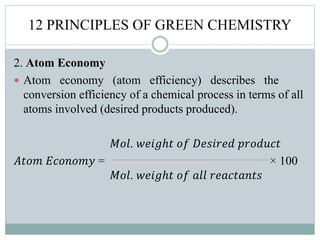
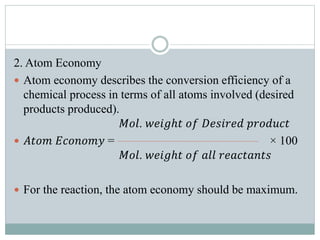
2. Atom Economy
 Atom economy (atom efficiency) describes the
conversion efficiency of a chemical process in terms of all
atoms involved (desired products produced).
𝑀𝑜𝑙. 𝑤𝑒𝑖𝑔ℎ𝑡 𝑜𝑓 𝐷𝑒𝑠𝑖𝑟𝑒𝑑 𝑝𝑟𝑜𝑑𝑢𝑐𝑡
𝐴𝑡𝑜𝑚 𝐸𝑐𝑜𝑛𝑜𝑚𝑦 = × 100
𝑀𝑜𝑙. 𝑤𝑒𝑖𝑔ℎ𝑡 𝑜𝑓 𝑎𝑙𝑙 𝑟𝑒𝑎𝑐𝑡𝑎𝑛𝑡𝑠
12 PRINCIPLES OF GREEN CHEMISTRY
3. Minimization of hazardous products
 Wherever practicable, synthetic methods should be
designed to use and generate substances that possess little
or no toxicity to people or the environment.
12 PRINCIPLES OF GREEN CHEMISTRY
4. Designing Safer Chemicals
 Chemical products should be designed to effect their
desired function while minimising their toxicity.
12 PRINCIPLES OF GREEN CHEMISTRY
5. Safer Solvents & Auxiliaries
 “The use of auxiliary substances (e.g. solvents, separation
agents, etc.) should be made unnecessary wherever
possible, and innocuous when used”
12 PRINCIPLES OF GREEN CHEMISTRY
6. Design for Energy Efficiency
 Energy requirements of chemical processes should be
recognized for their environmental and economic impacts
and should be minimized.
 If possible, synthetic methods should be conducted at
ambient temperature and pressure.
12 PRINCIPLES OF GREEN CHEMISTRY
6. Design for Energy Efficiency
 Developing the alternatives for energy generation
(photovoltaic, hydrogen, fuel cells, bio based fuels,
etc.) as well as continue the path toward energy
efficiency with catalysis and product design at the
forefront.
12 PRINCIPLES OF GREEN CHEMISTRY
7. Use of Renewable Feedstock
 “A raw material or feedstock should be renewable rather
than depleting whenever technically and economically
practicable.”
12 PRINCIPLES OF GREEN CHEMISTRY
8. Reduce Derivatives
 Unnecessary derivatization (use of blocking groups,
protection/de-protection, and temporary modification of
physical/chemical processes) should be minimized or
avoided if possible, because such steps require additional
reagents and can generate waste.
12 PRINCIPLES OF GREEN CHEMISTRY
8. Reduce Derivatives
 More derivatives involve
 Additional Reagents
 Generate more waste products
 More Time
 Higher Cost of Products
 Hence, it requires to reduce derivatives.
12 PRINCIPLES OF GREEN CHEMISTRY
9. Catalysis
 Catalytic reagents (as selective as possible) are superior to
stoichiometric reagents.
 e.g. Toluene can be exclusively converted into p-xylene
(avoiding o-xylene & m-xylene) by shape selective zeolite
catalyst.
12 PRINCIPLES OF GREEN CHEMISTRY
10. Designing of degradable products
 Chemical products should be designed so that at the end
of their function they break down into innocuous
degradation products and do not persist in the
environment.
12 PRINCIPLES OF GREEN CHEMISTRY
11. New Analytical Methods
 “Analytical methodologies need to be further developed
to allow for real-time, in-process monitoring
 and control prior to the formation of hazardous
substances.”
12. Safer Chemicals For Accident Prevention
 “Analytical Substances and the form of a substance used
in a chemical process should be chosen to minimise the
potential for chemical accidents, including releases,
explosions, and fires.”
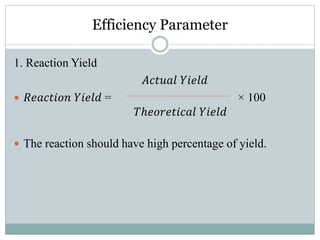
Efficiency Parameter
1. Reaction Yield
𝐴𝑐𝑡𝑢𝑎𝑙 𝑌𝑖𝑒𝑙𝑑
 𝑅𝑒𝑎𝑐𝑡𝑖𝑜𝑛 𝑌𝑖𝑒𝑙𝑑 = × 100
𝑇ℎ𝑒𝑜𝑟𝑒𝑡𝑖𝑐𝑎𝑙 𝑌𝑖𝑒𝑙𝑑
 The reaction should have high percentage of yield.
2. Atom Economy
 Atom economy describes the conversion efficiency of a
chemical process in terms of all atoms involved (desired
products produced).
𝑀𝑜𝑙. 𝑤𝑒𝑖𝑔ℎ𝑡 𝑜𝑓 𝐷𝑒𝑠𝑖𝑟𝑒𝑑 𝑝𝑟𝑜𝑑𝑢𝑐𝑡
 𝐴𝑡𝑜𝑚 𝐸𝑐𝑜𝑛𝑜𝑚𝑦 = × 100
𝑀𝑜𝑙. 𝑤𝑒𝑖𝑔ℎ𝑡 𝑜𝑓 𝑎𝑙𝑙 𝑟𝑒𝑎𝑐𝑡𝑎𝑛𝑡𝑠
 For the reaction, the atom economy should be maximum.
Atom Economy
e.g.
 Rearrangement Reactions:
 These reactions involves rearrangement of atoms that
forms molecule. Hence, the atom economy of these
reactions are 100%.
 Addition Reactions:
 These reactions involves addition of two or more
molecules without elimination that forms molecule.
Hence, the atom economy of these reactions are 100%
 Conversion factor:
Amount of reactant reacted
Conversion = × 100
Amount of reactant taken
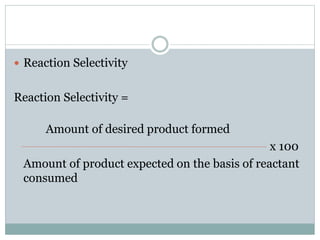
 Reaction Selectivity
Reaction Selectivity =
Amount of desired product formed
x 100
Amount of product expected on the basis of reactant
consumed
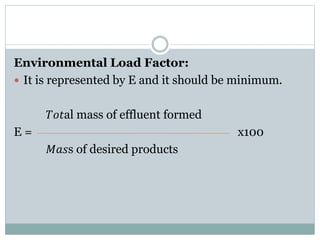
Environmental Load Factor:
 It is represented by E and it should be minimum.
𝑇𝑜𝑡al mass of effluent formed
E = x100
𝑀𝑎𝑠s of desired products
Microwave assisted Reaction: An approach to green
Chemistry
 Microwave assisted organic synthesis is defined as the
preparation of desired organic compound from available
starting material via some procedure involving microwave
irradiation.
 As it is less hazardous it is a potential tool of green
chemistry.
 Microwave Synthesis opens up new opportunities to the
synthetic chemist in the form of new reaction that are not
possible by conventional heating.
 It is an enabling technology for accelerating drug
discovery and development processes.
MICROWAVE IRRADIATION
 Microwave radiation is non-ionizing form of energy that
does not alter the molecular structure of compounds and
provides only thermal activation.
 This phenomenon is dependent on the ability of a
specific material to absorb microwave energy and
convert into heat.
 The principle of microwave heating is that the energy
can be applied directly to the sample rather than
conductively via the vessel. heating can be started or
stopped instantly
WHAT MICROWAVES ARE?
 A Microwave is a form of electromagnetic energy that
falls at lower
 frequency at the end of electromagnetic spectrum(300 to
300000MHz).
 It is present between infrared radiation and radio waves.
 Microwave uses EMR that passes through material and
causes oscillation of molecules which produces heat.
MECHANISM OF MICROWAVE
 DI ELECTRIC HEATING:
 Generation of thermal energy in a non conducting
material by the application of an electromagnetic force.
 wasted energy appears as heat called di- electric loss .
 The non-metallic material with poor thermal conductivity
can be very effectively heated by dielectric heating.
 Dielectric loss is proportional to frequency and square of
the supply voltage.
 Microwave dielectric heating mechanisms are of 2 types
1. Dipolar polarization mechanism
2. Conduction mechanism
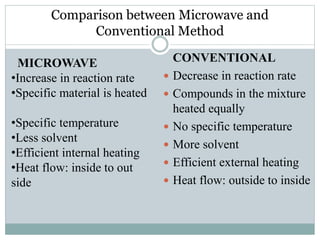
Comparison between Microwave and
Conventional Method
CONVENTIONAL
 Decrease in reaction rate
 Compounds in the mixture
heated equally
 No specific temperature
 More solvent
 Efficient external heating
 Heat flow: outside to inside
MICROWAVE
•Increase in reaction rate
•Specific material is heated
•Specific temperature
•Less solvent
•Efficient internal heating
•Heat flow: inside to out
side
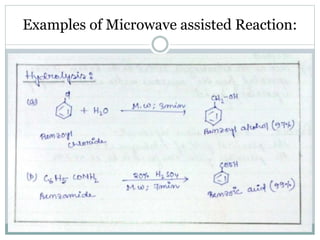
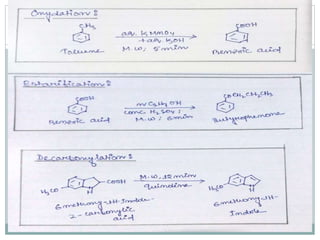
Examples of Microwave assisted Reaction:
Ultrasound Mediated Reaction
 Ultrasound is defined by the American National
Standards Institute as "sound at frequencies greater than
20 kHz."
 Ultrasound is sound waves with frequencies higher than
the upper audible limit of human hearing.
 Ultrasound is no different from 'normal' (audible) sound in
its physical properties, except in that humans cannot hear
it.
Ultrasound Mediated Reaction
 The ultrasound irradiation (also referred to as sonochemistry)
is an important tool in the field of organic chemistry.
 This technique has become extremely popular in promoting
various chemical reactions since the decade 1990–1999.
 The application of ultrasound has been useful in accelerating
dissolution, enhancing the reaction rates, and renewing the
surface of a solid reactant or catalyst in a variety of reaction
systems.
 In recent years, the effect of ultrasonic energies in organic
synthesis (homogeneous and heterogeneous reactions) has
widely increased.
Ultrasound Mediated Reaction
 The use of ultrasound in chemical reactions in solution
provides specific activation based on a physical phenomenon.
 acoustic cavitation. Cavitation is a process in which
mechanical activation destroys the attractive forces of
molecules in the liquid phase.
 Applying ultrasound, compression of the liquid is followed by
rarefaction (expansion), in which a sudden pressure drop
forms small, oscillating bubbles of gaseous substances.
 These bubbles expand with each cycle of the applied ultrasonic
energy until they reach an unstable size; they can then collide
and/or violently collapse.
Ultrasound Mediated Reaction
 Two of the most important advantages in the use of
sonochemistry in organic synthesis.
1. Increase of reaction rates
2. Increase of product yields
 So this methodology is more convenient when compared
with the traditional method, and it can be easily
controlled.
 For Heterocycles Heterocycles are one of the most
popular and important organic compounds because they
are involved in many fields of science.
Ultrasonic Reactions
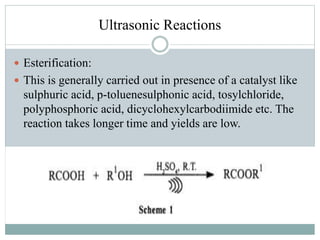
 Esterification:
 This is generally carried out in presence of a catalyst like
sulphuric acid, p-toluenesulphonic acid, tosylchloride,
polyphosphoric acid, dicyclohexylcarbodiimide etc. The
reaction takes longer time and yields are low.
Ultrasonic Reactions
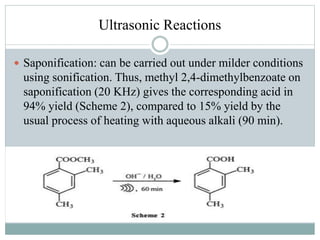
 Saponification: can be carried out under milder conditions
using sonification. Thus, methyl 2,4-dimethylbenzoate on
saponification (20 KHz) gives the corresponding acid in
94% yield (Scheme 2), compared to 15% yield by the
usual process of heating with aqueous alkali (90 min).

Green chemistry ppt jon

  • 1.
    NAME: JON JYOTISAHARIAH M.PHARM (PHARMACEUTICAL CHEMISTRY) 2ND SEMESTER PRESENTATION ON THE TOPIC GREEN CHEMISTRY DEPARTMENT OF PHARMACEUTICAL SCIENCES DIBRUGARH UNIVERSITY
  • 2.
    INTRODUCTION  Green chemistryis also known as environmentally benign chemistry or sustainable chemistry  Paul Anastas and John Warner, who defined green chemistry as the design of chemical products and processes that reduce or eliminate the use and generation of hazardous substances.  Chemical developments also bring new environmental problems and harmful unexpected side effects, which result in the need for ‘greener’ chemical products.
  • 3.
    INTRODUCTION  Green chemistrylooks at pollution prevention on the molecular scale and is an extremely important area of Chemistry due to the importance of Chemistry in our world today and the implications it can show on our environment.  The Green Chemistry program supports the invention of more environmentally friendly chemical processes which reduce or even eliminate the generation of hazardous substances.
  • 4.
    INTRODUCTION  Anastas andWarner formulated the twelve principles of green chemistry in 1998. These serve as guidelines for chemists seeking to lower the ecological footprint of the chemicals they produce and the processes by which such chemicals are made.  The invention, design and application of chemical products and processes to reduce or to eliminate the use and generation of hazardous substances.
  • 5.
    GREEN CHEMISTRY ISABOUT  – Waste Minimisation at Source  – Use of Catalysts in place of Reagents  – Using Non-Toxic Reagents  – Use of Renewable Resources  – Improved Atom Efficiency  – Use of Solvent Free or Recyclable Environmentally Benign Solvent systems
  • 6.
    12 PRINCIPLES OFGREEN CHEMISTRY 1. Prevention of Waste or by-products  It is better to prevent waste than to treat or clean up waste after it is formed
  • 7.
    12 PRINCIPLES OFGREEN CHEMISTRY 2. Atom Economy  Atom economy (atom efficiency) describes the conversion efficiency of a chemical process in terms of all atoms involved (desired products produced). 𝑀𝑜𝑙. 𝑤𝑒𝑖𝑔ℎ𝑡 𝑜𝑓 𝐷𝑒𝑠𝑖𝑟𝑒𝑑 𝑝𝑟𝑜𝑑𝑢𝑐𝑡 𝐴𝑡𝑜𝑚 𝐸𝑐𝑜𝑛𝑜𝑚𝑦 = × 100 𝑀𝑜𝑙. 𝑤𝑒𝑖𝑔ℎ𝑡 𝑜𝑓 𝑎𝑙𝑙 𝑟𝑒𝑎𝑐𝑡𝑎𝑛𝑡𝑠
  • 8.
    12 PRINCIPLES OFGREEN CHEMISTRY 3. Minimization of hazardous products  Wherever practicable, synthetic methods should be designed to use and generate substances that possess little or no toxicity to people or the environment.
  • 9.
    12 PRINCIPLES OFGREEN CHEMISTRY 4. Designing Safer Chemicals  Chemical products should be designed to effect their desired function while minimising their toxicity.
  • 10.
    12 PRINCIPLES OFGREEN CHEMISTRY 5. Safer Solvents & Auxiliaries  “The use of auxiliary substances (e.g. solvents, separation agents, etc.) should be made unnecessary wherever possible, and innocuous when used”
  • 11.
    12 PRINCIPLES OFGREEN CHEMISTRY 6. Design for Energy Efficiency  Energy requirements of chemical processes should be recognized for their environmental and economic impacts and should be minimized.  If possible, synthetic methods should be conducted at ambient temperature and pressure.
  • 12.
    12 PRINCIPLES OFGREEN CHEMISTRY 6. Design for Energy Efficiency  Developing the alternatives for energy generation (photovoltaic, hydrogen, fuel cells, bio based fuels, etc.) as well as continue the path toward energy efficiency with catalysis and product design at the forefront.
  • 13.
    12 PRINCIPLES OFGREEN CHEMISTRY 7. Use of Renewable Feedstock  “A raw material or feedstock should be renewable rather than depleting whenever technically and economically practicable.”
  • 14.
    12 PRINCIPLES OFGREEN CHEMISTRY 8. Reduce Derivatives  Unnecessary derivatization (use of blocking groups, protection/de-protection, and temporary modification of physical/chemical processes) should be minimized or avoided if possible, because such steps require additional reagents and can generate waste.
  • 15.
    12 PRINCIPLES OFGREEN CHEMISTRY 8. Reduce Derivatives  More derivatives involve  Additional Reagents  Generate more waste products  More Time  Higher Cost of Products  Hence, it requires to reduce derivatives.
  • 16.
    12 PRINCIPLES OFGREEN CHEMISTRY 9. Catalysis  Catalytic reagents (as selective as possible) are superior to stoichiometric reagents.  e.g. Toluene can be exclusively converted into p-xylene (avoiding o-xylene & m-xylene) by shape selective zeolite catalyst.
  • 17.
    12 PRINCIPLES OFGREEN CHEMISTRY 10. Designing of degradable products  Chemical products should be designed so that at the end of their function they break down into innocuous degradation products and do not persist in the environment.
  • 18.
    12 PRINCIPLES OFGREEN CHEMISTRY 11. New Analytical Methods  “Analytical methodologies need to be further developed to allow for real-time, in-process monitoring  and control prior to the formation of hazardous substances.”
  • 19.
    12. Safer ChemicalsFor Accident Prevention  “Analytical Substances and the form of a substance used in a chemical process should be chosen to minimise the potential for chemical accidents, including releases, explosions, and fires.”
  • 20.
    Efficiency Parameter 1. ReactionYield 𝐴𝑐𝑡𝑢𝑎𝑙 𝑌𝑖𝑒𝑙𝑑  𝑅𝑒𝑎𝑐𝑡𝑖𝑜𝑛 𝑌𝑖𝑒𝑙𝑑 = × 100 𝑇ℎ𝑒𝑜𝑟𝑒𝑡𝑖𝑐𝑎𝑙 𝑌𝑖𝑒𝑙𝑑  The reaction should have high percentage of yield.
  • 21.
    2. Atom Economy Atom economy describes the conversion efficiency of a chemical process in terms of all atoms involved (desired products produced). 𝑀𝑜𝑙. 𝑤𝑒𝑖𝑔ℎ𝑡 𝑜𝑓 𝐷𝑒𝑠𝑖𝑟𝑒𝑑 𝑝𝑟𝑜𝑑𝑢𝑐𝑡  𝐴𝑡𝑜𝑚 𝐸𝑐𝑜𝑛𝑜𝑚𝑦 = × 100 𝑀𝑜𝑙. 𝑤𝑒𝑖𝑔ℎ𝑡 𝑜𝑓 𝑎𝑙𝑙 𝑟𝑒𝑎𝑐𝑡𝑎𝑛𝑡𝑠  For the reaction, the atom economy should be maximum.
  • 22.
    Atom Economy e.g.  RearrangementReactions:  These reactions involves rearrangement of atoms that forms molecule. Hence, the atom economy of these reactions are 100%.  Addition Reactions:  These reactions involves addition of two or more molecules without elimination that forms molecule. Hence, the atom economy of these reactions are 100%
  • 23.
     Conversion factor: Amountof reactant reacted Conversion = × 100 Amount of reactant taken
  • 24.
     Reaction Selectivity ReactionSelectivity = Amount of desired product formed x 100 Amount of product expected on the basis of reactant consumed
  • 25.
    Environmental Load Factor: It is represented by E and it should be minimum. 𝑇𝑜𝑡al mass of effluent formed E = x100 𝑀𝑎𝑠s of desired products
  • 26.
    Microwave assisted Reaction:An approach to green Chemistry  Microwave assisted organic synthesis is defined as the preparation of desired organic compound from available starting material via some procedure involving microwave irradiation.  As it is less hazardous it is a potential tool of green chemistry.  Microwave Synthesis opens up new opportunities to the synthetic chemist in the form of new reaction that are not possible by conventional heating.  It is an enabling technology for accelerating drug discovery and development processes.
  • 27.
    MICROWAVE IRRADIATION  Microwaveradiation is non-ionizing form of energy that does not alter the molecular structure of compounds and provides only thermal activation.  This phenomenon is dependent on the ability of a specific material to absorb microwave energy and convert into heat.  The principle of microwave heating is that the energy can be applied directly to the sample rather than conductively via the vessel. heating can be started or stopped instantly
  • 28.
    WHAT MICROWAVES ARE? A Microwave is a form of electromagnetic energy that falls at lower  frequency at the end of electromagnetic spectrum(300 to 300000MHz).  It is present between infrared radiation and radio waves.  Microwave uses EMR that passes through material and causes oscillation of molecules which produces heat.
  • 29.
    MECHANISM OF MICROWAVE DI ELECTRIC HEATING:  Generation of thermal energy in a non conducting material by the application of an electromagnetic force.  wasted energy appears as heat called di- electric loss .  The non-metallic material with poor thermal conductivity can be very effectively heated by dielectric heating.  Dielectric loss is proportional to frequency and square of the supply voltage.  Microwave dielectric heating mechanisms are of 2 types 1. Dipolar polarization mechanism 2. Conduction mechanism
  • 30.
    Comparison between Microwaveand Conventional Method CONVENTIONAL  Decrease in reaction rate  Compounds in the mixture heated equally  No specific temperature  More solvent  Efficient external heating  Heat flow: outside to inside MICROWAVE •Increase in reaction rate •Specific material is heated •Specific temperature •Less solvent •Efficient internal heating •Heat flow: inside to out side
  • 31.
    Examples of Microwaveassisted Reaction:
  • 33.
    Ultrasound Mediated Reaction Ultrasound is defined by the American National Standards Institute as "sound at frequencies greater than 20 kHz."  Ultrasound is sound waves with frequencies higher than the upper audible limit of human hearing.  Ultrasound is no different from 'normal' (audible) sound in its physical properties, except in that humans cannot hear it.
  • 34.
    Ultrasound Mediated Reaction The ultrasound irradiation (also referred to as sonochemistry) is an important tool in the field of organic chemistry.  This technique has become extremely popular in promoting various chemical reactions since the decade 1990–1999.  The application of ultrasound has been useful in accelerating dissolution, enhancing the reaction rates, and renewing the surface of a solid reactant or catalyst in a variety of reaction systems.  In recent years, the effect of ultrasonic energies in organic synthesis (homogeneous and heterogeneous reactions) has widely increased.
  • 35.
    Ultrasound Mediated Reaction The use of ultrasound in chemical reactions in solution provides specific activation based on a physical phenomenon.  acoustic cavitation. Cavitation is a process in which mechanical activation destroys the attractive forces of molecules in the liquid phase.  Applying ultrasound, compression of the liquid is followed by rarefaction (expansion), in which a sudden pressure drop forms small, oscillating bubbles of gaseous substances.  These bubbles expand with each cycle of the applied ultrasonic energy until they reach an unstable size; they can then collide and/or violently collapse.
  • 36.
    Ultrasound Mediated Reaction Two of the most important advantages in the use of sonochemistry in organic synthesis. 1. Increase of reaction rates 2. Increase of product yields  So this methodology is more convenient when compared with the traditional method, and it can be easily controlled.  For Heterocycles Heterocycles are one of the most popular and important organic compounds because they are involved in many fields of science.
  • 37.
    Ultrasonic Reactions  Esterification: This is generally carried out in presence of a catalyst like sulphuric acid, p-toluenesulphonic acid, tosylchloride, polyphosphoric acid, dicyclohexylcarbodiimide etc. The reaction takes longer time and yields are low.
  • 38.
    Ultrasonic Reactions  Saponification:can be carried out under milder conditions using sonification. Thus, methyl 2,4-dimethylbenzoate on saponification (20 KHz) gives the corresponding acid in 94% yield (Scheme 2), compared to 15% yield by the usual process of heating with aqueous alkali (90 min).