1
Prostaglandisns
Prepared by- Shagufta Farooqui
Assistant Professor
Nanded Pharamcy College,Nanded
2
Prostaglandins were discovered in the 1930's. Ulf von Euler found that seminal fluid
and seminal vesicles from most animals including man contain a substance which
causes contraction of the smooth muscle of the uterus.
He named this new substance prostaglandin since they were originally thought to be
secreted by the prostate gland.
1930: Human semen – contracts uterus and other smooth muscles (SM) – fall in BP
Prostaglandin – derived from prostate gland
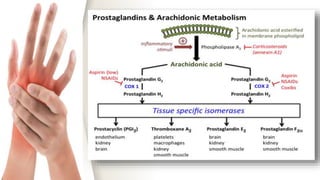
1970: Aspirin like drugs inhibit PG synthesis
 Thromboxanes (TX) and Prostacyclin (PGI)
History
3
Prostaglandins (PGs) and Leukotrienes (LTs): Biologically active 20
carbon atom polyunsaturated essential fatty acids released from cell
membrane fatty acids – lipid derived autacoids
Eicosanoids: PG, Thromboxanes (TX) and LTs – derived from
“eicosa”penta enoic acid - referring to 20 carbon atoms (“enoic” –
double bonds) The eicosanoids are considered "local hormones"
Most universally distributed autacoids – practically all tissues can
synthesize 1 or 2 PG or LT
• They have specific effects on target cells close to their site of formation
• They are rapidly degraded, so they are not transported to distal sites
within the body
4
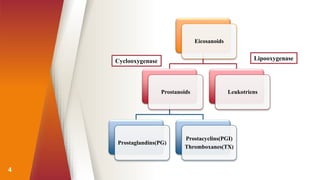
Eicosanoids
Prostanoids
Prostaglandins(PG)
Prostacyclins(PGI)
Thromboxanes(TX)
Leukotriens
Cyclooxygenase Lipooxygenase
5
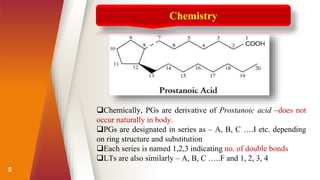
Chemistry
Chemically, PGs are derivative of Prostanoic acid –does not
occur naturally in body.
PGs are designated in series as – A, B, C ….I etc. depending
on ring structure and substitution
Each series is named 1,2,3 indicating no. of double bonds
LTs are also similarly – A, B, C …..F and 1, 2, 3, 4
6
7
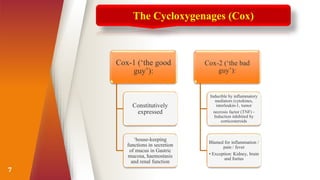
The Cycloxygenages (Cox)
Cox-1 (‘the good
guy’):
Constitutively
expressed
‘house-keeping
functions in secretion
of mucus in Gastric
mucosa, haemostasis
and renal function
Cox-2 (‘the bad
guy’):
Inducible by inflammatory
mediators (cytokines,
interleukin-1, tumor
necrosis factor (TNF) -
Induction inhibited by
corticosteroids
Blamed for inflammation /
pain / fever
• Exception: Kidney, brain
and foetus
8
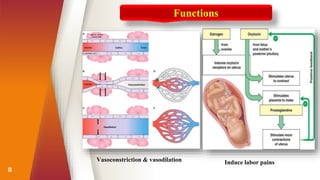
Vasoconstriction & vasodilation Induce labor pains
Functions
9
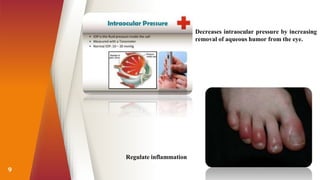
Regulate inflammation
Decreases intraocular pressure by increasing
removal of aqueous humor from the eye.
10
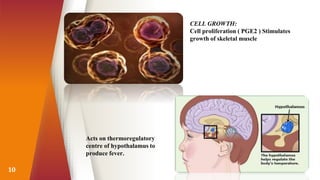
Acts on thermoregulatory
centre of hypothalamus to
produce fever.
CELL GROWTH:
Cell proliferation ( PGE2 ) Stimulates
growth of skeletal muscle
11
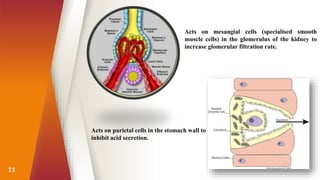
Acts on mesangial cells (specialised smooth
muscle cells) in the glomerulus of the kidney to
increase glomerular filtration rate.
Acts on parietal cells in the stomach wall to
inhibit acid secretion.
12
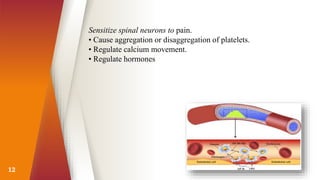
Sensitize spinal neurons to pain.
• Cause aggregation or disaggregation of platelets.
• Regulate calcium movement.
• Regulate hormones
13
CVS:
Prostacyclin and PGE2-Vasodilators
TXA2 Vasocnstriction
PGE2 and PGF2a-Weak cardiac stimulant
GIT-
1. Most PG and TXs stimulates muscle- Watery Diarrhoea
2. PGE2- decrease acid production and Increase mucous production
Airway-
1.PGE2 and PGI2- Relax bronchiol smooth muscles
2. TXA2- and PGF2a-contract bronchial smoth muscles –leads to asthma
Platelet
1. TXA2-Increase platelet agregation
2. PGI2- Decrease Platelet aggregation
3. PGE2 –Increase platelet aggregation (low concentration) and Decrease
Platelet aggregation (at high concentration)
14
Kidney
PGE2 and PGI2- Renal vasodilation and diuretic effect
PG synthesized in –Medulla and cortex
They regulate elimination of Na and H20 –Maintain blood pressure
Stimulate renin release
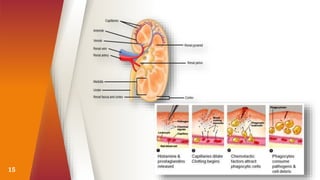
Inflammation-
Major role in inflammation
Increase blood flow, Increase leukocyte infiltration( when the fluid leaks into
the tissue around the vein), Increase development of oedema
Endocrine-
Increase release of insulin and Growth hormone, also Increase production of
steroids
15
16
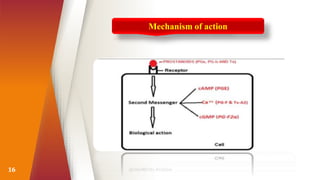
Mechanism of action
17
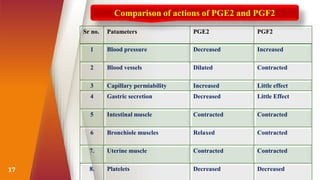
Sr no. Patameters PGE2 PGF2
1 Blood pressure Decreased Increased
2 Blood vessels Dilated Contracted
3 Capillary permiability Increased Little effect
4 Gastric secretion Decreased Little Effect
5 Intestinal muscle Contracted Contracted
6 Bronchiole muscles Relaxed Contracted
7. Uterine muscle Contracted Contracted
8. Platelets Decreased Decreased
Comparison of actions of PGE2 and PGF2
18
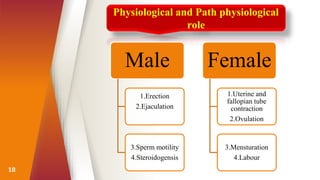
Physiological and Path physiological
role
Male
1.Erection
2.Ejaculation
3.Sperm motility
4.Steroidogensis
Female
1.Uterine and
fallopian tube
contraction
2.Ovulation
3.Mensturation
4.Labour
19
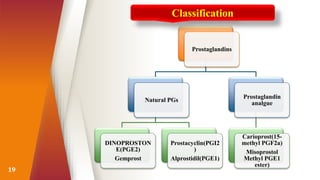
Prostaglandins
Natural PGs
DINOPROSTON
E(PGE2)
Gemprost
Prostacyclin(PGI2
)
Alprostidil(PGE1)
Prostaglandin
analgue
Carioprost(15-
methyl PGF2a)
Misoprostol
Methyl PGE1
ester)
Classification
20
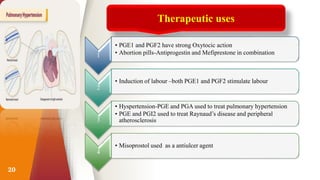
Therapeutic uses
1
• PGE1 and PGF2 have strong Oxytocic action
• Abortion pills-Antiprogestin and Mefiprestone in combination
2
• Induction of labour –both PGE1 and PGF2 stimulate labour
3
• Hyspertension-PGE and PGA used to treat pulmonary hypertension
• PGE and PGI2 used to treat Raynaud’s disease and peripheral
atherosclerosis
4
• Misoprostol used as a antiulcer agent
21
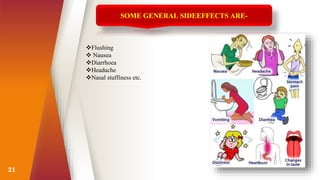
Flushing
 Nausea
Diarrhoea
Headache
Nasal stuffiness etc.
SOME GENERAL SIDEEFFECTS ARE-
22

Prostaglandins

  • 1.
    1 Prostaglandisns Prepared by- ShaguftaFarooqui Assistant Professor Nanded Pharamcy College,Nanded
  • 2.
    2 Prostaglandins were discoveredin the 1930's. Ulf von Euler found that seminal fluid and seminal vesicles from most animals including man contain a substance which causes contraction of the smooth muscle of the uterus. He named this new substance prostaglandin since they were originally thought to be secreted by the prostate gland. 1930: Human semen – contracts uterus and other smooth muscles (SM) – fall in BP Prostaglandin – derived from prostate gland 1970: Aspirin like drugs inhibit PG synthesis  Thromboxanes (TX) and Prostacyclin (PGI) History
  • 3.
    3 Prostaglandins (PGs) andLeukotrienes (LTs): Biologically active 20 carbon atom polyunsaturated essential fatty acids released from cell membrane fatty acids – lipid derived autacoids Eicosanoids: PG, Thromboxanes (TX) and LTs – derived from “eicosa”penta enoic acid - referring to 20 carbon atoms (“enoic” – double bonds) The eicosanoids are considered "local hormones" Most universally distributed autacoids – practically all tissues can synthesize 1 or 2 PG or LT • They have specific effects on target cells close to their site of formation • They are rapidly degraded, so they are not transported to distal sites within the body
  • 4.
  • 5.
    5 Chemistry Chemically, PGs arederivative of Prostanoic acid –does not occur naturally in body. PGs are designated in series as – A, B, C ….I etc. depending on ring structure and substitution Each series is named 1,2,3 indicating no. of double bonds LTs are also similarly – A, B, C …..F and 1, 2, 3, 4
  • 6.
  • 7.
    7 The Cycloxygenages (Cox) Cox-1(‘the good guy’): Constitutively expressed ‘house-keeping functions in secretion of mucus in Gastric mucosa, haemostasis and renal function Cox-2 (‘the bad guy’): Inducible by inflammatory mediators (cytokines, interleukin-1, tumor necrosis factor (TNF) - Induction inhibited by corticosteroids Blamed for inflammation / pain / fever • Exception: Kidney, brain and foetus
  • 8.
    8 Vasoconstriction & vasodilationInduce labor pains Functions
  • 9.
    9 Regulate inflammation Decreases intraocularpressure by increasing removal of aqueous humor from the eye.
  • 10.
    10 Acts on thermoregulatory centreof hypothalamus to produce fever. CELL GROWTH: Cell proliferation ( PGE2 ) Stimulates growth of skeletal muscle
  • 11.
    11 Acts on mesangialcells (specialised smooth muscle cells) in the glomerulus of the kidney to increase glomerular filtration rate. Acts on parietal cells in the stomach wall to inhibit acid secretion.
  • 12.
    12 Sensitize spinal neuronsto pain. • Cause aggregation or disaggregation of platelets. • Regulate calcium movement. • Regulate hormones
  • 13.
    13 CVS: Prostacyclin and PGE2-Vasodilators TXA2Vasocnstriction PGE2 and PGF2a-Weak cardiac stimulant GIT- 1. Most PG and TXs stimulates muscle- Watery Diarrhoea 2. PGE2- decrease acid production and Increase mucous production Airway- 1.PGE2 and PGI2- Relax bronchiol smooth muscles 2. TXA2- and PGF2a-contract bronchial smoth muscles –leads to asthma Platelet 1. TXA2-Increase platelet agregation 2. PGI2- Decrease Platelet aggregation 3. PGE2 –Increase platelet aggregation (low concentration) and Decrease Platelet aggregation (at high concentration)
  • 14.
    14 Kidney PGE2 and PGI2-Renal vasodilation and diuretic effect PG synthesized in –Medulla and cortex They regulate elimination of Na and H20 –Maintain blood pressure Stimulate renin release Inflammation- Major role in inflammation Increase blood flow, Increase leukocyte infiltration( when the fluid leaks into the tissue around the vein), Increase development of oedema Endocrine- Increase release of insulin and Growth hormone, also Increase production of steroids
  • 15.
  • 16.
  • 17.
    17 Sr no. PatametersPGE2 PGF2 1 Blood pressure Decreased Increased 2 Blood vessels Dilated Contracted 3 Capillary permiability Increased Little effect 4 Gastric secretion Decreased Little Effect 5 Intestinal muscle Contracted Contracted 6 Bronchiole muscles Relaxed Contracted 7. Uterine muscle Contracted Contracted 8. Platelets Decreased Decreased Comparison of actions of PGE2 and PGF2
  • 18.
    18 Physiological and Pathphysiological role Male 1.Erection 2.Ejaculation 3.Sperm motility 4.Steroidogensis Female 1.Uterine and fallopian tube contraction 2.Ovulation 3.Mensturation 4.Labour
  • 19.
  • 20.
    20 Therapeutic uses 1 • PGE1and PGF2 have strong Oxytocic action • Abortion pills-Antiprogestin and Mefiprestone in combination 2 • Induction of labour –both PGE1 and PGF2 stimulate labour 3 • Hyspertension-PGE and PGA used to treat pulmonary hypertension • PGE and PGI2 used to treat Raynaud’s disease and peripheral atherosclerosis 4 • Misoprostol used as a antiulcer agent
  • 21.
  • 22.